Friday, 22 July 2016
Raw meat: "K-Shop"
It sounds horrendously lurid and exploitative - the obvious poster quote would be Death Wish meets Sweeney Todd, ideally set out in a shocking pink or ectoplasmic green hue, and with an exclamation mark appended - yet you can see exactly where Dan Pringle's thought-through genre item K-Shop is coming from: it's born out of a sincere sympathy for those unfortunates stuck behind neon-lit bakelite counters at three in the morning, frying chips and shaving doners for lairy, horny or otherwise mashed-up clubbers. We've all observed their plight; here, we're introduced to Salah (Ziad Abaza), a politics student who returns to his native Bournemouth to help his ailing father run the family kebab outlet, and winds up adding one or two items to the specials menu after his customers push him too far.
As vigilante-movie lore insists, Pringle invokes a specific set of circumstances so we might at least initially go along with the killing: the indifference of the cops who now look upon Friday night brouhaha as standard, and therefore hardly worth investigating; the callousness of a system that refuses all responsibility for Salah's father's condition; the ugly, gloating privilege of those pissheads and pillfiends who come crashing through his doors; the way certain minor celebrities appear to have money, success, women handed to them on a plate. (As a Big Brother contestant-turned-local club owner, Scot Williams does a nifty impersonation of the kind of morally vacuous Z-lister who can only dream of becoming Danny Dyer.)
Vigilante movies have traditionally reared their ugly heads whenever and wherever a society has taken a pronounced shift to the right. K-Shop could do with a leaner cut: our patience, along with our moral flexibility, stretches only so far, and you come to feel the second half, circling around in the mire. (It also perpetuates one of this subgenre's most clanging cliches: the wall of newspaper clippings by which our so-called hero reveals his secret identity as a sociopath.) Yet on a narrative level, it actually functions far better than any of the titles in the movies' last vigilante cycle (which ran roughly from 2004 to 2009 - perhaps not coincidentally the Dubya years - and encompassed Man on Fire, The Dark Knight and The Brave One in the US, and Outlaw and Harry Brown closer to home).
Pringle identifies a recognisably grotty British milieu in the last-resort fast food stop, and proceeds through it with both an understanding of these outlets' place in modern city centres, and an eye for the skeezier fringes of the Friday and Saturday night crowd. We can safely assume the writer-director didn't have to look too far for the vignettes of aggro, banter and carnage that punctuate the film, but then the level of detail is sound throughout: even the characters' ringtones are telling. The definition of post-pub entertainment, K-Shop is also a horror movie with a (bloodied) social conscience: one to make you think twice as to how you comport yourself the next time you stagger across the threshold of Balham Fried Chicken in search of something to soak up the £1 shots or simply hold down the nausea.
K-Shop opens in selected cinemas from today, ahead of its DVD release on August 1.
Thursday, 21 July 2016
The credible hulk: "Sultan"
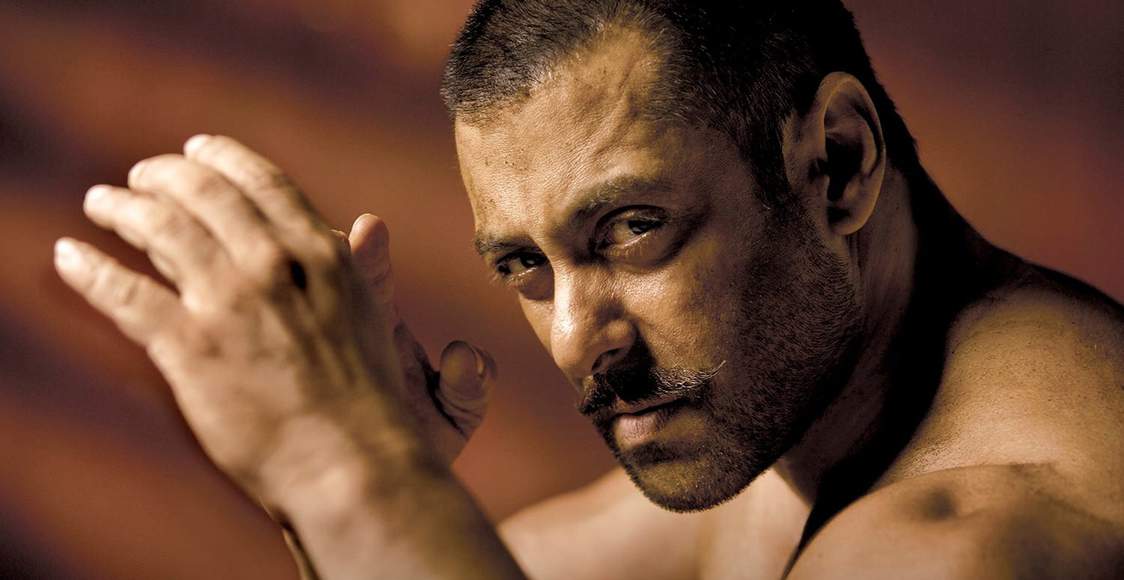
For Hindi cinema to become more self-aware and sophisticated in its appeal - as the modernising faction headed by writer-director-producer Anurag Kashyap would like - it may require the industry's pre-eminent stars to themselves display greater self-awareness, and leave behind the bouffant-haired hunks and eyelash-fluttering heroines of yore. This process of renewal, which has been fascinating to observe, began several years ago, but it's properly accelerated in the past twelve months, as audiences have cottoned onto what might at some stage be referred to as an Indian New Wave. After November's fitful Tamasha (a Resnais-like construction that saw Deepika Padukone and Ranbir Kapoor play variations of traditional Bollywood lovers) and April's intriguing Fan (where Shah Rukh Khan was a moviestar plagued by a stalker so representative of his own demons and insecurities he could only be played by Khan again), Sultan arrives as not nearly so knowing or playfully postmodern - it is, after all, a vehicle for Salman Khan, the least flexible of Bollywood's three King Khans. It nevertheless seems to riff on the lead's much-documented on- and off-screen travails: here is the story of a man of action having to overcome considerable personal adversity to regain his title as an ambassador for the Indian nation - and its movie-watching people.
Phase one of the Khan charm offensive came with last year's Bajrangi Bhaijaan, the Eid megahit in which the star successfully (and rather touchingly) shepherded a small child and the audience through a version of the Kashmir conflict. Phase two, which opened in the same slot this year, is effectively Khan's own The Wrestler, casting the star as Sultan Ali Khan, a humble lad from farming stock who uses his considerable bulk to become both a Commonwealth and Olympic champion before falling out of favour. The first half, an extended flashback from this moment of disgrace, gives us the backstory: how he first hit the gym upon being rejected by Aarfa (Anushka Sharma), a promising female wrestler, and eventually came to win not just several major championships but eventually this young woman's heart and hand in marriage. The second half is all comeback, wondering just what a fatneck might do with himself were he to gain the world - or the world title, at least - and suddenly lose everything he holds dearest to him.
Where there was a certain novelty in seeing Khan being sent in to sort out a real-world situation in Bajrangi Bhaijaan - and, indeed, in watching him wrestle with India's patriarchal system in last Diwali's lavish Prem Ratan Dhan Payo - Sultan operates along a conventional sports-movie arc. The world of the unfaked, Greco-Roman school of wrestling has been underexplored on screen, granted, and director Ali Abbas Zahar has the full Yash Raj budget to come up with convincing recreations of the Delhi Commonwealth and London Olympic Games. Once again, though, we're sitting through multiple examples of knockdowns and countouts as life-metaphors, backed up with the usual fast-cut training montages. (Zahar can at least punch up Sultan's country-boy background here, showing his hero not straining in some sweaty backstreet gym, rather pulling tractors and outrunning steam trains, all the while cultivating a roguish Oliver Reed moustache.) The stakes are so clearly established by the interval that there's only one trajectory the second half can follow.
Still, as January's Rocky reboot Creed demonstrated, these things can still stir an audience if done well, and Sultan is done pretty well, all things considered. It's way too long and prone to over-emphasis: far too much of the first half given over to illustrating just what an essentially great guy Khan (actor and character) is, at least one utterly superfluous love song, a second half premised on our hero's superhuman capacity to survive relentless beatings. Two elements keep us interested, though. The first is Khan himself, who's always been an imposing physical presence - here, even the muscles on his shoulder muscles appear to have muscles - but who has, over this recent run of films, become a markedly subtler performer: a director wouldn't hand his leading man this many close-ups if he felt the guy didn't know what to do with them. He retains that adenoidal quality most closely associated with The Sopranos's James Gandolfini, and uses it to sketch a character who while still not the brightest bulb - he first takes Aarfa's brush-off "shit guy" as a compliment - is at least a notch or two more intuitive than his bhai in Bajrangi, working the ring much as Khan the actor has come to work the moviegoing public.
The metatextual bonus - crystallised in the late image of Sultan wrestling with himself - is the tentative suggestion that the actor might just be using this latest vehicle to grapple with his own persona; that the humbling of Sultan Khan just before the intermission may, in fact, refer to the humbling of Salman Khan in real life. (Both involve a tragic, and almost certainly avoidable, loss of life.) If, dramatically speaking, it's something of a pity that his fictional avatar should thereafter undergo the slickest of rebranding - turning up in the octagonal MMA ring left abandoned at the end of last year's Brothers and becoming a license to print money - this development nonetheless reflects the manner in which Khan has reclaimed his own title as a box-office heavyweight, and somewhere within the triumphalism, you detect an admission on the star's part that, yes, at some point in the not-too-distant past, his ego may have got the better of him. It takes a big man to do that, just as surely as it takes a big man to carry piles of bricks over his shoulders - and a star with a sense of irony and humility to pull off all of the above in a film that also sees his character flounce off the set of a post-Olympic promo shoot, muttering "I'm a wrestler, not an actor". When even a lunk of Salman Khan's dimensions shows signs of becoming self-aware, something's very definitely afoot.
Sultan is now showing in cinemas nationwide.
Sunday, 17 July 2016
From the archive: "Star Trek Into Darkness"
JJ Abrams’ 2009 Star Trek reboot gave a once-dusty, kitschy brand an appreciable boost of youthful energy: its origin story, recounting Spock and co.’s early days at the Starfleet Academy, mixed state-of-the-art sci-fi with a college campus comedy, arriving at Revenge of the Nerds in space, or Starship Troopers with the earlier film’s grown-up satire replaced by a puppyish enthusiasm. The one question mark hovering above it was that of dramatic scale. For all that this 21st century Star Trek filled the IMAX with big bangs and other out-of-this-world effects, the story felt absolutely like the beginnings of something – a TV pilot that got lucky, from a creative with eminent small-screen credits (Felicity, Alias, Lost), starring actors beamed up from the boob tube. Dramatically, the sequel Into Darkness goes backwards if anything, stringing together a succession of playground tiffs, of a type the target audience might well recognise.
Spock (Zachary Quinto) tells teacher on Chris Pine’s ever-impetuous Kirk, in filing a negative report after the latter temporarily abandons his crew during an early mission. Kirk isn’t the only one abandoning our favourite Vulcan: his on-ship squeeze Uhura (Zoe Saldana) isn’t speaking to him either, after a set-to over something or other. Hell, even the loyal Scotty (Simon Pegg) is driven to hand in his resignation after his toys in the Enterprise’s engine room are momentarily removed from him. Captain’s log, stardate summer 2013: everybody’s sulking A LOT. It takes a common enemy to reunite them. This is disaffected doctor John Harrison (Benedict Cumberbatch), who begins his reign of terror by using Noel Clarke to blow up the Starfleet archive in future-London, and then goes into hiding. More so than The Mandarin in the recent Iron Man 3, Harrison is essentially Osama-for-beginners, obliging the Enterprise to go, more reluctantly than boldly, on a pre-emptive bombing raid against a planet that will stand for just about anywhere in the Middle East.
What Abrams has subscribed to about the original Star Trek is the notion that Starfleet somehow stands for America, its values and challenges. The pairing of Pine’s Kirk (the rebel/adventurer/cowboy) with Quinto’s Spock (the cool, rational analyst) appears more than ever here a humanisation of the checks-and-balances system the US prides itself on. Still, this is a summer event movie aimed more at teenagers than Prospect readers, so its notions of good and bad, right and wrong, tend to be rendered in easily grasped terms – as in the contrast between the deck of the Enterprise, with its soft-lit, Habitat-showroom feel, and that of rival spacecraft, which betray all the warmth of a Goth’s bedroom with the curtains closed. As a storyteller, Abrams specialises in momentum, not depth: it’s what drew millions of viewers to the withholding nonsense of Lost, and made him an ideal choice to jumpstart the ailing Mission: Impossible franchise. He’s quickly mastered the very modern skill of breaking up “character” scenes (i.e. tiffs) with a sudden jolt of set-spinning action, even if it’s something as hokey as having one of his characters strapped to a bomb that’s armed itself.
He doesn’t want us to become bored, but in so doing he risks our full involvement: we’re constantly more distracted than we are engaged, which is why I sensed even the fanboys around me beginning to get restless. All the movement reveals is the thinness of the material, its resemblance to the kind of glib teen drama one might idly ogle mid-afternoon on E4. With the characterisation set in stone, some of the schtick that tickled or amused first time round – Anton Yelchin’s Slavic accent (as Chekov), Pegg’s paycheque-eyeing mateyness – comes across as precisely that: mere schtick. Saldana and John Cho (as Sulu) are again limited to pushing buttons, and ticking boxes; even Karl Urban’s Bones – a man among boys, whose grouching was the closest the first film got to self-awareness – proves disappointingly subservient this time.
It’s an especially cheap trick on the screenwriters’ part to, at one point, try and milk emotion from James T. Kirk’s apparent demise, when we all know he’ll grow up to become William Shatner, but one typical of the relentless chicanery sustaining the film. Besides, no franchise has devoted itself more to preserving the smirk on Chris Pine’s face: you see it here in the way Alice Eve’s research scientist is served up to him on a plate, all curves squeezed into a figure-hugging jumpsuit, like the loveliest of bananas, just waiting to be unpeeled. It’d be a very jaded viewer who didn’t respond in some way to Into Darkness’s bouncy optimism – if nothing else, it’ll make a perfectly decent, eminently watchable Saturday-night contrast with Iron Man 3’s older-skewing snark and savvy – but bouncy optimism is really all this series has after two films: it remains a franchise you may prefer to pat on the head, rather than fully embrace.
Star Trek Into Darkness is available on DVD through Paramount; a third instalment, Star Trek Beyond, opens in cinemas nationwide this Friday.
Saturday, 16 July 2016
1,001 Films: "Deliverance" (1972)
Deliverance is a bad bromance. Four buddies - buff, faintly preposterous survivalist Burt
Reynolds, his pensive, pipe-smoking intellectual pal Jon Voight, plus
chubby insurance schlub (and biggest liability) Ned Beatty and
folksy joker Ronny Cox - set out to prove themselves canoeing up one of
the country's wildest stretches of river. Why? "Because it's there,"
Reynolds grunts, echoing the rationale of developers
through the ages. The quartet enter this unspoilt Eden in a state
of harmony - the now-notorious "Duellin' Banjos" sequence, rather than
ominous, is actually a rare example of locals and interlopers playing
nicely together - before coming to fall badly out of synch with their
surroundings; soon, these would-be masters of the universe find
themselves on their hands and knees in the dirt, scrabbling and, indeed,
squealing for their lives. For yes, this was 1972 - the year of Last Tango in Paris
- and the film in which sodomy went mainstream, in a scene that predicted
the extreme cinema of the late 1990s (John Boorman's direction seeming
to stretch out time, and his characters' torments, to fit) and that serves as
payback for what such supposedly civilised folks as Beatty had been
doing to the American landscape for years.
If Deliverance still (pardon the pun) holds water today, it's because those waters remain as muddied and troubled as ever. James Dickey's novel and screenplay were devised as parables of the great American divide(s), as pertinent to the era of Obama and Fox News as they were to that of Nixon and Vietnam. Assholes weren't the only things being split here: country would be set against city, man against nature, brain vs. brawn, each new conflict revealing further prejudice, and - collectively - measuring just how much disunity there was, and is, within the supposedly United States. Even these four friends can't ever seem to get their stories straight, resulting in a quietly nightmarish coda - a waking dream - that might be understood as as much a coming-home drama as might be found in any 70s war movie: these guys left a part of themselves behind up country, which they know they will never be able to talk about, either individually or together amongst themselves.
The overall effect is reliant on Boorman's ability as an outsider to summon up something thoughtful and disquieting to go alongside the muscular, primal thrills, or - in other words - to reconcile, within a two-hour entertainment, the Reynolds and Voight characters' perspectives, and display markedly greater sympathy for the latter's agonies, which you couldn't ever imagine a Milius or Michael Bay achieving. If not quite up to the hallucinatory force of the same year's Aguirre, Wrath of God (Deliverance's spiritual prologue), it stands as one of the more haunting and beautiful action-adventures Hollywood ever gave us, Vilmos Zsigmond's cinematography hewing close to a nature that was only ever going to win out over this opposition, robust as it was in that 70s character-actor way. For lest we be drawn in by the drama to forget, Boorman's crew were also seeking to impose themselves on their environment - and you can bet the actors, sent hurtling over white-water rapids and down sheer rock faces, had their own stories and scrapes to show for it.
Deliverance is available on DVD through Warner Home Video.
Friday, 15 July 2016
For what it's worth...
Top Ten Films at the UK Box Office
for the weekend of July 8-10, 2016:
1 (1) The Secret Life of Pets (U)
2 (new) The Legend of Tarzan (12A)
3 (new) Now You See Me 2 (12A)
4 (2) Absolutely Fabulous: The Movie (15)
5 (3) Central Intelligence (12A)
6 (new) Sultan (12A) ***
7 (4) Independence Day: Resurgence (12A) **
8 (5) The Conjuring 2 (15) **
9 (new) The Neon Demon (18) ***
10 (6) Me Before You (12A) **
(source: theguardian.com)
My top five:
1. The Hard Stop [above]
2. Weiner
3. Notes on Blindness
4. Baskin
5. Summertime
Top Ten DVD rentals:
2. Weiner
3. Notes on Blindness
4. Baskin
5. Summertime
Top Ten DVD rentals:
1 (1) Bridge of Spies (12) *****
2 (2) Goosebumps (PG) ***
3 (5) Spotlight (15) ***
4 (new) 13 Hours (15) **
5 (10) The 5th Wave (15) **
6 (6) Creed (12) ****
7 (8) Daddy's Home (12)
8 (new) The Danish Girl (15) **
9 (4) Pride + Prejudice + Zombies (15)
10 (7) Dirty Grandpa (15)
(source: lovefilm.com)
2 (2) Goosebumps (PG) ***
3 (5) Spotlight (15) ***
4 (new) 13 Hours (15) **
5 (10) The 5th Wave (15) **
6 (6) Creed (12) ****
7 (8) Daddy's Home (12)
8 (new) The Danish Girl (15) **
9 (4) Pride + Prejudice + Zombies (15)
10 (7) Dirty Grandpa (15)
(source: lovefilm.com)
My top five:
1. Son of Saul
2. The Witch
3. High-Rise
4. Truth
5. Bang Gang (A Modern Love Story)
Top Ten Streaming:
1 (new) The Chambermaid Lynn (18)
2 (new) Triple 9 (15) **
3 (new) Notes on Blindness (U) ****
4 (3) Trumbo (15) **
5 (1) Tale of Tales (15) ***
6 (2) Remainder (15) ***
7 (6) Embrace of the Serpent (12) ****
8 (4) Adult Life Skills (15) ***
9 (5) Bang Gang (A Modern Love Story) (18) ***
10 (re) Evolution (15) ***
(source: BFI)
Top five films on terrestrial TV this week:
1. The Lion King (Sunday, C4, 6.15pm)2. The Witch
3. High-Rise
4. Truth
5. Bang Gang (A Modern Love Story)
Top Ten Streaming:
1 (new) The Chambermaid Lynn (18)
2 (new) Triple 9 (15) **
3 (new) Notes on Blindness (U) ****
4 (3) Trumbo (15) **
5 (1) Tale of Tales (15) ***
6 (2) Remainder (15) ***
7 (6) Embrace of the Serpent (12) ****
8 (4) Adult Life Skills (15) ***
9 (5) Bang Gang (A Modern Love Story) (18) ***
10 (re) Evolution (15) ***
(source: BFI)
Top five films on terrestrial TV this week:
2. Something in the Air (Saturday, C4, 1.05am)
3. Chico & Rita (Friday, BBC2, 12.30am)
4. Total Recall (Friday, ITV1, 10.40pm)
5. Hairspray (Sunday, C4, 1.35pm)
"Baskin" (Guardian 15/07/16)
Baskin ***
Dir: Can Evrenol.
With: Mehmet Cerrahoglu, Gorkem Kasal, Ergun Kuyucu, Muharrem Bayrak. 97 mins.
Cert: 18
This slowburn Turkish
shocker suggests what might have happened if Once Upon a Time in Anatolia’s philosophically inclined patrolmen
had blundered into Eli Roth territory. We’re riding with a squad of grizzled
law enforcers, halting their musky after-hours banter to provide backup in an
ominously remote location: a gore-blasted museum of the macabre showcasing the
year’s most warped costume and production design. Writer-director Can Evrenol’s
cribs are blatant (don’t look now, there’s a Lucio Fulci bit) and Roth’s
influence is felt in a punitive streak that hints these non-PC coppers are
getting exactly what they deserve. Yet right through to his clever-bleak
pay-off, Evrenol finds forceful means of disconcerting us, cutting freely
between nightmare reality and vivid dreams, forever landing upon the ickiest of
textures. Sensitive souls need not apply, clearly, but hellfiends are hereby
alerted to a work of malevolent promise – a film that seizes the attention even
as some of its imagery turns the stomach.
Baskin opens in selected cinemas from today.
Mystic river: "Embrace of the Serpent"
The last of this year's Oscar nominees in the Best Foreign Language Film category to reach these shores, Embrace of the Serpent determines to transport us somewhere - not simply pick us up, spin us around for a couple of hours and then drop us back down in the exact same spot. In this, it goes against the flow of anywhere between 75-90% of modern movies; it's no surprise it's had the transfixing effect it's had on awards committees and audiences alike. The Colombian writer-director Ciro Guerra has here found a way to revivify the cinema's beloved yet increasingly careworn quest narrative, running two such narratives, from two very different time periods, in parallel. One unfurls at the turn of the 20th century, dispatching Theodor Koch-Grünberg (Jan Bijvoet), a real-life figure presented here as a beardy old goat, up the Amazon in search of a plant known for its life-giving properties. The other plays out around the midpoint of the same century, informed by all the sage and sorry wisdom accrued in the intervening years. Here, Evan (Brionne Davis), a modest botanist and student of his predecessor's writings, sets out to retrace the explorer's footsteps in the company of his now middle-aged guide Karamakate (Antonio Bolivar) and to work out how Theo, representative of science and enlightenment, came to perish in these parts.
Some of the tracks the men follow will be familiar to media-literate 21st century audiences. Not for nothing were such names as Conrad, Coppola and Herzog dropped in the film's early, breathless write-ups; there is a modicum of swaying National Geographic breasts, and a degree of curious jungle ritual. (Theo repeatedly asks his companions to blow a local form of snuff directly into his nostrils, a process that looks roughly as dignified as having it blown up one's rectum.) What is new is the perspective Guerra adopts. Crucially, Embrace of the Serpent starts not within such a flexible concept as "civilisation", but deep within the jungle, with one tribesman peering out from the banks of the river - thus making the white man Theo the Other whose motives are suspect. Though the explorer literally loses his compass at an early juncture, he shapes up as a comparatively harmless figure - a well-intentioned, somewhat sentimental blusterer - especially when set against those we encounter the further he drifts down river: primarily the rubber magnates, an absent presence whose deleterious effect on the locals is illustrated by the emergence of one sorry worker bee, who's lost an eye and an arm in the extraction process and begs his visitors to put him out of his misery; but also the missionaries, busy imposing a language and a punitive worldview upon a populace they deem and demean as cannibals.
For his part, the botanist Evan is playing catch-up - as indeed we all are, historically speaking - visibly humbled by his task, his surrounds and the eddies of madness he keeps sailing into: one port of call sees him confronted by a Kurtz-like white saviour who's appointed himself King and taken a child bride for his troubles, a sequence that eventually shades into zombie-like horror. Guerra's jungle really is massive - it spans the ages - and we sense how it would take a century or more to transform it into Shoreditch High Street, or just to flush the toxic legacies of colonialism from its system. The director filmed all this in situ, with many of the region's tribesmen enacting scenes from their own history, everybody pushing onwards through torrid rivers and tangled clearings in much the same way Herzog's crew did in making Aguirre and Fitzcarraldo. Embrace nevertheless emerges as a more mellow and forgiving inquiry than those reference points (and the comparison to Heart of Darkness) would suggest. The natural beauty of these sites is only accentuated by David Gallego's silvery monochrome photography, and you can't fail to notice how the hostile relationship between Theo and the young Karamakate softens into the amused tolerance the older guide displays around the open-minded Evan.
What's crucial is that it is a dialogue: fractious, wry, mocking, Guerra striving at every bend of the river to ensure that his indigenous characters are a good deal more than the mute savages history (and a whole history of North American movies) would damn them as, and that his white men are more complex and complicated than the usual bringers of light and wisdom. (Indeed, at various points, Theo and Evan appear the more helpless and lost of the two tribes. At this point in the annus horribilis that is 2016, who can say that's not the more truthful depiction?) Guerra arrives in this part of the world looking not for barbarism, rather poetry, which is why - amid the wealth of incident that adorns this route - you begin to spot the director making subtle rhymes between his time schemes, putting down the machete to pick up a pen: the butterflies pinned down in Theo's display case suddenly liberated around the older Karamakate's shoulders; the trees that, almost fifty years on, still bear the scars of rubber extraction; Theo's Box Brownie camera paired with Evan's far more portable Olympus.
The spectral light Guerra and Gallego capture is, we realise, another way of squaring this digitally projected, very 21st century film with the photographs we've all seen of the jungle, taken by explorers and scientists keen to position the locals as oddities, trophies or holdouts. By contrast, Embrace of the Serpent floats the thesis that if we go out into the world with the right inquiring yet respectful spirit, we might just return with an expanded consciousness, refined perceptions of ourselves, others and nature: you sense the progress it's working towards when, having spent the best part of the film worried about what exactly these white men are going to impose upon the natives, the final movement finds those same natives wondering aloud how best to get their own stories out to the wider world of white men. That Guerra's film, an essential part of that process, somehow registered with the Academy's palefaces is its own testament to the film's achievements, but then again this isn't a radical break from storytelling tradition so much as an informed continuation of what's gone before: an adventure movie - never more than a league or so away from the next pocket of peril, danger or wonder - albeit one working off an altogether sharper drawn and more richly detailed map.
Embrace of the Serpent is now playing in selected cinemas, and is also available to view on demand.
Subscribe to:
Posts (Atom)