Sunday, 10 July 2016
1,001 Films: "Last Tango in Paris" (1972)
Back in 1972 - the year of Deep Throat - Last Tango in Paris was the respectable face of screen erotica, a movie for audiences too timid to try anything that might be tarred with the porno brush. Nowadays, it's possible to see Bertolucci's film for what it perhaps always was: yes, the progenitor of the same cinema of extremes that later brought us The Piano Teacher and anything directed by Catherine Breillat (who has a minor speaking role here); but also the hetero Death in Venice - i.e. a phony classic, a preposterous, overrated, never-especially-sexy psychodrama operating somewhere between a light snooze and a total turn-off.
Weirdly haired, raincoat-clad, middle-aged miseryguts Marlon Brando, torturing himself and everybody else around him because of a suicide he probably caused, turns up to view an empty Paris flat that boasts one very mod con: the ripe and pouting yet supremely suggestible 70s chick Maria Schneider. He mumbles something that sounds like "I'll take it" - he's not solely talking about the appartement, you understand - and the two strike up a sulky, sadomasochistic affair in which sex serves both as a balm and a way to forget, and from which there can only ever be one way out.
Then-modish addenda include some wannabe Godard-Truffaut scenes featuring Jean-Pierre Leaud as a director with whom Schneider at least gets to have some degree of fun; with Brando, alas, she spends half her time listening to his incredibly tedious anecdotes ("the ass of death... the womb of fear," he drones, to cite but two of the script's rejected subtitles for Star Trek movies), and the other half getting manhandled to such an extent that she was later to complain about her on-set treatment. The nadir, of course, arrives when Brando performs his "knob of butter" trick on his sobbing conquest, where you don't know what's worse: the intimations of anal rape, or the leading man's horrible Dralon trousers, worn at a solemn half-mast.
As films about lovers attempting to shut out the real world go, it really isn't a patch on the resonant and formally controlled In the Realm of the Senses, though it might serve as an early example of the way Brando would routinely unbalance his 1970s work, a tendency (a personality flaw?) visible in everything from The Missouri Breaks to Apocalypse Now, becoming a burden apt to break the back of any film so conspicuously groping towards naturalism. A lot of Tango, specifically, now looks like chestbeating chauvinist nonsense, all po faces engaged in zipless fucks, and emotional truth was simply never on the agenda. Let's put this on the record once and for all: no two people in the history of mankind have ever had a relationship like this.
Last Tango in Paris is available on DVD through 20th Century Fox.
Saturday, 9 July 2016
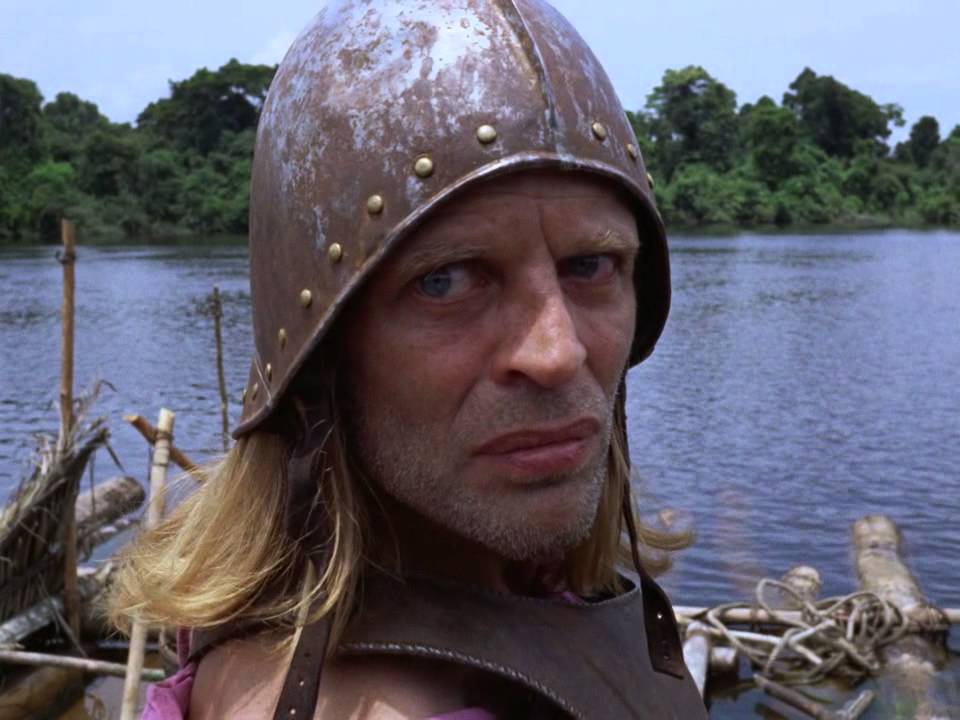
1,001 Films: "Aguirre, Wrath of God" (1972)
Some movies just go the extra mile. 1972’s Aguirre, Wrath of God was the work that, after an early run of documentaries and smaller fiction ventures, established Werner Herzog as a singular creative: a filmmaker prepared to travel to the ends of the earth in the company of madmen if it meant bringing back the extraordinary vision he saw lying in wait out there. The kind of film the penny-pinching actuaries who control the production fund pursestrings insist you can’t make, its legend remains intact: to bolster his recreation of a doomed 16th century Spanish mission to plunder the gold they believed lay in wait for them in El Dorado, Herzog actually went upriver into the jungles of the Amazon, not far from Machu Picchu, where he effectively abandoned all control, submitting to the mudslides and erratic tidal changes that were going to occur whether his cameras were turning or not.
The result would be one of those masterpieces that is many films simultaneously: a Conradian adventure; a Popul Vuh-scored nightmare you can’t believe is happening, or indeed happened; a gonzo form of Sealed Knot activity; and a documentary upon the making of a film in such extreme circumstances – both an Apocalypse Now and its own Hearts of Darkness. The dream/nightmare reading flows from the manner in which Aguirre creates its own logic: somehow, you just go along with the fact these conquistadors speak fluent German, and that they’re increasingly (mis)led by the none-more-Teutonic Klaus Kinski, as wild as the surrounding foliage. (Recent revelations about Kinski’s relationship with his daughters only strengthen the film’s depiction of madness: no-one in the history of cinema has wielded a sword or beaten up a horse with quite the same level of actionable conviction.)
Out of the mists of rage and time, the core interests that have sustained Herzog’s career for the best part of four decades begin to emerge. Nature, untamed, and red in tooth and claw; a sense of actuality, recording with a documentarist’s eye the perilous business of the party negotiating these muddy, choppy hillsides and rivers; a growing sense of horror, at the sight of the men being picked off one-by-one, or slowly drifting off the map and out of their minds; and a fascination with history, and what it has to teach us about the ways societies do and don’t function. As a core text of the engaged and critical New German Cinema, Aguirre was initially made subject to region-specific interpretation – no doubt fuelled by Kinski’s letting slip the loaded word “Führer” at a moment of leadership crisis. Certainly, it’s a vivid depiction of what can happen when the safe centre ground gets abandoned in pursuit of immortality.
Equally, though, you could view Aguirre as a parable of Vietnam, or a premonition of Afghanistan, or indeed of every other war since in which a large military force has been halted in its tracks by well-organised natives with sticks. A repeat viewing even gives teasing hints that we might see something of Herzog himself in Kinski’s Aguirre, who seems to stir up trouble and foster rebellion out of a need for turbulence, a turbulence that might match the restlessness of his own heart, head and feet. Herzog is, of course, greatly more circumspect than either his lead character or leading man, but Aguirre, Wrath of God remains an awesome thesis on what we have to gain and lose from pushing ourselves, and being pushed in return: the director had to haul a steamship over a mountain – for 1982’s Fitzcarraldo – to top it.
Aguirre, Wrath of God screens at the BFI Southbank in London this Wednesday night at 6.15pm, and is available on DVD and Blu-Ray through the BFI.
Friday, 8 July 2016
For what it's worth...
Top Ten Films at the UK Box Office
for the weekend of July 1-3, 2016:
1 (1) The Secret Life of Pets (U)
2 (new) Absolutely Fabulous: The Movie (15)
3 (new) Central Intelligence (12A)
4 (2) Independence Day: Resurgence (12A)
5 (3) The Conjuring 2 (15) **
6 (4) Me Before You (12A) **
7 (5) The Nice Guys (15) ****
8 (6) Alice Through the Looking Glass (PG)
9 (9) The Jungle Book (PG) **
10 (7) Teenage Mutant Ninja Turtles: Out of the Shadows (12A) *
(source: theguardian.com)
My top five:
1. Weiner [above]
2. Notes on Blindness
3. The Wait
4. Bayou Maharajah
5. The Neon Demon
Top Ten DVD rentals:
2. Notes on Blindness
3. The Wait
4. Bayou Maharajah
5. The Neon Demon
Top Ten DVD rentals:
1 (1) Bridge of Spies (12) *****
2 (2) Goosebumps (PG) ***
3 (3) The Hateful Eight (18) **
4 (4) Pride + Prejudice + Zombies (15)
5 (5) Spotlight (15) ***
6 (7) Creed (12) ****
7 (6) Dirty Grandpa (15)
8 (new) Daddy's Home (12)
9 (8) Room (15) ****
10 (10) The 5th Wave (15) **
(source: lovefilm.com)
2 (2) Goosebumps (PG) ***
3 (3) The Hateful Eight (18) **
4 (4) Pride + Prejudice + Zombies (15)
5 (5) Spotlight (15) ***
6 (7) Creed (12) ****
7 (6) Dirty Grandpa (15)
8 (new) Daddy's Home (12)
9 (8) Room (15) ****
10 (10) The 5th Wave (15) **
(source: lovefilm.com)
My top five:
1. Son of Saul
2. Mustang
3. The Ones Below
4. Hail, Caesar!
5. Anomalisa
Top Ten Streaming:
1 (new) The Chambermaid Lynn (18)
2 (new) Triple 9 (15) **
3 (new) Notes on Blindness (U) ****
4 (3) Trumbo (15) **
5 (1) Tale of Tales (15) ***
6 (2) Remainder (15) ***
7 (6) Embrace of the Serpent (12) ****
8 (4) Adult Life Skills (15) ***
9 (5) Bang Gang (A Modern Love Story) (18) ***
10 (re) Evolution (15) ***
(source: BFI)
Top five films on terrestrial TV this week:
1. The Shawshank Redemption (Friday, ITV1, 10.40pm)2. Mustang
3. The Ones Below
4. Hail, Caesar!
5. Anomalisa
Top Ten Streaming:
1 (new) The Chambermaid Lynn (18)
2 (new) Triple 9 (15) **
3 (new) Notes on Blindness (U) ****
4 (3) Trumbo (15) **
5 (1) Tale of Tales (15) ***
6 (2) Remainder (15) ***
7 (6) Embrace of the Serpent (12) ****
8 (4) Adult Life Skills (15) ***
9 (5) Bang Gang (A Modern Love Story) (18) ***
10 (re) Evolution (15) ***
(source: BFI)
Top five films on terrestrial TV this week:
2. Down Terrace (Saturday, BBC2, 1.55am)
3. Anchorman: The Legend of Ron Burgundy (Friday, BBC1, 11.35pm)
4. Barbara (Friday, BBC2, 12.30am)
5. Major Dundee (Saturday, five, 12.40pm)
Sunday, 3 July 2016
From the archive: "Now You See Me"
The big sleeper hit of summer 2013 - by which I mean the one blockbuster that wasn't a sequel or based on some other pre-existing property - was a caper movie affixed with the resistible slickness of American stage and street magicians. Boy, is Now You See Me slick: as directed by Louis Leterrier - an action maven who's enjoyed a run of solid hits without ever coming close to developing a recognisable style - this flimsy yarn of four illusionists being jetted across country to commit a series of heists at the behest of a mysterious benefactor makes the Ocean's Eleven revivals seem like primitive cave paintings. There is, granted, a relentless momentum to it that might just sweep you along, if you were sitting there with brain firmly in neutral at the end of a long working week: a Steadicam chase through a New Orleans restaurant reprises the tactics of Leterrier's Jet Li vehicle Unleashed, and sets more cars a-flipping than, say, The Prestige ever did. But where the Nolan film took its trickery seriously on some level, Leterrier's speed is just a cheat, a way of shuttling us past the implausibility of what it's describing, and obscuring whatever (already fuzzy) logic is at play here.
It cannot, however, get us to overlook the project's towering cynicism. We're meant to cheer these smugly bickering illusionists only because they're ripping off some bankers; their attitude as performers - you can pull in a big crowd if you're prepared to throw enough money at them - rather mirrors the producers' attitude to their own audience. So it is that a quadrant-covering cast occupies centre stage, although there's no real reason for Mark Ruffalo, playing perpetual catch-up as the FBI agent working the case, to be here, other than to cover whatever mortgage payments weren't already covered by the Avengers movie. (The presence of Michael Caine among the supporting players suggests a good deal of property tax was covered on this one.) It's another big, blaring American feature to revolve around the acquisition of money, the magic being but one means to that end, tricking us into the cinema just as the male magicians continually beguile their way into the opposite sex's undergarments. Early on, we see Jesse Eisenberg (not an actor you'd immediately cast as a practised womaniser, which occasions one of his least convincing performances) achieving one such conquest via a Dynamo-Dave Blaineish spot of cardshuffling, cautioning his mark with the line "the closer you look, the less you see". This throwaway film's rewards are of the shallow variety - which is why, unlike The Prestige, it barely merits watching once - but it's at least smart enough to have written its own best review.
Now You See Me is available on DVD through Entertainment One; a sequel, Now You See Me 2, opens in cinemas nationwide tomorrow.
(March 2014)
Saturday, 2 July 2016
1,001 Films: "The Heartbreak Kid" (1972)
Overshadowed, to some degree, by the towering reputation of The Graduate, The Heartbreak Kid nevertheless remains a superior example of "fools rush in" romantic comedy, and much revered by comedy writers and students of all ages. (Most notably the Farrelly brothers, who remade it to no great ends in 2007.) In part, that's because its gags derive from credible situations and character choices rather than manufactured schtick; in this, the film is very much a product of the new realism that flourished in the American cinema of the early 1970s. Impossibly romantic sporting-goods salesman Charles Grodin hastens his latest girlfriend (Jeannie Berlin) up the aisle - seemingly to get anywhere beyond second base - only to spend the couple's honeymoon in Miami Beach regretting his rashness, as the bride reveals herself to be needy, clingy, and the messiest of messy eaters. When the latter is sidelined by second-degree sunburn, our ungallant hero hits the beach and once more falls head over heels, this time for well-bred Cybill Shepherd, as you probably would. The remainder of the honeymoon plays out on just the right side of farce, as Grodin strives to be in two places, with two very different women, at once - oblivious to the fact he may just be making the same mistakes all over again.
As a guy, I have to confess it's impossible not to empathise with at least of the plight the central character gets himself in; the actor's unfailing charm, in fact, gets the screenplay out of several potential dead ends. Written by Neil Simon but directed by Elaine May, the whole does remarkably well to keep the maleness of the premise (the fantasy of the Shepherd character, a keen wearer of football jerseys; the misogyny around the first wife) in check throughout, something the Farrellys notably failed to do. Any qualms regarding the characterisation of the nagging, needy wife - a dubious staple of Seventies screen and sitcom - need to be set against our growing admiration for the skill and dignity with which Berlin inhabits the role: that of a woman who makes Janice from Friends seem like a keeper, and yet who still deserves better than to end up in the middle of one of cinema's worst and clumsiest break-ups ("Would you like whipped cream with that?"). A less showy, more observational director than her contemporary Woody Allen, May roots her laughs in personality and place, pulling off a lovely contrast between torrid Miami and the chilly Minnesotan wilderness to which a contrite Grodin exiles himself. Unlike the remake, nothing appears forced: its lightness of touch is just so, as is its wry acknowledgement of one key universal truth - that some people can never be happy.
The Heartbreak Kid is currently unavailable on any format.
Friday, 1 July 2016
For what it's worth...
Top Ten Films at the UK Box Office
for the weekend of June 24-26, 2016:
1 (new) The Secret Life of Pets (U)
2 (new) Independence Day: Resurgence (12A)
3 (1) The Conjuring 2 (15) **
4 (2) Me Before You (12A) **
5 (6) The Nice Guys (15) ****
6 (5) Alice Through the Looking Glass (PG)
7 (4) Teenage Mutant Ninja Turtles: Out of the Shadows (12A) *
8 (7) X-Men: Apocalypse (12A)
9 (re) The Jungle Book (PG) **
10 (9) The Boss (15)
(source: theguardian.com)
My top five:
1. Notes on Blindness [above]
2. Poor Cow
3. From Afar
4. Remainder
5. Adult Life Skills
Top Ten DVD rentals:
2. Poor Cow
3. From Afar
4. Remainder
5. Adult Life Skills
Top Ten DVD rentals:
1 (1) Bridge of Spies (12) *****
2 (new) Goosebumps (PG) ***
3 (2) The Hateful Eight (18) **
4 (new) Pride + Prejudice + Zombies (15)
5 (3) Spotlight (15) ***
6 (4) Dirty Grandpa (15)
7 (new) Creed (12) ****
8 (5) Room (15) ****
9 (new) Triple 9 (15) **
10 (new) The 5th Wave (15) **
(source: lovefilm.com)
2 (new) Goosebumps (PG) ***
3 (2) The Hateful Eight (18) **
4 (new) Pride + Prejudice + Zombies (15)
5 (3) Spotlight (15) ***
6 (4) Dirty Grandpa (15)
7 (new) Creed (12) ****
8 (5) Room (15) ****
9 (new) Triple 9 (15) **
10 (new) The 5th Wave (15) **
(source: lovefilm.com)
My top five:
1. Son of Saul
2. Our Little Sister
3. Versus: The Life and Films of Ken Loach
4. Bone Tomahawk
5. The Here After
Top Ten Streaming:
1 (new) The Chambermaid Lynn (18)
2 (new) Triple 9 (15) **
3 (new) Notes on Blindness (U) ****
4 (3) Trumbo (15) **
5 (1) Tale of Tales (15) ***
6 (2) Remainder (15) ***
7 (6) Embrace of the Serpent (12)
8 (4) Adult Life Skills (15) ***
9 (5) Bang Gang (A Modern Love Story) (18) ***
10 (re) Evolution (15)
(source: BFI)
Top five films on terrestrial TV this week:
1. In Which We Serve (Saturday, BBC2, 8.25am)2. Our Little Sister
3. Versus: The Life and Films of Ken Loach
4. Bone Tomahawk
5. The Here After
Top Ten Streaming:
1 (new) The Chambermaid Lynn (18)
2 (new) Triple 9 (15) **
3 (new) Notes on Blindness (U) ****
4 (3) Trumbo (15) **
5 (1) Tale of Tales (15) ***
6 (2) Remainder (15) ***
7 (6) Embrace of the Serpent (12)
8 (4) Adult Life Skills (15) ***
9 (5) Bang Gang (A Modern Love Story) (18) ***
10 (re) Evolution (15)
(source: BFI)
Top five films on terrestrial TV this week:
2. Clueless (Sunday, C4, 1.30pm)
3. Avatar (Saturday, C4, 8pm)
4. Arbitrage (Friday, C4, 12.10am)
5. Of Gods and Men (Friday, BBC2, 12.35am)
Old haunts: "The Conjuring 2"
2013's The Conjuring was a rattly old horror junkshop, repackaging some of the haunted-house gotchas of the Exorcist, Amityville and Poltergeist movies without the knowing tongue-in-cheek humour of 2010's Insidious, but with a deadening veneer of "based on true events" period authenticity that derived from taking real-life exorcists Ed and Lorraine Warren (played by Patrick Wilson and Vera Farmiga) as its subjects. With the film's real breakout star - porcelain devil doll Annabelle - having broken ranks by appearing in her own 2014 vehicle (shortly to spawn its own sequel), the Warrens have had to be inserted altogether inorganically in the dopily obligatory follow-up The Conjuring 2, which expands outwards to spend its - count 'em - 134 minutes in the England of the late 1970s, picking over a case it's not entirely clear the Warrens had anything to do with in actuality.
The originality bar is established early on with the laying of The Clash's "London Calling" over shots of red buses passing over Westminster Bridge; returning director James Wan then whisks us off to Enfield - or a studio approximation of same - where gor-blimeying single mother Frances O'Connor and her unruly offspring find themselves repeatedly bothered by a cranky old spook who wants his semi-detached house back. This is the same Enfield haunting that formed the basis of the recent Sky One drama that starred Timothy Spall as local psychic investigator Maurice Grosse (nicely played here by a squirrelly Simon McBurney); the Warrens are so disconnected from it - literally half a world away, reintroduced getting the events of Amityville out of their heads - you begin to wonder whether Warner Bros. didn't just cast around for an unrelated script that might be reworked to tie in with the series, much as Paramount did to extend the Cloverfield franchise. (Honestly, these Americans, coming over here, exorcising our ghosts.)
Like a lot of 2016 studio propositions, The Conjuring 2 is too big to fail - it spent its first two weeks atop the UK box office, and was still playing to half-full screens by the time I caught up with it in the third - but it's also too big for its own good. Pumping some of the vast amount of money the first film took back into the second gives O'Connor's brood the most unconvincing of West London semis: modest from the outside, it suddenly assumes Tardis-like dimensions once we're inside (which is to say on the studio floor), replete with vaulted ceilings, a couch the size of a battleship, and a heaving platter of cartwheel-sized biscuits with which to tempt non-spectral viewers. (The biscuits really threw me off: they make 1970s Wagon Wheels look like 21st century Wagon Wheels.) At times, the location resembles Thatcher's Enfield less than it does 18th century Versailles: if the clan really did have all this money to play with, why didn't they put it towards repainting the walls, which run the grotty gamut from mildew-green to Babadook-black? Really, they're just inviting trouble.
This disconnect between interior and exterior spaces goes to the heart of what's wrong about the sequel, which takes a milieu howling out for scratchy social realism - and a treatment along the lines of 2012's unusual Brit chiller When the Lights Went Out - but over-inflates it so the camera can perform slick rollercoaster loops around the sporadic paranormal activity. This cranked-up framing feels absurd even before characters start to get freaked out by Tonka trucks, or Ed - displaying a creative bent unseen in the first film - is found at the easel doing a nice watercolour of one spook, or puts his crucifix down to pick up a guitar and serenade O'Connor's offspring with his best Elvis impersonation. (We're bordering on Airplane! territory here.) As give-'em-(more of)-what-they-want fodder, it has its functional moments: there's a reasonably clever sequence involving a ghost and Ed's painting, though even this goes on long enough to devolve into loud dream-sequence crashes and bangs, no more than first-half timekilling before the Warrens can be delivered to Enfield.
Throughout, the mechanics are too obvious - too in your face - to allow The Conjuring 2 to develop any sense of the uncanny or unsettling: it doesn't so much creep up behind us as plonk itself in front of us like the Tango man, slapping us over and over around the chops. The subtlest work is done in one boo scene involving a television switching itself on and off (very Poltergeist), where we get a flicker of The Goodies (you can well imagine Graeme Garden's sideburns prompting a form of terror in impressionable viewers), and a flash of Maggie T assuming office. It's not unfeasible that Wan is trying to link the onset of these heebie-jeebies to Thatcherism - though it's just as likely another of the throwaway period markers strewn like confetti across these sets, like the perfectly folded copy of the Melody Maker adorning the living room table. (Who in this household would read it?) More symptom of consumer capitalism than credible diagnosis or possible cure, it's flabby, noisy, gassy product, broadly as spooky and lasting as a bad case of flatulence sparked by a can of own-brand beans.
The Conjuring 2 is still playing in cinemas nationwide.
Subscribe to:
Posts (Atom)