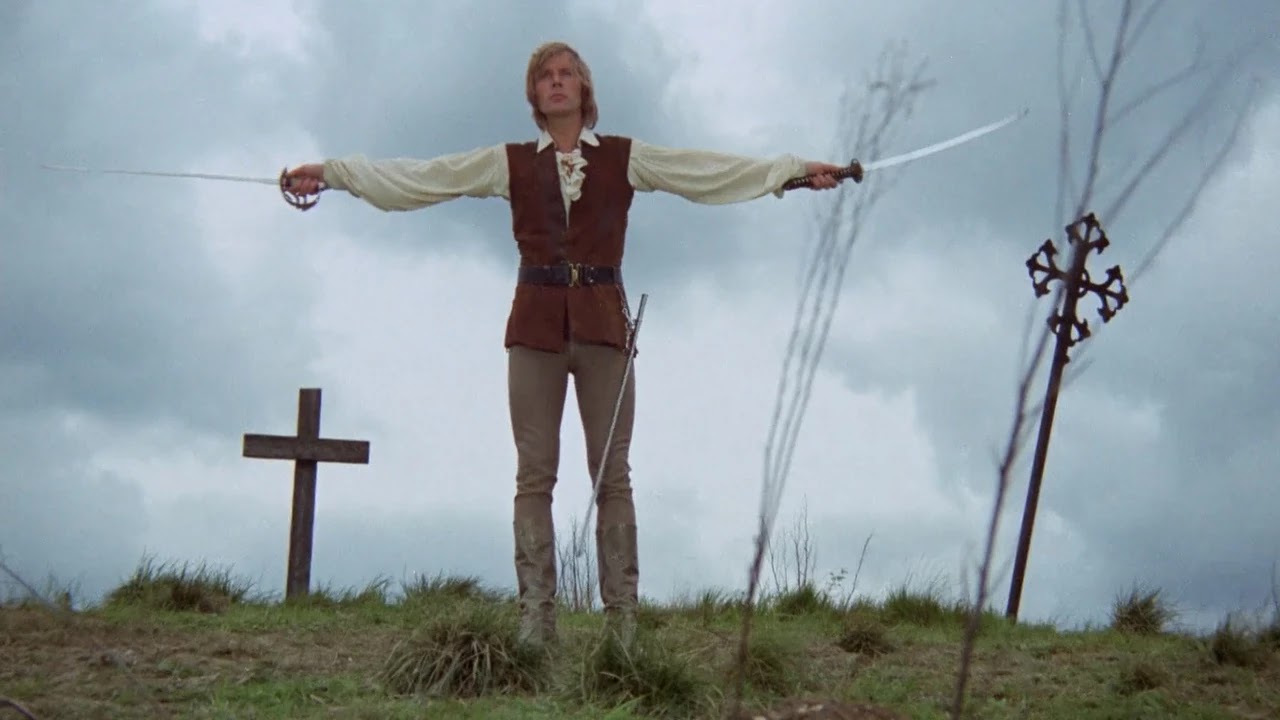
Captain Kronos: Vampire Hunter returns to selected cinemas from tomorrow; a limited edition 4K collector's edition Blu-ray is available from January 27.
Thursday, 16 January 2025
Stakeout: "Captain Kronos: Vampire Hunter"
Wednesday, 15 January 2025
Dylanland: "A Complete Unknown"
A Complete Unknown opens in cinemas nationwide from Friday.
In memoriam: Jack Bond (Telegraph 14/01/25)
His directorial career almost ended before it began. Hired on a BBC trainee scheme in 1962, Bond faced the sack after inventing outraged viewer responses during an early dry spell on Points of View (1961-present). He was only spared by controller Huw Wheldon, possibly sensing creative gifts that would be better deployed elsewhere.
Commissioned to mark the 50th anniversary of WWI’s outbreak, The Pity of War (1964) soon returned Bond to his employers’ good graces. He followed it with the career-making Dalí in New York, an hour-long study of the artist in residence at the St. Regis Hotel, fashioned at the point the Spanish surrealist was transforming his body into a canvas for performance art and his name into a saleable brand.
The Dalí that Bond filmed was equal parts exasperating (demanding his handlers source five thousand black ants for a performance piece) and fond. If it wasn’t for his wife, the artist admitted, “I would be lying in a gutter somewhere covered in lice.” Bond was both amused and charmed: “[He] always knew exactly what he wanted, and he got it… He was grand in the real meaning of the word.”
Seen calling Dalí’s chauvinism out was the Welsh-born polymath Jane Arden, Bond’s then-lover and collaborator on three intense, experimentally inclined features: Separation (1968), which Arden wrote and starred in, and Bond directed; the trippy The Other Side of Underneath (1972), which Bond produced for Arden to direct; and Anti-Clock (1979), a Godard-adjacent surveillance saga, co-directed by Bond and Arden, which became a minor US hit upon attracting Andy Warhol’s patronage.
After Arden took her own life over Christmas 1982, a wounded Bond suppressed these films (“along with a lot of thoughts and feelings”) and lived a self-described playboy existence, sailing his boat Moonsaga around Europe. He was eventually tempted back to dry land to contribute to Melvyn Bragg’s The South Bank Show, and “Fe-Fi-Fo-Fum”, Bond’s imaginative Roald Dahl profile of 1986, led to an offer to direct It Couldn’t Happen Here.
Initially conceived as a Pet Shop Boys video album, the project developed under Bond’s eye into an idiosyncratic, Clacton-shot theatrical feature, with the band’s Tennant/Lowe double-act being menaced in passing by Joss Ackland as a serial killer whose end-of-the-pier puns echoed Bond’s own back catalogue: “I’ve just been fishing with Salvador Dalí. He used a dotted line.”
Jack Cameron Bond was born in London on December 10, 1937, to insurance agent Frank Bond and postal worker Pat (née King). As a child, he was caught up in the Blitz: “We went to a beautiful house in the country. Very quickly we got bored, so we came back and spent the rest of the time being bombed.” The war, he said, turned him into “a fighter”. Leaving home at fifteen to move in with a barmaid who’d caught his eye, he subsequently trained in the Royal Army Educational Corps; his teaching plans were abandoned, however, after discovering the low rates of pay.
In later life, Bond completed several independently produced documentaries. The Blueblack Hussar (2013) was a revealing study of former pop pin-up Adam Ant on his comeback from mental health issues, wearing his bruises and battlescars as he once did warpaint; An Artist’s Eyes (2018) followed the instinctive young painter Chris Moon, poised on the verge of a commercial breakthrough that never quite follows.
The new century, however, brought plentiful appreciation of Bond’s own work. Dalí in New York went on permanent show at Florida’s Dalí Museum, earning its director a medal from the Raymond Roussel Society in 2023; while his collaborations with Arden were issued on DVD by the BFI, as was It Couldn’t Happen Here, complete with the promo for festive chart-topper “Always On My Mind” and Bond’s wry audio commentary: “Were we ever examined by doctors to see if we were sane?”
Bond is survived by his partner Mary Rose Storey, stepdaughter Lily Marlene von Kalbach, and three of his four children by his first wife Moira Tulley; his daughter Rebecca died in 2018.
Jack Bond, born December 10, 1937, died December 21, 2024.
Tuesday, 14 January 2025
In memoriam: Phyllis Dalton (Telegraph 13/01/25)
Both were projects from the more spectacular end of the Dalton wheelyard, involving oversight of sizeable costume departments and hundreds of extras. More commonly, Dalton specialised in a form of period dress that dutifully sublimated the necessary hours of research and unshowily devoted itself to conjuring up a particular era.
Hers was the kind of fundamentally practical costuming that didn’t fall apart amid multiple takes of a frenetic battle scene, that had a lived-in quality rarely noted in reviews but essential to establishing the credibility of a film’s world. As Dalton put it: “Anyone can make a smart frock; it’s much more difficult to make people from the past who are wearing ordinary clothes look real.”
On Doctor Zhivago, Dalton played a vital part in evoking the Russian revolution and its aftermath, though this wasn’t her first largescale Lean collaboration. Four years before, she had been the costume designer on Lawrence of Arabia (1962), where – among other items – she sourced and styled the pristine white headscarves that popped so indelibly against the film’s cinnamon desertscapes.
On behalf of her director, she played a crafty but undeniably effective tailor’s trick, stitching Peter O’Toole’s Army duds a size too small to signify Lawrence’s growing discomfort with military duty; she later placed the actor in ever lighter robes, to suggest a figure evaporating under a relentless sun.
But, as Dalton revealed, this was only a small part of the work required to fill Lean’s monumental frames: “One of the things was we did actually dress absolutely every last person you see on that screen… Lots of people think the Arabs all wore their own clothes, but that was another case of [there] being ten identical outfits for everybody.”
If anything, Zhivago was a more ambitious and challenging production yet. Over the course of the project, Dalton and her team delivered 3,000 costumes and 35,000 individual items of clothing; both Omar Sharif’s title character and Julie Christie’s Lara had ninety costume changes apiece. The challenge was even greater for attempting to reconstruct Russian winters while filming in Spain at the height of summer: Dalton was personally stationed to keep an eye on extras shrugging off their heavy furs in the sweltering Soria heat.
In a 2000 interview, she evoked her back-and-forths with Lean, in discussing the pink marabou worn by Geraldine Chaplin’s Tonya: “I originally did a much more sophisticated design because I thought she’d been at finishing school in Paris. She had a lovely big black sort of fluffy hat and a very tight, very pale pearl grey outfit. But David said he wanted her [in] white or pink or something. I said she can’t sit [wearing that] in the train all that time, and that was me being boring, really. In the end, you know, obviously you give in, and I did the pink outfit and he loved it.”
Such flexibility occasioned Dalton her first Academy Award; with Branagh’s Henry V, she was closing the circle, having previously served as a wardrobe assistant on Laurence Olivier’s 1944 film. Such experience made Dalton invaluable. According to producer David Parfitt, Branagh’s emergent Renaissance company, newcomers to cinema, had the idea “to surround ourselves with the very best people, on the assumption they would know what they were doing, and therefore cover our arses”.
In wartime London, Dalton had had to raid Old Compton Street’s button shops to decorate Renée Asherson; she now had a small fortune with which to bestow additional sparkle upon Emma Thompson’s Catherine of Valois. Again, though, Dalton mostly devoted her efforts to accurately serving the period: “One of the most important things about the job is that no-one should really notice the costumes, unless it’s a film about fashion, of course, where you’re supposed to.” Any singling out, praise or prize was deemed “a bit of a backhanded compliment, really”.
She was born Phyllis Margaret Dalton in Chiswick on October 16, 1925, elder of two children to a railwayman father and a mother who worked in a bank during the war years. After failing her eleven-plus exam, she was privately schooled in Uxbridge before studying dressmaking at the Ealing College of Art.
During WW2, Dalton began Wren training at Bletchley Park, which she confessed to finding “unbelievably boring”. An early instructor of hers said she hoped her new charge didn’t have “an artistic temperament”, and her creativity was limited to heating her bunk with lemonade bottles topped up with hot water: “I never thought the work was for me, but as there was a war on, we got on with it.”
Towards the war’s end, however, there was a stroke of luck. A grandmother entered Dalton in a fashion journalism competition in British Vogue; though her writings didn’t win, they impressed editor Audrey Withers enough to introduce Dalton to Elizabeth Haffenden, then costume designer at Gainsborough Studios in Islington.
Upon being demobbed, Dalton was taken on as a wardrobe assistant, eventually working her way up to designing in her own right. She went solo on the low-budget Rank thriller The Dark Man (1951), put Richard Todd in tartan for Disney’s Rob Roy, The Highland Rogue (1953), and moved into international production with Darryl Zanuck’s Caribbean-set social drama Island in the Sun (1957), gifting stars Dorothy Dandridge and Joan Collins glamorous swimwear and gowns.
She was responsible for the Army greens of the fondly remembered spy drama Carve Her Name with Pride (1958) and the Navy whites of The World of Suzie Wong (1960); her growing influence on the look of her chosen projects was such that the sailor’s outfit she assembled for Peter O’Toole in Lord Jim (1965) – the right size, this time, but with a top slit suggestively to the navel – found its way onto posters.
She proved more than adaptable as the medium segued from black-and-white into full colour: Carol Reed, arguably post-War British cinema’s second most significant director after Lean, sought out Dalton to provide both the crisp pyjamas and linen suits of Our Man in Havana (1959) and the playful jumble-sale free-for-all of Oliver! (1968), for which Dalton received her second Oscar nomination. (She lost to Danilo Donati’s work on the same year’s Romeo and Juliet.)
She worked more selectively in the 1970s, winning a BAFTA for her spare, elegant tailoring on Alan Bridges’ Palme d’Or-winning adaptation of The Hireling (1973), one of the great lost films of the decade. She returned to epic territory for the ambitious religious yarn Mohammed, Messenger of God (a.k.a. The Message, 1976), dressed the live-action scenes in Lionel Jeffries’ The Water Babies (1978) and had fun with the wacky Disney adventure The Spaceman and King Arthur (1979).
After amusing herself with Kim Novak’s embonpoint on the all-star adaptation of Agatha Christie’s The Mirror Crack’d (1980), Dalton then segued into the burgeoning international TV movie sector, winning an Emmy for her work on Clive Donner’s adaptation of The Scarlet Pimpernel (1982) starring Anthony Andrews, Jane Seymour and Ian McKellen.
She kept a hand in cinema, however, just about protecting her costumes from the pigs wreaking havoc in the Michael Palin comedy A Private Function (1984), and thereafter moving onto The Princess Bride (1987), where she designed a shoe to protect the injured toe of leading man Cary Elwes, and helped an entire generation fall head over heels for an ethereally pretty Robin Wright.
She followed Henry V with two further Branagh projects. On the noir pastiche Dead Again (1991), Dalton expressed some measure of disappointment that costumes designed for colour photography were instead being filmed in monochrome. More happily, the Chianti-shot Much Ado About Nothing (1993) – Dalton’s final credit – punched up the eminently photogenic cast’s tans with light shirts and smocks: “[Ken] wanted them earthy… bosoms nearly hanging out but no corsets, which is quite a problem to do, you know, when you haven’t got any construction.”
A longtime resident of Putney, which she described as halfway between the shops and the studios, she was awarded an MBE in 2002, and in 2012 was the subject of a BAFTA tribute attended by Omar Sharif, Tom Courtenay and Peter Egan, an event she greeted with characteristic self-effacement: “I’m surprised by all this attention… I’ve worked with some wonderful people, not just great directors, but great costumiers and costume assistants. You have to be a team; it’s very important. It’s no good if everyone ruins the look of what you’re doing, which is easily done.”
She was married once, to the theatre producer James Whiteley; they divorced before his death in 1976.
Phyllis Dalton, born October 16, 1925, died January 9, 2025.
Monday, 13 January 2025
Uptight downtown: "Babygirl"
It is, granted, another in the recent run of Movies About Business, a project couched in a certain way so as to be greenlit by actual executives. (It's quietly revealing that Babygirl should be opening on the same weekend as Maria: sent out to fight among themselves, here are two tony, female-led awards contenders the industry isn't sure what to do with, nor what the audience is going to make of them.) Yet it has two factors that kept me onside: an emotional complexity that owes more to the European arthouse than it does to those Fifty Shades movies, and Nicole Kidman, operating on another level altogether. Where Maria's Angelina Jolie is all surface, Kidman goes deeper and pushes further still. It's not just in the intimate scenes, which make us feel sorry for Keith Urban, but in the linking contextual sequences in which Romy submits to Botox, cryogenic freezing and (somehow worst of all) business podcasts, and the movie cops to the processes to which women who've grown used to a certain quality of life - possibly including La Kidman herself - feel obliged to submit on a regular basis. (Somewhere in these brisk, matter-of-fact cutaways: what The Substance might have exposed, were it not so keen to exploit Demi Moore's desperation.) As a performance, this is one part laying bare to two parts whistleblowing: actorly acknowledgement that some part of wanting it all may in fact be wanting not to be adored, a desire to escape the beautician appointments and designer duds and be treated like an employee, to be approached not as a goddess, but seen - really seen - as a real woman with real desires that need satisfying. The question is how, and here Reijn begins to reveal the film's serious intent: to figure out where the boundaries might be in the wake of all things #MeToo. Romy straightens herself out - by employing Samuel to straighten her out - only to walk, newly relaxed, into a whole other set of complications, not least how to get this liberating fling past HR. Which is where Babygirl begins to get properly funny - funnier, indeed, than Reijn's previous Bodies Bodies Bodies, which squandered its cast of emergent American comedians on utterly disposable material.
One way of approaching the new film is as a revision of Eyes Wide Shut (maybe even The Piano Teacher?) with Kidman recast as the uptight lead. Getting Romy out of her comfort zone entails days and nights in the grottiest hotels in existence (what an intern's stipend gets you, presumably); it also allows Reijn to contrast the fathomless complexity of female sexuality - these panties get in such a knot - with the relative simplicity of male desire. In several places, Babygirl appears to flirt with an anti-feminist reading: on some level, what it implies is that some women are wild animals who need training by boys who keep cookies in their pockets for that very purpose. Yet even that's been framed within the context that sexuality is an odd fucking thing for any of us to have to get our heads around, and that we'd do well to approach the task with compassion, humour and patience. The writing has one obvious limitation: the Dickinson character is not much better defined than a plot device, being the key to unlocking and unblocking this woman. (We never fully shake off our suspicions that if a real intern behaved like this, he'd be clearing his locker in a heartbeat.) But he's crucial to the dynamic Reijn is fostering here. If the hotel scenes occasionally assume the look of an actors' exercise - and Reijn surely intends some parallel between these power games and the production Romy's husband is seen rehearsing - these actors visibly benefit from having been directed by someone who's been in their position before: we're set to watching two people feeling one another out in compelling ways, and a director taking supreme care to protect her performers from indignity or foolishness. Part of the mainstream's recent terror of sex has been a fear of how to film sex: how do you observe these physicalities while avoiding crossing any lines with regard to taste, decency or consent? Fashioned by a Dutchwoman - as liberated as Verhoeven, if evidently not as male in the gaze - Babygirl provides one model for future explorations; whether or not you find it sexy will be a matter of personal preference, but the framing is always warm and inviting - it's attractive filmmaking - and it'd be one heck of a conversation starter if arrived at as a date movie. My brain, at least, was stimulated - and I'll take that from any movie on general release.
Babygirl is now playing in cinemas nationwide.
Saturday, 11 January 2025
Diva: "Maria"
Maria is now playing in selected cinemas.
Friday, 10 January 2025
For what it's worth...
UK box office Top Ten (for the weekend of January 3-5, 2025):
1 (new) Nosferatu (15) ***
2 (2) Mufasa: The Lion King (PG)
3 (new) We Live in Time (15) **
4 (1) Sonic the Hedgehog 3 (PG)
8 (6) Paddington in Peru (PG)
(source: BFI)
My top five:
1. Se7en
2. Babygirl
3. A Real Pain
4. Rocco and His Brothers
5. Nickel Boys
DVD/Blu-Ray/Download top ten:
1 (new) Wicked: Part 1 (PG) **
2 (new) Conclave (12) ****
4 (4) Venom: The Last Dance (15)
6 (18) The Fall Guy (12) **
7 (14) Oppenheimer (15) ****
8 (15) Bad Boys: Ride or Die (15)
9 (25) Barbie (12) ***
10 (24) Terrifier 3 (18)
My top five:
1. Juror #2
3. Kneecap
Top five films on terrestrial TV this week:
1. The Shape of Water (Thursday, Channel 4, 1.40am)
2. Pride & Prejudice (Saturday, BBC2, 6.35pm)
3. The Hurt Locker [above] (Saturday, BBC1, 12 midnight)
4. Saving Private Ryan (Sunday, BBC2, 10pm)
5. Missing Link (Saturday, BBC1, 2.30pm)
Subscribe to:
Posts (Atom)


