Thursday, 17 May 2018

Forever mine: "Allure"


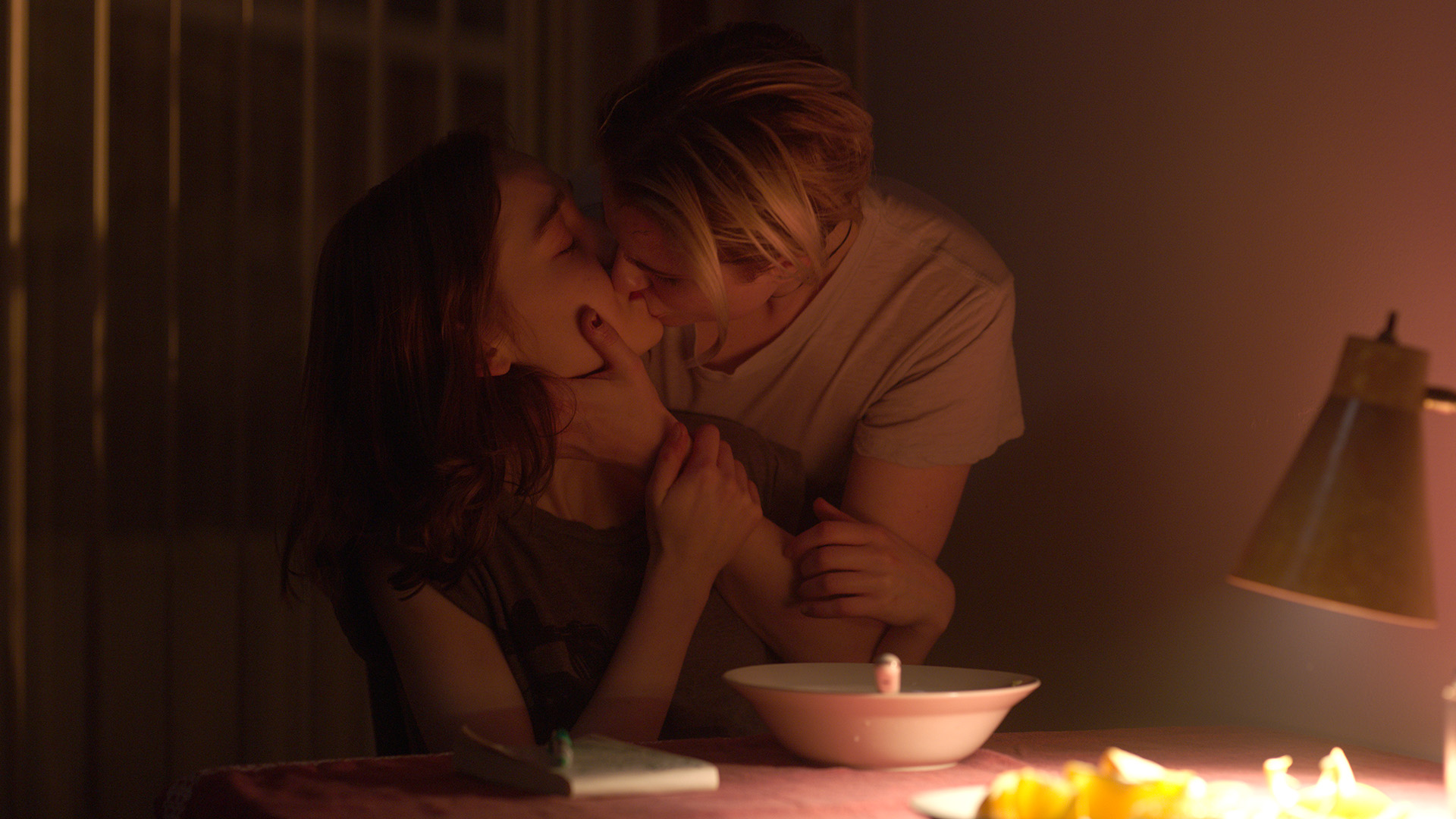
Allure, the debut film of photographer-turned-director siblings Carlos and Jason Sanchez, is an altogether cool puzzle piece, and the puzzle is one movie and TV watchers have been attempting to solve for over a decade now: what's eating Evan Rachel Wood? In the opening scene, we find this spiky, unconventional actress - a frostbitten Kristen Bell, a Sharon Stone origin story - abruptly terminating a bad Craigslist hook-up, sending her poor sod of a correspondent fleeing with tail between his legs; in the second, we witness her Laura oversharing with Eva (Julia Sarah Stone), the piano-playing teenage daughter of the well-to-do woman she cleans for; in the third, we watch as Laura is (it proves characteristically) bolshy with her father (Denis O'Hare), who gave her this job in the first place. The threads connecting these sequences, and those that follow, are interpersonal tension and fraught attraction: the puzzle takes greater shape when Eva rows with her mother and storms out of the family home to take refuge with Laura, a heroine who is already clearly on edge. In its leftfield, standoffish way, the film is a response to the calls for change within the industry some - not least Wood herself - have been making. You want greater female representation on screen? Here's a movie that has troubled women wherever you look.

The result qualifies as an oddity, if far from a complete success: a thriller that operates at an ultra-low frequency, that sets out to be no more than quietly, persistently stressful. The Sanchez boys get almost all their effects from the sight of two young women making credibly poor decisions, and then doubling down on them, as young people are sometimes wont to do; it hardly soothes our fraying nerves that the camera keeps shooting everybody through glass, as if these were bugs to be studied - or crushed. The actors bring these people to some kind of life: O'Hare is as rocksolid as he almost always is, and you sense Wood seizing a moment, or the opportunity to try something more challenging than the porcelain-doll role she currently occupies on TV's Westworld. There are, too, points where the autumnal anonymity of the directors' framing comes close to reproducing that ominous Gregory Crewdson style. Yet it quickly becomes clear that something's missing - that this is a crumpled, damaged movie about crumpled, damaged people, and there's not all that much those of us looking on from the cheap seats can do to fix it. As the initial crackle of intrigue subsides, Allure starts to seem banal and faintly TV movie-ish in its listing of everyday abuses: it sorely needed more heart or a dash of pulpy verve to justify its place on the big screen, and instead it's got Wood, a jagged ice sliver who keeps slipping through our fingers. This is one of those movies that is so deterministically glum and chilly that what it needs most of all is a hug - but it's not a film that invites easy embrace, and one suspects it might even squirm noncommittally out of that. No touching.

Allure opens in selected cinemas from tomorrow.

Wednesday, 16 May 2018

In bloom: "Mary and the Witch's Flower"


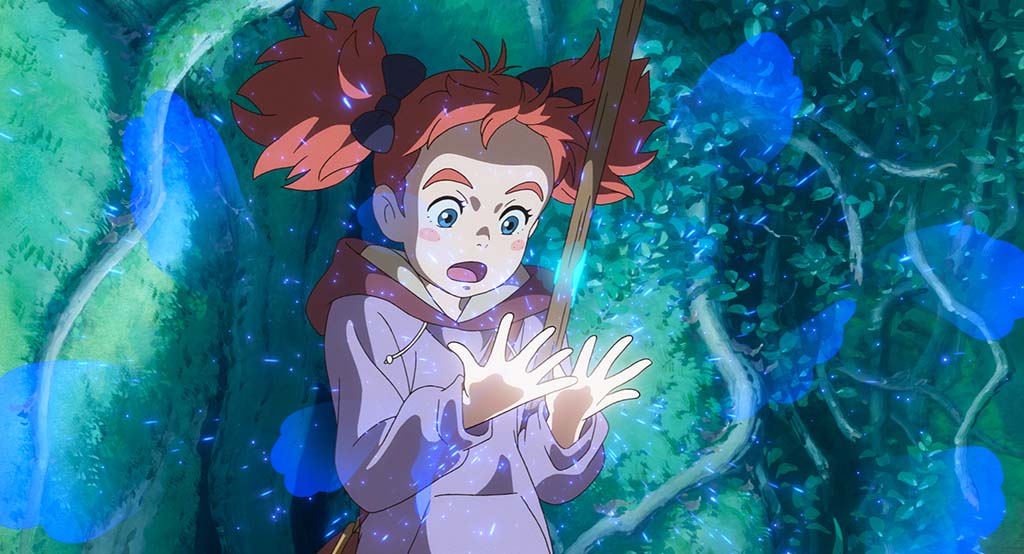
Mary and the Witch's Flower is the first release from Studio Ponoc, the Japanese animation hub established as a sanctuary/back-up plan by Studio Ghibli animators a few years ago when it seemed as though their employers were about to close the workshop doors for good. Mercifully, that hasn't been the case, and besides, Ponoc's debut offering isn't a revolution or separation so much as a continuation. Directed by Hiromasa Yonebayashi - who did 2011's Arrietty and 2014's When Marnie Was There over at Ghibli - Mary displays at least two of the signature elements of one who learnt their trade under Hayao Miyazaki: a love of landscape (incorporating a supremely close and attentive observation of natural life), and a preference for patient, old-fashioned storytelling, such as was prevalent in post-War children's literature. Having transliterated The Borrowers for Arrietty, Yonebayashi has here adapted Mary Stewart's 1971 novel The Little Broomstick, the spirited tale of a young girl who escapes boredom during a stay at her great aunt's home with the discovery that the berry of a certain flower, when applied to an old broomstick she finds in the woods, allows her to fly beyond the clouds to an academy for young witches and wizards.

In 2018, of course, that scenario can only recall Harry Potter, and one could arguably accuse Ponoc of the same calculation that has overtaken those US and European animation studios who've been led to rip off a Toy Story or Madagascar or Shrek every few months. Witching and wizardry has an obvious appeal to youngsters discovering how best to use their own powers: the parallels between Stewart's universe and the later one created by J.K. Rowling are only further underlined when Yonebayashi's Mary sticks her head around the door of the academy's broomstick class to spot a bowl-headed, round-spectacled young man singularly failing to master the wood clasped between his thighs. There are subtle deviations and outright differences, all the same. Madame Mumblechook, the academy's gargantuan headmistress, is no benevolent Dumbledore, rather the figurehead of a tyrannical regime that punishes outsiders and intruders like our redheaded, friendless heroine by transforming them into caged monsters. This Hogwarts, emphasis on the warts, is far closer to the Giant's kingdom in Jack the Giant Killer, and Mumblechook certainly cuts an imposing figure: part Tantrums & Tiaras-era Elton John, part Matilda's Miss Trunchbull, she strives to control the world around her, where Mary - happily sharing her lunch with adopted cat Tib - is content to live within it. (A very Miyazakian conflict, this.)

As all that would suggest, there is more here that is familiar than blazingly original. Alternately busy and cosy, the results come in on or about a par with such charming second-rank Ghibli diversions as Howl's Moving Castle or, indeed, Arrietty. Yonebayashi does, however, pull off one tricky balancing act, retaining the blithe innocence of the very best Ghibli films (key difference between Western and Japanese animators: the former spend many hours making animals talk, but only the latter seem to have studied how they walk) while also attempting the kind of (here rather trippy) widescreen action that sweeps kids up in its wake. I saw the film in a half-full public screening of the original subtitled version - an English-language dub is also doing the rounds - where in the pause that followed one agonising plummet from the sky, a tiny voice was heard to gasp "Is she dead?" (Worry not, little one.) We're headed towards a spectacular When Science Goes Wrong finale - every frame bursting with light and motion - which squares Frankenstein with Altered States; yet Yonebayashi also centralises the simple pleasure that is the sight of the aspirant witch's broomsticks - literal line drawings, transformed here into rocket-powered pogosticks - putt-putting vertically into the sky. Truly opportunistic producers would have seized upon these pared-down sleigh rides as an excuse to impose the 3D levy; Yonebayashi treats them, as Stewart did, as the basis of a magical, if somewhat evanescent, fly by night.

Mary and the Witch's Flower is now playing in selected cinemas.

Tuesday, 15 May 2018

The second mother: "Tully"


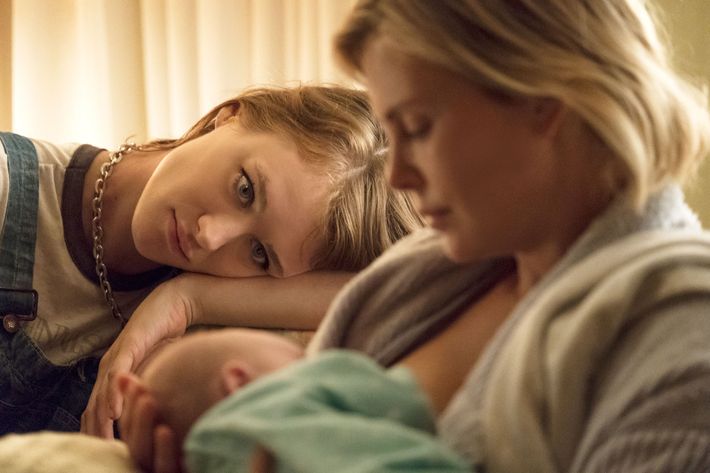
Although Tully bears a directorial credit for Jason Reitman - the self-effacing Canadian humanist whose work has grown ever more anonymous since 2009's Up in the Air - it's rather more obviously the handiwork of Diablo Cody, screenwriter of 2007's Juno, 2009's Jennifer's Body and 2011's Young Adult. From the last of these, the new film retains Charlize Theron, here rounder and mellower, but no less close to the end of some invisible tether; from the first, a baby bump that provides the source of all the stress - an unplanned (and heavily overdue) third child for Theron's Marlo. From Jennifer's Body, Tully takes... well, we'll get to that in due course.

For starters, what is apparent is that Cody - who gave birth to a third child of her own earlier this year - has embraced motherhood in a big way. Tully is all but a primer in how this experience might be lived by a woman well into her thirties (rather than Juno's inchoate wiseass): the mentally and physically exhausting business of belly-tending, bladder-pushing, milk-producing gestation; of treading barefoot on pieces of Lego at one in the morning, and sitting half-zonked in front of kids' films you don't, and don't care to, understand; and of doing all this with two other anklebiters in tow, and with little-to-no help from a hubby (in the film's case, Ron Livingston's Drew) whose first act, upon returning from the office, is to make pass-agg remarks about the microwave pizza being served up as a last-resort dinner, and whose second is to retire to the bedroom to play video games for the rest of the night.

When the plot kicks in, Tully feels like an oestrogen-infused variant of David Fincher's The Game (or even the recent Game Night): over dinner, Marlo's have-it-all brother (Mark Duplass) passes on details of the "night nanny" he and his wife employed to help raise their children for them. (He does this, we sense, as much to help his sister out as to point up how helpless she's become.) Enter Mackenzie Davis, trailing some of the young Laura Dern's uprightness, as Tully, the nanny in question, whose willowy, on-point togetherness would make Mary Poppins seem a slob, let alone the frazzled Marlo; it's somehow cruelly perfect that she should first waft into this household wearing a crop top that accentuates the untroubled flatness of her belly. 

Suddenly, Marlo has time to sleep, make herself up, and cook food with actual vitamins in; suddenly, too, the film starts to take shape, setting two very different models of femininity - the bright, carefree twentysomething and the bloated, self-loathing burnout - to meet in the middle of another of Cody's typically warm, funny female friendships. Yet we can also feel this culturally savvy scribe playing with our expectations of the nanny genre, and where this particular relationship might be headed. Sitting cross-legged and smiling at the foot of the bed as her charge first latches onto the Theron nipple, Tully somehow seems too perfect; you might just have a panicky flashback to The Guardian's Jenny Seagrove or the way Rebecca de Mornay terrorised poor Annabella Sciorra in The Hand That Rocks the Cradle.

What follows can seem squarely heteronormative (as Reitman's movies generally have done): the sentiment underpinning Cody's script is that having babies is hard labour, but well worth it in the end, a line that's been around roughly since the Stone Age and may well have some truth to it, but which can nevertheless sound tedious, self-righteous and/or desperate coming even from one's nearest and dearest. If it wasn't already apparent from Juno, a very likable teen pregnancy drama that had to shrug its shoulders at the thought of abortion in order to see its conceit through to fruition, Cody may be a more conservative talent than first thought, which perhaps explains why she's been allowed through the studio gates on such a regular basis.

The trick she plays here - and it is, in the main, an effective one - is to flirt with something weirder. It's Tully donning the waitress outfit her employer has bought to seduce Drew in the bedroom, and mounting him with Marlo's approval (a very Reitman-ish kink, this: a guy who just wants a gal to bring him apple pie). It's a quasi-conspiratorial scene in the shitty nightclub bathroom to which our heroines repair when Marlo needs to expel breast milk, which seems to be heading towards some kind of girl-on-girl consummation. And it is, at the last, the ending, which has set some critics to throwing up their hands, and which left the paying (and generally enthusiastic) crowd I saw the film with filing out of the room, audibly nonplussed.

For my part, I exited feeling neither shortchanged nor especially elated. Inevitably, Tully's conclusion carries the whiff of self-sabotage, suggesting that the script was was intended as a bait-and-switch operation, rather than the heartfelt paean it once seemed to be. Equally, though, that ending was on the cards all along, set up in conversations our heroines have about molecules, and in a thousand creative writing exercises besides, and I'm loath to dismiss it entirely, as it does get at something some mothers of my acquaintance have felt in the wake of bringing forth new life: it makes a kind of emotional sense, even as it plays out as a narrative futz or a crib from an already well-cribbed source. See it for Theron, here confirmed as the most commanding and versatile performer in American movies, and for the neatly cast Davis, who really does seem to have emerged out of nowhere fully formed - then ponder whether Tully's final ten minutes support or undermine its central thesis.

Tully is now playing in cinemas nationwide.

Friday, 11 May 2018

For what it's worth...


Top Ten Films at the UK Box Office 
for the weekend of May 4-6, 2018:

1 (1) Avengers: Infinity War (12A) ***

2 (new) I Feel Pretty (12A)
3 (3) A Quiet Place (15) ****
4 (2) The Guernsey Literary and Potato Peel Pie Society (12A)
5 (4) Rampage (12A)
6 (8) Blade Runner: The Final Cut (15) ****
7 (new) The Strangers: Prey at Night (15)
8 (new) Tully (15) ***
9 (5) Peter Rabbit (PG)
10 (new) Mary and the Witch's Flower (U) ***

(source: theguardian.com)

My top five: 
1. Raazi

2. The Old Dark House
3. Custody
4. Breaking In
5. Mary and the Witch's Flower


Top Ten DVD sales: 

1 (new) Jumanji: Welcome to the Jungle (12)
2 (2) Star Wars: The Last Jedi (12) ***
3 (1) Pitch Perfect 3 (12)
4 (new) Hostiles (15) **
5 (4) Paddington 2 (PG) ****
6 (3) Ferdinand (U)
7 (7) Thor: Ragnarok (12) ***
8 (8) Doctor Strange (12) **
9 (new) Braven (15)
10 (6) Justice League (12)

(source: officialcharts.com)

My top five: 
1. The Ice King

2. Film Stars Don't Die in Liverpool
3. Paddington 2
4. The Florida Project
5. Star Wars: the Last Jedi


Top five films on terrestrial TV:
1. Terminator 2: Judgment Day [above] (Saturday, ITV1, 10.05pm)
2. Big Hero 6 (Saturday, BBC1, 4.45pm)
3. Tomorrowland (Sunday, BBC2, 6pm)
4. Eddie the Eagle (Sunday, C4, 9pm)
5. Muriel's Wedding (Sunday, five, 10.35pm)

Meet the family: "The Old Dark House"


It's been obscured for some while, but 1932's The Old Dark House has now been dug out of the archives to be presented to us as the foundation stone of an entire subgenre. Without James Whale's adaptation of the J.B. Priestley novel Benighted, an outlier in the Universal horror cycle, there would be no Amityville, no The Haunting (in either good or bad iterations), no Insidious chapters one through four. Raymond Massey and Gloria Stuart (later the old dear in Titanic), plus pal Melvyn Douglas, are caught in a storm one night while traversing the Welsh borderlands en route to an appointment in Shrewsbury. They seek shelter in a spooky mansion that looms up out of nowhere, only for the door to be opened by a bearded, mumbling Boris Karloff ("even Welsh ought not to sound like that," comments Massey), footman to the deeply strange Femm family: tall, highly strung Horace (Ernest Thesiger) and his squat, squawking, at least partially deaf sister Rebecca (Eva Moore), who barely lets Stuart settle in before accusing her of revelling "in the joys of fleshly love". 

As that would suggest, The Old Dark House nowadays plays as every bit as funny as it is scary, and that's deliberate: Whale, who had already signed off on Frankenstein but would go on to make the semi-parodic Bride of Frankenstein, is here single-handedly inventing not just the haunted house movie, but the comedy-horror film that would stand on an adjacent plot. (Other titles that owe a considerable debt to the film would include The Addams Family, anything associated with The League of Gentlemen, and High Spirits with Steve Guttenberg.) Although Massey winds up poking around the house's cloistered upper floors with a candle, and Stuart gets spooked by shadows, horror diehards may start feeling shortchanged, because for most of its slender 75-minute running time, the film leans heavily in the direction of the comedy of manners. 

Our normie heroes find themselves caught between Thesiger's singularly odd, oddly sympathetic Horace, imploring everyone "have a potato" at the Femm dinner table, and brash latecomer Charles Laughton as the Lancastrian laird who gets pie-eyed over supper, and promptly passes out; Douglas subsequently winds up seducing the latter's chorine companion (Lilian Bond) in the back of a jalopy (to the sound of a crowing cock), while Karloff's footman crosses a line with the fetching Stuart. A measure of wobbly-banistered creakiness ensues as the house gives up its secrets, but it remains packed with very Thirties pleasures - the most eccentric character performers of that era, assembled on the kind of set they just don't build (or light like this) anymore - not to mention one of the earliest cinematic assertions that there's nowt so queer as folk. And that's before anybody gets within three miles of Shrewsbury.

The Old Dark House is now playing in selected cinemas.

"Breaking In" (Guardian 11/05/18)


Breaking In ***
Dir: James McTeigue. With: Gabrielle Union, Billy Burke, Richard Cabral, Ajiona Alexus. 88 mins. Cert: 15

Two female-led payback thrillers in a week: something looks to have shifted within the culture. (What exactly remains to be seen: Revenge could equally be paired with last month’s Death Wish as evidence of a violent lurch to the right.) Breaking In is the major studio option, which means a male writer and director, fewer nasty edges and minimised bloodshed (as if someone at Universal was hedging for a lower rating); it also unfolds around one of those implausibly vast, only-in-the-movies properties, replete with poolroom, expansive crawlspace and a security system to set any CIA wonk to salivating. Nevertheless, this viewer caught himself giggling at just how well it was working.

Gabrielle Union is the protective mother who arrives in rural Wisconsin – sans husband, but with young son and daughter in tow – to oversee the sale of her no-good father’s estate. Suspicions are raised that somebody may have beaten her there; these are borne out with the appearance of four variably stubbly louses – headed by Twilight’s Billy Burke – with eyes on the $4m in dad’s safe. Momma Bear is soon on the wrong side of the house’s electronic shutters, with her kids being held hostage indoors – a nimble reversal of standard siege-movie procedure, in that our sympathies now reside with the figure on the outside looking in.

Is it significant that this individual should be a female of colour? Journeyman director James McTeigue’s better work (V for Vendetta, Sense8) has always maintained an element of social commentary: we sense him lingering when Burke tells Union “you are a woman, alone, at the mercy of strangers”, which makes it even more cathartic whenever our resourceful heroine locates a weak spot. That subtext provides the only spice in what’s basically a meat-and-potatoes runaround, but these 88 minutes never drag their heels long enough for us to get hung up on their myriad implausibilities. One of those low-expectation releases that’ll see you right if Infinity War remains sold out.

Breaking In opens today in cinemas nationwide. 

"Sherlock Gnomes" (Guardian 11/05/18)


Sherlock Gnomes **
Dir: John Stevenson. Animation with the voices of: Emily Blunt, James McAvoy, Michael Caine, Johnny Depp. 86 mins. Cert: U

Whatever could have led diminutive megastar Elton John to bankroll a series of digimations headlining humble garden gnomes? The fragile tchotchkes debuted in Rocket Pictures’ 2011 venture Gnomeo & Juliet, which offered Ozzy Osbourne voicing an ornamental faun, a soundtrack of childproofed Elton hits, and near-unsurpassable novelty value. This flatly functional sequel relocates the trinkets from Stratford to London, where G&J’s honeymoon is almost over – she’s spending too much time in the garden – and a spate of gnome thefts attracts the interest of Baker Street’s finest, voiced here by Mortdecai star Johnny Depp as the same old supercilious pseud.

What follows lacks Pixar’s ambition and rich subtexts – Ben Zazove’s simultaneously overworked and underpolished script proceeds along that quest narrative line worn thin by years of multiplex filler – but gets so far on a very British daftness that is not entirely without charm. There are flourishes in the animation, equivalents to the parakeets and palm trees that once graced the exec producer’s specs: Sherlock’s deductive processes are illustrated in lively, hand-drawn black-and-white sketches, and we get the mildly radical touch of an African-American Irene Adler, now a moll running a speakeasy for dolls – voiced, in a bid for exportability, by Mary J. Blige.

The whole makes for painless, occasionally chuckle-worthy matinee viewing, but after two films, this still looks and feels like a franchise driven more by commercial calculation than creative inspiration, a pension fund for a multi-millionaire who surely doesn’t need the pocket money. The formula sits a stratum or two too close to the surface: easily relatable little things for the little ones, plus bouncy discofied versions of “I’m Still Standing” for accompanying baby boomers. It remains to be seen whether future jaunts up this garden path can crowbar in anything as artful as “Song for Guy” or “Someone Saved My Life Tonight”. 

Sherlock Gnomes opens in cinemas nationwide today.