Sunday, 16 October 2016

From the archive: "Ouija"

 
Ouija **
Dir: Stiles White. With: Olivia Cooke, Ana Coto, Daren Kagasoff. 89 mins. Cert: 15

Because nothing says Halloween more than gathering in the dark to experience a carefully strategised branding opportunity. The latest product of the unholy synergy between Michael Bay’s Platinum Dunes and toymakers Hasbro is a rudimentary horror in which bland Everyteens are slain while communing with their late friend via the sinister Ouija – an item currently mass-produced by Hasbro Inc. While increasingly tired thousand-decibel prods counteract the absence of dynamism in watching kids spelling with a polyurethane planchette, matters become comically venal. “I don’t want to touch it,” shirks one player. “C’mon – they’re sold in toy stores,” is the response. Everybody’s pocket money deserves better. 
 
(October 2014)
 
Ouija is available on DVD through Universal Pictures. A sequel, Ouija: Origin of Evil, opens in cinemas nationwide from Friday.

Saturday, 15 October 2016

For what it's worth...


Top Ten Films at the UK Box Office   
for the weekend of October 7-9, 2016:
 
  
1 (new) The Girl on the Train (15) *
2 (1) Bridget Jones's Baby (15) *
3 (2) Miss Peregrine's Home for Peculiar Children (12A)
4 (3) Deepwater Horizon (15)
5 (4) The Magnificent Seven (12A) **
6 (6) Finding Dory (U) ***
7 (new) War on Everyone (15) * 
8 (new) Tristan und Isolde - Met Opera 2016 (12A)
9 (7) Kubo and the Two Strings (PG) ****
10 (8) Don't Breathe (15) ****  

(source: theguardian.com)

My top five:   
1. Driving with Selvi
2. Tharlo
3. Under the Shadow 
4. Kate Plays Christine
5. American Honey
 

Top Ten DVD rentals:  
   
1 (1) Captain America: Civil War (12)
2 (10) Mother's Day (12) 
3 (3) The Jungle Book (PG) **
4 (2) The Nice Guys (15) ****
5 (4) Alice Through the Looking Glass (PG)
6 (new) The Guv'nor (15)
7 (7) Batman vs. Superman: Dawn of Justice (12)
8 (8) Eye in the Sky (15) ***
9 (6) Love & Friendship (U) ***
10 (re) The Huntsman: Winter's War (12)    

(source: lovefilm.com)
                                   
My top five:  
 

Top five films on terrestrial TV this week:   
1. The Magdalene Sisters (Sunday, BBC2, 12midnight)
2. Starred Up (Saturday, C4, 12.05am)
3. Stoker (Sunday, C4, 12.10am)
4. Dil Dhadakne Do (Thursday, C4, 1.05am)
5. You Don't Mess with the Zohan (Saturday, five, 3.05am)

Wednesday, 12 October 2016

From the archive: "Angels & Demons"


Ron Howard and Tom Hanks have been nothing if not vocal, these past few weeks, about the manner in which Vatican officials were less than helpful during the filming of Angels & Demons, the sequel to 2006's The Da Vinci Code, blocking access to key locations and generally making an episcopal nuisance of themselves. The Catholic Church can and have been accused of many things, but having endured Angels & Demons, I can report that their judgement on this matter at least is all but unimpeachable. In the future, indeed, I would encourage them to go further still. The College of Bishops should be stationed on rooftops with rifles and prepared to take down anybody who even thinks of greenlighting another Dan Brown adaptation. Altar boys could be orchestrated into a network of saboteurs, and sent out to cut the power of any cinema showing the film. And could not Pope Benedict be persuaded to revive the rack, in order to make all those involved in the production of this series recant their myriad mortal sins?

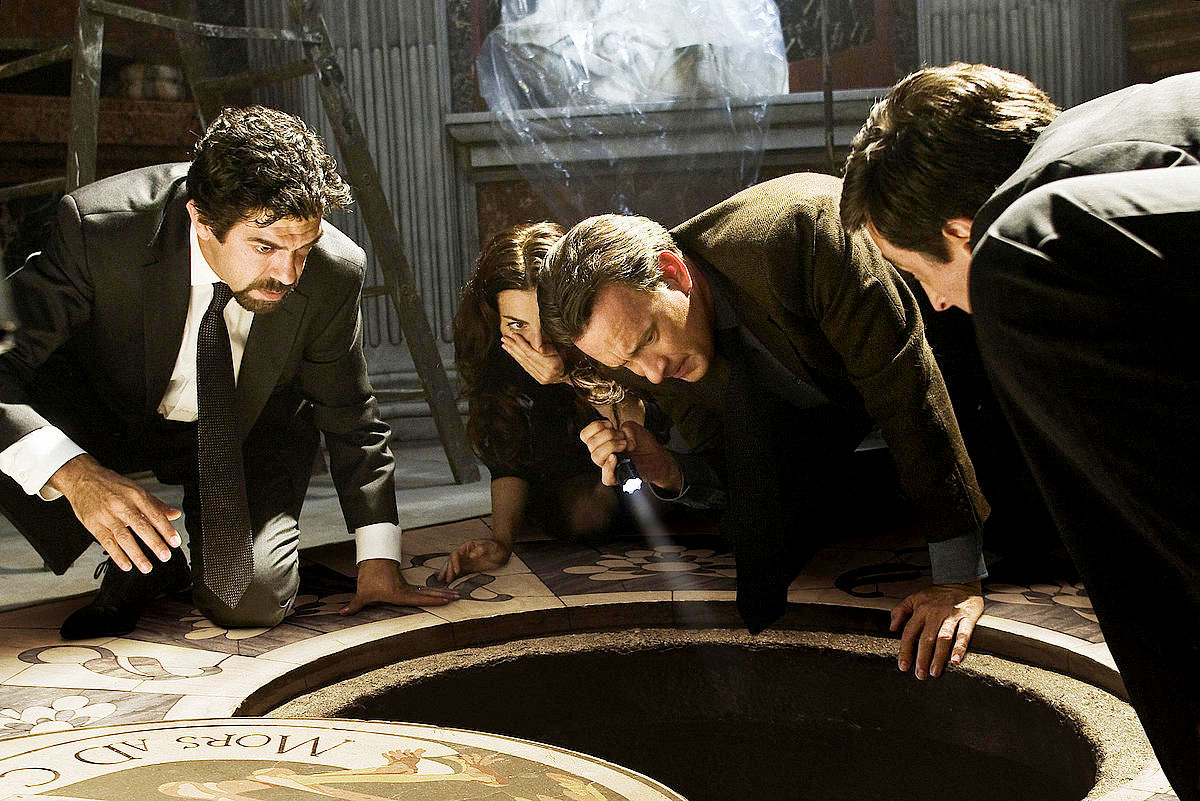
Let's start with Brown himself, the source of so much that is wrong with the film. Angels & Demons' opening ten minutes offer, in no particular order, the following splurge of incident: the death of an incumbent Pope, the murder of a priest inside the Large Hadron Collider, followed by the theft of antimatter by a group calling themselves the Illuminati, who then announce their plans to set off an explosion in St. Peter's Square. The general air of turmoil is compounded by the kidnap of a further four priests who - lawksalordy - just so happen to be the leading candidates in the race for the papacy. I'd argue no man could make sense of this nonsense, but Tom Hanks's Harvard symbologist Robert Langdon is back to give it a go. Hanks has, thankfully, been shorn of the footballer's mullet he sported in the first film; gone, too, is his erstwhile sidekick Audrey Tautou, and her charming way of mangling the English language. In comes the remarkably dull Ayelet Zurer as the - it says here - "beautiful and enigmatic Italian scientist" Dr. Vittoria Vetra.

Together, this pair run around between statues and murals in the fashion established by Jerry Bruckheimer's brainlessly enjoyable National Treasure franchise, yet second time out, it's the influence of another Bruckheimer franchise that appears to hold the greatest sway. The script is clogged with what I can only call CSI dialogue, in which supposedly intelligent, highly trained professionals have to explain in painstaking detail to one another (and thereby to us) technical terminology of which the other party would surely be well aware. (In reality, every line in the typical CSI episode would be greeted with an exasperated "yes, but I know that.") Yet the average hour of CSI would also make room for character development, mordant wit, pauses for thought, Government-sponsored crime-doesn't-pay propaganda, and - and here's where it differs most from the Browniverse - science that rings true. Angels & Demons, by contrast, dashes ever onwards in a relentless, diarrhoeic flow of exposition.

There's no stopping it - one priest gabbles about the crucifixion of the first Pope even as the mark of a branding iron sizzles on his chest - and no digesting it; what we're left with are actors wearing the facial expression of trapped wind sufferers, playing characters we're not given time to care about, solving puzzles we couldn't give a toss about. The first film at least allowed actors of the calibre of Ian McKellen, Alfred Molina and Paul Bettany to chew the scenery; maybe it's the recession, but this time, the cast stretches only to cheaper Europeans, attempting sinister in a variety of accents. Sweden's Stellan Skarsgard is the grumpy head of Vatican police; Dane Nikolaj Lie Kaas offers lightweight glowering as a criminal mastermind who apparently bases all his decisions on which direction 16th century statues are pointing. On the side of the angels, we find Armin Mueller-Stahl as the exceptionally non-committal Cardinal Strauss, sighing "if it's God's will, it may as well be done" - Brown can't even be bothered to write his men of faith with any conviction - and, wait for it folks, Ewan McGregor as the Camerlengo, Patrick McKenna, an Ulsterman whose accent thickens noticeably at moments of crisis ("Der's been a develoipment!").

For the most part, McGregor manages to cloak his now-standard look of a man desperate to collect his paycheque, fill up his motorbike, and ride the furthest imaginable distance from the film he's signed up to appear in; and yet there can be no preparing the viewer for his participation in a final reel so ludicrous, nay risible - it involves McKenna literally parachuting himself into the vacant papacy - it can only be interpreted as an unholy hoax, designed to expose the sheeplike gullibility of summer-season cinemagoers. Nothing else could explain Hanks's continued participation in a franchise so painfully po-faced and humourless, nor Howard's sudden desire, so soon after the considered Frost/Nixon, to churn out a film so essentially sloppy in its storytelling, so flat-out contemptuous of its audience. Are they just goofing off? If so, the joke's on us. For make no mistake: Angels & Demons isn't guilty-pleasure bad. It's not amusingly bad. It's not even so-bad-it's-good bad. It's worse-than-The-Da-Vinci-Code- bad. It's they're-taking-the-piss bad. It's don't-give-them-your-money bad. Altar boys of the world: you know what to do.

(May 2009)

Angels & Demons is available on DVD through Sony Pictures Home Entertainment; a further sequel, Inferno, opens in cinemas nationwide on Friday, and is reviewed here.

Tuesday, 11 October 2016

From the archive: "The Da Vinci Code"


Hollywood executives must love it when precisely no brain power is required of them in their daily working. Few synapses would have been tested in greenlighting The Da Vinci Code, the film of the book everybody in the Western world bought just to see why everybody else was reading it. (Did we ever arrive at an explanation for that, by the way?) You can see the logic: if every person who picked up a copy of Dan Brown's novel in an airport departure lounge or WHSmith 3-for-2 offer was to buy a ticket for the movie, then the movie would be well on its way to becoming one of the biggest grossing blockbusters of all time. The fatal flaw in this reasoning concerns not how many people worldwide have bought and read The Da Vinci Code, but the number of people worldwide who've read The Da Vinci Code twice. Whether the book is supremely readable or unreadable claptrap - and I've heard strong arguments proposed on both sides - its mystery cannot surely deepen appreciably on a second, cinematic run through. Those who've read the book will already be aware of what happens in the movie. Those who haven't are unlikely to be converted by a very dull, occasionally silly and punishingly long film.

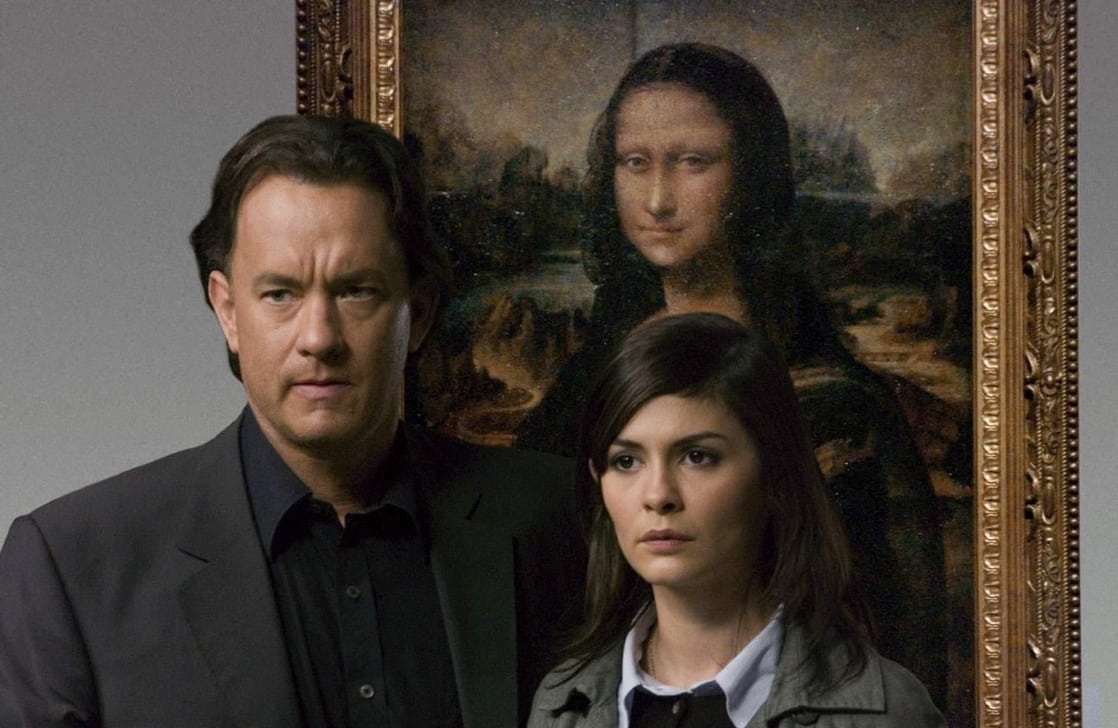
In the interests of full disclosure, I should admit - if you haven't already guessed - that I fall into the latter camp. (Hey, there are novels by Flaubert and Dostoyevsky I haven't read yet, all of which I intend to get round to once I've finished the latest Viz.) Still, friends tell me one of the book's strengths is its interactivity - that buzzword of the modern era. However shoddy Brown's plotting, however clunky his writing, the reader could nonetheless join in with working out the anagrams and riddles that sustain the writer's narrative. I cannot for the life of me see how a film or an audience would benefit from sending Forrest Gump and Amelie Poulain to do all this thinking for us. For, yes, we now have Tom Hanks as Robert Langdon, an American cryptologist in Paris who's framed for the murder of a curator in the Louvre, although Batman & Robin scribe Akiva Goldsman's adaptation is so clumsy that, several days after watching the film, I still have no idea why Langdon is the chosen stooge. (Maybe it's just that he happened to be in town on a booksigning tour; had Opus Dei waited a week to bump the curator off, they would have had to frame Katie Price, say, or Alain de Botton.)

Anyway, Langdon is helped to evade police custody - and thereby granted time to work out the clues the curator left behind - by the gaminely unconvincing Parisian cop Sophie Neveu (Audrey Tautou, for it is elle). Over the course of the two-and-a-half hours of Ron Howard's film, our hero will bump up against a variety of dogma, not to mention a rogues' gallery of supporting performers. Paul Bettany - bless him - is the self-flagellating albino monk and part-time hitman Silas, who for some reason shoots the curator in the gut rather than head, thereby allowing him plenty of time to take one last tour of the gallery setting the entire plot up. Ian McKellen plays a temperamental chateau-owner referred to as Leigh Teabing. (That's Leigh Teabing.) Alfred Molina is the Catholic bishop Aringarosa - bless you - trying to keep a mortal secret from getting out. These characterisations are vivid in a lukewarm pulp sort of way, but they cannot conceal what's always bugged Brown sceptics: that the plot of The Da Vinci Code is pure bunkum (high-flown conspiracy) built on top of something that already demands a, let's say, heightened level of belief (organised religion).

With a smidgen more reality - if the cover-up had been engineered by a government, rather than the Church - the film might be borderline credible, as Hollywood runarounds go. If it had displayed any trace of humour, it could have been just as much infectious fun as the Nic Cage codebreaker National Treasure. As it is, we're left with a film where the big twist centres on a number of utterly spurious claims - whom Jesus once had over for dinner, and (somewhat more controversially) whether Leonardo da Vinci wasn't as good as Brian Sewell says, particularly in the matter of differentiating between male and female subjects. (The correct response, at every turn, is "oh, come on", if not "well, who cares?") And where the book apparently made a virtue of rollicking along, Goldsman supposes this is one of those plots that requires continual explanation, and so the film keeps sitting its characters down so someone can talk us through another section of the complex waffle that forms Brown's backstory. The location varies, but the stop-and-sit principle applies throughout: in the back of an armored van; on a bench at midnight in the Bois de Boulogne; on a plane; over tea and biscuits at Gandalf's - sorry, Leigh Teabing's - house.

Alternatively, we're offered flashbacks, endless, unnecessary flashbacks to illustrate some washed-out religious pageant or justify the present-day action. You get a feel for the imagination Howard and Goldsman credit their audience with in a scene that cuts from Langdon and Neveu escaping from an airport in a car to the flashback that picks apart how they got there: by, erm, getting out of a plane and then running across to the car. Star power, a flicker of chemistry, might have got us to overlook the monumental dumbness of it all, but Hanks, in his all-black outfit and extreme hairdo, has the look of an underemployed football pundit; he'd surely be more at home pontificating on England's World Cup chances than solving Sudoku puzzles pertaining to the Son of God. And even those of us with a weakness for French actresses speaking in English will have to concede that Tautou is beyond all hope here: as performances in a second language go, this is very nearly as awkward as Zhang Ziyi's turn in Memoirs of a Geisha; these words - not great words to begin with - just don't sit right in her mouth. One comes to The Da Vinci Code expecting revelation, perhaps some explanation of why the book was so damn popular, but Howard's film can offer nothing so exciting as that. Instead, after all those hours in the High Court, all the money spent by Sony on promotion, all those high-powered edicts delivered by senior representatives of the Church, what seemed like endless documentaries on Channels Four and Five, one comes to conclude this is one of those occasional cultural phenomena that lead one to look to the heavens and cry out in vain: come on, people, was it really worth this much fuss?

(May 2006)

The Da Vinci Code is available on DVD through Sony Pictures Home Entertainment.  

Saturday, 8 October 2016

For what it's worth...


Top Ten Films at the UK Box Office   
for the weekend of September 30-October 2, 2016:
 
  
1 (1) Bridget Jones's Baby (15)
2 (new) Miss Peregrine's Home for Peculiar Children (12A)
3 (new) Deepwater Horizon (15)
4 (2) The Magnificent Seven (12A) **
5 (new) Supersonic (15)
6 (4) Finding Dory (U) ***
7 (3) Kubo and the Two Strings (PG) ****
8 (6) Don't Breathe (15) ****
9 (9) Bad Moms (15) **
10 (new) M.S. Dhoni: The Untold Story (PG) *** 

(source: theguardian.com)

My top five:   
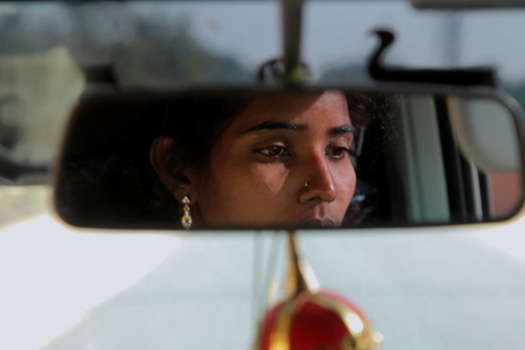
1. Driving with Selvi [above]
2. Tharlo
3. Under the Shadow 
4. My Scientology Movie
5. The Greasy Strangler
 

Top Ten DVD rentals:  
   
1 (1) Captain America: Civil War (12)
2 (new) The Nice Guys (15) ****
3 (2) The Jungle Book (PG) **
4 (new) Alice Through the Looking Glass (PG)
5 (3) Deadpool (15)
6 (9) Love & Friendship (U) ***
7 (7) Batman vs. Superman: Dawn of Justice (12)
8 (4) Eye in the Sky (15) ***
9 (5) Eddie the Eagle (PG) ***
10 (new) Mother's Day (12) 

(source: lovefilm.com)
                                   
My top five:  
 

Top five films on terrestrial TV this week:   
1. Begin Again (Sunday, BBC2, 10pm)
2. Wonder Boys (Sunday, BBC2, 11.40pm)
3. American Pie 2 (Friday, ITV1, 10.40pm)
4. Safe (Sunday, five, 11.20pm)
5. Predators (Sunday, C4, 11.05pm)

Friday, 7 October 2016

"Still Loved" (Guardian 07/10/16)


Still Loved ****
Dir: Debbie Howard. Documentary with: Lou Evans, Juliette Gaunt, Matt Gaunt, Beth Morris. 77 mins. Cert: 12A
 
Released to coincide with Baby Loss Awareness Month, Debbie Howard’s documentary hears out bereaved parents across the North Midlands, talking with remarkable candour about their experiences of stillbirth. If the early crosscutting elides some of each case’s specificity, it succeeds in describing a more general arc, from horror and numbness to acceptance and a resolution to move forwards – either by trying to conceive again or investing creative energies in alternative projects. The process confronts us with undeniably tough material: the snapshots of the deceased sting as much as the pans across the box-fresh bibs and bootees bought in excited anticipation of the big day. (The whole film is a fleshing-out of the six-word story typically attributed to Hemingway.) Yet you can only be struck by the resilience the interviewees display, and the trust they place in Howard – a trust repaid several times over by a work of commemoration that will also surely provide considerable consolation.

Still Loved tours selected cinemas from today.

"War on Everyone" (Guardian 07/10/16)


War on Everyone *
Dir: John Michael McDonagh. With: Alexander Skarsgård, Michael Pena, Tessa Thompson, Stephanie Sigman. 98 mins. Cert: 15
 
When our culture is finally swallowed by snark, all movies will resemble this benumbing buddy-cop facsimile, a major misfire from The Guard’s John Michael McDonagh. Rather than a plot, McDonagh here offers a monotonous succession of low blows, pitting New Mexico detectives Michael Pena and Alexander Skarsgård against various minority punchbags and prompting them to gurgle insensitively – a careworn post-Gervaisian tactic that might only be excusable if these jabs were funny. That title’s fair warning at least, but it’s hard to engage in any rewarding way with a film in which not a single word is meant or felt – unless McDonagh really is the worst kind of reactionary. 

War on Everyone opens in cinemas nationwide today.