Friday, 12 July 2019

Succession: "Spider-Man: Far from Home"


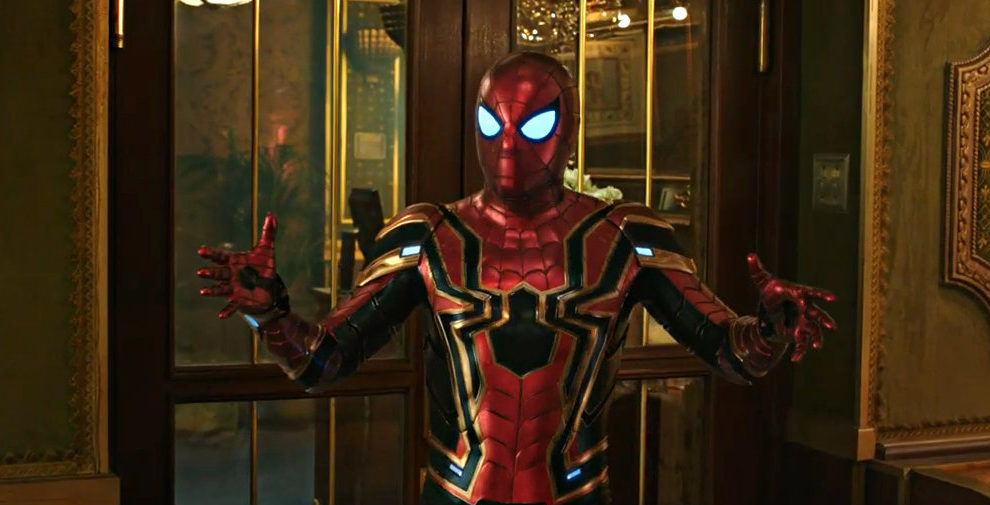
Turns out they spun themselves a safety web. Marvel's fallback plan, after the supposedly ne plus ultra activity of Avengers: Endgame, is to set out the continuing adventures of Peter Parker, whose existence had been called into question by the events of Avengers: Infinity War before being reaffirmed by its follow-up. For franchise fans, then, here is a new hope. For the rest of us, Spider-Man: Far from Home might resemble standard corporate practice: the replacement of an ageing, infirm figurehead (in this case, Robert Downey Jr.'s fallen Tony Stark, a.k.a. Iron Man, vanguard of the Marvel Cinematic Universe when it launched in 2008) with a fresher face, and - here - a performer who's logged relatively few hours in latex going through the same superhero motions, and thus has no qualms about taking on the extra responsibility. After two self-consciously "dramatic" films wrapping up the Avengers arc, Far from Home is also clearly kickback, Marvel's European Vacation: shrugging off the passing of key Avengers via a highschooler's YouTube video - on reflection, all the reflection those developments truly merited - it pitches Parker (Tom Holland) and pals towards Venice, Prague, London and a bizarre idea of the Netherlands before finally returning him to swing unburdened by baggage through the streets of New York. Tony Stark died, it transpires, so that Peter Parker could live.

The fresh air and change of locations that follow ensure Far from Home is broadly likable, if ramshackle in places (evidently the result of many script drafts) and no more essential than anything that's come before it - it is, bottom line, just another film in a series. If it's an improvement on 2017's Spider-Man: Homecoming, that's in part because it doesn't have to slog through an origin story we've already sat through twice since the turn of the millennium: it can drop us amid the action, then crack on with distracting us for two hours, before arriving at an idea that might just get us and the key creative personnel through another one yet. Returning director Jon Watts - fast-tracked into the Marvel millionaires club off the back of 2015's Cop Car - looks far more assured in his marshalling of that personnel: he's worked out what works in these movies, what might be usefully dwelt upon, and what can be dashed through. Holland is endearingly precise in those scenes that don't convert Parker into a computerised avatar, and there really is something heartening in Zendaya's reinvention of Mary Jane: not the apple-pie all-American sweetheart the character was conceived as during the LBJ administration, but a squinty, scowly 21st century beanpole some measure smarter and cooler than any of the boys around her. These kids are building a winning partnership - more winning, at least, than Stark's wooing of his own secretary, or the sketchy pairing of Stark's chauffeur Hap (Jon Favreau) with Parker's widowed Aunt May (Marisa Tomei), which at this precarious moment within the MCU seems more consolidation of power than sincere love match.

The latter subplot again flags up New Spider-Man's regrettable tendency towards thespwaste, following Homecoming's flat squandering of such talents as Donald Glover and Michael Keaton. In her four minutes of screen time, Tomei has only to present as a lovely snack for a hungry-looking Favreau (she could be replaced by almost anything on the catering table), and while the excellent Angourie Rice (The Nice Guys) ekes out a few nice moments from a secondary classmate role, Martin Starr and J.B. Smoove appear stranded as unlikely chaperones, comedians abandoned by a script full of lines that have the form of jokes, but not the content that might coax actual laughter. We're also noticeably closer to the movie centreground than the MCU has previously brought us (which presumably explains why the suits thought Far from Home a safe bet to get mourning or sceptical viewers back in the multiplex). The artful string theory and speculation of last December's placeholding Spider-Man: Into the Spider-Verse has been abandoned for now; in its place, we're offered yet another teen coming-of-age picture, albeit one with the budget to go places, and one that has to stop occasionally for the crashes, bangs and general citysmashing that are an obligatory part of this universe. The consolation is that, wherever he finds himself within this world, Watts locates and hits most of his story beats, and thus the film hits its own target: it does the job the executives were expecting it to do, and you and I get the experience we were surely hoping for when we handed over our cash at the box office.

Far from Home even smuggles in one new-ish element, in that at least some of those crashes and bangs - those brought about by Mysterio (a bearded Jake Gyllenhaal, doing a thoroughly professional job of concealing an obvious twist) - are pure fakery, a screen set in place to conceal all manner of nefarious activity. (Nefarious corporate activity, furthermore: once again, Marvel draws a clear line between "good business" - as represented by the redeemed martyr Stark and his spider-suited young protege - and bad.) If the cash-rich escapism of Far from Home had anything remotely to do with the real world, we might read this as the MCU's comment on Trumpism: indeed, a closing-credit sequel set-up reveals the Daily Bugle has reinvented itself as an Info Wars-style online portal, with J. Jonah Jameson (a welcome return for J.K. Simmons) appointing himself as its blustering Alex Jones. Within the MCU, however, it returns us to something like the self-referentiality of 2017's Thor: Ragnarok, offering some acknowledgement of how flimsy all this make-believe really is. Far from Home is aptly fresh-faced in its admission that what we're watching is just a movie, no more, no less; it's an improvement on the wannabe gamechanger Endgame, which - with its turn-back-the-clock plotting - struck me as fundamentally dishonest. It would require a creative as singular as Taika Waititi to make that self-referentiality pop as it did in Ragnarok; Watts, still at the beginning of his career, isn't prepared to be too cheeky or self-critical just yet. And I left Far from Home with a concern that the Stark legacy is about to stick our sweet-kid hero with cumbersome gadgetry that will overwrite what made him unique in the first place. (Spidey's suit is already looking ominously ferric.) Still, I'd be happy enough if this second phase of Marvel contented to be no more than light entertainment like this - some of the best smoke and mirrors money can buy.

Spider-Man: Far from Home is now playing in cinemas nationwide.

Thursday, 11 July 2019

Agatha Christie's Porno: "Knife+Heart"


Lots of cult and cultish stuff around right now: faced with the dominance of Marvel product that millions around the world would at best describe as being "all right", our filmmakers and distributors appear to have been drawn towards the margins, in search of the material that will generate what four, maybe five sheltered oddballs in the audience will persuade themselves is the single greatest work of cinema they've ever seen. With Knife+Heart, Yann Gonzalez - the ultra-cine-literate young French writer-director beloved of the Cahiers crowd - furnishes us with a polysexual period murder-mystery set in the world of gay porno that immediately recalls early Almodóvar as remade under the influence of David Lynch and Nicolas Winding Refn. If that's not cult enough for you, it also invites Vanessa Paradis to go full vamp beneath a bobbed blonde wig as a recently jilted porn director attempting to win back the ex she peeps on through a hole in the studio wall. From its opening sequence, juxtaposing frames from a skinflick - two men humping in the woods, observed by a tree-licking third party - with a kill scene in which a masked ne'er-do-well takes a dildo concealing a sharp blade to the first of La Paradis' cast and crew, the movie serves as a solicitation to the kinky and suggestible souls in the audience: you like to watch, don't you?

I did, for a bit. Most of Gonzalez's imagination has gone on recreating the kind of porn movies that might credibly have circulated within the Parisian demimonde circa 1979, paralleling what Paul Thomas Anderson was up to in the L.A. of Boogie Nights. We get a flash of Anal Fury, a fairly standard production-line job elevated by the outré scene in which an inflamed stud in police uniform begins literally banging away at a typewriter, but Gonzalez's thesis is that a combination of heartbreak and grief allows Paradis' Anne to find her authorial voice: her later reverie Homocidal - featuring men licking mirrors, and inspired to some degree by the murder investigation playing out around her - falls all too clearly in the tradition of Genet, Cocteau and Fassbinder's Querelle. Knife+Heart is at its most piquant in its juxtaposition of sex and death, lending a queer eye to the mucky business of a Hitchcock or Brian De Palma film, and in doing so revising an equation that has long been central to exploitation cinema. Sexual pleasure here doesn't automatically entail a bloody demise (though there are a few of those); Gonzalez instead floats the intriguing idea that porn (standing in for any other kind of movie, indeed any other kind of art) could equally serve as a means of processing trauma, and furthermore a means of unmasking the killer - a vehicle for expression and revelation, rather than submission and degradation. For all the teary-eyed conviction Paradis lends to her first scenes, Anne has evidently been conceived as a survivor, not the victim a more punitive creative might have made of her.

Scene-by-scene, the film has enough to catch the eye. Gonzalez arranges his jolie-laide faces and out-of-the-way places into striking tableaux: Anne's increasingly florid set-ups are interrupted by a picnicking sequence that would have done for either Renoir, and the closing credits play out over a marvellously dreamy commingling of bodies, as opposed to corpses. The problems arise when Gonzalez attempts to couple up these artfully attended frames into anything more substantial. With the layered heft of Peter Strickland's In Fabric, the season's foremost fetish-item, beyond it, we soon feel Knife+Heart leaking transgressive energy. It's a good-looking hook-up that runs out of puff. Gonzalez is still working his way up from shorts (MUBI UK is currently streaming one, 2017's eminently wacko Islands, to supplement Knife+Heart's release), and you feel as much during a midsection, pure padding, that finds Paradis roaming a forest for no especially compelling reason. We might also do well to remember that early Almodóvar was itself ragged and threadbare: only when the Spaniard began writing from life experience rather than passing fancy - around 1995's The Flower of My Secret - did he become the filmmaker who's now so revered. Gonzalez provides a few promising flickers of stimulation and titillation, certainly, but it's a rum old do - an act of perversity the cineaste may not have intended - when a porno film-within-a-film exhibits more plot, more grounding cause-and-effect, than the film itself.

Knife+Heart is now playing in selected cinemas, and streaming via MUBI UK.

Wednesday, 10 July 2019

Help!: "Yesterday"


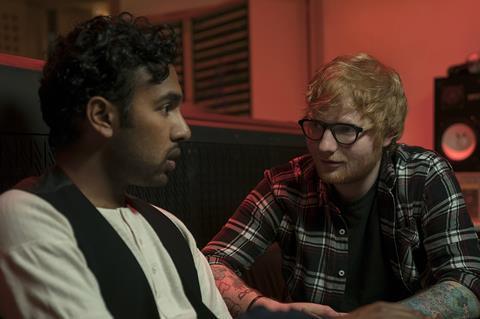
As the memes that have proliferated on Twitter in the week since its release indicate, Yesterday is far more interesting and resonant as a conceit than it is as a movie. You can understand why Danny Boyle, seven years on from orchestrating an Olympic opening ceremony that unified a sceptical Britain through pop culture, might have been attracted to a project inviting daydreamers everywhere to join its protagonist in wondering "where did that go?"; the film is very much a retreat into the gentle, generally harmonious England of screenwriter Richard Curtis, a creative we might think of as decidedly pre-Brexit. The problem is that Boyle's films are at their best whenever they're inhabiting the moment, hotwired into the present tense, rather than sidestepping gingerly around it: it's why Trainspotting, hammering down Princes Street to the strains of "Lust for Life", was a thousand times more compelling than its 2017 sequel, guardedly looking over its own shoulder. That plugged-in Boyle can be witnessed at points in Yesterday: in the first act's Beatles-erasing global power outage - blacking out the Tube, a baseball game and a Korean news broadcast - which plunges us into some bewildering communal experience, and changes the way the whole world turns; and in a few shots late on, apparently grabbed on the hoof at what looks like an actual Ed Sheeran gig. What falls in between, however, only demands that Boyle meekly spins the wheels of plot: learning of the Fab Four's non-existence from pals who prove such prototypically Curtisian dimbulbs you wonder whether they'd have heard of the Beatles in any event, struggling singer-songwriter Jack Malik (Himesh Patel) ransacks the canon and becomes an overnight superstar, bigger than John, Paul, George and Ringo combined. Like I said, it's a great idea.

As a film we're paying to see, however, Yesterday has major issues. Foremost among these is musical: having prised the songs from Apple for a king's ransom, Boyle doesn't appear to have the budget left to do anything much with them, save to use them to cue lame gags ("It's the guitar - it has to gently weep more") and scene after scene of Curtis-formula sappiness. For a while, I was happy to play along, admiring how Yesterday had alighted upon the one group this premise would truly work with: it wouldn't with the Stones, who were always the end of something rather than a beginning, and the disappearance of any lesser group would only yield varyingly indifferent shrugs (or cheers, if it were Kasabian). The limitations become clear with each cosy interlude, trivial sidebar and televisual set-up. Arriving on the heels of May's Rocketman, which likewise failed to match its inspiration's imagination, Yesterday made me wonder whether a decade of austerity has finally crippled the British film industry, as it has almost everyone else. The film's visual poverty bottoms out with a recreation of the Beatles' fabled rooftop gig of 1969 in which Jack emerges onto the roof of... a hotel in Gorleston, attended by a smattering of extras who may as easily have been queuing for ice cream. There may be another culprit, again a decade old: 2008's Mamma Mia!, not just a piece of crap, but a piece of crap that fouled up the movies' longstanding relationship with music. That desperate pro-am karaoke sesh posed the question "will this do?", and the gathered masses, giddied by the prosecco cinemas had started to sell with an eye to making bad movies seem tolerable, hollered resoundingly in the affirmative. Thus: the B-sides of Mamma Mia! 2, the artless lipsynch of Bohemian Rhapsody and Rocketman, and now Yesterday's limp covers. Facing renewed threat from rival media, the movies give in to a glorified fan service comparable to Netflix's algorithms, routinely doling out what we know and love, without anything extravagant in the way of repackaging. It'll do. It'll have to do.

Anecdotal evidence would suggest Yesterday has so far done just fine for less demanding crowds, and there are elements that function here. Boyle retains the wisdom to deploy Sheeran (playing himself) as a sight gag from the minute he turns up on Jack's doorstep resembling a squashed gonk - living proof this world is so random and chaotic that just about anyone can become the world's biggest pop star. Patel has a nice variety of bemused and baffled expressions, in accord with someone who wakes up one day to find themselves sitting on a goldmine. (There's the hint of subversion in the fact these songs should have been appropriated by a British-Asian lad, but the script never backs it up: it's an idea raised in casting, then forgotten about.) He also sings the songs, albeit in that bland troubadour style that is very 2019 and not terribly Beatles; having inherited the original idea, most of the movie's creative energy has been expended on imagining what would happen if some of the world's greatest tunes were converted into the kind of MOR fodder trotted out by hack musicians to accompany corporate ad campaigns. It takes the sad songs, and makes them worse. Nothing in James Corden's cameo explains how Frank Harper's wastrel son in TwentyFourSeven wound up becoming a US primetime sensation - there may be a Curtis script in that - and Yesterday is consistently awful around its women: Simperin' Lily James as the manager-pal who only realises she loves Jack after he becomes successful (much as we realise, if we hadn't already, that Curtis has some pretty fucked-up ideas about women and fame), and a miscast, mirthless Kate McKinnon as a representative of all those dead-eyed suits who made the deals that brought Yesterday into something like existence. Given the context, couldn't Curtis have paired his hero with a Yoko or Linda Mac, someone with some kind of inner life, who could have pointed up how the Beatles were as much influenced as influential?

That would, of course, require more of the complication one key character talks about late on in Yesterday - that the movie be about more than just a bloke remembering Beatles songs for the benefit of that sizeable demographic of baby-boomers who also remember Beatles songs and have considerable money to burn. The rest of us can at least count our blessings that an idle fantasy as flimsy and (ironically) as forgettable as this overwrites nothing: in our reality, we still have A Hard Day's Night, Yellow Submarine, The Hours and Times, Backbeat and countless other cinematic reminders of why the Beatles mattered (and still matter). Anyone who had the misfortune to sit through The Boat That Rocked and About Time should know Curtis is no longer to be trusted around music and high concepts. The real disappointment here comes from watching Boyle, a filmmaker who once served as a standard bearer for the unconventional, exhilarating and new, succumbing to the conventional, excruciating and naff: in a film bound up in string theory and besieged by butterfly effects, Yesterday's final montage, set to (gulp) "Ob-La-Di, Ob-La-Da", suggests what would have resulted if Boyle had made a complete horlicks of that Olympics opener - or if he'd revealed himself to be the less-than-mastermind behind the notoriously toecurling 2012 closing ceremony, that cavalcade of faux pas during which we should, perhaps, have started to feel the tectonic plates of the United Kingdom shifting uneasily. Signing on for Bond, now this: I do hope one of our erstwhile young gunslingers isn't about to draw out his career by becoming British cinema's foremost embarrassing dad. We've got one Stephen Frears already; that feels quite enough.

Yesterday is now playing in cinemas nationwide.

Tuesday, 9 July 2019

The old curiosity shop: "In Fabric"


To observe that Peter Strickland's is a cinema of fetishes is to understate the extent to which all cinema is a cinema of fetishes. Still, few working filmmakers have been so brazen in centring those fetishes so: think back to the obsessively curated sounds of 2012's Berberian Sound Studio or the butterflies and role-playing of 2014's The Duke of Burgundy. To these, Strickland's latest In Fabric will add a killer red dress, plus several more elements dredged up from the darkest, dustiest recesses of this filmmaker's imagination. The characters here talk as we talk in 2019, yet they inhabit a space that appears inexorably tied to a formative moment in the 46-year-old Strickland's life. We see, in no particular order, a landline telephone (which prompts a further Proustian jolt as its owner answers a call by reciting the full eleven-digit number); green flock wallpaper; personal ads directing interested parties to P.O. box numbers; and foursquare television sets carrying trippy ads for a local department store. As has been noted elsewhere, Strickland's work has a close kinship with hauntology, that very modern science in which discarded artefacts and recordings are scoured for proofs of how we used to live; before a single drop of blood is shed, In Fabric is possessed of that spookiness that follows from stumbling across the long lost or abandoned. The characters - lonely divorcee Marianne Jean-Baptiste, young newlyweds Hayley Squires and Leo Bill - come and go. The dress - crimson-red, with an invocation in Latin stitched into the hem - will be all that survives of them.

The perversity in this redesign of the heritage (or, if you prefer, costume) drama stems from the much-travelled Strickland's ability to mesh the very English with the somehow most un-English. (In Fabric is the only film in existence to bear the closing credit "Shot in Croydon, Reading, Budapest and Visegrad"; Strickland's passport alone would make him an interesting filmmaker to have around at a moment where loud questions are being raised about our national identity.) As for the former, look to the film's fond evocation of a 1970s-era department store, which - with its bespoke wrapping papers, pneumatic tube system to carry change and overly attentive staff - would surely have seemed the height of high-street sophistication around the time of Are You Being Served?. (It's a film that recognises you and I are witnessing the fall of the House of Fraser, and that we just don't get the same experience walking into a Primark or TK Maxx.) There's something uniquely parochial about the bug-strewn restaurant Jean-Baptiste visits on dates, the passive-aggressive meetings she's corralled into by her work superiors (Steve Oram and Julian Barratt, with especially unnerving teeth), and a sequence of lads-night-out awfulness that can only end in a big pool of carroty vomit. Most directors are stuck in adolescence or some other version of the past, dreamers who haven't ventured all that far from the bedrooms in which they first plotted how to remodel the world. Strickland's Thames Valley-on-Thames creeps into view before us as a shitty Brigadoon, left untouched by either the cold, hard collateral of the Thatcher years or the cheerier gentrification of New Labour: a land that time appears to have forgotten, it is, in every sense, another country.

More exotic are those collaborators this director has picked up on the travels around Europe that began with 2009's Katalin Varga. First among equals here: the Romanian actress Fatma Mohamed, playing the role of shop clerk-cum-sorceress, who would appear to find it impossible to say or do anything with any degree of normality, and may as a result be the most fascinating figure in any film presently on release. (Like a distaff equivalent of the similarly maquillaged Robert Blake in Lost Highway, you cannot take your eyes off of her, and worry what would happen if you did.) Yet there's also a small army of behind-the-camera tech whizzes, again sourced from Eastern Europe, who work overtime to ensure nothing about In Fabric looks or sounds quite as it would in, say, a Working Title production set in the 1970s. These outsiders, doubtless less familiar with Mollie Sugden and Wendy Richard than they would be with Harry Kümel's Daughters of Darkness, help Strickland to equip the film with unexpected flourishes in production design and cinematography, and there again on the soundtrack. Why is it that the outgoing message on the Jean-Baptiste answerphone has been recorded by a woman in evident distress? Why does the department store's emergency broadcast feature somebody cackling malevolently? How can the thoroughly rational British film industry have spawned a creative whose choices are so persistently, deliriously irrational? (This may have been the question asked of Michael Powell around the moment he unveiled his Red Shoes.)

Strickland still presents as a bit of a knobtwiddler himself, which may explain why his has become a cinema especially beloved of blokes: it's full of those arcane concerns men habitually mothball away in that headspace where their emotional intelligence ought to go. Too much of this beardy squirrelling can seem unhealthy: I found The Duke of Burgundy rather like being cornered in an attic by an uncle keen to expound upon his collection of vintage lesbian erotica, and thus spent much of it longing for fresh air and cleansing sunlight. Here, however, he does a far better job of turning the dial and locking onto that frequency where the funny-strange becomes indistinguishable from the funny-ha ha. The casting keeps it lively: it's amusing that the diminutive Jean-Baptiste should find her home invaded by her son's Amazonian life-model girlfriend (Gwendoline Christie, from Game of Thrones), and seasoned comedy players Oram and Barratt have their oddball schtick down to a wonky tee. Yet they're drawing on a filigreed script that invents its own language - florid in places, gnomic in others; the contrast alone draws a laugh or two - and appears capable of a wry autocritique, recognising the limits of the cataloguing approach. The line "what I'd give to know what goes on in the male mind" cues only a droning monologue on the workings of washing machines that sends anyone in the vicinity to sleep. We've all known men like that; hell, we may even have been that man at some point.

Somewhere in the back of In Fabric's mental warehouse, there lurks the idea that material goods (possibly capitalism en tout) can be a deadly business - lethal, when not plain boring. It's visible in the shot of excitable consumers lining up outside the store's doors in the early hours to be greeted by the satanically wild-eyed manager we've just seen sexually pleasuring himself over one of his mannequins; there again in the vicious fistfight that breaks out between two women of a certain age over a particular sale item. (Here, Strickland seems to realise that Black Friday would chime favourably with the works of Mario Bava.) Yet that may be too lend too much sociopolitical import to what is, ultimately, another solidly tongue-in-cheek addition to a determinedly cult filmography. I remain in that minority who maintain Strickland lost something after Katalin Varga, which operated in a more sincere mode, when the nature of the domestic film business required he come indoors, work on sets, and watch the go-for-the-throat wildness that made his debut so arresting tail off into cultivated eccentricity. Still, he's never abandoned his craft, nor his attention to detail; there's both consolation and pleasure to be derived from In Fabric's lovingly tailored pastiche. Strickland knows how to dress these fetishes up, and how to air them out when necessary, and there are moments - usually involving that dangerous red chiffon billowing in the night - when In Fabric strikes the eye as an uncannily fetching object.

In Fabric is now playing in selected cinemas, and streaming via Curzon Home Cinema.

Monday, 8 July 2019

1,001 Films: "Au Revoir les Enfants" (1987)


After a run of American films that included the now-canonical Atlantic City and My Dinner with Andre – followed, in turn, by the less successful Crackers and Alamo Bay – Louis Malle returned to his native France in the mid-1980s, where he set about producing his most autobiographical work. An account of the writer-director’s experiences during 1943-44 at a Catholic boarding school in Fontainebleau, 1987’s Au Revoir les Enfants would be Malle’s attempt to reconnect with his own heritage, and his country’s troubled past.

Reissued this week to mark the global Holocaust commemorations, the film retains the look of a highly personal confession: a careful outpouring of emotions that – as the debate surrounding the release of Lanzmann’s Shoah two years earlier had suggested – were still, four decades on from the war’s conclusion, being processed. It remains one of those rare occasions when a filmmaker could truly lay claim to being the voice of their generation.

That it became Malle’s biggest success worldwide is doubtless attributable to school’s status as a universal rite-of-passage: it should still strike chords with anybody whose little face lit up at the sight of a dog on the loose in the playground. Malle depicts the beatings and bullying that went on between the bombing raids that forced him and his contemporaries into the school’s basement, but also a good deal of boyish bonhomie; his interest resides in the shelter the school provided young minds and bodies, and how – like the rations the pupils shared between them – it could ultimately stretch only so far.

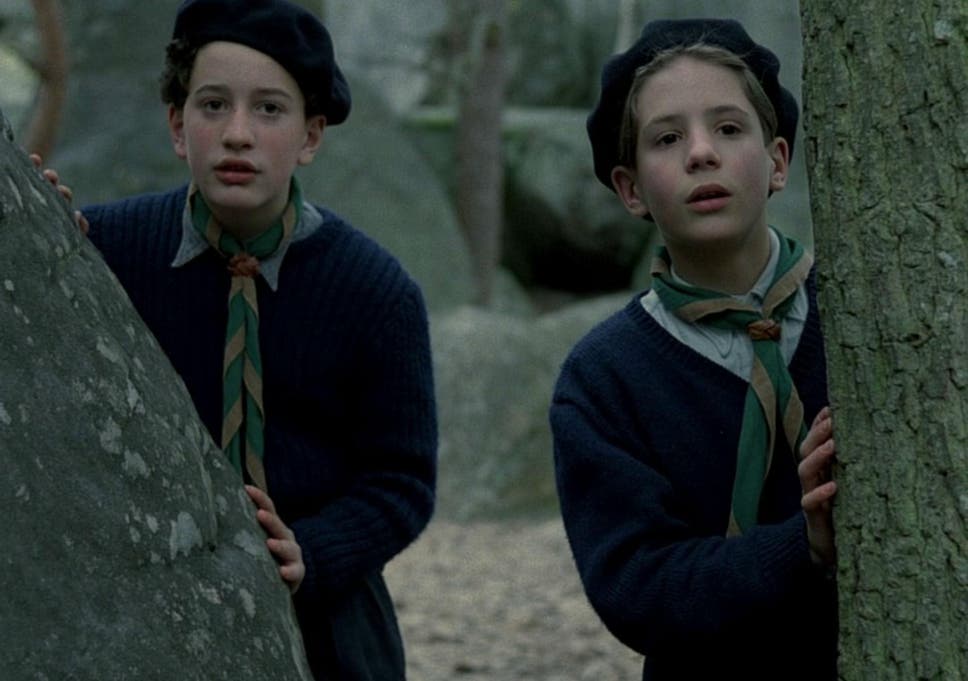
At the film’s centre is the rapport rich kid Julien (Gaspard Manesse) – the Malle surrogate; he has his homework marked as “intelligent, but a bit pretentious”, which sounds exactly the sort of evaluation a budding filmmaker would receive – strikes up with curly-haired newcomer Jean Bonnet (Raphaël Fejtö). The two boys bond over a shared love of reading, “The Three Musketeers” their preferred text, only to find Vichy France isn’t entirely receptive to Dumas’s one-for-all, all-for-one credo, after Julien discovers his pal was actually born Jean Kippelstein, and that le jeune Bonnet has been keeping something under his hat.

Shot by Renato Berta in sombre tones that do much to evoke the years of austerity, the film treats Kippelstein’s Jewishness as a rather more contentious form of the contraband the boys squirrel away from their keepers in the school’s mouldering brick walls. Malle never labours his points – the film remains more coming-of-age pic than historical tract – and even when Julien sees Jean playing the piano (for a young Irène Jacob, as the school’s music teacher) and apparently drawing upon a deep well of sadness, our hero can’t quite put the pieces together. (“Arse licker” is his considered response.)

We do, however, gain a palpable sense of the encroachment this period entailed: personal space comes to be broached, secrets dragged into the cold light of day. Joshing German soldiers populate the local bathhouse; Vichy officers storm an upmarket restaurant; by the final act, the Gestapo are storming the classroom, and rearranging the map of Europe. Much of it has the feel of vivid, formative lived experience. The scenes depicting Julien’s fear upon being abandoned in the woods during a treasure hunt, and his joy upon discovering Chaplin, are composed of sights and sounds Malle clearly couldn’t forget easily.

Though the school often appears like a microcosm of the wider country – notably during the last-reel betrayals (“C’est de la guerre, mon vieux”) – the perspective throughout is that of an uncommonly mature schoolboy: Julien and classmates have opinions on everything from the pin-ups they’ve swiped from their brothers to whether Laval has sold France down river, and even the smokers behind the bike sheds are discussing Bergson. Malle knew what wartime does to innocence, and Au Revoir les Enfants stands as his own, powerful testament of youth: an acknowledgement one was forced to grow up regrettably quick back then.

(MovieMail, January 2015)

Au Revoir les Enfants is available to rent via Amazon Prime.

Friday, 5 July 2019

For what it's worth...


Top Ten Films at the UK Box Office 
for the weekend of June 28-30, 2019:

1 (1) Toy Story 4 (U) ***

2 (new) Yesterday (12A) **
3 (2Aladdin (PG)
4 (3) Men in Black International (12A)
5 (7) Casino Royale - Secret Cinema (12A)
6 (re) Avengers: Endgame (12A) **
7 (4Rocketman (15) ***
8 (new) Apollo 11 (U)
9 (6) The Secret Life of Pets 2 (U)
10 (8) X-Men: Dark Phoenix (12A)

(source: BFI)

My top five: 
1. Don't Look Now [above]

2. Article 15
3. Mari
4. Spider-Man: Far from Home
5. In Fabric


Home entertainment Top Ten (DVD/Blu-Ray/Download): 

1 (new) Fighting with My Family (12)

2 (2) Cold Pursuit (15) **
3 (1) How to Train Your Dragon: The Hidden World (PG)
4 (6) Toy Story (U) *****
5 (9) Toy Story 3 (U) ****
6 (13) Toy Story 2 (U) *****
7 (20) The Kid Who Would Be King (PG) ***
8 (7) Aquaman (12)
9 (15) Spider-Man: Into the Spider-Verse (PG) ***
10 (11) BumbleBee (PG) ***

(source: officialcharts.com)

My top five: 
1. Ash is Purest White

2. The Hole in the Ground
3. The Kindergarten Teacher
4. Loro
5. If Beale Street Could Talk


Top five films on terrestrial TV:
1. Memento (Saturday, BBC1, 12midnight)
2. The Emperor's New Groove (Sunday, C4, 2.30pm)
3. The Master (Thursday, C4, 1am)
4. Ruby Sparks (Friday, C4, 1.05am)
5. Wanted (Friday, ITV, 11.05pm)

"The Queen's Corgi" (Guardian 05/07/19)


The Queen’s Corgi **
Dirs: Vincent Kesteloot, Ben Stassen. Animation with the voices of: Jack Whitehall, Julie Walters, Tom Courtenay, Sheridan Smith. 85 mins. Cert: U

Is this a sign of things to come? The premise of this animated screenfiller has been locally sourced: these are indeed the misadventures of one of Her Majesty’s pluckier and more resilient canine companions. Much of the action thus takes place in and around a functionally rendered Buckingham Palace, complete with photorealistic Liz-and-Phil (in Union Jack slippers). And yet a cursory glimpse at the credits reveal that most of the key creative personnel – headed by directors Vincent Kesteloot and Ben Stassen – are unmistakably… Belgian. At risk of drifting towards protectionism, is there no-one on this side of the North Sea who could digitise a few poop gags for tuppence-ha’penny? Or would that bring the animators responsible perilously close to charges of treason?

Since 2008’s Fly Me to the Moon, Stassen’s Brussels-based nWave studio has generated cheap and cheerful product for harassed parents to make do with if the Pixar’s sold out. Corgi’s script, by Gnomeo & Juliet scribes Rob Sprackling and Johnny Smith, affords this team a handful of goofy ideas to play with. Protagonist Rex (voice: Jack Whitehall) is exiled after disgracing himself while resisting the aggressive advances of President Trump’s female corgi; on Poverty Row, he falls into an underground fight club overseen by a hulking mastiff inevitably called Tyson, and lent Ray Winstone’s booming tones. Upon the latest mirthless rehash of the rules of a now 20-year-old David Fincher film, you realise this is something like if the first Toy Story had referenced The Conversation or Harold and Maude.

That both developments raise the spectre of assault reflects the absence of that safety testing present in more sophisticated animations. Kesteloot and Stassen are too busy scrabbling for content – basically fine, largely indifferent, sometimes misjudged – to fill the gaps between frenetic setpieces. Any semi-original flourishes are outnumbered by secondhand bits of business: while a passing trans character strikes the eye as progressive, the accompanying “queen” joke dates from roughly 1973. Everything cancels itself out. The voice cast at least ensure the whole falls at the livelier end of tat: Winstone seems to be having fun in the recording booth, and there’s a certain novelty in hearing Prince Philip talk like Tom Courtenay. If they bother with a sequel, they should stick him in a Range Rover.

The Queen's Corgi opens in cinemas nationwide today.