Friday, 14 September 2012

"About Elly" (Moviemail 14/09/12)


Though it emerges in the UK after A Separation, About Elly… is the film Iranian writer-director Asghar Farhadi completed immediately prior to starting work on that award-winning opus. If the later film dropped us into a warzone from the get-go, the tactics Farhadi deploys here are altogether more lulling. It begins as ensemble drama – a Farsi Big Chill, if you like – as a group of extended family and friends rent a villa for a weekend away by the sea. Initially, it’s all drinking and clowning around, charades and volleyball, as Farhadi hones in on the contrasting personalities of the two women at the group’s centre: spirited young mother Sepideh (Golshifteh Farahani) and her reticent acquaintance Elly (Taraneh Alidoosti), a teacher back in Tehran who, despite efforts to matchmake her with a fellow guest, appears weirdly isolated, even before the incident that brings the fun and games – joltingly, shatteringly – to a halt.

What we’re watching is the making of a director who – almost as though in reaction to the slow, observational cinema of Kiarostami, Makhmalbaf et al. – has resolved to pitch himself headlong into situations spiralling rapidly out of control. At pivotal moments here, the previously unobtrusive camera will go rogue, careening alongside those characters now running through the frame, either alarmed or aghast – and you can’t fail to spot A Separation’s striking immediacy taking shape. About Elly… is fascinated with fallout. The group closes ranks and begins pointing fingers at one another; the glowing tans of this utterly convincing ensemble fade to pallid masks, behind which everybody struggles to conceal their secrets; the once-happy holiday home starts to look like the shabby shack it always was; and the sound of the sea lapping against the shore, once so soothing, comes to rub the characters up the wrong way, eroding nerves, patience, their sense of security.

If there’s a difference between Elly and A Separation, it’s that the former is less overtly political. A Separation was in part a study of the system that made it harder for ordinary Iranians to get on with their lives; Elly’s characters are well-enough positioned to get away from Tehran, and they face a tragedy that could happen to any set of people anywhere. At a stretch, you could read the cover-up the group engineers as an indicator of how easily corruption comes to rear its ugly head in this society. (The film begins and ends with a vote, one more crucial than the other.) More often About Elly… operates on or around the same pitch as those screams of quiet horror old Antonioni movies used to give off, faced with our continued inability to really know those around us.

About Elly opens in selected cinemas from today.

"ParaNorman" (Moviemail 14/09/12)


After a summer of by-the-numbers animations, it’s a relief to find one with some underlying creative vision. ParaNorman, which emerges from Laika, the stop-motion whizzes behind 2009’s terrific Coraline, centres on a pre-teen whose best friends are all ghosts, and whose favourite pastime is watching zombie movies – smartly homaged in the opening sequence – with the spirit of his recently deceased grandma. Naturally, Norm’s parents don’t believe that their son sees dead people – “it’s part of the mourning process,” insists Mom – but in the approach to his hometown Blithe Hollow’s 300th anniversary festivities, these sightings are becoming all too common.

Something terrible is clearly about to happen, but the film has a funny way of letting us know: one of the first signs of the upcoming zombie invasion will be a trembling loo-roll dispenser. Alongside the usual knockabout comedy, there’s also a dash of pleasing subtext. It’s down to Norman, with his pluck, resourcefulness and imagination, to lift the curse which has left the town’s residents such dullards; the sharpest gag comes when the zombies, upon their arrival, prove as terrified of the complacency and conformism before their bloodshot eyes as any notionally sentient lifeform is of them. (Blithe Hollow, indeed: what’s the point of returning from the grave to eat brains if there aren’t any on display?)

Cleaving closer to Joe Dante – and TV’s fondly remembered Eerie, Indiana – than it does to Tim Burton, ParaNorman deserves praise for daring to be different. Co-directors Sam Fell and Chris Butler halt the frantic action for a lovely flashback allowing a lonely boy and girl to connect through the ages, and they’ve championed diversity at every possible juncture. It’s there in the voice cast – which extends from indie faves Anna Kendrick and Casey Affleck to Broadway veteran Elaine Stritch and our very own Bernard Hill – and again in their production choices.

Jon Brion’s score ring-fences the melancholy studio executives generally tend to jolly out of their family releases; more cheeringly yet, a late character revelation joins the video for Carly Rae Jepsen’s summer earworm “Call Me Maybe” in suggesting we’re becoming more progressive about the kids we see being represented on screen. Perhaps not for the very young, it’s nevertheless a film sufficiently clued-up to the pleasures of the horror genre to make its motto “there’s nothing wrong with being scared – so long as you don’t let it change who you are”.

ParaNorman opens nationwide today.

"To Rome With Love" (Moviemail 14/09/12)


Anyone hoping Woody Allen would sustain the winning form he hit upon with last year’s Midnight in Paris might do well to dial down their expectations going into To Rome With Love. This latest, one of Allen’s occasional short-story compilations, tells four tales set in the Eternal City, and settles for a 50-50 hit-to-miss ratio, where Midnight got up to 60-40. It’s one for the fans, who’ll be able and keen to spot the themes its creator is turning over and, in some instances, outright restating; we’re firmly in Allen’s roadshow phase, where each film performs a version of the director’s greatest hits by way of an opening-night gala for international film festivals.

Half of Rome’s strands drift from the memory even as they’re playing out. Roberto Benigni as a nondescript company man who suddenly and inexplicably finds himself subject to the absurd scrutiny that comes with fame is a reworking of Deconstructing Harry/Celebrity-era riffs that scarcely develops beyond idle fantasy. Still, it registers rather more than the farce involving separated newlyweds, the wife lost to the city’s streets, the husband offered lessons in love from a local working girl (Penelope Cruz, addending subtitles to Mira Sorvino’s character from Mighty Aphrodite).

Allen himself makes a welcome screen return as the conservative father of a young woman (Alison Pill) who’s fallen for an idealistic union rep: it’s the objectionable business involving Rachel McAdams’ parents in Midnight in Paris approached from a new and broader-minded perspective, with the great Judy Davis as Allen’s wife and far better jokes. (Not least one of the funniest slow-burn pay-offs of Allen’s late period, as his retired opera director realises his Italian opposite number sings like Pavarotti, but only in the shower.)

The most completely realised of the stories has architect Alec Baldwin see something of his younger self in naïf Jesse Eisenberg and – like a Jiminy Cricket with superior hair – begin life-coaching the boy as he’s tempted away from girlfriend Greta Gerwig by the latter’s flaky actress pal Ellen Page. Allen is getting at something here about the benefits of hindsight and experience, and though he squanders Gerwig, he affords Page a memorable neurotic episode as she contemplates the sexual possibilities of her upcoming project. (The usual caveats about late Woody and his female characters apply.)

That these latter strands require no subtitles, and could be redrafted to play out anywhere in the world, is the biggest giveaway the new film is even less engaged with Rome than its predecessor was with Paris, but it’s clear some lessons are being taken from these wilderness years, particularly about casting: Pill’s thousand-kilowatt smile and Eisenberg’s nervy shrugs lend a certain pep to the middle-to-bottom drawer material. Another minor work, then, which makes the 112-minute running time something of a liability as its jokes and other pleasures are driven into the ground – but those clutching to these thin Woody straws might be reassured there are still jokes and other pleasures to be driven there.

To Rome with Love opens in selected cinemas from today.

"Keyhole" (Moviemail 14/09/12)


The films of the lo-fi Canadian maverick Guy Maddin once aspired to the qualities of silent melodrama, in part because this director didn’t have the resources to make anything else. Maddin has moved on since then – a little, at least. Keyhole offers a phantasmagorical mash-up of studio-era crime and horror tropes: it’s The Desperate Hours in The Old Dark House, though there are equally traces of David Lynch and The Tempest in the mix, and nothing is deemed too far out there to be absorbed. In the crime movies of the studio golden era, the family home was almost always a neutral venue, but Maddin’s house refuses to co-operate with its occupiers – the gang of bank robbers holing up during a storm, awaiting their leader – instead assuming a weird life of its own.

Arriving late with the blind girl he’s rescued from drowning, tough guy Ulysses Pick (Jason Patric) promptly hears the voice of our ghost narrator, informing him that his wife Hyacinth (Isabella Rossellini) is being held captive on the building’s top floor. Non-supernatural features coming between the couple include an outdoors-indoors suite, where the rain lashes down and characters go to die; yet each new floor unleashes a whole new set of skeletons to rattle around. Only an exorcism – or a big skip – might sort this place out; instead, Udo Kier turns up after half an hour to treat us to a monologue about wasps.

The temptation is to shake one’s baffled head and write the whole thing off as an extended madlib, but it’s never boring, replete as it is with copious, pan-generational nudity, layered, almost subliminal imagery, most but not all of it phallic, and the use of the game Yahtzee as an analogue for self-gratification. The choicest cameo comes from the one-armed man getting his stump licked by an especially willing maid, though the wild-eyed, thick-bearded fellow condemned to pound a nail into a wall for all eternity runs him a very close second.

Again, it is possible just to marvel at Maddin’s ability to mount this kind of unpitchable, committee-proof vision on what is evidently a limited budget: even the insertion of “proper” actors like Patric and Rossellini into his universe hasn’t made the films any less niche. Set against the director’s best work – Careful (1992), Dracula: Pages from a Virgin’s Diary (2002) – this particular vision is cluttered and slapdash, and may only be fully comprehensible to Maddin himself, but it’s possible it might just tickle you somewhere about your person. For best viewing, you may want to enter the cinema as though it were open night at an underground filmmakers’ co-op circa 1966. Told you Maddin had moved on a little.

Keyhole opens in selected cinemas today.

"Premium Rush" (Metro 14/09/12)


Premium Rush (12A) 91 mins ***

Post-The Dark Knight Rises, the campaign to turn the likable Joseph Gordon-Levitt into a bona fide leading man shifts up a gear. The much-anticipated Looper arrives in two weeks; first, there’s this pedal-to-the-metal actioner in which Gordon-Levitt plays a cocky Manhattan bike messenger heading rapidly for a fall. Wilee (“like the coyote”) is having a bad enough day trying to salvage his relationship when a nervy client hands him an ordinary-looking envelope. Not ordinary enough, alas: soon he’s being pursued by a car containing the ferociously beep-beeping Michael Shannon, a dirty cop whose eyes are set very firmly on our boy’s package.

Savvy writer-director David Koepp – he penned Jurassic Park and Spider-Man – treats it as a live-action cartoon, scrolling the clock around and cutting to satnav-vision in a bid to maintain maximum velocity. He’s cast actors you’d want to keep up with: railing against backpacks and bad language on TV, Take Shelter’s Shannon is just having a blast here. The film’s essentially BMX Bandits with some Red Bull in the tank – that tame 12A is about right – but it’s still wise to the pleasures of watching a hero flat-foot his pursuers with a well-timed bunny-hop. If Messrs. Hoy, Storey and Pendleton hadn’t done enough to make cycling seem sexy, this might well do the trick.

Premium Rush opens nationwide today.

Wednesday, 12 September 2012

Not much cop: "The Sweeney"


Nick Love's big-screen update of the old TV cop show The Sweeney starts as it means to go on: with a frustrating hint of the original's marvellous singalonga theme tune (inevitably, there's a junky drum-and-bass version over the end credits) and two cars full of coppers rating women out of ten. Even the female officers join in, and nobody under discussion is getting more than a six. In Love's Sweeney, the women are encouraged to be as tough as the men, because they're part of "the force", and you need the force to be at least as tough, if not more so, than the nasty sorts they're dispatched to take down. This mob are facking hard-as, in every respect. "I got a hard-on," guffaws one of the troops, as he charges into battle, fully tooled-up. The punchline of the ruckus they're heading to sees Ray Winstone's Jack Regan, old-school yardstick of tough, punching through a wall to throttle his quarry: "We're the Sweeney, shithead: you're nicked." That's hard.

Hardness, of course, is exactly what we need in cities where there are such sociopaths as Jean-Charles de Menezes and Ian Tomlinson careening around; let's face it, The Sweeney posits, hardness is what you want, innit, you slaaaaaag. When he's not out putting the choke on nonces and blaggers, big Jack is wooing a colleague (Hayley Atwell), who just so happens to be married to the posh bloke in internal affairs who's been trying to shut Regan's department down on the grounds of disproportional hardness. I say wooing; what this relationship involves in actuality is grappling sex in pub toilets, 'cos Regan's a REAL MAN who knows how to treat a bird proper, like. (I couldn't see any evidence in the credits, but Ms. Atwell must surely have been structurally reinforced with concrete for these scenes, given the bulk bearing down on her. Wallop? Bosh.)

More so than any Merchant-Ivory period movie, The Sweeney has a chip on its shoulder about class that you don't have to be a member of the Bullingdon Club to find weird indeed. You see it in the decision to have Old Etonian Damian Lewis Cockney it up to play Regan's generally sympathetic superior, who has to apologise, come the finale, for ever doubting Jack's methods; and again in the decision to give further exposure to tubby, charismaless street urchin and part-time cider flogger Plan B, who - as a big-screen idea - just isn't working. His sullen Carter, who Winstone's Regan seemingly keeps around just to make his knuckle-first methods of detection look a little smarter by comparison, cues a hitherto unheard-of reaction: making the viewer pine for Dennis "writes the theme tune, sings the theme tune, moans about the script, turns apologist for wifebeaters" Waterman.

The film has one fallback in the sheer, undeniable, unavoidable presence of Winstone, who's able to bare-handedly rip the nuances from the grunts Love and John Hodge have written for him ("How you doin'", "What a cunt") the way other actors do with the words in Aaron Sorkin monologues. And you sense Love getting to live out a lads' fantasy in taking over Trafalgar Square for a morning and having everyone run around with guns for a bit. Mostly, though, his film is lazy and unambitious, more or less exactly the picture you had in your head when you first heard Nick Love was directing an update of The Sweeney. 

Compare it to the Michael Mann films it wants to be - which offset their thick-ear cop business with rich strains of melancholy and philosophy - or the recent Polisse's questioning of the role our forces must now play in society, and it strikes you as so much silly posturing: the work of men who want their 70s glory days back, found the irony of TV's Life on Mars a bit on the poncy side, and spend their afternoons in the boozer waiting for The Professionals to replace On the Buses on ITV4. Heaven knows they're out there, and heaven knows The Sweeney has been made for them, not me. But even at the time of 2007's Outlaw and again around 2009's The Firm, I used to think Love was a good director stuck with unworthy material, resigning himself to giving a certain audience what they want. With each film he signs off on, that opinion is going daaahn: The Sweeney is a four at best.

The Sweeney opens in cinemas nationwide today.

Saturday, 8 September 2012

1,001 Films: "Lola Montès" (1955)


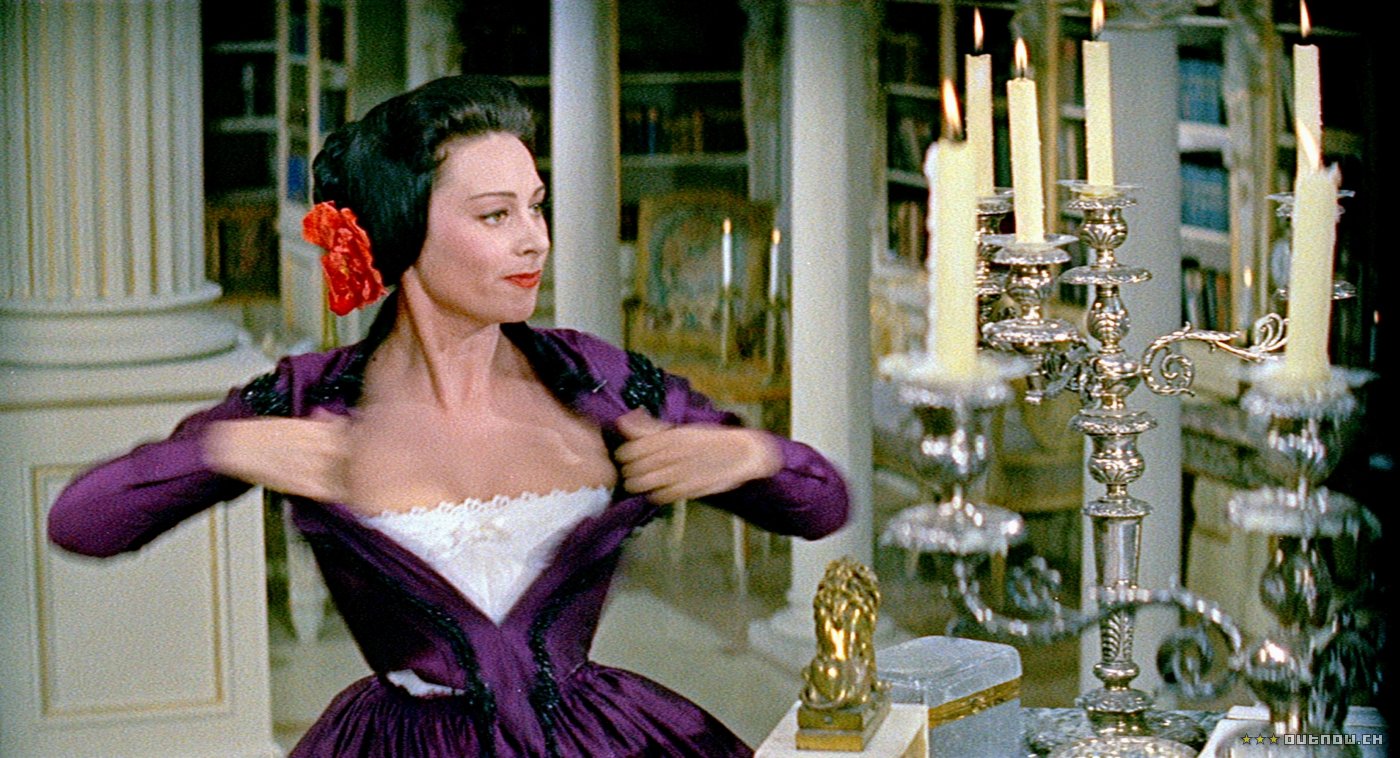
Lola Montès is a treasure, long thought disfigured, from a time when the movies were still aspiring to be the greatest show on Earth. At its heart sits the eponymous 19th-century actress and socialite (the very lovely Martine Carol), first observed as a numbed presence in a touring circus overseen by ringmaster Peter Ustinov, answering questions from the audience on the subject of her romantic and sexual misdaventures. An early flashback finds Lola loving and leaving Franz Lizst (Will Quadflieg), thus establishing the high artistic calibre of her conquests; elsewhere, she's carted off by the Cossacks (painful) at the behest of the Russian count who's become obsessed with her; she proves so overwhelming she causes a Turkish wrestler to lose his first bout ever; and eventually she ends up fomenting revolution in Bavaria after tempting Ludwig I (Anton Walbrook) from his wife. As the show goes on, it becomes clear that the woman who gave her body to so many may be, as a doctor observes, "worn out before her time", and might not be around for the encore.

You might read it as a cautionary tale, then, except - up until its final moments - the film, the final screen credit of the great director Max Ophüls, never feels like it: it's alive, all-embracing, unfailingly passionate. Ustinov sets the tone when first offering Lola her own spot in the show: "We'll show everything women dream of doing, but don't dare." Lola's sexuality is presented as transgressive - she tears off the dresses that would corset her - and celebrated as a vehicle for one woman's social mobility. Its sister film would be Renoir's French Cancan, another jouissance only recently restored to its former glory: both films seek to imbue an innately theatrical set-up with a certain worldliness and life-wisdom (who better to serve as a ringmaster than Ustinov, that anecdotalist and bon viveur par excellence?), and viewing them back-to-back, one might see how the European cinema of the 1950s came of age.

Ophüls uses curtains, frames-within-the-frame and lens trickery to illustrate the constraints his heroine rubbed and pushed against - key production design: the staircase wrapped around an aviary of caged birds - but he uses sound (and Georges Auric's score, in particular) to open the film out. Lola is a melody everybody's trying to nail down, and Carol, playing her from debutante to rueful middle-age, gives a supremely skilful performance, asked to act, ballet dance and tightrope-walk both literally and figuratively in keeping sympathetic a character one might otherwise find infuriatingly flighty. Upon its first release, producers perturbed by the film's intricate structure hacked away at it, reducing the cathedral Ophüls built for his heroine to rubble; the recent restoration, however, reveals Lola Montès as way ahead of the curve on celebrity, and apt for appropriation as one of cinema's most essential feminist texts. The downer conclusion looks to be heading into Thelma & Louise territory - apparently setting up a final leap into freedom - but the very last shot is pure Peter Greenaway, unsparing and hopeless in its pageantry, as Lola gives herself up to men and commerce once more, this time perhaps for good.

Lola Montès is available on DVD through Second Sight.