Friday, 7 September 2012

"A Night in the Woods" (Guardian 07/09/12)


A Night in the Woods (15) 82 mins ***

Another week, another found-footage horror. This good-looking, creditably tangled Brit entry benefits from a better-than-average jolt-count and rigorous, dirty-fingernails acting from Scoot McNairy (Monsters) and Anna Skellern as a troubled couple – he’s a garrulous Yank, she’s a repressed Brit – using their handicams as digital confidants whilst on a camping tour of Dartmoor; an opening title card informs us that the pair, along with Skellern’s cousin Leo (Andrew Hawley), subsequently disappeared. Richard Parry’s film suffers from a certain post-Blair Witch familiarity as the night-vision gets toggled and evidence of a local legend (“the Huntsman”) is discovered dangling from the trees. Yet it’s unusual in using its 80-odd minutes to burrow down into these characters and match their psychic states with the (still underfilmed) location’s physical terrain: one way or another, these relationships will end up on the rocks.

A Night in the Woods opens in selected cinemas today, ahead of its DVD release on Monday.

"Dredd" (Metro 07/09/12)


Dredd (18) 96 mins ***

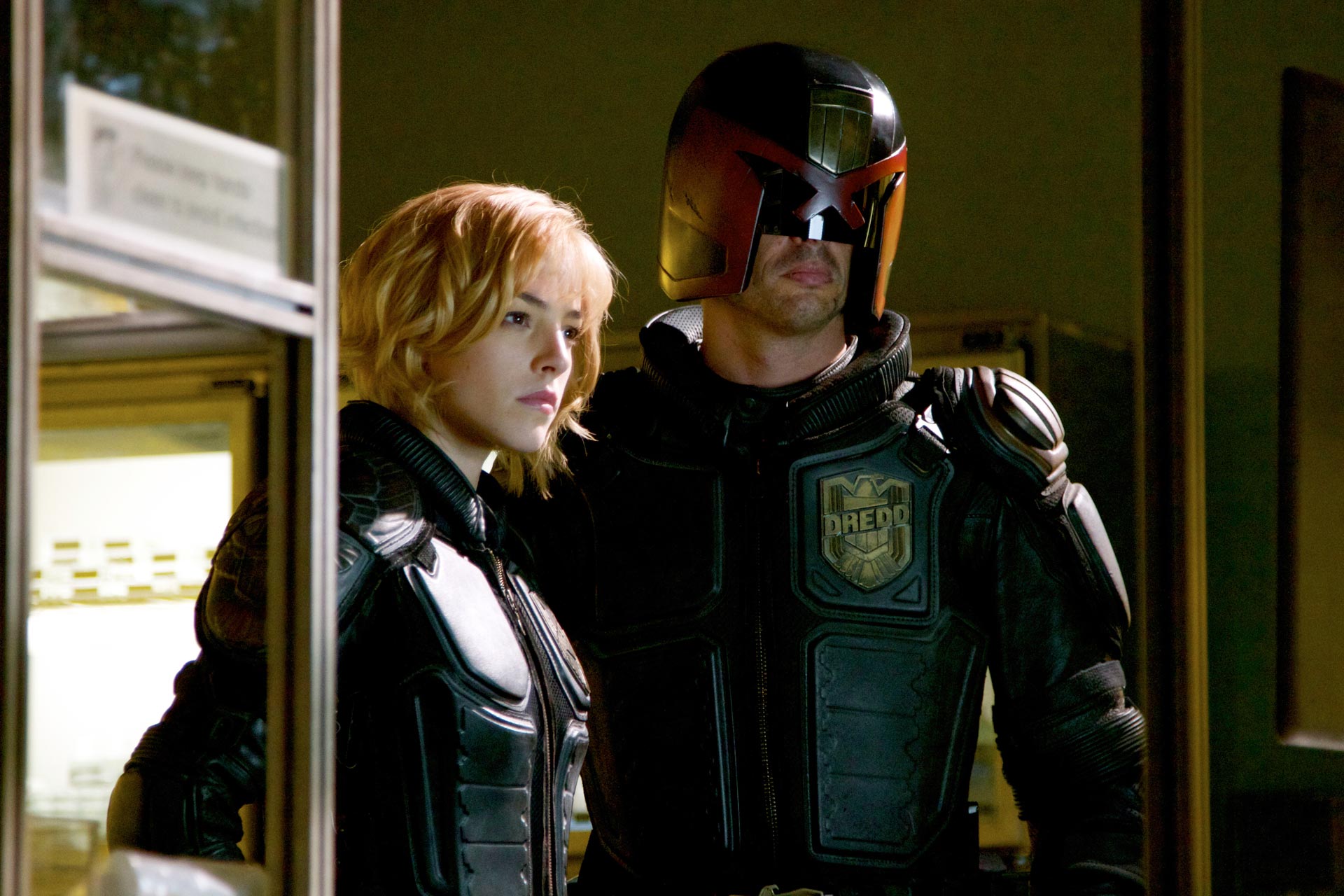
Here’s a turn-up for the comic books. On paper, and even in trailer form, a 3D reboot of 2000AD’s hardnut perennial looked far from promising – this despite the fact it only had to better 1995’s Sly Stallone vehicle, source of countless “Dredd-ful” headlines, to seem worthwhile. Rather than rehashing multiple strands of character mythology, screenwriter Alex Garland and director Pete Travis keep their adaptation appreciably simple. Here, we spend one day in Mega City One, watching the aftermath of a bloody triple murder playing out in a tower block put on lockdown when ruthless drug-pusher Lena Headey decides she’s had enough of the law sticking their helmets into her business.

What follows is something like The Raid redux, as Dredd (Karl Urban’s nose and chin, skilfully suggesting an entire character) attempts to escort a witness from the building, aided by Olivia Thirlby’s ultra-empathetic probie, and hindered by Headey’s many minions. The 96 minutes of agreeably pulpy, shrewdly paced action that follow are further elevated by the dabs of slo-mo beauty cinematographer Anthony Dod Mantle lends to the mounting carnage. Too grungy to count as an unqualified blast, perhaps, it’s nevertheless a very sound franchise-builder, sketching a universe where stories and crimes remain to be investigated. For once, sequels would seem necessary, even welcome.

Dredd opens nationwide today.

"St. George's Day" (Metro 07/09/12)


St. George’s Day (18) 104 mins *

Frank Harper, the burly, charismatic character actor familiar from The Football Factory and Shane Meadows’ earlier films, sorely overstretches himself in co-writing and directing this unreconstructed – actually, scarcely constructed – ladfest, which sees him calling in favours from the stars of every homegrown crime caper of the past 15 years. Those mugs paying to see it in cinemas should be issued with an I-Spy Book of Two-Bob British Gangster Faces to tick off: it’d be more involving than anything in St. George’s Day itself.

Amid an insanely tangled, cooked-up-in-the-boozer plot – cobbling together lost drugs, angry Russians, hooligans, dollybirds, diamonds smuggled in sex toys and, of course, lap-dancing clubs – there’s a perverse enjoyment to be found in seeing Harper and Craig Fairbrass, as bristling cousins, re-enacting the Michael-and-Fredo business from The Godfather on a Tesco Value budget. Still, you’d be happier if the goons and uglymugs reasserting England’s glory over the Dimitri-come-latelies of Eastern Europe didn’t look and sound quite so much like English Defence League canvassers. Jog on, everybody. Jog on.

St. George's Day opens in selected cinemas today.

Thursday, 6 September 2012

1,001 Films: "Smiles of a Summer Night" (1955)


Smiles of a Summer Night is something of a cinematic odd-one-out: far and away Ingmar Bergman's lightest film, it forms a stepping stone between this director's bittersweet early works (Summer Interlude, Summer with Monika) and his outwardly doom-laden mid-period masterpieces (The Seventh Seal, Wild Strawberries). It proceeds from the assumption that everyone always falls for the wrong person, and that every single one of the film's characters - invited to a weekend away in the country - needs to get laid very quickly. Each time two of the film's characters look likely to get it on, somebody makes a thoughtless and passion-killing remark, lips betraying hips, and both they and we are back to square one (or first base).

Bergman displays a previously unseen but entirely welcome silly streak, putting pompous lawyer hero Egerman (Gunnar Björnstrand) in a floppy nightcap and pushing him into a puddle; the heavy sense of Fate evoked in the director's other films is here less a curse than a blessing, as witnessed when the cord wrapped around a suicidal preacher's neck breaks, leading him to stumble across the one woman whose love can save him. It's very fast, often very funny, quite sexy, and easily the most quotable of all Bergman movies, with lines as finely honed as Shakespeare's ("you have that perfection which perfection lacks", "a gentleman does not face a rival deprived of his trousers"), nestling alongside an early mission statement from a filmmaker already showing signs of the wisened old man he would emerge as: "I am tired of people, but that does not prevent me from loving them."

Smiles of a Summer Night is available on DVD through Tartan.

Wednesday, 5 September 2012

Space oddity: "Love"


Have you ever wondered what John Carter might have looked and played like if it had been funded by an American alt-rock collective, rather than an overreaching Hollywood studio? (A lone wag pipes up: "no", before conceding "probably better than the original".) Love, a feature collaboration between the group Angels & Airwaves (nope, me neither) and their long-time promo director William Eubank, sets out two suddenly familiar stories: first, a prologue in which a lieutenant in the Civil War is sent to investigate a mysterious apparition in the middle of nowhere, then the tale of a lonely astronaut on the International Space Station, who's reached the point where isolation is beginning to get the better of him. Interwoven with this latter strand are (staged) talking heads with individuals reflecting upon our need for connection - thus leading the viewer, in turn, to wonder how all of the above might relate.

Tinkering with a modest budget in the L.A. equivalent of a garage and back garden, Eubank has a visual style locked down: crafting cosmoses and battlefields you buy completely, Love is - after Gareth Edwards' Monsters - another demonstration of the effects that can be achieved these days with a little bit of money, and a whole lot more care and attention. The soundscape, too, is rarely less than striking, the A&A boys summoning forth the kind of atmospheric audio that makes a match with those moments when we're given cause to ponder the space that exists between us. In fact, Love only starts to wear thin as a sustained piece of storytelling: if John Carter finally had too much going on, Eubank's film often appears to have too little to justify even its clipped 80-minute running time. 

The catalogue-handsome Gunner Wright, as the astronaut, does what he can with the thin dramatic meat floating around in front of him, but he's mostly left to play goo-goo by himself, without the modulation or variation accorded to Sam Rockwell in the not dissimilar Moon; though it provides the answer to some of this universe's mysteries, the closing stretch can't shake off the suspicion that that film, Kubrick's tourbus fave 2001 and possibly even a bit of the beloved WALL-E have been repackaged as an extended emo promo. It's certainly intriguing, though, with sporadic flashes of something bigger and more beautiful besides: perhaps one to file alongside the Pet Shop Boys' It Couldn't Happen Here and Kate Bush's The Line, The Cross and The Curve in the category of weird conceptual offshoots that end up on fans' DVD shelves.

Love opens in selected cinemas from Friday.

The big switch-off: "Shut Up and Play the Hits"


Documentarists Dylan Southern and Will Lovelace's previous project - 2010's No Distance Left to Run, about the reuniting of Blur - formed a superior example of the let's-get-the-band-back-together narrative, with the bonus of being wholly true. In their new film Shut Up and Play the Hits, again moving in credible musical circles, the drive is towards putting a band to bed - forever. In 2011, James Murphy announced his electropop outfit LCD Soundsystem would play one last gig, at Madison Square Garden, before unplugging their sequencers for good. As Murphy himself admits, this was partly out of a fear of the kind of elongated soap opera the music business tends to foster (*cough* Mickandkeef *cough*); more precisely, it was from a sense that touring had reduced the group to the lowly standing of a covers act, trying in vain to replicate the clinical precision of each bleep and wibble committed to vinyl; generally, it was a bid to get out of the game before the fun stopped. 

The surprise lay in the fact that recognition had come late to Murphy, a sturdy thirtysomething with a salt-and-pepper beard and the pensive demeanour of an early dotcom entrepreneur. Here's that rare popstar with a weight of thought and experience behind him: one early pan across the Murphy bookshelves briefly alights on Graham Greene, Thomas Pynchon and David Gaddis, tomes you suspect Justin Bieber, or Peregrine from One Direction, most likely won't have consulted the next time they go out to get their haircut. What follows is, in essence, a concert with footnotes, any context for Murphy's music gleaned in passing from an interview the frontman was filmed giving to a journalist a few days before the gig.

As the journo notes, Murphy's decision to stop the music was "supremely controlled" - a clean break - and that description fits the film, for the most part. Southern and Lovelace favour clean, crisp images, sound design to give the cinema speakers a thorough workout; yet within this technical framework, they have a way of getting intimate with their subjects, and pinpointing those dramas facing musicians at pivotal moments in their careers. The concert is intercut with scenes from the decidedly un-rockstar routine Murphy finds himself having to adapt to in the days after the event: taking the dog for a walk, shaving off the stubble, throwing off a hangover that, in this case, counts as both literal and figurative.

Still, it's become apparent from these directors' opening one-two that their default mode - euphoric, as with fans at gigs - starts to look hazy if you don't share their excitement at hearing these tunes or being backstage with these musicians. Clearly something about ver Soundsystem's music connects with the shrugging, swaying, in some instances sobbing hipsters we see filling the Garden that night, but the music left this viewer cold. This is indie disco of a variety only just more substantial than the whimpering, apologetic nerdgasms of Hot Chip; at its rockiest, it veers perilously close to the hybridisation of the accursed Pendulum.

Any stagecraft here is minimal: we get a choir for one song, and a glitterball, but are mostly left to watch Murphy and chums bopping around behind synths. That element of careful control does rather shut out the messy emotion which made the Blur film so compelling: retirement was, after all, Murphy's decision to make. (A more critical film might have asked his bandmates what they made of the decision to put them all on the dole over night, at a moment when the average rent on a Soho studio loft isn't coming down noticeably.) A fond send-off, granted, for a group who achieved the near-impossible - to emerge from the music industry with their creative integrity unsullied by ad campaigns or greatest-hits packages - its appeal may simply be limited to fans who weren't there that night.

Shut Up and Play the Hits opens in selected cinemas from Friday.

Saturday, 1 September 2012

1,001 Films: "The Man From Laramie" (1955)


Just look at Jimmy Stewart in the opening moments of Anthony Mann's off-centre Western The Man From Laramie: lost in the landscape, if not his own vengeful thoughts. His travelling companion describes the scene best: "Hate's unbecoming in a man like you." This, then, is the New Stewart, the 50s Stewart, the Stewart of Rear Window, The Naked Spur and, later, Vertigo; the Jimmy who was unafraid to throw a punch or take a life, perhaps because his own psyche was so covered in scars and bruises. Mann's film casts him as Will Lockhart, a trader who rides into town with both personal and professional business to attend to, only to first see his wagons burned and mules slaughtered on the salt flats by the firebrand heir to a cattle company intent on monopolising the area. Even so, this newly agonised Stewart remains the least complex figure in a busy, involved oater: a white hat who lands himself a stigmatic wound after being shot in the hand at point-blank range, and who keeps wandering into the middle of a much more compelling power struggle back on the ranch. This latter is a dusty kingdom drawn up along Shakespearian lines, where the ageing patriarch's eyesight is failing, and his two foremen - one a hot-blooded relative, the other his cooler son-in-law - jostle (fatally, as it happens) for position.

Some of it is plain weird, bordering on the Lynchian - just as Stewart's mannerisms must have registered with that director at a formative age, so the film may have had some bearing on the stranger-in-a-strange-town business of Twin Peaks: a key plot point is a dream the rancher has, revealing the identity of a murderer - and I'm undecided as to whether it's a strength or a weakness, in this case, that the film never settles down in the manner you'd expect of a Western. Certainly, there's something offputting in the way Stewart serves for the most part as a minor distraction, even a mild annoyance: the cattle company has problems interesting enough before his trader begins snooping about, not least the presence in their ranks of one of the screen's best mannered and outwardly most respectable serial killers. The final half-hour at least - a search for a wagon full of guns which is also a quest to prove or disprove the character of the living and the dead - demonstrates Mann's ability to weld psychological signifiers to action.

The Man From Laramie is available on DVD through UCA.