Wednesday, 5 September 2012
Space oddity: "Love"
Have you ever wondered what John Carter might have looked and played like if it had been funded by an American alt-rock collective, rather than an overreaching Hollywood studio? (A lone wag pipes up: "no", before conceding "probably better than the original".) Love, a feature collaboration between the group Angels & Airwaves (nope, me neither) and their long-time promo director William Eubank, sets out two suddenly familiar stories: first, a prologue in which a lieutenant in the Civil War is sent to investigate a mysterious apparition in the middle of nowhere, then the tale of a lonely astronaut on the International Space Station, who's reached the point where isolation is beginning to get the better of him. Interwoven with this latter strand are (staged) talking heads with individuals reflecting upon our need for connection - thus leading the viewer, in turn, to wonder how all of the above might relate.
Tinkering with a modest budget in the L.A. equivalent of a garage and back garden, Eubank has a visual style locked down: crafting cosmoses and battlefields you buy completely, Love is - after Gareth Edwards' Monsters - another demonstration of the effects that can be achieved these days with a little bit of money, and a whole lot more care and attention. The soundscape, too, is rarely less than striking, the A&A boys summoning forth the kind of atmospheric audio that makes a match with those moments when we're given cause to ponder the space that exists between us. In fact, Love only starts to wear thin as a sustained piece of storytelling: if John Carter finally had too much going on, Eubank's film often appears to have too little to justify even its clipped 80-minute running time.
The catalogue-handsome Gunner Wright, as the astronaut, does what he can with the thin dramatic meat floating around in front of him, but he's mostly left to play goo-goo by himself, without the modulation or variation accorded to Sam Rockwell in the not dissimilar Moon; though it provides the answer to some of this universe's mysteries, the closing stretch can't shake off the suspicion that that film, Kubrick's tourbus fave 2001 and possibly even a bit of the beloved WALL-E have been repackaged as an extended emo promo. It's certainly intriguing, though, with sporadic flashes of something bigger and more beautiful besides: perhaps one to file alongside the Pet Shop Boys' It Couldn't Happen Here and Kate Bush's The Line, The Cross and The Curve in the category of weird conceptual offshoots that end up on fans' DVD shelves.
Love opens in selected cinemas from Friday.
The big switch-off: "Shut Up and Play the Hits"
Documentarists Dylan Southern and Will Lovelace's previous project - 2010's No Distance Left to Run, about the reuniting of Blur - formed a superior example of the let's-get-the-band-back-together narrative, with the bonus of being wholly true. In their new film Shut Up and Play the Hits, again moving in credible musical circles, the drive is towards putting a band to bed - forever. In 2011, James Murphy announced his electropop outfit LCD Soundsystem would play one last gig, at Madison Square Garden, before unplugging their sequencers for good. As Murphy himself admits, this was partly out of a fear of the kind of elongated soap opera the music business tends to foster (*cough* Mickandkeef *cough*); more precisely, it was from a sense that touring had reduced the group to the lowly standing of a covers act, trying in vain to replicate the clinical precision of each bleep and wibble committed to vinyl; generally, it was a bid to get out of the game before the fun stopped.
The surprise lay in the fact that recognition had come late to Murphy, a sturdy thirtysomething with a salt-and-pepper beard and the pensive demeanour of an early dotcom entrepreneur. Here's that rare popstar with a weight of thought and experience behind him: one early pan across the Murphy bookshelves briefly alights on Graham Greene, Thomas Pynchon and David Gaddis, tomes you suspect Justin Bieber, or Peregrine from One Direction, most likely won't have consulted the next time they go out to get their haircut. What follows is, in essence, a concert with footnotes, any context for Murphy's music gleaned in passing from an interview the frontman was filmed giving to a journalist a few days before the gig.
As the journo notes, Murphy's decision to stop the music was "supremely controlled" - a clean break - and that description fits the film, for the most part. Southern and Lovelace favour clean, crisp images, sound design to give the cinema speakers a thorough workout; yet within this technical framework, they have a way of getting intimate with their subjects, and pinpointing those dramas facing musicians at pivotal moments in their careers. The concert is intercut with scenes from the decidedly un-rockstar routine Murphy finds himself having to adapt to in the days after the event: taking the dog for a walk, shaving off the stubble, throwing off a hangover that, in this case, counts as both literal and figurative.
Still, it's become apparent from these directors' opening one-two that their default mode - euphoric, as with fans at gigs - starts to look hazy if you don't share their excitement at hearing these tunes or being backstage with these musicians. Clearly something about ver Soundsystem's music connects with the shrugging, swaying, in some instances sobbing hipsters we see filling the Garden that night, but the music left this viewer cold. This is indie disco of a variety only just more substantial than the whimpering, apologetic nerdgasms of Hot Chip; at its rockiest, it veers perilously close to the hybridisation of the accursed Pendulum.
Any stagecraft here is minimal: we get a choir for one song, and a glitterball, but are mostly left to watch Murphy and chums bopping around behind synths. That element of careful control does rather shut out the messy emotion which made the Blur film so compelling: retirement was, after all, Murphy's decision to make. (A more critical film might have asked his bandmates what they made of the decision to put them all on the dole over night, at a moment when the average rent on a Soho studio loft isn't coming down noticeably.) A fond send-off, granted, for a group who achieved the near-impossible - to emerge from the music industry with their creative integrity unsullied by ad campaigns or greatest-hits packages - its appeal may simply be limited to fans who weren't there that night.
Shut Up and Play the Hits opens in selected cinemas from Friday.
Saturday, 1 September 2012
1,001 Films: "The Man From Laramie" (1955)
Just look at Jimmy Stewart in the opening moments of Anthony Mann's off-centre Western The Man From Laramie: lost in the landscape, if not his own vengeful thoughts. His travelling companion describes the scene best: "Hate's unbecoming in a man like you." This, then, is the New Stewart, the 50s Stewart, the Stewart of Rear Window, The Naked Spur and, later, Vertigo; the Jimmy who was unafraid to throw a punch or take a life, perhaps because his own psyche was so covered in scars and bruises. Mann's film casts him as Will Lockhart, a trader who rides into town with both personal and professional business to attend to, only to first see his wagons burned and mules slaughtered on the salt flats by the firebrand heir to a cattle company intent on monopolising the area. Even so, this newly agonised Stewart remains the least complex figure in a busy, involved oater: a white hat who lands himself a stigmatic wound after being shot in the hand at point-blank range, and who keeps wandering into the middle of a much more compelling power struggle back on the ranch. This latter is a dusty kingdom drawn up along Shakespearian lines, where the ageing patriarch's eyesight is failing, and his two foremen - one a hot-blooded relative, the other his cooler son-in-law - jostle (fatally, as it happens) for position.
Some of it is plain weird, bordering on the Lynchian - just as Stewart's mannerisms must have registered with that director at a formative age, so the film may have had some bearing on the stranger-in-a-strange-town business of Twin Peaks: a key plot point is a dream the rancher has, revealing the identity of a murderer - and I'm undecided as to whether it's a strength or a weakness, in this case, that the film never settles down in the manner you'd expect of a Western. Certainly, there's something offputting in the way Stewart serves for the most part as a minor distraction, even a mild annoyance: the cattle company has problems interesting enough before his trader begins snooping about, not least the presence in their ranks of one of the screen's best mannered and outwardly most respectable serial killers. The final half-hour at least - a search for a wagon full of guns which is also a quest to prove or disprove the character of the living and the dead - demonstrates Mann's ability to weld psychological signifiers to action.
The Man From Laramie is available on DVD through UCA.
Friday, 31 August 2012
For what it's worth...
Top Ten Films at the UK Box Office
for the weekend of August 24-26, 2012:
1 (1) Brave (PG) **
2 (3) Ted (15) ***
3 (2) The Bourne Legacy (12A)
4 (5) The Dark Knight Rises (12A) ***
5 (new) Keith Lemon: The Film (15) [above]
6 (4) The Expendables 2 (15) ***
7 (new) The Three Stooges (PG)
8 (7) Diary of a Wimpy Kid: Dog Days (U)
9 (8) Ice Age 4: Continental Drift (U)
10 (new) The Imposter (15) ****
My top five:
2. The Imposter
Top Ten DVD rentals:
1 (1) Safe House (15)
2 (2) 21 Jump Street (15) **
3 (4) The Descendants (15) ***
4 (5) The Woman in Black (12) ***
5 (10) Man on a Ledge (12)
6 (new) Lockout (15) **
7 (7) The Vow (12) **
8 (6) Sherlock Holmes: A Game of Shadows (12) *
9 (3) Headhunters (15) ***
10 (new) The Best Exotic Marigold Hotel (12) **
(source: lovefilm.com)
My top five:
2. Faust
5. Himizu
Top five films on terrestrial TV this week:
1. The Wizard of Oz (Sunday, five, 4.50pm)
2. Gone Baby Gone (Thursday, BBC1, 11.20pm)
3. Land of the Dead (Monday, ITV1, 10.35pm)
4. Submarine (Sunday, C4, 11.15pm)
5. Pride and Prejudice (Saturday, ITV1, 11.10pm)
In the mix: "Berberian Sound Studio", "Total Recall" and "A Few Best Men" (ST 02/09/12)
Berberian Sound Studio (15) 92 mins ****
Total Recall (12A) 118 mins **
A Few Best Men (15) 97 mins **
A dark sibling to this year’s keynote film The Artist, Peter Strickland’s
psychodrama Berberian Sound Studio
wants to recalibrate how we listen to the movies. But then it would: its
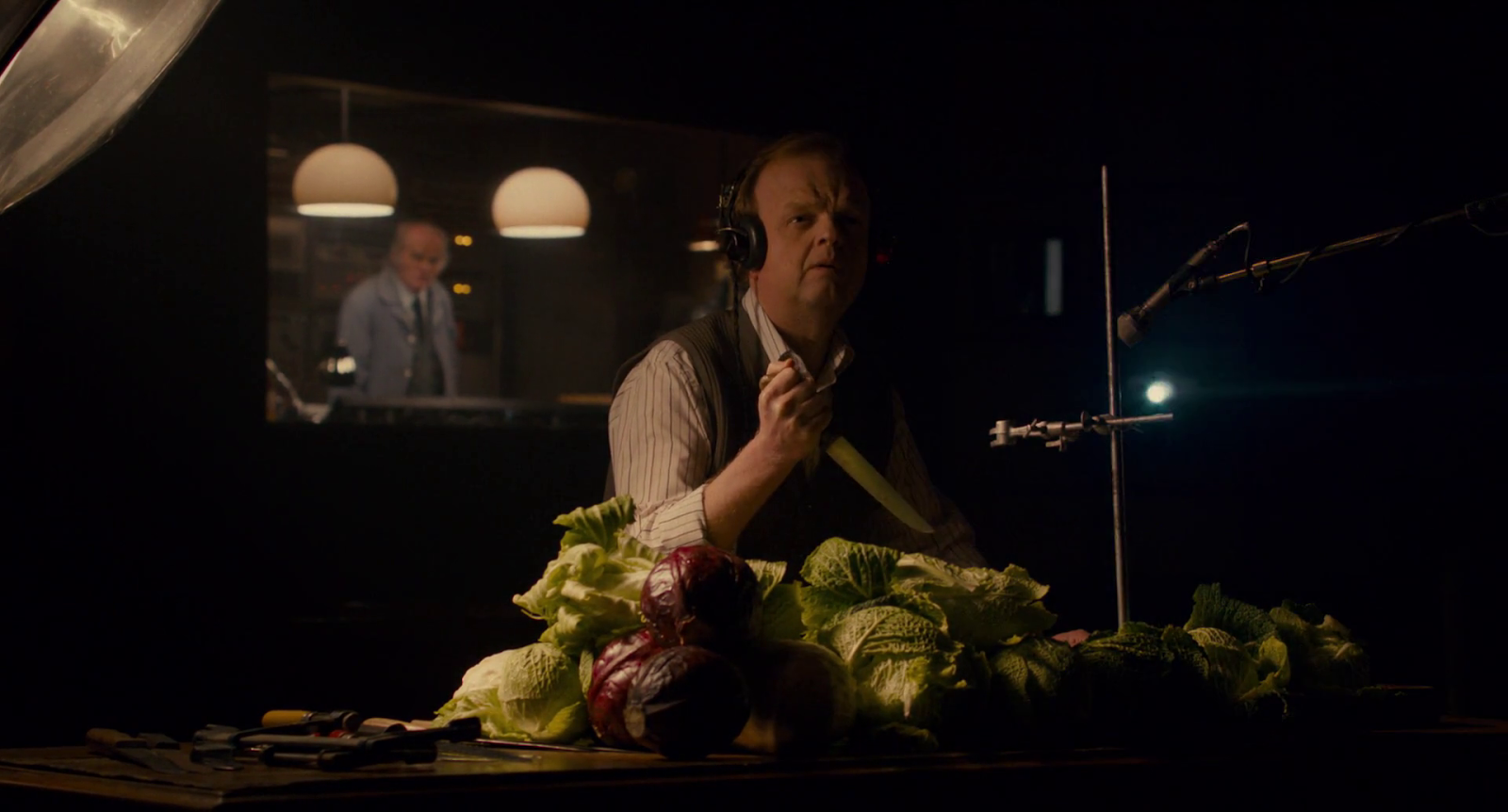
protagonist, Gilderoy (Toby Jones), is a sound engineer, removed from quiet
1970s Dorking to oversee the dubbing of an Italian slasher movie. Where his
hosts gabble in grand gestures, this fastidious, socially awkward Englishman
abroad soon finds himself trapped behind the sound booth’s muffling glass. Like
the effects he puts down on tape – an aptly morbid verb, given the carnage
playing out in his ears – we sense he’s at risk of getting cut off.
What Strickland has recognised is that there always
was something of the night about the giallo,
this strikingly unrestrained school of horror, with its whispered Latin chants,
its black-mass organ scores, its dashes of misogyny, behind the camera as
before it. Assisting Gilderoy in his task are a shifty pair of sonic
specialists whose job is to take sharp knives to watermelons or hammers to
cabbages – an unhealthy sacrifice of fruit and veg, made after dark with the
intent of giving onscreen death a realistic backing track. On this stage,
five-a-day isn’t a dietary suggestion, but the bodycount.
Low-key and suggestive, Berberian probably isn’t for gorehounds, but it’s a persuasive
study of breakdown – personal, professional, technological – and of a breed not
given to the eruptions of rage the giallo
cycle showcased. “You English: always hiding,” admonishes flamboyant director
Santini (Antonio Mancino), popping a grape in our hero’s mouth in the hope of
relieving his emotional constipation. Strickland made his breakthrough, 2009’s
surprising rape-revenge thriller Katalin
Varga, in Romania, and the alienation he felt there informs this latest: he
knows what it is to be away from home, tired and lonely and not speaking the
lingo, trying to reconcile the business of simulated killing with keeping a
level head.
Berberian Sound Studio is certainly what
one would call a knobtwiddler’s film, more than faintly male in its obsessions.
Yet it’s hard not to be impressed by precisely that level of formal control,
and the intimate knowledge of genre and art cinema Strickland weaves into his
own distinct sound and vision; if Katalin
Varga took notes from Bergman’s The
Virgin Spring, somewhere in here is a very English take on the ruptures of Persona. With each cut and splice, the
new film becomes quietly insinuating and unsettling: as with The Artist, as with all artists, its
worst fears lie in screaming, and not being heard.
Hollywood’s studios, meanwhile, retain their
baffling fascination with old properties. Take Len Wiseman’s Total Recall, which guts Paul
Verhoeven’s 1990 Philip K. Dick adaptation with the sole aim of installing
whizzier gadgets and features. Dick’s identity-shifting characters no longer
shuttle between Earth and Mars, but Britain (sorry, “the United Federation of
Britain”) and “The Colony” (Australia) through the Earth’s core, necessitating
a mid-commute gravitational flip that must be hell on the train upholstery. In
come rain-drenched sets care of Blade
Runner’s Chinatown collection, and Colin Farrell, replacing Arnold
Schwarzenegger as working stiff-turned-secret agent Quaid.
If the new version counts in any way as an upgrade,
it’s in how it contrives to toss its nimble lead odd dramatic notes – literally
so, in one coded piano sonata – that his sausage-fingered predecessor couldn’t
possibly hit. Still, Verhoeven gave this material a pulpy, 18-rated force;
stuck with a teen-friendly 12A certificate and dull ass-kickers in Jessica Biel
and Kate Beckinsale, Wiseman can make no more of it than a generic runaround.
This director can do helter-skelter action and whiplash fist-fights until he
and his actors are blue in the face, but that’s the problem: even without the
earlier film’s existence, this Recall
would start to seem naggingly – even needlessly – familiar.
A Few Best Men heads south in all senses. This is The Hangover transported to Australia,
where Twilight blandie Xavier
Samuel’s union with a politico’s daughter comes under threat from oikish pals
Kris Marshall and Kevin Bishop; you’ll just have to suspend disbelief at the
notion two Brits would be the lairiest guests at an Aussie wedding. Director
Stephan Elliot (Priscilla, Queen of the
Desert) at least takes you down to its level gently, tempering even the
crasser elements – think hungry rams and laxatives – with a degree of
affection. Moderation doesn’t make it funnier or more inspired, though: the
Hitler moustache jokes are cribbed from comedian Richard Herring, and Olivia
Newton-John’s coke-snorting mother-in-law does rather sum the whole up when she
asks one best man, as of the restless audience, “Where do you think you’re
going? They haven’t played “YMCA” yet.” Inevitably, they do.
Berberian Sound Studio is on selected release; Total Recall and A Few Best Men are in cinemas nationwide.
"Samsara" (Metro 31/08/12)
Samsara (PG) 102 mins **
As
cinematographer, Ron Fricke provided the astonishing widescreen imagery for
1982’s Koyaanisqatsi, an eco-doc
beloved of college stoners. Now a director, Fricke slides similar footage along
the Generation Game conveyor belt for
this illustrated lecture, inspired by the Buddhist wheel of life. Ooh, Samsara coos, there’s a temple. Some
lovely nature, there. There’s another temple. There’s some people, scrabbling
like ants. And there’s a cuddly toy, left behind in the ruins of a village
where some fool put their recycling bin out on the wrong day.
It’s a
field day for gawpers: hard not to be struck by the painstaking craft of monks
creating vibrant tableaux from grains of sand, or the performance artist who
transforms himself into a living corpse with clay. Increasingly, though, the
tone grows hectoring and resistible. Fricke shows us the world’s most
spectacular holiday snaps as a prelude to finger-wagging: “See, pesky Westerners –
you’ve made this tiny Asian woman cry. Do you feel good, conformist parasites?
Well, do you?” You
may need to be stoned to get through it.
Samsara is on selected release.
Thursday, 30 August 2012
1,001 Films: "Kiss Me Deadly" (1955)
Kiss Me Deadly comprises one of the most distinctive, strikingly haphazard private-dick mysteries the studio era produced. By way of contrast with The Big Sleep - which famously offered too much plot for even its creators to fully figure out - Robert Aldrich's film has a story that goes nowhere between ten minutes (when a letter is posted) and 75 minutes (when the letter is received), involving a hero who really doesn't have an idea what he's getting into (the case drops into his passenger seat rather than walking into his office, which limits the element of choice), which has to end with a Big Bang simply to dispel all the uncertainties gathered over the previous hour-and-a-half.
While out driving along some lost American highway, preening, self-regarding thug Mike Hammer (Ralph Meeker) almost runs over a dame who's naked under her trenchcoat, then wakes up to learn that heavies have pushed him and his now-dead passenger's corpse off a cliff. Soon, "the big squeeze" is being put on Hammer and his associates, convincing the detective the dame was into "something big". The thick-ear plot - adapted from a well-thumbed Mickey Spillane novel by A.I. Bezzerides - then goes on simply to follow its protagonist from interrogation to interrogation, but the film has a) an interesting hero to follow, and b) a director capable of working variation into each of those interrogations. In Hammer - who, like the perpetually digging Sam Spade, lives up (or down) to his name - we're presented with a shamus who uses brute force, rather than wit or cunning, to extract his answers; flashes of his previous criminal career come through in scenes which find him terrorising a pool party or snapping an opera fan's most collectible records, and in the look of pleasure on Meeker's face as Hammer goes about shutting a coroner's hand in a drawer.
In the absence of clear, considered narrative, Aldrich instead stages a series of inspired, outlandish moments: the flourish of ominous brass that accompanies Hammer as he takes the two - two! - steps required to get him from a boxing trainer to a nearby telephone; small, progressive nods of the head towards L.A.'s emergent Irish, Asian and African-American communities; out-of-nowhere lines of dialogue ("Why are you always trying to make a noise like a cop?"). The sets, similarly, are dotted with instances of off-the-cuff invention: Hammer's extraordinarily futuristic answering machine, a sister to 2001's HAL, perhaps; the dog with bow in hair perched on a secretary's desk, apparently placed so to set up a symmetry with a cat sitting atop a switchboard later on. With its still-jolting violence and absurd, darkly comic flourishes, it's hard not to think this is the P.I. movie David Lynch would make: the final sequence, with its stroboscopic light, erupting beach houses and peroxide-blonde femme fatale, isn't so far removed from the world of that director's very own Lost Highway. Which is where we came in...
Kiss Me Deadly is available on DVD through Twentieth Century Fox.
Subscribe to:
Posts (Atom)