Thursday, 17 December 2020

Minor movements: "The Woman Who Ran"

Since the turn of the millennium, the Korean filmmaker Hong Sang-soo has been making a name for himself as a purveyor of small, self-contained dramas - no wild twists, no spectacular effects - about people bumping into and nudging up against one another on the streets of his native Seoul. These have become wildly popular on the festival circuit, as a) the majority run some way under 90 minutes, thereby counting as light relief from the circuit's four-hour documentaries about arable farming, and b) they frequently involve cultured souls sitting around aimlessly chatting and drinking, thereby holding up a flattering mirror to the after-hours festival experience. They haven't, however, established much of a foothold in the UK, certainly not when compared to other overseas territories: France, in particular, where Hong has been championed as an auteur on a par with, say, Kiyoshi Kurosawa (and seems but an especially breathless paragraph away from being framed as an Asian Éric Rohmer). Prior to this week's The Woman Who Ran, the only Hong title to receive full theatrical distribution here was 2013's Nobody's Daughter Haewon. Approached in isolation, a Hong film might look inconsequential, shruggingly uncommercial, a curious little indulgence. Yet see enough of them, devotees argue, and a genial worldview becomes apparent, as does a thematic and tonal consistency that makes each distinct title a potential point of entry: stick any of these DVDs on, and you'd know within fifteen minutes if Hong was a filmmaker for you. In this respect, he's less like the shapeshifting Kurosawa than the similarly revered Hirokazu Kore-eda, though I suspect Hong would find Kore-eda a bit too plotty for his own tastes.

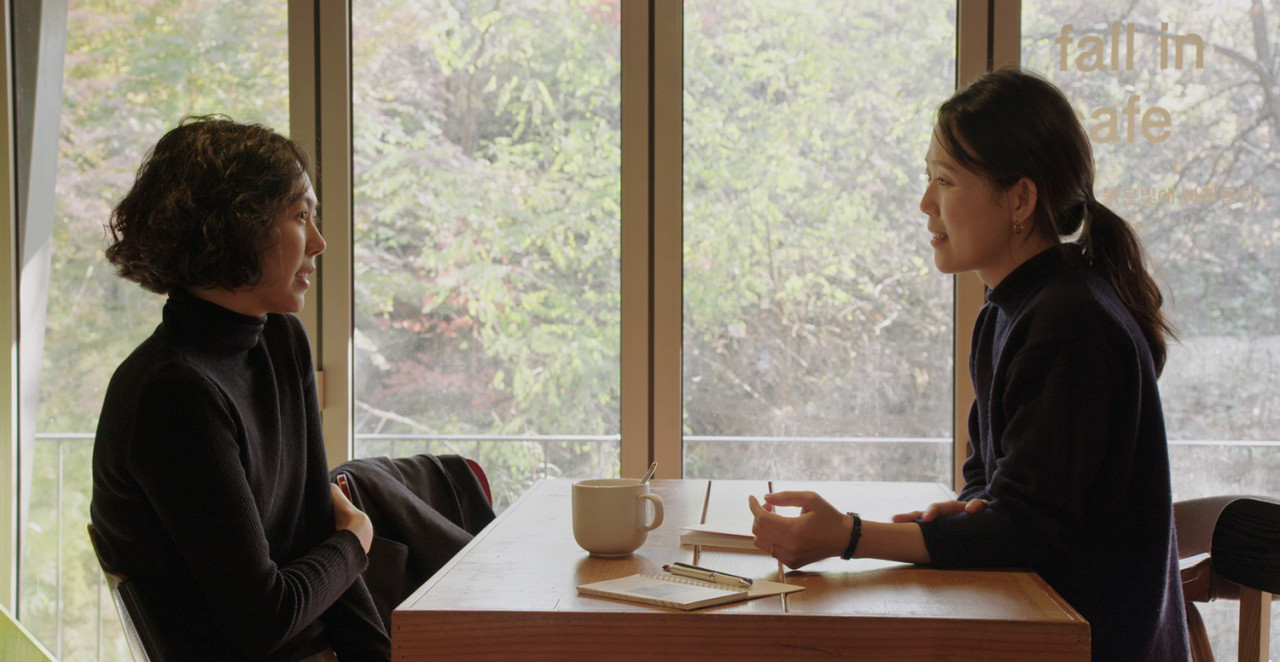
It's not that The Woman Who Ran doesn't have a story; it's more that Hong is only interested in selected turns and situations within that story. It opens with a reunion between two old friends: bespectacled, divorced, solitary Young-soon (Seo Young-hua) and the younger-seeming Gam-hee (Hong muse Kim Min-hee), who arrives merrily loved-up. As they reminisce and natter, we could be sitting in on any other coffee morning; Hong is lulling us, to some degree. But note how he slowly adds elements, scene by scene. The two old pals are joined by Young-soon's amenable housemate Young-ji (Lee Eun-mi). The latter is briefly caught up in a semi-heated discussion with a male neighbour who's concerned that the girls have been feeding the housing block's stray cats. (An especially well-fed and expectant-looking feline is a welcome addition to the repertory at this point.) There's a lot of background, offscreen or under-the-surface drama going on here. Gam-hee is woken up in the middle of the night by a spooky figure on Young-soon's CCTV system; and in the morning, it turns out she has other friends to visit. She will be more forthcoming with some than she is with others: that's the real story. The film's sharper stretches of writing and playing draw us in, as we would be listening to an anecdote being told by a longtime companion. But it remains selective, and here's where frustration, too, enters the picture.

The biggest mystery concerns the identity of the runner referred to in the novelistic title. Hong tosses in an early red herring via some gossip relayed by Young-soon about a neighbour who abandoned her family - but that tale-within-a-tale draws into focus how committed the film's other women are to their current status. It may be the casting of the minxy Min-hee, but Gam-hee presents as far flightier than she's letting on. Whether that mystery is satisfactorily resolved over these 77 minutes is another matter; we're being offered slices of life, not a full meal. Having advised Hong newcomers to start anywhere they like, I also feel obliged to add that this filmmaker is very much an acquired taste; he works by accumulation. I still sometimes feel a need, watching this director's work, for a little extra narrative oomph, a drop more dramatic hot sauce - for some of that offscreen conflict to be wrestled on screen. Hong's cinema could only have gained the marginal toehold it has in our ruthlessly competitive film culture because it's so cheap to produce: much has been written about the artless zooms - a directorial signature, used to break up his talkier long takes - but The Woman Who Ran really does look as though it was shot in mere days. (It sounds a bit tinny, too, stuck with weird musical stings apparently sourced from tape recordings.) That lack of risk is front-and-centre here: this one's so self-contained that, like an old friends' coffee morning, it barely needs anybody else looking on. Still, there remains something admirable about Hong's capacity to make mountains - or at least molehills - out of his characters' small talk. If you were drawing up a list of contemporary cineastes whose work would meet the critic Manny Farber's definition of "termite art", he'd be right up there - though you'd add him with an air of amazement that a cinema this insistently minor-key, this barely there, hasn't yet been stamped out.

The Woman Who Ran will be available to stream via MUBI from Sunday.

Wednesday, 16 December 2020

Family of strangers: "Farewell Amor"

Ekwa Msangi's engaging, Sundance-certified indie Farewell Amor hones in on a state of affairs that must be a commonplace among diaspora families, but which has until now gone unfilmed. That's odd, because it's an inherently dramatic situation: a family who reunite as perfect strangers. It's taken 17 years for Angolan cabbie Walter (Ntare Guma Mbaho Mwine) to raise the funds necessary to bring wife Esther (Zainab Jah) and their teenage daughter Sylvia (Jayme Lawson) across to his new home in New York. The reunion in his boxy apartment only points up how out of synch they've grown: the secular Walter sparking concern by bringing wine home and trailing memories of an earlier fling, Esther proving as devout as her name hints. Sylvia, for her part, seems less than keen on the whole arrangement: the Afrobeats pulsing through her earbuds suggest her head's still somewhere else. Still, some residual affection - the loosest of bonds - keeps them together, while Msangi's camera dances tentatively around them. She takes each of their sides individually - first Walter, then Sylvia, then Esther - and watches as, after this rocky restart in the New World, everyone starts to find their feet and move in something closer to harmony.

In doing so, the writer-director demonstrates the kind of good classical practice taught in screenwriting school: three acts and a coda that collectively provide a more rounded portrait of the same small core of scenes. The Rashomon-like structure has a particular potency in this application, in that each of these characters starts out detached from the other two, harboring their own secrets and desires: Walter in photos on his dashboard, Sylvia in instant messages, Esther in her prayers. (The coda is what happens when those cats are forcibly removed from their bags.) Within that careful, considered framework - previously sketched in a 2016 short, Farewell Meu Amor - Msangi sporadically attempts more instinctive gestures. The Walter section is primed with fragment-episodes, cut before we get the full picture; everything here is a little jagged, as the city might present upon first arrival. No wonder Sylvia does herself an injury; no wonder her father emerges as so clueless with regard to his new housemates. As he finds out, so do we; the film gets more conventional as it goes on, heading towards a dance-off that mirrors a domestic crisis. Yet nothing seems forced or contrived: the naturalistic performances describe characters slowly stretching their legs and getting their feet further under an initially unfamiliar table. A neatly composed calling-card for Msangi, a gentle heartwarmer for the rest of us, with a nice cameo from the talismanic Joie Lee (Spike's sister), passing a torch between generations of indie filmmakers as this rough-hewn family's airy neighbour.

Farewell Amor will be available to stream via MUBI from Friday.

Tuesday, 15 December 2020

Spirits having flown: "The Bee Gees: How Can You Mend A Broken Heart"

Frank Marshall's Bee Gees doc How Can You Mend A Broken Heart comes in on or about a par with Ron Howard's Beatles doc Eight Days a Week: it's been thoroughly authorised, which gets it access to the one surviving Gee (Barry) and a beguiling array of Gibb archive, but also limits the filmmaker from probing as he perhaps might. How deep is its love? Fathomless. How deep is its content? Fair-to-middling. It remains quite the story, such that it's a miracle we haven't yet had to endure a fictionalised biopic with copious stick-on facefuzz, or some godawful jukebox musical à la the ABBA or Queen ones: the tale of three dorky siblings from the Isle of Man - beardy (Barry), baldy (Maurice), toothy (Robin) - who momentarily succeeded Chic and Donna Summer as disco royalty. (And thereby expanded the form's appeal, drawing in and pacifying those heterosexual white folks who might otherwise be gathered in baseball stadia blowing up Sylvester records.) As that title acknowledges, however, the trio were as much sentimentalists as they were strutting urban sex gods, as much light entertainment as night fever: a early clip of Robin trilling "I Started A Joke" is enough to prove that. That versatility would be their making, both behind-the-scenes - where they wrote for Dolly Parton, Diana Ross and Barbra Streisand - and on record, where three distinct vocal ranges could be heard combining in often blissful harmony. Sometimes they went low; sometimes they went "Stayin' Alive" high. The musician-turned-academic Mykaell Riley here dubs them "the chameleons of pop", which sticks: one of those rare acts to be all things to all people, they attracted admirers and fans at different stages of what proved a four-decade career as a trio. As a young purist/snob in the Eighties, I rather resented these and other Seventies holdovers as their comeback recordings scaled the charts, but I was finally won round to "You Win Again" some thirty years later, after the pop historian Bob Stanley described it in his magnum opus Yeah Yeah Yeah as "a Christmas carol composed in a shipyard".

As retrospectives go, How Can You Mend A Broken Heart is a bit of a whizz-through, offering little along the way to dispel the idea - nurtured in a strain of British TV comedy (Clive Anderson, the Lucas-Walliams Rock Profiles) - that the Gibbs have always been slightly touchy around personal matters: family business, best resolved inhouse. These Bee Gees cut their first album five minutes in, which precludes any real discussion of their background; it's down to celebrity contributors Noel Gallagher and Nick Jonas to offer (unexpectedly lucid) commentary on the fraternal dynamics in play. The throughline is the work, and how the group came to reinvent themselves during rocky transitional phases: turning to a more American sound to get away from the ballads that fell out of favour as the Sixties counterculture came to be replaced by post-Watergate cynicism, then bringing those ballads back when pop got sappier (or more sincere) in the immediate wake of Live Aid. What Marshall's account suggests is that they were above all else savvy, which is something we tend to value more in our electricians and bank managers than we do in our rockstars. Rather than flying too close to the sun or plunging headlong towards the abyss, the brothers were always looking for ways to adapt and sustain themselves in the face of audience indifference or Bee Gee fatigue. (Marshall, who's signed his name to ten times as many films as a producer than as a director, is keen to link their achievements to the production whizzes - Ahmet Ertegun, Arif Mardin - brought in to assist in the group's evolution.) 

Don't come expecting excess or extremes, in other words. Maurice's drinking - a possible consequence of having to play go-between whenever Barry and Robin were at loggerheads - is but an undercurrent in a stray Lulu aside before it's acknowledged in the closing credits; only the presence among the interviewees of a newly sober Eric Clapton - another Robert Stigwood signing - points to the very public ways in which a musician can go off-rails. Like the guitar track on "Jive Talkin'", arrived at after Barry heard the noise his car's tyres were making on a Miami freeway, the movie skitters onward, while remaining steadily middle-of-the-road. It threatens to get a little more explosive as we exit the Seventies, Marshall intercutting the light and joy of a Bee Gees stadium gig with footage of Steve Dahl's notorious Disco Demolition Night; finally, pop culture sees Dahl not as some chortling, Moyles-esque maverick, but as a petty tyrant, and his event for the latter-day bookburning it was. Yet if the Bee Gees weren't reactionaries, they were hardly revolutionaries, either - too cautious to attempt what the Beatles, with whom they briefly crossed paths in the 1960s, were working towards in their final years together. Marshall has a clip of a visibly beleaguered Barry insisting as much around this time: "We're not a political force, we're a pop group." A good one, mind: three grafters with a keenly felt sense of craft, which is why their best songs from the Sixties and Seventies were every bit as energising when Barry, last Bee Gee standing, reprised them in the legends slot at Glastonbury 2017. As a film, it's rarely more than slickly professional entertainment with some nice harmonies - very Bee Gees, in its own way - but endure the last-reel footage of Ed Sheeran covering "Massachusetts", and your reward is just a glimpse of a revelation: Barry, now grey-haired and solitary, opening up for what feels like the first time about what he had, and what he's lost. Is this the curse of the British working-class male of a certain age, that you spend a lifetime channelling your emotions into your work, and can't say what you really feel until it's too late? As he once put it: how can you mend a broken heart?

The Bee Gees: How Can You Mend A Broken Heart is now available to rent via Prime Video.

Monday, 14 December 2020

Alternative rock: "David Byrne's American Utopia"


At first it strikes the eye as a strange idea of utopia, characterised less by abundance than drab functionality. American Utopia, Spike Lee's film of David Byrne's live staging of his 2018 album, plays out across a small square space, decked out in neutral colours, on which a small group of men and women congregate in matching grey suits. Sometimes we see them front-on, performing within apparent touching distance of an audibly delighted crowd; sometimes we watch them from above, pulling restrained geometric shapes. Everything we see, however, is determinedly pared-down, self-contained, back-to-basics, an austerity utopia: one of the few striking aspects is that these men and women sport neither shoes nor socks. Found sitting alone at a desk, Byrne himself walks us through the opening number ("Here") as if it were the text of a TED talk on neurobiology, and maintains the air of a Royal Institution lecturer between songs old ("This Must Be The Place", "I Zimbra", "Slippery People"), new ("Everybody's Coming To My House") and in between ("Blind", "Lazy"). The utopia he's attempting to manifest is one of people rather than material things, and it insists upon a diversity of races and genders; it's why a protest song by the pansexual, Afro-futurist Janelle Monáe ("Hell You Talmbout") so happily integrates into this repertoire. The grey-haired elder statesman overseeing it expends far less energy (and hogs far less limelight) than his 1984 incarnation in the great concert film Stop Making Sense. That Byrne was looking to burn down the house, and he appeared capable of generating the light and heat that might bring that to pass. This Byrne is a genial cove, maybe a little burnt by experience, keen to invite folks over to his house - or a theatre rescaled to resemble a front room - without making too much fuss, or drawing undue attention. These are uncertain times for the free-thinking humanist, after all, and besides, he's just happy being part of a crowd, one among many.

That shuffly sort of framing is one respect in which American Utopia differs from its predecessor, recorded when both America and Talking Heads were in their early Eighties pomp. There, we were watching a spectacle building itself from the floor up, becoming more extravagant with each number. (By the finale, Talking Heads were finally bigger than New York: it would only take a song as infernally catchy as "Road to Nowhere" - reprised here, in a notably less ambivalent, openly celebratory key - to make them global megastars.) Here, the band are all on stage with Byrne, instruments strapped to their shoulders or waists to keep them mobile, within the opening ten minutes. Byrne and choreographer Annie-B Parson rehearsed them, achieving the not-small feat of converting session musicians into fully-fledged backing dancers; Lee, caught on his most self-effacing, best behaved form since 2013's Old Boy remake, was then called in to make a document of the event. (The venue was New York's Hudson Theater; in the closing moments, we see Byrne emerging from the stage door and cycling home, as he reportedly did every night.) The new songs, which don't quite have the same wow factor as the canonical classics, could arguably do with a bit more visual pizzazz than we get from watching well-drilled support technicians cavorting around a tightly defined workspace; there are only so many shapes they can pull after a while. But then American Utopia was always conceived as about more than just the music.

For one thing, we get a fuller political perspective than the angular weirdo Byrne of 1984, still prone to giving interviews in blackface, was capable of articulating: the between-song repartee addresses such contemporary issues as voter registration and police shootings. Stop Making Sense was a record of a gig, but American Utopia at times resembles Byrne's characteristically idiosyncratic riposte to the Trump rallies: intentionally modest in scope, comic in its self-mockery. Watch him spoofing his way through the final minute of "Slippery People", and hear out his drolly inclusive intro to "Everybody's Coming to My House", and it's clear to see the extent to which the frontman has become a showman. "I dance like this/Because it feels so damn good," sings Byrne during "I Dance Like This", a hipster's response to Genesis's "I Can't Dance", before continuing "If I could dance better/You know that I would". Yet the lack of exceptionalism there appears key to the utopia: Byrne makes himself small - eschewing the old big suit, becoming part of an ever-shifting chorus line - so as to make greater space for others. And what's really crucial is that even when the music cuts out - as it does during that song - the show goes on, regardless of Trump, Covid, your obstacle of choice. That show now lands among us, on streaming in the absence of unshuttered cinemas, after months of viral videos capturing the joy our fellow shut-ins - and disenfranchised gig-goers - have rediscovered in dancing around bedrooms and kitchens not much smaller than Byrne's stage. If I'm reading this project right, that kind of bliss may only be possible when nine-to-five capitalism is put on hold, life isn't business as usual, and people have the time and energy to cut a rug. Isn't this just a brainiac's rebranding of the message progressive pop has been pushing ever since the countercultural Sixties? Almost certainly. But amid this punishing new world order, sometimes the freedoms we take delight in can be as minimal as kicking off your shoes and socks. And you get very strange looks if you do that in a cinema.

David Byrne's American Utopia is now available to rent via Prime Video.

Breaking sad: "County Lines"


Crime rarely pays and is frequently deadly, but for a while there - even if just a brief while - it can seem as exciting as hell, a tantalising break from the norm. We meet Tyler (Conrad Khan), the 14-year-old protagonist of Henry Blake's debut feature County Lines, as he slopes aimlessly round the corridors of his inner-city London school, underengaged when he's not kicking off. It's not that he's an entirely bad kid: he's protective of his younger sister Aliyah (Tabitha Milne-Price) and has interests beyond the schoolgates, and in a way every decision we watch him make in the film is made to shore up his slightly lopsided household. It's just that no-one's really shown any interest in him. His mother Toni (Ashley Madekwe) has fallen out of synch with her offspring, a consequence of having to work nights; his teachers already have their hands full trying to stop pitched warfare breaking out in underfunded, overpopulated classrooms. Enter Simon (Harris Dickinson), an older boy who rescues Tyler from some kebab-house bullies, and later re-emerges as a reassuring constant on the streets around our boy's home - albeit the sidestreets, and then mostly after dark. Blake's research into the county-lines phenomenon manifests on screen as a heightened level of context: he shows us how easily Tyler's head might be turned, so that when Simon finally makes him a questionable job offer - after a shopping trip that feels horribly like grooming of a sort - it doesn't seem implausible that the youngster takes him up on it. We're almost as trapped within this world as Tyler is, so we see why he might mistake a well-paying dead end - cross-country drug-smuggling - for a viable way out.

From the off, it's good thriller material, in that it's tied up with movement, and rapidly puts its protagonist in places we don't really want a child to be. The film's theme is the wrong form of mobility - a way of life that might only seem like mobility to someone impressionable, and then only after all other avenues have been closed down. What's notable about the direction, however, is its relative sobriety, the near-total absence of sensationalism; Blake just coolly, calmly lays this world out. First point of contact. The trains. The grim destination. That suggests a shrewd head behind the camera, because there are elements here - particularly the flophouse that serves as a drug distribution centre, with its sclerotic wallpaper and pleading junkie (Johanna Stanton, both heartrending and terrifying) - that might otherwise have played as too much, heavy-handed at best. As it is, County Lines is still quite a lot to be confronted by, but it's also just enough to remain credible, and to preserve some troubling grace notes, such as the quietly virtuosic revelation around the midpoint that Tyler is by no means alone in getting snared up with this risky, nasty business. For a first feature, Blake's shot choices are exceptionally assured: I'm thinking of the pick-up that plays out against the backdrop of the artificial pitches on which we learn Tyler has demonstrated some talent (all that potential, now badly misrouted), and a truly haunting hold on a school photo of our boy at precisely the point in the plot where the innocence it captures looks to have drained away, possibly for good. (The decision Blake took with cinematographer Sverre Sørdal to cast their interiors in elevated levels of gloom makes doubly moving the stray rays of sunlight seen sneaking into the closing minutes.) 

One of the more perverse aspects of 2020 is that just as Britain collectively prepares to shoot itself in either the foot or the head - partly as a result of a widespread lack of mobility; the only hope left at this stage may be that the resultant shock wakes up some of our dopier friends and neighbours - the national film industry has launched more forceful and promising first films than in any other year in living memory. Maybe the moment is the reason: that we've all endured so many projects advertising a country-house Britain where everybody knows their place that a small army of Morlock-movies, narratives of discontent describing the less sunny realities of Brexit Britain, was bound to rise up and push back sooner or later. (Never forget that the same cinema that generated Chariots of Fire and A Room with a View under the Thatcher government also signed off on My Beautiful Laundrette and Raining Stones.) Like Fyzal Boulifa's Lynn + Lucy, its equal at the summit of the Great British Debut stockpile of 2020, County Lines is far from easy viewing: its 90-minute running time, further sharpened by at least one jolting timeshift, induces the shock of seeing a desperate situation turn very bad very quickly. Yet it's strongly performed - particularly by Khan and Madekwe, who forever seem like people rather than punchbags, a crucial distinction within this especially rigorous form of social realism - and superbly handled by Blake. If, whether now or in years to come, you needed a reminder of the dark place Britain got itself in - and was allowed by its leaders to get itself in - in the run-up to January 1, 2021, this would be a fine place to look.

County Lines is now playing in selected cinemas, and streaming via Curzon Home Cinema and the BFI Player.

Friday, 11 December 2020

For what it's worth...


T
op 10 films at the UK and Ireland box office (for December 4-6, 2020):

1 (6) Elf (PG) **
2 (1) Home Alone (PG)
3 (5) WolfWalkers (PG) ****
4 (new) A Christmas Carol (PG) **
5 (4) Two by Two: Overboard! (U)
6 (2) Honest Thief (15)
7 (38) Pixie (15)
8 (re) The Grinch [2018] (U)
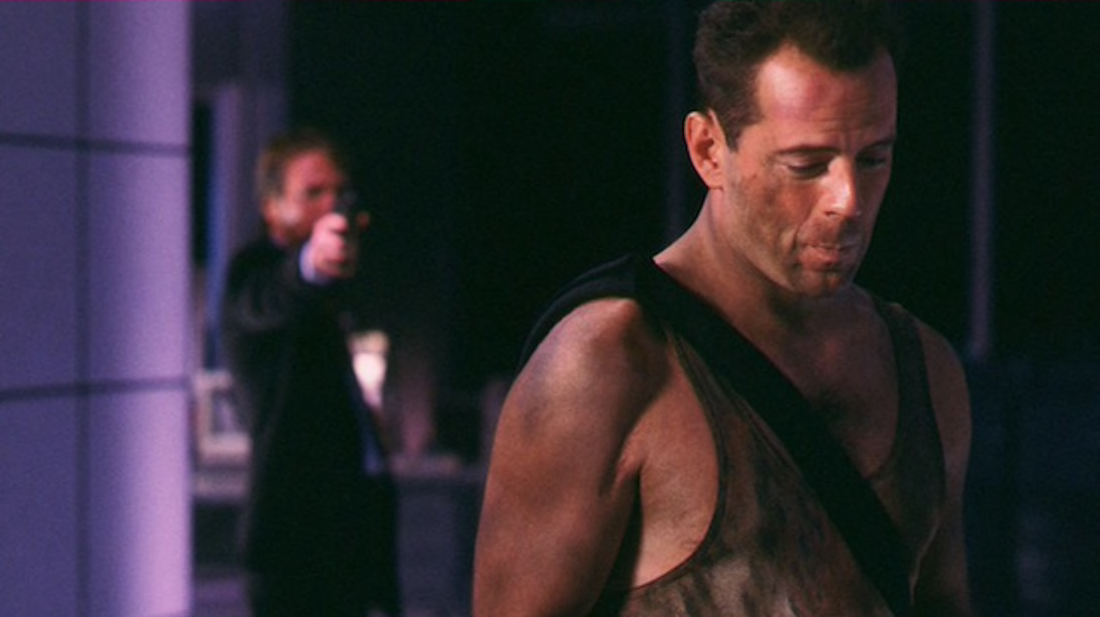
9 (re) Die Hard [above] (15) *****
10 (new) Katherine Jenkins: Christmas Spectacular from the Royal Albert Hall (U)

(source: BFI)

My top five films currently on release:
1. David Byrne's American Utopia


DVD/Blu-Ray/Download top ten: 

1 (1) 
Elf (PG) **
2 (3) Last Christmas (12)
3 (8) The Grinch [2000] (PG) ***
4 (11) Love, Actually (15) ***
5 (2Mulan (12A) ***
6 (34) Home Alone (PG)
7 (15) The Polar Express (U)
8 (7) 1917 (15) ***
9 (new) A Christmas Gift from Bob (15) **
10 (new) The Lord of the Rings Trilogy (12) ****


My top five: 
1. The Irishman

 
Top five films on terrestrial TV this week:
1. The Untouchables (Saturday, BBC2, 9pm)
2. Great Expectations (Sunday, BBC2, 1.50pm)
3. The Godfather (Sunday, BBC2, 10.10pm)
4. Cape Fear (Saturday, five, 10.40pm)
5. mother! (Sunday, C4, 12.05am)

Work from home: "Peter Duncan's Jack and the Beanstalk"

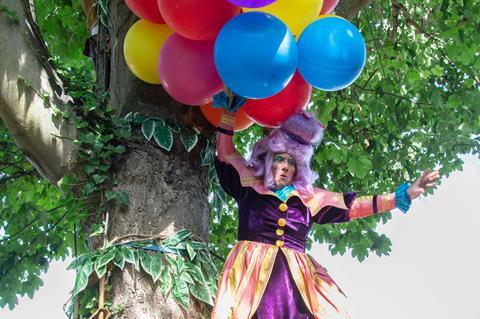
In his guise as figurehead of the mid-Eighties children's TV series Duncan Dares, the sometime Blue Peter presenter Peter Duncan took on an array of outward-bound challenges, from dragon boat racing to tightrope walking. Earlier this year, Duncan accepted his biggest challenge yet: to save Christmas - and some small part of the West End theatre industry - from the rigours of Covid, by staging a pantomime under lockdown conditions in the grounds of a (very nice-looking, apparently spacious) house in South West London. It shouldn't have worked. It couldn't work, surely. Reader, here's the thing: watching Peter Duncan's Jack and the Beanstalk, I smiled and chuckled more than I have during any of the vastly more expensive awards contenders presently being forced down critics' necks by the major studios and streaming providers. From a very early point - perhaps as early as the first full musical number, complete with socially distanced chorus line - it becomes clear it's been made by people who understand that pantomime is its own eccentric artform: an artform composed of, on one hand, heightened stagecraft and audience awareness, and on the other, a built-in crapness - a built-in British crapness - which Netflix, with its many millions to throw at slick, by-the-yard content, couldn't possibly get near.

So, between regular pauses for audience participation, we witness puppets and costumes that could conceivably have been cobbled together by Duncan and Janet Ellis using old socks and ping-pong balls, thrillingly gratuitous references to "Hands, Face, Space" and Can't Pay? We'll Take It Away, and the broadest imaginable playing in the confines of what may or may not be the Duncan vegetable patch. There's a joke about Pringles that is as old as the hills, and still works. That, on reflection, may be as good a definition and illustration of showbusiness as we could ask for: you take the most antiquated of schtick (timeless, scholars call it), and you give it the energy to get a laugh all over again, even - especially - in times such as this; there's a magic and joy in it. It has to be considered a strange year when one ends it attempting to fast-track Peter Duncan onto any centralised list of national treasures, but he makes a tremendous Dame Trott, flashing his bloomers and giving one especially ribald gag about a tree just enough spin to get it past smaller ears. Co-directing with Ian Talbot, he also makes a shrewd judge of how to make pantomime work as low-budget, shot-at-home cinema: part of the delight here comes from seeing someone using whatever modest sums of cash are available at this level of the British film industry to fashion something good-natured rather than cynically opportunistic, and committedly, commendably daft. Though heaven knows what the neighbours made of it all.

Peter Duncan's Jack and the Beanstalk is now streaming via www.pantoonline.co.uk, and screens in cinemas nationwide from today.