Wednesday, 22 July 2020

Under construction: "How to Build a Girl"


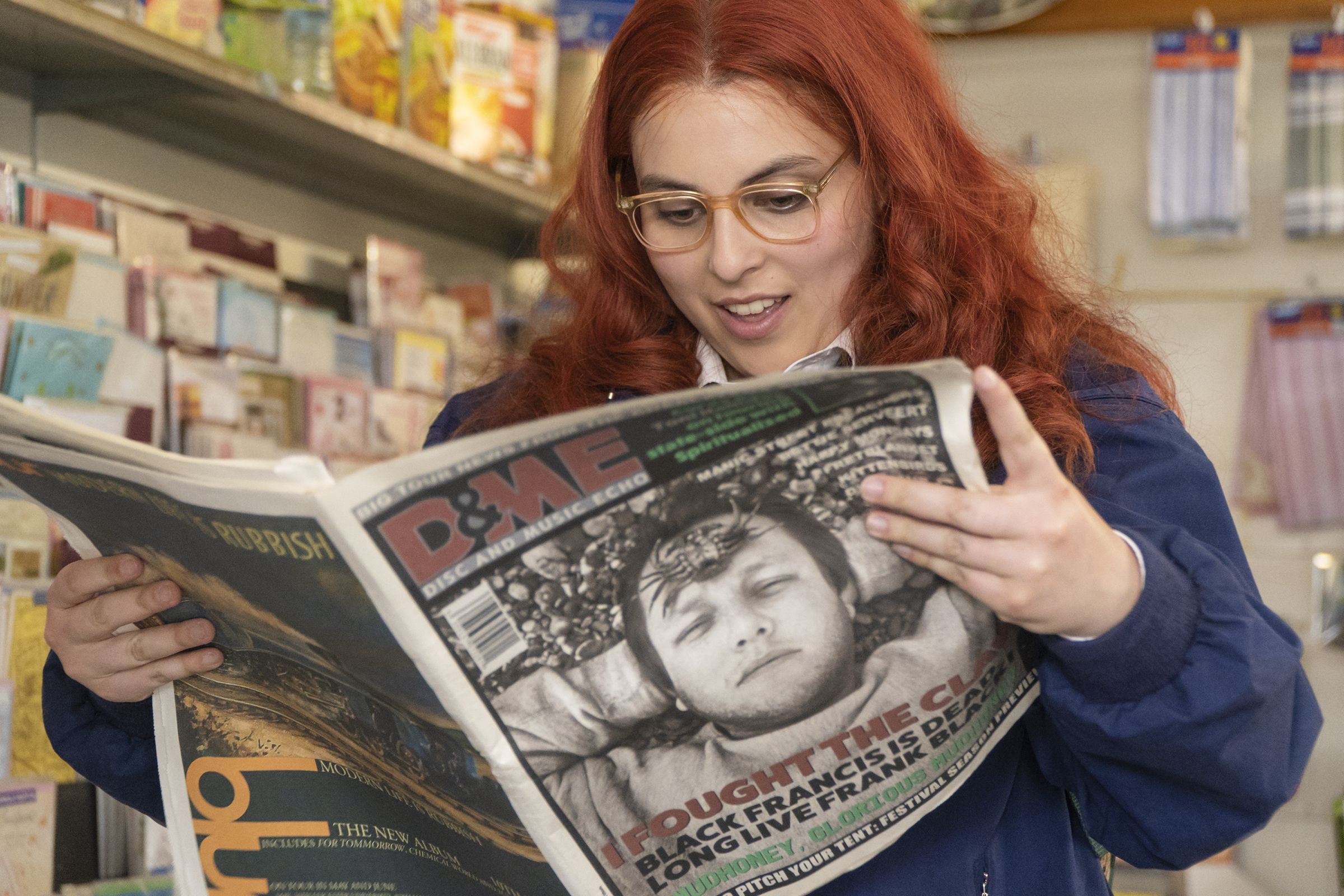
Channel 4's rather wonderful, gone-too-soon sitcom Raised by Wolves was Caitlin Moran: The Early Teenage Years. This week's How to Build a Girl, produced by the channel's Film4 arm, rejoins Moran in late adolescence - or, rather, it introduces us to the pseudonymous Johanna Morrigan, a character in her own right, played by Booksmart's Beanie Feldstein as a geeky, speccy, heavyset outsider forever pressing a nose against the window of adult life. Young Mor(rig)an has two stated aims: first to find a suitable swain, a trickier task than one might imagine in the altogether shallow dating pool of her native Wolverhampton; and then to become a world-changing writer, in the image of the literary heroines she's taped to her bedroom wall. The onlooker will by now be aware of Ms. Moran's real-world status - chart-topping author, columnist, reigning queen of UK Meeja Twitter, denmother of rock - and so the second of these is never in too much doubt, but Coky Giedroyc's film takes everyone back to a moment in time when this precocious persona was setting out on that path and suspended between poles: between coursework and a career, the sticks and Soho. On one side Little Women, cited by our heroine-narrator when she compares the repossession of a rental television (ah, the late 1980s) to the death of Beth March. On the other, something geographically and spiritually closer to Loose Women.

The film that results distinguishes itself from the crowded coming-of-age field by virtue of its Wolverhamptonness and its Moranness. Rather than turning its back on any provincialism - as many a British teenpic has, so as to maintain a beady eye on the lucrative export market - How to Build a Girl leans into it. I suspect mild confusion will ensue when the film finally plays in Poughkeepsie, prompted by Feldstein's accent (which stuck even this ear as floating up a few clicks north of Molyneux) and one early reference to Cyrille Regis. The Morrigans' front room appears pokily familiar after Raised by Wolves, albeit now with Paddy Considine - patron saint of the North Midlands - on dream-dad duties as an eternally patient jazz-funk drummer, and Sarah Solemani picking up the short straw of having to follow the formidable Rebekah Staton as Moran mère. (With typical quiet skill, Solemani offers a novel reading of the same role: a woman drained by childbirth, where Staton rarely appeared anything other than emboldened by it. One's an inspiration, the other a cautionary tale; our feminism can be flexible, much as our mothers can be both.) It's inevitably in the bedroom where the film begins to stretch its imaginative muscles, having young Johanna's pin-ups - famous faces, played by famous faces - come to life and dispense time-honoured words of wisdom. It's also where the Moranness becomes most apparent, setting our heroine to masturbating at her typewriter and providing a primer of sex tips: a mid-film crowdpleaser, but also one that comes, as it were, out of nowhere. (Up until then, Johanna has given the impression of an almost Julie Andrews-like chastity.)

It's not the only point in How to Build a Girl where you become aware of a certain erraticness in the adaptation. (You could screen it alongside the BBC's recent Normal People and The Luminaries in a season illustrating the pros and cons of commissioning an author to convert their own bestselling words into pictures: assumed or privileged knowledge remains a pitfall.) As its title suggested, Moran's memoir was meant as a survival guide - a passing-on of the ladyflame, detailing what to cling onto and who to avoid while making the fraught transition from young adult to woman of the world. The movie retains a lot of that useful intel, and is the stronger for it: wide-eyed ingenues will learn how best to handle horrible bosses and contemptuous colleagues, what to do when a rock star invites you back to his suite after a gig, and - more constructively - how to find a critical voice that expresses enthusiasm and scepticism without lapsing into gushing fangirlism or outright nastiness. (There aren't many books that teach you that, and even fewer movies: Moran has successfully dramatised the trial and the error.) One knock-on is that Johanna often feels as if she's on a conveyor belt being filled by with enriching or sobering life experience, like an avatar in an unusually lively public-information broadcast: here she is gaining a break, here she is blowing it, here she gets a new wardrobe (indie-disco dandy, replete with top hat, leggings and ginger hair dye), here's another break.

I've been scratching around on the fringes of the British media long enough to know this is often how things are in reality - I ditched the leggings back in 2007, granted - but it makes for odd ellipses in any filmed narrative, as it would on a CV. Before Johanna lands her first meeting at the "Disc & Music Echo" (geddit) off the back of a one-page critique of the Annie soundtrack, there's not all that much indication of the qualities of her writing - obviously a tricky aspect to dramatise, but one that's surely essential to our understanding of this girl's inner life, her compulsion to strike out on this course, how she landed any such break. Still, given Feldstein's latest tremendously enjoyable performance, it almost doesn't matter: you buy her as not just an embodiment of a recognisably Moranesque spirit, but a big rubber ball of potential energy, destined to bounce all the way close to something like the top. It's an unanticipated, poignant irony that the film of this life should land on UK screens in the same week Q magazine - one of the last, tangible artefacts of the pop-press golden age in which Moran was fortunate enough to make a name for herself - has gone to the wall as a consequence of all things Covid. Yet if you were watching it at an impressionable age (the 15 certificate is ideal), on a council estate, with vague notions of starting a career in journalism of some kind, I could see how you might well find the film inspiring and encouraging in equal measure. Forged in the image of its creative prime mover, How to Build a Girl is broadly a good and cherishable thing.

How to Build a Girl is available to stream via Amazon Prime from Friday.

Warm bodies: "Come As You Are"


In its original form, Come As You Are was a 2011 Belgian crowdpleaser called Hasta La Vista that followed the misadventures of three young disabled men - a grouchy paraplegic, a gentle blind giant and a cancer patient, himself in a wheelchair - as they made their way to a Spanish brothel to purge themselves of their virginities. (It had been inspired, in turn, by the story of the American-born disability activist Asta Philpot.) That movie wasn't exceptional cinema, but it proved genial fun, and was notable for letting its disabled characters be who they were - cranky, klutzy and/or horny - rather than framing them as inspirational paragons of virtue; for once, a subtitled film's English language title had it spot on. It's now been remade in English, although not quite as extravagantly as the same year's comparably themed Intouchables was when the Weinstein Company converted it into the Bryan Cranston vehicle The Upside. This Come As You Are presents as a modest indie diversion with a small payload of recognisable TV faces, which carries the boys - ported over in the exact same configuration of eyes and limbs - from suburban America to a cathouse in Montreal in what uptight paraplegic Scotty (Grant Rosenmeyer) quickly dubs "Operation Copulation". "We're not calling it that," insists Matt (Hayden Szeto), the trio's carcinogenic conscience, but it's as apt an alternative title for the remake as any.

Anglicising (or re-Anglicising) this set-up underlines the extent to which it owes a debt to those millennial teen sex comedies - it's all but American Pie times Road Trip - in which characters such as Matt and Scotty would be tossed at most one or two lines in the back of a party scene in a fumbling attempt at inclusivity. Writer Erik Linthorst and director Richard Wong do them the honour of rolling their wheelchairs front and centre, but much else here would be familiar to anyone with a passing knowledge of the subgenre: the snafu incurred while buying condoms, the parental panic when it's discovered the kids have flown the nest for an unknown destination, the confusion of genders that ensures Sam, the chauffeur hired to steer them on this love cruise, turns out to be a woman (Gabourey Sidibe, from Precious) who gets to impart her own kind of experience on one of the lads. (Her blossoming relationship with sweet-natured squinter Mo (Ravi Patel) is here to offset any residual squeamishness anybody might have around the foregrounding of sex work.) Like those studio-backed millennial sex comedies - an improvement of a sort on the Porky's/Screwballs school, not least in the fluency of their filmmaking - Come As You Are really isn't looking to offend anyone: its (not ignoble) aim is to reassure viewers that disabled does not equal sexless, and that that's OK. It has, however, drawn a measure of flak on its way to our screens for the decision to cast non-disabled performers in the leads.

This struck me less as an outrage than a glaring missed opportunity, particularly when you consider the size of the casting pool for disabled actors in the United States in comparison with what the casting pool for disabled actors must be back in Belgium. I was reminded of the tentative step forwards the Farrelly brothers took while casting Shallow Hal and Stuck on You with disabled performers - and that led me to consider what that incorrigible pair might have done with this odyssey's more provocative aspects. (Given our luck this year, we may have ended up with the Peter Farrelly of Green Book, and something blander besides.) As it is, the Linthorst-Wong retelling remains insistently middle-of-the-road: unimaginative in its visuals and prone to deploying Scotty's under-amusing beatboxing as a soundtrack while we shuffle between nondescript locations, this version is constantly in motion without gathering anything like the depth it would need to be properly moving. In this respect, the North American cinema really does appear to be going backwards. Nothing here will stay with me the way lines, moments and characters from an earlier indie on this subject, 1992's sadly out-of-circulation The Waterdance, have done - but then that film, born of harsh life experience rather than international remake rights, rode its wheelchairs consistently harder, throwing up chewy, sticky truths about paraplegic intimacy. Come As You Are merely potters and stutters along, amiably but forgettably.

Come As You Are is now showing at London's Genesis Cinema, and streaming via Curzon.

Tuesday, 21 July 2020

Dream Weaver: "Stage Mother"


There's probably never been greater spiritual need for crowdpleasing razzle-dazzle since the end of World War II, but this week's Stage Mother offers a decidedly rough-hewn form of uplift, as clunky as the platform heels worn by some of its supporting cast. Shot in a Nova Scotia that somehow has to pass for both Texas and San Francisco, and with an Australian lead cast as a drawling, down-home, red-state conservative, this feels like a North American redo of 2014's Pride, albeit with plot elements that suggest a very broad, post-Drag Race update of that fine Ben Whishaw drama Lilting. Jacki Weaver, the Aussie in question, plays one Maybelline Metcalf, a Texan choirmistress who learns that the drag queen son she estranged herself from many years before has OD-ed, and that - shock horror times two - she's thereby inherited Pandora's Box, the gay bar where her boy performed in wig and bodice to a topless mixologist and the lightest imaginable smattering of patrons. Will she: a) immediately sell up to the highest bidder, kick out her boy's live-in lover (Adrian Grenier), and invest any profits in armament stock and Christian conversion camps; or b) make a new home and life for herself in the big city, use her Southern Baptist savvy to rally the troops, and turn the bar's fortunes around in time for the pageant of some variety that is contractually obliged to provide the rousing happy ending?

Well, you know the drill by now - and you can't complain you aren't getting exactly what you've gone to see. (Before anybody asks: yes, there's a montage set to a Scissor Sisters track.) Are there any surprises? Well, you might raise an eyebrow at the casting of Entourage fuckboy Grenier as a hypersensitive lover of men, although he ranks among Stage Mother's least persuasive aspects. Better, if typically underemployed, is Lucy Liu as the deceased's BFF, a blowsy simgle mom touting a homemade cocktail she's dubbed the Banana Climax ("my secret ingredient is resentment"). And I guess it's unexpected to find Thom Fitzgerald behind the camera, given that he was last seen on UK screens with The Hanging Garden and Beefcake, an artful pre-millennial one-two that positioned him as a possible pathfinder for the then-niched New Queer Cinema. You spy him going for something a touch more sensitive than the commercial norm with actors in rooms he has to retreat into because small-town Canada isn't fooling anyone as a workable replacement for the Castro district, and his rebuilding of this community is hard to dislike, but Stage Mother is a bust dramatically because Maybelline, trailing no internalised resistance and bound by no detectable inner conflict, is pure fairy godmother/plot device, solving everybody else's problems while dispensing trailer-ready epithets ("I don't connive... I scheme"). Writer Brad Hennig nails down the set template around her: first adversity, then comeback, with a pause to insert a last-reel spanner in the works - Maybelline's hidebound husband, keen to nudge her back towards Option A - before, inevitably, the show goes on.

Stage Mother opens in selected cinemas from Friday.

Monday, 20 July 2020

A hidden life: "The Portuguese Woman"


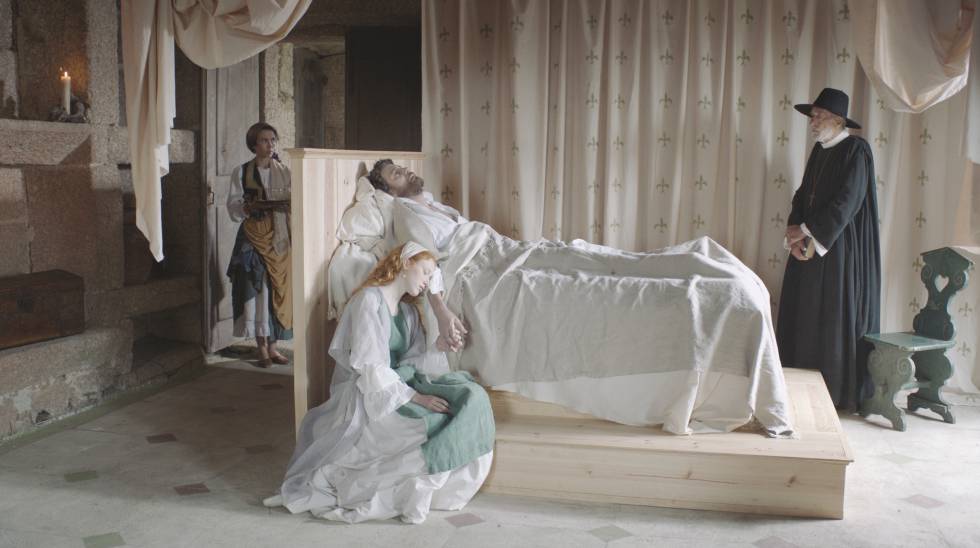
There is a type of Portuguese film - movie would be too energised a word - that explains why Portuguese cinema has never enjoyed its Spanish neighbour's international reach. Slow as molasses, as opaque and fathomless as the ocean itself, they are broadly to cinema what that laboured non-song with which Portugal won the Eurovision a few years back was to pop. The great Portuguese director Manoel de Oliveira wasn't beyond slipping into this listlessness from time to time in his pursuit of Lofty Art; it has also filtered down into the broccoli-like work of Pedro Costa, the cineaste 21st century cinephiles most have to grit their teeth and pretend to like. (Miguel Gomes, who gave us his sprightly Arabian Nights last decade, looks to have escaped this curse for now.) The Portuguese Woman, Rita Azevedo Gomes's curious adaptation of a Robert Musil novella, initially presents as rather ominous in this respect: it's a period drama, set out as a series of tableaux vivants, which clocks in at a fairly forbidding 136 minutes. Early on, as actors declaim heavy lines about the Bishop of Trent or otherwise wander wordlessly back-and-forth between adjacent rooms, you may start to wonder whether this will be another example of that type of Portuguese film. But it's too eccentric for that. The heroine, for one, is a redheaded horsewoman (Clara Riedenstein) who first appears to have been cast for her equestrian gifts - the way she gallops into a castle, an early sign of the film's restless, animal life - while a torch singer (Fassbinder muse Ingrid Caven, a stray remnant of Berlin cabaret) drapes herself in the background of certain scenes, sporadically ambling forth to belt out a song on an appropriate theme. I mean, it's different.

The argument would be that any residual listlessness here is entirely right for the story Azevedo Gomes is retelling. This is, after all, the story of a woman left behind: the Lady to a Lord, Von Ketten (Marcelo Urgeghe), Riedenstein's "Portuguesa" has been uprooted from her homeland and confined to a tumbledown castle in Italy with her never-more-aptly-named ladies-in-waiting to raise her newborn son while his Lordship is off waging war. Part of the pleasure of the film is the same pleasure one felt watching Portrait of a Lady on Fire, which is to say the pleasure of being immersed in a world without men, and allowed the time to notice the fabrics, the furnishings, the paintings on the ceiling, the changes of light in a room. All the designers under Azevedo Gomes's command appear to have been working overtime: it's clearly not the case that this production had a budget of millions at its disposal - a state of affairs that meshes with the impecunious couple at the film's centre - but the craftspersons involved have had to pick exactly the right weathered prop, or the right combination of weathered props, to hold the viewer's attention for as long as these scenes play out; they've been charged with providing the framework that contains what little narrative drama Azevedo Gomes has scraped from Musil's slender source material.

The director herself is no less busy persuading us that what she's creating here is cinema, rather than the novel, play or portraiture that material more readily suggests. She keeps her camera mostly static and shoots front-on, letting scenes run, but the longer those scenes run, the more aware we become of the extraordinary work she's doing with frames-within-frames, shadows and recessed space: you can be looking at the focal point of one scene - usually Riedenstein, with her translucent skin - for upwards of a minute before noticing a small group of huddled players secreted away in the opposite corner of the image. There will be critics better versed in art history who could brief you as to precedents: even a novice like me detected the influence of Velázquez, not least in Azevedo Gomes's insistent open-door policy, though the depth of her field equally reminded me of the contemporary photographer Gregory Crewdson, and a handful of scenes in milord's bedchamber have the look of Peter Greenaway, if Greenaway had let so much as a welcome, healthy breeze blow through his famously airless sets. What's crucial - what keeps us from yawning or switching off - is that opening up, which banishes listlessness and opacity, encouraging us to find the life in the shot that's been hidden away with the heroine. There's not much more to it than extreme formal virtuosity, but Azavedo Gomes does succeed in throwing open a window on a moment when a lady of leisure had more leisure than ever.

The Portuguese Woman is available to stream from today via MUBI UK.

Sunday, 19 July 2020

From the archive: "P'tit Quinquin"


Over a run of films from 1997’s La Vie de Jesus through 2006’s Flanders and beyond, the writer-director Bruno Dumont has gone in search of whatever miracles can be occasioned in the world nowadays – a quest that arguably peaked around the time a character was returned to life in 2009’s Hadewijch, a resurrection worthy of sincere comparison with Dreyer or Bresson. How do you top that?

Well, Dumont was invited by French broadcaster ARTE to expand his vision over a four-part television series, and the result – opening here in one single, 200-minute chunk – is an eccentric murder-mystery with echoes of such previous auteur-TV as Lynch’s Twin Peaks and von Trier’s The Kingdom. It’s not just timely but significant that its action should unfold over the summer holidays: it appears the work of a serious talent properly mucking about, resulting in as much a provocation as anything else in this director’s filmography.

As individual chapter readings (“La Bête Humaine”, “Au Coeur du Mal”) suggest, P’tit Quinquin does sort of tessellate with what’s gone before. Again, we’re in rural northwest France, in a little hamlet near the Normandy coast, where the local kids have nothing much to do save run wild. Our eponymous hero, young Quinquin (Alane Delhaye), leads a gang who could be the kids from E.T. – there’s a fat one, a skinny one, and a girl – were they not borderline feral, tossing firecrackers everywhere and continually roughing one another up.

New distraction is found when someone starts feeding human body parts to local cows, leading the foursome to take to their BMXs and shadow – read: get in the way of – the ensuing police investigation. Dumont’s most astounding gag, however, is that the officer sent to restore law and order – Bernard Pruvost’s Captain van der Weyden – can’t even keep his own body under control: his jerky movements and pronounced facial tics suggest some form of St. Vitus’s Dance, or Jonathan Pryce impersonating John Shuttleworth.

Van der Weyden arguably isn’t so far from the oddball lawman of L'Humanité; Dumont’s tilling the same realist farmland, just a couple of acres over. Maybe, after La Vie de Jesus and L'Humanité, nobody thought to ask Dumont whether he wanted to try something lighter; maybe those refuseniks who found those films’ strain for spiritual truth laughable spotted what the rest of us didn’t.

Either way, with the extended running time, you feel Dumont relaxing into this world, loosening up in a way that after his earlier, gloomier work comes as a miracle in itself. P’tit Quinquin makes for a pretty lackadaisical procedural – a joke that gets only funnier as the bodycount rises and van der Weyden appears no closer to identifying a suspect – choosing instead to parallel the kids’ inquiries with those of the grown-ups.

Anyone worried that Dumont has turned cosy can rest easy: traces of something edgier remain. In so far as this enterprise has a conventional throughline, it concerns the tetchiness that exists between the village’s white and non-white kids, which spills over into outright racism, and then a needless tragedy; it’s heavily suggested that the community’s insularity might explain the murders. (It might also explain the physiognomy of all present.)

The slackening of the narrative line allows the characters to run loose – like animals let off the leash – and for Dumont to better observe them in their natural environment: everybody’s at play (and slay) in the fields of the Lord, and the final moments suggest what we’ve been watching have merely been the opening, earthly skirmishes in an ongoing cosmological battle. (In this respect, P’tit Quinquin is very much like Twin Peaks; a second season has been mooted.)

There can’t, even so, have been that many series with so vivid a feel for a region’s faces and places, for its rituals and other idiosyncrasies, its ambient light and sound. You’d struggle to declare it a masterpiece – you’d have to pick your jaw off the floor, for starters – but it stands as a noteworthy fluke, a singular turn of events even seasoned arthouse observers could never have seen coming. Catch it now, in one go in the cinema, before it turns up on BBC4 over consecutive Saturdays and everyone goes mad for it.

(MovieMail, July 2015)

P'tit Quinquin is available on DVD via New Wave Films, and to stream via Curzon Home Cinema; a sequel, Coincoin and the Extra-Humans, will be available to stream from Friday and reviewed here this week.

Saturday, 18 July 2020

From the archive: "Short Term 12"


At first glance, Short Term 12 - a SXSW-approved breakthrough feature from the Hawaiian-born writer-director Destin Cretton - seems to gesture back towards the founding principles of the 1990s independent scene: you see it in the film's quiet attention to place, and to those marginalised lives playing out there. In this instance, the focus is on the teenage residents of a nondescript care home, and the twenty- or thirtysomethings drafted in to serve as mentors or guardians, big brothers and sisters, barely past the age of pimple-popping themselves yet obliged to occupy positions of immense responsibility. Cretton favours the slow drip of information. Though there are isolated episodes of acting up, much of the movie unfolds on becalmed, sleepy afternoons where there's nothing for these kids to do save hang out in one dorm room or another and open up to whoever's around about how they got here and how they're now feeling. The carers' energies are most keenly expended on Marcus (LaKeith Stanfield), a brooding 18-year-old gifted with mad rap skills yet quick to temper, and self-harming newcomer Jayden (Kaitlyn Dever), yet it's equally clear their makeshift custodians have stories to tell and scars to show for themselves: the pressure gets too much for embedded power couple Grace and Mason (Brie Larson and John Gallagher Jr.) when they learn they're expecting a child of their own together.

This material had its origins in Cretton's 2008 short, and the attenuated storytelling arguably speaks more to the attempt to spin that short into a feature proper than it does to the arduous processes of therapy. On the latter front, the film betrays a major hang-up on that very American idea of closure, and you feel it remoulding all its constituent traumas for neat, tidy conclusions; a final, audience-pleasing act of release is at once the quickest the film's pulse races, and its least convincing aspect. The filmmaker Cretton most resembles at this stage is James Mangold, who went over the course of a decade or so from the nicely atmospheric, ambivalent Heavy to the soapy care-home melodramatics of Girl, Interrupted and thence to making Tom Cruise and Wolverine movies: he's a work in progress. That Short Term 12 nevertheless retains a certain fragile promise is chiefly down to its excellent cast - particularly the funny, sympathetic Larson, here getting a deserved bump from supporting to lead status, and the very convincing Dever, who does something heartrending with a self-penned children's fable that speaks to Jayden's unhappy experiences. The last-reel reappearance of Melora Walters as a therapist, meanwhile, looks like a knowing nod back to that late-Nineties ur-text Magnolia - but that worldlier, stragglier three-hour opus knew slightly better than Cretton how much hard work forgiveness can be, and that it takes all the effort in the world to put a smile on some people's faces.

(November 2013)

Short Term 12 screens on BBC1 tonight at 11.55pm.

Friday, 17 July 2020

For what it's worth...


Top 10 films at the UK box office (for the weekend of July 10-12, 2020):

1 (re) Star Wars Episode V: The Empire Strikes Back (U) ****
(1) Onward (U) ***
3 (new) Black Water: Abyss (15) **
4 (2) Trolls World Tour (U)
5 (6) Dirty Dancing (12) ***
6 (re) Knives Out (12) ***
7 (7) Grease (PG) ****
8 (re) The Shawshank Redemption (15) *****
9 (re) Harry Potter and the Philosopher's Stone (PG) ***
10 (4) The Greatest Showman (PG)

(source: BFI)

My top five films currently on release:
1. Clemency
2. The Good Girls
3. Ghosts of War
4. Villa Empain
5. A Portuguese Woman


DVD/Blu-Ray/Download top ten: 

1 (9) 
Military Wives (12)
2 (5) Sonic the Hedgehog (PG)
3 (4) Frozen 2 (U) **
4 (3) Birds of Prey, or... (15)
5 (2) Dolittle (PG)
6 (1) The Invisible Man (15) ****
7 (6) 1917 (15) ***
8 (16) Joker (15) **
9 (7) Dark Waters (12) **
10 (8) Onward (U) ***

(source: officialcharts.com)

My top five: 
1. Parasite

2. The Assistant
3. True History of the Kelly Gang
4. Ema
5. The Invisible Man


Top five films on terrestrial TV this week:
1. Stand by Me [above] (Sunday, five, 4.25pm)
2. Maps to the Stars (Saturday, BBC2, 10.55pm)
3. For a Few Dollars More (Friday, BBC2, 11.20pm)
4. Short Term 12 (Saturday, BBC1, 11.55pm)
5. X-Men: Days of Future Past (Sunday, C4, 10pm)