Friday, 19 June 2020

Conservation: "The Day After I'm Gone"


The Israeli drama The Day After I'm Gone puts forward a strong contender for the most leftfield location of any 2020 release: a Tel Aviv safari park. For a while, writer-director Nimrod Antal's feature debut looks to be taking the scenic route, circling and thereby avoiding its central issue in the company of a character doing likewise. It's anchored by a sturdy performance from Menashe Noy, an actor who resembles Al Pacino if Pacino were an introvert, here cast as Yoram, a gruff, closed-off vet, brilliant (indeed, a lifesaver) in the emotionless, antiseptic space of the operating theatre, yet hopeless when it comes to connecting with any other creature. (You wonder to what degree local viewers will take him as representative of the Israeli male species.) This matters, because Yoram is raising a college-age daughter, Roni (Zohar Meidan), whose behaviour has started to veer towards the erratic: she comes back to the home the pair share in the early hours, when she comes back at all. Although it unfolds in a different milieu, this relationship isn't so far removed from that encountered in last year's Eighth Grade, and some real-life asymmetrical households besides. With the mother-wife who might translate or otherwise mediate between these two lost to illness, the pair have been left at odds, or at best in a state of mutual indifference - the extent of which is eventually revealed when the police show up one night to inform an oblivious Yoram that his child has attempted suicide under his own roof.

What follows, after Roni is discharged from hospital and father and daughter make an agonisingly silent journey home, is a film about the work required to repair pumped stomachs, slashed wrists, broken bonds. This is not as easy as it would be in any comparable American drama. Eldar is acutely aware of the distance between Yoram and Roni, a distance that possibly explains why dad can't ask daughter what she wants and needs without bellowing: here is a man with not much give in him. (When Roni asks what would have happened if she hadn't been rescued, Yoram gives a witheringly rational response that sounds more like sarcasm than sympathy.) At this point, the film takes its most American turn, redirecting father and daughter outwards on a road trip to see mum's grave and visit relatives in the Occupied Territories. Being in the car forces the pair to spend time together; it also obliges Yoram to adopt a less rigid stance than we've seen him do in the confines of the city. Here, The Day After I'm Gone begins to appear a little more conventional than a film that opens with leopard brain surgery would suggest, though there are surprises (like the revelation of Yoram's career as a reality-TV star) and some intriguing local specifics.

For starters, extending the focus beyond this one household might lead us to wonder whether being set in one's ways, refusing to budge an inch, isn't a national characteristic that's become the source of a national crisis. At the relatives' house, passing talk of the BDS boycott and a nightmare Yoram has involving a monument to a fallen soldier provide their own markers that this isn't the healthiest set of structures for anybody to be existing in. Equally, however, I think you could just admire Noy's skilful, rigorously unsentimental performance, giving the barest minimum scene by scene to camera and co-stars, yet gradually opening up a crack in the brick wall Yoram has constructed around himself, admitting not just the reality of this situation but his own liability in it, his own frailty. The film's finale, which really does come to seem like a small, quiet everyday miracle, rests on no more than a slight shift in mood, in a man as in a room - an upturning of a generally downturned mouth that signals things may well be better from now on, if not entirely A-OK. The work goes on, and has to go on. Here is a film that feels like the first, carefully weighted words in a conversation; as the sad passing of the young Bollywood star Sushant Singh Rajput at the weekend underlined, that conversation is often no less than a matter of life and death.

The Day After I'm Gone is now streaming on MUBI UK.

Thursday, 18 June 2020

A room with a view: "On a Magical Night"


The career of the French writer-director Christophe Honoré may just constitute the biggest fakeout in 21st century cinema. Honoré first emerged amid the millenium's New Extreme Cinema with 2004's pretty joyless Ma Mère, which set permagrump Louis Garrel to sulking, smoking and shagging everyone up to - and, inevitably, including - maman Isabelle Huppert. Since then, however, Honoré has more often than not been found engaged in the manufacture of cinematic bonbons, turning out melancholy musical-dramas - such as 2007's Love Songs and 2011's Beloved - as if he'd been told he was actually the rightful heir to the late, great Jacques Demy. In his latest On a Magical Night, the songs remain largely non-diegetic, but once more - as the film's English-language title signals - we find Honoré in upbeat mode. Or at least as upbeat as anybody can be when making a light comedy about marital separation. 

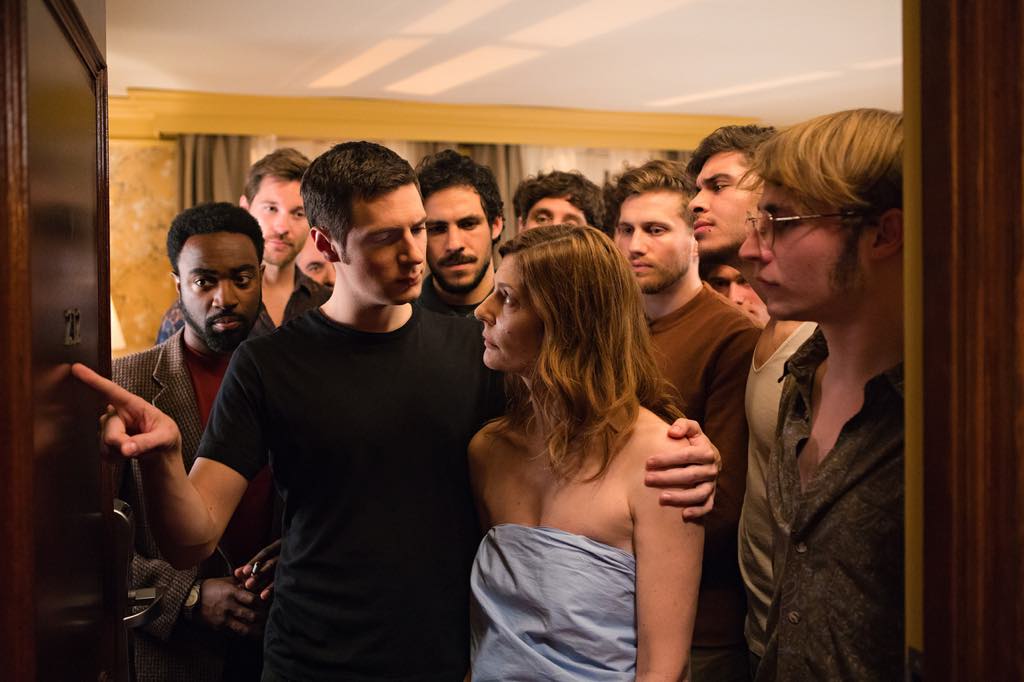
The set-up initially owes less to Demy than Woody Allen (to whom Honoré gives thanks in the closing credits), and at a time when Allen has been reduced to limp impersonations of his earlier, funnier self (cf. the recent A Rainy Day in New York), there might be some comfort to be taken in watching someone else doing a half-decent Allen impersonation. Chiara Mastroianni plays Maria, a married history professor with a roving eye for younger men (including her own students) who, after having her infidelities rumbled, checks out of her swanky Montparnasse marital pad and into a hotel room across the road that affords her a view of her heartbroken hubby (Benjamin Biolay). The twist is that this is a magical hotel room, which - among its other amenities - offers our heroine new perspectives on her past and an opportunity to confront her demons in the form of a younger version of hubby (Vincent Lacoste), whom she finds both more attractive and more communicative than the weary fortysomething on the other side of the street. This opening up of parallel realities, roads not taken is très Demy - it owes a lot to a handful of lines at the end of The Umbrellas of Cherbourg - although raising these possibilities in ironic tribute isn't quite the same as wearing your string theory next to the heart on your sleeve.

Elsewhere, your response is liable to be dictated by your immediate response to those three words "magical hotel room", which present as decidedly sugarcoated. (Told you Honoré was making bonbons, and that's before we get to the film's montage of half-eaten eclairs, abandoned in the quest for carnal knowledge.) You'll need to swallow them, and then go as matter-of-factly along with the ghosts' appearance as Maria herself does. If it helps, Mastroianni is giving the light-comic equivalent of John Cusack's performance in 1408, holding a throwaway premise together while sustaining viewer sympathies. It definitely helps that she remains stylish and charismatic in this task: I'm not sure whether Honoré has ever considered working with an icon of Juliette Binoche's standing, but this is absolutely the kind of role with which Binoche has been associated - though possibly it needed the clown in Mastroianni's genes to even half-sell us on that gaga premise. Certainly, the hotel-room scenes, which involve bedfuls of buff hunks and a passing Charles Aznavour impersonator, are more fun than the mopey business going on over on hubby's side of the street, where we observe Biolay, a sadsack Andy Serkis, settling like a well-worn beanbag into the fatherhood he's felt he's been denied. It's all fluff and nonsense, to be honest, and the ratio has long tipped in the latter's favour by the time of the slowed-down, John Lewis ad-bound rendition of "Could It Be Magic?" that rounds events off, but Paris - even as viewed from inside a hotel room that is also a magical hotel room - really does look lovely. There may be a degree of escapism for shut-in streamers here, if nothing much else.

On a Magical Night is available to stream via Curzon from tomorrow.

Wednesday, 17 June 2020

The girl with all the gifts: "Joan of Arc"


I remain hopeful we'll see Coincoin and the Extra-Humans, the second part of Bruno Dumont's rather brilliantly eccentric TV series P'tit Quinquin in cinemas or on a streaming platform soon. In the meantime, we have Joan of Arc, this ever more playful filmmaker's take on one of the defining French legends - a tale at which directors as diverse as Carl Dreyer and Luc Besson have felt compelled to take a run. (Joan of Arc is itself Dumont's sequel to 2017's Jeannette: The Childhood of Joan of Arc, unreleased in the UK; you won't necessarily need to have seen it to get the feel of the new film.) Dumont's take runs over the scrubland and sand dunes that formed the topography of his previous Slack Bay - one prominent feature of the acting: the breathlessness that follows from having to scramble repeatedly over such uneven terrain - and is distinguished by two elements. Firstly, his Jeanne is played by a ten-year-old (Lise Leplat Prudhomme), a casting flourish that gestures towards the warrior queen's innocence and the purity of intent she brought to her vision of the future (a free France), but also towards a relative inexperience in the field. This Jeanne's big problem is getting battle-hardened or otherwise dismissive adults to believe her and fight for her cause; she is very much a Joan of Arc à la Greta Thunberg. Secondly, though these are too few and far between for the film to be claimed as a musical, electropop numbers sporadically punctuate the action, and help to communicate those interior conflicts the film's variably expressive semi- and non-professional actors cannot. Needless to say, it'll take some getting used to; you might hurdle one of these conceptual coups and stand on the other as if it were the pointy end of a rake. What is clear is that Joan of Arc is very much its own thing; once again, Dumont has fashioned a film that marches to the beat of its own drum - and sometimes drum machine.

One reason producers have thrown their weight and money behind the Dumont approach - and he's more prolific now than he ever was in the first years of his career - is that he's been content to work with comparatively limited resources. For his Joan movie, he has at most 30 horse riders at his disposal, a panoply of previously standing cathedrals to shoot in, and he doesn't appear too fussed by the usual period-movie diktats about extras in fancy costumes: when Fabrice Luchini drops by for his one scene as the King, he does so apparently wearing an upturned and upholstered blancmange mould on his head. Occasionally here, Dumont will shape those limited resources into real cinematic poetry: take the early battle scene where, rather than charging, the riders arrange themselves into geometric shapes, as though competing in some demonstration event at the Horse of the Year show. A drone camera hovers over the battlefield, reframing this spectacle as either Jeanne's view (a vision of where she wanted her men to ride, like a whiteboard on the wall of a Premier League dressing room) or God's view (perceiving some grand and quietly beautiful design to the waging of war). At ground level, however, Joan of Arc more often than not proves less certain, even a touch wobbly - and some Dumont diehards will doubtless argue that such wobbliness in itself makes a refreshing change from the polished Downton school.

Nevertheless, it was a risk to hand 135 minutes of archaic historical exposition to semi-professional performers, and I wasn't ever convinced it was one that really repays viewer patience. Leplat Prudhomme makes for a compelling screen presence while still - or, rather, she's convincing as someone with a compelling cause - but even she tends to gabble her lines when prompted, like a fifth grader cast as Dorothy in a school production of The Wizard of Oz. Dreyer had the godly advantage of working during the silent era: he could cast interesting faces - as Dumont always has done, and does so again here - and not have to worry unduly about the sounds coming out of their mouths. I kept watching, because there are points where the movie gods look down upon Joan of Arc with a kindly eye, and the sparse, back-to-basics approach almost, almost works, almost reveals some new, instructive route through this story. Dumont elicits some droll fun from Joan's torturers, introduced after the manner of the gravedigger in Hamlet, moaning about their humdrum fate in the middle of a Pas-de-Calais nowhere; and the trial scenes can't help but benefit from having the grand majesty of Amiens Cathedral at their service, even if the sheer scale of the backdrop reduces Dumont's interrogators - and not just little Leplat Prudhomme - to the standing of pipsqueaks. They are, alas, mere flashes of inspiration: sporadic visions that don't quite flesh out, either into a directorial battleplan or truly involving cinema.

Joan of Arc will be available to stream via Curzon from Friday.

Tuesday, 16 June 2020

Young Marcel: "Resistance"


Jonathan Jakubowicz's Resistance invites judgement as the sum total of its casting choices, in which it is literally and figuratively all over the place; it's an illustration of how a good story when told in one spot by a single, committed narrator can be knocked wildly off-course when seized upon as an international co-production with a dozen polyglot producers tossing notes into a hat. A prologue finds the Venezuelan actor Edgar Ramirez playing an Orthodox Jew in pre-WW2 Munich, reassuring his son everything will soon return to normal shortly before being escorted off stage right by stormtroopers. Then, we lurch ahead to the end of the war, where Ed Harris as General Patton - one of Jakubowicz's better decisions - is regaling his troops with what we're told is a story that will make sense of the soldiers' sacrifices. Only then do we get the story itself, and it's a notable one: how the young Marcel Marceau - back when he was Marcel Mangel, stuck behind the counter of his father's charcuterie in Strasbourg - played his part in the resistance by helping to smuggle Jewish children out of danger. We know from his later career that Marceau could be relied upon to keep the mission hush-hush, but Resistance also means to impress on us how the mime-to-be honed his skills entertaining the kids on their journey. If you can make youngsters living in the darkest existential fear laugh, the thinking goes, then the world is your oyster - provided it stays a world in which we're free to laugh. Marceau is played by Jesse Eisenberg, who is to the Strasbourg of the early Forties what Ramirez was to the Munich of the late Thirties, and the casting leaves Resistance as a film that poses a unique philosophical question of both history and the viewer: what if Mark Zuckerberg had invented a machine to go back in time and stage his very own Sound of Music?

Such puckishness leavens what threatens to become another dull Europudding. Resistance isn't a film that works, but neither is it quite as ploddy as you might fear; instead, it jerks and judders along the way to the conventional heroism of its finale. This Marceau has a funny relationship with his father (the fine Austrian actor Karl Markovics), a serious man who can't believe he's been raising anyone so frivolous as a clown under his roof. The script has a bead on how resistance is often born of youthful rebellion - a desire to mock overbearing authority that came easily to a Chaplin scholar of Marcel Mangel's red-and-white stripe. A sincere, intelligent performer, Eisenberg fashions a kind of fun out of these early scenes, and the tighter the Occupation's grip, the more the actor's natural jitteriness makes sense for the role. The film around him, alas, parks its tanks on the border between fresh and cutesy, almost worthwhile and increasingly trying, Sophie Scholl: The Final Days and Roberto Benigni's Life is Beautiful. It never quite gets its tone or line of approach right, and you suspect that's the result of allowing a director to be beset by his producers. Jakubowicz - whose blunt kidnap thriller Secuestro Express got the Weinstein seal of approval a decade-and-a-half ago - reserves most of his energies for those setpieces in which Marceau and chums divert their fresh-faced charges beyond the gaze of the film's altogether uncomplicated Nazis. He seems almost to be sighing, however, whenever he's obliged to shoot scenes of Marcel bonding with the kids by pretending to be a squirrel, or sets about our hero's nowhere-bound romance with Emma (Clémence Poésy), knowing all too well these are the concessions serious filmmakers sometimes have to make to raise the funds and draw a crowd. Are these any worse than the concessions Jakubowicz made by folding Ramirez (who never appears again) and Harris (who has the indignity, come the closing moments, of being revealed as no more than Marcel the mime's warm-up man, reframing Patton as the Lennie Bennett of World War II) into that extraneous first act? Decide for yourself by all means, but Resistance struck this onlooker as decidedly naive history, requiring its audience be as wide-eyed and credulous as the average mime artist requires us to be wide-eyed and credulous.

Resistance will be available to stream from Friday.

Sunday, 14 June 2020

From the archive: "Prince Avalanche"


A rift looks to have opened up between director David Gordon Green and the new comedy superstars whose bandwagon he jumped on with 2008’s Pineapple Express and 2011’s The Sitter and Your Highness. In June’s This Is The End, Seth Rogen could be heard pitching ideas for Pineapple Express 2, with Green nowhere to be seen; worse, the not entirely unfunny Your Highness was dismissed in one conversational aside as every bit as regrettable for these hip showbiz bucks’ CVs as Bill Murray claimed Garfield was for his in the similarly meta Zombieland.

Green, for his part, has maintained a dignified silence, and now ventures back out on the road with Prince Avalanche, a remake of the Icelandic film Either Way (itself opportunistically rushed into UK cinemas this weekend) that picks up the Malick-y/Thoreau-ish thread in a filmography that began in the American heartlands with the tremendous George Washington and All the Real Girls; now, however, Green possesses an even easier rapport with his performers, and a fresh perspective on the kind of bromance he’s spent these past few years peddling.

The new film unfolds in 1988, and in the wake of the (real-life) bushfires that swept through Texas. A two-man road crew are hard at work respraying markings and sticking down the cat’s eyes. Alvin (Paul Rudd), the older of the pair, is a frowning, moustachioed stickler keen to use his days and nights in the wilderness to commune with nature and learn German, that most Romantic of tongues. Lance (Emile Hirsch), who happens to be Alvin’s girlfriend’s brother, has tagged along for the money, but clearly misses the heady thrills of the city.

Green’s recent bromances depended on a more or less complete disavowal of the opposite sex, but in Prince Avalanche, women come to be defined by their absence: the one flesh-and-blood example we see of the fairer sex, an old dear pottering confusedly around her fire-gutted home, is a mystery, possibly even a ghost. These guys miss the girls; it’s all they can talk and think about, and their experiences bring them closer together.

Lance, nicely played by Hirsch as a model of reckless, restless youth, confesses “nature makes me horny”, and it’s hardly surprising, given how Green and cinematographer Tim Orr contrive to cram more animal imagery into each frame than one might find in the average Talk Talk video; every last woodlouse and pendulously endowed donkey makes an appearance, but there’s just no Eve for these lonely Adams in this parched Eden.

This will become tragically apparent in the case of Alvin, compelled to mime a domestic scene in the rain amid the remains of one bulldozered property – the ruins providing an analogue for what’s left of his own collapsing relationship. Rudd, one of modern comedy’s subtler performers, pulls us in by suggesting the wistfulness and suppressed heartbreak stored up behind his bristling, officious moustache: this is the portrait of resigned middle-age that didn’t quite come over amid the ingratiating jollification of February’s This is 40.

Rudd can be very funny, as when he flexes his biceps in a bid to convince as the outdoorsy type or in his clumsy attempts to impress the world with his new-found language skills, but crucially, when his pent-up Alvin is given cause to chase Lance through the woods with a hammer, Green allows the pursuit to peter out in a silence that lets us feel the character’s pain – where an 18-wheeler of a movie like Pineapple Express would have ploughed on regardless.

As Mother Nature works her best effects on these boys, so too Prince Avalanche’s calmness works on the viewer, allowing us to hear those soothing or poignant notes that were drowned out or simply weren’t present in this director’s recent films. The roads these guys roam back and forth along, pondering where to go with their lives, become eloquent metaphors for all those conflicting impulses that lie at the heart of a man. Venture out alone, put up a tent, and try to live the life self-sufficient? (In this regard, the casting of Hirsch, wandering hero of 2007’s Into the Wild, is particularly resonant.) Or seek out somebody new, no matter that letting down your guard may result in only more pain?

Lance and Alvin rebuild, repaint and tarmac over the cracks; sometimes they take a drink, smash shit up, and then get back to the task in hand. Had it arrived closer to the time – and had Paul Schneider not been transferred elsewhere in the Parks & Recreation department – Prince Avalanche might have come as a sequel to All the Real Girls, one of the all-time great break-up movies. I write this as someone who sniggered as much as anybody during Pineapple Express and Your Highness: Green is moving back in the right direction here.

(MovieMail, October 2013)

Prince Avalanche is now streaming on MUBI UK.

Saturday, 13 June 2020

From the archive: "99 Homes"


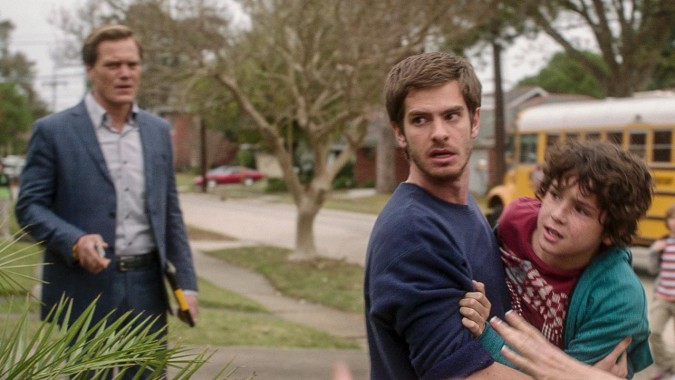
99 Homes is the latest of writer-director Ramin Bahrani's dispatches from working-class America, and its opening fifteen minutes, as close to a state-of-the-nation address as this director has ever filmed, are heartbreaking. Florida realtor Rick Carter (Michael Shannon) is introduced looming - as only a Shannon character can - over the former owner of a property the bank has just foreclosed on, a man who chose to put a bullet in his brain rather than incur the hardship of homelessness. This would be tragic enough, but the day-to-day detail of Carter's dirty work is every bit as wrenching: here he is showing up on the doorstep of the house struggling construction worker and single parent Dennis Nash (Andrew Garfield) shares with his mother (Laura Dern) and young son, and - despite the occupants' pleas - crowbarring them and every last one of their possessions out onto the front lawn, so he can snap this one-time home up and sell it on for profit. The desperate stakes are underlined when Dennis accepts a job offer from the man who's turfed him out: we might feel the proximity of neat screenwriting contrivance, if the job in question didn't require Dennis to enter a house that's been deliberately flooded with sewage, and thus literally wade through shit. A bond of some sort forms. Carter gains an extra pair of hands to help with the heavy lifting and recalcitrant tenants (whose language Dennis speaks all too well); in return, Dennis gains an education in the system that left him out in the cold, while getting paid - handsomely - for his endeavours. To you and I, of course, this alliance has the look of a deal with the devil - we wonder how long it can possibly last - but then beggars can't be choosers, especially not in this economy. 

What follows is a less-than-scenic tour of that part of Florida that bore the brunt of the late Noughties financial crash - modest homes, people clinging onto them by their fingertips - in the company of two eminently capable guides. Shannon's Carter, like many agents of late capitalism, has a way of insulating himself from the consequences of his actions ("I didn't kick you out; the bank did"), and a tendency to approach people as though they were secondary to his ever-expanding portfolio. (Even here, he insists "don't get emotional about real estate".) Yet he's never anything so straightforward as a monster, just a guy working a rigged system, and doing it well enough to have generated a surplus for himself (folding money, bricks and mortar, a wife and a mistress); we might have admired or envied him, as Scorsese and Terence Winter encouraged us to admire or envy The Wolf of Wall Street's Jordan Belfort, were Bahrani not so rigorous about showing us the lives and dreams this bastard has trampled on to get where he is. Confronted by the fresh-faced Garfield, some viewers will likely express the usual qualm that the actor's too youthful for the role, no matter that he's gained a pectoral tattoo and wields a mean drill. It's dramatically effective, however, that someone this angelic-looking should wind up pulling the same low moves as his mentor to keep a roof over his lopsided family's heads. If nobody's building, and eviction is your nearest growth industry, why not get your hands dirty? 

Inscribed through this rueful scenario like seaside rock is a sorry understanding that, with things being as they are, it may no longer be possible to get ahead in America without screwing somebody else over. That youth keeps Dennis's relationship with his mother interesting, too: it provides an oblique reflection of the arrested development capitalism brings about - leaving grown men and women living at home with their parents - and positions centre-frame a boy looking to his mom to know that what he's doing is right. The hurt on Garfield's face when he realises that he isn't is exactly that of a five-year-old who's been caught with his hand in the cookie jar: this, Bahrani says, is what we've all been reduced to. The name of the late Roger Ebert - an early supporter of this filmmaker's work - appears very prominently in 99 Homes' closing credits; wherever that doyen of the screening rooms is now, he'd surely offer two enthusiastic thumbs-up at the film's slowburn reassertion of conscience against the backdrop of an even wilder, ever more unregulated West. Underscreened and thereby overlooked on its UK theatrical release, this is the work of an independently minded creative demonstrating he can deploy name actors instead of non-professionals, and attempt something more commercial in his framing, while remaining engaged, committed, and self-evidently on the right side of this hellacious ongoing struggle.

(August 2017)

99 Homes screens on BBC1 at 11.05pm tonight, and will then be available to stream on the iPlayer here for the next month.

Friday, 12 June 2020

For what it's worth...


My top ten streaming picks (for the week beginning June 12, 2020):

1 (new) The Australian Dream (15) **** (via Amazon, Curzon, BFI)
2. The Uncertain Kingdom (15) **** (Curzon, BFI)
3. The County (12A) **** (Curzon)
4 (new) Virus Tropical (uncertificated) *** (MUBI)
5 (new) Days of the Bagnold Summer (12A) *** (via Amazon, Curzon, BFI)
6. Guest of Honour (uncertificated) *** (Curzon)
7. Woman at War (12A) *** (MUBI)
8. Dating Amber (15) *** (Amazon Prime)
9. MS Slavic 7 (uncertificated) *** (MUBI)
10. Mike Wallace Is Here (15) *** (Curzon)


DVD/Blu-Ray/Download top ten: 

1 (new) Dolittle (PG)

2 (4) Onward (U) ***
3 (2) 1917 (15) ***
4 (new) Parasite (15) *****
5 (1) Bad Boys for Life (15) ***
6 (7) Cats (U)
7 (3) Little Women (U) ****
8 (8) Frozen II (U) **
9 (new) Underwater (15)
10 (10) Jumanji: The Next Level (12)

(source: officialcharts.com)

My top five: 
1. Parasite

2. The Personal History of David Copperfield
3. Ordinary Love
4. Portrait of a Lady on Fire
5. Vivarium


Top five films on terrestrial television:
1. Room (Saturday, C4, 11.25pm)
2. Selma [above] (Friday, BBC2, 11.20pm)
3. Philomena (Sunday, BBC1, 10.30pm)
4. 99 Homes (Saturday, BBC1, 11.05pm)
5. The Cabin in the Woods (Channel 4, Sunday, 12midnight)