Saturday, 12 October 2019

"The Dead Center" (Guardian 11/10/19)


The Dead Center ***
Dir: Billy Senese. With: Shane Carruth, Poorna Jagannathan, Jeremy Childs, Bill Feehely. 92 mins. Cert: 18

The cult that gathered around Shane Carruth – the polymath writer-director-performer who dreamt up the equally brilliant and baffling Primer and Upstream Colour – might well want to reconvene for this effectively low-key chiller in which their godhead takes top billing, while ceding creative duties to the Nashville-based Billy Senese.

With its twin-track storytelling, Senese’s film owes less to Carruth’s filmography than to upmarket TV fare like True Detective and the recent Unbelievable. In one narrative line, a conflicted, corner-cutting psych ward doctor (Carruth) breaches the headspace of a hulking patient (Jeremy Childs) who revived in the morgue after an apparently successful suicide attempt; in the other, a medical examiner (Bill Feehely, bearing a useful resemblance to CSI’s William Petersen) heads into the field to investigate how this John Doe got on the slab, and how he got up off it.

Sensing any answer might test credibility, Senese troubles to establish a detailed, lived-in medical backdrop, staffed by overstretched pros who, while doing their best for some deeply traumatised individuals, realise both they and their charges are at the mercy of forces they cannot control.

Granted, there’s not much within this universe one might identify as truly original. The psych ward’s long corridors – whether deathly empty or overrun with chaos; no happy or even manageable medium here – are a horror staple; John Doe’s gift/curse inverts that of John Coffey, the life-giving lifer of Stephen King’s The Green Mile; and his fascination with spirals is one of several lifts from post-millennial J-horror.

What’s crucial is how Senese and cinematographer Andy Duensing film these elements: patiently, attentively, with a rare feel for space and ambient atmosphere, and a reluctance to turn over easy explanations that invites tantalising metaphorical readings, and counts as recognisably Carruthian.

As a standalone performer, Carruth is very solid, and in fact smartly cast as an authority figure who proves at least as inscrutable-to-difficult as those in his care. Yet the attention from doctors and camera alike makes this an even better showcase for the previously unnoticed Childs, a bug-eyed, upright presence who could pass for Michael Shannon’s older brother, and whose agonised primal screams are going to sound bloodcurdling coming through the right cinema sound system.

The Dead Center is now playing in selected cinemas, ahead of its DVD release on October 21. 

Friday, 11 October 2019

Super smash bros: "War"


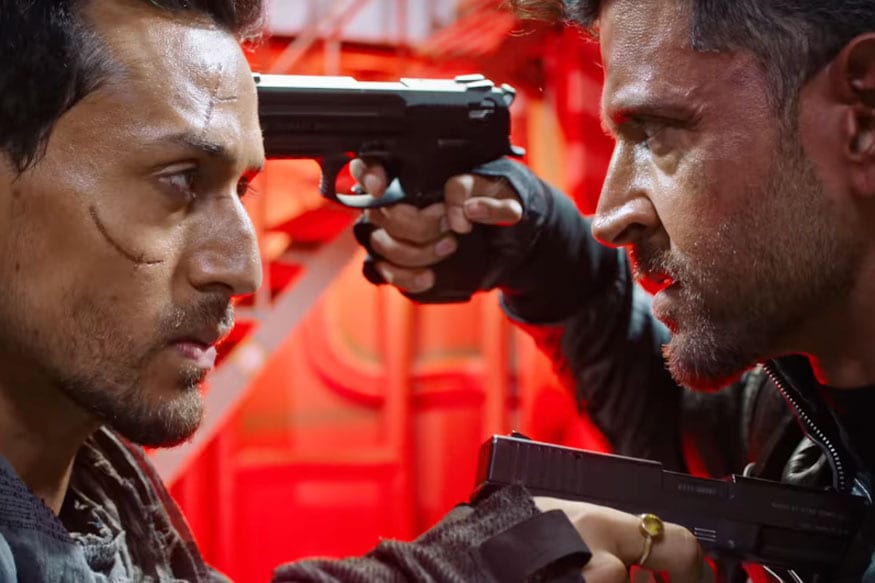
The 2019 Hindi release War shouldn't be mistaken for 2007's Jet Li/Jason Statham runaround of the same name, although its MO is not entirely dissimilar: repeatedly bash two chiselled lunks of wood together, as drummers do their sticks upon the commencement of battle, and hope enough of a crowd comes out to investigate what that rumbling sound might be. Lunk one is the honey-eyed, magnificently jawlined Hrithik Roshan as Kabir, a seething intelligence operative who's gone rogue while hunting India's most wanted terrormonger. Lunk two is Tiger Shroff as Kabir's sometime protege Khalid: upright and bulging, with a faintly concerned air, like an electric toothbrush bulked up on a diet of whey protein. The pair have previous. Khalid's dad once betrayed Kabir back in the day, and almost the entire first half is given over to detailing how the boys' paths bifurcated after one especially disastrous mission in the Middle East. But - man, oh man - how they look at each other, and how they dance together (this being one of Bollywood's now vaguely unfashionable masala movies, where national security successes are celebrated with scenes of uncommonly limber hoofing to hi-NRG dance music): with the certainty of hardened gym bunnies who know they've met the sparring partner of their dreams, or the one who might just blow them to kingdom come. As many observers have noted since War opened last week, any innuendo lurking in that phrase is very much there on the screen.

It needs to be said: from start to finish, War is near-total nonsense. It will take in, to cherrypick a few of its choicer developments, a villain who changes their identity - multiple times - with the assistance of India's top plastic surgeon; a cell phone hidden in a grilled rainbow trout; and a second half that comprehensively overturns the premise of the first. Furthermore, it's derivative nonsense: boiling down to that none-more-Nineties question "Where's the flashdrive?", this is an unapologetic throwback, which differentiates it from those recent Hindi films trying new or newish things while exploring the "new India". What War also is, though - and this is likely why audiences have turned out in such numbers for it over the past seven days - is an example of what can happen when a studio (in this instance, the equal parts rich and canny Yash Raj Films) invests properly in its nonsense. Several weeks ago, I found myself lamenting how cheap the medium-high octane action scenes in Angel Has Fallen looked: as if, in this post-2008 austerity moment, audiences were being asked to cheer for whatever dusty scuffles the remnants of the Hollywood system have left in them to kick up. (The summer's Hobbs & Shaw suffered from the same issue to a lesser degree, which is why it threw up the altogether prosaic sight of Idris Elba revving a motorcycle past a Greggs in Glasgow-passing-for-London. In this context, the return of the unstintingly profligate Jerry Bruckheimer with Gemini Man and the upcoming Bad Boys 3 cannot come soon enough, whatever the merits or otherwise of those movies.) 

War's budget (its War-chest?) bounces viewers breathlessly from Tikrit to the Gold Coast via the Med and the Arctic Circle, yet the producers' wisest investment came in backing the writer-director Siddharth Anand. Anand has clearly watched The Fugitive and Heat (and the local variations thereof) many times over: he knows the action form, and has a sharp, intuitive sense for what works within it. War has a simple, tried-and-tested concept - two men prepared to pursue one another to hell and back, or (as the above itinerary would frame it) to the ends of the earth - but it's simple enough not to require undue explanation, and simple enough for the movie not to come a cropper over it. It's simply there to yank us through the carnage at top speed; it's all we can do to hold on and see where it carries everybody. The action scenes - Tiger's one-man raid on a druglord's mansion (an apparent single take that establishes Anand's eye for spatial continuity), Hrithik's Mission: Impossible-ish takedown of a military supply plane from above, a razz around the backstreets of a Portuguese coastal berg - are absurdly big. Thumping, too, whenever they approach the matter of hand-to-hand combat: it's a multiplex-bound actioner that wears its 15 certificate as a badge of honour. Four action directors are credited, and each looks to have brought something worthwhile to the table. The setpieces are predominantly analogue (as opposed to digitised), making jolting use of those stunt teams who've been sitting round twiddling their thumbs since the first green screen was rigged up, and they retain an appreciable internal logic: however stroboscopic the editing gets, we never lose sight of which character's out front, and who's playing catch-up.

With responsibility for these expensive money shots delegated, Anand seems to have enjoyed himself mightily catching the grace notes that emerge in the midst of this mayhem, much as car windscreens catch flies when propelled at speeds of 70mph and beyond. A flaw Kabir identifies in Khalid's peripheral vision during an early training sequence inevitably returns to narrative play come the finale; there's something very charming in the way the boyish Khalid (Shroff arrives here off of May's Student of the Year 2) refers - or defers - to Kabir as "sir" long after the latter has been established as India's most wanted; and when Kabir removes his wraparound shades and tosses them up in the air mid-shootout to see in their reflective lenses the exact whereabouts of those firing on him, style is successfully wedded to function. Even the faintly sappy post-intermission scene in which Kabir schools the orphan girl he's inherited on his travels (told you it was nonsense) as to the lessons one can take from a school soccer game - "It doesn't matter who wins or loses, so long as you can say you've given your best" - seems to reflect Anand's own plan of action. Watching War, you get the impression (sadly rare in big-budget cinema) that everyone - especially Hrithik, never more so than when piloting a motorbike away from a fireball while sporting a replacement pair of sunglasses - gave of this ridiculous material their very best, which is why it emerges as the year's most unexpectedly enjoyable popcorn movie.

War is now showing in cinemas nationwide.

Wednesday, 9 October 2019

Sorry for laughing: "Joker"


Ten years ago, Todd Phillips ascended to the Hollywood A-list upon the runaway success of The Hangover, in which the director's piledriver comic touch reduced a hall-of-fame comedy pitch to fitful mediocrity, hammering every last punchline into the ground for the benefit of those dunderheads who'd found Judd Apatow's human comedies too subtle. You might have felt punchdrunk even before the problematic Mike Tyson showed up for a nudging cameo that demonstrated Phillips had no truck with the so-called PC brigade; hey, what happens in Vegas stays in Vegas, right? Except it didn't: a sequel headed to Thailand, principally for the purposes of taking cracks at the country's transgender sex workers, before Part III - seemingly cowed by the outrage levelled at its predecessor - settled for bland amiability, and an acknowledgement of just how quickly this joke had exhausted itself. Since then, Phillips has taken a turn for the serious, perhaps inspired by the acclaim lavished on the recent works of longtime Will Ferrell enabler Adam McKay (The Big Short, Vice). McKay went serious to teach us something; that's why his films often come over as didactic. Phillips has gone serious for different reasons: to paraphrase his words in an interview published last week, "woke culture is killing comedy", a sentiment that suggests someone needs to pull his head from his behind and sit him down before, to cite one of many possible examples, TV's It's Always Sunny in Philadelphia, which has found ever more inspired ways to razz the excesses of both the PC and non-PC brigades. (As ever, if no-one's laughing at your jokes, it may not be the culture. It may just be you.) Following up 2016's already forgotten War Dogs, a foreign-policy goof that set nothing and nobody alight, Todd Phillips Serious Artist now brings us Joker, a Venice Golden Lion-winning origin story for the clown that fought Batman which seeks to monetise white male frustration and rage much as recent Marvel movies have monetised wokeness. There is, after all, a lot of it about. 

If it weren't so obviously and intrinsically cynical, Joker could at least be admired for the way it sets itself up as a lightning rod for all manner of contemporary concerns. The antihero's first line is "Is it just me, or is it getting crazier out there?"; one of his closing lines, delivered just before he assassinates a public figure on live television, is "Everyone is awful, it's enough to drive you crazy." (He is at least consistent, both in his worldview and his tendency to speak like the whiniest and most self-pitying of manboys.) What falls in between builds a grim tension, in order to enable an even grimmer release. The tension follows from the humiliations visited upon Arthur Fleck (Joaquin Phoenix), a lowly sign twirler in the rat-infested Gotham City of the early 1980s, who lives with his ailing mother (Frances Conroy) and displays an underlying instability Phillips signals via a close-up of the words "mental illness" Fleck writes in his notebook in totally twisted handwriting. The first hour works overtime to establish Fleck as Gotham's most miserable loser, yanking him through menial labour, personal slapdowns, professional rejections and social faux pas; once he takes delivery of a gun and sets his sights on comic-turned-talkshow-host Murray Franklin (Robert De Niro), we're basically sitting waiting for the wiry, strung out Phoenix to snap. Phillips made his directorial debut with 1993's Hated, a profile of the shit-slinging rocker GG Allin, and followed it with 1998's Frat House, on the fallout from some especially vicious college hazing rituals. Clearly, he has a longstanding fascination with individuals who cross the line separating victim from aggressor; Joker slots into this filmography as not a million miles away from a textbook radicalisation narrative.

How far we've come since Jack Nicholson made this role his own thirty years ago. That Joker was the kind of fun carnival turn cinemagoers once expected to see at the multiplex, a flamboyant spot of pantomiming from a performer operating well beyond the point of caring what anybody thought of his choices. Since then, our Jokers - Heath Ledger, Jared Leto in Suicide Squad, now Phoenix - have got progressively more neurotic and self-involved, too busy smearing greasepaint over their inner demons to do anything so frivolous as crack a funny. (Points to anyone who can guess what this says about us as a society.) Phoenix brings some of his usual skill and full-bodied commitment to the project - contorting his features and his torso into an ambulant Munch scream - but we might wonder to what end his talents have been co-opted here. A dreadful, heavy suspicion persists that the actor has been cast to lend some tortured-artist charisma to a character who is fundamentally a mopey, wormy sadsack, the kind of non-entity who fails to trigger automatic doors. (The thumping slapstick that results comprises the one laugh in the whole two hours of Joker, and perhaps only one that could have been engineered by the director of The Hangover.) What are we supposed to feel for this guy? At no point in my adult life have I felt an urgent need to discover where Batman first sourced his cape, but I can understand why creatives have routinely returned to his origin story, to explore where heroism - or caped crusading, vigilantism, whatever you want to call it - comes from. Affording the same treatment to an entirely fictional villain teaches us what, exactly? That even grinning sociopaths start out as one of us? Well, Todd, you're going to have to define the "us" there.

If there were a single flicker of genuine human emotion in this mechanically exploitative picture, that line of inquiry might have yielded something. Instead, Joker is both benumbed and numbing, a succession of cattle-prod impulses that don't amount to a damn thing. Nothing gets developed beyond the anti-hero's morbidly misanthropic outlook: not his tentative pursuit by the cops (a heinous waste of Bill Camp and Shea Whigham), nor the Kill the Rich movement that springs up in the Joker's wake. (We only know it's called Kill the Rich from a newspaper discarded in the margins of one frame; its recruits go remarkably underdiscussed for a mob attempting to overthrow the established social order.) Instead, the screen fills up with empty gestures: a bizarre ballet Fleck performs in a dishevelled washroom (beneath - of course - a flickering striplight) after his first killing, the happy/sad faces Phoenix pulls at either end of the movie, the dismantling of a fridge that looks like the kind of Methody nonsense an A-list actor can get away with under the eye of a credulous director, but which in and of itself adds precisely zilch to our understanding. Elsewhere, Phillips appears to know exactly what buttons he's pushing, the fire he's playing with: that's why he sets the creepy Arthur to fondling the young Bruce's face through the gates of Wayne Manor, and subsequently sets the first public appearance of the ghoulish Joker to the strains of a Gary Glitter track. Like any wannabe edgelord, there's no fear or insecurity he won't prey on, whosoever profits, whatever the taste it might leave behind. The movie's opening weekend take indicates Phillips has been successful indeed in courting that growing demographic of depressives and malcontents who've found the superheroic promises the movies have been making since 9/11 count for diddly squat in the real world. Yet this viewer is old enough to remember the days when Hollywood escapism sought to carry us outside ourselves, and didn't just jab artlessly and haphazardly at an audience's weak spots.

Joker is now playing in cinemas nationwide.

Monday, 7 October 2019

1,001 Films: "A Story of Women/Une Affaire de Femmes" (1988)


A Story of Women is yet another Chabrol movie where we're invited to wonder whether the protagonist will get away with it - though surely only the most fundamentalist of viewers would consider this particular protagonist a murderer. Its source is a 1986 book by Francis Szpiner recounting the true story of Marie-Louise Giraud, a Cherbourg woman who, in the midst of the Nazi occupation, established a brief but profitable sideline as an abortionist-for-hire, offering her services to women who couldn't face the idea of bringing another hungry mouth into their already straitened households, or who felt no urge to be a mother when the father was unlikely to return home from the front, or who'd simply fallen pregnant by gadabout German officers. For the film's remarkably (chillingly?) practical Marie (Isabelle Huppert), practising abortions is "no harder than anything else" at a moment of such strain: at least she gets a sliver or two of soap and a decent handful of notes out of it.

21st century viewers will almost immediately be set to thinking of Vera Drake, yet in contrast to Mike Leigh's insistent (though hardly unjustified) seriousness, Chabrol demonstrates a far lighter touch. The script - which Chabrol wrote with Colo Tavernier - takes the form of a compendium of stories that speak to the place of a woman in wartime, some grim, yes, but others blackly comic, most full of life. Marie longs to be a singer - at one point, she accepts a record player in lieu of payment - and so we're never more than a scene or two away from music and dancing; her peculiar narrative arc represents the closest the movies have come to a feminisation of the gangster or spiv movie template. Chabrol puts front and centre the blunt fact that his heroine came to make a killing in at least one sense. As her clients pass through, Marie's house gets notably brighter and lighter and full of fancy things otherwise unavailable under rationing: furs, jam, lipstick, even a handsome younger lover after she abandons her shellshocked, pant-shitting soldier hubby (François Cluzet).

Viewers will have to decide for themselves just how sympathetic this makes her, and in its accumulation of properly knotty, tricky ironies - not least the suggestion the War might have been a boom time for some; or, to translate, that there's money in death - the latter-day film A Story of Women most closely resembles is Verhoeven's steely-eyed Black Book of 2006. It wouldn't be a Chabrol movie without a betrayal somewhere down the line, yet even if you don't especially warm to Marie herself, you can't help but notice and savour the immense skill in Huppert's complex, multi-faceted portrayal of a woman who found an unlikely calling in life: providing her country with a service the powers-that-be weren't prepared - and, in certain places today, still aren't prepared - to acknowledge or ratify. The gut-punching closing stretch will make you consider your own position on abortion every bit as much as A Short Film About Killing made you consider your own position on the death penalty.

A Story of Women is not currently available in the UK.

Sunday, 6 October 2019

On demand: "Call Me By Your Name"


The film that launched a thousand memes on first release, Call Me By Your Name now looks a curiously old-fashioned affair - an arthouse throwback in which attractive people in photogenic surrounds work through the feelings stirred up by the newcomer in their midst. It's so old-fashioned it builds towards a tearful leavetaking on a railway station platform; so old-fashioned it follows that with a handing down of wisdom from father to son. In retrospect, the presence behind the camera of Luca Guadagnino - the emergent Italian stylist who lit up screens with I Am Love and A Bigger Splash - may be of far less significance than that of writer, producer and apparent creative prime mover James Ivory, late of Merchant-Ivory and first to see the sensual cinematic possibilities in André Aciman's 80s-set source novel. The newcomer, as you will be aware by now, is Oliver (Armie Hammer), a tall, strapping masters student who arrives at the Italian country retreat of American archaeology professor Michael Stuhlbarg to commence a summer of field studies. Most affected is the prof's bumfluffy 17-year-old son Elio (Timothée Chalamet), the skinny, oft-shirtless focus of many of those memes, who gives up his room to the new arrival, but gains intimacies besides in return: a warm body in his bed, someone with whom he has to share a bathroom and on whom he develops the most throbbing of teenage crushes. At once, the film presents as less fusty than those arthouse favourites of the 1960s/70s that dealt with relationships between intellectual men and their young female acolytes, principally by adopting a perspective close to the junior party when faced with a (slightly) old man; the setting may be Italy, but these characters are following in the footsteps of the Greeks.

This led to a measure of disappointment in certain quarters when the film proved far less fleshy than certain viewers were clearly anticipating: a freshly plucked peach sees more action than the camera ever does, and one coyly chucklesome pan from the boys on the bed to a nice tree out of an adjacent bedroom window may lead some to wonder from which decade the film hails exactly. Even that discrete manoeuvre, however, is true to the summery Rohmer fables that are Guadagnino's obvious inspiration here - films from an age when a glimpse of Claire's knee was all viewers were given to go on. The reaction (I may mean over-reaction) to CMBYN upon its debut seems like yet another illustration of just how film culture has changed since the millennium. Those Rohmer films were part of the fabric of international cinema, a small handful of the literate, sophisticated dramas that emerged every week, month, year. Guadagnino's film - no less of a romance for civilised adults - was converted, via the now-standard festival-circuit hype, into an Oscar-worthy event, announced as the thinking person's awards bait, then turned over to the mothmen and scarab beetles of Film Twitter so that its every aspect might be embroidered and picked over. Perhaps it's no surprise that those devotees of social media should have wanted more in the way of instant gratification; two decades of full-frontal assaults from Gaspar Noe and Carlos Reygadas, among others, have left the arthouse crowd thirstier than ever, and in certain quarters, the simmering desire of the classics may no longer hit the spot.

Still, to cavil at CMBYN for that is to ignore the film's essential warmth: it has far more blood in its body than similar movies by Joanna Hogg (Archipelago) and Olivier Assayas (Summer Hours), to name but two. That warmth extends beyond the climate - caught in Apichatpong Weerasethakul associate Sayombhu Mukdeeprom's dreamy cinematography, which meshes very specifically with the viewer's own memories of times in the sun - to, say, the fond observation of the dorky, white-socked shapes Hammer pulls on the dancefloor to the Psychedelic Furs' "Love My Way", or of what the bored, antsy Elio gets up to on those sticky afternoons when he's the only one left in the villa, or indeed of the near-stereotypical Italian couple who, having been invited to join this party for dinner, proceed to gesticulate their way through all three courses. At all these junctures, Guadagnino sits, waits and watches, leaning into a lingering embrace of these characters - thereby creating the kind of memories they too might carry into later life - rather than hunting for quick, cheap thrills. Playing the long game allows him to overcome the (admittedly, not unenjoyable) superficiality of his earlier films; the proximity of Ivory - a steadying hand, from another era of period romances - has been good for him. The sincere interest the film displays in archaeology helps to set the characters in some wider historical context, and sets the camera to thinking about more enduring elements than flesh or fashion. (Watching Elio tail Oliver around a dig site, you may recall George Sanders and Ingrid Bergman picking over the pieces of a marriage during their own Journey to Italy. Told you it was a throwback.)

One surprise a few years down the tracks is that there weren't more outright spoofs among the memes: this is, after all, the kind of determinedly high-minded film in which one character enters a room asking "Darling, have you seen my Heptameron?" This may be down to the absence of French and Saunders-style sketch shows from the contemporary TV schedules. (I suspect Harry Enfield and Kathy Burke, in their erstwhile Kevin and Perry modes, would have had a lot of fun with it.) Yet it's also surely attributable to the affection we, too, come to feel towards these characters. Hammer, for all his Ivy League-schooled affections, seems genuinely flustered by the young buck's attention, and chivalrously determined to do the right thing by and with him; and without expending himself unduly, Chalamet really does give the 21st century's defining portrait of what it truly means to be a horny, sulky teenager on holiday, with time on your hands and the world at your feet. I still maintain this isn't the most dramatic of movies: for a queer-leaning coming-of-age tale set in the early 1980s in a notoriously macho country, the stakes are strangely low, because absolutely no-one on screen seems opposed to Elio and Oliver coupling up. (The kid's parents - Stuhlbarg and Amira Casar - are real sweethearts; right through to dad's closing words of wisdom, it's a film set back then, but informed by a very modern set of attitudes, which takes another edge off it.) What it finally is, after all the fuss and buzz, is no more or less than a nice movie, one that puts us alongside people (and actors) we like in a place we might want to visit or revisit every once in a while. As any archaeology student worth their MA could tell you, it's not the first movie to do that; and though market forces may presently be against this, it almost certainly won't be the last.

Call Me By Your Name is available on DVD and Blu-Ray through Sony Pictures, and is now streaming on Netflix. 

Saturday, 5 October 2019

1,001 Films: "Who Framed Roger Rabbit" (1988)


Above everything else, Who Framed Roger Rabbit was a very savvy extension of the Disney brand, from a moment - the late 1980s, before the revival sparked by The Little Mermaid - when the corporation could have been forgiven for packing away its felt tips for good. The masterstroke of Robert Zemeckis's film was to retreat to the Hollywood of the 40s and 50s, the last time the studios had a first-rate roster of animated talent to populate their movies with; and so we find Dumbo as an on-loan contract player, Betty Boop doing the rounds as a cigarette girl, and those two rival ducks of animation, Daffy and Donald, sharing a squawking piano duet. Into this world stumbles boozy, washed-up studio detective Eddie Valiant (Bob Hoskins), put on the case of Maroon Pictures' second biggest star after the eponymous rabbit is accused of murdering the head of the rival ACME studio. The cited motive is jealousy, but - like a PG-rated Jake Gittes - Valiant grows convinced conspiracy is afoot; his investigation isn't helped by the fact his client, an unlikely sidekick and now Toontown's most wanted, is determined to make the sourpussed flatfoot laugh.

A Looney Tunes pastiche generates more entertainment in the first five minutes than most contemporary blockbusters offer in two-and-a-half hours, but also sets a high bar for the live-action business; you may wish a little more of the cartoon's wit had seeped into the subsequent feature. Who Framed Roger Rabbit also stands as one of the first examples of what became a movie commonplace: a mainstream entertainment where the villain embodies the same corporate interests that gave life (or at least money) to the film itself. Christopher Lloyd's Judge Doom is intent on reducing Toontown to "billboards, wonderful billboards", presumably of the kind Disney now routinely sling up to promote their school-holiday releases; as it seemed at the time, there's still an air of misjudgement about the finale of what's ostensibly a family film, requiring the bad guy to first fall under the wheels of a steamroller and then (as in the 18-rated Robocop) finished off in a chemical spill. (Such peculiarities of tone are rife in Zemeckis's biggest hits: the flirtation with incest in Back to the Future, the depiction of Jenny's sex life in Forrest Gump. You get the impression he'd have developed into a very different filmmaker had he not been landed at an early stage with the reputation of Hollywood's go-to guy for wholesome, PG-13 success stories.) The animation - overseen by Richard Williams - is strong, but what increasingly holds the attention nowadays is Hoskins's excellent work in one of the toughest acting assignments of the decade: remember this was back in the late 1980s, before performing in front of blue or green screens had become a standard feature of the film actor's day. A few scenes with flesh-and-blood love interest Joanna Cassidy aside, Hoskins ventures into uncharted territory here, and never betrays the fact - even when handcuffed to a hyperactive bunny, being tossed around by a gorilla, or having to act out the hots for a female cartoon.

Who Framed Roger Rabbit is available on multi-format DVD through Disney.

Friday, 4 October 2019

For what it's worth...


Top Ten Films at the UK Box Office 
for the weekend of September 27-29, 2019:

1 (1) Downton Abbey (PG)

2 (2) Ad Astra (12A) ***
3 (5) Hustlers (15) ***
4 (new) Ready or Not (18) ***
5 (3) It: Chapter Two (15) **
6 (new) Fleabag - NT Live 2019 (15) [above]
7 (4) Rambo: Last Blood (18)
8 (6) The Lion King (PG)
9 (9) Dora and the Lost City of Gold (PG) ***
10 (new) The Goldfinch (15)

(source: BFI)

My top five: 
1. Midnight Cowboy

2. Honeyland
3. For Sama
4. The Farewell
5. The Climbers


Home entertainment Top Ten (DVD/Blu-Ray/Download): 

(2) Aladdin (PG)
2 (new) The Secret Life of Pets 2 (U)
3 (1) John Wick: Chapter 3 - Parabellum (15) ***
4 (4) Avengers: Endgame (12) **
5 (3Pokemon: Detective Pikachu (PG)
6 (7) Godzilla: King of the Monsters (12)
7 (5) Rocketman (15) ***
8 (new) X-Men: Dark Phoenix (12)
9 (6) John WickChapters 1-3 (15) ***
10 (10) Bohemian Rhapsody (12)

(source: officialcharts.com)

My top five: 
1. Eighth Grade

2. Only You
3. Booksmart
4. Rocketman
5. Thunder Road


Top five films on terrestrial TV:
1. La La Land (Saturday, BBC2, 9.20pm and Friday, BBC2, 11.45pm)
2. Bee Movie (Saturday, BBC2, 8.40am)
3. National Treasure (Sunday, five, 5.30pm)
4. To Catch a Thief (Sunday, BBC2, 12.30pm)
5. X-Men (Sunday, C4, 11.05pm)