Thursday, 20 June 2019

Suzie goes to Hollywood: "Division 19"


Division 19 is one of those done-on-a-shoestring indies that may ultimately function better as showreels than they do as entertainments people might pay to see. The British writer-director Suzie Halewood, who garnered some favourable reviews for her 2008 crime caper Bigga Than Ben before going off-radar, has struck out for Hollywood to construct herself a brave new world: a desaturated vision of 2039 L.A., where anonymity is deemed illegal, citizens are subject to 24/7 surveillance, and prisoners are deployed as money-spinning entertainment brands, thumping one another as the main attraction on pay-per-view television. As that last trope suggests, this world has been constructed out of the bric-a-brac of a thousand other filmed dystopias. Division 19 opens with a tear-down-the-system monologue straight out of the Tyler Durden playbook; the title does a very precise job of locating the action that follows within touching distance of both Neill Blomkamp's District 9 (monitoring stations hover over Halewood's city) and the Luc Besson-produced District 13 franchise (the hero's hacker brother has enlisted a team of free runners to help overthrow the status quo). Lording over proceedings - in a role previously occupied by The Running Man's Richard Dawson, Fortress's Kurtwood Smith and Elysium's Jodie Foster - is the estimable Linus Roache, who makes a very big deal of delivering one pun ("Ex-fucking-con Factor"); Dutch import Lotte Verbeek is the bored widow who - in the most rote scene of any 2019 release - throws herself at our hero for the sole reason that that's what a bored widow does in this type of film. Clarke Peters of The Wire shows up for an afternoon's work as a tech-whizz refusenik whose spacious hideaway contains a big noticeboard covered with index cards connected with bits of string. In the future, evidently, original ideas will be at a premium.

The likely reason Division 19 has landed this theatrical outing - rather than simply being funnelled towards the streaming dumpster, as our more derivative content is nowadays - is that Halewood and director of photography Ben Moulden work up what initially proves a most diverting look. You wouldn't need me to tell you that it surpasses most of the tatty British indies we see, but the first act would give certain studio movies a run for their money. With minimal resources for large-scale VFX at their disposal (the monitoring stations have been skilfully computed, but the blasts they send out are, well, suboptimal), Halewood and Moulden do a lot with overviews of an otherwise deserted L.A. (and Detroit passing for L.A.) being overrun by massed ranks of hoodie-clad revolutionaries. For twenty minutes or so, it doesn't matter that these frames generate zero atmosphere, and that what's going on within them is another muddled runaround; thereafter, you start to wonder whether having to shoot out of the way at odd times of the day killed any sense of unrehearsed activity, and to feel sedated by the dead air circulating where the project's pulpy, subversive life ought to have been. One revealing line in the otherwise unremarkable screenplay: when asked what he used to do in the days before his flight from the powers-that-be, our prisoner-turned-fugitive protagonist Hardin (Jamie Draven) drawls "advertising". Division 19 does rather have that feel: something that catches the eye for a few seconds, but has nothing to hold it, or indeed the attention, thereafter.

Division 19 opens in selected cinemas from tomorrow.

Wednesday, 19 June 2019

The wanderer: "Amin"


It will eventually carry us into tricky, perhaps even problematic territory, but we won't see many films this year more steeped in life as lived at ground level than Philippe Faucon's Amin. A prologue makes a brisk survey of a community of African and Middle Eastern migrants working hard to prop up the French economy; only after we've been instilled with some sense of how these men spend their days (a hand-to-mouth existence pulling long shifts within the construction industry) and their nights (swapping wages for beer in small backstreet bars, with scant thought for the future) do we really get to spend any time with the central character. This is Amin (Moustapha Mbengue), a foursquare Senegalese who finds himself supporting two economies simultaneously. Most protagonists in the recent wave of migrant cinema have left somewhere for good; Amin, by contrast, is obliged to shuttle back and forth between his homeland and France, leaving wife and kids behind to make the Euros he can smuggle back into Senegal to help reshape the lives of his family, friends and neighbours. A lot rides on these broad shoulders, in other words: he's an especially long-distance commuter, and a man who's made himself an absent father for the express purpose of laying foundations. A further complication awaits. While renovating one residential property, Amin strikes up a relationship with its owner Gabrielle (Emmanuelle Devos), a divorcee nurse involved in a bitter custody battle with her ex. Here is a second home, if ever there was, and given the exhausting overtime the renovation entails, and the nurse's sudden desire for soothing male company, perhaps it's inevitable the pair soon tumble into bed. The money Amin once took home to his wife in person begins to be wired through instead.

You may detect the faintest strain of melodrama in this set-up - perhaps a distant echo of Fear Eats the Soul, Fassbinder's enduring tribute to the lowly gastarbeiter - yet Faucon holds it at bay, first via the plaid-workshirt plainness of his shooting style, then a deeply idiosyncratic editorial approach. That men-at-work prologue, it turns out, isn't an isolated diversion. Frequently, the focus shifts towards secondary characters - Amin's colleagues, the nurse's daughter, the old woman standing at the next window in the money transfer office - in a way that gestures towards the complexity (and possible connectivity) of these lives. (A closer precedent than Fassbinder would be Robert Guédiguian, whose work - right through to this past January's The House by the Sea - has generally kept an eye out for those washing up on France's shores.) Is it any more than a gesture, though, I wonder? Faucon's approach is such that Amin, hopping from site to site in solidarity with its characters, itself starts to seem temporary, sketchy even. There's something honourable in this: Amin's story is deemed only just more important than what's going on back in Africa, or at the next window, or in the life adjacent. The risk is that we don't pick as much up about this man as any straightforward character study would give us; that it reduces him to mute passivity, forever passed over or looked beyond. With his hesitant French-as-second-language, first-time actor Mbengue cuts a very different figure from Eric Ebouaney in last week's A Season in France; that's partly down to the relative status of these protagonists - the latter's Abbas was more settled - but also, I fear, down to Faucon's skimpy characterisation. I could never quite shake the suspicion Amin had been conceived first and foremost as a walking irony - homebuilder turned homewrecker - rather than flesh and blood, no matter how many sex scenes he's pitched into. Glib platitudes are dodged, and at no point are we allowed to fall into complacency; it's still refreshing to chance upon a movie that insists life is more complicated than most movies allow for. You'll just have to weigh these qualities against Faucon's reluctance to hold to a satisfying narrative line (c'est la vie, hein?), and his restless shifting around a blank protagonist who is finally neither here nor there.

Amin opens in selected cinemas from Friday.

Monday, 17 June 2019

Ba-ba-bank robbery: "The Captor"


The Captor is a generic retitling of a movie that emerged in the US this past April as Stockholm, and which replays what an opening credit describes as the "absurd but true" events that gave us the phrase "Stockholm syndrome": Sweden's first ever stick-up job on a bank in 1973, overseen by a figure who went by the alias Kaj Hansson. The latter is played here by Ethan Hawke, reuniting with writer-director Robert Budreau, for whom he played Chet Baker in Born to Be Blue. Weirdly, there's an element of crossover between the two films. Hawke's Hansson demonstrates a certain rockstar charisma, leading the taxi driver conveying him to the bank in question to wonder whether he's in town for a music festival; he carries a radio with him alongside his pump-action shotgun, allowing him and his associate (Mark Strong) to caterwaul along with Dylan at one point. (Like the credit said: absurd but true.) Once he's donned wig, leather jacket and American accent (a detail that excuses the non-Swedish casting), we sense him attempting to take control of this stage, both as an actor (demanding the release of his ensemble from prison, and a cool million-krone payday for himself) and as a director of sorts, bellowing instructions at the bank's employees, one of whom, a mousy, married clerk by the name of Bianca Lind (Noomi Rapace, with Deirdre Barlow specs) came to, well, love it. Even after Kaj held a gun to her head.

As a film, The Captor suffers from some of the familiar limitations of the medium-budgeted, multiplex-bound international co-production. Though Budreau drops in the occasional shot of crowds massing behind police barriers outside the bank, the bulk of the activity plays out indoors, on a cavernous set that enhances the idea Hansson's idea was a form of theatre but strands the viewer nowhere especially Swedish. Budreau's script, meanwhile, steadfastly refuses to approach this story as anything other than a cray-cray taproom anecdote, generating plenty of laughs but no real insights. There would surely have been scope for a more psychologically searching treatment of these events, some reflection on just how oddly people can act under extreme duress, and you can't help but think the actor who aced the pent-up priest in Paul Schrader's First Reformed and the actress who gave us the original (and best) Lisbeth Salander would have very much been up for that challenge. As it is, the film remains strangely incurious about Bianca, who could have made for a fascinating character study - a settled salarywoman who abandoned some of her usual certainties (not just a husband, but a small child) when faced with the swaggering bad boy Hansson - were the role not so underwritten. Rapace mostly has to signal defences lowering by removing those glasses; we seem to be nearing some breakthrough or revelation just as The Captor fades to black and rolls the closing credits.

The funny thing is: it is a heck of an anecdote told straight, and another demonstration of Hawke's newfound ability to organise a movie around himself. Introduced combing his droopy moustache, his Hansson is a vain narcissist and, as Hawke senses and conveys with great aplomb, a terrible ham: not the Al Pacino of the roughly contemporaneous Dog Day Afternoon, but the Pacino of the ad campaigns that followed it, perpetually yelling and hollering, and looking parodically aggrieved whenever events don't break his way (which is often). This element of human comedy is further punched up whenever the straight-laced chief of police (Christopher Heyerdahl, in the godly lineage of Max von Sydow) descends from the bank's upper floors, where his team have installed themselves, to offer notes or frown at Hanssen like a parent rebuking a wayward child. By the time Kaj is caught screeching "I hate you! I hate you!" at this unflustered figure of authority, you realise the role must have been a tremendous release valve for Hawke after the self-denial of the Schrader movie: for a grown man with the weight of the world on his shoulders, swap in a brat who's been told he can't have the sweets he wants. (Is that why Bianca was so drawn to him, that he was a replacement child who needed mothering?) In order for The Captor to work, we too have to watch this stick-up go comprehensively to pot and still fall on some level for the less-than-mastermind behind it: I wouldn't say I'd lay down my life for Kaj Hansson, but Hawke makes him unpredictable fun to be around.

The Captor opens in selected cinemas this Friday.

Sunday, 16 June 2019

On demand: "Stree"


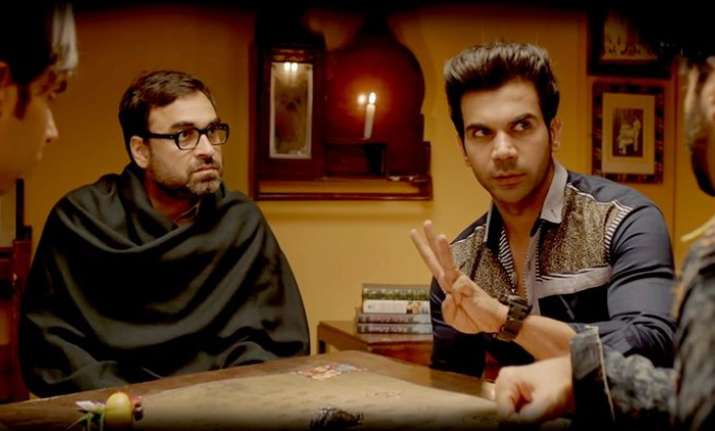
In the two years since the conclusion of the Telugu epic Baahubali bestrode the international box-office like a colossus, the Indian mainstream has doubled down on all things big, yielding a procession of long, lavish magnum opuses: Padmaavat and Thugs of Hindostan last year, Manikarnika and Kalank this. Local audiences, perhaps understandably feeling overstuffed, have instead started to gravitate towards smaller, lower-profile, more distinctive diversions, such as the beguiling comedy-horror Stree, one of the sleeper hits of 2018. Amar Kaushik's film is well-managed and carefully composed, running just two hours rather than the now-standard three and constantly altering the shape of its central conflict, such that it never becomes entrenched. It's also, purely and simply, a great deal of fun; you can see why movielovers turned out for it so. Rather than requiring D.W. Griffith-scale sets, much of the action plays out within the confines of a superstitious rural village where even now, in the second decade of the 21st century, the residents hold firm to a belief in the Stree, a witch who adopts human form to prey upon single men. Bad news, this, for our hero Vicky (Rajkummar Rao), a guileless tailor introduced tumbling head over heels for the spookily serene new girl in town (Shraddha Kapoor). Having seen movies enough, you and I will have some idea of what he's getting into; the running joke, however, is that the protagonist is basically clueless, somebody very much to be toyed with.

The set-up allows Kaushik and the emergent writing team known as Raj and DK to themselves toy with what the opening credits describe as a "ridiculously true" folk legend, while throwing in plenty of knowing scary-movie business. Not for the first time in a film such as this, there are rules to guarantee survival, but they're delivered by Pankaj Tripathi (the crime boss in Netflix India's Sacred Games) in the guise of a distractible, prissy scholar. The Stree's first victim is shown preparing for an evening of what's euphemistically referred to as "friendship" with a lady of the night. And when Vicky is handed a list of tasks by his mysterious new sweetheart, the score takes on some recognisable Mission: Impossible bombast - no matter that said mission involves no more than our boy figuring how to get his hands on a lizard to remove it of his tail. The script, meanwhile, is fashioning its own form of amusement circumnavigating viewer expectations and warding off any misogyny that might lurk amid its mythos. The poor old Stree, it transpires, is as much of a victim as those she's been led to prey upon, this time of a patriarchal society's assumptions. That much becomes clear in the unusually strong second half - always a litmus test for modern Bollywood; the movie doesn't peak too soon - as the village empties out and Vicky assembles a ragtag team of ghostbusters to shoo the spirit in the direction of peace.

Here, Kaushik makes merry with his story beats and delights in his ensemble, particularly the droll Tripathi and the sleepy Aparshakti Khurana, whose Bittu can be witnessed eating a banana during one team meeting, presumably as it's important to keep up potassium levels when dealing with the undead. Funnier still is Raj, more character actor than star, but an increasingly reliable kitemark of quality - he was the crusading lawyer in 2012's Shahid and the faux-romantic hero of February's Ek Ladki Ko Dekha Toh Aisa Laga - who here gets to stutter and stammer and seem to care not one jot that much of the joke is on him. (One great, subversive image late on: Vicky in newlywed garb perched atop a rock like a siren, yet conducting himself in the manner of a lamb to the slaughter - a lure not just for the Stree, but for any analysts of gender in Bollywood cinema, who'll note how this makeshift damsel-in-distress is occupying a spot the movies have traditionally reserved for the fairer sex.) Representatives of that generation bombarded into submission by the Conjuring franchise and its myriad spin-offs may find there isn't enough quiet-quiet-loud for their liking. Yet Kaushik swaps in other forms of surprise (throat-singing!) and ample wit besides: to these VHS-trained eyes, Stree really wouldn't look out of place in a double- or triple-bill with any of that weirdly memorable Eighties run of comedy-horrors that began with Vamp and The Monster Squad and eventually begat Beetlejuice.

Stree is now streaming on Netflix.

Friday, 14 June 2019

For what it's worth...


Top Ten Films at the UK Box Office 
for the weekend of June 7-9, 2019:

1 (1) Aladdin (PG)

2 (new) X-Men: Dark Phoenix (12A)
3 (4) Rocketman (15) ***
4 (3) The Secret Life of Pets 2 (U)
5 (new) Take That - Greatest Hits Live (12A)
6 (2) Godzilla: King of the Monsters (12A)
7 (new) Bharat (12A) **
8 (new) Casino Royale - Secret Cinema (12A)
9 (6) John Wick: Chapter 3 - Parabellum (15) ***
10 (new) Late Night (15)

(source: BFI)

My top five: 
1. Kind Hearts & Coronets [above]

2. A Season in France
3. The Adventures of Priscilla, Queen of the Desert
4. Gloria Bell
5. Liam Gallagher: As It Was


Home entertainment Top Ten (DVD/Blu-Ray/Download): 

1 (29) Stan & Ollie (PG) ***

2 (new) The Lego Movie 2: The Second Part (U) ***
3 (3) Bohemian Rhapsody (12)
4 (1) How to Train Your Dragon: The Hidden World (PG)
5 (new) The Mule (15)
6 (2) Bumblebee (PG) ***
7 (4) Glass (15)
8 (10) Aquaman (12)
9 (5) The Secret Life of Pets (U) **
10 (6) Mary Poppins Returns (U) ***

(source: officialcharts.com)

My top five: 
1. Sauvage

2. Beautiful Boy
3. Liam Gallagher: As It Was
4. A Private War
5. Can You Ever Forgive Me?


Top five films on terrestrial TV:
1. Babe (Saturday, ITV, 1.45pm)
2. Mia Madre (Saturday, BBC2, 12.45am)
3. What We Do in the Shadows (Sunday, BBC2, 11.15pm)
4. Billy Elliot (Saturday, BBC1, 10.20pm and Friday, BBC1, 12.10am)
5. Whisky Galore! (Sunday, BBC2, 11.30am)

"The Hummingbird Project" (Guardian 14/06/19)


The Hummingbird Project **
Dir: Kim Nguyen. With: Jesse Eisenberg, Alexander Skarsgård, Salma Hayek, Michael Mando. 111 mins. Cert: 15

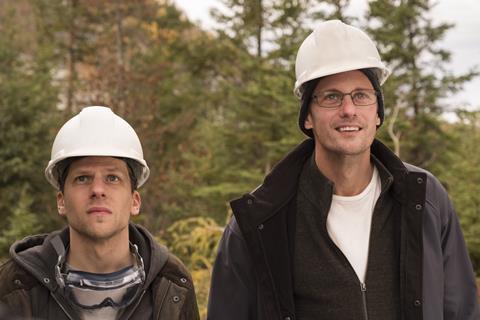
At last, the starry drama about fibreoptic cable-laying the world has been crying out for. Part of me wants to cut this enigmatic drama from Canadian writer-director Kim Nguyen some slack for going out of its way to disprove the notion there are no longer any truly original concepts in North American cinema: it’s markedly distinct from anything currently showing, and you’ll be amazed anybody heard this pitch and thought to open a chequebook rather than, say, calling security. Yet scene-by-scene, Nguyen’s sketchy question-mark of a film proves so leftfield it risks seeming esoteric or – with its technical dialogue on the matter of “neutrino messaging” – openly baffling, the kind of verbose corporate parable David Mamet would sit down to write only after a heavy night on the sauce.

Jesse Eisenberg plays Vincent, an ambitious day trader pumping his resources into digging a tunnel between Kansas and New York, a scheme designed to tap stock market data a millisecond faster, and thus turn him a sizeable profit. To this end, he has recruited his nervy coder cousin Anton, played – in the first of many bizarre choices here – by Alexander Skarsgård beneath a bald pate that immediately recalls BBC arts editor Will Gompertz. Skarsgård wasn’t alone in spending long hours in hair and make-up puzzling over this script: Salma Hayek, as the ruthless CEO the pair aim to undercut, has her lustrous locks dipped in grey paint and offset with NHS specs. Eisenberg, meanwhile, contends with tummy trouble, for Vincent’s burrowing sets off rounds of doubtless symbolic intestinal distress.

What can it all mean? The business of rewiring America for personal gain feels secondary to Nguyen’s vision of characters who, for all their efforts to connect, appear deeply alienated. Around the neutrinos, one spies some conventional messaging about faster communication not necessarily equalling better communication. Yet it’s so erratically delivered you suspect scenes have gone missing; Vincent’s unhealthy obsession is conveyed via a Morse code of Eisenbergian yammering. It’s a rare misfire that makes one want to see more from its maker: we get intriguing ideas, images and locations, and enough close-ups of excavation equipment to enrapture plant-hire enthusiasts. With few narrative or thematic hook-ups, though, I guarantee a lot more headscratching before this working definition of a curio.

The Hummingbird Project opens in selected cinemas from today.

Thursday, 13 June 2019

Citizens of nowhere: "A Season in France"


Mahamet-Saleh Haroun is the Chadian writer-director who, with French funds, has filed some of the most astute and engaging film-dispatches to have come out of Africa since the turn of the millennium: 2002's Abouna, 2006's Dry Season and 2010's A Screaming Man all secured UK distribution, while 2016's honourable political inquest Hissène Habré, A Chadian Tragedy played at that year's London Film Festival. His latest feature A Season in France, another notable contribution to the current wave of artistic responses to the question of migration, follows characters who might easily have figured in Haroun's earlier African films as they strive to put down new roots on the European mainland. By the standards of the huddled masses recent cinema and TV have depicted scrambling for their lives, Abbas (Eriq Ebouaney), who's fled civil war in the Central African Republic for a fresh start in Paris, has it pretty good as we join him. Granted, he has to hop from temporary lodgings to temporary lodgings, son and daughter in tow, as he waits for his appeal to be heard by the Court of Asylum; on the other hand, he's found steady employment on a market stall, and love with a colleague, Carole (Sandrine Bonnaire). Yet the further Haroun leads us inside this limbo - the dreadful pause to hear whether you have the right to exist in the place where you live and work - the more certain sadnesses become apparent. Abbas is haunted by the spectre of his late wife, which has started to impact upon his relationship with Carole; and unlike his happy-go-lucky daughter Asma (Aalayna Lis), his closed-off son Yacine (Ibrahim Burama Darboe) has grown resentful of dad's inability to keep the same roof over this already lopsided family's heads.

Spending time among these characters allows us to notice how Haroun's school of social realism is more overtly stylised than, say, the Dardennes, who worked a similar narrative beat with The Silence of Lorna and The Unknown Girl. Haroun doesn't move his camera much, and there's none of that on-the-fly, over-the-shoulder faux-vérité by which the Dardennes get us into their protagonists' heads and shoes. Instead, he stands his ground - putting down roots Abbas cannot - and simply observes, unafraid of deploying lighting shifts, sound effects or Wasis Diop's spare, unobtrusive score to move our emotions around. He spots, in passing, the sudden chill of privilege Carole feels sat in a waiting room among asylum seekers, knowing they'll likely walk out of this space with their lives changed one way or another; mainly, Haroun uses the camera to find a distinct, politically pointed line of approach to his asylum seekers - meeting them square on as vulnerable, flesh-and-blood men. Both Abbas and bookish family friend Etienne (Bibi Tanga) are suffering from a sexual impotence that feels inextricably linked to their powerlessness as citizens, their fears of a knock at the door in the night, the erosion of their role as providers of shelter. (It's the dramatic flipside of the impotency theme running through Ousmane Sembene's great African satire Xala.) We see the sting when Yacine huffs "a real father would have his papers", and we witness this man withering in other departments, too, losing his job, his temper, his nerve. With nothing to prove his existence, Abbas becomes very nearly as ghostly as his wife's apparition; first he howls, then he disappears into the ether.

That phallocentric element may complicate matters, threatening to reduce A Season in France to no more than just another film made by a man about the experiences of a man. (Factor in the racial aspect, and it's a heated argument waiting to happen.) Reassurance lies in the unarguable fact Haroun made this film about this particular man: a gentle, nurturing giant - pushing a placeholding diet of omelettes and pears upon his offspring - who, through circumstances beyond his control, comes to question all the decisions that have led him to this point. It might sound unbearably sad, but Ebouaney creates a touching, understandably harried intimacy with Bonnaire, and he's great with the kids, who emerge over the course of these 100 minutes as forceful personalities in their own right. It's a tremendously empathetic performance: deprived until the closing moments of any explanatory monologue, he instils in us a rich sense of what Abbas has lived through, the things he's seen, and just what he's lost (or abandoned) along the journey to what he'd hoped would be secure ground. The film around him operates at the level of quiet tragedy, too nuanced and melancholic to start hectoring its audience, although it gathers an unexpected, accusatory power in a final movement that carries us from limbo to haunted wasteland. The fixed timeframe of the title reflects how Haroun links migration to a form of nostalgia - a longing for the fixed points and home comforts of the past that manifests in the present as a restless, draining, possibly futile search for certainty. I don't think you'd necessarily have to have travelled from the Central African Republic to feel that way nowadays.

A Season in France opens in selected cinemas from tomorrow.