Saturday, 18 February 2017

From the archive: "Testament of Youth"


In Testament of Youth, a fine act of remembrance for the dead of World War I, a face becomes a battlefield. The face – subtly, sometimes gravely beautiful – belongs to Alicia Vikander as Vera Brittain, whose first-hand account of the Lost Generation would become as essential to our understanding of this conflict as Anne Frank’s diary would be to our understanding of life under the Nazis. The first time we see it, it is palely haunted, drained of all life, and decidedly out of place amid the Armistice Day revelries; a two-hour flashback reveals why this young woman was in no mood to party.

Those who’ve read Brittain’s memoir, or seen the much-admired TV adaptation of 1979, will already know the reasons, but this big-screen version, directed by James Kent from a script by Juliette Towhidi, makes a point of delaying the inevitable. In the spring 1914 scenes, unflustered kids frolic in the wide-open spaces of the early 20th century: here, at least, Vikander’s Vera glows, attracting male admirers as a flame does moths, before discarding them in pursuing her own path to Oxford. Yet dreaming spires provide only scant shelter from storm conditions, and what Vera sees, hears and experiences over the next four years comes to be written upon Vikander’s features: any greenery is soon torn up, the blossom and dew stripped away as it surely was on the fields on Ypres and Passchendaele. As beauty is despoiled, so too is innocence lost.

Towhidi knows how much of this story’s impact is tied up with Brittain’s prose, and how eloquently it issued the teenager’s standard cry of “it’s not fair” when faced with the expectations imposed upon her generation. (Men: do your bit, and hope not to catch a bullet. Women: marry young, and hope your swains will someday return.) Through voiceover and letters, she’s retained much of its internality, its sometimes clumsy and faltering yet always heartfelt poetry, without sacrificing any narrative momentum. For their part, Kent and cinematographer Rob Hardy have found atmospheric means of describing the slow march to war, and its destructive effect on the landscape. The emerald lawns of Brittain’s Buxton home and the Oxford quads, the comforting pastels of Vera’s knitwear, gradually disappear, replaced by the sombre browns of mud and blood, the black of bomb-blasted battlefields. The fresh air of those early interludes drains out; mustard gas prevails.

Hallmarks of the Well-Made British Period Piece remain, not least a BAFTA-sturdied supporting cast: Emily Watson and Dominic West give deft sketches of privilege as Ma and Pa Brittain, and broadly half the cast of the recent Mapp and Lucia drop by for afternoon tea. Yet this Testament attains its rare emotional focus by demonstrating the effects of war on its cast’s fresher faces: there’s an argument Kent even bests Gone with the Wind’s Atlanta sequence by cutting back into his own towering crane shot revealing the full extent of the carnage, to retrieve his heroine, shellshocked in the midst of it all.

As every foolish, youthful dream gets trampled into this mire, these faces will be angered, numbed and, in the worst cases, disfigured, and Kent holds to the idea there’s more power in framing these front and centre than there is from fussing unduly about the genre’s usual bows and ribbons. The result approaches both its material and its period with commendable delicacy and sensitivity: it’s some sign of Kent’s achievement that he can even quote Brief Encounter in one railway station leavetaking, and not seem like a haplessly reaching copyist. The sense of separation and loss this admirable film evokes really is that acute.

(MovieMail, January 2015)

Testament of Youth screens on BBC2 tonight at 9pm.

Friday, 17 February 2017

For what it's worth...


Top Ten Films at the UK Box Office   
for the weekend of February 10-12, 2016:
   
1 (new) The Lego Batman Movie (U) ***
2 (new) Fifty Shades Darker (18)
3 (1) Sing (U) ***
4 (2) T2: Trainspotting (18) **
5 (3) La La Land (12A) ***
6 (5) Lion (12A) ***
7 (4) Split (15) ***
8 (6) Hacksaw Ridge (15) ****
9 (7) Rings (15) ***
10 (new) The Space Between Us (PG)

(source: theguardian.com)

My top five:   
1. Toni Erdmann
2. Loving
3. Moonlight
4. John Wick: Chapter 2
5. The Founder 
 

Top Ten DVD rentals:  

1 (1) The Girl on the Train (15) *
2 (2) Deepwater Horizon (15) ***
3 (3) Bad Moms (15) ** 
4 (4) Suicide Squad (15)
5 (6) The Secret Life of Pets (U)
6 (5) Sausage Party (15) ***
7 (7) Star Trek Beyond (12) ***
8 (8) War Dogs (15)
9 (re) Ghostbusters (12)
10 (10) Mechanic: Resurrection (15) **

(source: lovefilm.com)

My top five:  
1. Under the Shadow
2. The Girl with All the Gifts
3. Kubo and the Two Strings
4. Anthropoid
5. Julieta


Top five films on terrestrial TV this week:   
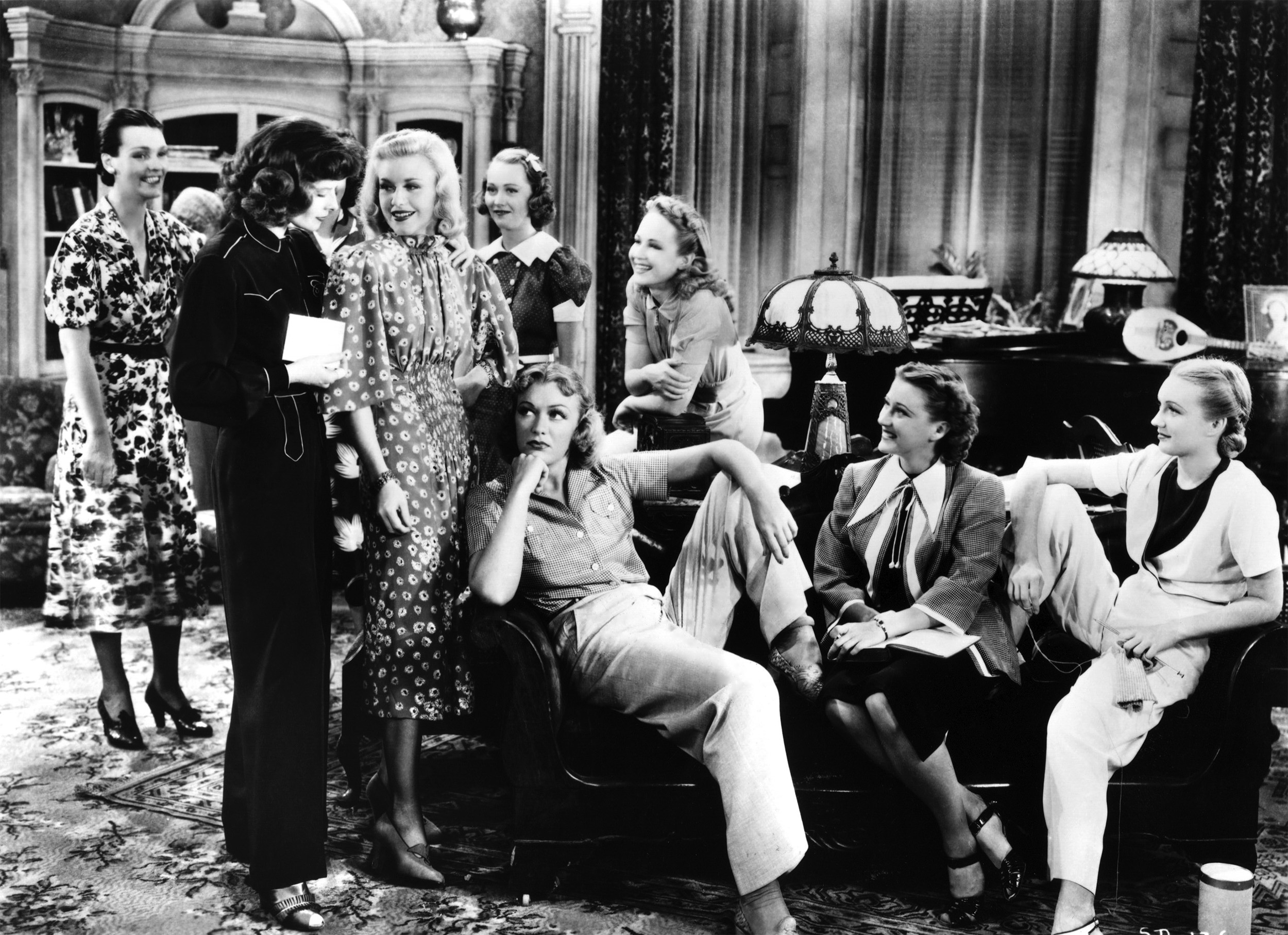
1. Stage Door [above] (Saturday, BBC2, 6.30am)
2. The White Ribbon (Saturday, BBC2, 12.55am)
3. Testament of Youth (Saturday, BBC2, 9pm)
4. Being A.P. (Sunday, BBC2, 10pm)
5. X-Men: Days of Future Past (Sunday, C4, 9pm)

Where's the beef?: "The Founder"


The latest item off cinema's conveyor-belt of business stories - which seems to have gone into overdrive the closer America's Business President™ got to the White House - would appear far likelier to coincide with an audience's tastes and interests than all those movies about the fluctuations of the stock market in the wake of the 2008 crash, or any project involving Matthew McConaughey overseeing the day-to-day operations of a South Asian goldmine. Indeed, most viewers watching The Founder in their friendly neighborhood megaplex will be doing so approximately ten minutes' walk from the phenomenon-cum-juggernaut whose origins it describes, for John Lee Hancock's film concerns the making of McDonald's, and the breaking of the brothers who actually gave that name to popular culture.

It opens in 1954, where we find travelling salesman Ray Kroc (Michael Keaton) having no particular luck attempting to shift industrial kitchenware from the boot of his car. His world - our world - changes when an order for half-a-dozen milkshake mixers comes in from the San Bernardino base of overstretched pattyslingers Mac and Dick McDonald (John Carroll Lynch and Nick Offerman). After consulting the map, Kroc heads West to achieve his destiny and claim his fortune - by seizing upon the McDonalds' establishment as the basis for a nationwide franchise, replacing the dairy in the shakes with powder, while bulking out the ideology. It was Kroc who hit upon the idea of the Golden Arches, and the notion of referring to both your workforce and customer base as "family" - a touch ironic, given his screwing-over of Mac and Dick, and the negligence he displayed towards then-wife Ethel.

This, then, is the point at which brotherhood ceded to rampant individualism, product to branding, and capitalism - the simple exchange of money for goods - to corporate capitalism, with its insistence on suppressing costs, inflating profits and crushing the opposition. We thus await a film as toothy as its leading man, one that might do for fast food what, say, The Social Network did for Facebook... and yet The Founder winds up only halfway towards where it seemed to be heading. The casting of Keaton, certainly, is one acknowledgement that Ray Kroc was a bit of an oddball: here is another of history's wheedling white guys, alone in hotel rooms, pushing themselves on towards glory to the accompaniment of dubious motivational recordings. As Ethel (Laura Dern, trailing Enlightened wokeness) asks when her hubby finally returns home one night, "When's enough going to be enough for you?" "Probably never," comes the response, as fast and unnourishing as the food.

This Kroc is another of America's weirdo puritans, angrily confronting those franchise owners who deign to deviate from the established McMenu, tutting and fussing around those bad crowds of rock 'n' roll-loving teenagers who went against his quasi-evangelical belief that the Golden Arches should serve as a beacon for right-thinking families. (Somewhere in that pleasingly ambiguous title - sourced from the job title on Kroc's business cards - there are echoes of 2012's The Master.) The pity is that this script somehow swerved David Fincher or Paul Thomas Anderson's in-trays - or that these generally critical filmmakers felt they'd had their fill of dealing with litigious organisations. Hancock is a solid, skilled storyteller - he did the persuasive baseball fable The Rookie in his guise as a Disney company man - and he retains a sharp eye both for the flatter stretches of the American landscape, and the illumination these Golden Arches cast: you can't help but be struck by the eerie, angular Hopper beauty of the franchise's first outlets, against which the soft pastels, chummy adspeak and blocked toilets of today's McDonalds appear more resistible still.

Yet he's never been one to upset the applecart, or send back the molten apple pie: he prefers to blow gently on the material until it's cooled for slightly easier consumption. (You feel the wafting of lawyers' notes being passed back-and-forth behind the camera.) The screenplay - by Robert Siegel, who penned the appreciably salty The Wrestler - doesn't lack for savage ironies (witness Dick's rebuttal of Kroc's sharking: "I'll have no part of such commercialism. It's not McDonald's"), but Hancock hurries cautiously past them; he breaks up the fervent talk about growth with a piano number ("Pennies from Heaven", naturally), and generally plays the negotiation of sums - of which there is perhaps a touch too much, come the second half - for sunny, cutesy comedy. At several points, you sense the film backing off entirely, unwilling as it is to alienate or implicate that large demographic (pardon the pun) who don't much care what they're shovelling in their mouths, nor really where it came from.

The time is surely right for a rigorous examination of modern corporate practice, and the all-consuming monsters it spawns, but stretches of The Founder inadvertently resemble adverts for post-film dining (Patrick Wilson and Linda Cardellini at their most handsome - which is pretty damn handsome - whipping up a non-dairy milkshake) or TED talks for wannabe Trumps (enter B.J. Novak as the lawyer advising Kroc that the real money resides not in shilling burgers, but in owning the land on which those burgers are grilled). Absent from the frame is any real indication of the litter and obesity to come, or anything of Danny Baker's description of the average McDonald's as "a hospital waiting room that just happens to sell food". (In short, nothing of this.) The Hancock version is handsomely produced, capably performed, and benefits substantially from Keaton's snake-oil smarts in the lead role; it'll fill a gap in anticipation of your next Quarter Pounder. But imagine the shaded Fincher version, or the freewheeling Anderson version, and the belly truly begins to rumble.

The Founder opens in cinemas nationwide today.       

"John Wick: Chapter 2" (Guardian 17/02/17)


John Wick: Chapter 2 ***
Dir: Chad Stahelski. With: Keanu Reeves, Riccardo Scamarcio, Ian McShane, Ruby Rose. 122 mins. Cert: 15

2014’s John Wick, Keanu Reeves’ first hit in almost a decade, arrived as a brisk, limber counterblast to the excesses of the Marvel and Fast& Furious universes, configured by ex-stuntman Chad Stahelski towards non-virtual, live-on-location fisticuffs. The sequel succumbs to Hollywood inflation, cranking up the budget, volume and running time, and pitching Reeves’ reluctant assassin back into new forms of carnage every fifteen minutes. Climaxing with a gallery shootout that underlines the series’ aspirations to pop art, that carnage can feel videogamey, yet it remains imaginatively designed and executed: Stahelski’s among the few action directors working whose big guns still pointedly demand reloading.
 
The impact, however, gets muffled by extra layers of the nerdy (under)worldbuilding through which the first movie cut such a stylish dash. Business with metaphysical ledgers and gold coins carries the none-too-thrilling whiff of accountancy; one belated cast addition returns us to the Matrix movies’ torturous footnotes. Any franchise employing Peter Serafinowicz as its Q-via-Alfred figure surely retains some sense of humour about the nonsense it’s peddling, and Chapter 2 will pass a Friday or Saturday night as mindlessly as its predecessor. Yet if the third instalment – excitingly trailed here – runs much beyond two hours, stern objections should be lodged with the ombudsman. 

John Wick: Chapter 2 opens in cinemas nationwide today.

"Love of My Life" (Guardian 17/02/17)


Love of My Life **
Dir: Joan Carr-Wiggin. With: Anna Chancellor, John Hannah, Hermione Norris, James Fleet. 106 mins. Cert: 15
 
This creaky curio exiles Brits to Toronto to enact a necromantic tangle: architect Anna Chancellor finds her domestic complacency with ambulant cardigan James Fleet disrupted first by a terminal cancer diagnosis, then the reappearance of roguish novelist ex John Hannah. Nudging the dial towards bad taste might have been interesting – it’s partly couched as a fight for sexual bragging rights, with Hannah claiming “first dibs on the last fuck”. Director Joan Carr-Wiggin plumps for bookclub cosiness, alas, leaving every sitcom set-up resembling farce without the energy. The actors strive to give it spark and emotional amplitude, but the script barely seems to understand how humans exist hour-by-hour, let alone in moments of mortal crisis. 

Love of My Life opens in selected cinemas from today.

Wednesday, 15 February 2017

1,001 Films: "Céline and Julie Go Boating/Céline et Julie vont en bateau" (1974)


Céline and Julie Go Boating is a pontoon-film: three hours of cinema in the specific employ of whiling away a lazy afternoon; improvisation without limits; endless game-playing. Librarian Julie (Dominique Labourier) first encounters stage magician Céline (Juliet Berto) after the latter drops her sunglasses in a park, and the former runs after her - and around most of Paris - to return them. Initial resistance to this new connection over, the two women form a weird bond - part that of psychic twins, part stalker and stalkee - and find themselves drawn to an abandoned house whose spooky inhabitants (Bulle Ogier, Marie-France Pisier, Barbet Schroeder) form a red-hand gang apparently responsible for the death of a child. Still, this brief synopsis really isn't the half of it. Jacques Rivette's fluid direction ensures the film is, at once, everything and nothing: pursuit thriller, slapstick comedy, inchoate chick flick (the suggestion is that every librarian needs some Céline in their life, and the conclusion will involve the rescue of a princess), ghost story, droll joke (going boating is precisely the last thing Céline and Julie do), murder-mystery, cabalistic incantantion, and advert for the life-changing properties of boiled sweets.

Rivette's films are typically characterised as experiments with time; this one's an exercise in regression, encouraging both its players and audience to travel back to a moment when nothing was more important than to play in or out all day. Amid the not inconsiderable highbrow analysis the film has spawned, the one adjective that appears nowhere near enough is "childish": Céline and Julie will play with dolls and blackboards, incur bloody knees, and make an awful lot of noise in the children's section of the library. You perhaps wouldn't expect it from a film that runs 193 minutes, but Rivette spends much of that time paring down: this is celluloid as plasticine, director as budding afterschool sculptor. All the quirks and kookiness accrued in the first hour go in the second, where the filmmaker puts his head down and begins smoothing away the possible narrative alternatives. Céline and Julie themselves play their part: Céline has to put off Julie's boyfriend, just as Julie has to kill off Céline's career, so that the two of them can concentrate all their energies on the murder-mystery that comes to dominate the third hour. Eventually, they end up just like those of us in the audience: looking straight ahead, watching a story take shape and play out.

If Céline et Julie doesn't quite live up to the towering reputation it acquired among cinephiles in the 1970s, it's because it doesn't ultimately prove anything much, except how susceptible we might be to even the most trivial of ideas if we're locked up with them long enough. Rivette shuts out the world for such an extended duration that his heroines' dressing-up games come to assume the utmost importance while we're watching them. But so what?, you might say. This is, after all, the brain's way of adapting to what it's presented with: sequester anybody with a Scientologist for such a period, and they might well emerge proclaiming that Battlefield Earth was at least a little underrated. The film's signature scene finds Céline and Julie struggling to stifle yawns when faced with the innate repetition of their investigations. They know this trifle is dragging on; we know it's dragging on; Rivette knows it's dragging on, and yet he still seems reluctant to hurry matters along. Such obstinacy - the stubbornness of a child, you might say - makes Céline et Julie an obvious go-to text for anyone teaching alternatives to linear Hollywood three-act structure. And anything that restores Juliet Berto - a beanpole-siren with the most gorgeous combination of eyes, lips and elbows in all cinema - to our consciousness can only ever be commended. Yet perhaps the BFI has done Rivette a slight disservice in restoring a work as mystical as this to full circulation: even if its spell remains unbroken, some of the magic has gone.

(May 2006)

Céline and Julie Go Boating is available on DVD through the BFI.

Tuesday, 14 February 2017

1,001 Films: "Chinatown" (1974)


Hard to believe, but we’re now as far away in time from Chinatown as Chinatown was from its source. Much as Bonnie and Clyde had dressed up and reinvigorated the 1930s gangster cycle, Roman Polanski’s 1974 masterpiece offered a gimlet-eyed update of that same decade’s gumshoe films, reinserting all the sex and violence the Hays Code simply wouldn’t have allowed – for the benefit of cinemagoers whose cynicism had only redoubled under the Nixon administration. A hybrid of classical and modern forms, it remains as vivid as ever, returning to circulation this week as the flagship re-release of the BFI’s Polanski retrospective.

Amidst L.A.’s pre-WWII drought, we join Jack Nicholson’s smirking private dick Jake Gittes, splashing about in life’s shallow end – quipping through adultery cases, swapping dirty jokes with the boys – until he falls into the one case that forces him to reassess his buoyant mood. A plot to divert water supplies away from parched farmland brings Gittes into contact with glamorous widow Evelyn Mulwray (Faye Dunaway) and Noah Cross (John Huston, that magnificent relic of 30s L.A.), a big fish with a monstrous appetite. Soon Jake’s up to his neck, then up to his nose, the rising waterline measured by the appearance of Polanski himself as one of the screen’s more flamboyant heavies, touting a flickknife like a divining rod and looking for trouble.

Chinatown’s reputation over the years has chiefly rested on its Robert Towne script, generally regarded as the best ever circulated within Hollywood, which hit upon a near-perfect balance between persuasive character beats, witty pastiche and the unfolding of an involving story: certainly, there’s something truly inspired in the connection Towne makes between the perversion of civic duty at the film’s dark heart and that going on between this case’s primary persons of interest. Yet another look reveals just how beautifully paced the whole film is – and for this we surely have Polanski to thank. Every scene evokes Gittes’ languorous, somewhat flatfooted amble, allowing the detective time to work through his hunches, annoy a secretary, make a fool of himself – and for he and we alike to be lured in enough to be hit and hurt by the final round of revelations.

Some debate, however, remains as to who was responsible for the film’s unusually acute social overview: note the heightened attention paid to waiters and gardeners, those lackeys who help sustain the system yet get shut out of key conversations, meetings, financial benefits. We’re all peepers peering in on the machinations of power, and – like Gittes himself – eventually reduced to the status of helpless onlookers. Chinatown’s final collapse into pessimism – its resigned shrug at the fact there are just certain things that go on, evils powerful men will always do, areas we cannot go into – is overwhelming, yet it’s this unvarnished worldview that has helped to keep it relevant. In refusing the romanticism that underpinned even the grittiest Bogart vehicle, Polanski preserved intact a sour moral that could be applied to any moment – not least one when our own governors and executives have started to draw more and more from the pot, and common resources, whether fresh water, libraries or greenbelt land, are being sold off to help balance the books. Corruption – to the film’s eternal benefit, and our administrators’ perpetual shame – is timeless.

(January 2013)

Chinatown is available on DVD through Paramount Home Entertainment.