Monday, 19 December 2016

For what it's worth...


Top Ten Films at the UK Box Office   
for the weekend of December 9-11, 2016:
   
1 (1) Fantastic Beasts and Where to Find Them (12A) ***
2 (2) Moana (PG) ****
3 (3) Sully: Miracle on the Hudson (12A)
4 (new) Office Christmas Party (15)
5 (4) Allied (15)
6 (6) Arrival (12A) ***
7 (7) Trolls (U)
8 (new) Snowden (15)
9 (8) Bad Santa 2 (15) **
10 (new) Befikre (12A)    

(source: theguardian.com)

My top five:   
1. The Nightmare Before Christmas
2. Blue Velvet
3. The Young Offenders [Northern Ireland only]
4. Moana


Top Ten DVD rentals:  

1 (1) Finding Dory (PG) ***
2 (2) The BFG (PG)
3 (new) David Brent: Life on the Road (15)
4 (3) The Beatles: Eight Days a Week - The Touring Years (12) ***
5 (new) Ghostbusters (12)
6 (new) Swallows and Amazons (PG)
7 (5) Star Wars Episode VII: The Force Awakens (12) **
8 (9) Miss Saigon: 25th Anniversary Performance (15)
9 (4) Me Before You (12) **
10 (new) The Legend of Tarzan (12)

(source: lovefilm.com)

My top five:  
1. Napoleon  

 
Top five films on terrestrial TV this week:   
1. Miracle on 34th Street [above] (Friday, C4, 12.10pm)
2. And Now for Something Completely Different (Friday, BBC2, 12.05am)
3. The Guest (Saturday, C4, 12.15am)
4. How to Train Your Dragon (Thursday, BBC1, 3.40pm)
5. The Lord of the Rings: The Fellowship of the Ring (Saturday, ITV1, 4.15pm) 

"Ballerina" (Guardian 16/12/16)


Ballerina ***
Dirs: Eric Summer, Éric Warin. Animation with the voices of: Elle Fanning, Dane DeHaan, Maddie Ziegler, Carly Rae Jepsen. 89 mins. Cert: U

Carefully positioned to catch youngsters who’ve seen Moana but can’t get into Rogue One, this serviceable French-Canadian digimation cleaves to the post-Cowell redefinition of the word “journey”: its heroine is a redheaded dreamer (voiced by Elle Fanning) who flees her orphanage to blag a spot in the fin-de-siècle Paris Opera. There’s a novelty about watching an animated character pursuing a creative career rather than, say, setting out on a quest with wisecracking animals, although the gendering appears altogether trad post-Moana: while our gal pirouettes, her strutting male companion lands himself a gig in Gustav Eiffel’s workshop. It’s attentively, attractively designed – with a real eye for the light hitting the buildings of a city under construction – but a shade more Black Swan in its DNA might have made the happy ending less inevitable and its pep less repetitive: the lyrics of its empowerment pop soundtrack (“What’s wrong with being confident?”) swiftly become indistinguishable from the spoken dialogue.

Ballerina opens in cinemas nationwide today.

Wednesday, 14 December 2016

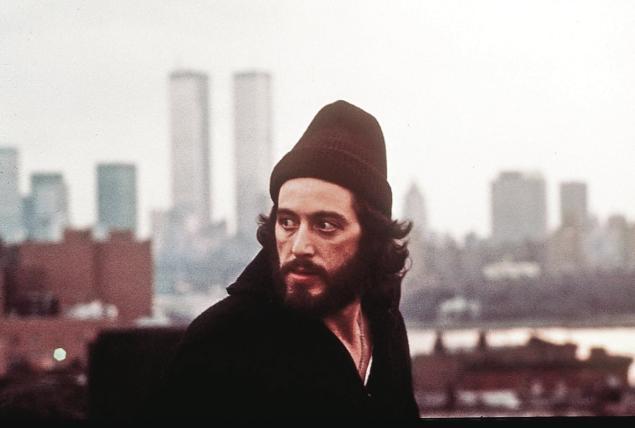
1,001 Films: "Serpico" (1973)


Along with the later Dog Day Afternoon and Prince of the City, Serpico was one of Sidney Lumet's career-redefining true-crime visions of New York before the clean-up: here's a place mired in corruption, where even those still trying to stay on top of things were liable to be brought down in the daily course of events. (Travis Bickle is parked up just around the corner with his engine running, obscured by the rain, dirt and sewer smoke.) It's less police procedural than murder-mystery, an attempt to square the bearded cop bleeding out in the back of an ambulance in the opening moments with the fresh-faced new recruit (Al Pacino) we then see reporting for duty, who immediately establishes himself as different from his colleagues by reading the writings of Isadora Duncan and refusing to take anything for free. Already, one notes Lumet's gift for economically describing character, and Pacino's ability to disappear and grow inside a role: on one level, Serpico is all about performance and identity, built as it is around a protagonist who - in refusing to wear the uniform that had become tainted by that point - is constantly having to prove himself. (Hence Duncan; hence the moustache and beard that transform Frank Serpico into an avant la lettre Barry Gibb.)

The kind of corruption the film depicts - quiet, persistent, low-level graft, skimming off a few lousy bucks here and there - is obviously far less dramatic than that presented in The Godfather, and possibly it now looks over-reliant on Pacino's innate hoo-ha-hery to sustain it through its more meticulous stretches (his "I can shout anywhere!" isn't so much a throwaway ad lib as a manifesto for much of the work to come); Lumet also invents that cop-film cliche of the the obsessive investigator who gets so caught up in his work that his wife or girlfriend has to leave just to get him to notice her. Still, you can see why it struck a chord at its particular countercultural moment - as elsewhere in America, the idealism of a bookish, hairy young thing is used to show up the failings of his elders, portrayed as either indifferent or utterly complacent by the kind of doughy, sweaty character actors who proliferated in 1970s cinema - and it holds up today, if less as a gripping thriller than as a parable of individual heroism gone awry within a system that simply doesn't care.

Serpico is available on DVD through Paramount Home Entertainment, and on Blu-Ray through Masters of Cinema.

Monday, 12 December 2016

Bird's-eye view: "The Eagle Huntress"


Among the nomadic people of the Altai mountains separating Central and East Asia, certain traditions have had to be upheld so as to survive the region's long, harsh winters. One of these involves the men of the tribe capturing an eagle, then training it so as to catch those small creatures that give forth meat to eat and pelts to wear and trade; after seven years, the men grant the bird its freedom, maintaining the circularity of life, and strive to pass on their hunting knowledge to their sons and heirs. Early on in the British director Otto Bell's new doc The Eagle Huntress, we learn how this process has caught the eye of Aisholpan, a combative, ruddy-cheeked girl in her pre-teens whose open-minded father has started to divert his wisdom to her, rather than his far younger male progeny. Enter the tribal elders, who clear their throats and begin harrumphing. "Girls do not go eagle-hunting," these old duffers insist. "Women are weaker and more fragile. They get cold." What ensues, over the next eighty minutes, will be the learning of lessons, and the opening up of new frontiers.

Bell's film isn't passing into unexplored cinematic territory: Aisholpan and her clan exist in the same timezone as the crowdpleasing ethnography of 2003's The Story of the Weeping Camel and - more fantastic beasts - Ben Hopkins' Kyrgyzstan diversion 37 Uses for a Dead Sheep. (The ovine polo game showcased in that film recurs here.) The advantage that Bell has is the process of eagle hunting itself, an extraordinary sight to behold right from the early, health-and-safety defying sequence that finds Aisholpan edging down a sheer rockface, crashing into the understandably perturbed bird's nest, and either distracting or hypnotising it with a hand before lassoing and making off with it. Equally striking is the growing intimacy between child and bird, which unfolds somewhat like a Kes of the mountains: she feeds it strips of meat first wrapped around a stick, then eventually with her fingers, reward for seemingly long afternoons in the cold learning to hold, catch and let go.

This rich observational material has been organised in conventional fashion. Daisy Ridley's voiceover suggests Bell wasn't always confident in what his own images were communicating; a tinkly-sentimental piano score keeps threatening to break into Oleta Adams' "Get Here" (and segues all too readily into Sia's on-the-nose closing-credits song "Angel by the Wings": "Fly on the eagle's wing/You can do anything"); and narratively, we're destined for the first ever competitive eagle hunt to feature a female participant. You feel a remarkable story has been tailored to fit an internationally saleable template, the unfamiliar being translated into the more directly graspable. (That savvy operator Morgan Spurlock appears among the producer credits.) It is, still, remarkable and involving viewing: you can't miss the pride of Aisholpan's family as they wave her off to the competition, nor the evident love of this father for his daughter, as heartening, in its own way, as the majestic swoop of the eagle itself as it approaches its targets. That spectacle, as it has done in the grounds of stately homes through the ages, should be enough to glue antsy youngsters to the spot in wonderment - but, while they're there, they might also learn a thing or two: how other cultures live, what girls can do, perhaps even how to watch, maybe love, a predominantly subtitled movie.

The Eagle Huntress opens in selected cinemas from Friday.

Sunday, 11 December 2016

1,001 Films: "Enter the Dragon" (1973)


Bruce Lee's English-language debut Enter the Dragon has become renowned as a defining exploitation feature, in spite (or perhaps because) of its funding by a studio: this was Warner Bros. attempting to cash in on kung fu and Bond movies by throwing substantial amounts of money at a hybrid of the two. Lee plays Lee, a Shaolin-trained fighter sent by British intelligence to take part in an international tournament on a remote island owned by Han (Shih Kien), the Blofeld-like criminal mastermind who just so happens to have killed our hero's sister. While there, Lee finds himself paired against American representatives John Saxon (who's trying to pay off gambling debts) and Jim Kelly (a crossover character from the emergent blaxploitation cycle, a Sweet Sweetback type on the run from racist cops). Fumbling through its exposition, the film seems to take an age to get to the opening bouts of the tournament, and after an initial skirmish, Lee - busy playing secret agent - has to wait almost an hour of screen time to get into his first proper punch-up.

Director Robert Clouse, an entirely deaf martial-arts specialist who spent his three decade career churning out video-rental standbys (Black Belt Jones, Game of Death, Gymkata, the China O'Brien series), spends this downtime ticking off various drive-in staples (the love interest is Ahna Capri, one of Russ Meyer's bosom buddies), and taking advantage of the studio backing to deliver hundreds of extras and mucho exotic travelogue footage, held together by Lalo Schifrin's gloriously of-its-moment score. The question remains whether this deluxe padding enhances or detracts from the essential kung fu elements. Lee, as mesmerising in the still before a punch or a kick as he is when in motion, could clearly hold the screen perfectly well by himself, doing his own thing; he spends far too much time here creeping around and wrangling snakes to keep the espionage plot spinning. Like a lot of studio-funded attempts to appropriate hot trash-culture phenomena, it's thus probably not as "pure" as Lee's earlier films; still, it has a great stick insect fight.

Enter the Dragon is available on DVD and Blu-Ray through Warner Home Video.

Friday, 9 December 2016

For what it's worth...


Top Ten Films at the UK Box Office   
for the weekend of December 2-4, 2016:
   
1 (1) Fantastic Beasts and Where to Find Them (12A) ***
2 (new) Moana (PG) ****
3 (new) Sully: Miracle on the Hudson (12A)
4 (2) Allied (15)
5 (new) Pitbull: Tough Women (18)
6 (5) Arrival (12A) ***
7 (3) Trolls (U)
8 (4) Bad Santa 2 (15) **
9 (new) The Edge of Seventeen (15) ***
10 (new) Bleed for This (15) ***

(source: theguardian.com)

My top five:   
1. The Nightmare Before Christmas
2. Blue Velvet
3. The Young Offenders [Northern Ireland only]
4. Moana


Top Ten DVD rentals:  

1 (1) Finding Dory (PG) ***
2 (2) The BFG (PG)
4 (5) Me Before You (12) **
5 (6) Star Wars Episode VII: The Force Awakens (12) **
6 (4) The Angry Birds Movie (U)
7 (7) Now You See Me 2 (12)
8 (8) Supersonic (15)
9 (9) Miss Saigon: 25th Anniversary Performance (15)
10 (new) Pete's Dragon (PG)
 
(source: lovefilm.com)

My top five:  
1. Napoleon  

 
Top five films on terrestrial TV this week:   
1. Paddington [above] (Sunday, C4, 6.15pm)
2. Senna (Saturday, ITV1, 11.25pm)
3. The Last Stand (Sunday, five, 11.25pm)
4. 22 Jump Street (Friday, five, 9pm)
5. You're Next (Wednesday, C4, 1am)

On DVD: "Lights Out"


If Hollywood is to devote its entire summer roster to bombastic B-movies, it may be preferable that they turn out like Lights Out: brisk, no-nonsense fare that gets us in and out of the multiplex, more than passably entertained, in just under two hours. Although an extension of director David F. Sandberg's much-admired 2013 short of the same name, the feature-length Lights feels at this moment in time like an attempt to re-engineer The Babadook as a straightforward quiet-quiet-loud horror flick capable of exploiting even the average Dolby surround system. The mystery here is why several members of the same family find themselves pestered by a black-clad, long-taloned figure who only appears after the illumination in any given room has been snuffed out. It quickly does for clan patriarch Billy Burke - K-Stew's dad in the Twilight series, and thus not a guy easily flustered - in a prologue set within a textiles factory; it then comes after stepsiblings Teresa Palmer and Gabriel Bateman, who's taken to clutching candles and sleeping with a torch. That the pair's mom (Maria Bello) is a pill-popping depressive gives some indication of what might be eating everybody - but hold your horses, amateur Freuds, it's not quite as simple as that.

Granted, the script - by the increasingly notable Eric Heisserer (who did Arrival, where he similarly converted scant source material into something more substantial) - takes the occasional shortcut in getting us from A to B, although this at least ensures Lights Out never approaches the absurd running time of The Conjuring 2: at one point, Palmer stumbles across another of the horror cycle's dusty expositional boxes, containing all the useful plot information a final girl might require. Yet some appreciably knotty complications are established and unpicked over the course of these eighty-odd minutes: mom and daughter are barely speaking after a fraught custody battle, which makes teaming up to see off the spectre tricky, and the standoffish Palmer is busy enough already trying to get her head around the idea of a puppyish fuckbuddy who wants to turn himself into a boyfriend. 

The more mechanical business - the frantic taping down of light switches and replacing of bulbs - is all in good working order and pretty fun going; it's a neat development that the "monster" (who comes to be referred to as Diana) can operate in brightly lit rooms, so long as there's a shadow of some sort (under a bed, say) into which she can retreat - and the gathered effects squad make very striking an antagonist who mostly exists in silhouette form. Sandberg's also slightly more attentive to his actors than is the norm in this field: casting Palmer as the fruit of Bello's loins feels instinctively right, and this may be the first film to make full narrative use of the dark crescents under the younger actress's eyes. (She does look as though she's being kept awake at night.) Among the many demographics Sandberg is likely to send home contented would be the Val Lewton fan club - but this is one of those modern horrors that may actually play better as sleepover fare on DVD, where it can be watched in near-total darkness, than it would in a multiplex screen, where some of the overhead lights have to be kept on for health-and-safety reasons.

Lights Out is available on DVD from Monday.