Sunday, 3 November 2013

From the archive: "Berlin Alexanderplatz"


Made for West German television, yet released theatrically across the U.S. and Europe, Rainer Werner Fassbinder's monumental 15-hour adaptation of Alfred Döblin's novel Berlin Alexanderplatz sits firmly and insistently at the intersection of cinema, literature and theatre. Döblin's theme was the moral and financial stagnation of the German state during the 1920s; his protagonist, the portly Franz Biberkopf (a mountainous display of screen acting from Günter Lamprecht), a wifekiller released from jail after serving four years. Corruptible and mentally unstable, Biberkopf staggers out into an especially rundown corner of a Berlin disempowered by Versailles, inhabited chiefly by drunks, wastrels and prostitutes. Early encounters characterise Biberkopf as a big baby, voiding himself of any and all responsibility. After a turnabout at the prison gates that appears to signify some desire to return to the womb, he spends much of the first episode wailing on a rabbi's floor, before clamping himself to his lover's nipple; later instalments revise this interpretation to show the character as first a vampire - a fatter Nosferatu - leeching off those around him, no matter how sour the taste of the blood, then increasingly as a victim of blind allegiance, and a history hellbent on repeating itself. 

With hindsight, we can see where all this is heading. The bread is being baked, the circuses gathering, but the Nazis don't arrive until episode nine (and, even then, remain a cursory presence), which allows whole parts to be devoted to watching Biberkopf sinking into a drunken stupor (episode four) or trading a succession of women for use as whores (the outstandingly chilly episode five, which introduces Gottfried John as a recurring face of evil). Yet Döblin's experiment was to show how the hearty, opportunistic Biberkopf - with his camaraderie, vows of reform and knowledge of the lines he must not cross - might be considered relatively heroic in a society as fatally compromised as this; the narrative keeps throwing him up against those whose souls are in a far shabbier condition than his own. 

It's not that we aren't warned - the first episode bears the ominous subtitle "The Punishment Begins" - but the process makes for a long haul in the presence of characters who are both far from sympathetic and often intended more as symbolic avatars than recognisable, flesh-and-blood creations. Marked by the specific creakiness of period TV pacing and the more general torturousness that came easily to Fassbinder as both personality and director, it might, perhaps, have only been lapped up as it was by cineastes in the decade that gave the world Shoah, Dekalog and the first Heimat; even approached broken down as a DVD box set in our post-Wire era, Berlin Alexanderplatz requires some swallowing.

What may well compel you to stick with it is a rich strain of desperate, tragic gutter poetry - a strain that actually provides a valuable, grounded corrective to Reitz's made-for-TV project, which looks at Germany from the top down rather than from the pavement up. (The Heimats are all opera and mountain tops; Fassbinder makes his home amid the country's alleyways and puddles.) From the proliferation of prison imagery, extending outwards from caged birds and monkeys to the cramped claustrophobia of the studio sets, we derive that everyone on screen is wounded and trapped, marching round and round in circles, looking for someone to promise them release, ease their pain or point them in the right direction; watching it in the middle of another Depression, it hits you as an utterly pertinent parable of the mass derangement that can occur in the absence of social mobility.

Fassbinder's pressure-cooker aesthetic, coupled to a then-unprecedented attention to sound and music, allows scenes and performances to build to a pathological fever pitch, each movement of the camera another twist of the knife, until the unremittingly brutal diptych of episodes 11 and 12, in which a series of primal screams are followed by a protracted murder. Purged of any trace of humour, it quickly assumes a very Germanic weight, and you could say that, like its anti-hero, it could do with shedding a few pounds. (An extraordinarily bold epilogue, featuring a human slaughterhouse and the never-more-desolate strains of Kraftwerk's "Radioactivity", transports us to another place entirely, and merits discussion in its own right as a two-hour stab at Fire Walk with Me-like revisionism, reviving some characters even as it trashes its sets and all that has gone before.) Yet it's precisely that gravity that gives Berlin Alexanderplatz its remarkable quality of evocation: it would, I'd suggest, be impossible to come away from it without a profound and lasting sense of this time and this place; a sense that seeps into you like the damp, and which no history book - bound up with issues of objectivity and respectability - could ever give you. Bitter as it is, if you do make it through to the end, you will find it hard to leave these characters behind.

(November 2010)

Berlin Alexanderplatz screens in its entirety at London's ICA over the next two weekends as part of Iain Sinclair's 70x70 season. Full details can be found here

Friday, 1 November 2013

For what it's worth...


Top Ten Films at the UK Box Office        
for the weekend of October 25-27, 2013: 
       
 
1 (new) Cloudy with a Chance of Meatballs 2 (U) ***
2 (2) Captain Phillips (12A) ****
3 (new) Jackass Presents: Bad Grandpa (15)
4 (1) Turbo (U)
5 (new) Ender's Game (12A)
6 (new) One Chance (12A)
7 (3) Escape Plan (15) **
8 (4) Prisoners (15)
9 (5) Sunshine on Leith (12A)
10 (6) Blue Jasmine (12A) **
 
(source: Guardian.co.uk)

My top five:      
 
1. Gloria
2. Philomena
3. Wolf Children  
4. Short Term 12     
5. Nosferatu the Vampyre

 
Top Ten DVD rentals: 
       
 
1 (new) Oblivion (12) *
2 (new) Behind the Candelabra (15) ***
3 (new) World War Z (12) **
4 (1) Jack the Giant Slayer (12) ** 
5 (4) Cloud Atlas (15) ****
6 (new) The Big Wedding (15)
7 (new) Trance (15) *** 
8 (2) Identity Thief (12) * 
9 (new) After Earth (12)
10 (new) Hummingbird (15) **         

(source: lovefilm.com)
       
 
My top five:        
1. Before Midnight  
2. We Steal Secrets: The Story of Wikileaks        
3. Renoir    
4. Like Someone in Love      
5. The Pervert's Guide to Ideology  


Top five films on terrestrial TV this week:          
1. Once Upon a Time in Anatolia [above] (Saturday, C4, 1.20am)
2. Grease (Sunday, C4, 5.50pm)
3. Ghost Busters (Sunday, five, 1pm)
4. Hombre (Monday, C4, 12.55pm)
5. A Cock and Bull Story (Saturday, BBC2, 11.55pm)

Wednesday, 30 October 2013

1,001 Films: "Playtime" (1967)


Singular comic vision, or folie de grandeur? Playtime, Jacques Tati's spin on the Man with a Movie Camera-style portrait of a city, wordless and as studiously designed as The Fountainhead, amounts to the director-star (in Hulot garb) stumbling around an office block, into a trade fair (selling brooms with headlights on them for nocturnal cleaning, and flip-top bins in the Doric style) and then back out into the night. It's not so much modernist or futurist as diagonalist: the whole movie's obtuse, at an angle, a "sideways look" at the consumerist world - and we should note at this point that the words "sideways look" don't guarantee laughs, and that Tati's methods here are such that it is very, very easy to get lost in the film's grand design.

From this writer's perspective, Playtime is almost funny, and the reason for that "almost" is that too much thought has been applied to what might make the film funny: this blueprint-like comedy has been relentlessly refined, streamlined to the point where what was originally amusing or incongruous about any given scene or moment no longer entirely exists. This is a film full of "things that happen" rather than jokes per se - a baggage label fluttering uncontrollably, a commuter accidentally grabbing a lampshade rather than a bus's pole - and yet it also seems one of the least eventful comedies of all time, arriving entirely without plot: if what stand-up comics refer to as observational comedy is the translation of images into words, Tati seems determined to convert those words back into images, and because of the way he crams the back and sides of the frame, you will need to see Playtime on a big screen for these "jokes", such as they are, to stand even the slightest chance of working. Baffling for me, apparently hilarious for others: truly, comedy has never been so subjective.

Playtime is available on DVD through the BFI.

Tuesday, 29 October 2013

From the archive: "The Haunting in Connecticut"


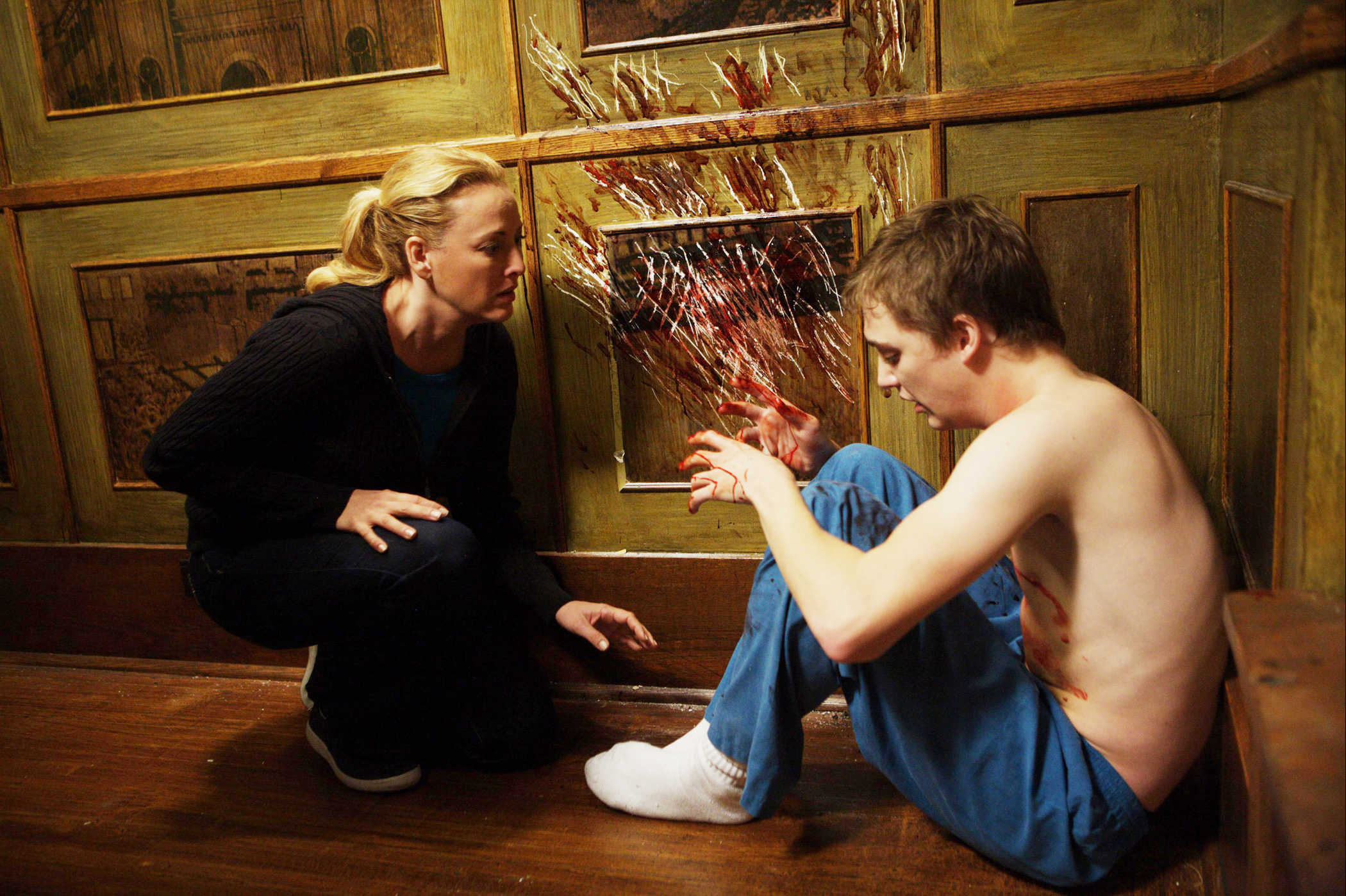
It's been a duff season for horror. We've been beset by pointlessness (Friday the 13th, My Bloody Valentine), pretension (The Broken), more sadism (Martyrs); perhaps it's no surprise that the horror movie critics and audiences have best responded to (Let the Right One In) is the one that barely functions as such. Audiences have shown greater faith in Peter Cornwell's The Haunting in Connecticut than the film's distributors (who hustled it into cinemas without a press screening), and there may be more than a little relief in their response to a film that earns its creeps and scares the old-fashioned way, with a modicum of patience and - yes - even craft. Virginia Madsen and Martin Donovan move their brood to a suspiciously innocuous suburban pile to be closer to the hospital at which their eldest (Kyle Gallner) is receiving treatment for cancer. Soon, said son is seeing floors awash with blood, and nefarious activity behind the frosted glass of a locked door; of course, it could just be his meds.

Though Cornwell makes use of some of the gimcrack sound-and-editing effects that marked 2005's The Exorcism of Emily Rose, the last post-Exorcist chiller to use science and religion to give some credibility to a study of (allegedly true-life) unexplained phenomena, the screenplay - co-authored by horror scholar Adam Simon - does something unusual and smart in linking its supernatural terrors to the feelings of pain and helplessness that must follow from suffering a terminal illness, or watching a loved one die. Muted, unhurried, and - for all its scuttling bugs and crabs - admirably low-key, it's also performed with a welcome degree of sincerity: Madsen (refining her now-stock over-burdened mom role) and Donovan (succumbing to the devil of a drink inside him) make a very handsome couple, and Gallner is a rare screen sufferer to actually look sickly beneath his brave smiles. Nothing too remarkable, but decently assembled and satisfying in its storytelling, offering both rational and religiose explanations for most of its mysteries.

(April 2009)

The Haunting in Connecticut is available on DVD through Entertainment in Video; a sequel, The Haunting in Connecticut 2: The Ghosts of Georgia, opens in cinemas nationwide this Thursday.

Saturday, 26 October 2013

For what it's worth...


Top Ten Films at the UK Box Office      
for the weekend of October 18-20, 2013: 


1 (new) Turbo (U) [above]
2 (new) Captain Phillips (12A) ****
3 (new) Escape Plan (15) **
4 (1) Prisoners (15)
5 (2) Sunshine on Leith (12A)
6 (3) Blue Jasmine (12A) **
7 (4) Filth (18) ***
8 (5) Rush (15) **
9 (new) Boss (12A)
10 (7) Le Week-End (15) ***        

(source: Guardian.co.uk)

My top five:
   
 
1. Wolf Children
2. Prince Avalanche  
3. Captain Phillips  
4. The Epic of Everest  
5. The Pervert's Guide to Ideology  


Top Ten DVD rentals: 


1 (new) Jack the Giant Slayer (12) **      
2 (new) Identity Thief (12) *      
3 (5) Iron Man 3 (12) ***       
4 (4) Cloud Atlas (15) ****      
5 (3) Olympus Has Fallen (15) ***      
6 (1) Star Trek: Into Darkness (12) ***       
7 (2) Mud (12) ***       
8 (6) Lincoln (12) ****      
9 (re) A Good Day to Die Hard (12)      
10 (8) Zero Dark Thirty (15) ***
       
(source: lovefilm.com)


My top five:      
1. Before Midnight
2. We Steal Secrets: The Story of Wikileaks      
3. Renoir  
4. Like Someone in Love    
5. The Pervert's Guide to Ideology  


Top five films on terrestrial TV this week:        
1. The Thirty-Nine Steps (Sunday, BBC2, 7.05am)
2. TT: Closer to the Edge (Friday, ITV1, 10.35pm)
3. Ghost Busters (Sunday, five, 6.55pm)
4. Cloudy with a Chance of Meatballs (Sunday, five, 12noon)
5. Monster House (Sunday, five, 5.15pm)

Friday, 25 October 2013

"Cloudy with a Chance of Meatballs 2" (The Guardian 25/10/13)


Cloudy with a Chance of Meatballs 2 (U) 95 mins ***

Obligation rivals inspiration in this passable sequel to 2009’s appreciably zappy gastro-themed digimation. There’s a smart, satirical idea in having wayward inventor hero Flint Lockwood (voiced by Bill Hader) picked up by West Coast ideas hub LiveCorp, a suspiciously shiny consortium of blue-sky, out-of-the-box thinkers – it’s just a pity it’s only there to launch the kind of episodic quest that now sustains our lazier half-term timekillers. Fortunately, the animators get stuck in: the foodscape Flint’s party passes through is again wittily realised, each frame sprinkled with colourful hybrid creations, from “flamangos” to “shrimpanzees”. If one misses the original’s emotional throughline, the bubbling fondue of sight gags and dad jokes (“How’d ya make a gorilla stew?”) does enough to keep you smiling, and – sorry, parents – any merchandise pertaining to the too-cute sentient strawberry known as Barry is going to be high on your shopping list this Christmas.

Cloudy with a Chance of Meatballs 2 is in cinemas nationwide.

Thursday, 24 October 2013

Baggage claimed: "Enough Said"


What strikes you first about Nicole Holofcener's Enough Said is how purposefully gentle it is. For a romantic comedy, there's no straining for comic effect: like a session on the fold-up massage table carried around by its heroine, this is a subtly probing affair, determined to make you relax into its company - and good company it proves, too. In some ways, Holofcener is simply obliging us to adapt to the pace of the characters populating this second-chance romance: two folks who've been around the block a little, and are now content to take matters as they come, at their own speed. To watch the film is to see how life goes.

With the minimum of fuss, we're introduced to Eva (Julia Louis-Dreyfus), a masseuse, and Albert (James Gandolfini), a television archivist - both in that forty-fifty age bracket, both with a teenage daughter by an earlier marriage. Though they're at ease with themselves, and with one another, the pair have baggage, history - literalised by that massage table, and his profession - which they sometimes feel compelled to tuck away or tidy up: kids that still need attention, gnarly feet, missing teeth, middle-age spread, relationships that didn't work out. One of Eva's clients, the waspy poet Marianne (Catherine Keener), turns out to be Albert's ex, and her on-table griping about her ex comes to warp Eva's perception of her new beau, if indeed Albert can be described as either new or a beau.

It takes a special chemistry to get past these things, of course, and Enough Said will likely go down as one of 2013's few movies to actually benefit from the increasing pre-eminence of television, in this respect. The film permits Louis-Dreyfus a wider showcase for the timing highlighted on Seinfeld and further sharpened by the recent Veep; it also allows Gandolfini to play against established type as a big softie, while demonstrating all the dramatic subtlety fostered over the course of several seasons of The Sopranos. Holofcener, too, has kept herself busy between projects with TV gigs: as with her episodes of the pretty wonderful Enlightened, Enough Said is good at honing in on the minutiae of everyday lives, and the need for connection to lift us out of the crappy ruts we sometimes get stuck in.

I think it's fair to say that Holofcener's strengths lie as a writer and director of actors. Her mise-en-scène isn't notably more widescreen than her TV work; though the interior design is better these days, she's still making the kind of chattily unfussed indie she made with 1996's Walking & Talking. Still, who needs Kubrick when a filmmaker's virtues are so plainly human? Holofcener has always had a cherishable ear for the ways in which men and women think and talk: there may be no greater illustration of the difference between the sexes currently available than the scene in which Eva complains to her best friend Sarah (Toni Collette) about the male client who blithely watches her struggling to cart her table up his front steps, causing Sarah's husband to ask "Did you ask him to help?"

Yet this director has also kept an eye on the longer game, recognising how with age comes balance, tolerance, a reluctance to judge. Her lovers, experienced enough to know the challenges of living a life, are notably more patient and forgiving than their bitchy, snobby offspring; Eva and Albert's mid-film separation will be all the more affecting for seeing two characters we've come to know and care about trying desperately to act like responsible adults, rather than gnashing their teeth and tossing the crockery at one another. Forever taking its cue from its characters, Enough Said remains a gentle massage for the head, heart and tearducts rather than anything more vigorous; yet, whether by Louis-Dreyfus's shows of the nervy, deflective humour common to some women, or by the sight of Gandolfini in his penultimate role, wrapping up all his scenes in an affectionate bearhug, you are touched.

Enough Said is in selected cinemas.