Saturday, 16 March 2013

Gas, food, longing: "Shell"


Shell sounds like a parody of the Grimmer British Artflick. (Heaven knows how writer-director Scott Graham pitched it.) We're at a filling garage in the Scottish Highlands, the kind of quiet pitstop that might merit one or two scenes in any conventional road movie. The garage is owned by Pete (Joseph Mawle), a gruff, epileptic mechanic whom you quickly sense is happier tinkering under the bonnets of cars than he is around flesh and blood; it's run by his 17-year-old daughter Shell (Chloe Pirrie), who's bored and yearning and very much stuck where she is for the time being.

Everyone else, we gather, eventually leaves this locale - including Pete's wife, who walked out when Shell was four. (A recurring image: the tail lights of cars pulling off the shale and away down the road, out of sight.) Back at the ranch, to a soundtrack of howling mountain wind, Pete stays out the back, coming in only for his nightly supper (deer stew, with slices of white bread to mop up with), while Shell lingers up front, striking up fleeting sparks with whichever regulars happen to pass through, and reminding Dad of her mum.

That last clause might sound warning bells. We're not quite in the out-there territory of Tim Roth's unshakeable directorial debut The War Zone, but in this wilderness, Pete and Shell could be Adam and Eve, the first (and last) man and woman around for miles. Graham's interest lies in the hesitant dance the pair perform, trying to be intimate while still being appropriate: her snuggling up to him, desperate for any trace of warmth or affection, Pete warily backing off, and having to kick in the plexiglass window of one old banger in an attempt to let off steam.

Since the success of Fish Tank, there's been a school of British filmmaking indebted to Andrea Arnold, in part because everyone's aware there's an audience for it. Shell could almost be that film's Jarvis-Fassbender relationship, transposed to a more scenic (yet more remote) backdrop. Yet it's admirably precise in its detail and performances: Pete collapsing onto a kitchen floor that doesn't look to have been mopped for some while, a shelf full of faded, dated Dairy Milk holders no rep has been in to fill up or replace. Mawle, all pinched and pained restraint, could have been carved out of the surrounding hillsides; Pirrie alternates fierceness and vulnerability in the manner of a younger Emily Watson, never letting us forget a young girl's future is at stake. Necessarily limited and low-key, but assured and very atmospheric with it.

Shell is in selected cinemas.

Thursday, 14 March 2013

Bag of tricks: "The Incredible Burt Wonderstone"


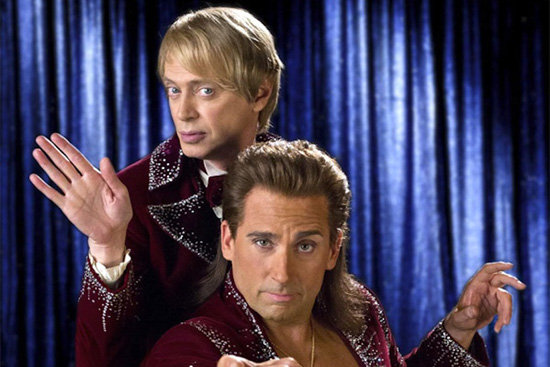
What was once referred to as the New American Comedy is getting old, and having to recycle many of its better ideas. Don Scardino's The Incredible Burt Wonderstone proceeds from the startpoint that magic - like dodgeball, and the ice skating commemorated in Blades of Glory - is an inherently nerdy (and therefore funny) pursuit, no matter how many tattoos the brooding likes of Dynamo and David Blaine might accumulate. So it is that high-school rejects Burt Weinzelstein and Anthony Murtz have reinvented themselves as Burt Wonderstone and Anton Marvelton (Steves Carell and Buscemi), Vegas legends with Siegfried and Roy hair who specialise in the kind of dorky illusions that almost write themselves. (Of course this pair emerge on stage to the Steve Miller Band's tragically dated "Abracadabra".)

Yet after thirty years of friendship, cracks are beginning to show. Burt's ego has simply grown too big to pass through any trapdoor. Ticket sales are plunging. And the duo face a new threat with the emergence of street magician Steve Gray (Jim Carrey), a long-haired, Christ-like figure whose stunts, like holding in his urine for four days straight ("live on Intense TV"), usually involve some degree of physical pain or discomfort, and - shot on handicam, with an eye to future YouTube uploads - are interpreted as somehow sexier and more real than Burt and Anton's phony posing.

Screenwriters Jonathan Goldstein and John Francis Daley previously wrote the improbably successful Horrible Bosses, and this has the feel of something that emerged from a similar drawer: we get some good laughs, coupled to an underlying sense nobody here is really straining themselves to push the envelope or reinvent the wheel. The central narrative joist - two men who realise they can't function without each other - is wearing thin now, and the whole remains unsurprisingly male: Olivia Wilde, as Burt and Anton's glamorous assistant Jane, continues to build a career for herself accepting the scraps many less pliable actresses would have tossed aside.

On the surface, at least, Scardino keeps up a consistent flow of funny ideas - Burt gabbling singlehandedly through the routines he and the injured Anton once performed together, Anton's ill-fated charity trip to Cambodia, a casino called Doug - and superior casting helps. Though Buscemi is sidelined far too early for the film to be anywhere near great, Carell's sideways shuffle into Stiller-ish unsympathetic territory does at least break a run of roles (Dan in Real Life, Hope Springs, Seeking a Friend for the End of the World) that merely called upon the actor to be ordinary, not funny.

Carrey, in an appreciable comeback, gives it the same welcome jolts of energy as the celebrity cameos in Scardino's 30 Rock day job; best of all is Alan Arkin, kvetching under spray-on hair in what Dodgeball obliged us to refer to as the Rip Torn role: the comedy mentor who stops being cranky long enough to nudge the protagonist back in the direction of redemption. It's not magic, exactly - typical of its latent laziness: pretty much all of its tricks are pulled off with the aid of CGI - but it'll painlessly kill a couple of hours on your next long-haul flight, and it's obviously preferable to Mitchell and Webb's Magicians.

The Incredible Burt Wonderstone opens nationwide tomorrow.

A nasty hobbit: "Maniac"


The tawdry peep show Maniac sees that group of French horror extremists who were so in vogue five years ago (director Franck Khalfoun, writer-producers Alexandre Aja and Grégory Levasseur) remaking a thirty-year-old VHS favourite using a point-of-view gimmick you'll recognise as either three years old (Enter the Void), fifteen years old (The Prodigy's "Smack My Bitch Up" promo), twenty years old (Henry: Portrait of a Serial Killer), fifty years old (Peeping Tom) or sixty-five years old (The Lady in the Lake). It's an original take on the source material, but only up to a point.

We're looking out at latter-day L.A.'s lonely-hearts scene through the eyes of mannequin hoarder, hair fetishist and sociopath Frank (Elijah Wood). The fact we're essentially watching Frodo: Portrait of a Serial Killer need not in itself be a dealbreaker: Wood, sensing an opportunity to expand his range beyond the cherubic and cutesy, has been grubbified in the glimpses we get of him in bathroom and rear view mirrors, and his boyish features speak to an arrested development that is exactly where his character is coming from.

No, the problem with Khalfoun's Maniac is that gimmickry: the shot (and shock) selection quickly becomes obvious - we're looking at whatever Frank's leering over - where a John McNaughton or Michael Powell stepped back from time to time and used the first-person perspective to make critical points about the observer(s). These films were adult, and serious, of course; this one gets us into its title character's head but one way - visually - and for all its Frenchy pretensions (laying the "Ave Maria" over measured shots of a female naked and hog-tied, having Wood's eye drawn to the fancy-schmancy activity at the neighborhood dance academy), its gaze remains resolutely adolescent. 

Khalfoun inevitably uses the conceit as another way of getting us inside the women's locker room, where you can see everything but a point, and sense the watcher isn't being critiqued so much as rewarded for his patience. Sure, there's plenty of the technical virtuosity these filmmakers have founded their careers on, and it is properly horrible when it sets out to be - secreting its scalp-slicing around the most squalid and worn-down quarters of this much-filmed city - but it can't get past a slavering fanboy psychology that regards the camera as merely a tool to get at women's boobs and entrails. Put another way: even if you felt Maniac needed a remake, you may not feel wholly enthusiastic about sitting in the same room as this one.

Maniac opens in selected cinemas from tomorrow.

Wednesday, 13 March 2013

From the archive: "In Good Company"


In Good Company, a third successive crowdpleaser from writer-director Paul Weitz (American Pie, About a Boy), centres on Dan Foreman (Dennis Quaid), a fiftysomething ad sales executive at Sports America magazine. Dan's been undergoing some changes recently. His wife Ann (Marg Helgenberger) has just announced she's expecting the couple's third child. Eldest daughter Alex (Scarlett Johansson), a budding writer, is moving out to New York University. And, one morning, Dan walks into the office to find the magazine has been taken over by a major conglomerate; by lunchtime, he's working for a new boss, a nervy upstart named Carter (Topher Grace), who makes Dan his "wingman" and promptly falls for Alex.

It's in some ways a flat-out apologia for corporate practice - the sort of film it must be very easy for latter-day Hollywood suits to greenlight - but tempered by Dan's growing insistence on the human touch and a return to doing the right thing. Encoded somewhere in Weitz's superior screenplay is a paean to keeping matters insular (indeed, in the family), which means the film will probably find its biggest audience in the heartlands of Dubya's America; its original title, oft-dropped in the script, was Synergy, the sound of which is practically guaranteed to have anyone not protected by a white collar coming out in a rash.

And yet In Good Company still qualifies as the most purely enjoyable new film of 2005 so far. A lot of that can be attributed to the performers: the best ensemble assembled in some while, topped by the most likable of double-acts in Quaid and Grace. The latter skilfully permeates Carter's shellacked Young Republican veneer with cracks and insecurities enough to let us see both the hollowness of his lifestyle choices and the mixed-up soul skulking behind them. And Quaid, on something of a run after standout work in Far From Heaven and The Rookie, continues to get better with age, projecting integrity without blandness.

Further down the cast list, Johansson is momentarily liberated from older guy's fantasies (Lost in Translation, Girl with a Pearl Earring) and confirmed as one of the most vital screen presences of our age. Her scenes with pa Quaid are a lesson in how to avoid the creepy Nabokovian experiences undergone by Katie Holmes and Michael Keaton in last week's First Daughter; it helps that someone's bothered to work out an age gap. There's fine supporting work, too: David Paymer was surely born to play a character named Morty Wexler; Selma Blair does something terrifically amusing and sympathetic with her two-scene bit as Carter's ex-wife; and even Weitz's Chuck & Buck director Miguel Arteta gets a cameo as a maintenance technician.

Rather than the snappy, subversive The Apartment or the glossy, disingenuous Jerry Maguire - two obvious templates - In Good Company may finally be to the Noughties what a Baby Boom or The Secret of My Success was to the 1980s: a carefully scripted, well-played film which just so happens to capture the spirit of its time. If the head is telling you America really doesn't need another advert for big business right now, the heart should at least be warmed by the knowledge big business doesn't deserve an advert this funny, touching and accomplished.

(February 2005)

In Good Company screens on Channel 4 tonight at 2.30am.

Monday, 11 March 2013

1,001 Films: "One-Eyed Jacks" (1961)


One-Eyed Jacks finds Marlon Brando using all his post-Streetcar clout to fund and self-direct a sprawling Western saga in which he could star, pose, woo, and wear a black hat and spurs in much the same iconic fashion he did motorcycle leathers in The Wild One, or a dirty vest in the Tennessee Williams movie. It opens with Brando's bank robber Kid Rio being left for dead in the desert by long-time partner Longworth (Karl Malden) in the wake of their most recent heist. As has already been established by their habit of referring to one another as "Kid" and "Dad", these two have a strange, more than likely allegorical bond: after serving five years in Sonora, the Kid busts out and finds Longworth has switched sides again, living in peaceful seclusion with his family as the sheriff of Monterey. This provides the perfect opportunity for Kid to ride into town with his new gang - again, shades of The Wild One, with horses in place of motorbikes - and begin working through his daddy issues.

The overall impression is of the kind of Tex-Mex vengeance saga that Peckinpah was later to goose into dynamism, and that Delmar Daves would have turned round within 80 minutes. At two hours plus, Brando's variant is a stubborn packmule of a movie, full of scenes in which the actors shuffle on to mumble their lines in true Method fashion, the director apparently subscribing to the notion that revenge is a dish best served cold indeed. (You sense he might only have got away with it in an age when Hollywood favoured the overblown and epic.)

The funny thing is, One-Eyed Jacks does have weight, particularly in addressing matters of sex and money, particularly whenever Brando and Malden share the screen. The film formulates itself into a Western precursor to Pasolini's Theorem, as Rio moves in with Longworth's new clan and - unlike the "good" cowboys of Shane or Hud, who came to be domesticated - immediately sets about stirring up trouble, seducing his host's stepdaughter with a heap of horse manure about being a secret Government agent.

Brando the director mines every conceivable trace of irony from these quote-unquote romantic scenes, in which the anti-hero feeds his quarry a line in the hope she'll spread her legs and rile dear Daddy; but he then flips this relationship to suggest the spark of sincere feeling that exists between the two characters - and gets a strange effect by casting an actress of unconventional looks (sad-eyed one-film wonder Pina Pellicar) who's surely too old to be playing gullible ingenues, giving their coupling something of a last-chance saloon feel.

From the acting style to its framing and content, it's absolutely a film that has its director's bullish personality stamped across it: it has all the tin stars, showdowns and shootouts you'd expect from a studio-backed turn-of-the-60s Western, but also - in such scenes as the one that finds Malden tying Brando to a post and whipping him into submission - a lipsmacking, semi-camp strain of perversity that fits with the Brando who would drag up for The Missouri Breaks a decade or so later.

One-Eyed Jacks is available on DVD through Network.

Friday, 8 March 2013

For what it's worth...


Top Ten Films at the UK Box Office
for the weekend of March 1-3, 2013:

1 (new) Hansel & Gretel: Witch Hunters (15)
2 (1) Wreck-It Ralph (PG) ***
3 (3) Mama (15) **
4 (2) A Good Day to Die Hard (12A)
5 (new) Safe Haven (12A)
6 (4) Les Misérables (12A) *
7 (new) Broken City (15) **
8 (re) Argo (15) ***
9 (new) Arbitrage (15) ****
10 (new) Stoker (18) ***

(source: BFI)


My top five:
1. The Princess Bride

2. Robot & Frank
3. Arbitrage
4. Hi-So
5. Cloud Atlas


Top Ten DVD rentals:

1 (1) The Bourne Legacy (12)
2 (2) Ted (15) ***
3 (4) Looper (15) ****
4 (3) The Dark Knight Rises (12) ***
5 (10) Total Recall (12) **
6 (5) The Perks of Being a Wallflower (12) **
7 (8) Lawless (18) **
8 (7) Ice Age 4: Continental Drift (U)
9 (6) The Sweeney (15) *
10 (re) The Five-Year Engagement (15) **

(source: lovefilm.com)

My top five:
      

Top five films on terrestrial TV this week:
1. There Will Be Blood [above] (Thursday, BBC2, 11.20pm)
2. Fight Club (Friday, C4, 11.20pm)
3. The Man From Laramie (Saturday, BBC2, 2.20pm)
4. In Good Company (Wednesday, C4, 2.30am)
5. Splice (Sunday, C4, 11.05pm) 


Wednesday, 6 March 2013

1,001 Films: "La Jetée/The Pier" (1961)


Chris Marker's photo-roman - later the inspiration for Terry Gilliam's 12 Monkeys - sets out, in a series of still photographs punctuated by the odd sign of life, a post-apocalyptic landscape in which experiments are carried out on human survivors to recreate the world through memory; our hero has to travel back to the past, where he begins to work through a relationship with a young woman he remembers, then ahead to the future, in a bid to save what remains of mankind. It's technically dazzling, with exceptional sound editing: its snippets of narration, like the images, fade in and out after the manner of half-recalled phrases. Peel back some of the (very 60s) modish pretension, and within a span of twenty-nine minutes, it appears to tell the story of every love affair in history, including yours and mine.

La Jetée is available on DVD in a twin-pack with Marker's Sans Soleil through Optimum Hone Entertainment.