Friday, 21 September 2012

"Hysteria" (Moviemail 21/09/12)


For a film on the development of the vibrator, Tanya Wexler’s Hysteria has been suffering from an ominous lack of buzz. A grand unveiling at last year’s Toronto film festival – generally a launchpad for an awards push – was met not with the vocal screams of delight backers Sony would have liked to have heard, but with awkward shifting in seats; it finally reaches the UK this week, hoping a bright, mostly British cast can help the audience past the film’s limitations as both comedy-drama and social history.

We’re in 1880s London, being introduced to various characters representing the attitudes of their day. Hugh Dancy, summoning the boyish charm that once was Hugh Grant’s stock-in-trade, plays Mortimer Granville, the ambitious, forward-thinking young doctor appalled by his seniors’ slaphappy approach to patient care; Jonathan Pryce is Dr. Robert Dalrymple, the slightly stiff specialist in hysteria whose wing Granville falls under; Rupert Everett is Edmund St. John-Smythe, the eccentric inventor whose tinkering, combined with Granville’s new-found anatomical nous, resulted in this small yet liberating evolutionary bunny-hop.

Wexler – an American filmmaker taking her own step forwards after her indie bow Finding North – wants to nail down the stifling repression that informed these times: you feel some passion beginning to stir whenever Maggie Gyllenhaal’s suffragette is allowed to take centre stage. Yet Hysteria takes a soft and self-defeating route to get there: the film proves damagingly attached to the romantic flourishes of conventional costume drama, and – crucially – altogether discreet, often simperingly coy, about the matter (as it were) in hand.

Overly worried female sexuality might be too threatening a subject with which to confront an audience head-on, the film instead runs away, seeking refuge in lush curtains, love triangles and silly farce in a bid to obscure exactly what it should have been getting at. Clearly no-one involved wanted to put off the Downton Abbey/Pride & Prejudice crowd, but if Wexler had been allowed to pull back the drapes and loosen up a little, her film might have had more chance of hitting the spot. As it is, Hysteria is nothing to make the Earth move.

Hysteria opens in selected cinemas from today.

Inner city pressure: "Tower Block"


As suggested by a poster employed as a background prop at a key juncture, there's a crossover of creative talent between the grimly effective thriller Tower Block and last month's Cockneys vs. Zombies. Both these films succeed in getting to the spirit of a place, but the buoyant, resilient East End established in the earlier production is here replaced by the tired, depressed, worn-down milieu of an inner city tower block where a few residents hunker down, awaiting relocation ahead of the building's planned demolition. With admirable economy, writer James Moran and directors James Nunn and Ronnie Thompson sketch a world of peeling paint and microwave meals, where fights break out unprovoked in the hallway and single mothers, seeking relief from their travails, leave their babies at home unattended to go out on the lash. (Operating at this budgetary level, the film's grunge is altogether more credible than that of the Weinstein-sponsored, Brad Pitt-starring Killing Them Softly.)

After an opening act in which a cynical developer (Christopher Fulford) lets slip to a contractor he'd do anything to get rid of these hangers-on, all hell breaks loose when an unseen sniper in a neighboring block opens fire; the residents - who've barely exchanged hellos, save when snaffling money or drugs off one another - are repelled beyond their front doors and out into the corridor, where a community of sorts is formed by default. Given the cramped confines, you could see it as Hitchcock's Lifeboat reconfigured for Broken Britain, though one suspects Moran's primary influences are more recent: there are elements of such puzzle-pictures as 1997's Cube, as the survivors try to figure some way out of their now-boobytrapped building, and 2004's Saw, with the second-act realisation the principals are being punished for a past failure to act.

The limited means puts the emphasis back on the writing and acting, which holds up, even if none of the leads are allowed to leap off the screen as they did in the comic-book universe of C-vs.-Z. Ralph Brown is typically dependable as the ex-squaddie who's good for a fist fight but proves helpless when it comes to strategy; Sheridan Smith is believable as the heroine in a Bruce Willis vest, whose promising new relationship the sniper has ended, bloodily; and there's surprising and skilful work from Jack O'Connell, humanising a nasty, opportunistic little shit of a character with a few well-placed dabs of humour. It may just be too circumscribed to be an Attack the Block-like breakout - though it makes fewer mistakes, and would work particularly well on TV, from where it draws much of its cast - but it absolutely makes the most of its limitations. Compare it to 1997's Downtime - itself rather optimistically billed as "Die Hard in a tower block", and featuring Paul McGann as an asthmatic copper - and you can see how British genre filmmaking has taken a quantum leap forwards in terms of confidence and, most crucially, basic competence.

Tower Block opens in selected cinemas from today.

Thursday, 20 September 2012

"Inbred" (Guardian 21/09/12)


Inbred (18) 90 mins **

This sniggering Brit splatterfest dispatches a minibus of inner-city care kids on a team-building exercise to the ominously named Northern backwater of Mortlake, where the cross-eyed, buck-toothed locals – gathering in their local The Dirty Hole (hur hur) after a hard day’s livestock-burning – take none too kindly to outsiders. The ever-welcome Jo Hartley (Thomas Turgoose’s mum in This is England) catches the shambling, happy-amateur tone as one of the carers, yet both the comedy and horror elements rake over old ground. The warped variety show the kids stumble into – with its trouserless organist “Clayderman” and grim forms of 3D entertainment – owes rather too much to Python, The League of Gentlemen and Channel 4’s late-night gem Focus North; co-writer/director Alex Chandon may also be the first person since That’s Life!’s Doc Cox to find phallus-shaped carrots enduringly funny. Amiable, but best kept for DVD. 

Inbred opens in selected cinemas today, ahead of its DVD release on October 15.

Stiff upper lips: "Hysteria" (ST 23/09/12)


Hysteria (15) 95 mins **

The themes of Hysteria are breakthrough and release, so why does it feel so uptight? Tanya Wexler’s fumbled history lesson – charting the invention of the vibrator in 1880s London by idealistic doctor Mortimer Granville – emerges one year on from its festival debut poised awkwardly between satirising stuffy Victorian values, and courting that audience who simply revere repressive order and nice curtains. Throughout, its skirts are kept at half-mast, revealing knickers held firmly in a twist: it scarcely has a handle on the British as a race, much less on the nature of female desire.

For the most part, Wexler settles for the compromise option of mild farce, ushering a discreet strain of panto through a succession of well-appointed exam rooms. Having developed RSI as a result of his treatments, Hugh Dancy's Granville vacillates between incessantly bicycling suffragette Maggie Gyllenhaal and her meeker sister Felicity Jones. Rupert Everett turns up, pulling trailer-ready epithets from his top hat. Meanwhile, the entrance of Sheridan Smith as harlot-turned-housemaid Molly the Lolly (“fancy a lick?”) and Ashley Jensen as a working-class lass named Fannie suggests the writers had the makings not of a feature, but a half-promising limerick.

Belatedly, Hysteria shows you exactly where it went wrong. A last-reel courtroom drama – in which the establishment puts a woman’s body on trial, with enforced hysterectomy one possible outcome – momentarily raises the stakes, tells us something of these times, and chimes with those latter-day patriarchs instructing women what they should do with their uteri: rushed and token in this telling, this should have been the whole film. Wexler is keener to tickle than to teach us, but in doing so her decidedly quaint and understimulating comedy turns the female orgasm into a sniggering joke – which can’t surely have been the intention, can it?

Hysteria opens in selected cinemas from today.

On DVD: "Anton Corbijn: Inside Out" (Metro 20/09/12)


Anton Corbijn: Inside Out (15, DVD only) ***

“I grew up in a vicarage,” reveals photographer-director Corbijn at the beginning of Klaartje Quirijns’ documentary portrait, at once explaining the spare, Dutch Calvinist beauty of his work. Corbijn shoots rock gods like religious icons, the seriousness of his imagery reflecting the self-seriousness of those indie types (Depeche Mode, REM, Nirvana) who’ve sought to define themselves against the surface idiocy of pop. Caught in pre-production for 2010’s flawed-interesting George Clooney vehicle The American, Corbijn makes for rather a dour subject in himself – there’s lots of Anton contemplating the landscape – but he evidently thrives on collaboration: he may be the only man alive to perk up around Lou Reed. Quirijns can’t make the worldview any less monochrome, but her film delivers a solid primer on how it was formed. Returning to his childhood home, Corbijn delights in pointing out that his bedroom window looked out onto a cemetery. This, too, makes sense.

Anton Corbijn: Inside Out is available on DVD through Momentum.

Flamboyance: "Diana Vreeland: The Eye Has To Travel"


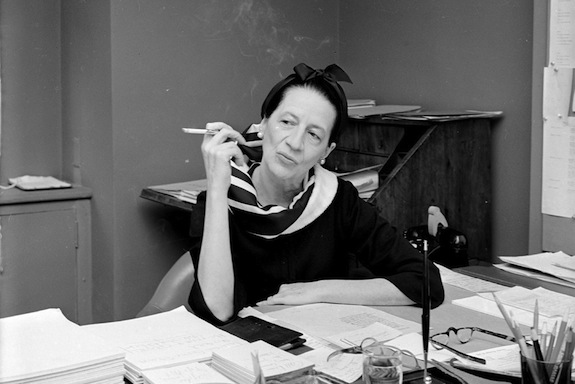
Diana Vreeland (1903-1989) spanned the 20th century. Long before she became America's most prominent fashion guru, she claimed to have crossed paths with Diaghilev, Nijinsky and Buffalo Bill; she partied in Harlem through the Roaring Twenties, and in Paris in the Thirties, where she boasted she brought it was she who King Edward to his knees, by selling Wallis Simpson her lingerie; she saw Hitler at the opera one night before the War in Munich, and found it incredible anyone with that moustache could be taken seriously. Later on, she guided Jackie O. on what to wear for her husband's inauguration, and decamped to London just as the Swinging Sixties came to town. She'd make a tremendous character for a Woody Allen film, if Allen still knew how to write strong, forthright, funny women.

The Eye Has To Travel, an affectionate documentary portrait overseen by Vreeland's daughter-in-law Lisa Immordino Vreeland, collages its subject's memories - as told to George Plimpton during the writing of her biography - along with archive newsreel, film clips (Vreeland inspired at least two lightly fictionalised characters in turn-of-the-Sixties movies), and generally glowing testimonies from colleagues, designers and celebrities. It's still a fashion documentary, in which the interviewees gush "she wore flats and black tights before anybody even thought about it", as though Vreeland were responsible for some vast evolutionary leap forwards, but it never takes itself too seriously, in part because Vreeland herself never seemed to take herself too seriously. As extracts from her journalism suggest, this was a gal less interested in the truth of the period than she was in the life of the party. 

Vreeland works best as a repository of mad ideas: the suggestions in her early "Why Don't You?" column ("Every girl should train as a geisha", "Wash your child's hair with champagne") owed less to practical experience than an especially boozy lunch. Overlooked by an adventuress mother for a sister who was - by all accounts - far less of an ugly duckling, her most constructive contribution to modern aesthetics may have been her support for unconventional beauties, encouraging her models to turn apparent flaws into unique selling points: she was gaga for Cher and Barbra, and did as much as anybody to open the pages of Vogue and Harper's up to the smoky charms of Anjelica Huston, as well as blonde-haired, blue-eyed all-American girls like Lauren Hutton. It's telling she was effectively exiled as the one-size-fits-all commercialism of today's fashion industry reared its very ugly head; those rushing to see it direct from London Fashion Week might like to think about that. "Some people create fashion. Diana was fashion," quips one interviewee - yet this engaging film positions Vreeland as fashion at its best: flamboyant and colourful, and ever-so-slightly cuckoo.

Diana Vreeland: The Eye Has To Travel opens in selected cinemas from tomorrow.

Mercury rising: "Hungarian Rhapsody: Queen Live in Budapest"


Freddie Mercury's virtual reappearance at the Olympics closing ceremony - a roaring success among audiences desperate for anything to interrupt the general Lennox-Sandé-Spice-Tempah drossflow - looks to have provided the impetus for the remastering of 1986's concert film Hungarian Rhapsody: Queen Live in Budapest, a mainstay of the music VHS Top 10 charts back when we still had Smash Hits to print them. Cineastes would doubtless be a little more excited if we'd discovered the director was a young Béla Tarr, setting the classic Queen line-up to trudging hands-in-pockets through some muddy backwater, Brian May's hair unravelling only further in the harsh wind of the plains. Instead, the band plumped for one János Zsombolyai, a functionary of the then firmly Communist state's television service, which means we get utilitarian coverage of a brisk 90-minute set that opens with "One Vision" ("gimme-gimme-gimme-fried chicken"), so it's not a total loss. 

As a 25-minute primer showing before the concert itself suggests, we're being transported back to that particular post-Live Aid moment where Queen could lay claim to being the biggest group in the world, having survived the twin assaults of punk and New Wave. (The broadcaster Danny Baker has claimed the former was a direct reaction not to the pomposity of prog, as is commonly assumed, but the sight of Freddie taking to the stage with flutes of champagne and a crown on.) What's more, they'd emerged with new material ("Vision", "A Kind of Magic") that would segue seamlessly into the likes of such established classics as "Under Pressure" and "Bohemian Rhapsody" without driving anyone out to the bar. (Though you could well nip out to the loo during the Highlander-derived "Who Wants to Live Forever?", a song that always merited the response "Not if I have to keep listening to this".)

Best to make clear that, despite its re-release, this is no Stop Making Sense, which hailed from a more imaginative, visionary place. As a set, it goes markedly soft in the middle: five minutes of May guitar-wanking before "Now I'm Here" only makes one glad Stock, Aitken and Waterman came about, while "Is This The World We Created?" is a slog of a Clueless Serious Song to file alongside Phil Collins's "Another Day in Paradise". Zsombolyai has less of an idea of how to film "Bo Rap" - surely a gift for creatives - than the makers of Wayne's World, and there's some dutiful filler involving band members around town: May's jaunt in a hot-air balloon is out-banalled by John Deacon's efforts to engage a shy seven-year-old in conversation. Still, you get all the call-and-response business Mercury was doing before it became de rigueur for rappers, hands are raised in the air with great frequency, and there's that piano bit at the beginning of "Seven Seas of Rhye", which is the closest this group ever got to the raw excitement of a "Pinball Wizard". Your dad, for one, will love it.

Hungarian Rhapsody: Queen Live in Budapest opens in selected cinemas tonight.