Friday, 25 May 2012

Attack the block: "The Raid"


The Raid is what one might describe as an up-down action movie, both in terms of its directional thrust - starting on the ground floor of a tower block, then frenetically running, punching and kicking its way north - but also to acknowledge the fact that nobody in this construction appears capable of staying on their feet for very long. The other crucial axis the film turns on, however, is very much West to East: it's the work of young Welsh filmmaker Gareth Huw Evans - you'd never guess he was Welsh, with that name - who travelled to Indonesia in pursuit of either a dynamic new martial art to document, enlightenment, or the steady supply of shattered bones made possible by the area's relaxed health-and-safety guidelines.

Well, as the Evanses would doubtless say, there's globalisation for you. The move may have appeared counter-intuitive in movie terms - don't most aspirant tyros seek their fortunes by going West? - yet at a time when one can put all the action movie heavyweights one can think of in the same film and still only end up with the 15-rated The Expendables, it's impossible to imagine the modern, infantilised Hollywood permitting a bodycount this elevated in a project this fundamentally brutal. At the risk of getting overly Aristotelian about a flick best taken in on a Friday or Saturday night - when, if nothing else, you can take the morning after to recover - The Raid plays like a bracing return to first principles: this really is live free or die hard. It's practically a snuff movie, in everything but the body bags.

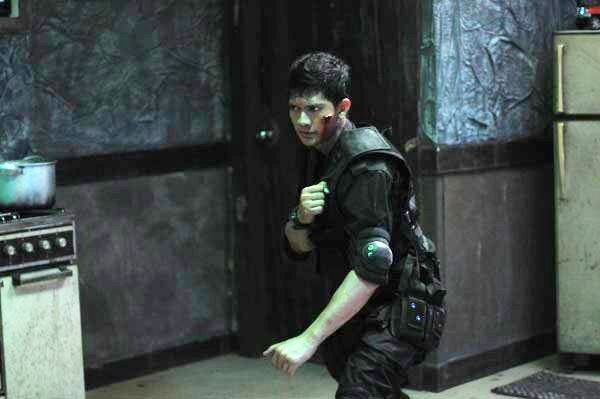
The set-up is appreciably simple. A unit of armored police has been bussed into a tower block in which a crime lord has been offering temporary shelter to every passing ne'er-do-well and nogoodnik - consolidating his power by, in effect, insulating himself from the relevant authorities with toxic human asbestos. The raid, inevitably, goes badly wrong, leaving our plucky cop hero Rama (Iko Uwais) - and we know he's the hero, because we've earlier seen him saying goodbye for the day to a heavily pregnant wife - to move from floor to floor, seeking to achieve pretty much singlehandedly what his colleagues have failed to do en masse

This progression suggests The Raid as the ultimate boiling-down - refinement wouldn't quite be the word - of all those films that sought to turn first-person console shoot-'em-ups into engaging cinematic entertainments. The further up the tower block we go, the fewer players there are left standing, and the higher the stakes become: annoyed at his minions for failing to stop the SWAT team from entering - and at the realisation that these dead tenants are unlikely to stump up with next month's rent - the kingpin announces over the building's intercom system that he'll offer permanent residency to anyone who'll help clear the halls of what he describes as the "infestation". The police negotiate the first five floors with relative ease, before incurring major casualties on floors six and seven; Rama picks up an injury himself at one point, and has to drop down a couple of levels - out of a window, naturally, and using some poor sod's body as a landing mat - before working his way up again.

For all the bonekicking and bloodshed, there's probably a Buddhist reading of The Raid - that these are the levels of hell one must pass through to arrive at the redemption promised by the subtitle appended for the film's American release - but I suspect most Western viewers will be reminded first and foremost of Bruce Willis's supercop John McClane and the none-more-influential Die Hard. The line Evans draws is appreciably straight and no less vertical, but it's a thinner one, with only a scrappy fistful of character notes to flesh it out. Willis had the advantage of a wardrobe, a sense of humour, a particular way of walking (that of feet filleted by broken glass) by which to define McClane; Uwais is whippet-shaped, deadly earnest, and moves like a hurricane, but has that Jet Li problem of registering more as a force of energy than as a fully-fledged personality. (And no, I wouldn't be stupid enough to say this to his face.)

For all that, The Raid makes for limber and dynamic cinema: having fresh limbs before the camera, and fresh eyes behind it, allows the film to kick this genre about as far as it might now legally go while fostering a style of carnage that is as grungy as John Woo's once was baroque. These performers and stuntmen come to attain a weird and wonderful harmony with the bashed-up production design they come to bounce off or careen through: each floor is a riot of limply flickering striplights, graffiti-bruised walls, wheezing meth labs, finished off with broken chairs, broken tables and broken necks. If The Raid takes off in the UK in the fashion I suspect it might, Terence Conran might have to launch a whole new range of very distressed-look furnishings to meet the demand. And the sequel, in which the 60 Minute Makeover team are choppered in to clear up this mess, really will be something.

The Raid is on nationwide release.   

Sunday, 20 May 2012

For what it's worth...


Top Ten Films at the UK Box Office
for the weekend of May 11-13, 2012:
1 (1) Marvel Avengers Assemble (12A) **
2 (2) American Pie: Reunion (15) **
3 (new) Dark Shadows (12A) ***
4 (3) The Lucky One (12A)
5 (4) Beauty and the Beast 3D (U)
6 (5) Safe (15) ***
7 (6) Salmon Fishing in the Yemen (12A) ** 
8 (new) Piranha 3DD (18)
9 (new) How I Spent My Summer Vacation (15)
10 (7) The Hunger Games (12A) **
(source: BFI)
My top five:
5. Faust
Top Ten DVD rentals:
1 (2) War Horse (12) ** 
3 (4) The Help (12) ***
4 (3) In Time (12) ***
5 (5) Crazy, Stupid, Love. (12) *** 
6 (7) The Ides of March (15) **
7 (6) Contagion (12) ***
8 (10) Friends with Benefits (15) ***
10 (re) My Week with Marilyn (15) ***
(source: lovefilm.com)
My top five:
  
Top five films on terrestrial TV this week:
1. From Russia with Love (Saturday, ITV1, 3.40pm)
2. Bonnie and Clyde (Saturday, ITV1, 11.40pm)
3. Sugar [above] (Sunday, BBC2, 12.30am)
4. Man on Wire (Sunday, BBC2, 10pm)
5. Anchorman: The Legend of Ron Burgundy (Sunday, BBC1, 11.10pm)

Friday, 18 May 2012

"Even the Rain" (The Guardian 18/05/12)


Even the Rain (15) ****

With Ken Loach’s The Angels’ Share Cannes-bound, here’s a timely reminder of the filmmaker’s considerable influence. Regular Loach screenwriter Paul Laverty and director Icíar Bollaín (who acted in Land and Freedom) have constructed a very smart, socially aware fable about a Spanish film crew – headed by heartthrob-Herzog Gael García Bernal – who arrive in Bolivia to shoot an epic about Columbus’s entry into the New World, only to start blindly perpetuating the exploitation their own project seeks to denounce. As production gradually unravels amid protests over the privatisation of the region’s water supply, tense, pointed action ensues: Bollaín cranes her camera to highlight the real-world injustices developing beyond the on-location ego trips. Striking performances from Luis Tosar, as a cynical yet flexible producer, and Juan Carlos Aduviri, as the native who becomes a figurehead for those who don’t have the luxury of playacting. 

Even the Rain opens in selected cinemas from today.

"If I Want to Whistle, I Whistle" (The Guardian 18/05/12)


If I Want to Whistle, I Whistle (15) ***

This punchy, economical Romanian drama establishes a strong sense of place (a young offenders’ institute in the countryside) before gradually coming to describe the trouble its protagonist – Silviu (George Pistereanu), a hothead with two weeks remaining on his sentence – finds himself in. The close-knit, Dardennes-like approach, hewing squarely to Silviu’s shoulders, catches the boy’s growing isolation from both his fellow inmates and the world beyond the gates; it also prompts a simmering performance from Pistereanu, forced to prove himself amid an ensemble of actual young offenders whose roughhousing looks and sounds very much the real thing. The stand-off that results, as Silviu finally decides to grab what he wants in life, proves as despairing as it is tense: not for the first time, a Romanian film shows us an individual floundering within a system from which there can be no easy escape.

If I Want to Whistle, I Whistle opens in selected cinemas from today.

"Iron Sky" (The Guardian 18/05/12)


Iron Sky (15) **

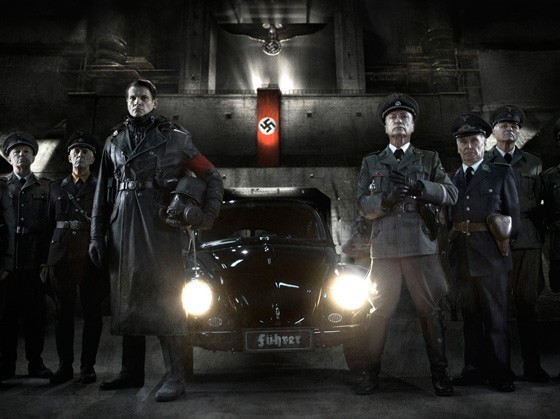
Nothing about this Finnish-derived space oddity, opening (and closing) next Wednesday, quite matches its tagline’s genius: “In 1945, Nazis went to the Moon; in 2018, they’re coming back”. Timo Vuorensola’s film uses its B-movie plot – an American lunar mission stumbles across a swastika-shaped HQ to the right of the Sea of Tranquility, causing its inhabitants to launch a renewed counter-offensive on Earth – as a pretext for silly gags, some satirical (the Party’s used the hiatus to rebrand themselves as caring, sharing oppressors), some old-hat (don’t Nazis have preposterous-sounding military ranks?). High on energy, blue-screen and careless acting, low on production value (its UN Security Council chamber is less a war room than a war nook), it’s marginally more inspired and certainly more likable than Snakes on a Plane or The Human Centipede as Net-spawned exploitation fodder goes, but you can safely wait for the DVD. It’s out the following Monday. 

Iron Sky opens in selected cinemas on Wednesday, before landing on DVD from Monday 28th.

Sunday, 13 May 2012

Vaulting obsessions: "She-Monkeys"


It remains astonishing at times, the range of skills actors in modern movies are required to master. The young female leads in the tart Swedish teen drama She-Monkeys are meant to be keen exponents of vaulting, which requires the actresses involved to look not just comfortable but enthusiastic striking poses on the backs of horses going at a fair clip around the corral. Elsewhere, these girls will be seen clowning about (and plunging off) the high-dive board, and fooling around with a biathlon rifle. If you haven't as yet twigged the metaphor, this is adolescence as competitive, contact sport: an arena within which limber young bodies will be stretched this way and that, put to the test, and eventually - in one notable example - broken; it may be the only Swedish movie to evoke the spectre of Tonya Harding.

At the centre of Lisa Aschan's film is the friendship, and then the rivalry, that develops between two girls: Emma (Mathilda Paradeiser), the sensible, thoughtful new recruit to this afterschool gymkhana, and the club's queen bee/top dog/front rider Cassandra (Linda Molin), a harsh, glacial Nordic beauty - think the young Agnetha from ABBA, or a big-screen Saga Noren - whose smile reveals a pair of almost vampiric incisors. This is apt, because these two first bond while getting their teeth into the local boys, who don't know what to make of the pair's formidable collective confidence, but really, they only have eyes for one another - which gets tricky, when it turns out there are but limited places on this particular team.

There's an obvious thematic crossover here with Celine Sciamma's Water Lilies (with which She-Monkeys shares a UK distributor), though - as the new film's title suggests - Aschan's interest lies more in fauna than flora. An early sequence of Emma training her dog in the woods, and a rather graphic scene of equine coitus, set up just how keen the movie is to go off in pursuit of animal behaviour, and the way we pick up tics (and possibly ticks, given the background emphases on female grooming) from those around us. Emma's younger sister Sara (Isabella Lindquist), seen being ejected from a public swimming baths (and made to feel shameful) for refusing to wear a bikini top, comes home to spoon in bed with her oft-absent father; when the latter's not there, it seems entirely natural to her that she should proposition her teenaged male cousin, in a sequence that's simultaneously funny and weird.

The film is never quite as cruel as something like Breillat's À ma soeur!: it has time for these girls' giggly, conspiratorial pleasures, and those nights when they laugh so hard with one another they can't help but wet themselves. As with Sciamma's films, it's arguably more comfortable inhabiting the same space as its female leads than it is around anybody else (the parents remain somewhat hazy creations), and often plays less like conventional narrative cinema than a loose sequence of formative moments, a compilation of textures: skin on skin, water on skin, skin on sand. Vivid these moments and textures remain, though, beautifully rendered - perhaps played would be the better verb - by the young cast. We can see the women Emma and Cassandra are growing into, and the mistakes they're likely to make, if they don't or cannot correct themselves, and these 83 minutes are all too keenly informed by painful memories of just what it takes to be best in show.

She-Monkeys opens in selected cinemas from Friday.

All in the family: "2 Days in New York"


2 Days in Paris, Julie Delpy's second film as writer-director, formed one of the spikiest, most scabrous romantic comedies of recent times - and given the bland pap Hollywood has made us sit through in that department of late, I mean that as the highest possible compliment. Wittily setting off its neurotic heroine Marion (Delpy herself) against her cranky American boyfriend (Adam Goldberg) in the French capital, Paris felt like the looney-tunes offshoot of those Before Sunrise/Before Sunset movies in which Delpy had previously featured so prominently, running with all those mad, eccentric or off-colour ideas the more refined, romantic indie entertainments simply hadn't the time for.

Well, five years down the line, things have changed in Marion's life: as she announces at the beginning of the sequel 2 Days in New York, Jack has moved on, leaving her with a young son, yet the nascent photography career she was embarking on at the time of the first film has taken off, to the point where she's receiving gallery attention. She also has a new boyfriend in Mingus (Chris Rock), a radio DJ with a daughter of his own from one of his two prior marriages. From this small yet crucial biographical detail, we can deduce that Delpy has a fondness not for the shiny happy people of romcom lore, but individuals who are lined and lived-in and a little bit bashed-around by life: it gives them character, with which they attempt to offset whatever baggage they've picked up in the process.

Still, Marion and Mingus, for all their quirks and hang-ups, begin to seem the very model of normality when the former's family and associates, memorably introduced in the first film, show up again en masse at their New York apartment: there's her magnificently self-absorbed sister Rose (Alexia Landreau, a co-writer here), who promptly displays a very French attitude to nudity; Rose's current boyfriend Manu (Alex Nahon), who - oh, by the way - just so happens to be Marion's ex, and thinks nothing of conducting a drug deal in front of his hosts' children; and - bien sûr - Marion's father Jeannot (Albert Delpy, above), who continues to resemble a berserker Kris Kringle. (Delpy missed a trick in not setting this sequel in the run-up to the Xmas period: the comic possibilities would have been infinite.)

Delpy père remains these films' ace in the hole: impossible, I would venture, to witness the catastrophe this veteran makes of a plate of cheesecake, or to overhear his Anglicised pronunciation of the phrase "very funny" and not chuckle heartily. Given the distinctive worldview both 2 Days films exude - venturing that most people spend their days either pissed-off or horny, and that it's a miracle (rather than a given) that any of us can get it together long enough to make even a temporary connection - we might conclude that a rich strain of eccentricity runs in this family. 

Yet where Delpy's feature debut Looking for Jimmy tended towards the aimlessly gabby - not for nothing did its director once make a short entitled blah, blah, blah... - her ear has grown more refined with time. Paris, like its predecessor, operates at a high, often deliberately grating pitch: its keynote is the fractious dinner table scene that leaves Mingus aghast at these Frenchies' fast and furious (yet still, apparently, affectionate) conversation, their debate punctuated only by deafening blasts of a malfunctioning entry buzzer. Yet the editorial is sharper and more selective: there's something unusual and very likable in the way Delpy positions erstwhile motormouth Rock as the voice of reason, employing him to ground the material and slow it down whenever it threatens - as it frequently does - to veer into outright farce.

Whatever else Delpy might be, she's unfailingly generous: while Marion frets and stresses, she encourages a sexy-funny turn from Landeau as the slatternly sis who spends three-quarters of a yoga class hanging out of her leotard, and writes fun bits for Dylan Baker as a squarish neighbour sucked into the madness that follows in the visitors' wake, and for Gregory Korostishevsky as a handyman with the recent cinema's most specific list of refreshment demands. At the very last, the film even offers 2012's choicest celebrity cameo: from Mr. Vincent Gallo, Esq. - "actor, director, poet, motorcycle racer", as he bills himself - as the client who buys Marion's soul at a gallery show and precipitates the finale. Maybe this is a little cosier than the first film - people get that way once they've had kids - but you show me the filmmaker capable of coaching the ego behind The Brown Bunny into revealing a wicked self-mocking streak, and I'll say, beyond any and all doubt: this, here, is a lady who can direct. 

2 Days in New York opens nationwide from Friday.