Thursday, 19 September 2024

On demand: "The World to Come"


Lost from view as the world went into Covid lockdown, the Christine Vachon-produced, Mona Fastvold-directed period piece 
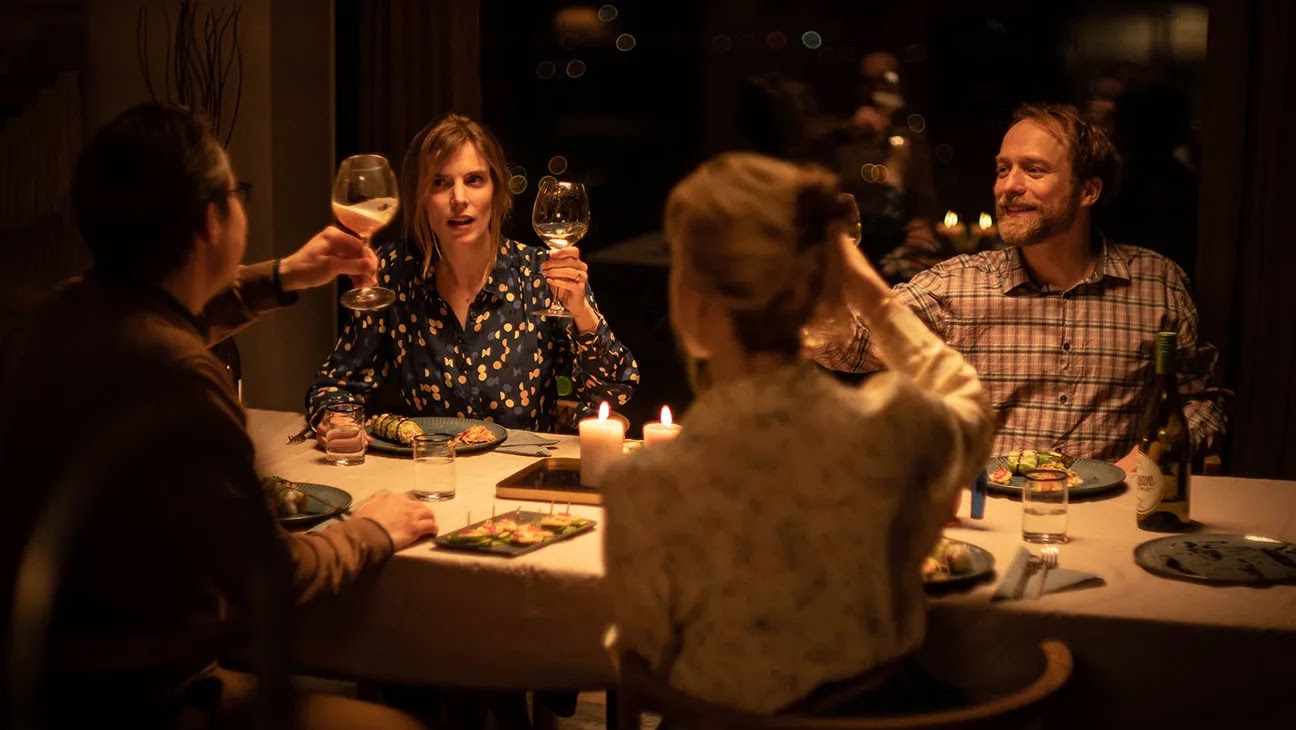
The World to Come is to the American cinema what Portrait of a Lady on Fire was to its French equivalent: an absorbing, involving and finally deeply moving new angle on the whole business of love in crinoline and long johns, elevated by the kind of textured writing and playing you may have thought had been purged from today's cinema. It opens on January 1, 1856, with Katherine Waterston's heroine Abigail reading from her diary: "We begin the New Year with little pride and no hope." A black-clad farmer's wife in a frosty backwoods nowhere, Abigail has already seen a child die in her arms, and has resolved to dial down her expectations for anything beyond a hard, passionless existence; her diarising, which continues to float up on the soundtrack at sporadic intervals, is a ghost of the literary life a woman with her evident eye, brains and sensitivity might have enjoyed had she been born in another time and place. Alas, in this world, she's married to Casey Affleck. Still, we are not set down here to mope and suffer, rather to feel our way toward rapture. We get a hint of it with the arrival in town, just ahead of spring's first shoots, of Tallie (Vanessa Kirby): red-haired, roughly the same age as Abigail, modern in her outlook and dress, visibly very fond of her new companion and confidante. Alas Tallie, too, has a beardy-mumbly indie man waiting for her back at home (Christopher Abbott), and this is several decades before anyone really had the right vocabulary for queerness, open relationships and polyamory. For some while in The World to Come, the people appear every bit as penned in as their livestock.

We, however, can spend that time enjoying the textbook pleasures of the period drama: handsome, foursquare production design (albeit, in this instance, applied to the draughty shacks of second-generation settlers with barely two sous to rub together), mutedly pretty costumes, a feel for a scrap of land at different times of the year, first buffeted by snowstorms, and then - by the annual miracle of nature - renewed promise. Composer Daniel Blumberg's mournful slide guitar keeps threatening to segue (not inappropriately) into Chris Isaak's "Wicked Game". Jim Shepard and Ron Hanson's script, meanwhile, offers abundant lessons in the practicalities of living at this particular historical moment, including an improbable cure for fever. (An enema with molasses: these people had no word for Lemsip, either.) The whole construction - and the film rapidly puts down foundations and assumes that solidity - is elevated by a genuine rarity: an absolutely essential, distinctly Malickian voiceover that opens up the drama, letting on what Waterston's Abigail can only elegantly gesture at onscreen, whether doubts, fears or hidden but swelling passions. What's truly poignant about The World to Come is that the world it describes is so small and ordinary, so indifferent to the happiness of its inhabitants. (In this exploratory, ill-connected America, you can consider yourself lucky if you don't perish amid a harsh winter frost.) Yet within it, Fastvold and her collaborators spy a window of opportunity, a moment or two to be seized, and with those a chance to escape the past and emerge somewhere closer to our liberated present. There will be obstacles: Affleck and Abbott describe men who are not insensible but very much of their time, unhappy and longing in their own way, fearful for good reason, possessive and potentially murderous with it. Yet the movie finally chooses love, inviting its superb female leads to let down their guard as with their hair and create something all the more precious for being so precarious: a cabin of their own.

The World to Come is available to rent via Prime Video and YouTube.

Tuesday, 17 September 2024

Squirm and squirm again: "Speak No Evil"


Unusually, it makes complete sense that someone should have thought to remake 2022's Danish shocker
Speak No Evil. For all the breathless responses it inspired, that film barely made it off the festival circuit, a result of a) being two films in one, both difficult to market beyond the horror cognoscenti, and b) a final act that limited word-of-mouth to a blunt "well, that was an ordeal". (Intonation up and positive if you're a horror nut, down if you're anybody else.) It also makes sense that Blumhouse should have handed the assignment to British writer-director James Watkins, whose Eden Lake, a commendably nasty class-warfare thriller of 2008, moved through adjacent thematic territory. Where Christian Tafdrup's original honed in on cultural differences - and key differences - between the Danish and Dutch, this Anglicisation duly pits Brits (more specifically yet: the English) against Americans. Thus we find nice, mild, internationally minded Yanks Scoot McNairy and Mackenzie Davis shuffling meekly up a West Country garden path (in an electric car, natch), pausing to gawp at the Cerne Abbas Giant's erection; they're headed there at the invite of crass Limeys James McAvoy and Aisling Franciosi, who have strong feelings about the French and foreign cheese, brew their own Calvados, somehow still have Chuck Norris films on their TV, and entertain designs besides on our nervous-Nelly heroes. Here, the remake alights on something genuinely new: this Speak No Evil is the first film in cinema history where the Americans are wallflowers and milquetoasts and the Brits are the bolshy, pushy, thoughtless arseholes. How far we've come in the wake of Brexit.

For two-thirds of his running time, Watkins respects the original's structure, and in doing so he recognises that Tafdrup's was a structure worth respecting, setting us as it did to squirming through a gradual cranking-up of transgressions (grounded in everyday interactions: childcare, dining, sleeping). Anyone who's already squirmed this way will find themselves spotting small, appreciable divergences. Foremost beneficiary of the script's regional variations, McAvoy's Paddy - almost certainly the defining screen Paddy; every Englishman called Paddy I've ever met has somehow been exactly like this - is more Johnny Mercer than full-on Faragista, but still a recognisable posh type, prone to quoting Philip Larkin and rocking out to Def Leppard. But this isn't just the McAvoy show. A fine thespian bridge quartet builds believably awkward relations, and both Americans, in particular, feast on the tensions within these characters, their marriage and this social situation: the most compelling square centimetre you'll see on screen all week is the zigzagging knot between McNairy's eyebrows. Crucially, these houseguests are sentient human beings with - when it comes down to it - actual, tough choices to make, as distinct from the original's wilting patsies; that shift in characterisation ensures Watkins' film feels less of a wind-up or sick joke at someone's expense than a well-rounded comedy of manners. 

If the first film was recognisably from the country that brought you those cartoons of the Prophet Muhammad, the remake is very definitely from the country that gave the world The Office. (A little note of Brent enters McAvoy's performance as, over dinner, he asks his guests what the biggest sexual organ is.) Yet lest matters get too cosy or familiar, it's also - as Watkins plainly relishes - a film from the same part of that country as 1971's Straw Dogs, which brings us to the remake's biggest deviation from its source, its radical change of ending. Tafdrup's conclusion was one provocation among many; Watkins substitutes what felt to me like an entirely logical progression. (Such a logical progression, indeed, that it's the road I thought the original might have followed had its makers demonstrated any real interest in the children being shuffled around as props and plot points.) First time round, Speak No Evil was an ordeal that didn't bear thinking about, chiefly because it made very little sense beyond a certain point. The Blumhouse variation plays less like a conventional remake than a careful course correction or superior second draft, all the stronger for having given serious consideration to what did and didn't work in its source. The results are solid multiplex entertainment rather than high film art, but they also represent something rare and cheering in 2024: an instance of a studio movie not fumbling but fixing its story. Easier to hear the (ever-valid) point being made when it's not drowned out by off-camera sniggering; here, Watkins and co. swap in genuine narrative smarts.

Speak No Evil is now showing in cinemas nationwide.   

Saturday, 14 September 2024

On TV: "Peterloo"


It's now clear that Mike Leigh's
Peterloo hasn't quite caught the public's imagination in the same way its predecessor, 2014's Mr. Turner, did. There would appear to be several reasons for this. Rather than a national-treasure performer playing a national-treasure artist painting vibrant London sunsets, Peterloo promises a lesser-known ensemble (toplined by Maxine Peake beneath a Vermeer bonnet) in a reconstruction of a little-known corner of British history - the 1819 massacre of peaceful protestors at a rally in Manchester - which resulted in a crushing defeat for the working classes. In its efforts to discuss the causes and ramifications of this under-discussed episode, the new film gets wordier and wordier with each scene; instead of Mr. Turner's pretty pictures, it commits to the dourness of pre-electrification Northern life in exactly the same way Leigh's tough Vera Drake committed to the dourness of the East End slums; and after two-and-a-half hours, it concludes with a downer ending that confirms the pessimist's view of history as, more often than not, a terrible slap in the face. I wondered whether any of the suits involved passed Leigh a note to inquire whether he couldn't in some way lighten matters up a touch, and then of course realised the famously ornery director wouldn't have paid them the blindest bit of notice anyway.

There may be something honourable in such intransigence, and there are still elements to admire here, notably in the film's evident scholarship, its management of scale and its historical veracity. From just a few minutes of onscreen activity, we can infer the performers had immersive training in how to best use the looms, angle grinders and printing presses by which the film evokes 19th century labour practices, and that Peake may very well have slept with the period potato peeler she's seen wielding at one point. Leigh has used Amazon money to purge from the frame anything that might scan as distractingly modern, and thereby recreate a dark age - one that, in the bright light of our touchscreen era, feels closer to feudalism than it does to the present - in which the fate of the British working classes was arguably sealed. (No nation-spanning French Revolution for us; instead, the protestors were driven into retreat, told to know their place, keep calm and carry on kowtowing. Or else.) There is, however, plenty of evidence to suggest that Leigh has become increasingly self-conscious in his efforts to (re)make history. The idiosyncratic choices of this director's previous period dramas (which include Drake, Turner and - best of all - 1999's Topsy Turvy) - arrived at spontaneously, either in workshop or on the day of filming - seem themselves to have been purged, and what's left behind betrays a familiar weakness of long-held passion projects: everything appears nailed in place, fussed over, vaguely lacquered. So much energy has been funnelled into Peterloo's recreation of life as it once was that actual life has been micromanaged out of it.

This is also, I think, a very specific take on history, which isn't always to the film's favour, as those early reviews questioning the simplicity of Peterloo's politics have flagged up. Leigh remains capable of dramatic subtleties and grace notes: I warmed to one workers' meeting, where an extremist young longhair can be heard screaming for the King's head, while centrist dad avant-l'heure Philip Jackson tries to avoid throwing the baby out with the bathwater. And the director's pre-existing commitment to the collective takes on a new edge in this context: Rory Kinnear's Henry Hunt, parachuted in from London in what other movies would doubtless position as the white-saviour role, is here defined as a snippy, metropolitan-elite snob who goes missing when the going gets tough, and doesn't even merit an epitaph in Leigh's eyes. (Peake, too, occupies no more than a supporting role; the varyingly unruly mob's the real star.) Yet Leigh's depiction of the ruling classes is forever more cartoonish than chilling, and these caricatures only add to the sense of an overly declamatory drama, wall-to-wall with wobbly-jowled, tophatted speechifying in which the same handful of sticking points are hammered to death. Long stretches of Peterloo would serve as unimpeachable civics lessons - they're like the twenty-minute collectivism scene that stopped Ken Loach's Land and Freedom dead in its tracks - but they're far less effective as drama or cinema than they are as a demonstration of oratorical technique.

What's missing from these scenes is any resonant debate - the debate Leigh set up very simply in a film like 2008's Happy-Go-Lucky by putting two individuals with radically different perspectives (there, Sally Hawkins' indelible Poppy and Eddie Marsan as her equally unforgettable driving instructor) in the same confined space. Peterloo is too grandiose for that, keeping its two tribes at arm's length for most of its duration, and busying itself with waffling that puts its conflict off - and off, and off again - until everything explodes at Peterloo in what the BBFC, somewhat deflatingly, describes as "moderate violence". The film's second half proves markedly stronger, with its poignant what-ifs, its glimpses of the victory that looked to have been within its huddled masses' grasp before the descent into pitched battle. You feel Leigh wants both the film and the massacre to serve as a rallying cry - an opportunity to learn from history, and improve on past results - yet on a scene-by-scene basis Peterloo treats that history as a done deal, rather than an ongoing struggle. Its box-office thud feels emblematic of a moment where the British Left, no less caught up in windy, angry, exhausting self-analysis, seems itself on the brink of defeat, while the working classes they once vowed to protect are being led towards the void by a new generation of oddbod toffs and poshos. "Liberty or death!," cry Leigh's rebels, shortly before setting off on what would, for some of them, be a fateful last march. To battle-scarred, experience-burnt 2018 ears, that might sound like another dangerously binary choice.

(December 2018)

Peterloo screens on Channel 4 at 11.55pm tomorrow, and will then be available to stream via the Channel 4 site.

Friday, 13 September 2024

For what it's worth...


UK box office Top Ten (for the weekend of September 6-8, 2024):

1 (new) Beetlejuice Beetlejuice (12A)
3 (3) It Ends with Us (15)
4 (2) Deadpool & Wolverine (15) *
5 (4) Alien: Romulus (15) ***
6 (1) Despicable Me 4 (U)
7 (7) Blink Twice (15) **
8 (6) Inside Out 2 (U) ****
9 (re) Star Wars: Episode III - Revenge of the Sith (12A) **
10 (new) Firebrand (15)

(source: BFI)

My top five:
1. The Third Man 
2. Batman Forever [above]
4. Kal Ho Naa Ho


DVD/Blu-Ray/Download top ten: 

1 (1) Inside Out 2 (U) ****
2 (new) Twisters (12) ***
3 (2) Despicable Me 4 (U)
4 (3) A Quiet Place: Day One (15) ***
5 (new) Bad Boys: Ride or Die (15)
6 (7) Back to Black (15)
7 (17) The Lord of the Rings: The Fellowship of the Ring (PG) ***
8 (14) The Garfield Movie (U)
9 (6) Furiosa: a Mad Max Saga (15) ****
10 (28) The Lord of the Rings: The Two Towers (12) ****


My top five: 
1. Furiosa: a Mad Max Saga

 
Top five films on terrestrial TV this week:
1. The Mask of Zorro (Saturday, Channel 4, 11.45am)
2. The Best Man (Sunday, BBC Two, 10pm)
3. Night at the Museum (Saturday, ITV1, 5.05pm)
4. The Outfit (Friday, BBC One, 10.40pm)
5. Peterloo (Sunday, Channel 4, 11.55pm)

Thursday, 12 September 2024

In memoriam: Norman Spencer (Telegraph 11/09/24)


Norman Spencer
, who has died aged 110, was a writer, producer and production manager who played a crucial role in David Lean’s breakthrough films, including In Which We Serve (1942), Great Expectations (1946) and Oliver Twist (1948); towards the end of his life, he was reportedly the oldest man living in the Greater London area, and the second oldest man living in the United Kingdom overall.

Beginning as third assistant director on In Which We Serve and working his way up to unit manager on Blithe Spirit (1945) and associate producer on The Passionate Friends (1949), Spencer helped Lean define the notion of quality British cinema. Entertainments above all else, these collaborations were also emotionally expressive, and supported by the best craft the British industry could afford in the post-War years; like Spencer himself, they endured.

The pair parted ways creatively after rewriting The Bridge on the River Kwai (1957) – where Spencer suggested The Colonel Bogey March be whistled rather than sung, the better to avoid censorship issues with the bawdy lyrics – meaning these early ventures typically lacked the scale of Lean’s later widescreen epics. Yet they were similarly rooted in considered storytelling, born of long brainstorming sessions over tea and coffee in Lean’s offices.

The results were hilariously comic in the case of Hobson’s Choice (1954), for which Spencer urged Lean to forsake his initial casting choice Roger Livesey in favour of Charles Laughton. (The script earned Spencer, Lean and Wynyard Browne a BAFTA nomination.) They were more poignant when addressing a seasoned Katharine Hepburn’s quest for love in Summertime (1955), its extensive Venice location work indicating the new, international direction Lean was travelling in. As the filmmaker put it, British soundstages were “a pitch-black mine… I prefer the sun.”

The pair fought several battles along the way. According to Spencer, Noël Coward doubted Lean’s capacity to adapt Blithe Spirit: “He said that David Lean had no sense of humour, he shouldn’t go anywhere near comedy, but he was wrong”. Lean only inherited The Passionate Friends after a cast revolt against original director Ronald Neame. The War Office repeatedly tried to halt production on Kwai, claiming a British officer would never behave as Alec Guinness’s Colonel Nicholson does.

Lean’s singular mix of perfectionism and distractibility, specifically his susceptibility to the opposite sex, posed its own challenges. Conceived as a vehicle for the director’s new wife Ann Todd, Madeleine (1950) proved a particular trial to shoot (“the marriage was going wrong”). As Spencer noted: “[David] was a huge womaniser: to my knowledge, he had almost 1,000 women. When we shot [Hobson's Choice] in the streets, people asked: ‘Who’s that good-looking actor?’ I had to say: ‘That’s not the leading man, it’s the director.” 

Spencer nevertheless persevered, returning to assist Lean on Lawrence of Arabia (1962), where he liaised with Morocco’s King Hassan II on locations, and sourced the many extras required for the film’s populous battle scenes. “We had to have a thousand camel saddles made, and we had to teach the camel riders in Morocco to ride in the way they ride in Jordan, which was a huge undertaking,” Spencer recalled. “But it had to be done, because the scenes had to match.”

Norman Leslie Spencer was born in Stockwell, London on August 13, 1914, two weeks after the outbreak of the First World War. He spent his childhood years in Essex, where the family relocated; after seeing his first film, aged nine, in Leigh-on-Sea, he pestered his parents for a toy projector.

Spencer left school aged fourteen and briefly worked as a commercial artist in central London, where he landed his first break. While painting a mural at a dance studio in Great Portland Street, the dancers told him various studios were hiring extras for crowd scenes, paying one guinea a day. Spencer duly volunteered his services at Pinewood, eventually appearing in barrack-room comedy Splinters in the Air (1937).

But it was over at rival Denham Studios where Spencer put down creative roots, appearing uncredited in the Marlene Dietrich/Robert Donat romance Knight Without Armor (1937) and as an athlete in A Yank at Oxford (1938). While apprenticing elsewhere – his first screen credit came as a clapper loader on the Madame Tussaud’s-set horror Midnight at the Wax Museum (1936) – he developed a profitable sideline as a stand-in, doubling for such stars as George Formby and Leslie Howard, and thereby earning an extra five pounds a week.

It was at Denham that Spencer first met Lean, then working as an editor: “We were both mad about film and started going to the pictures together with our wives. I remember one time David saying: ‘The sound is terribly low on this – let’s speak to the manager.’ The manager said loftily: ‘You don’t understand. The film comes to us and there's nothing we can do.’ David said: ‘Let me up to the projector room.’ Imagine David Lean being told he didn’t know about these things!”

Spencer was duly invited aboard when Lean formed Cineguild Productions with Coward and Neame in the wake of In Which We Serve’s success. Yet external circumstances meant he had to turn down a scheduled first assistant director gig on This Happy Breed (1944), Lean’s morale-boosting adaptation of Coward’s hit play: “Shooting was about five weeks away when I got my call-up papers. There was nothing anybody could do about it, and I was called up into the army.”

Following his Lean collaborations, Spencer himself branched out, overseeing the druggily existential road trip Vanishing Point (1971), a film as far from Lean as it was possible to get. Berated by critics – The New York Times’ Roger Greenspun called it “a movie about which I can think of almost nothing good to say” – Vanishing Point was embraced by young audiences who thrilled to its anti-authoritarian vibe. Spencer called it his most notable success as a producer: a scrappy idea – handed to him by the Cuban writer G. Cabrera Infante – converted into a major countercultural hit.

Later, Spencer operated as a middleman for journalist Donald Woods and director Richard Attenborough (who’d made his acting debut in In Which We Serve) on the project that became Cry Freedom (1987). This was a sweeping, awards-courting epic in the Lean vein, centred on the friendship between liberal South African Woods (Kline) and anti-apartheid activist Steve Biko (Denzel Washington); it was nominated for three Oscars and seven BAFTAs, winning Best Sound at the latter.

By that point, Spencer was an old hand, and British cinema had become far grander than the cottage industry he’d passed into fifty years before. Interviewed in 1999, he recalled the early days of working with Lean: “We started making films together and when we’d finished one, we’d always want to make another right away. We’d haunt bookshops, and he’d say, ‘Within nine feet of us is a wonderful idea for a film.’”

He married Barbara Sheppard in 1943, and is survived by the couple’s two children, including the actress Sally-Jane Spencer, who made her uncredited screen debut, aged four, in Lean’s The Sound Barrier (1952).

Norman Spencer, born August 13, 1914, died August 16, 2024.

On demand: "Speak No Evil"


The Danish shocker
Speak No Evil caused a minor commotion on the horror festival circuit in 2022, in part, one suspects, because it looked unlike anything else on the horror festival circuit at that time. With its not uncostly aesthetic of cosy furnishings and aspirational knitwear, it gains an odd, effective quality: it's a horror film that looks like the kind of genteel Susanne Bier endeavour that would happily, and altogether mildly, meet the needs of BBC4's Saturday night "upmarket Eurofilm" slot. Yet Christian Tafdrup's film gradually reveals itself to be a wolf in sheep's clothing, nasty in both its underlying messaging and onscreen execution; what's finally been dressed up here is a nationalist party's slogan of "you can't trust foreigners these days". A Danish couple - Louise (Sidsel Siem Koch) and Bjørn (Morten Burian) - befriend Dutch contemporaries Patrick (Fedja van Huêt) and Karin (Karina Smulders) on an idyllic Tuscan retreat; pointedly, they bond over their cultures' shared rejection of political correctness, although the meat-loving Dutch pair (who definitely voted for Wilders) prove more enthusiastic about this than the weaker-willed Scandinavians. The real trouble begins after the former invite the latter back to their remote Low Countries home, where the signs all's not right rapidly stack up: the hosts' heavyhanded treatment of their mute son (and dismissive treatment of his Arab babysitter), a dispute over paying for an expensive dinner, ominous soundtrack parps over shots of a windmill. The vibes are very distinctly off - and this, we are led to believe, is Europe as we find it a quarter of the way into the 21st century.

Tafdrup keeps one hand firmly on the dial that determines how off those vibes are, staging the whole film, from front to back, as a mounting series of transgressions, first conversational and only arguably forgivable, then physical (Patrick walking into a bathroom where Louise is showering, and peeping on the Danes making love), then fatal. The whole plot literally turns on a wishy-washy liberal's need to make nice: events deterioriate rapidly after mealymouthed wretch Bjørn returns to his hosts' place to retrieve a toy rabbit his daughter left behind after they fled in the middle of the night, and then has to justify taking the position he did. ("Why are you doing this?," he asks Patrick late on. "Because you let me," is the response.) This is demonstrably - and I might also say all too obviously - a film that hails from the same corner of the world that gave us the Lars von Trier variations, Thomas Vinterberg's The Hunt and those cartoons of the Prophet Muhammad; to find Speak No Evil as shattering as many on the festival circuit apparently did, you will need to have filtered out some fairly loud bait-the-libs snickering coming from behind the camera. One of the reasons Tafdrup made the film look as it does, you realise, is to sucker in exactly the audience whose lifestyle and attitudes he means to razz. (You too have to go along with it, in order for it to finally knock you out.) Some skill is involved in this, not least in delaying the reveal of precisely why the vibes are off, and the actors work well as a push-me-pull-you unit, taut passive-aggression giving way to actual aggression, even if I wasn't entirely sold on the bad decision-making required of the Danes to keep this ordeal going, nor finally the psychology of their tormentors. If you were feeling kindly, you'd say it was a well-engineered wind-up from a country that's come to specialise in winding the world up. If you're having an off day, you might be more inclined to label it brattish trolling, the movie equivalent of spending 95 minutes in the Breitbart comments section.

Speak No Evil is currently streaming via Shudder, and available to rent via Prime Video; an American remake opens in cinemas nationwide tomorrow, and will be reviewed here in due course.

Wednesday, 11 September 2024

On demand: "Louisiana Story"


1948's Louisiana Story found Robert Flaherty picking up where he left off when World War II interrupted, with another peaceable, poetic, artfully constructed documentary-fiction hybrid, albeit now with an ominous sense of things to come. Non-fiction legend has it that the veteran filmmaker only got this one, his final feature before his death three years later aged 67, over the line thanks to a sizeable financial contribution from the Standard Oil Company. Yet a certain editorial nous is evident in the way Flaherty folds in this encroachment, and makes a film about a paradise being lost. First, he gives us the paradise: a small Cajun family unit (mutely devoted ma, "colourful" pa, their cheeky, gap-toothed offspring, his pet raccoon) living a broadly idyllic existence on the banks of the Mississippi. Then he introduces the complications, via signs of American modernity: the slick speedboat of the corporate forces pursuing an interest in this territory, its backwash capsizing our young hero's canoe; a vast oil derrick hoisted into position to blot the landscape; a soundtrack that suddenly fills with clanks and bangs. For a while, Flaherty gives his backers what they may have wanted from their investment. While the Pulitzer-winning score by Virgil Thomson busily signals progress, development and that everyone before the camera is going to be in the money once the desired black gold is struck, we watch
 the kind of friendly human faces one might have seen in early Esso or Shell commercials, lingering close-ups on drill bits and mining infrastructure, and cutesy-funny interactions between the boy and the engineers overseeing the project. (Here, the movie meshes with another of the era's forms of industrial filmmaking: Disney's live-action nature tales.)

Yet the overall picture we're looking at is markedly different from the unspoilt, essentially 19th century landscapes of Flaherty's Nanook and Tabu. In shifting his focus back to America, the filmmaker raises one of the bigger questions hanging over the second half of the 20th century: now that we've agreed war isn't the way forward, just how much is big business going to (be allowed to) take? You wouldn't necessarily have to stretch too far to see Flaherty constructing a parallel between the oil men tampering with nature and the frankly terrifying alligators floating down river, putting that cute raccoon (among other examples of local wildlife) in mortal danger. These are hunting grounds, after all, and it takes on-the-ground smarts, real resistance and unity, to outwit and see off such predators. Over the next 75 years, profits and waters would rise, the levees would break (if not the levies), and man would continue to pump petrochemicals into the sky and hope for the best; for much of that time, successive waves of documentarists (starting with the Direct Cinema movement spearheaded by Richard Leacock, one of Flaherty's assistants here) sought a back-to-basics purism that led to Flaherty being written off critically as either a figure of white paternalist condescension, a faker or a hopelessly wide-eyed naif. You can't fail to be struck by the wonder still present in this filmography - wonder at what's been put before the camera, that we should all see such sights - yet the films now appear far more complex, revealing and rewarding than any of the above labels would allow for: what Flaherty signed off with here is, at heart, an uncannily beautiful film about despoilment.