Wednesday, 9 November 2022

Exhibition: "Bros"


It's now clear the marketing tactic of trumpeting
Bros as the first studio romcom with openly gay leads backfired spectacularly. The straights - to be more specific, the homophobes and non-curious - were sent fleeing; gay viewers, meanwhile, were pushed into analysing what this notionally totemic picture said about them, and were broadly indifferent to what they saw. I caught up with Nicholas Stoller's film in its second week on release, by which time it had been relegated to a (very) light smattering of lunchtime matinees, which can't possibly have been its creators' intention: does representation really count if you're representing to six people shuffling Greggs bags while checking their phones? The issue, I think, wasn't the representation per se, but the trumpeting, which feels self-satisfied at best, and is to some degree built-in. Writer-star Billy Eichner is best known for a series of viral videos in which he shouts at New Yorkers on the street, and to this viewer as the point at which TV's Parks & Recreation upped the volume and lowered its quality control. He starts out here yammering at 70mph, as Bobby, mouthy host of an LGBTQ-themed podcast, and rarely dials back anything thereafter. "You're very intense," observes his chiselled sweetheart Aaron (Luke Macfarlane), which is the polite word for it. And all this is just in the film's early stages: by the conclusion, a plot hike is offering us some jolting idea of what Billy Eichner might look and sound like on steroids.

The agitation central to Eichner's screen persona seeps rapidly into a film that already appears more than a little unrelaxed, so tangled up is it with the burden of satisfying hopes and expectations, and the trickiness of balancing fragile personal truth with the crushing demands of cinematic commerce. We join Billy-as-Bobby as he's appointed head of a trust overseeing New York's first LGBTQ museum, and the workplace scenes, which stand as some of the liveliest in the film, involve an ongoing discussion with fellow board members (including Community's Jim Rash and Glee's Dot-Marie Jones) as to the direction key exhibits should take - in other words, who to represent, and how to represent them. When Bobby and Aaron start dating, it's to movies that prompt discussions of the movies that came before; there are variably affectionate takedowns of Brokeback Mountain (straight actors play sad and gay), Bohemian Rhapsody (for framing a gay icon in terms of his heterosexual dalliances) and those recent cable TV movies skewed towards the pink pound. Nobody on screen gets any time off from thinking about gay representation - it may be the first romcom where the protagonist's heartache is secondary to what's weighing on his mind. And so we start to feel the stress, too. One of the reasons Bros doesn't wholly seduce as romantic comedy is that it never allows us to relax the way even a midranking hetero romcom like You've Got Mail did. That film is glimpsed in passing here, still blithely removed of any such representational burdens, its characters free to be and love. By contrast, there aren't enough poppers in New York for Bros, which comes over as clenched when it's not chaotic; even with its (quite funny) Debra Messing cameo, it's all will, no grace.

Much of that stress can be traced back to Eichner himself, who's written a series of monologues for the other performers to fleetingly interrupt - a break from the tradition of producer Judd Apatow, whose best comedies (The 40-Year-Old Virgin, Funny People) have been essentially democratic in their methods. This is mature Eichner, which means he's saddened by the scene he overlooks from a nightclub balcony, and disdainful of the generations partying in his wake (a nice, tart line: "We had AIDS, they had Glee"). But his self-pity is harder to take than Woody Allen's must have been when the latter was reinventing the hetero romcom at the tail end of the 1970s. You understand all too easily why the abrasive and irascible Bobby keeps being blocked on Grindr, and it has nothing to do with the quality of his ass pics. Bros works best whenever it wriggles out of the chokehold of tribal responsibility (even the film's jolliest sex scene involves wrestling) to present as just jokes. Some of these are scene-specific: I liked the idea of Zellwegr, a dating app where users gather to talk about actresses before going to sleep. Many more are blessed with pansexual comedy nous: a TV movie aimed at bisexuals called "Christmas with Either", a gender-reveal orgy, talk of a sex-positive Tiny Tim. (Novel, funny ideas, wherever you sit on the Kinsey scale.) And Eichner is plainly engaged on some level with the ins and outs of gay history - what's come before - in a way that feels valuable and educative. There are more references to Stonewall than I can remember there ever being in a romcom, and a cameo for Harvey Fierstein, who - in his current, silver-haired incarnation - really ought to be playing Ursula in Disney's upcoming live-action Little Mermaid redo.

But the movie keeps circling back to its own hang-ups, and to a central relationship that forever feels like Eichner's fantasy, as a slightly schlubby fortysomething, of finding an adoring, endlessly supportive young hunk to stand by him while he gets his shit together. It boils down to the exact same flaw that's sunk so many straight-leaning romcoms in recent times, including several prominent examples from the Apatow school. And there is a lot of shit to get together. Billy-as-Bobby's midfilm monologue on how his self-loathing was drilled into him as a child is sensitively handled - or more sensitively handled than you'd perhaps expect from the director of Get Him to the Greek - but it also reminded me how wise Simon Amstell was to distance himself from the protagonist of 2018's Benjamin by casting someone else in the Simon Amstell role; there was a crucial opening-up of perspective (not to mention breathing space) in that movie that there isn't here. I still had a reasonable time with Bros: it's hard for me to object too vociferously to any film that features both the line "lesbians, disperse!" and a solid Yentl gag. There might even be lessons to be learnt from the film's commercial failure, if the studios were any longer interested in learning lessons that don't result in them printing money hand-over-fist. But chief among them would have to be that a film can't ever be entirely good for the gays if it's seen and widely perceived to be representing only one among their number. The trouble with Bros is that it barely seems to justify the plurality of its own title: in the end, it really is all about Billy.

Bros is playing in selected cinemas.

Saturday, 5 November 2022

For what it's worth...


Top 10 films at the UK box office 
(for the weekend of October 28-30, 2022):

1 (1) Black Adam (12A)
2 (3) Lyle Lyle Crocodile (PG)
3 (2) The Banshees of Inisherin (15) ****
4 (new) Prey for the Devil (15)
5 (new) Coldplay - Music of the Spheres: Live Broadcast from Buenos Aires (12A)
6 (4) Smile (18)
8 (new) Barbarian (18) ***
9 (5) Halloween Ends (18)
10 (new) Triangle of Sadness (15) **

(source: BFI)

My top five:
1. The Thing


DVD/Blu-Ray/Download top ten: 

1 (2) Bullet Train (15)
2 (new) Terrifier 2 (18)
3 (1) Minions: The Rise of Gru (U)
4 (3Jurassic World: Dominion (12)
5 (5) Elvis (12) **
6 (16) The Batman (15) ***
7 (4) When the Crawdads Sing (15)
8 (6) Top Gun: Maverick (12) ****
9 (8) Sing 2 (U)
10 (7Thor: Love and Thunder (12) **


My top five: 
1. Top Gun: Maverick


Top five films on terrestrial TV this week:
1. Spider-Man 2 (Saturday, ITV, 3.10pm)
2. Manchester by the Sea (Saturday, BBC2, 12.50am)
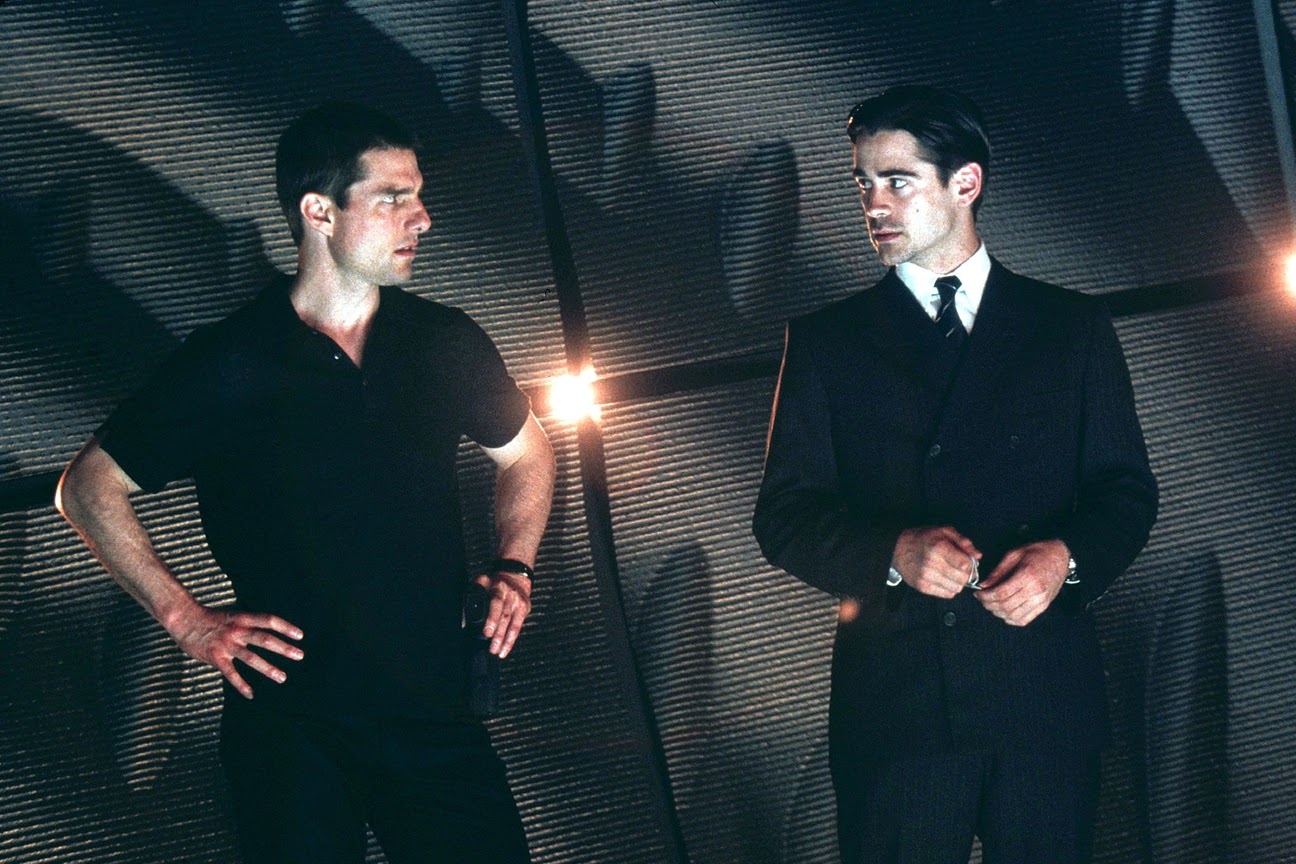
3. Minority Report [above] (Saturday, C4, 11.50pm)
4. The Addams Family (Sunday, C4, 3.45pm)
5. Spider-Man 3 (Sunday, ITV, 11.05pm)

"Watcher" (Guardian 02/11/22)


Watcher
****

Dir: Chloe Okuno. With: Maika Monroe, Karl Glusman, Burn Gorman, Madalina Anea. 91 mins. Cert: 15

Not to be confused with the recent Netflix hit, but a very solidly engineered Hitchcockian throwback, such as the Odeon used to lay on. Company man Karl Glusman and resting actress Maika Monroe are the upwardly mobile young Americans relocating to a Bucharest bolthole boasting a prominent picture window; with hubby out schmoozing clients, his better half has time enough to dwell on a gruesome local murder spree, and the silhouetted figure peering down from an adjacent property. Suspicion shifts and moves still closer to home, but on one point Chloe Okuno’s film remains resolute: these characters would have avoided a lot of grief had they invested in net curtains.

As late as Wes Craven’s Red Eye in 2005, we could take this species of medium-budget runaround for granted. Yet Watcher prompts not just relief that it exists, but actual, genuine, old-fashioned thrills. Striding confidently into studio terrain after contributing to last year’s V/H/S 94, Okuno works up a muted style and aces her setpieces, retooling passing extras as peripheral threats; her sound design goes right through you. She clearly punches up an underlying psychology in Zack Ford’s script, having the actress’s mounting fears compounded by frustration at a Rational Spouse seeking to explain them away as girly misunderstanding. (Glusman’s heroically regrettable moustache offers its own grounds for divorce.)

Practically the only novelty is that Okuno spots this gaslighting for what it is, though that permits us the rare privilege of a mainstream thriller heroine observed erring on the side of caution throughout. As in 2014’s It Follows, Monroe is no pushover, and her reward for persistence, amid the nicely unpredictable finale, is a “told you so” moment for the ages. Unimprovably brisk at 91 minutes, it’s not messing around – and probably won’t hang around long at a moment when the schedules are being primed with comic cuts and starrier awards fare. But a few more of these nifty diversions, and the multiplexes might once again be a viable night out. 

Watcher is now playing in cinemas nationwide.

"The Last Heist" (Guardian 31/10/22)


The Last Heist
**

Dir: Coz Greenop. With: Terry Stone, Perry Benson, Michael Head, Sam Gittins. 86 mins. Cert: 18

You could find it reassuring that, even as the pound yo-yos and democracy unravels, there will forever be a corner of the British film industry that is grim-faced geezers in boozers toting shotguns and plotting shenanigans. This very late entry in a cycle initiated during the Blair administration attempts something a little more characterful than usual, as signalled by the presence of the great Perry Benson in the prologue as a bar owner who corks it before giving up his life insurance details to his son. Yet it still involves an hour of perilously muggy business, as the lad (co-writer Michael Head, sporting a marked resemblance to the young Frank Harper) recalls his old gang to Perry’s bar to work out where their raid on the recalcitrant insurers went bloodily awry. It’s a bit Reservoir Bodge: there’s much gruff talk of codes, and a liberal scattering of the other C-word, before the film pulls a loopy twist from an otherwise threadbare sleeve.

Fair play: that leftfield redirection provides a welcome jolt of energy, no matter that it may befuddle or shake off the Rise of the Footsoldier hardcore. (If nothing else, The Last Heist qualifies as the first geezer-pic to feature a sincere Terry Stone monologue on the toll ducking-and-diving can take on one’s mental health.) Up until then, however, Coz Greenop’s film is all too static and theatrical, stubbornly welded to its primary shooting location, and in thrall to less than scintillating banter that serves chiefly to set up the next flashback. While these at least give Benson more opportunity for effing, jeffing and plunging the occasional head in a deep fat fryer, it leads to a deathly lack of urgency. It’s overextended even at 86 minutes, and though fun, that cracker-barrel twist also propels Greenop towards what instinctively feels like the wrong choice of ending. Not the worst try at this sort of material, but you can already hear it circling the bargain bin. 

The Last Heist will be available to rent from November 14.

Three hours in a leaky boat: "Triangle of Sadness"


Ruben Östlund is going up in the world. As recently as a decade ago, the Swedish writer-director was making small sociological experiments with participants you didn't recognise (because they were often amateurs) and titles that needed explanation (Involuntary, Play, Force Majeure). These pointed, provocative investigations led to 2017's amusing artworld satire The Square, a self-consciously big picture that won the Cannes Palme d'Or the way undertaking certain research lands you the Nobel Prize. This, in turn, has unlocked a budget big enough for 
Östlund to retrain his sights, in his latest project, on the international yachting set, and to welcome a major American star (Woody Harrelson) on board as the captain of a gleaming ship of fools tossed suddenly to the elements. Triangle of Sadness runs 147 minutes to The Square's 151, but everything else about it feels more expansive - more inflated - yet. It opens with a recreation of a fashion event that demonstrates much the same verisimilitude as the artworld happenings in The Square, then settles in for a fifteen-minute argument between dim-bulb rich kids (Harris Dickinson and Charlbi Dean) over the payment of a restaurant bill. On and on it goes, at first excruciating-funny because so banal, then just banal, then plain dull, then duller by the second. Around minute five or six, I began to groan internally: here are characters you wouldn't want to spend thirty seconds in a lift with, let alone two-and-a-half hours on the high seas. As the pair settled their differences and the boat carrying them (and far uglier representatives of the 1%) finally cast off, I found myself glancing nervily back in the direction of the receding shoreline. Getting on for three hours, Ruben? With these fuckers?

I'll spare you some time and trouble by saying you could show up an hour late for Triangle of Sadness and miss absolutely nothing of significance. The first act is a further extension of Östlund's trademark cringe comedy - along the front row of that fashion show, among influencers, between moneyed passengers and overworked, underpaid crew. Yet the fieldwork on this particular voyage is newly imprecise, the methodology increasingly slapdash. In Involuntary and PlayÖstlund engineered situations that were flinty, revealing, discomfiting. Now, with a Palme d'Or in his back pocket and a newfound coterie of producers on hand to applaud his every choice, he contrives long scene after long scene without ever alighting on more than minor passive-aggression. The characterisation and dialogue's not as funny as it once was, it's nothing very much to look at (where The Square at least had that art to fill the gaps between its bug-like characters), and the editorial line is persistently obvious, pitched at great volume towards the idiots in the back. Those earlier films were often naggingly ambiguous, leaving its scenes as open to viewer interpretation as any other set of real-world data. Here, it's clear almost from the off that the director no longer trusts the audience to arrive at their own conclusions - that's presumably why he has the Dickinson and Dean characters buzzed by CG flies on the sundeck. (They're shit, ha.) There's no science left in Triangle of Sadness; and as art, it's iffy, to say the least.

Granted, Östlund is still good for a setpiece, and here's one area where the extra cash must have helped. To Force Majeure's avalanche and The Square's apeman interruptions, Triangle adds a turbulent captain's dinner, in which the waves lashing the boat's exterior are matched by the violent fits of vomiting inside. (Thematic rationale: with consumption this conspicuous, something's got to come back up.) It's not clever, and it sure ain't pretty, especially when the boat's overburdened loos get in on the act, but it's something, I guess - and you can sense the film's most fervent supporters clinging to this eruption of gross-out energy in the face of that nothingy first hour. In the grand scheme of things, however, it's no more than a pivot. Where it redirects us, as deflation sets in again, is a symmetrically dull third act: a Survivor episode with less compelling participants that attempts a simplistic overturning of the status quo, before the kind of non-ending you can get away with after winning the Palme d'Or. (Of course these characters survive the shipwreck - they're such hollow constructions they can only float - but now we're stuck on an island with the fuckers. It's Cast Away with no Hanks and seven volleyballs.) I can understand why Cannes, with its long history of indulging the indulged, went gaga for it; in France, remember, they hold La Grande Bouffe as dear as we Brits do the Paddington movies. Yet Triangle of Sadness washes up here as but 2022's most illustrious example of how cinema is being comprehensively outflanked by television: there's nothing in Östlund's film that wasn't offered far sharper treatment, in digestible 50-minute bites, by Mike White in HBO's The White Lotus. Now with two Palme d'Ors to his name, Ruben Östlund really is going up in the world. But at what cost to the rest of us?

Triangle of Sadness is now playing in selected cinemas.

It's good to talk: "The Banshees of Inisherin"


There is such a thing, I think, as an IFC: an Inherently Funny Conceit. (One example, sourced from recent British TV: parachuting a performer as chaotic as Daisy May Cooper into any quiet Home Counties backwater.)
The Banshees of Inisherin, Martin McDonagh's follow-up to Three Billboards Outside Ebbing, Missouri, proceeds from a C that is very much IF, contending that on a small island off the Irish mainland, in the spring of 1923, two grown men - played by the eminently manly Brendan Gleeson and Colin Farrell - should suddenly decide not to be friends anymore. No immediate reason cited; the gradual revelation - for these are not men who part easily with their feelings - is that Gleeson's Colm, a man possessed of some minor musical ambition, finds Farrell's farmer Padraig a bit dull to be going forward with. Part of the gag is that, this being as small a place as it is, the two men can't avoid one another, whether they're driving their livestock or necking Guinness at the island's solitary pub. Part of the gag, this being a Martin McDonagh film, is that the pair could scarcely have gabbed at one another any less in their days in one another's good books. 

But then the weather shifts, and a fine mist of melancholy begins to descend over, and saturate, the entire picture. These men have precious little going for them - it may be why the movie opens with Padraig calling on Colm to accompany him to the pub at two in the afternoon - and now they both have one less thing in their favour. That they keep bumping into one another only drives home the sadness of the split: with so few people to talk to already, why choose silence as a default? So it's funny, but also soulful and even painful, a break-up movie in its essence, dense with various forms of rejection, abandonment and severance. Around the halfway point, as the screen fell under an expanse of especially grey cloud cover, the following, somewhat troubling thought formed in my mind: we're all talking about The Banshees of Inisherin's Oscar chances, but has anybody troubled to ask Martin McDonagh if he's doing all right?

Being a critic and not a psychiatrist, I can only offer these observations. The accepted wisdom with McDonagh has long been that he's an immensely gifted screenwriter and theatremaker who merely drifted behind the camera. On the evidence Banshees provides, he's doing a far better job there than, say, Aaron Sorkin for one. You will have to accept that this is almost as cartoonish a vision of Irish life as Three Billboards was of small-town America, or indeed Father Ted was of Ireland's rural extremities; there appears to be a donkey at every window, and a whey-faced simpleton on every footpath. And I'm not sure McDonagh has all the filmmaking basics nailed down just yet. His inserts of Padraig looking across the sea to a mainland being blitzed by the Civil War struck me as more than a touch clunky both visually and editorially, and one lakeside scene is so mangled in its syntax - with repeated violations of the 180° rule - that it threatens to become avant-garde. But he gets the big and small stuff right, which is what matters most here. Some of the hard work was done for McDonagh by his location managers: the film unfolds along a stretch of coast that automatically opens this frame up to glorious sunsets and atmospheric skies. But within that framework, the shots of the characters in their isolation are surreptitiously moving, a form of ongoing portraiture of men wearing themselves away to tiny nubs.

The writing, of course, is McDonagh grand, filling in any gaps with mischievous life. This screenplay will get nominations, maybe even an award or two, just for one midfilm joke about a bread van. (It's that good, although on reflection, I may have creased even harder at a passing instance of gobshite humour. Asked at the dinner table to stop eating with his mouth open, Barry Keoghan's dim delinquent Dominic - source of much of the film's humour, and one of its eventual tragedies - retorts with a peerlessly sarcastic "Where am I now, France?") Banshees benefits from the period-movie handsomeness that comes as standard whenever a creative has started to stockpile hits and gongs - yes, everyone loves the knitwear, with good reason - but it also stands as McDonagh's most forceful attempt yet to conjure up an entire universe from talk alone: you spy that aim most clearly in the scenes around the island's general stores, where the villagers gather to swap "news" - everyday tittle-tattle - and the film further expands its horizons via a relatively simple exchange of lines.

It's good talk, crucially, and a gift to these actors besides: even the minor roles - priest, bartender, the storemistress, whom everyone immediately tells they've no time to talk, because they know she'd talk the hind legs off that donkey - come to be sharply defined by one tongue or another. McDonagh's work with his leads, meanwhile, is nothing short of exceptional. Farrell has long been admired and envied for having two of the best eyebrows in the business. Here, demonstrating just what a skilled actor he's become with age, he does something new with them, pulling them low on his forehead as one would a shower cap, and thereby making Padraig a simpler fellow than any of the actor's previous characterisations: naive, uncomprehending, pathetic. (Even when trying to reverse the power dynamic in one scenario, by attempting to show up the island's abusive policeman in front of his fellow villagers, he gets cuts down verbally for bearing "shite news", and then punched on the nose for his troubles.)

Gleeson looks to be operating in a comfortable mode of gruff stoicism for much of the running time: we might wonder how much Colm is driven by genuine animus for Padraig, and how much of his indifference is a wind-up, something new to do with a pal in a place where there isn't much else to be done. Only in the second half does he let slip the despairing position Colm is in, and the extremes he's prepared to go to so as to get the peace he seeks - at which point the full extent of the film's sadness becomes heartbreakingly clear. Part of that heartbreak is that these men are so good together: fine actors, cheering company, fun to look at, in their little-and-large way. As I said to my own companion as we left the auditorium, I don't think I've laughed so much at a film for some while and still come away feeling so blue, some indication that Banshees is simply more effective at getting under the skin than any previous McDonagh film. It's so effective that it can afford to keep the Civil War at a distance, as a sideshow; approached as parable, Banshees would still have much to say without it. Part of the heartbreak, it pains me to admit, is that, however verbose McDonagh's film gets, all its talk keeps circling an unarguable, lived-in, rather sorry truth: that we men can be funny creatures sometimes. You might be better off with a donkey, all told.

The Banshees of Inisherin is now showing in cinemas nationwide.

Thursday, 3 November 2022

When the shit goes down: "Barbarian"


This was perhaps inevitable. 2014's Unfriended claimed the title of the first Facebook horror; 2020's Host reigned supreme as the first Zoom horror. Continuing the trend of a chiller for every app, Barbarian lands among us as the first Airbnb horror. Pulling up outside the sole rentable property in one of Detroit's more rundown suburbs, fresh-faced Tess (Georgina Campbell) soon finds herself having to work through a list of everything that can go wrong when your leisure options have been laid on by a laxly regulated free market: no keys in the dropbox, no-one at property management to take your call, the discovery of a double-booking, made more frightful yet here upon the discovery the dude occupying Tess's rented room is the Skarsgård brother last seen playing the clown in the It remake. You can see the prosaic movie that might develop out of this set-up: tension in the communal areas, leading to a chase around the kitchen, hiding in the crawlspace; clues in the guestbook; everyday household items redeployed as torture implements and/or tools of resistance. Instead, writer-director Zach Cregger has constructed something trickier and more surprising, a film that - like its central property - has hidden depths and unexpected backchannels. This really is one of those instances where it would be best to avoid reading too much in advance, the better to be redirected and misdirected in turn; Cregger will take you on quite the journey around the houses, and out towards the wilderness on the outskirts of civilisation. If that's what you're looking for of a Friday or Saturday night, I'll gladly wave you off here, safe in the knowledge I'm putting you in pretty good hands.


For anyone in need of a harder sell, permit me to add the following observations. The movie rests on three pillars of strength, foremost among them Cregger's screenplay, which dares to go in those new directions, even as it risks disconcerting the audience. Rossitsa Bakeva's modest feat of production design - with typical studio perversity, this wholly US-funded production elected to recreate a square mile of Detroit in Bulgaria - allows that script to keep opening the doors that it does. In passing, we're offered a panorama of a neighbourhood in varied states of disrepair, but in an uncommonly architectural horror movie, one that kept reminding me of Mike Nelson's immersive installation art, it's the interiors that really stay with you: precisely evoked rooms - borderline psychic spaces - inhabited at different times by folks with very different (not always the best) reasons for being there. Thirdly, there is Cregger's canny deployment of actors. That we remain in situ is in large part down to Justin Long as the movie's own super-sub: an innately sympathetic performer brought on at half-time to play a less than admirable character. An unlikely white knight for any film to call upon when the shit goes down - as down it goes here - Long's AJ is a brisk sketch of male indifference and recklessness. (You wince just at the way he treats someone else's laptop.) I think the smarts run a little thin towards the end, and the directorial control begins to waver. The revelation of its "monster" owes something to The League of Gentlemen and Little Britain (which is where it gets retrograde and sniggery) and something to Parasite (which is where it gets derivative); Cregger's talents lie in restructuring rather than renovation, and the #MeToo business that feels integral to this weekend's Watcher feels performative, even insincere here. (It is recognisably, at the last, a movie directed by a Zach.) Still, you can have a discussion about that in the lobby after Barbarian has messed with you every which way.

Barbarian is now playing in cinemas nationwide.