Friday, 15 April 2022

Strangers on a train: "Compartment No. 6"


The writer-director Juho Kuosmanen announced himself internationally with 2016's 
The Happiest Day in the Life of Olli Mäki, a genuine heartwarmer about a lesser-known figure in Finnish sporting history. That film's considerable charm lay in its suggestive smallness, its ability to conjure an entire philosophy from a judicious slice of life. Compartment No. 6, by contrast, is Kuosmanen launching himself into international co-production and international travel - indeed, the film's subject is travel itself, the people you meet and the experiences you gather along the way. (It won the Grand Prix and glowing notices at last year's Cannes, in part - I suspect - because it was being seen by a jetset who'd had their own travel plans stymied by Covid for the best part of a year.) It opens as a study of a stranger in a strange land: this is Laura (Seidi Haarla) is a Finnish postgrad student whom we join in turn-of-the-Eighties Moscow (on the soundtrack: Roxy's "Love is the Drug", Desireless's eternal "Voyage Voyage"), where she's studying archaeology and in a relationship of some kind with an older local woman (familiar artfilm face Dinara Drukarova). Hopping aboard the sleeper train to Murmansk - where she intends to track down some petroglyphs - she finds herself sharing a carriage with a very different variety of Russian: bullet-headed, vodka-sipping, glue-sniffing alpha Ljoha (Yuriy Borisov), who proceeds to get rapidly in his cups, assert Russian superiority, litter the communal table, and accuse our gal of selling her body for cash. Suboptimal companionship, then, and yet Kuosmanen, persisting with the optimism that made his breakthrough film such a tonic, maintains: a stranger is just a friend you haven't heard fart in their sleep yet.

Whether or not the film charms you to anything like to same degree as Olli Mäki may depend on the degree to which you find that optimism stretching a bit thin over the larger canvas. Where the previous film crept up on the viewer from nowhere, Compartment is running on a far more familiar track - the one carrying us from Mutual Antipathy via Hearts Thawing to Opposites Attract. Universality isn't going to harm a filmmaker's prospects in the global marketplace, but the most interesting material here is specific, tied to the utter grimness of Cold War-era train travel: the smoking, the lack of space, privacy, running water, quiet, or any warning of when your stop is coming up. Olli Mäki had that timeless black-and-white sheen going for it, but this limited colour follow-up, all sludgy browns and beiges, is so unromantic on the whole as to make those the Before Sunrise comparisons it generated in Cannes seem wildly off-mark. Whenever these prospective lovers leave the train, it's cold, wet and grey; everyone disembarking looks unwashed, unkempt, unslept. I suspect Kuosmanen would probably rather we approach the film as a youthful (mis)adventure rather than a romance per se; if it is a romance, it's not one you'd want to breathe in especially.

Haarla and Borisov demonstrate sporadic flickers of chemistry, but I found Compartment much tougher to embrace than its predecessor. The filmmaking here is far more tentative, even sluggish in places; many of these frames are conspicuously (if perhaps accurately) ugly; and some of it sounds pretty ugly, too. It's not Kuosmanen's fault, but I wonder whether Yuri's yobbish outbursts just hit the ear as less forgivable in 2022 than they would have done at Cannes 2021. (Next stops: Bucha and Mariupol.) It's hard to cheer for a film where you don't want the leads to have anything to do with one another after a while, and I'd frankly no idea what Kuosmanen was up come the third act, which consists of Laura and Ljoha clowning around at length in the snow. (Here, Compartment No. 6 suggests a Drive My Car voided of all meaning and substance.) Two films into his career, this filmmaker has established himself as a festival-friendly humanist, one who sees the best in his characters; the question going forward will be whether that in itself is enough to sustain a career. The big test may come when Kuosmanen makes a film set in the here-and-now, at a point when our fellow travellers are more complicated and harder to get on with than ever before.

Compartment No. 6 is now playing in selected cinemas, and available to stream via Curzon Home Cinema.

Monday, 11 April 2022

On demand: "The Mitchells vs. the Machines"


Disney all but had this year's Best Animated Feature Oscar in the bag with
Encanto: big, bright, a healthy tick in the representation box, but also a film with infernally catchy, much-streamed Lin-Manuel Miranda songs to keep it in voters' minds over an unusually elongated awards season. With The Mitchells vs. the Machines, their rivals at Sony Animation landed on the kind of wild card it's good for an industry to have in the mix. It has a similar idea to Disney's recent, enjoyable buy-in Ron's Gone Wrong - humanoids who have to stave off a rise of the machines - but as produced by The Lego Movie and Cloudy with a Chance of Meatballs' Miller/Lord pairing, it's been encouraged to lean even further in the direction of goofiness. Writer-directors Michael Rianda and Jeff Rowe also attempt something novel and affecting with their characters, particularly with the relationship between straitlaced father Rick (voiced by Danny McBride) and his aspirant filmmaker daughter Katie (Abbi Jacobsen), respectively representing a generation for whom technology has become second nature and one that's still struggling to make head or tail of it. Rianda and Rowe are supremely alert to the ways in which the personal and technological have meshed in recent decades, yet they grasp the possibilities of tech as a means of communication like any other: Katie's zappy, graphic-laden YouTube videos wind up instructing Rick on what his girl wants and needs from him. They're funny with it, too, showing up with pocketfuls of gags they scatter like sweets to a pantomime crowd.

The irony, of course, is that a film on the perils and pitfalls of tech should be so reliant on technology itself. From a very early stage, we're aware we're watching what only digimation can do; the film moves so fast, and crams so much appreciable detail into the back and sides of the frame that you soon long to study it at half-speed, or to rewatch it again from scratch. (I return to a line of thought stumbled upon during Pixar's early Noughties pomp, namely that digimation might be to traditional hand-drawn animation what screwball comedy was to the set-bound, often stage-derived drawing room comedies of the Twenties and early Thirties: an evolution and an acceleration.) Somehow this dizzying movement and colour (the palette's that of gas-station Slurpees; you want to force it on the makers of superhero movies) doesn't obscure a genuine personality. Rianda and Rowe generated all the necessary ones and zeroes, while understanding their real work lay in doodling over the top of them; their film has the layers you don't get in those cheap, dashed-off half-term screenfillers. 

The Mitchells prove to be the best defined animated family since the Parrs of The Incredibles, or - perhaps more realistically - the Belchers in TV's Bob's Burgers: the make-nice mom (another Linda, voiced by Maya Rudolph) with her heart-shaped earrings; the nervy younger brother (Rianda himself) who likes dinosaurs but nothing else, and is terrified by the thought of interacting with the opposite sex; the boss-eyed pug - a slobbery Minion - whom the very young will almost certainly want to adopt. There's also a terrific villain in Olivia Colman (she's in everything!), voicing a power-crazed Alexa (Malexa?) who uses her new-found sentience to get really, really sarcastic. If it's zippy and surfacey, for once that feels a choice designed to allow the film to cover a lot of ground and squeeze much more in: it is, at the very least, the only animation in existence to feature the music of Le Tigre and a Furby proclaiming "behold, the twilight of Man". With each new, Haribo-caffeinated project, Miller and Lord restate their goal of tossing tattered formulas and playbooks to the wind, and going off at 200mph in search of new ideas and possibilities. There's a sense of discovery, play and spontaneity about their work - and the work they've sponsored - which we're not currently seeing anywhere else in the multiplex; Hollywood would be a far healthier place were they to be appointed Kings of Everything.

The Mitchells vs. the Machines is now streaming on Netflix.

Sunday, 10 April 2022

On DVD: "King Richard"


From the outside, you may think you know what you're about to get from
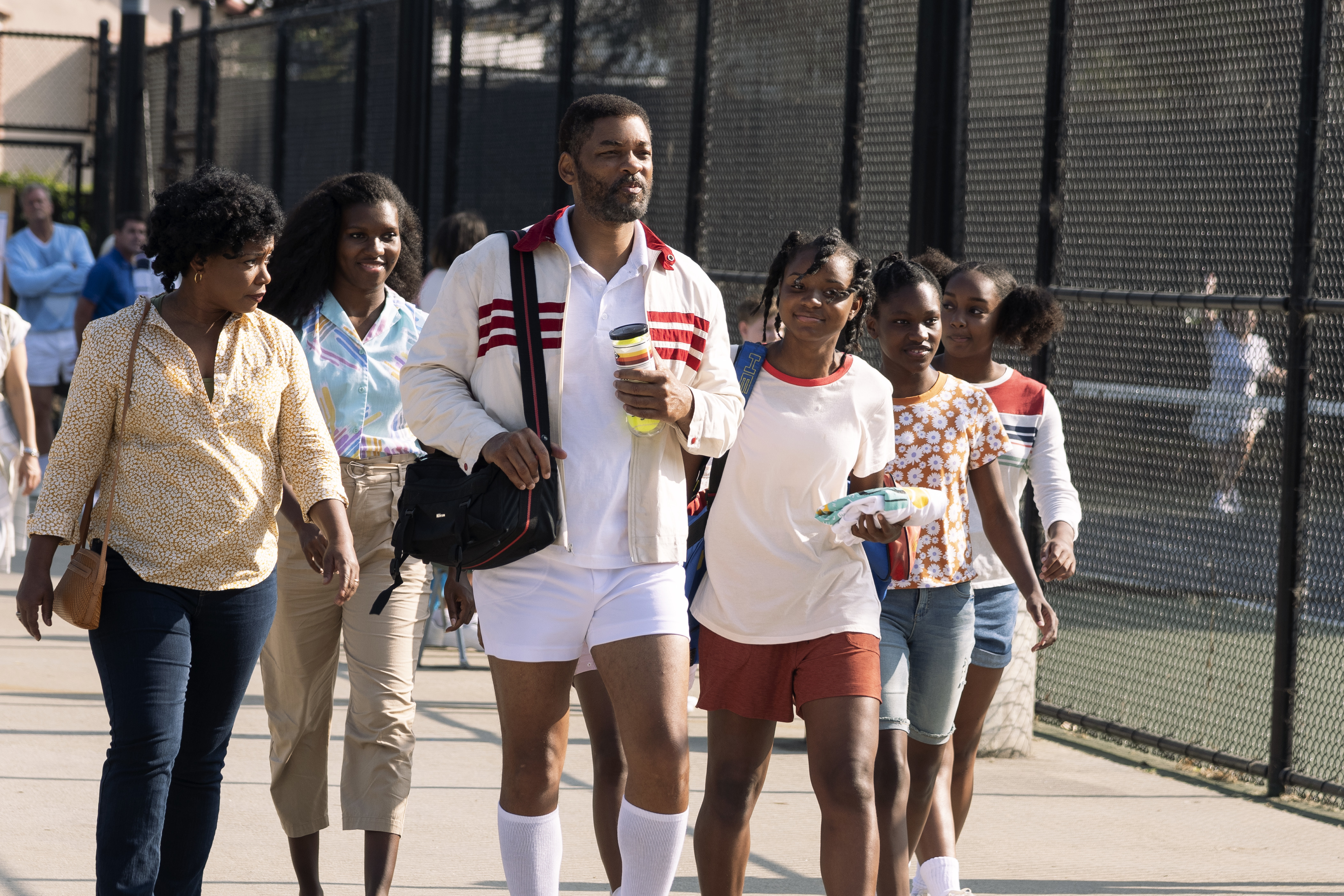
King Richard. The assumption may be that this is merely the Hollywoodisation of a feelgood story that has already been much rehearsed, whether in documentary form (2012's Venus and Serena, 2016's Serena, 2018's Being Serena) or the Sunday supplements in the run-up to every Grand Slam event over the past two decades: how the Williams sisters were guided by their father Richard from lowly beginnings on the concrete public courts of Compton to eventually become two of the greatest athletes of all time. This latest retelling, directed by Reinaldo Marcus Green from a script by Zach Baylin, reshapes that achievement into a more movie-ish thing - a shambling dreamer's crazy hustle. This Richard Williams (Will Smith) is operating from a 78-page masterplan, written before either girl was born so as to net his at-that-point theoretical offspring at least $50,000 for four days' work at a WTA tournament. It could only sound crazier if hadn't succeeded several times over.

If you've ever spotted the real-life RW on the sidelines at Wimbledon or Flushing Meadow, you'll know that he can present as a genial but eccentric fellow. Baylin makes a reasonable case for him being a product of his experiences - his natural distrust of white folks attributed to being chased by the Klan as a boy - while the casting prevents him from ever seeming weird, as might have been the case with another actor in the role. Smith's Richard is from first to last a loving father, tired from all his hustling (and night shifts as a security guard) but clear-eyed enough to see promise where others weren't prepared to look; a man willing to insert himself as a bulwark between his girls and the gang life, as represented by the sweet-talking hoodlums scattered around Compton's baselines. As a result, he saw a 100,000-to-1 gamble - "finding two Mozarts in the same family", as one sceptical onlooker puts it - pay off quite spectacularly. King Richard, which covers a relatively small timespan and concludes before Venus wins her first professional tournament, lets us watch the groundwork and that initial bet being placed; along the way, it even makes sense of Richard's propensity for wearing tennis shorts wherever he went. In his mind, he was dressing for business.

Making his studio debut after 2018's promising Monsters and Men, Green is fated to follow this story where it was meant to go, though that may not necessarily be a fault in this instance. (It is a good story, after all.) Somewhere in King Richard, there's a rather more radical and accusatory film on race relations, addressing the way the Williamses collectively challenged and shook up what was still, even at the back end of the 20th century, a largely privileged, country-club pursuit. The film we have can't lean too hard in that direction; its target audience would be your standard multiplex crowd. Yet glimpses of this narrative keep coming into view, like a ball that's been hoiked across from an adjacent court. Richard struggles to hold his temper when a nosy neighbour sends the police round to the family home to check on the welfare of his girls; he loses it completely when a (white) agent insists on referring to Venus and Serena's progress as "incredible". (He means "beyond the scope of human comprehension"; Richard's ire substitutes "Caucasian" for "human".) Their context may have been altered forever by Smith's regrettable Oscar-night lapse, but these scenes benefit from the star's ability to draw a firm line in the sand and then withdraw from it with a smile - or a smile and a fart, in the second example.

Elsewhere, the story may be preordained, but Green's choices keep scenes and stretches far livelier than anticipated. Saniyya Sidney and Demi Singleton are persuasive as the sisters, adroitly mirroring the young Venus and Serena's giggly personalities; they also give a fair approximation of the pair's on-court personas. Jon Bernthal, as the girls' coach Rick Macci, arrives at the exact point a 140-minute movie needs a jolt of rude energy, and proceeds to do just that, calling Richard out on his mulish inflexibility, his refusal to deviate from the detail of that initial 78-page document. History would demonstrate that Richard Williams was right to stand firm, but the film isn't afraid to question this King's wisdom along the way, as a family member would. Aunjanue Ellis's rocksolid portrayal of the girls' mum Oracene has something to do with that, as does Smith's performance, with its intriguingly steely flickers of egotism and control. Baylin mitigates against those, by reasoning that Richard had much to fear from any loss of control: more than anyone around him, he sensed the risk involved in letting his daughters go into a world that is often indifferent to the fate of young Black women. Green folds it all into a thoroughly professional entertainment, one that gets the tennis right, is never mawkish, and is only rarely as obvious as it could have been. There's a lot of love and care in these frames, and it extends beyond the expected admiration for everything its subjects achieved. Nevertheless, as Venus and Serena wind down their playing careers, King Richard can stand alongside the cluttered trophy rooms in million-dollar mansions as its own polished memento of where this family came from and what they overcame.

King Richard is available on DVD through Warner Bros., and available to rent via Prime Video and YouTube.

Friday, 8 April 2022

For what it's worth...


Top 10 films at the UK box office (for the weekend of April 1-3):

1 (new) Sonic the Hedgehog 2 (PG)
2 (new) Morbius (15)
3 (new) The Bad Guys (U)
4 (1) The Batman (15) ***
5 (3) Ambulance (15)
6 (4) Uncharted (12A)
8 (5) The Nan Movie (15)
9 (6) The Phantom of the Open (12A)
10 (8) Sing 2 (U)

(source: BFI)

My top five:
1. Cries and Whispers
3. Europa
5. River

 
DVD/Blu-Ray/Download top ten: 

1 (1) Spider-Man: No Way Home (12) ***
2 (new) Scream [2022] (18)
3 (2) The Matrix Resurrections (15)
4 (3) Dune: Part One (12) **
5 (4) No Time to Die (12) ***
6 (8) Encanto (U) ***
7 (5) Clifford the Big Red Dog (PG)
8 (7) West Side Story (12) ***
9 (31) King Richard (12) ****
10 (17) Paw Patrol: The Movie (U)


My top five: 
1. The Green Knight
2. Flee


Top five films on terrestrial TV this week:
1. Great Expectations (Saturday, BBC2, 2pm)
2. Wildlife (Monday, BBC2, 11.40pm)
3. 22 Jump Street (Good Friday, ITV, 10.15pm)
4. Matilda (Good Friday, ITV, 2pm)
5. Out of Sight (Sunday, BBC1, 11.40pm)

Tuesday, 5 April 2022

From the archive: "The Second Mother"


The gap separating the haves from the have-nots has long provided a regular field of study for South American filmmakers: standing on the doorstep of the United States probably does that to a national cinema. If Anna Muylaert’s
The Second Mother proves less confrontational than City of God, Neighbouring Sounds or the gleefully spiky Chilean satire The Maid, it’s nevertheless telling that a Brazilian filmmaker can cast one of her country’s biggest stars as a housekeeper and not have it seem as incongruous as Jennifer Lopez playing a put-upon chargirl in Maid in Manhattan.

For much of the first act of Muylaert’s film, we’re simply pottering around a well-appointed Sao Paulo residence, getting the lay of the land. Val (Regina Case, probably still best known over here for 2001’s Me, You, Them) is introduced giving her employers’ young son swimming lessons in the family’s outdoor pool, and then – a decade on – schooling this now-teenage boy in the myriad vagaries of the opposite sex.

Here is a woman who absolutely knows – and is apparently extremely comfortable with – her circumscribed place in the world: though she enjoys the run of the manor during daylight hours, by night – after fashion bigshot Dona Barbara (Karine Teles) has returned from the office – Val is confined to making meals in the kitchen or inhabiting the cramped backroom she shares with a noisy washer-dryer.

Muylaert makes a subtle joke out of the fact Barbara is hardly some horsewhip-brandishing tyrant. She is, rather, just like many other employers of domestic labour: a woman with a lot on, elevated expectations of her offspring, and (not unrelated) a certain public image to maintain – such that we’ll see her instruct Val to put the plastic coffeepot the maid bought for Barbara’s birthday away during that night’s party in order to use a more artful Swedish one in its place.

Still, a faultline opens up under this household, the day that Val’s ambitious, architecture-student daughter Jessica (Camila Mardila) comes to stay for the summer. Through the shrugging intervention of Dona Barbara’s doctor hubby Carlos (Lourenco Mutarelli), she’s installed in a swanky guest room, rather than the mattress Barbara had assigned for her on the floor of her mother’s quarters, and she’s considering dipping a toe in that pool, too…

Though there’s absolutely nothing show-offy about Muylaert’s direction – much of the legwork is taken up by a fine script and excellent performances – it becomes clear from a very early stage that she knows how to use her widescreen frame to punch up what is essentially a matter of space and encroachment. She creates funny ballets around doors and corridors, and a mini-maelstrom over Jessica’s tendency to raid the fridge for snacks; choice camera positioning emphasises the first mother’s absence, and the closeness of the second to the first one’s offspring.

On a purely human level, you can’t help but find yourself drawn in by Case’s matronly presence: Val seems like someone who would not only be gossipy good fun, but who would also – in times of crisis – give tremendous cuddle. Yet Muylaert finds pockets of credibly idiosyncratic, fractious life everywhere she looks: Carlos, seen as a barely present, henpecked drip, gradually emerges as a far shiftier, if no less ineffectual presence, while Jessica’s introduction allows the film to play the expectations of three generations of women off against one another – and demonstrates the power of the young to inspire their elders.

We barely leave the house, and we hardly need to: Muylaert, here announcing herself as a genuine discovery, understands that sometimes all the comedy and drama a filmmaker needs is right there under one roof. After a victory lap around the festival circuit, her film arrives on UK screens as the very best kind of crowdpleaser: full of empathy, lightly worn filmmaking nous, and – above all else – a quiet, reflective wisdom as to the ways in which the world now divides up.

(MovieMail, September 2015)

The Second Mother is available to stream from today via MUBI.

Friday, 1 April 2022

For what it's worth...


Top 10 films at the UK box office (for the weekend of March 25-27, 2022):

1 (1) The Batman (15) ***
2 (new) RRR: Rise Roar Revolt (15) ***
3 (new) Ambulance (15)
4 (3) Uncharted (12A)
5 (4) The Nan Movie (15)
6 (5) The Phantom of the Open (12A)
7 (new) The Worst Person in the World (15) *****
8 (6) Sing 2 (U)
9 (2) Jujitsu Kaisen 0 (15)
10 (8) The Duke (12A) ****

(source: BFI)

My top five:
1. Cries and Whispers [above]
3. Europa
5. River

 
DVD/Blu-Ray/Download top ten: 

1 (1) Spider-Man: No Way Home (12) ***
2 (2) The Matrix Resurrections (15)
3 (4) Dune (12) **
4 (5) No Time to Die (12) ***
5 (3) Clifford the Big Red Dog (PG)
6 (16) Nightmare Alley (15)
7 (6) West Side Story (12) ***
8 (7) Encanto (U) ***
9 (9) Ghostbusters: Afterlife (12) **
10 (8) The King's Man (15)


My top five: 
1. Falling


Top five films on terrestrial TV this week:
1. All the President's Men (Sunday, BBC2, 11.10pm)
2. Grease (Saturday, C4, 4.20pm)
3. True Lies (Tuesday, five, 10pm)
4. Calamity Jane (Saturday, BBC2, 1.50pm)
5. 99 Homes (Tuesday, BBC2, 11.15pm)

On demand: "Master"


Amazon's latest post-Peele proposition Master follows Netflix's Dear White People and The Chair in identifying the college campus as a renewed site of American tension. (Consider the various hullabaloos around identity politics, cancel culture and Critical Race Theory.) Writer-director Mariama Diallo adopts a two-pronged narrative strategy to port us directly into the eye of the storm. In Diallo's Chair strand, Regina Hall wrestles with the pressures of being appointed the first Black housemaster (a term that has... connotations) at the venerable Ancester College; to her mounting horror, she finds the commitment to racial equality goes no deeper than a few words on a press release. In the Dear White People strand, Ancester student Zoe Renee finds her first-term nerves - not knowing where she is, nor really who she is - exacerbated by her race, the callous indifference of her Caucasian dormmates, and the expectations others have of her. Very quickly, it becomes apparent that Master is striving to be two movies simultaneously. There's some idle sorority chatter about a witch who was hanged on this site, and the student who fell under her spell at precisely 3:33 in the morning - purest horror-movie hokum. Yet this also sits side-by-side with a straight-faced dramatic examination of the everyday racism faced by the Hall and Renee characters. The film's been positioned and sold as a genre piece, but it's neither structured nor paced as such; at best, it's only ever in the region of genre-adjacent.

It's not that the two strands cancel one another out, but you can feel them getting in each other's way, and often flat-out tripping up any push for compelling momentum. The slowburn quality will likely repel anyone who heads this way expecting another Urban Legend or Sorority Row; it feels mostly like Diallo giving herself time to figure out just how hard she wants to lean into the horror angle. (As it is, the schlockier aspects - ooky nightmares, icky maggot infestations - come over as rote, off-the-shelf placeholders.) Recognising that there's something of interest in here somewhere, the performers commit to finding it. Renee is a valuable new face, at the dreamier end of sensitive, and Hall, attempting something more dramatic than we're used to seeing from her, has a good bedside speech on residual trauma ("It's America, it's everywhere"). Even she, though, seems stumped by a late, torn-from-the-headlines twist ("This is a lot"), and you can hear the air whistling out of the whole thing in the closing twenty minutes. Nothing matches the assurance of The Chair, a series compiled by people who've been in the industry for a good decade, and felt confident enough to make merry with some of the more absurd contemporary discourse. Though she earns marks for her final needledrop, Diallo appears terrified throughout of being seen to lighten up, lest she appear frivolous or flippant around the most contentious of topics. Jordan Peele's early career has demonstrated that you can have (a good deal of) pointed fun with similar material, but Diallo is visibly still feeling out who she is and what she wants to do in this field. For better and worse, this is freshman stuff.

Master is now streaming via Prime Video.