Friday, 10 December 2021

For what it's worth...


Top 10 films at the UK box office (for the weekend of December 3-5, 2021):

1 (1) House of Gucci (15)
2 (3) Encanto (PG)
3 (2) Ghostbusters: Afterlife (12A) **
4 (new) Christmas with André 2021 (PG)
5 (4Eternals (12A)
6 (5No Time To Die (12A) ***
7 (new) Boxing Day (12A)
8 (new) Resident Evil: Welcome to Raccoon City (15)
9 (6Dune: Part One (12A) **
10 (new) Dziewczyny Z Dubaju (18)

(source: BFI)

My top five:
5. The Matrix

 
DVD/Blu-Ray/Download top ten: 

1 (1) The Grinch [2018] (U)
2 (5) The Grinch [2000] (PG) ***
3 (9) Elf (PG) **
5 (3The Suicide Squad (15) *
6 (8) Fast & Furious 9 (12)
7 (4Paw Patrol: The Movie (U)
8 (11) The Polar Express (U)
9 (7) Black Widow (12) ***
10 (16) Arthur Christmas (U) **


My top five: 
1. Zappa


Top five films on terrestrial TV this week:
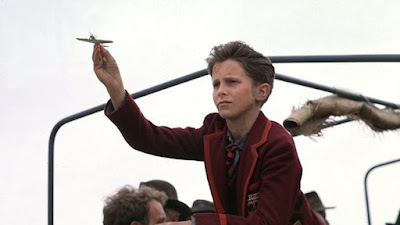
1. Empire of the Sun [above] (Thursday, BBC2, 11.25pm)
2. The Gay Divorcee (Wednesday, BBC2, 2.15pm) 
3. Bad Times at the El Royale (Saturday, C4, 12midnight)
4. The Shape of Water (Sunday, C4, 10.55pm)
5. Liar, Liar (Saturday, ITV, 1.50pm)

Thursday, 9 December 2021

We were there: "Rebel Dykes"


In decades of yore, a documentary such as Rebel Dykes would have snuck out in the wee small hours of the morning on Channel 4, its title presenting as either fuck-you provocation or come-hither tease, depending on personal outlook. Directors Harri Shanahan and Siân A. Williams have here assembled a brisk, engaging 90-minute primer on an entire subculture: that of the young lesbians resident in London at the turn of the 1980s, some natives, some smalltown girls drawn there because there wasn't anything like it going on at home. Some of these young women would find their way to the protest camps outside Greenham Common; there's a certain overlap with the recent doc Mothers of the Revolution. Others bent towards art, formed a band, made a racket their own way. Some were just out for a good time. From the recollections of scene survivors, we piece together an idea of disparate groups of outsiders and outcasts groping round in the darkness of Thatcher-era London, first to find their tribe, then to find something either constructive, disruptive or fun to do with them. The quiet thrill of the film lies in the sight and sound of women inventing a scene underground, and more or less from scratch: putting on their own club nights and stencilling the posters, stapling fanzines and newsletters together, importing sex toys in one case, in several others hooking up. There appears to have been a lot of wrestling in viscous substances on the bar circuit: one participant reveals she was fine with jelly and baby oil, but drew the line at spaghetti hoops, which sounds wise.

It's a film that can only benefit from emerging in the wake of Russell T. Davies' hit C4 series It's a Sin, which outlined a no less self-supporting network inhabiting the same moment; a prime opportunity for these women to get their memories on the official record. (For producer Siobhan Fahey - not the ex-Bananarama one, but a scene habituée interviewed here in turn - it's clearly been an opportunity to compile a social history that hadn't previously made it into cinemas.) These interviewees are a diverse lot: many are white Londoners, natch, but there's also testimony from Black and mixed-race women who were fighting other battles besides, trans contributors who quite possibly found this scene more welcoming than its fractured latter-day equivalent, and visitors from Northern and Eastern Europe drawn here by a vibe, a sound or a look across a crowded dancefloor. (Among the nostalgias the film prompts: for a time when Britain might have seemed attractive to onlookers.) If their testimony sometimes presents as a little scattered, that's because their interests were scattered. The scene these women curated spanned performance art, S&M, AIDS activism, garage rock, ball-less dildos, and a wider commitment to overthrowing the patriarchy. Yet they remain self-aware and funny with it, whether dredging up a moderately filthy Ian McKellen anecdote or unpacking video footage of a meeting communed by what one observer labels "the lesbian sex police" to decide whether all the whips and dog collars were good for the movement ("Everyone had completely lost their sense of humour by that point"). There may well be lessons for today's Left here: how to navigate schisms, and communicate beyond one's own echo chamber. Wherever they came from, whatever drew them there, these women are now defined by an abiding togetherness and a fierce pride in their achievements. Camcordered evidence of their working and rough-edged animations mesh with the presiding fanzine aesthetic, and there's one climactic flourish: a recreation of the (oddly indelible) events of May 23, 1988, when lesbian activists stormed the BBC's Six O'Clock News studio and got the none-more-cis Nicholas Witchell so flustered. When nothing's doing, do it yourself.

Rebel Dykes is now playing in selected cinemas, and is available to rent via the BFI Player.

Monday, 6 December 2021

On demand: "Museo"


Back in 2014, the Mexican writer-director Alonso Ruizpalacios signed off on an odd, memorable debut film titled 
Güeros, one of the more playful New Wave homages of recent times. In his subsequent projects, Ruizpalacios has persisted with that film's theme of truth versus reality. His most recent offering, A Cop Movie, has just started streaming on Netflix, to rightful acclaim; but you'll have to navigate around YouTube's pay-per-view Originals section to access its 2018 predecessor Museo, a former festival-circuit favourite that bills itself as "a replica of a true story". Promotional photos show Gael García Bernal balancing a Rubik's Cube on his head, and in some ways the film is very much a Rubik's movie. It has Bond-style opening credits, features Scorsesean crime moves, and lands upon a great McGuffin in a sackful of Aztec gold, but Ruizpalacios keeps shuffling around these shiny borrowings with an eye to placing his characters' transgressions in some wider social and historical context. He's playing two roles simultaneously: dextrous director and careful, concerned curator.

The gold is swiped from Mexico City's National Institute of Anthropology and History by a pair of opportunistic slackers: Wilson (Leonardo Ortizgris), our narrator and the notional conscience of the piece, and Juan, commonly known as Lazy Juan or Shorty (which is where the diminutive Bernal comes in), a veterinary student from an upper-middle class family whose doctor father (Alfredo Castro, Latin American cinema's new go-to for forbidding patriarchs) insists on putting his boy through an annual drug test. ("It's anal this year," he tells Juan, unnervingly.) Within this uptight milieu, Juan and Wilson come to represent mischief and rebellion. Juan spoils a family Christmas gathering by telling the youngsters Santa's not real, and he appears to have conceived the idea for the heist as payback for the earlier slight of being told he couldn't touch the exhibits. The duo are thus liberators, intent on returning the gold to its rightful burial place, yet they're also as naive as children. They end up falling out over this booty, not in that no-honour-among-thieves, Sierra Madre style, but in the manner of kindergartners squabbling over a toy - perhaps even that self-same Rubik's Cube.

The trick is that Ruizpalacios makes their waywardness infectious and involving. Consider the heist itself: a fiddly thing, necessitating the use of tacks and copper wire to shortcut the museum's alarm systems, and carried out in a Rififi-like silence. It's a setpiece that grants us the thrill of being somewhere we shouldn't be, doing something we shouldn't be doing - and seeing it pay off. And yet Ruizpalacios is just as interested in the way the boys' crime exposed a set of attitudes, opened up a faultline between the generations. To you and I, the heist may just resemble an unusually sophisticated variant of student hijinks. Yet to the Castro character, eyeballing the TV news coverage while blind to the fact he's sheltering those who carried out this raid, those responsible are "the dark shit of this country" and "deserve to be whipped in the town square". That's where the tension within this narrative comes from: our mounting fear these boys will end up receiving far more than just a light judicial slap on the wrist.

Around them, you catch Ruizpalacios and his cinematographer Damián García amusing themselves with off-kilter compositions; every now and again, their protean imagery clicks together like the tumblers on a safe. The graphics on a Space Invaders-type game line up with the hieroglyphs on a tomb; a picture on a wall rhymes with a sculpture we've earlier seen the boys relieving themselves against. (The idea of replication - that we're all just walking in somebody else's footprints - creeps into the film's very visual design.) It might seem a deeply eccentric film were you to miss these internal rhymes and connections, the playfulness nudging it forward, and the control reining it in; as it is, it's still fairly rum, right through to the Simon Russell Beale cameo as an English fence who twigs faster than most that the kids he's dealing with are lambs to the slaughter. Characterful and illuminating with it, though, inviting us to join in with the challenge the film sets itself of puzzling these events out - to parse what this tale really meant, its societal implications, and what these boys' misdemeanours teach us about the relationship between Mexico past and present.

Museo is now available to rent via YouTube Originals.

Friday, 3 December 2021

For what it's worth...


Top 10 films at the UK box office (for the weekend of November 26-28, 2021):

1 (new) House of Gucci (15)
2 (1) Ghostbusters: Afterlife (12A) **
3 (new) Encanto (PG)
4 (2Eternals (12A)
5 (3No Time To Die (12A) ***
6 (4Dune: Part One (12A) **
7 (new) Anything Goes: the Musical (PG)
8 (5) King Richard (12A)
9 (6) The Boss Baby 2: Family Business (PG)
10 (8Venom: Let There Be Carnage (15)

(source: BFI)

My top five:
5. The Matrix [above]

 
DVD/Blu-Ray/Download top ten: 

1 (4) The Grinch [2018] (U)
3 (2) The Suicide Squad (15) *
4 (3Paw Patrol: The Movie (U)
5 (14) The Grinch [2000] (PG) ***
6 (new) Arsène Wenger: Invincible (12)
7 (7) Black Widow (12) ***
8 (6) Fast & Furious 9 (12)
9 (10) Elf (PG) **
10 (16) Space Jam: A New Legacy (U)


My top five: 
1. Zappa
3. Limbo


Top five films on terrestrial TV this week:
1. Unforgiven (Thursday, five, 10.30pm)
2. Another Year (Wednesday, C4, 1am)
3. Crawl (Friday, C4, 11.50pm)
4. The Wife (Sunday, BBC2, 11.10pm)
5. The Old Man and the Gun (Sunday, C4, 12.30am)

The young Paolo: "The Hand of God"

Was cinema this retrospective before lockdown, or was it that lockdown forced everyone to look backwards and inwards because we didn't know what we had to look forward to? Kenneth Branagh's boyhood reminiscence Belfast and Paul Thomas Anderson's coming-of-age romp Licorice Pizza await us; this week we have The Hand of God, which finds Paolo Sorrentino throwing back to his own mid-Eighties adolescence in sunkissed Naples. For the director's onscreen surrogate Fabietto (new Chalamet-in-waiting Filippo Scotti), it's a moment of immense promise, not least as the greatest footballer on the planet - Diego Armando Maradona - was heading this way after his time at Barcelona. (It's possible Sorrentino's memory was triggered by the exceptional archive footage in Asif Kapadia's recent Diego Maradona, which focused on this period.) For the filmmaker, it might appear a prime opportunity to make his own Amarcord, an earlier saga of adolescent longing and bosomy women, yet the leisurely opening pan around the Bay of Naples establishes Sorrentino's desire to stretch out in every direction - to tick off every Fellini movie in two hours with the assistance of Netflix money. This camera often drifts off beyond the speakers at the end of their dialogue; scenes that start in one place are often hijacked and rerouted elsewhere. What this director did for Rome in The Great Beauty, he now does for his birthplace, reframing Naples as a vast stage across which scurry eccentric relatives and the film folk who would make up Sorrentino's second family; cigarette smugglers and the most expensive footballer in Christendom; bats, boobs and Baronesses. "Looking is all I know how to do," shrugs Fabietto, indirectly nailing down the strengths and limitations of the Sorrentino filmography. In the lad's defence, there was clearly a lot to look at. Faced with a world as well-stocked and wondrous as that The Hand of God puts on screen, how could you not want to pick up a camera and start recording?

The Sorrentino we rejoin here is cuddlier and more approachable than the tyro who gave us 2018's bilious Loro. That he's sailing into crowdpleasing waters is immediately evident from the decision to recall his favourite actor, the great Toni Servillo, not as the kind of oddbod/predator/cold fish he's traditionally played under the eye of this director, but as Fabietto's father Saviero, a pipe-smoking, worldly charmer who has some very Italian ideas about the opposite sex, but proves loving and supportive, and snaffles most of the funny lines. (Saviero uses a billiard cue to change TV channels; asked why he hasn't forked out for a remote, he scoffs "Don't talk nonsense, I'm not a Communist".) Servillo's presence is also crucial as the film moves into more tender territory. When Fabietto goes to bed a teenager and wakes up an orphan - as, tragically, was the case in Sorrentino's own upbringing - we're obliged to note the importance of having drolly funny, rocksolid individuals like Saviero and his wife Maria (Teresa Saponangelo) around. We miss them when they're gone. This is new for Sorrentino, who's previously appeared cool-to-standoffish behind the camera, too busy lining up his shots to much care about the emotions of the people passing through them. (A certain melancholy born of detachment was as good as it got.) 

The Hand of God, by contrast, turns out lively-to-sentimental, describing first something that happened to this boy and then how he muddled through. No sooner has Fabietto attended his parents' funeral, he's being scooped up in a smuggler's speedboat and swept off to Stromboli; no sooner has he had his heart broken by the sight of his favourite actress in another man's arms, he's chasing after a director in the hope of learning something new. (The memory can be like a tap: open it just an inch, and it all comes flooding out.) If the prodigious movement involved means Sorrentino sacrifices a little of his trademark visual sheen, The Hand of God gains in depth; it's reflective in another way besides. In the final moments, shortly before leaving for Rome and the life his creator now leads, the young Sorrentino wanders his old neighbourhood, taking one last look at the people he first met and then left behind there; it's not the only sequence here where self-discovery intersects with self-justification, producing a rich subtext of this-is-why-I-do-what-I-do. This is the kind of film a director makes to compensate for the one thing they weren't able to see properly in their younger days - or because there are people they can no longer look at. That's why we continue to look back, and why those looking back continue to turn to the cinema, which has always been rather good at converting absence into presence.

The Hand of God opens in selected cinemas today, and will be available to stream on Netflix from December 15.

Please release me: "Dying to Divorce"

The documentary Dying to Divorce, an equal parts grim, emotive and illuminating dispatch from the Turkish gender wars, opens with a bleak set of facts. One in three Turkish women are reported to have been victims of domestic violence. Divorce remains frowned upon, and a running counter of femicides in the year 2015 - the year the film opens - ticks up to 293 before director Chloe Fairweather cuts away. Any corrective seems unlikely to come from the top down: we see Prime Minister Erdoğan being roundly applauded for a speech in which he baldly states "You cannot put men and women on an equal footing. That's against nature." It may however bubble up from the ground, in the form of Ipek Bozkurt, head of a team of activist-lawyers Fairweather fell in step with midway through the last decade. Bozkurt has her hands full, but tailing her as she goes about her daily activity gives the filmmaker uncommon access to any number of stark, sobering stories. Dying to Divorce is barely a quarter-hour old when it introduces us to Arzu, a woman whose husband took a shotgun to her arms and legs so she couldn't leave him; said husband subsequently walked away to be with his mistress, and is currently imprisoned on a separate charge of rape. (Arzu's father admits he may have made a mistake marrying his child off at 14.) Observing Bozkurt's meetings with clients such as Arzu also opens up a revealing contrast. On one hand, Fairweather shows us the modern, metropolitan Istanbul, with its trams, Facebook pages and female lawyers. On the other, however, we spy attitudes and atrocities that look and feel very much like holdovers from the Middle Ages.

Fairweather, a British documentarist, is here walking in the footsteps of the pioneering Kim Longinotto: her film would make an instructive double-bill with Longinotto's 1998 film Divorce Iranian Style, or an instructive triple-bill with 2005's Sisters in Law. Yet her approach isn't as strictly fly-on-the-wall as Longinotto's would be: she's giving an overview of many years, and with the help of editors Andrea Cuadrado and Paul Dosaj, she structures her material for maximum impact. We hear the story of how Arzu was gunned down before we see the full extent of her wounds; later, we're introduced to another of Bozkurt's clients, former TV anchorwoman Kübra, as a garrulous on-camera presence, before Fairweather cuts to her as she is today - motionless and struggling to form a sentence, having been brained by her ex. ("She really loved talking," notes the mother who now serves as her full-time carer and interpreter.) Considerable effort has been made to banish any grey areas or ambiguities, those mitigating circumstances that let abusers off the hook: these women's stories are properly shocking, and being deployed not just to make a case against the ingrained chauvinism and misogyny of the Turkish state, but to comprehensively clinch it. Around them, Fairweather skilfully knits in exterior events. In this context, the attempted coup of 2016 becomes a public manifestation of what had previously gone on behind closed doors: another terrifying eruption of male violence. The 2017 referendum that handed Erdoğan even greater powers, meanwhile, is reframed as not just democratically suspect, but suggestive of how this entire country finds itself in an abusive relationship with its so-called strongman leader.

In both cases, Dying to Divorce alights upon material that illustrates how hard it is to overturn a certain patriarchal mindset, and just what the women Fairweather places front and centre are up against. Bozkurt exhibits the tenacity and optimism you'd expect from the heroine of a documentary such as this, but as the film proceeds - and her cases slalom through the courts - the walls seem to close in on her. This is no easy breeze to social justice, but a genuinely testing period that takes in terror attacks, soldiers in the streets, the loss of that referendum, and the arrest of her friends and colleagues. There's a moment around two-thirds in when you genuinely start to worry about her ability to make it through to the end credits in one piece - which, of course, is the film's point: that under regimes such as this, even an educated, successful woman - one with a network of friends, relatives and professional contacts - is at threat. For the time being, Ipek Bozkurt speaks up because Kübra finds it hard to; she moves and fights, because Arzu cannot. But she knows, as any woman knows, that all this could just as easily happen to her, too. In the final moments, we watch hundreds if not thousands of feminists, young and old, defying the authorities and flooding the streets of central Istanbul for 2019's International Women's Day March, deemed an illegal act of protest by the Erdoğan administration. It's an image that conveys a fragile yet stirring sort of hope - until these women come nose-to-nose with the heavily armoured, predominantly male ranks of the city's riot squad. The struggle goes on.

Dying to Divorce screens this Wednesday at the Cameo, Edinburgh.
Wednesday, 1 December 2021

On demand: "The Power of the Dog"


Jane Campion's The Power of the Dog is a peculiar one in many ways, not least for being a Western where all the most significant action takes place indoors. It opens with the spectacular feint of a cattle drive, spearheaded by chalk-and-cheese brothers Phil and George Burbank (Benedict Cumberbatch and Jesse Plemons); and sporadically we peer out at the rolling hills of New Zealand, here passing for the Montana of 1925. Mostly, though, Campion forces the characters she's yanked from Thomas Savage's 1967 novel into close-quarters, the better to observe pronounced contrasts in their personalities. Where George is shy, chivalrous, and has ideas about coming in off the range and moving into high society, Phil remains militantly unwashed, and brooding-to-contemptuous in his attitudes to others. (His pet name for George is "Fatso".) Those contrasts don't even out any after George takes a wife, local hotelier and recent widow Rose (Kirsten Dunst), installing yet more folks under this roof - for Rose brings with her a son, Peter (Kodi Smit-McPhee), a whey-faced, whippet-thin teen first introduced pressing flowers. Naturally, Phil takes against the boy, calling him "half-cooked", and more broadly appears dismayed at the fact this proto-emo and his barely less fragile mother have swept in to steal his sap of a sibling's heart. We wonder whether this might be pure jealousy, Phil's acknowledgement that his own heart is incapable of such depth of feeling. Netflix have handed Campion the resources to expand the baroque love triangle of her international breakthrough The Piano into an even more baroque quadrangle. Yet The Power of the Dog comes down to much the same thing, ultimately: a battle over domestic space.

What's admirable about the new film is that it's never schematic. Campion, now an elder stateswoman, is far less interested in the colour of her characters' hats than she is in observing all these people (even the often villainous Phil) as people. Rarely can a film have taken so much trouble to give everybody on screen a hobby. Phil has a banjo he plucks at; if he's representative of any group, it may be all those men who've picked up a guitar in a bid to demonstrate their mastery of the universe. Peter shakes off the slights he receives as an incipient science nerd via rigorous use of a hula hoop. Removed by marriage from the restaurant she tends more or less single-handed, Rose takes to the bottle to refill her now-copious free time: she gains a hubby, but there's no hobby big enough to occupy the hole becoming a woman of means leaves in her life. When George, ever-sensitive to trouble on the homefront, moves a baby grand into the ranchhouse for his wife, the link to The Piano is made only more explicit: once again, Campion is fascinated by the way her characters express themselves. That fascination trickles down to fill every nook and cranny of this household, with its stuffed and mounted animals' heads and its shrine to the boys' late father. It's a bit of a dump, if truth be told, a longtime bachelor pad that could sorely do with a woman's touch, or at least a little lightening up. Watch how the initially mute housekeeper (Genevieve Lemon) comes to renewed, chatty life once Rose moves in and the boys aren't around. Yet when Rose herself sits down at the piano to pick out a tune, she's rapidly drowned out by Phil and his bloody banjo-plucking. My house, my tunes.

It is, then, a Western of duets rather than duels, more lyrical than it is bloody or violent. (Hence the 12A rating - though some viewers may want to look away when it's time for Phil to castrate his bulls.) Plemons and Dunst, reunited after TV's Fargo, have the easy energy of plumped-up cushions nestling on a sofa, though they're rudely scattered as Cumberbatch - radiating negativity, if never fully shaking off his air of good breeding - hones in on the kid with fateful consequences. Campion sketches these unusual, conflicted figures so well that we're prepared to follow them wherever this perverse plot goes - and it is a plot that yields genuine surprises, from the fate of the rabbit Peter brings into this household to the sheer number of topless cowboys the camera observes in passing. Couple those with the box of unmentionables Peter discovers under the porch - a rather more profane shrine - and it becomes clear Campion comes this way to skewer the myth of the macho cowpoke. Not all the subversion works in the film's favour: I always think it a pity when a director strips Dunst of her usual vivacity - though I see Rose has to wither for Campion to make her point. (I also wonder whether a trad Western such as 2003's Open Range, which itself picked over the pros and cons of domesticity, wasn't better placed to generate an emotional impact.) Yet this is a film with plenty of eccentric life in it elsewhere, and a real feel for tetchy, awkward, passive-aggressive human interaction. Best to approach it as a tale of the unexpected rather than a potential Best Picture, but The Power of the Dog may wind up as the only film in this year's awards mix that truly understands what it is to have to live with weird, toxic or just plain terrible housemates.

The Power of the Dog is still showing in selected cinemas, and is available to stream on Netflix from today.