Monday, 18 January 2021

Men and motors: "Archive"

Archive is a movie only a born tinkerer could make, bolted together as it has been from scraps and offcuts of more immediately prominent SF movies. Nothing has been reinvented in this process, exactly, but it runs enough current across its circuit boards to get up and running, and generates enough juice to keep itself going where several not dissimilar, higher-profile projects have gone haywire or packed up altogether. The tinkerer-in-chief is Gavin Rothery, previously a VFX supervisor on Duncan Jones's Moon, and he's emerged from his shed with a riff on the lonely-spaceman subgenre. Theo James, bedecked with specs (ergo: brainy) and stubble (ergo: hunky, mind), is George, an engineer found circling a modernist retreat in the snowy forests of future-Japan, where he's been dispatched by his employers to develop a response to a background security crisis. He has assistance in this task, in the form of two robot helpers who resemble, respectively, one of the Silent Running droids and Kryten from Red Dwarf; in a throwback touch that immediately endeared Archive to this viewer, these are played by performers in robot outfits. Yet George is distracted by an ongoing pet project: constructing a sleek, A.I.-enabled android as a repository for the spirit of his wife Jules (Stacy Martin), with whom he shares increasingly distant videocalls. As we join him, he's halfway there, with the android suspended, as yet legless, from a ceiling-mounted harness. Archive is almost too slick and wipe-clean to acknowledge the fact - in the Before Times, we'd have described it as "multiplex-ready" - but it is, on some essential level, a film about a dude building himself a sex robot.

Rothery, thankfully, has grander designs - including, perhaps, building himself a lasting career in high-end sci-fi. As a debut feature, Archive amply demonstrates its maker's ability to take a modest budget (although picked up by Universal for release, it was shot independently, in the forests of Hungary) and ensure every penny is on screen, put towards the creation of a convincingly busy universe. And there's a lot going on here; Rothery's best decision was to give himself the space he needs to dissect his own ideas. He works hard early on to suggest that George's computer-controlled fortress - a forward projection of Bluebeard's castle, or Du Maurier's Manderlay - has rooms and wings beyond those communal areas the camera initially scans. Occasional forays into the protagonist's headspace, meanwhile, indicate that George - whose light facial scarring isn't explained for some while - has hidden, either untapped or suppressed memories; some of these result in passing nightmares while we wait for the film's masterplan to be revealed. As if all that wasn't enough, on a ground level, those lumbering robo-prototypes, on which our protagonist once lavished such care and attention, are becoming jealous of their high-definition, far more sculpted, thoroughly aerodynamic "sister". As with much of the best SF, its core lies within earthly reach: we're watching a story about a man struggling to manage his relationships, and coming to realise the damage that follows from putting women into boxes.

Once he's established this stronghold, and its chief resident's psyche, as having weakspots, Rothery submits them to a sustained probing of his own - another process, and one that could have seemed inelegant, were it not for the assured pace of the storytelling, and the visual polish being applied at every stage. (Rothery also served an apprenticeship in various art departments; it shows.) Laurie Rose, one of our finest cinematographers (Sightseers, London Spy, Summerland), lends the exteriors a wintry beauty commensurate with the chill of a cautionary tale, and he and Rothery make the robotics - whether analogue, CG or acted - a source of genuine fascination. (To some extent, they've fashioned an entire movie out of the opening sequence of Jonathan Glazer's Under the Skin, a crashlanded UFO of a film that still seems as dense with ideas and ripe for reappropriation as it did on first release.) What's crucial to its success is the balance Rothery strikes between the organic and the man-made; I whisper this quietly, given the prevailing critical orthodoxy, but I felt he did a far better job of that than Alex Garland did in the course of 2014's thematically adjacent Ex Machina. Between the gadgetry here, there lurks such eminent human interest as a flashback that develops from the sight of the flesh-and-blood Martin devouring a doughnut, and you'll be able to see for yourself why that might linger long in anybody's memory. (Especially once you realise where that scene is heading.) As Rothery correctly realises, those grace notes would take a lifetime of tinkering to replicate.

Archive is now available to rent via Prime Video.

On demand: "Pieces of a Woman"

If you've heard one thing by now about Pieces of a Woman, the Hungarian filmmaker Kornél Mundruczó's English-language debut, it's that the film's opening half-hour hangs heavy over everything that follows. Here is the streaming era's Saving Private Ryan. Unto the breach, then: in a well-furnished apartment in Boston, a young couple watch powerlessly as their carefully scheduled home-birthing arrangements go incrementally awry. It seems ominous, for starters, that the male half of the couple, Sean, should be embodied by a typically bristling Shia LaBeouf; we sense there's only so much comfort and reassurance he can provide to partner Martha (Vanessa Kirby). With their chosen midwife overseeing a difficult labour elsewhere - though surely it wouldn't be this complicated - the pair have been assigned a back-up, Eva (Molly Parker), who appears nurturing and attentive. But - and this is a big but - Eva seems just a fraction too surprised by every development: the accelerating speed of the contractions, the drops of blood Martha leaves behind when she exits the bathtub, the child's ghostly heartbeats, the way the newborn comes out pink but rapidly - dismayingly - turns blue. It's a girl; and thereafter, alas, everybody must revert to the past tense. By the time the title appears on screen at the end of this long, unbroken sequence, formalising the rupture of a life, a heart and a relationship, Mundruczó and his regular screenwriter Kata Wéber have shown exactly why they call it labour. Set against this, reclaiming a heavily fortified beach from the Nazis seems almost a walk in the park. They've also delineated the kind of worst case scenario that should make for great, piercing drama. What if all that labour was finally fruitless?

That question is at once weighty, delicate and tragically common, and I'm not so sure the film comes up with worthy (or even especially convincing) responses. Its remaining ninety minutes are given over to the picking-up of pieces, laid out month by month, carrying us and the characters from the greyest and iciest of winters into the renewal of spring. (And already, you may sense one of the problems here: the symbolism is too obvious. Everything's upfront.) The set-up is fraught with dramatic possibilities: a localised fraying of nerves, leaving everybody bruised and hypersensitive, and Martha in particular unable to turn into a shop or street containing children without wanting to flee in the opposite direction. That feels truthful. But more broadly Pieces needed actors capable of transmitting and amplifying this dreadful lived experience, and instead it runs into an ongoing issue within the contemporary American cinema: it's stuck with a generation of performers who've barely known sacrifice or loss, and thus have very little to draw upon when it comes to recreating those conditions for the purposes of drama. We're watching adult material that's been handed over to kids. For much of Pieces, I found myself wondering whether said material would have found more persuasive expression closer to the filmmakers' own homeland. Maybe it wouldn't, maybe it'd just make it less sexy and saleable - Netflix snapped up this version after it premiered at last year's Venice festival - but a lined and lived-in Eastern European face or two might equally have given the film a gravity this glossier endeavour struck me as sorely lacking in.

Kirby - the movie's big awards hope - is capable enough, but she's acting through a daze for much of the film, and landed with some Heavily Symbolic Business involving apples that is only there to seed an eye-rollingly corny final image. (I put it to those colleagues who've mitigated that this image is the only element that detracts from an overall dramatic severity: nope, it's integral to the design.) LaBeouf, meanwhile, confirms himself as among the most erratic performers currently working; no-one, not even an acclaimed arthouse director, can snap him out of his bullshit. He was very good last year playing different varieties of gruff asshole in The Peanut Butter Falcon and Honey Boy; here, he takes a character surely written as a loving man buffeted by misfortune, and plays him as... another gruff asshole. Oddly - and this is a sign of a film with no idea where its own strengths lie - Pieces picks up dramatically once the central relationship is sundered forever, and Mundruczó and Wéber set out to resolve the matter of Parker's midwife, accused of criminal negligence: here, at least, the vague naturalism takes some form, albeit the hackneyed form of the courtroom drama. In the meantime, all that's left on screen are gestures towards profundity, rather than profundity itself: keeping the cameras rolling during an unhappy attempt at make-up sex, and a family dinner to which Sean's mistress (Sarah Snook) just happens to have been invited, getting Ellen Burstyn (as Martha's mother) agitated enough to throw in a Holocaust reference that comes out of nowhere and leads to nothing. In all these cases, the refusal to call cut doesn't generate depth; it merely confirms the film's strange inability to cut deep. (It's as though it stunned itself with that prologue.) Mundruczó and Wéber glide over the surface of an unhappy situation; what Pieces of a Woman finally suggests is Cassavetes redone as affectless content.

Pieces of a Woman is now streaming on Netflix.

Friday, 15 January 2021

For what it's worth...


My top ten streaming picks (for the week beginning January 15, 2021):

1. Bloody Nose, Empty Pockets (uncertificated) ***** (Curzon)
2 (new) Archive (15) **** (Prime Video)
3 (new) Dear Comrades (12A) **** (Curzon)
4. Un Film Dramatique (uncertificated) **** (MUBI)
5. David Byrne's American Utopia (12A) **** (Prime Video)
6. Cold Meridian (uncertificated) **** (MUBI)
7 (new) About Some Meaningless Events (uncertificated) *** (MUBI)
8 (new) MLK/FBI (12) *** (Prime Video, Curzon, BFI Player, Dogwoof on Demand)
9. Ham on Rye (uncertificated) *** (MUBI)
10. The Basilisks (uncertificated) *** (MUBI)

DVD/Blu-Ray/Download top ten: 

1 (2) The New Mutants (15)
2 (1) Tenet (12) **
3 (new) Bill & Ted Face the Music (PG)
4 (3Roald Dahl's The Witches (PG)
5 (14) Fantastic Beasts: The Crimes of Grindelwald (12)
6 (5) Spider-Man: Far from Home (12) ***
7 (6) Bad Boys for Life (15) ***
8 (7) Little Women (U) ****
9 (9) Jumanji: The Next Level (PG)
10 (35) The Greatest Showman (PG)


My top five: 
1. Shirley

 
Top five films on terrestrial TV this week:
1. All the President's Men [above] (Sunday, BBC1, 12.05am)
2. True Lies (Saturday, C4, 11.20pm)
3. Foxcatcher (Saturday, BBC1, 12.30am)
4. A Hard Day's Night (Saturday, BBC2, 2.05am)
5. 99 Homes (Saturday, BBC2, 10.20pm)

Thursday, 14 January 2021

On demand: "Saint Maud"


The charge of Rose Glass's seesawing debut Saint Maud lies in watching a power struggle unfolding within a house beset by demons. The house, which stands alone on a clifftop in a dead-end seaside town, belongs to Amanda Kohl (Jennifer Ehle), a noted dancer rendered immobile by terminal cancer. Her outgoing carer, escaping while the going's still halfway good, describes Amanda to her replacement as "a bit of a cunt", but she's at least straightforward with it, your basic bitter boho diva. No, it's the incoming nurse, a mousily devout thing called Maud (Morfydd Clark), who's the real odd one here, less a repository of academically trained rationalism than a character from another century, prone to fainting fits, bouts of self-flagellation, and passing conversations with God. (Her closest cinematic sister would be Emily Watson's Bess from Lars von Trier's Breaking the Waves, yanked sideways into the horror genre.) As a carer, Maud proves attentive to the point of possessive, warding off Amanda's admirers where she can for reasons that emerge in the course of her structuring voiceover: this wingnut has a pronounced saviour complex for which the usual DBS checks probably can't test. The tension is thus a matter of how Maud will defy what medical science has deemed inevitable; though, given the intensity of Clark's performance, and Maud's willingness to do terrible things to her own knees and the backs of her hands, it appears there is no extreme to which our gal isn't willing to go.

This week, we found out Saint Maud is leading the field at the London Film Critics' Circle Awards with a total of eight nominations, which strikes me as... surprising. Glass's film is unarguably an eyecatching debut: born of an off-kilter sensibility, thoughtfully composed by its maker and her cinematographer Ben Fordesman, and set out over a brisk 84 minutes. Glass isn't wasting anybody's time here. It's one of those debuts where the influences sit close to the surface, readily identifiable: the house on the hill is recognisably Amityville-Psycho, there's a liberal dash of The Exorcist in the mix, while the fraught relationship between the headscarfed Amanda and her terse-mouthed custodian is a little bit What Ever Happened to Baby Jane?, albeit played dead straight. Yet that adds up to an oddly sullen B-movie, and I'm afraid the close juxtaposition of promenade mundanity and old-school Gothic in particular never quite took for me. I can see what Glass was going for: seaside town as end of the world, exactly the place people come to die, complete with big brooding skies that open up, come the final reel, like a portal to another dimension. But it's hard to keep up that cosmological seriousness when there's a donkey derby and a penny arcade not ten minutes out of shot; the two halves of the picture - the fantasy and the realism, the heaven and hell - didn't coalesce into an entirely satisfying whole for this viewer.

Once she's exiled from the enabling gloom of the Kohl house and left to walk these streets for the best part of the second act - once she's exposed to what passes for daylight here - it becomes clear that Maud makes little sense as a character, and doesn't have to make sense, being at heart the kind of erratic, vengefully rampaging God-botherer who could occupy the psychopath role in any number of trashier entertainments: it's just, this being an Arty British Horror, she gets her visions from a William Blake coffee table book, that's all. Clark is certainly committed in the role, and all but unrecognisable from her dual turn in Armando Iannucci's The Personal History of David Copperfield; the industry may well have a uncommonly gifted shapeshifter at its service in the years ahead. (She could be our Julie-Marie Parmentier, head slitherer of Lucie Hadzihalilovic's Evolution.) Yet as Adam Janota Bzowski's parping score, the loudest sign of directorial overcompensation here, kept flagging, the film she's turning otherworldly cartwheels within is a hokier, far less robust proposition than Natalie Erika James' recent Relic, another all-gal chiller premised on the horrors of impending doom and the strains that follow from caring for someone so close to the grave, but one that felt lived-in rather than conceptual, internally coherent, and - again, at least to this voting critic - far more affecting.

Saint Maud is currently available to rent via Prime Video.
Tuesday, 12 January 2021

On demand: "Time Trial"


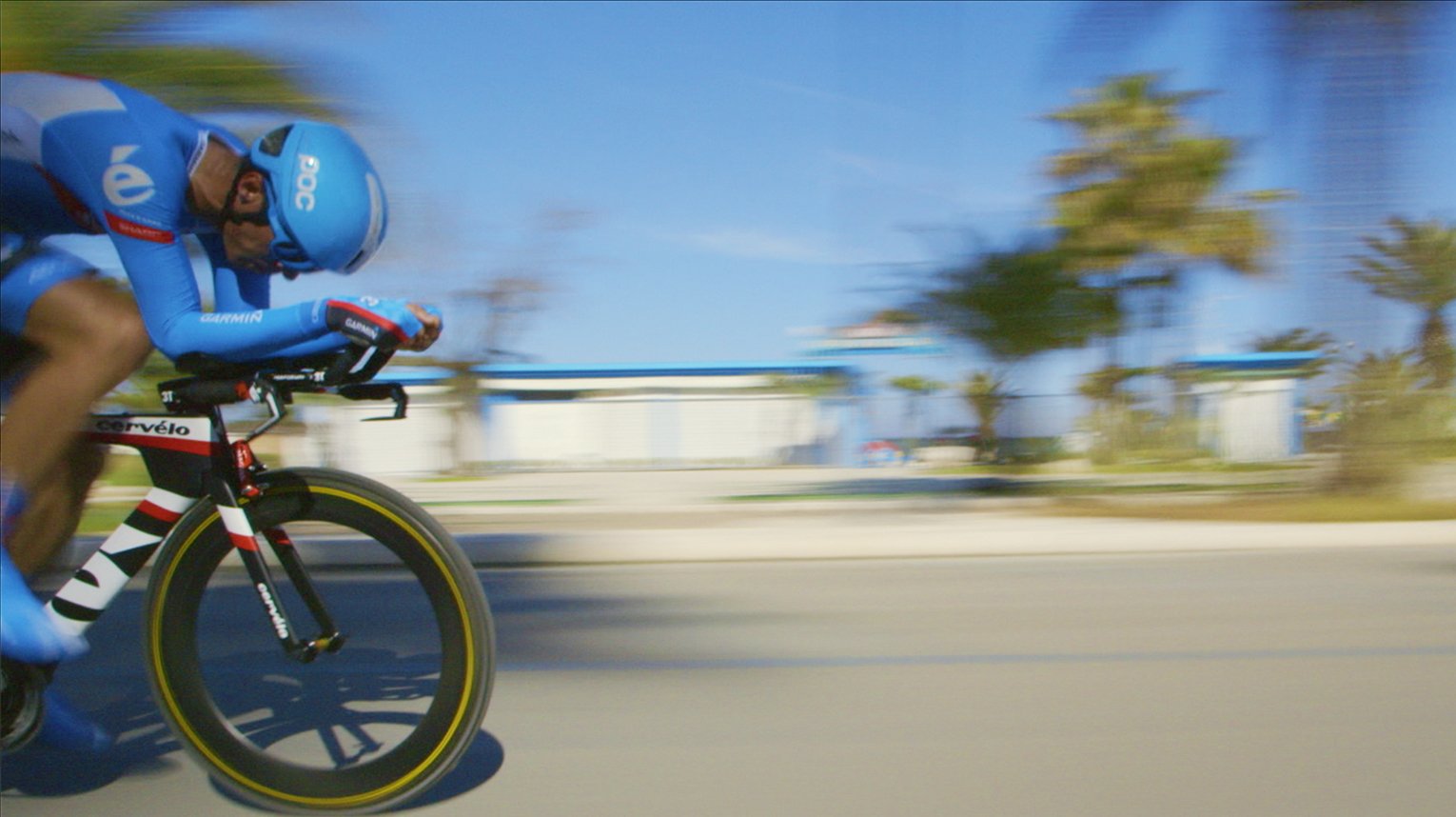
Finlay Pretsell's documentary Time Trial represented a stepping stone or pivot in the life of its subject, the pro cyclist David Millar: it marked the end of a long and distinguished if ultimately tarnished Grand Tour career, and the beginning of Millar's subsequent career as one of our most insightful TV analysts. We get the backstory early on, but are then thrown into the very middle of a comeback. (Millar was banned for doping offences in 2004; having served out the ban, he signed for the Garmin-Slipstream team in 2007. Pretsell joined him in early 2014, when this now road-weary 37-year-old was giving one more push to make the hallowed Tour de France.) Non-cycling folks will need to know going in that Millar was in some ways a special case. Unlike the bullishly unapologetic Lance Armstrong, he put his hands up when caught, accepted his punishment and served his ban with humility; after becoming a vocal anti-doping activist - someone whose words on the matter carried an extra weight, possibly inextricable from personal regret at the victories he cast into doubt, and the years lost to the sin bin - he assisted the sport in its late Noughties clean-up efforts, and eventually returned to the saddle to demonstrate it was still possible for him and others like him to ride (and win) clean. A more conventional film might have made that the story: the old warrior takes to the road one last time in search of redemption. Pretsell, however, recruited Millar almost as a Trojan horse, a means of getting the viewer inside these big races: he mikes the cyclist up, straps a GoPro to his handlebars, and in doing so, arrives at an artefact that is at least as revelatory as that Dispatches documentary about Graham Taylor when he was England manager. Time Trial gets us inside the peloton, which proves to be far noisier than you might intuit from the TV coverage, all grumbling, mumbling and plotting, a grudge on wheels. It gets us inside the Garmin team cars, home to some distinctly choice language. (The film earned a surprise 18 rating on its theatrical release for that very reason.) And it gets us inside David Millar's head, as he tries to process his trajectory and make peace with everything he's seen and done over the preceding decade-and-a-half.

Rather than giving us the helicopter overview familiar from TV cycling coverage, the film gets us in close, in other words. Close enough to watch the riders swapping lunch items, or making small talk like bored office workers (Millar enjoys a cherishably low-NRG bond with fellow veteran Dan Martin); close enough to follow its subject on domestique duties, winding his way through the field to hand out waterbottles to teammates, only to realise he's forgotten to pick one up for himself. There's an especially heartbreaking setpiece, on a real grizzly, drizzly day, which involves no more than Millar struggling to put his gloves and jacket on mid-race: the loneliness of the long-distance stage rider has never been more apparent. These aren't the only setbacks this aging warhorse faces. As a cyclist, Millar is - by his own admission - almost as shot as any other 37-year-old going uphill on a Grand Tour ("I'm not good enough... fuck"). Yet he was also shrewd enough to sense that, and to take on a new role as a domestique for the filmmaker, carrying footage from the front (and back) of the field as he did those waterbottles, and thereby showing Pretsell - and the rest of us - how a bike race works, sounds and looks, on good days and bad. Instead of those soaring, stirring heli shots, then, we get something more antsy, immersive, impressionistic; if we lose the sense of where we are, who's winning and what anybody else is racing for, we gain a potent idea of what it is to ride - the routine, the fatigue, the nerves. That's valuable, if not always necessarily dramatic. And so the end of one thing - Millar's last laps around the circuit, a final measure of closure - becomes the start of another: the process whereby a sportsman-turned-commentator comes to convey something truthful about their sport, thereby adding to the sum total of human knowledge. In the final moments, we see Millar in motion on the dancefloor, and note that Pretsell may be the first sports documentarist to have taken a cue or two from the Claire Denis of Beau Travail. His subject, meanwhile, appears similarly liberated: no longer bound by team orders or sodden wet weather gear, free to move and express himself as he likes.

Time Trial is now available to stream on the BBC iPlayer.

Monday, 11 January 2021

Potential: "Ham on Rye"

Tyler Taormina's mysterioso Ham on Rye begins as many other teen movies have over the past forty years, with scenes from a recognisably American suburbia. Nice, anonymous houses on quiet, leafy backstreets. A late-summer sunlight that makes the whites of the image - and this neighbourhood is whiter than most - a little misty, as unreal as a dream, or the opening of Blue Velvet. Behind those closed doors, the kids are dressing up, applying Lynx, painting their nails, making an effort we sense they wouldn't otherwise. From their chatter, and the buzz of excitement that mounts as they emerge from their bedrooms, take to those streets and form coteries, we know this is a special day; they all have something big ahead of them. And yet, despite their dickybows and corsages, their destination isn't prom or graduation, as we might expect. No, these kids are heading to Monty's Deli, a nondescript sandwich joint apparently located several miles from their homes, in one of those middle-of-nowhere stripmalls our American friends are so bizarrely fond of. Is this a representative generational safe space, like the diner in Diner - a place these kids can talk, pair off to old hits, make memories? Given the brief shot of an NDA being signed on entrance, and that this class of '21 initially sit munching in subdued silence, the answer appears to be a big fat no. Are they themselves destined to become chopped liver, chewed up and spat out, if not swallowed whole? What in the hell kind of scene is this, exactly?

Those seeking literal answers will likely emerge from Ham on Rye frustrated. Taormina's going for metaphysical abstraction; his film's wispy elusiveness is sorta-kinda the point. A clue is offered, however, in the very first sequence, a deftly cut mosaic of a Fourth of July-like celebration, complete with a fireworks display undermined when the cigarette lighter involved fails to spark as the organisers were hoping. Another follows when one parent waves his son off at the kerb with an incongruously frantic and overbearing "Don't mess this up! Don't mess this up!" A contrast is thus established: great expectations versus drab, dull, disappointing adult reality. Early on, one of Taormina's debutantes proffers a postcard from an older sister living further afield that inspires the gushy comment "Being older is, like, really good". I write this as a fully grown adult: I mean, sure, it has its moments, but there's also a reason we have a show called Curb Your Enthusiasm. These guys will eventually dial it back a bit, and Taormina, who's nearing thirty, seems to understand this as well as anyone. The grown-ups he shows us - particularly Monty himself, portrayed in passing by Dan Jablons as the most put-upon of pork-pullers - are almost universally worn-down, beat-up or otherwise fatigued, people whose best days are behind them.

Against that sorry backdrop, the youthful promise of the next generation becomes more striking still: the bloom of fresh-faced boys and girls floating down streets on scooters and Segways (one difference between children and adults: the former still possess the energy to launch themselves into the world), their anticipation that tonight will be a good night, the best of all possible nights, the first of many such nights to come. Why, then, do they wind up somewhere as mundane as Monty's, very much a place of the adult world, with its clogged meatgrinder and two-dollar fruit cups? You may as well ask why kids gravitate towards your nearest Subway outlet, which strikes me as scarcely less mundane, but I prefer to think that Taormina failed in his efforts to land a more spaciously cinematic venue - too expensive - and wound up here himself. Beyond the deli, his film attains plentiful scope - there are a couple of gorgeous Selznick skies, and his shots of abandoned parking lots and other civic centres have some of the photographer Gregory Crewdson's potent portent - but everybody comes to Monty's for a reuben and a reality check. It also surely helped him corral his cast of largely unfamiliar players, Nickelodeon regulars (where Taormina previously worked) and former TV child stars who keep straight faces around this strange premise and help foster a disconcerting, pregnant mood. People drift apart and disappear, we wonder where they went, and life goes on somehow. Taormina drops us into the middle of this existential Kodak moment knowing from experience that it cannot last - but also that this is all the more reason to try and get some of it on camera.

Ham on Rye is now streaming via MUBI.

Strike!: "Dear Comrades"


Veteran Andrei Konchalovsky's latest Dear Comrades, part of a wider cultural project wherein Russia has started to wrestle with its own turbulent past, takes a ground-level view of a system that doesn't work anything like as efficiently or fairly as its overseers claim. It may well have some appeal west of its Novocherkassk setting. (The film has already been named as Russia's official entry for this year's Oscars.) The year is 1962, and we're introduced to local Party official Lyudmila (Yuliya Vysotskaya), a taut, high-toned blonde ideologue, as she disentangles herself from a married colleague's bed to receive preferential treatment at the neighbourhood deli, pushing past the dozens queuing for essentials. Many of these neighbours keep remarking on how prices went down under Stalin; Lyuda's only response is that the scarcity of goods is but a "temporary hardship". "We shall persevere," she insists. Her hardline belief will be tested, however, when workers at the town's locomotive manufacturing plant walk out on strike. At work, she finds herself in the thick of increasingly fraught negotiations between the Party's top brass and its rank-and-file. At home, she's looked upon sceptically by her aging father (Sergei Erlish), so sick of the present regime that he digs out his old war uniform and retreats inside it, and with open contempt by her militant daughter Svetka (Yuliya Burova), who sides very much with the workers. What Konchalovsky and co-writer Elena Kiseleva establish is an impasse, both social and domestic: they know that when a country comes to a standstill, political rhetoric is no longer enough. Promise the electorate the world and instruct them to eat cake when that promise goes undelivered, but that's still dependent on the supply lines bringing those suckers their cake - and their milk, and their bread - being open and functioning. Like I said, the film may well have some meaning in the world beyond Russia.

As the strike catches the eye of Moscow and the KGB - who regard it as exactly the kind of unrest that needs quelling before it spreads - Dear Comrades initially presents as a series of meetings, and meetings about meetings. Early scenes aren't so far removed, in time or tone, from Armando Iannucci's The Death of Stalin, and we similarly feel this situation see-sawing between the vaguely absurd and the potentially tragic. One Party official voices his concern that Novocherkassk has always been "a high-risk zone" and a centre of "counter-revolutionary Cossack activity". (There are possibly UK cabinet ministers who feel much the same way about Liverpool and Manchester.) Increasingly, though, those of us unschooled in this real-life chapter of provincial Soviet politics will get the sinking sense that this strike is fated to end badly. That feeling is only heightened when Moscow sends in a general known as "The Beast", who has the bulk and bearing to back up that nickname, and whose first act upon taking up his post is to insist the soldiers dispatched to the area be given extra munitions. Here is a country at war with itself, half holding firm to the Party line, half to the ideals Lenin had in mind for the workforce. And in the middle of it all, Lyuda: at once a straight-faced functionary, a mother, a former soldier, a neighbour and a citizen who comes to see - close-up, and with her own eyes - that something is very wrong when adherence to dogma leads to blood being hosed from the streets. Konchalovsky has filmed an awakening of sorts, but the woman getting woke remains troubled by her complicity in these events; even as the political becomes painfully personal, she's being yanked into siderooms to rewrite the ordinances that will justify some new oppression. Within a country at war with itself, a woman at war with herself.

That first act is defined by a lot of contextualising talk; the Konchalovsky who made Runaway Train for Cannon Films 35 years ago is nowhere to be seen for some while. But he pulls off a brilliant, bracing setpiece around the midpoint as a KGB-appointed sniper opens fire on the strikers: in the midst of the crowdsplitting chaos that results, we know exactly where each bullet ends up. In the aftermath of that atrocity, Dear Comrades regroups and paints a vivid picture of the brutal arbitrariness of this moment in Russian politics. A nurse being asked to sign the 1962 equivalent of an NDA asks the wrong question and gets carted away, never to be seen again. A mortician appears utterly inured to the corpses piling up in his corridors. (He's a little like the Alfredo Castro character in Pablo Larrain's Post Mortem.) The film's period recreation is precise and handsome: it's composed in crisp monochrome Academy frames, adorned with perfectly chosen faces, from the blustering apparatchiks to the too-smooth KGB spy Lyuda falls in line behind. Yet the action is informed by a recognition that such handsomeness, such civility counts for only so much when the tanks roll in, and that business-as-usual attitudes and party politicking often obscure so much that would be better brought into the light. Propelled by an unravelling Vysotskaya, who has some extraordinary scenes as a combination of stress and vodka jemmies the scales from her eyes ("What am I supposed to believe in, if not Communism?"), Dear Comrades stands as a punchy, deeply moral late-career work to set alongside Andrzej Wajda's Katyn - a director's attempt to make peace with events he lived through, a reckoning with the past that provokes lingering, uneasy questions in the here and now. Why did it take so long after this for the Soviet people to throw off this system? How many more people had to die so as to maintain the status quo? And one more, I think: is post-Soviet Russia any better off now that its cronyism, corruption and state-sponsored violence are out there in the open?

Dear Comrades will be available to stream via Curzon Home Cinema from Friday.