Wednesday, 14 October 2020

Something in the woodshed: "The Other Lamb"

The industrious Polish filmmaker Malgorzata Szumowska is presently touring her latest, Never Gonna Snow Again, around the festival circuit (it arrived in London earlier this week); to coincide, MUBI UK have rescued her previous film, last year's The Other Lamb. This was Szumowska's English-language debut, and a cult movie in both senses of the term: a film about the internal power struggles of a religious sect settled in the American wilderness, it proved too cool for crossover success upon its U.S. release - or, indeed, wider distribution, which is why it's only emerging here now on streaming. One or two creative choices suggest that this was Szumowska's shot at a Handmaid's Tale, which - given the strongly feminist bearing of her earlier works (2011's Elles, 2015's Body) - probably shouldn't surprise anyone too much. We're out in the back of beyond (actually rural Ireland, passing for the American heartlands), with Michiel Huisman growing his hair Christ-length to play a false prophet referred to as "Shepherd", holed up here with his "wives" - women young and old in gorgeously colour-coordinated smocks - to preach scripture and have it away as often as possible. Particularly besotted is teenage newcomer Selah (Raffey Cassidy), although she's the one who discovers the Shepherd's dirty secret: a woodshed in which he locks away all those who stray from His path, most prominently Denise Gough as a character who extends Szumowska's interest in the many ways men exert dominance over the female form, scarred, breasts taped down, banished and deemed "a broken thing" simply because she no longer has any interest in cooking and cleaning for The Man.

One immediate advantage the film has over the TV Handmaid's Tale (as distinct from Atwood's The Handmaid's Tale) is that it gets to the point: it takes 96 minutes to establish this world, show us the heinous acts committed within it, and then gesture towards a turning point. Szumowska doesn't labour the grimness unduly: The Other Lamb is often dreamily beautiful, particularly in a stretch describing a hilltop ritual involving Selah and a pregnant ewe. Working closely with regular cinematographer Michał Englert, this director's eye for composition and colour has sharpened project by project. The issue is one of abstraction, and how allusive a film can get before it starts to seem almost entirely elusive. It's weird that an ostensibly humanist director, possessed of a sincere concern with that which we do to our own and other people's bodies, should have generated a run of movies that feel as though they're taking place at arm's length, featuring characters who rarely seem more than cyphers. We get a useful conversation here between Cassidy and Gough's Sarah that explains why these women are here and submitting to such a heightened level of control - but it's placed at the halfway mark, some time after we've given up wondering. Like the gradually displaced cult, The Other Lamb starts circling round on itself: it never satisfyingly develops, in part because its characters - slapped early on with the labels of either "victim" or "oppressor" - have no room to develop, save to get more oppressive or brutalised still. Though played out against different backdrop, the dynamic of the second half is largely the same as that of the first, until a rushed, unpersuasive ending sounds a note of hopeful change. Szumowska continues to strike me as a talent who's almost there, but not quite: once again here, she alights upon vivid scenes and moments, and fails to find a means of connecting them up into a more forceful whole. I'm not sure The Other Lamb tells us anything more than that there are men who treat women like livestock, which hardly seems news in 2020, and - as with the TV Handmaid, which has somehow drawn in viewers with the promise of further degradations and humiliations - makes for a strange idea of entertainment.

The Other Lamb streams on MUBI UK from Friday.

Tuesday, 13 October 2020

King Roy: "Being a Human Person"


The writer-director Roy Andersson came late to non-Swedish cinemagoers. His international breakthrough was 2000's Songs from the Second Floor, a mordant, intricately choreographed series of tableaux from what looked like the end of the world; when that stunned critics and audiences, he was already closing in on sixty, and entering his fourth decade of leftfield imagemaking. The advantage is that he arrived fully formed: as his 2007's You, the Living and 2014's A Pigeon Sat on a Branch Reflecting on Existence subsequently underlined, here was a Bergman with sight gags, an auteur with both a deep insight into the human condition and the desire to laugh it off. The new doc Being a Human Person, directed by Fred Scott for the reliable Archer's Mark shingle (Next Goal Wins), joins the stout, jolly Andersson - in his youth, a dead ringer for Joel Edgerton; now resembling an appreciably lived-in Wimpy from the old Popeye cartoons - in the three-tiered townhouse on a busy Stockholm thoroughfare that has served as his studio and home since 1981, as he rides Pigeon's success and begins work on what the now 77-year-old director announced would be his final film, About Endlessness. (This would win him the Best Director gong at last year's Venice festival; it opens in the UK imminently.) 
Scott's film is a making-of, then, but it's also one of those superior making-ofs - like 2013's Michael H. Profession: Director, Yves Montmayeur's portrait of mid-Amour Michael Haneke - which allows us to pass through a portal and enter a filmmaker's inner sanctum, to see just how a very distinctive worldview is serviced and maintained. Among Studio 24's clutter of books, props and maquettes, we meet a small army of able and willing craftspeople, who've helped Andersson realise the full gamut of human experiences, from joy to suffering (mostly suffering); who've staged everything from a contemporary crucifixion to the first snowfall of winter; who've filled these frames with the lowliest of salarymen and mounted King's men. From the off, Scott's doc circles one reason any given Andersson film is so rich: he's got the whole world in his house.

Could that be why the camera frequently observes Andersson two doors down, drinking the first of the day's many long draughts at a neighbouring bar? Here, Being a Human Person introduces a genuinely unexpected note of drama: those once-busy assistants start confessing to fears that Andersson's elevated alcohol consumption is set to bring this production, this career and their own livelihoods to a premature end, sadder than anything the director himself has previously envisioned for the screen. As the film's subject wobbles in and out of rehab, Scott's film never dodges the issue. Pinned down for one of their fond, typically thoughtful conversations, Andersson admits to Scott that his drinking is "a way of avoiding being bored". A biographical strand, useful for newcomers, suggests this entire career has been a considered retreat from the overnight success of the director's third film, 1970's A Swedish Love Story: a sunkissed teen romance that was broadly as conventional as its title insinuated, and which conferred a celebrity on Andersson that he was neither expecting nor comfortable with. 1975's darker-shaded "Giliap" was Andersson beginning to plough his own eccentric furrow - yet one of the dangers of creating your own reality, in your own front room (Andersson even shoots exteriors in the studio, with the aid of sophisticated green-screen and trompe l'oeil effects dissected in passing here), is that you wind up getting stuck in a rut. Is alcohol Andersson's means of escape? Or is it, as one assistant wonders, that he's been drinking to drag his feet - to put off the moment when he has to call cut for the final time? (Because: what then? Talk about looking into the void.) Either way, a fairly standard-looking directorial profile suddenly presents us with a prospect both intriguing and terrifying: that of watching Roy Andersson turning into one of his own pallid, downtrodden, helpless characters.

To some extent, at least. About Endlessness is long in the can, critically acclaimed and awaiting release, so we can rest assured that this creative and physical decline was only permitted to go so far. Though concerns about Andersson's constitution and blood alcohol float deep into the final reel, Being a Human Person ultimately reveals that the director was less helpless than he sometimes appeared mid-shoot. Here, Scott takes a note or two from Next Goal Wins, operating in direct contravention of auteurist philosophy: more so than most Andersson projects, About Endlessness looks to have been a team effort. Scott films that loyal army of artisans and acolytes pulling together in Andersson's absence to keep this production going, and then - once their employer returns, with the addition of a crutch to keep him upright - keep the filmmaker focused long enough to pull focus on the final scenes, and explain himself further under Scott's questioning. What becomes apparent is that everybody who passes through the door of Studio 24 brings something new and useful to Andersson's vision, from the pensioner who gives the director some idea of how he might fruitfully spend his retirement to the non-professional actor, brought here by the casting call Andersson sporadically tapes to his front window, who admits he couldn't make head nor tail of Pigeon, but nevertheless fortifies the new film with his portrayal of an unnecessarily aggressive dentist. Early on, one of Andersson's assistants states that seeing the brushstrokes in a painting "doesn't destroy the picture; it just makes it more rich, to see the process". Scott allows us to see Team Andersson's workings - some of it fraught and haphazard, some of it altogether more assured, much of it worthy of a Venice Best Director prize, currently on display at the pizza parlour over the road from Roy's place. In doing so, he's fashioned a tool for better understanding an oeuvre that, for all its singularity, and the sense it could only have been created by one man with a very specific worldview, is in fact democratic in a very Scandinavian way. If Andersson's characters look as though they've not long for their world, that's because none of us have long for this world - not even the man who created those characters, and worlds besides.

Being a Human Person opens in selected cinemas, and will be available to stream via Curzon Home Cinema, from Friday; About Endlessness opens on November 6. 

Drinking buddies: "Blue Boy"


The Blue Boy in the title of Blue Boy is the name of a bustling Berlin gay bar. Manuel Abramovich's short - streaming on MUBI UK later this week - evokes this space, and the lives of those who pass through it, through a series of static single shots of boys, some of whom appear bluer than others. They are, it becomes clear, rent boys, and Abramovich finds them sitting at the Blue Boy's bar on what must be a quiet afternoon or evening, listening (and reacting) to playback of earlier taped testimony. Some talk of typical chat-up lines, or nights with clients; some discuss the existential experience of being a stranger in a strange land (the accents range from Brazil to Eastern Europe) or of acting gay for pay; one reveals the line of questioning the police took upon accusing him of being in possession of too much money; the very first of Abramovich's subjects merely reads out the boilerplate legal disclaimer documentarists ask their subjects to sign, doubtless to reassure us the filmmakers here were acting transparently, and not out to exploit. This formal sound/vision split - we hear the boys talk, but their lips aren't moving - speaks to another, particular to this profession: what's on their faces versus what's on their minds. Abramovich's visuals put us squarely in the position of the bar-hopping consumer: he lines his boys up like drinks. Yet the soundtrack seems to liberate these sex workers, however briefly, from the daily transactional grind; it affords them the opportunity to express themselves in ways they probably couldn't when the Blue Boy is at its busiest, to ponder, laugh or simply stare the viewer down silently. This timeout can't last long, though: there are bills to be paid, needs to be met. A stray audio snippet placed over the closing credits sounds a lingering note of disquiet; it's what results when such interactions go sour, as they surely do every now and again. In the day-to-day reality of the Blue Boy, and places like the Blue Boy, there are no legal disclaimers, no reassuring declaration of rights.

Blue Boy streams on MUBI UK from Thursday.

Monday, 12 October 2020

On demand: "The Forty-Year-Old Version"

After many years of struggle, the playwright Radha Blank came to wider attention as a writer-producer on Spike Lee's recent serial reworking of his early film She's Gotta Have It for Netflix, and we may have Blank to thank for the way that series converted a rough-edged, unavoidably male auteur text into something more polyphonic, vibrant and generous still. Having hit up her employers for some of that big streaming money, Blank now makes her directorial debut with a film that looks to be actively channelling the American indie scene Lee did so much to renew in the late Eighties/early Nineties. The Forty-Year-Old Version is a pandemic-relatable tale of stalled development, shot in handsomely chalky black-and-white by Eric Branco, and possessed of an especially earthy sense of humour. Almost every one of the new bohemians Blank's camera alights upon is bored, horny and underemployed; if there's been a more accurate depiction of the creative life on screen in recent years, I've yet to see it. (And this, of course, is why the powers-that-be want so badly to retrain us.)

How close Ms. Blank is to this reality, only she can say, but to all outward appearances, she's writing what she knows here: the movie plays like backstory, cluing the viewer in on where she was and what she got up to in the days before Spike came calling. She plays no less than "Radha Blank", playwright and sometime fixture on those 30 Under 30 lists, now caught in the midst of a pretty considerable mid-career slump, seen teaching creative writing to Harlem college kids, and looking on ruefully as her work is persistently rejected by (white) impresarios stuck with an altogether proscriptive vision of what theatre by writers of colour should look and sound like. Stuck for better ideas, she decides to relaunch herself as a rapper going under the name RadhaMUS Prime - the Black equivalent of whatever Joaquin Phoenix turned himself into before he did Joker and won the Oscar. This affords us the unexpected sight of a woman in her mid-40s attempting to make her way in the rap game, clad in a do-rag more redolent of Ena Sharples than Queen Latifah. It gives the film the chance to rub up against such pointed issues as opportunity, heritage and cultural gatekeeping, and to keep its sights squarely on the spectre of artistic failure. No straightforward rags-to-riches narrative, Radha's story instead suggests that creative progress is haphazard by its very nature, a matter of one or two peaks and some very deep troughs.

First and foremost, however, The Forty-Year-Old Version is funny: it doesn't tackle those issues head-on so much as back itself up and grind lustily against them. We meander through distinct worlds, each amusing in its own way. In higher education, Blank can subvert the established Dangerous Minds template of inspirational teaching by getting in slanging matches with her pupils and halfway encouraging those crushes her students have developed on her; over in theatreland, meanwhile, we learn of an all-female staging of 12 Angry Men (a poster later reveals the play to have been retitled The Angry 12, simultaneously absurd and yet not unthinkable in 2020) and an "integrated" production of August Wilson's Fences. The abiding fondness for performance in all forms extends to choice supporting parts, like Lamont (Jacob Ming-Trent), the aggressively sexual homeless guy who heckles Radha every time she leaves her digs, and D (Oswin Benjamin), the DJ who shows up at Radha's auditions to get paid and winds up giving notes, like a 21st century update of Chazz Palminteri's character in Bullets Over Broadway. Deep down, this is a film that knows creativity is often born of unlikely collaborations, and what may initially seem like wrong turns.

Up on the surface, The Forty-Year-Old Version sometimes seems a little ramshackle. This will sound like a backhanded compliment, but what makes it so credible an artistic vision is that it's almost exactly the film you can imagine the Radha within the movie making, bound up at some essential level with the plight of a heroine circling round, screwing up and trudging back to square one. I suspect an indie producer of the late Eighties/early Nineties would have pushed for a tighter edit - or simply never have released the funds that would have allowed Blank to shoot a two-hour-plus movie in the first place. (That's the Netflix effect, as applicable to Black women as it has been to white male directors. It's equality of a kind.) Yet along the mazy and winding road to the film's big theatrical finale - a note of show-must-go-on uplift, nicely complicated by the fact Radha considers this show to be the worst kind of sellout - The Forty-Year-Old Version keeps gathering up moments of insight, valuable (if sometimes chastening) life experience. We're here to watch a character refind - and refine - her voice, and in doing so allow the woman playing her to spin nights and years of toestubs, bellyflops and other public humiliations into a raggedy-assed triumph of sorts. That's a life skill, and it's what creatives do better than anyone else I know; maybe we should offer to retrain venture capitalists and day traders in this art of humility.

The Forty-Year-Old Version is now streaming on Netflix.

At the LFF: "Mogul Mowgli"

Mogul Mowgli starts out as a music-biz narrative with a twist. Its man-on-the-mic, British-Pakistani rapper Zed (Riz Ahmed), isn't some plucky underdog desperate for a break, as were the heroes of 8 Mile and Gully Boy, rather a young man at something close to the top of his game. We join Zed as he rounds off a sold-out gig in New York before an audience of adoring fans, hearing word as we pass backstage of major-label interest, and news of a European tour as support to an even bigger name besides. Yet as the cheers subside, it becomes apparent that Zed is also something of a lost soul, endlessly touring in search of something or other: money, fame, respect. And he can't stop, muttering even in what should be his sleep. He's on the brink in more ways than one, this restless lad, and it looks exhausting. The bulk of Bassam Tariq's debut feature, co-written by director and star, investigates what happens after someone who's loosened all ties returns to his family home in the London suburbs, where he's referred to by his given name Zaheer, and the health issues he'd presumably suppressed to go out on the road flare up in a major, life-altering way. Here, Zed has finally to confront all that past, all that heritage he'd left behind or failed to process, from the tangible (the demo tapes scattered on the shelves of his teenage bedroom) to the trickier business of his relationship with his devoutly Muslim father, and the longer-standing matter of Britain's role in the division of India and Pakistan. This is, in short, a lot; it's no surprise a protagonist who initially stood before us as a superstar in the making should finish the film looking for all the world like a broken man.

It also explains why Mogul Mowgli feels so schizophrenic for much of its running time. You can't fault Tariq and Ahmed's ambition here, but what they've assembled is two or three films in one, much as their protagonist is at once Zed (young man with world at feet), Zair (product of his circumstances) and vulnerable flesh-and-blood besides. Tariq's direction broadly goes for pared-down realism: he deploys that square frame Andrea Arnold brought back into arthouse fashion both as a means of tightening his focus a little and bearing down further on his already overburdened hero. Yet occasionally, out of nowhere, he'll reach for some expressionist flourish, like the figure in a headdress who reappears in moments of crisis to remind Zed of the sickness (in the original, and not the rap sense) of Partition. That's a taste of the seriousness of the issues Mogul Mowgli is turning over; yet we also get a sidebar about a rival, more commercial rapper, RPG (Nabhaan Rizwan), whose twerk-heavy videos serve as a source of sniggering humour. Another influence asserts itself: Atlanta, the FX series set in the rap game and headed up by a notable polymath (for Donald Glover there, read Ahmed here), which over its two seasons has veered from slapsticky comedy to state-of-the-nation address via more sincere, heartfelt relationship material. I'd only say that it's easier to pull off those tonal shifts on TV, where there are pauses for adbreaks and a week's gap between episodes; in a 90-minute movie, such switch-ups point towards madness, or at least cacophony.

Thank heavens, then, for Ahmed, one of our most expressive and skilful performers, who's been either slightly underutilised or wisely selective in the decade since his 2008 breakout Shifty. He withers as this narrative demands - his ribcage looms out from a mid-film shower scene - but for long stretches the actor is just about the only element holding a fractured, distractible film together. A sometime MC himself, it was almost a given that he convince as the electrifying performer we see spraying rhymes at the start of the movie, yet he's also very good as the frail young man forced by medical circumstance to drop the imposture of his stage act, whose increasingly burdened body seems a consequence of an especially troubled mind: it's a performance that converts all Mogul Mowgli's issues into palpable, perishable flesh. (Watching Zair submit to cupping by superstitious relatives, I briefly wondered why someone in this kid's position - who appears to have started making serious bank - wouldn't have access to more proven forms of medical care; but by that point Ahmed has done all we need to suggest that a character once flanked by entourage is now essentially helpless.) So it's a lively mixed bag with a grounding central turn, and Tariq already looks capable of consolidating his big ideas with an effective image or two; the route is haphazard, but he finally leaves us at an understanding of the mental and physical toll history takes on even those who may want nothing to do with it. In the madness and noise it has to cut through to achieve this clarity, Mogul Mowgli feels like a distinctly 21st century film: an attempt to get its head around everything that's presently driving us cuckoo and wearing us down. If it doesn't all work, you can't say it's not doing the work.

Mogul Mowgli previews in selected cinemas nationwide tomorrow night as part of the 2020 London Film Festival; it opens October 30. 

Saturday, 10 October 2020

From the archive: "Queen of Katwe"

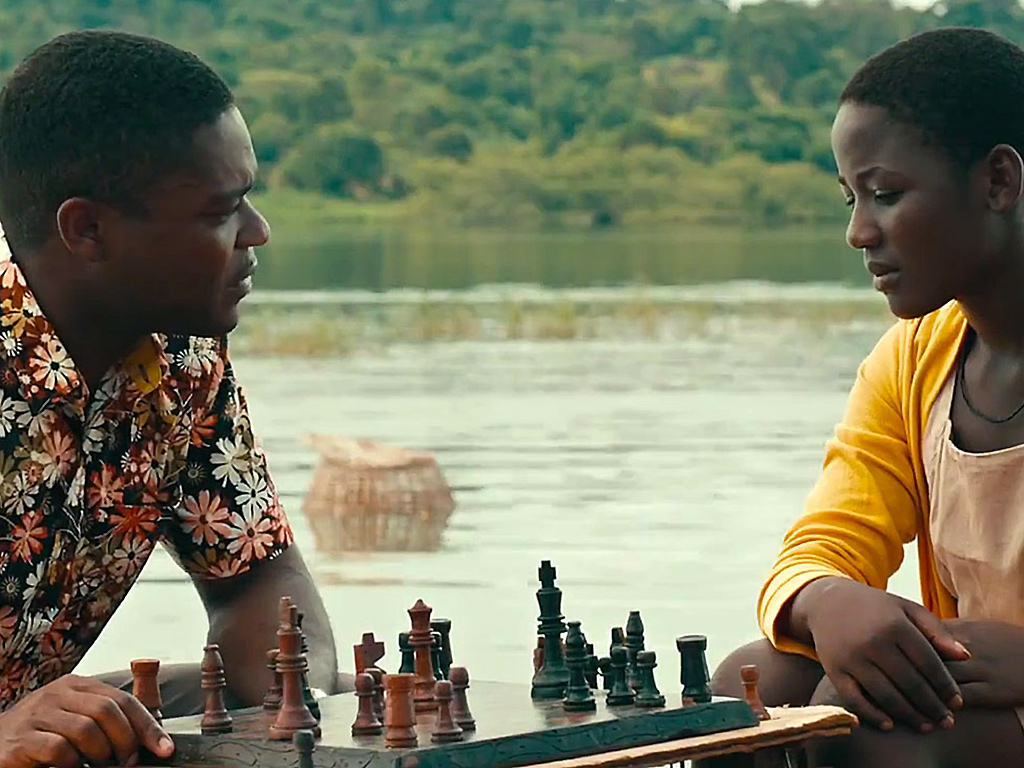
Much has been made of the fact Queen of Katwe counts among the first live-action Disney releases set in Africa not to take place on the safari circuit, or to feature a preponderance of Caucasian actors. Another way of approaching it would be as the next evolution of the studio’s true-life sports movies, following the appointment of Whale Rider’s Niki Caro to direct last year’s gridiron vehicle McFarland, USA. Again, a noted female director – here, Mira Nair – has been tasked with assembling gently inspirational montages; the big difference is that the activity lifting everybody up is that most sedentary of pastimes, chess.

Our heroine is Phiona Mutesi (Madina Nalwanga), a young Ugandan raised among the colour and bustle (read: extreme poverty) of the eponymous Kampala slum, where she resides with her single mum Harriet (Lupita Nyong’o) and multiple siblings. The tactical skills that will be her saviour are first borne out playing with salvaged bottletops down at the community rec centre; thereafter, they’re nurtured by resident sports nut Robert Katende (David Oyelowo), who trains Phiona to beat first those prep school kids who’ve had all the advantages she hasn’t, then adversaries on the international stage.

Many of these moves are familiar. Phiona’s progress compares to that of the plucky young protagonists of the US indie Fresh and the recent Kiwi drama The Dark Horse, two other films in which rooks and bishops suggested a path, however zigzagging, away from deprivation. William Wheeler’s script, drawn from journo Tim Crothers’ book, doesn’t underplay the game’s metaphorical applications. “Follow your plans, and you will all find safe spaces,” coach Robert urges his young charges, while pointing out how chess always allows defeated players to reset the pieces and start all over again. (Ah, we go: just like life!)

Still, even at its most on-the-nose and Disneyish, you may just find yourself forgiving Queen of Katwe, for rarely can a studio release have looked so glowingly at its African characters, whether hunched over the board, relaxing in what passes for the family home, or sleeping on the floor in a room full of beds because that’s what these characters know. Nair’s back in the thematic territory of her international breakthrough Salaam Bombay! – that pre-Slumdog Slumdog – and she’s surrounded herself with performers who sense they have an illuminating story on their hands, and keep nudging it away from the obvious.

Nyong’o demonstrates that her 12 Years a Slave turn wasn’t just beginner’s luck with her fierce yet loving display as Harriet; Oyelowo shakes off the mantle of Selma’s Dr. King, his loose and lively Robert more than just a repository of checkerboard wisdom. And Nalwanga is a very shrewd piece of casting: at repose, she has that hackles-up defensiveness oft seen in those who’ve been repeatedly told they won’t amount to anything, and even in tournament mode, she demonstrates a stillness-cum-slowness that makes it all the more surprising and cheering when she gets herself out of trouble or checkmates an opponent.

We’re squarely in the movie centreground here: Queen of Katwe can’t lay claim to being the most politically significant film of the moment (Ava DuVernay’s 13TH surely claims that title), nor even this week (welcome back Ken Loach). Yet elevated by Sean Bobbitt’s vibrant photography and a buoyant Afropop soundtrack, it emerges as what’s likely to be the most enjoyable and stirring example of representation we’ll see this awards season: a film that, like the best Disney fare, connects on some deep and profound level with that part of us that still seeks to improve ourselves – and, who knows, perhaps even the world.

(MovieMail, October 2016)

Queen of Katwe screens on BBC2 today at 1.15pm.

Friday, 9 October 2020

For what it's worth...


Top 10 films at the UK and Ireland box office (for the weekend of October 2-4, 2020):

1 (1) Tenet (12A) **
2 (new) Cats & Dogs: Paws Unite! (U)
3 (2) After We Collided (15)
4 (3) Bill & Ted Face the Music (PG)
5 (new) The Elfkins (U)
6 (4) Onward (U) ***
7 (new) On the Rocks (12A)
8 (new) David Attenborough: A Life on Our Planet (PG)
9 (6) 100% Wolf (U)
10 (5) The New Mutants (15)

(source: BFI)

My top five films currently on release:
1. The Ground Beneath My Feet
4. Rocks


DVD/Blu-Ray/Download top ten: 

1 (1) Scoob! (U)
2 (3) Trolls World Tour (U)
3 (new) Weathering with You (12)
4 (4) Bad Boys for Life (15) ***
5 (11) 1917 (15) ***
6 (new) The Secret - Dare to Dream (PG)
7 (13) Onward (U) ***
8 (15) A Star is Born (15) ***
9 (7) Sonic the Hedgehog (PG)
10 (5) Spider-Man: Far from Home (12) ***


My top five: 
1. A White, White Day

 
Top five films on terrestrial TV this week:
1. Get Out (Sunday, C4, 10.55pm)
2. Raazi (Tuesday, C4, 2.10am)
3. Queen of Katwe (Saturday, BBC2, 1.15pm)
4. Bee Movie (Sunday, C4, 4.15pm)
5. Mission Impossible: Ghost Protocol (Saturday, C4, 9pm)