Thursday, 8 October 2020

A secret history: "Beyond the Visible: Hilma af Klint"

Beyond the Visible is a documentary about discovery; it's the Searching for Sugar Man or Finding Vivian Maier of abstract expressionism. Director Halina Dyrschka's subject is Hilma af Klint, a Swedish painter of noble birth who was active from the 1890s onwards, yet whose work has only really been exhibited internationally within the past decade. So where had this trailblazer been hiding? The reasons for af Klint's underexhibition are guessable, to some extent: the hidebound attitudes of her time (insisting, as they did, that a woman couldn't be a serious artist, and that genius was an exclusively male preserve), and a reluctance among later curators to admit that everything they thought they knew - chiefly, that abstract expressionism began with Kandinsky and co. at the start of the 20th century - was fundamentally wrong. (An early side-by-side comparison in Dyrschka's film makes clear af Klint was painting similar shapes and colours at the back end of the previous century.) Yet we also learn af Klint set down her brushes prematurely to care for an aging mother - something her male contemporaries wouldn't have had to consider - and insisted, on her death, that her canvasses be sealed away, a wish converted into a fait accompli when they passed into the care of a nephew who regarded this oeuvre as a woeful burden. So Dyrschka pulls on her white gloves and picks up the pallet knife, keen to pare back the glaze of historical and critical indifference af Klint's work accrued over the past century, and thereby expose her subject's vibrant talent to a new, hopefully appreciative audience.

In this, Beyond the Visible proves highly successful. It has a rather uncertain opening - falling into the abstract before anybody broaches the expressionism - but once it gets into the biographical pith, the film is revealed as scholarly in the best sense. Instead of leaning on talking heads who might have reduced this story to the matter of an earcatching Radio 4 play, Dyrschka returns us time and again to the paintings, sketchpads and notebooks that lay out af Klint's workings, show how she developed, and speak for themselves; this camera has been set to collecting evidence, proofs of an underobserved life. Do the canvasses merit such sustained cinematic scrutiny? Yes, and then some. Partly, it's just that these upturned rectangles are so vast: Dyrschka observes an actress playing af Klint from above in reconstructions of studio life that immediately suggest some highbrow version of scenes from Take Hart or Art Attack. Completed, the paintings have a strikingly Scandinavian facility with colour and light. Her best works radiate and glow; they could be early prototypes for those lightboxes now used in the treatment of Seasonal Affective Disorder. (How apt that the film should be creeping out as we prepare to put the clocks back.) And though they contain their share of internal mysteries and ambiguities to be puzzled out by the onlooker, they don't appear to be tangled up with art theory, presumably as their creator wasn't spending her offdays jawing about her work in the usual boys' clubs. One benefit of being shunned by the artistic mainstream is that it leaves the creative free to work at his or her own pace, to do precisely their own thing. af Klint could be open to the elements (spiritual, scientific, natural) where her contemporaries were caught up in conversation and competition with one another, travelling as a group.

The art historians Dyrschka has assembled here - a thoughtful, eloquent (and largely female) collective, more than making up for the blindness of their predecessors - take a long, hard look at the work and arrive at a persuasive theory: that af Klint may finally have been too self-effacing to attain the reputation and retrospectives of a Malevich or Mondrian. We hear of her insistence that the marked, vital energy in her canvasses came from without and flowed through her; the suggestion is that this art was somehow a work of channelling rather than the tortured creation for which af Klint's male contemporaries were so feted. (A key-seeming biographical fact: af Klint spent time working as a medium, which landed her with the reputation in art circles of a kook or a crank. Look again, and there is an extent to which her paintings resemble signs and wonders in need of third-party interpretation.) Rather than impose herself on the landscape she found herself in, then, the af Klint of Dyrschka's engaging study became one with it; and with its abundance of natural imagery, Beyond the Visible proposes a merger between this most organic of artists - a vegetarian who kept notebook-listings of mosses, trees and leaves - and the wider world. Pulled out of the archives and into the light of a new century, we can now see how af Klint's spirals resemble fronds, petals, DNA helixes, how her concentric circles mirror those carved into tree trunks, a secret history inviting renewed examination. Evidently, af Klint's talent blossomed out of sight - exiled to the wilderness, while the male business of dealmaking and reputation management carried on in the city - but just because no-one was looking, it doesn't mean there wasn't a considerable beauty to behold.

Beyond the Visible: Hilma af Klint opens in selected cinemas from tomorrow.

Wednesday, 7 October 2020

Get scrappy: "Kajillionaire"


The first joke in Miranda July's deeply wonky heist comedy
Kajillionaire is that nobody on screen remotely resembles a person of means. The best joke is that its characters are con persons with no confidence. Meet the Dynes, a cash-strapped clan of gleaners who live behind a foam-production business in L.A. - welcome once again to July country - from where they sporadically scuttle to undertake the scams that keep them going. Defined immediately by the state (and I do mean state) of their hair, they are, in descending age, flustered patriarch Robert (Richard Jenkins, sidehair tufted up amusingly at the ear), his weary wife Theresa (Debra Winger, sporting the tiredest locks you'll see on any American actress this year) and their uptight daughter, who goes by the name of Old Dolio (Evan Rachel Wood, long and straggly). We get a feel for just how makeshift and hand-to-mouth this existence is when they win a trip to New York. July shows the three flying out, and swiping those items their fellow passengers have left behind upon disembarking; then - with no budget to go any further, and half an eye on a lost-luggage grift - they sit for several hours in the airport car park, gazing at the distant Manhattan skyline and sampling the fruits of their bicoastal foraging, before turning round and flying directly back. What's key is who they run into on this trip. The return journey allocates Richard and Theresa an especially chatty seatmate in Melanie (Gina Rodriguez), who doesn't appear notably better off than her travelling companions, except that she's far more secure in herself; unlike the Dynes, she doesn't have to contort her body to avoid creditors, or walk as if the ground beneath her feet is about to swallow her up. She is, in short, the dose of warming Californian sunshine the family direly needs - either to help them make their millions, or simply to get them the conditioning treatment their sorry scalps are crying out for.

It's a funny meet-cute, and for a while, it generates a film that seems especially attuned to the moment: a gentle diversion for a time when all but an elite few are struggling to survive. Melanie namedrops Ocean's 11 as she's taken under the Dynes' wing and coached in the art of the low-level sting, but the family's targets aren't the inaccessible rich, rather old men and women in varying states of befuddlement. (Somewhere in here, July is acknowledging we're at the point where Western economies are setting underdog against underdog.) The small miracle of Kajillionaire's first half is that these predations don't turn us off the characters; the writing, playing and direction offsets their swindles with a disarming mix of eccentricity and empathy. The Dynes have conscience enough to play out the roles of a long-estranged family for one codger as he lies on his deathbed; and we sense - not least from Old Dolio's uncharacteristically enthusiastic attendance of a Positive Parenting class - that these folks are doing what they do in the hope of someday leading a regular life. (They're dreamers, of a sort.) 

Alas, there comes a point where July clearly absconded with the fairies, facilitated by the Annapurna beancounters. This is a film with major second-half tail-off; you may start to wish the money had run out on everybody around the hour mark. It's a script problem, first of all: the Dynes are far more compelling as a lopsided family unit than they are when Melanie gets between Old Dolio and her parents, at which point Kajillionaire devolves into an oddball sleepover. But it's a personnel problem, too. Rodriguez, better served by TV (Jane the Virgin) than she has been by the movies, gets a fine showcase for her sunny charms, but it's a perverse film that leaves the Jenkins-Weaver pairing behind to pursue Wood on this form. The actress is convincingly clenched, yes - Old Dolio seems weighed down by having to wear all her clothes at once, bracing herself for another quick-change routine - but she's increasingly effortful and mannered, squishing the light comedy that once made Kajillionaire so fun. What's left behind drifts indifferently into territory that's neither comic nor dramatic, leaving a film that started out displaying such generosity clinging to a thin pocketful of quirks. 

Kajillionaire streams on the BFI Player tonight as part of the 2020 London Film Festival, before opening in selected cinemas from Friday.

Tuesday, 6 October 2020

On demand: "The Boys in the Band"

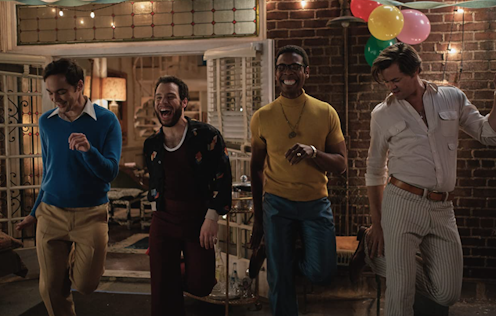
A landmark document of 20th century American gay life, The Boys in the Band began life as a 1968 play by Mart Crowley; adapted into a well-received, now rarely screened film by William Friedkin in 1970, it was revived on Broadway two years ago to commemorate the play's fiftieth anniversary. That revival has in turn sparked a confident new filmed version, stacked with openly out talent and enthusiastically objectified eye candy, and produced by Ryan Murphy as part of his 2020 masterplan to swamp Netflix with new content. (Seriously: I know these are restless times, but does the guy ever sleep?) Viewed from here, Crowley's play seems more than ever a precursor to the rigidly hetero The Big Chill. We're invited to a birthday party at the rooftop apartment of fretful New Yorker Michael (Jim Parsons), where the guests will chat, flirt, bond, bicker and formation dance to Martha and the Vandellas' "Heatwave". Via a process not unlike chromatography, Crowley drew out a pretty full spectrum of gay experience as it was circa '68, ranging from the ever-flamboyant Emory (Robin de Jesús) and dumb-as-nuts hustler Cowboy (Charlie Carver) to bisexual, straight-passing scene elder Hank (Tuc Watkins) and unhappily closeted Alan (Brian Hutchison). Had Buzzfeed been a thing in 1968, there would almost certainly have been a Which Boy in the Band Are You? survey with which amused or confused patrons could kill time in the interval. The new version, directed by stage veteran Joe Mantello, reproduces the show on a streaming budget; but it does so knowing full well that the context has shifted. On opening night, these boys' interactions could be claimed as a flag, planted just off-Broadway for a small, endangered minority to rally around; a half-century on, and Crowley's text has become a flagstone, almost a museum piece, an enduring memento of what this scene looked and sounded like before America loosened up and the virus (AIDS, not Corona) began eating away at it.

That possibly confers a frowning import and seriousness on what was always meant as a diverting, hopefully enlightening night out. In fact, there are elements here that now fall somewhere between totemically and parodically camp. Michael answering the (rotary dial) telephone with "Backstage, Funny Girl" is very much of its moment; the reference to Maria Montez might have seemed yellowing first time around. Yet there's still real comic and dramatic juice in Crowley's text. Tensions ramp up after Alan crashes this jolly soiree - in a tuxedo that only accentuates his stiffness - spouting homophobia that has the ring of externalised self-hatred. Yet they're offset by some very funny writing. Michael witheringly nails one acquaintance as being "as straight as the Yellow Brick Road". Asked what he does for $20, Cowboy guilelessly shrugs "I do my best". Martello and cast lean into those lines that serve as sturdily planted markers of the extent to which things have changed. Asked whether he lives with his parents, the handsome Donald (Matt Bomer) quips "Yeah, but they're gay"; that joke's lost some of the absurdity it would have had back in 1968. Emory confessing "I have such a problem with pronouns" could be your awkward co-worker fumbling the issue of trans rights - and here this Band acknowledges that Crowley's play was but Act One of a far bigger, much more inclusive story. Even so, from the playwright's pointed deployment of the adjective "normal", it's clear The Boys in the Band was always weighing up past against present, where these characters were in 1968 versus where they'd been.

That's the meat of the second half, as rain forces the boys indoors and into a parlour-game revisit of formative experiences. If the bitterest line - born of harsh lived reality - is Michael's last-reel "Show me a happy homosexual, and I'll show you a gay corpse", the abiding impression is that the trailblazing New York of 1968 (or just this particular square footage of real estate) was at least slightly more progressive, welcoming and tolerant than the America of the post-War years, much as 2020, for all the doubt and uncertainty we may presently be working through, is broadly more progressive, welcoming and tolerant than 1968. Whenever the writing goes deep - as party chat often does after midnight - Martello allows his skilful, evidently well-rehearsed ensemble to position their characters on a continuum of queerness, and allows the viewer to weigh up whether or not they have it any better or easier than these boys. (I say 2020 is a beacon of progressivity, while also being acutely aware that America's latest Supreme Court nominee has her beady little eyes set on rolling back legislation for gay marriage.) Even if you knew nothing of this material's provenance - if you were only watching because you had a crush on Bomer or Andrew Rannells, or because you recognised Sheldon from The Big Bang Theory - you could probably tell this was a stageplay from the heightened level of talk. You think you've got the measure of the volume and garrulousness when Zachary Quinto, with a perm that suggests what might have happened if M*A*S*H-era Elliott Gould had played gay, turns up as the birthday boy and the chattiest Kathy of the lot. Yet it's still poignantly clear that Crowley was clearing a safe space for what couldn't be widely talked about at the time, and Martello is no less alert to how talk can breed conviviality, companionship and compassion. You'll have been to far less entertaining and stimulating parties.

The Boys in the Band is now streaming on Netflix.

Monday, 5 October 2020

On TV: "Robin Williams: Come Inside My Mind"

Directed by Marina Zenovich and produced by the tireless Alex Gibney for HBO, the documentary Robin Williams: Come Inside My Mind is at once a tribute, a celebration and a doomed exercise, attempting to get inside the head of one of the least predictable comic performers of his generation, and thereby puzzle out what led him to take his own life, aged 63 in 2014. It opens with a clip from Inside the Actors Studio, where Williams responds to a question from host James Lipton (himself no longer with us) regarding the workings of his mind with an extended riff on the daily life of the human brain. It's manic, electric, and the studio audience responds as one, with a standing ovation, yet - crucially - Williams is generalising, deflecting; he doesn't speak to the possessive pronoun in the original question. If he didn't know how his mind worked, how can we? What's evident is that he had a gift, and that he was a gift, both to audiences and to filmmakers piecing together an appreciation of the life and work out of the bounteous footage available. Zenovich casts her net enjoyably wide: we get the stand-up alongside clips from Williams' now rarely repeated teatime TV staples (Happy Days, Mork & Mindy), plus outtakes from same (in which Pam Dawber is returned to us as a terrific sport and a lost babe) and excerpts from the many, many hours the subject logged on late-night chatshow sofas. (In American public life, this may be as close as we get to seeing a performer on the psychiatrist's couch.)

Yet the film also digs deep, and here Come Inside My Mind bears Gibney's no-stone-unturned influence: we get messages Williams left on pal Billy Crystal's answerphone, an outtake of him making Philip Seymour Hoffman crack up on the set of Patch Adams, a glorious return to the 2003 Critics' Choice Awards, where Williams lost to Jack Nicholson and Daniel Day-Lewis and still gave the night's funniest acceptance speech, and an offcut from an EPK interview with his World's Greatest Dad director Bobcat Goldthwait that goes swiftly - and unusably - off-topic. Biographically, there are almost as many lows as highs. There was that triple gutpunch, not long after his elevation to the A-list, of seeing Popeye crash-and-burn, John Belushi white out on the same drugs Williams himself was blitzing, and Mork & Mindy being unceremoniously canned. And there was the abiding, apparently unsolveable problem of how to come down from the pure dopamine hit of onstage adulation: the drink and drugs Williams turned to in order to sustain the high offered few lasting physical benefits, though they also generated a smart late-life routine about addiction ("I went to rehab in wine country, just to keep my options open") which made light of heavy personal experience. To quote Steve Martin, Williams' co-star in a 1988 revival of Waiting for Godot you'd pay good money to see repeated in its entirety: "On stage, he was the master: funny and quick and in control. In life, he wasn't on stage any more."

There's enough here to make fans and sceptics alike rethink elements of the career. It's clear that Williams found love and stability with his second wife Marsha - it may be the only time in Hollywood history that running off with the nanny generated more happiness than misery - and that fatherhood gave this only child a ready audience of youngsters with which to goof around. That, I think, explains some of the film choices for which he took such a critical hammering - though the evidence still suggests that Williams was always vastly funnier and more entertaining with the child locks off. He could be subtle, too, lest we forget: Zenovich has the clips from Good Will Hunting, One Hour Photo and Being Human to illustrate that, plus an audio masterclass in the art of doing nothing that reveals an astute actorly intelligence behind the onstage freewheeling and spitballing. Eventually, Come Inside My Mind addresses the underlying health issues and tiredness that was a consequence of giving it all, night after night, take after take. (The devil-may-care Goldthwait, with whom Williams was both personally and professionally close, may be the key to understanding what weighed on these shoulders in their final years.) Yet he'd given a lot to so many, and the film-shrine Zenovich and Gibney have curated in his wake proves at least the equal - in its scope, its detail and its profound love for its flawed, troubled subject - of Judd Apatow's excellent HBO retrospective The Zen Diaries of Garry Shandling. One of the reasons the past few years have been so depressing is that we've lost many of the people who made us laugh, at exactly the moment we needed them most.

Robin Williams: Come Inside My Mind screens on Sky Arts this Wednesday at 12.15am.

Sunday, 4 October 2020

For what it's worth...


Top 10 films at the UK and Ireland box office (for the weekend of September 25-27, 2020):

1 (1) Tenet (12A) **
2 (2) After We Collided (15)
3 (3) Bill & Ted Face the Music (PG)
4 (6) Onward (U) ***
5 (5) The New Mutants (15)
6 (8) 100% Wolf (U)
7 (10) Unhinged (15)
8 (7) Rocks (12A) ****
9 (12) Trolls World Tour (U)
10 (new) Schemers (15)

(source: BFI)

My top five films currently on release:
1. The Ground Beneath My Feet
4. Rocks


DVD/Blu-Ray/Download top ten: 

1 (1) Scoob! (U)
2 (re) Star Wars Episode II: Attack of the Clones (PG) **
3 (2) Trolls World Tour (U)
4 (7) Bad Boys for Life (15) ***
5 (6) Spider-Man: Far from Home (12) ***
6 (new) Full Metal Jacket (15) ***
7 (9) Sonic the Hedgehog (PG)
8 (10) Jumanji: The Next Level (PG)
9 (new) One Flew Over the Cuckoo's Nest (15) *****
10 (5) Little Women (U) ****


My top five: 
1. A White, White Day

 
Top five films on terrestrial TV this week:
1. The Searchers [above] (Sunday, BBC2, 4.05pm)
2. I Am Not a Witch (Sunday, C4, 12.15am)
3. A Hard Day's Night (Saturday, BBC2, 12.20am)
4. 12 Years a Slave (Saturday, C4, 9pm)
5. Article 15 (Tuesday, C4, 1.30am)

Saturday, 3 October 2020

School of hard knocks: "Rocks"

In better years, Rocks might have become a Trainspotting-like cultural phenomenon, not just the small but appreciably shaped word-of-mouth sensation Sarah Gavron's film has emerged as over the past month. It has a similarly effervescent, youthful cast, none of whom you're likely to have encountered before, who bring to the screen new attitudes, slang and rhythms, a freshness you can't teach but which you might want to bottle. With its predominantly non-Caucasian cast and untranslated jokes in Somali, it's a film at ease with the idea of a modern, changing, multi-ethnic Britain, in a way our generally stagnant film industry, for all its hastily applied diversity initiatives, really hasn't been. (Its closest comparison points would be Francophone: Girlhood, Divines, the recent Papicha; there's even a little of Laurent Cantet's Cannes-winning The Class in the mix.) Most importantly of all, it's a piece of sensitive, unforced storytelling, leading us by the hand into the world and life of a teenage Londoner about to have a very great - too great - responsibility placed on her shoulders. Her given name is Shola, though she's commonly known by her contemporaries as Rocks (Bukky Bakray), and - in a crucial year for her education - her depressed mother will flee the family's housing-estate nest, leaving her to try and keep the lights on, while shuttling a younger brother, Emmanuel (D'angelou Osei Kissiedu, the sweetest damn kid you'll see on screen this or any other year), to and from school. Plot may be the one aspect of Rocks that isn't entirely box-fresh: it's the story of a latchkey kid, albeit one given a vivid 21st century remix, with a Ray BLK song over the closing credits.

Gavron's previous projects - most prominently, 2007's Brick Lane and 2015's Suffragette - were assured, but also ever so slightly dutiful: they were the kind of films (literary adaptations, period dramas) which the industry expects from its creatives, where everybody hits their marks, behaves themselves, and goes home with a rosette and something to put on at the Odeon of a Sunday afternoon. Rocks is what happens when a director turns her film over to a cast who have too much energy to ever stay on their marks for long. There are two credited writers (Theresa Ikoko and Claire Wilson) who presumably shaped the narrative line and individual back-and-forths, but most scenes here are rocket-fuelled by the young performers' spontaneity, their capacity for going off-book and coming back with something truer or funnier still: they bust unexpected moves, or give a line a little more mouth and cheek than a Sylvia Young graduate would, resulting in tremendous free-for-alls in the playground and one home-economics class. The film's secret weapon was casting director Lucy Pardee, an Andrea Arnold go-to, who not only found the foursquare, very engaging Bukray, but surrounded her with a coterie of sharp-tongued contemporaries, and then surrounded them with - or, more accurately, had them surround - teachers who really resemble flustered and weary functionaries, doing their best to stem a rising tide of teenage snark. Even the passing hometime chat has the effect of the space dust one of the girls tests on the innocent Emmanuel: it pops and fizzes. You can't get enough of the stuff.

Quieter, but no less present, is Ikoko and Wilson's understanding of what these girls are fighting and hollering about. In recent years, the industry - driven, as ever, by supremely comfortable Hampstead dwellers - has given itself over to the generation of saleable, aspirational images. Rocks doesn't lack for that confidence in filming London that has been such a feature of capital-set films since the 2012 Olympics (as valuable a legacy as any), but it also offers the novelty of seeing a London where people are credibly strapped for cash - where a £29 return fare to Hastings is deemed beyond the financial pale. Rocks starts the film on a rooftop overlooking the Gherkin, Shard and Walkie Talkie - those markers of the ostentatious, sometimes outright dirty wealth currently flowing through the city, placed tantalisingly out of reach - only to spiral downwards after the money her mum left her goes AWOL. The 12A rating serves as reassurance things won't get too grim, and she has a tightly knitted safety net in her pals, as the film's final movement establishes. Here, Rocks gives its characters and cast a deserved break, allowing everyone to feel some sun on their faces, and a glimpse of a better, more leisured life. It's only ever a glimpse, though: Gavron, Ikoko and Wilson sense even this heightened level of girl power isn't enough to truthfully carry their characters any further in this landscape. (Hence their tentative, open-ended conclusion.) Still, if there isn't all that much optimism around in the Britain of 2020, there is more than most in a film such as this: hope for an industry adapting to clear space for these stories; for those creatives out there telling those stories so well; and most of all for youngsters like Rocks and her mates, buffeted and bruised by the moment, yet possessed of a remarkable ability to bounce (and answer) back.

Rocks is now playing in selected cinemas, and available to stream via Netflix. 

Thursday, 1 October 2020

The second mother: "A Perfectly Normal Family"

Whatever your position on the 21st century's bestselling author of children's literature, the needle looks to have shifted. I've spent the best part of the past month marvelling at the fact that ITV4 - home of The Sweeney reruns and blokesports - were running those trans-centric Starbucks adverts (flagrant corporate appropriations of identity politics, yes, but also oddly moving markers of a moment, unthinkable on free-to-air TV even a decade ago) in the middle of the channel's Tour de France and World Series of Darts coverage; even more surprising (and encouraging) is the fact that, unlike Alesha Dixon's jewellery choices, these ads have met with no backlash to speak of. Last week, the French doc Little Girl offered a matter-of-fact survey of the life of a trans kid; this week sees the release of the Danish drama A Perfectly Normal Family - a title that would have served Little Girl almost as well - with its PG-rated take on the plot and themes of Amazon's groundbreaking series Transparent. (Like that show, the film has drawn criticism for casting a cis male in the lead role.) Making the change here is family man Thomas (Mikkel Boe Følsgaard, a lookalike for the young Lars von Trier), announcing in the first reel that he wants to live a new life as Agnete. It's a decision that distances this former patriarch from a sometime wife, whose response is to file for divorce, and the couple's children, teenage Caroline (Rigmor Ranthe) and especially football-loving youngest Emma (Kaya Toft Loholt), obliged to process the fact a) their parents are divorcing and b) their dad is now another mum. Trust the Danes to drag the spectre of Mrs. Doubtfire out of the closet: what we're watching is the standard family unit that's provided the bedrock for a century's worth of family movies being broken down and reconstructed along new, progressive lines.

In charting this family's progress from astonishment and anger to acceptance, Malou Reymann's film is never less than reassuringly Scandinavian: all warm sunlight, nice houses and open minds. It's rare to encounter a movie where you sense there was both a counsellor and a child psychologist on standby behind the camera to nudge these actors in the right direction should they come looking for guidance. Reymann is very astute about Emma's desire to keep Agnete at arm's length, watching as this suddenly sullen kid wraps a towel around her face to block out the sight of the new woman in her life, and comes to insist Agnete doesn't publicly refer to herself as her mother. It's recognisable as the cringing embarrassment most tweens feel around their folks, only exacerbated by the confusion and resentment Emma feels about the paradigm shift visited upon her at a formative moment. This is not a film that takes any great formal or narrative risks, the better to cushion its life lessons. Reymann subtly locates the action in the early Noughties (around the time her own family was undergoing a similar transformation), which cues passing references to Britney Spears and John Toshack, but surprisingly little evidence of transphobia beyond a grandad's befuddled deadnaming at a family get-together; her boldest choice is to sporadically insert home video footage of Agnete in her Thomas days, which - as in Transparent's opening credits - serves as a relic of ostensibly simpler times. The editorial aim is to show the mixed-up Emma feeling her way through a complicated situation, and thereby allow anyone in a similar position to rest easy, knowing these things can be worked out for the best. You could teach A Perfectly Normal Family in classrooms - and I suspect it'll find a ready audience in that (seemingly swelling) demographic of young parents who'd rather their offspring were schooled in anything but Harry Potter.

A Perfectly Normal Family opens at Manchester's HOME and Sheffield's Showroom, and will be available to stream, from tomorrow.