Saturday, 19 September 2020

If the kids are united: "White Riot"

Here's a timely one. With White Riot, the documentarist Rubika Shah gives us a potted history of the origins of Rock Against Racism, the organisation launched in 1976 by photographer and performance artist Red Saunders as a response to the massing ranks of the National Front (then under the jowly stewardship of Martin Webster) and those variously addled elements within rock - the increasingly uncool Clapton, yes, but also Bowie and Rod Stewart - who'd started flirting with the rhetoric and imagery of the lunatic fringe. Shah's history leans heavily on interviews with RAR's (predominantly white) founder members, several of whom recall childhoods in the colonies, and seeing racism close-up at a formative age; what the film proposes is that the 1970s saw an especially noisy outbreak of the same unresolved issues around Empire the once-United Kingdom is still working through almost a half-century later. Their accounts are reinforced by testimony from those musicians who subsequently stuck out their necks in support of RAR's aims: a rainbow coalition that encompasses The Clash's Topper Headon, representatives of both legendary reggae outfit Steel Pulse and all-Asian rockers Alien Kulture, Pauline Black from The Selecter and the white, bisexual Tom Robinson, given pause to reflect on how this motley crew (plus roadcrew) effectively invented intersectionality before it became a leftist ideal.

So the film has a stance, and some damn good tunes to revisit - how does it translate this story into images? Pretty well, it turns out. 1976 was just pre-video, so Shah has had to rummage through the archives and fall back on (in places, slightly familiar) news footage to describe the trouble breaking out on Britain's streets, but she has an ace up her sleeve in a selection of striking photographs, taken by Saunders and others, that cut through any historical distance and capture the essence of an especially lively, often outright turbulent moment. That moment was one in which the nation's youth were trying on identities for size, and Shah invites us to see Rock Against Racism as a gang of sorts in itself, with its own shared views and interests, a friendly rival in the emergent Anti-Nazi League, often violent enemies (NF skinheads, the police) and its own inhouse newsletter in TempoRARy Hoarding, cobbled together in the manner of punk's DIY fanzines, with typography and content that clearly drew on and fed into the irreverent music press of the time. Shah's own approach is rather fanzine-like: she patches her material together with modest resources but plentiful energy, while remaining aware certain images here should stick in the viewer's craw. More than once, White Riot reminded me just how virulent, how unabashed Seventies racism was - how it became a badge its viler proponents could pin to their lapel and identify one another by. And yet this doesn't seem so different from the state of play in late 2020; the insinuation is that we've spent forty years hiding or institutionalising such prejudices, attempting to make them respectable. As UKIP absorbed the BNP vote, so too the Conservatives consolidated their power by swallowing the UKIP vote more or less whole. "Our job was peeling away the Union Jack to reveal the swastika underneath," Saunders suggests; after a decade of Downton and Brand Britain buoyancy, it would appear some of the adhesive is once more wearing off.

A caveat: this fanzine is missing a few pages from its back end. White Riot concludes on a not unearned upnote, with joyous, understandably irresistible colour footage of the RAR-organised Carnival Against The Nazis - held in London's Victoria Park in 1978 before a crowd of thousands, with headliners The Clash joined on stage by Sham 69 frontman Jimmy Pursey for a performance of the titular showstopper - and a closing graphic pointing out the National Front were routed at the ballot box in the following year's election. Yet this was surely in part because the hard and/or posturing right had a new blonde pin-up to vote for; there's another half-hour, and quite possibly another film, in how RAR (which continued until 1982) adapted to the challenges of Thatcher's Britain, and how its activities fuelled the later activism of Red Wedge and Love Music Hate Racism. (It's that rarest of releases: a film that feels too short for its own good.) That this especially evocative snapshot emerges as no exercise in cosy nostalgia is Shah's achievement here; that's attributable to the unnerving proximity of its words and pictures to where we are today. All the conditions would now appear in place for some kind of Rock Against Racism revival - except, maybe, the music, which (with a very small handful of honourable exceptions) submitted to corporate control sometime towards the end of the last century, and has consequently wound up almost entirely depoliticised. The hope is that Shah's film can inspire musos who've been twiddling their thumbs during lockdown to come up with music and lyrics worthy of this critical moment, that envision some urgently sought forward path.

White Riot is now playing in selected cinemas, and available to stream via Curzon Home Cinema and the BFI Player.

Thursday, 17 September 2020

1,001 Films: "Underground" (1995)

Emir Kusturica's 1995 Palme d'Or winner Underground replays the history of the former Yugoslavia, then just broken up into its constituent states, as wild, funny, cacophonous, seemingly never-ending farce. It opens in 1941, just as the Nazis marched into town, with the story of two brothers: roguish marketeer Blacky (Lazar Ristovski) operates on instinct, while Communist Party apparatchik Marko (Miki Manojlovic) constitutes the brains of the family. This is a fairly familiar fraternal split - "the two of you could make one good man," observes Natalija (Mirjana Jokovic), the actress who comes between them - but together the brothers run the resistance movement, shuffling through the tunnels beneath the streets of Belgrade, where they've stashed the city's Jewish population. In the years following the War, Marko rises to become a key political player, while keeping Blacky - whose girl and status Marko has stolen - in the dark by insisting the conflict is still ongoing. To achieve this end, Marko fakes air raid sirens, and installs a camera in the floor of his house to monitor what's going on beneath his feet; but Marko eventually makes a break for it overground, coming out fighting like those fabled Japanese soldiers who emerged from their bunkers long after WW2 had ended. And that's only the half of it.

Never one for restraint, Kusturica here establishes what was to be a signature style with Marko's instructions to the underground's resident brass band as he initiates a bar brawl: "faster and louder". Underground is all setpieces, with only a menagerie of barnyard animals and that horn section to obscure the fact and hustle things along from one crazed tableau to the next. At one point, Marko opens up a trap door and emerges in an asylum, and there's not a huge difference between this scene and any other in the movie. When a grenade goes off at close range, Blacky pops out of the smoke cloud with his face blackened and hair askew, like a cartoon character. The sight of a man kneecapping himself has its potency undermined somewhat for being intercut with images of a chimp in a tank. Of all the aesthetics that developed amid the European cinema of the 1990s, Kusturica's was up there as amongst the most acquired of tastes: you may come away from Underground never wanting to hear another tuba or French horn again. Personally, I've always found Kusturica's excess wearying over the long haul - and three hours of Underground is probably more than enough - but individual bits are nothing short of inspired. Take the scene halfway through where Marko and Natalija, happily ensconced in power, visit the set of a historical drama recreating the events of Kusturica's first hour, where the same actors also turn up playing the fictionalised Marko-and-Natalija in the film-within-the-film. The payoff is that this film's actors-in-Nazi-costume are the first people Blacky sees upon emerging from the depths, thus confirming his belief that the War has continued unabated. It can seem more and less complex, but the moral of Underground is that, one way or another, history is almost always repeating itself somewhere in the world.

Underground is available on Blu-Ray via the BFI.

Wednesday, 16 September 2020

Wild ones: "Savage"


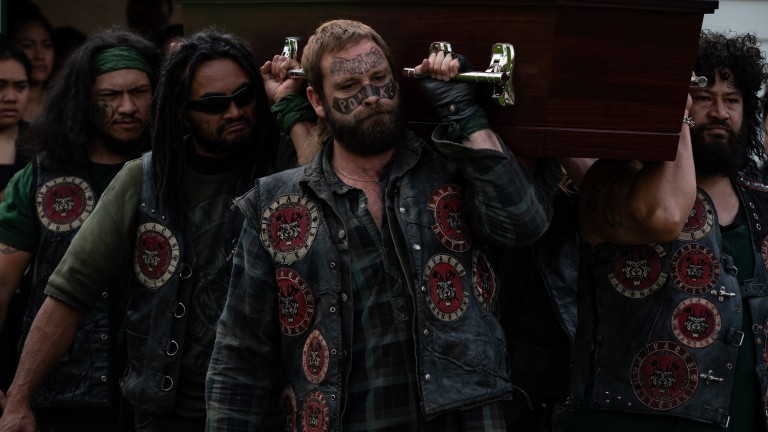
There was a sequel to Once Were Warriors, that Kiwi landmark of 1994 set within the country's Maori and Pacific Islander communities - 1999's What Becomes of the Broken Hearted? - but it went straight-to-video (and generally underdiscussed) in the UK. Sam Kelly's Savage is a standalone item, but one that often feels like a prequel of sorts, so closely does its world tessellate with that of its predecessors. Kelly sets before us the following: a backwater town, not big or forgiving enough for anything other than the narrowest and most suspicious of minds to gather; penned-in and pent-up characters; and an uneasy tension between ethnic groups still operating along tribal lines. We open in 1989, in the bruising company of a biker gang - the Pokene Savages - doing its bit for diversity, in that it's presided over by growling, hammer-wielding blondie Damage (Jake Ryan, who might resemble Aaron Eckhart or Alexander Skarsgard were it not for his mullet and conspicuous face tattoos) and second-in-command Moses (John Tui). Yet after dipping an understandably tentative toe in this mucho-macho world, Kelly then follows these characters back to 1965, to illustrate what it was to grow up in such a violently divided place, and how the unlikely alliance between Damage and Moses first came about. Kelly's concern is with the haphazardness of youth - we're vaguely reassured when Damage (born Danny) leaves behind the Nazi flag we briefly see one of his white cohorts flying in the 1970s scenes - and the getting of wisdom, although this development will be deferred for several decades, hard won, and never at any point looks like much in the way of fun.

It is, then, a very different depiction of Pacific Eighties life than Taika Waititi's fondly nostalgic Boy: Kelly drags us back to what appear literally unenlightened times - cinematographer James L. Brown insistently tamping down his hues - and then even further into the Dark Ages. The film that shapes up before us is one of two halves, and there are places where the protagonist's haphazardness slips into the wider picture; yet that roughness is, finally, the source of Savage's power. The 60s/70s sequences are a little run-of-the-mill, like an afterschool special that's had permission to turn the air blue from time to time. (The violence, kept largely off-camera, doesn't hit home as it has done elsewhere.) Yet Kelly pushes notably deeper when we circle back to the late Eighties, helped in no small part by Ryan's darkly charismatic performance. If the actor doesn't go full Russell Crowe-in-Romper Stomper psycho, he patrols the periphery of a similar scene most effectively. Too much the underdog to give into his brother's seething ethno-nationalism, Damage comes to realise he may now be too old to romp or stomp as he once did, and there's something intriguing in the sight of this sometime destroyer of worlds sensing he may have lessons in self-preservation to pass on: witness his wholly unsentimental mentoring of Red (Poroaki Merritt-McDonald), a kid he seems as likely to throttle as nurture. You'll require a high tolerance for men locking antlers - often in the confines of a makeshift biker bar that resembles a rec yard - though Kelly also works in revealing, contrapuntal scenes in which those men fail to relate to those rare women they don't immediately scare off, and some delicate imagery besides: consider the fence on which Damage carves a notch for each passing year, a marker of his inability to move on, a prison tally chart, only on the outside.

Savage is now playing in selected cinemas. 

Tuesday, 15 September 2020

In the fog: "The Lighthouse"


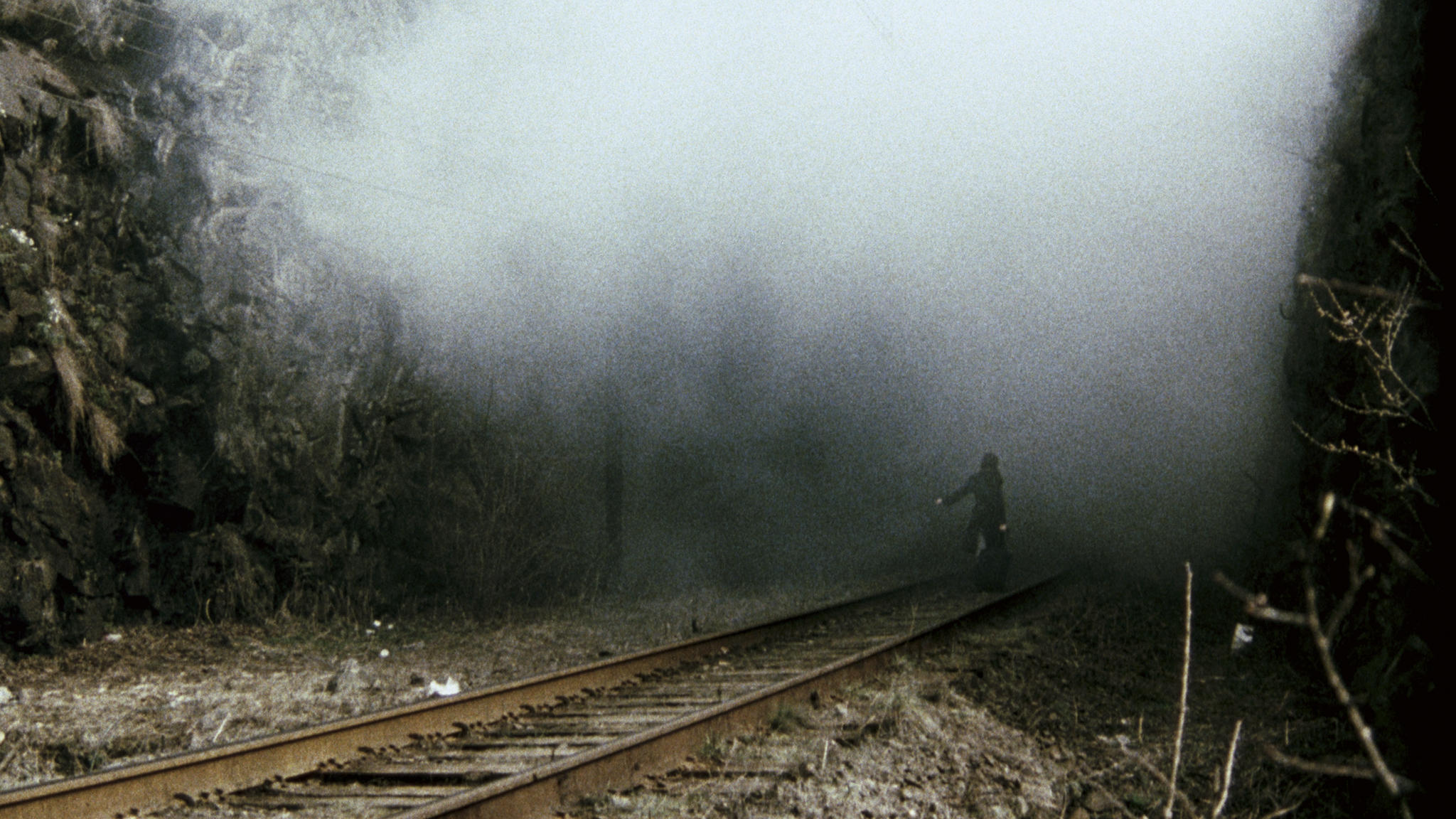
Not to be confused with the recent Willem Dafoe/R-Pattz curio, the earlier The Lighthouse - a 2006 drama by the late Armenian director Maria Saakyan, revived this week on MUBI UK - displays a bold pictorial sense, but also suffers from the opacity seen in so much Soviet and post-Soviet cinema: a lot of activity without anchoring narrative sense, a tendency to reduce its characters to figures in a landscape, a thick mist literally obscuring proceedings. Peer into it, and one can just about make out some sort of homecoming: that of Lena (Anna Kapaleva), a young woman who returns home after a civil war to find her family and friends torn between rebuilding and walking away. What follows is ambiguous, verging on the unfathomable. The conflict is represented by one recurring helicopter making the same buzzing movement overhead, which is partly effective as a source of tension, but also clearly the result of budgetary restrictions, and the repetition extends to multiple shots of characters washing their faces. Certainly it flows, and its chaos - its insistent scrambling of past and present, documentary and fiction, pristine and grainy film stocks - may be exactly that of life during wartime; its textures stay with you, but I'll be damned if I didn't watch it wearing the most quizzical expression. Its final image is of (staged? actual?) all-male formation dancing. Your guess will be as good as mine.

The Lighthouse will be available to stream via MUBI UK from Thursday.

Monday, 14 September 2020

Night music: "Max Richter's Sleep"


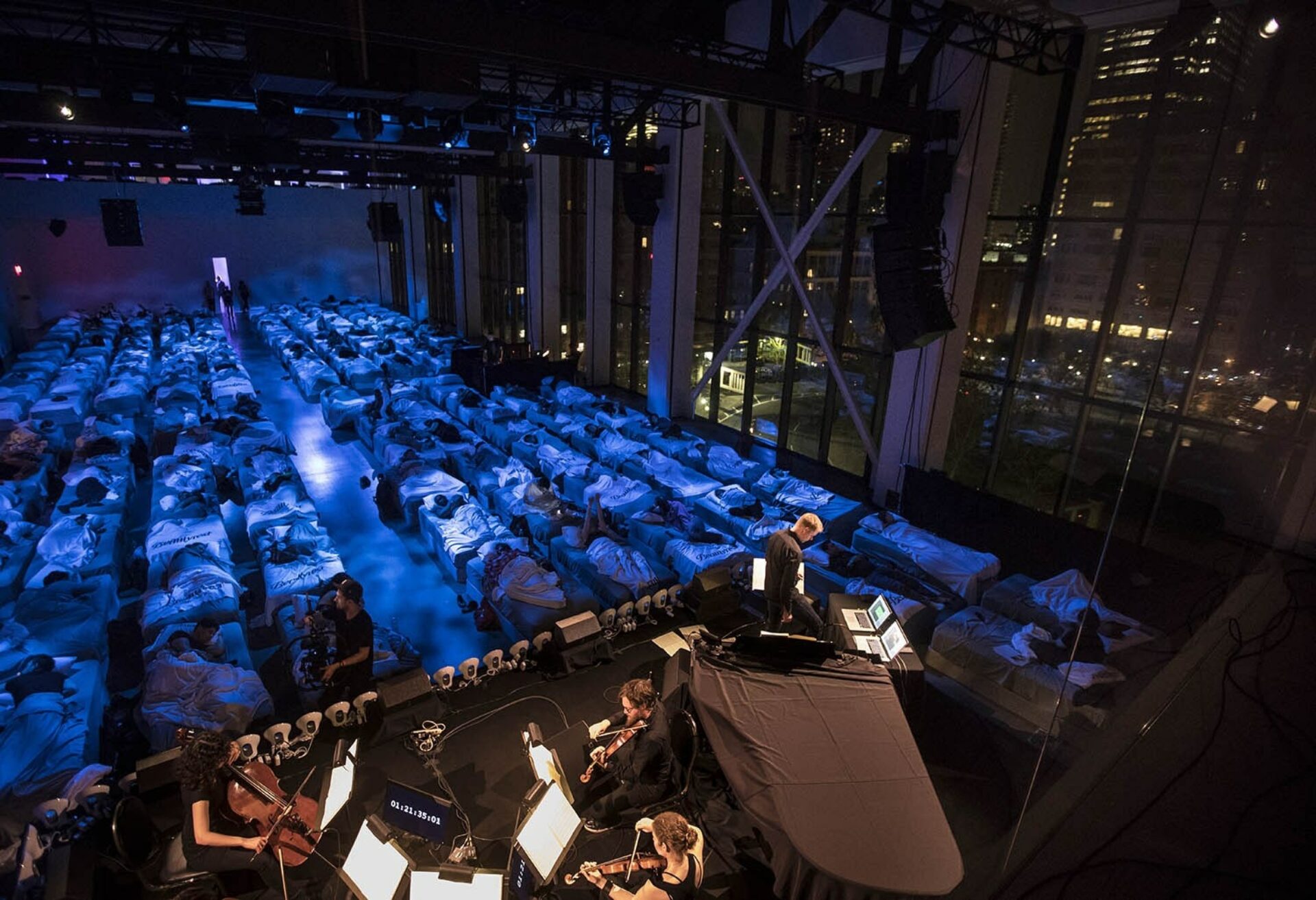
Max Richter's Sleep is a documentary made to preserve and promote an artwork most viewers won't personally have experienced, and which even those who paid money to see it live will likely have nodded on and off through. Before you take that as a damning assessment of its qualities, know that any such snoozing was the exact response its creator intended. Running a full eight-and-a-half hours, and generally performed as twilight gives way to darkness, Sleep was conceived so as to help the listener catch a few zzzs here and there - which arguably only makes it worthier of close study amid the restless nights of 2020. The composer is Max Richter, the well-spoken Brit best known for his film scores (Shutter Island, Arrival), who here gets to talk newcomers and long-term admirers through his philosophy, the genesis of this specific piece, and what it might represent in the wider context of the world. To some degree, it seems, Sleep might be approached as a musical equivalent to slow cinema or slow cooking. As that world speeds up exponentially, to the benefit of big business if not necessarily the individual, this extended piece (which we learn Richter has been tinkering with for several decades now) provides a way for the listener to stretch out, take an eye off the clock and let down one's guard - those circumstances that have traditionally inspired overburdened humanoids to switch off for the evening.

Appropriate, then, that after an initial burst of drone-heavy ambient scenesetting, Natalie Johns' film should take on a gently lulling quality, all low lighting and measured pans around cities in the course of putting their heads down for the night. Factor in the music, and it wouldn't surprise me if matinee and late-show viewers found themselves succumbing to multiple micronaps. What will they miss? Some considered discussion of craft, for one: an eight-hour piece means there are plentiful notes and movements to be accounted for, and Johns sporadically takes a step backwards - taking care to avoid drowsy concertgoers - to describe how Richter got to staging these big nights out in high-profile venues. To its credit, this is one of the few recent arts docs to bring up the matter of money, and to address - at least in passing - the scrapes and sacrifices made earlier on so that Richter and his wife/creative director Yulia Mahr could inhabit the well-appointed property we find them in. Yet as you'd expect from a film produced by Mahr and Richter's record label Deutsche Grammophon, some of this tips over into unenlightening fandom ("Max's music cleans your soul," gushes one admirer), and approximately a third of the running time is made up of shots of people nodding off: not necessarily the most dynamic imagery, deployed as screenfiller while the soundtrack is doing the heavy lifting.

Clearly, I'm far from Sleep's target audience: I write both as someone who needs something close to total silence to get anything like a satisfying night's shuteye, and someone who finds the idea of dragging a sleeping bag along to an outdoor venue in order to sleep in public - surrounded by other people - little short of terrifying. (Those interviewed insist that this is a reinvigorating collective experience, to which I say: all very well, I just hope your wallet, phone and shoes are still there come sun-up.) I kept wanting Johns to dig a little deeper into the logistics of such an event, and to ask the (perhaps literal-minded) questions that might have offset the hushed dreaminess of this endeavour. What do you do if you need the loo? Given the shared intimacy - a hundred or so cribs lined up in close proximity - do people hook up at these concerts? Given the rigours of modern employment law, does the (relatively small) orchestra get a break at any point? What's everybody doing for breakfast? (You may have visions, as I did, of some opportunistic burger van pulling up outside the venue at five a.m., the noise of the generator and smell of onions rather taking the New Agey edge off the dawn chorus.) But no: we're left with what's effectively a taster of/promo for the more immersive Sleep Live, designed to give ticket sales a boost whenever Richter is next able to take this show out on the road. It's an aptly relaxing watch, if also prone to a Sky Arts-ready tastefulness that is, in its own way, soporific.

Max Richter's Sleep is now playing in selected cinemas, and available to rent via Prime Video and Curzon Home Cinema.

Sunday, 13 September 2020

1,001 Films: "Sátántangó" (1994)


Both a masterpiece and a badge of honour for its survivors, Béla Tarr's extraordinary 1994 adaptation of László Krasznahorkai's novel Sátántangó achieves the purest imaginable distillation of a particular arthouse aesthetic, and - not coincidentally - stakes some claim to being the least commercial movie ever made. Comprising a full seven hours of long takes photographing hunched and put-upon humanoids traversing muddy agricultural flatlands in a resolute monochrome, Sátántangó shouldn't be watched back-to-back with, say, Speed; if the shock didn't kill you outright, you'd almost certainly succumb to the moviegoer's equivalent of the bends.

As an experiment in screen time, and just how immersive the film experience can be, Tarr's film makes Céline and Julie Go Boating seem a breeze at half the length. What the director's imitators (yes, that means you, Gus van Sant) haven't quite grasped is how these experiments don't circumscribe a properly satisfying telling of stories. From its chapter headings onwards, the film is unapologetically novelistic in its description of a community where nothing much happens except it rains.

Tarr devotes at least thirty minutes to introduce each of the characters dancing with the devil, where a conventional feature would in only one or two scenes, ten minutes tops. Here, then, are squabbling business partners Futaki (Miklós Székely B.) and Schmidt (László Lugossy), one cuckolding the other. Here is the returning poet Irimias (local rock star Mihály Víg), in whose florid turn of phrase the villagers come to place far too much trust. And here's the grumpy doctor and unofficial town chronicler Orvos (Peter Berling), whose trip out to replenish his stocks of pear brandy turns into an epic quest, and sets up the film's magnificently sardonic punchline.

During its second third, Sátántangó begins to circle around on itself, repeatedly returning to a nightmarish gathering in the village pub, like an incorrigible alcoholic. Accordion music plays as though on a loop; one local staggers about balancing a bread roll on his forehead; and even the spiders start to conspire against these characters. As visions of human futility go, it's right up there; the circularity, in this instance, is infernal. The death of an innocent while most of the villagers are in this state of inebriation seems to set up a murder-mystery, but Tarr instead scatters his principals further, turning them into refugees and immigrants in a way that chimes with events elsewhere in Eastern Europe at the time of the film's production.

Yes, it's tough-going in places - a cinema that exposes characters and viewers alike to the elements, the K2 of film - and an experience for which you may need to train yourself. (Tarr's comparatively accessible Werckmeister Harmonies and Damnation - his Snowdon and Ben Nevis, if you like - are available as a DVD double-pack.) But this director has a remarkable eye for the halls and corridors of bureaucracy, rainy-grey mornings, empty town squares and the ways bored children find to kill time, and the characters - cursed by fate, squabbling over money, scared and superstitious; people who, even when in groups, seem to be ploughing their own lonely furrow, waiting for God-only-knows what - aren't so very far removed from you and I. It takes a while to get there, obviously, but the view from the top is unlike anything else in the movies.


Sátántangó is streaming at Curzon Home Cinema, and available on Blu-Ray through Curzon Artificial Eye.

Saturday, 12 September 2020

For what it's worth...


Top 10 films at the UK and Ireland box office (for the weekend of September 4-6, 2020):

1 (1) Tenet (12A) **
2 (new) The New Mutants (15)
3 (new) After We Collided (15)
4 (2) Onward (U) ***
5 (4) Unhinged (15)
6 (3) 100% Wolf (U)
7 (5) Pinocchio (PG) **
8 (6) Trolls World Tour (U)
9 (re) Black Panther (12) **
10 (new) Les Misérables (15)

(source: BFI)

My top five films currently on release:
1. Memories of Murder
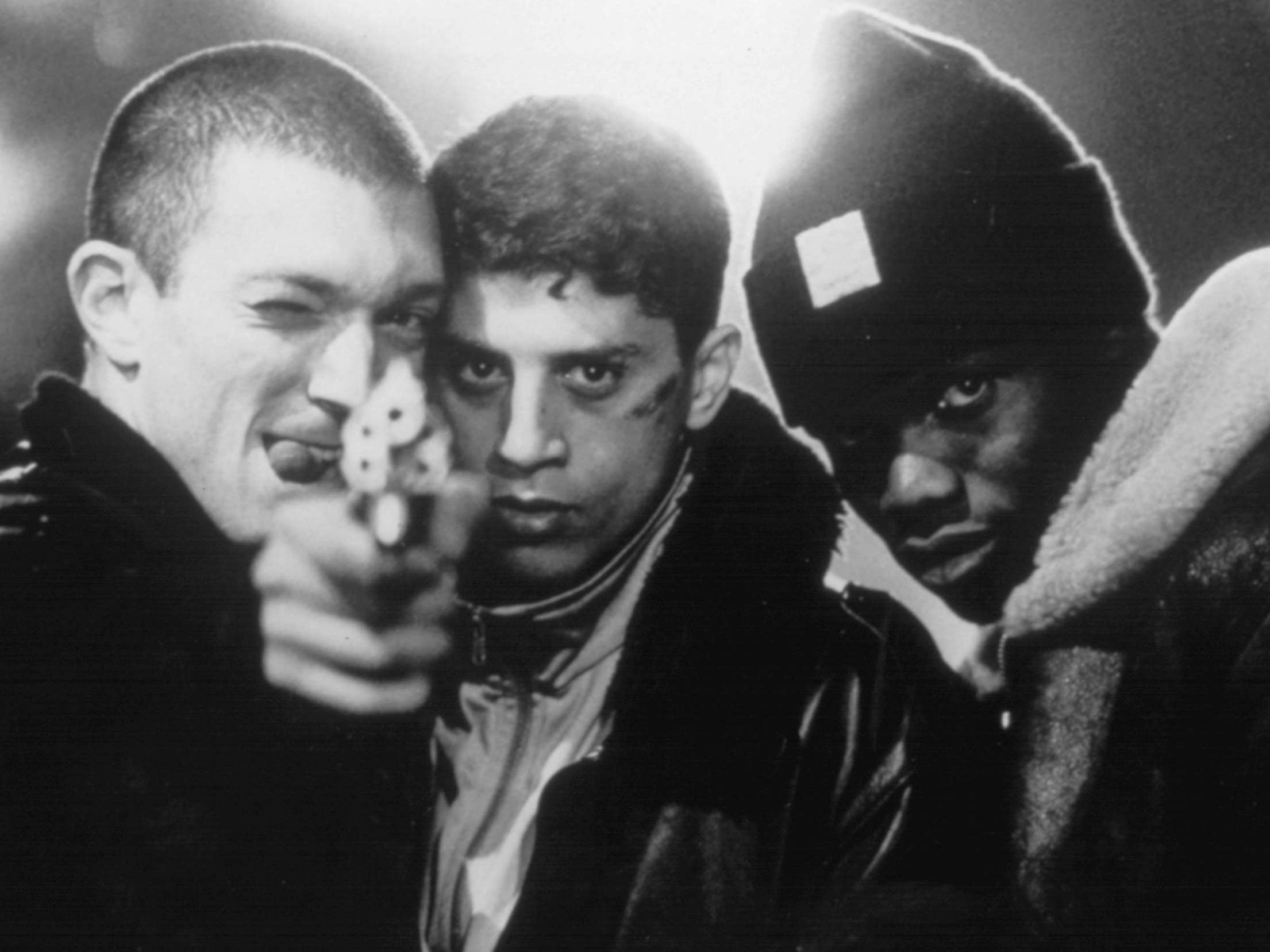
2. La Haine [above]
3. Koko-Di Koko-Da
4. Away
5. The Karate Kid


DVD/Blu-Ray/Download top ten: 

1 (9) 
Black Panther (12) **
2 (2) Sonic the Hedgehog (PG)
3 (3) Trolls World Tour (U)
4 (4) 1917 (15) ***
5 (5) Joker (12) **
6 (10) Star Wars: The Rise of Skywalker (12)
7 (6) Birds of Prey, or... (15)
8 (7) Dolittle (PG)
9 (12) Jumanji: The Next Level (PG)
10 (16) Bad Boys for Life (15) ***

(source: officialcharts.com)

My top five: 
1. Koko-Di Koko-Da

2. Marriage Story
3. The County
4. Spaceship Earth
5. A Paris Education


Top five films on terrestrial TV this week:
1. Casablanca (Sunday, BBC2, 4.20pm)
2. Memento (Saturday, BBC2, 9.45pm)
3. Bill & Ted's Bogus Journey (Thursday, five, 11.05pm)
4. Bill & Ted's Excellent Adventure (Wednesday, five, 11.05pm)
5. Robin Hood: Prince of Thieves (Sunday, five, 3.05pm)