Saturday, 11 July 2020

Turnarounds: "Finding the Way Back"


This is bound to sound like news from another time and place: there's a new Ben Affleck movie. Finding the Way Back - simply The Way Back in the U.S. - would have been no more than makeweight screenfiller in any normal summer: it's another of those uplifting triumph-over-adversity sports dramas that typically play to bigger crowds in the States than they have done over here. Yet if it never deviates too far from the formulaic, its careful, attentive handling reminds us there are reasons why this formula works and will work so long as there's an audience in need of a boost and a darkened room to screen (or stream) these stories in. We rejoin Affleck, now full-bearded and several stones heavier than usual, in the role of Jack Cunningham, a separated, sad-sack construction worker so woebegone he keeps a Bud in his shower soap rack, and the local liquor store owner knows him by name. That name, we gather, was a lot bigger in Jack's days as a high-school basketball star; the decline he's subsequently slumped into is momentarily paused when said alma mater invites him back to replace a coach who's succumbed to a heart attack. Initially, our guy is reluctant: "My life is full right now," he insists, while sitting alone in an ill-furnished apartment and washing down a microwaved burrito with what remains of a six-pack. The further he gets into the cups he uses to drown his sorrows, however, the more convinced he becomes of his ability to fulfil the post. His shirt will remain defiantly untucked, but he throws on a jacket and tie, shambles down to the court, and begins to whip the school's lippy, unruly, generally coasting playing roster into shape. Game on.

So we know exactly where it's headed: it'd be unlikely if Jack crashed and burned so badly that the final shot left him and the kids behind a dumper, huffing meths. It's to the credit of director Gavin O'Connor that the film isn't quite the done deal it might have presented as. O'Connor made one of the best sports movies of recent times in 2011's rock-'em-sock-'em MMA melodrama Warrior; here again, he demonstrates a sharp eye for both the very specific rhythms of the sporting arena (the crowds, the pageantry) and the wider, working-class communities to which these games, these rituals mean so much. (Why else would the Government have placed such emphasis on getting Premier League football back up and running in the middle of a crushing pandemic?) Brad Ingleby's rather flat screenplay may be following one template, but O'Connor takes much of his cue from Friday Night Lights, the superior Peter Berg gridiron drama that begat the much-laurelled television series. One immediate sign that the direction, at least, is on the right path, that O'Connor is keen to steer matters away from the Dangerous Minds-in-Air Jordans blandness that the set-up suggests: Affleck's Jack is allowed to spit and curse, as a barely functioning alcoholic might after being dragged in from the cold and presented with renewed responsibilities. Somebody involved with this production has been savvy enough to convert this pottymouthing into an amusing running joke ("I'm working on it." "Work harder.").

Finding the Way Back never approaches Warrior's tremendous emotional heft, and that's in part attributable to the fact basketball makes for a far less dramatic spectacle than brothers-in-arms having to kick and punch seven shades of what Jack Cunningham would almost certainly call shit out of one another. (The match scenes are less about tactics and plays than the electricity in the room, the potential for individual and collective change.) Yet there's a quiet, professional control about it that elevates the film above much studio filmmaking. For one thing, O'Connor doesn't labour the rebuilding motif, as I feared he might: he inserts one shot of Jack sitting halfway up a flight of steps at the halfway mark, then lets the story and character continue on their way. He knows that his star is prepared to do the necessary heavy lifting. Affleck struggles to sell us on the pep talks - seemingly cobbled together from those in a dozen other inspirational basketball dramas - but he manages to steer both that character and the movie away from the self-pity into which they could so easily have lapsed. Jack never gets so far away from his initial dishevelment that he becomes exemplary, or a safe bet. Early on, his sister (Michaela Watkins) tells him to wash his shower curtain as it stinks, and something of that accusation sticks to him. Our hero trails a whiff of mildew deep into the final act; even when sober, he's never entirely clean. Affleck makes us understand that this is a man who may simply have replaced the old beer buzz with the adrenalin rush of live sports - and that even the latter may not be enough when life becomes especially rough. We don't just have a new Ben Affleck movie, then, we have a fairly decent Ben Affleck movie. It's a start.

Finding the Way Back is now available to stream via Amazon Prime.

Wednesday, 8 July 2020

A woman's work: "Litigante"


Litigante is one of a growing number of films - the recent output of the Safdie brothers being foremost among them - to run principally on stress, ordeals that seek to raise the viewer's blood pressure by dropping us in the middle of a chaotic situation to watch a thoroughly frazzled, overburdened protagonist try and figure some way through the fire. The Colombian writer-director Franco Lolli's follow-up to 2014's Gente de Bien opens up on Hallowe'en, with a non-supernatural nightmare: a daughter looking on helplessly as her ageing, stubborn mother undergoes an MRI scan and is informed by physicians that her cancer is spreading beyond control. The burden of care is but the first of the weights placed on the shoulders of the film's heroine Silvia (Carolina Sanin). She has a young son, who'd be a handful in any other time and place. As a spokesperson for Bogota's works department, she finds herself in the firing line for the questionable decisions taken by her superiors. And she's not above taking questionable decisions herself, like copping off at a party with the shaggy radio presenter who'd earlier skewered her party line on the air. Here is a film that recognises that when given the option of making life easier or harder for themselves, there are people in this world who will always plump ruefully for the latter.

Lolli certainly gives himself plenty to work with, across multiple fronts. With the assistance of co-writers Marie Amachoukeli-Barsacq and Virginie Legeay, he sets strands running that pulse with the urgency of frayed nerves or forehead veins: the deterioration of the mother (brilliantly embodied by non-pro Leticia Gómez), plagued by a hacking cough that hardly comforts us in summer 2020; the deliquency of the son, requiring Silvia to take up what seems like semi-permanent residence in the office of the lad's headmaster; the hostile reaction of Silvia's loved ones to the unlikely new man in her life. Then there is the accusation that our heroine has been taking her eye off the ball at work, to which the only rational response can be: well, given all of the above, wouldn't you? The caffeine-junkie Safdies have been guilty of juicing up their stress-test movies via plot contrivances, strikingly ghastly performers and a mode of filming that is in itself somewhat anxiety-inducing. (They may get found out once hipster critics get over their ridiculous A24 fetish.) Lolli rightly senses he can tell his story naturistically - that he can simply focus on the basics of writing and performing - and still put over a strong sense of the state his protagonist is getting in: the understated moral of Litigante is that you wouldn't have to be a bank robber or a reckless gambler/jewellery dealer to find modern life a bit much.

It demands a lot of the actors, who have to sustain a harried demeanour while committing to the muddling through that gets you and I through the trying weeks; they have to avoid becoming martyrs or patsies, and cultivate something truthful. (Their plates are almost as full as those of the characters.) Lolli coaxes a strong performance from the raccoon-eyed Sanin - better known as an author - as a woman so busy tending to others that she barely has chance to define who she is in herself: a nap around the halfway mark is about as good as it gets. That Litigante is never as draining or depressing as it might sound is that her Silvia passes through this whirlwind clutching clear proofs of the happiness she wants for herself: to raise a family, serve the common good, to love and be loved in return, three distinct goals that tend to pull their pursuers in very different directions. The surprise is that this pursuit heads not towards an explosion (as per Safdie) but some easing-off - it's this director's gift to the character, a break she sorely deserves. If Litigante has a goal of its own, beyond showing something of life as it often was before the great pause of 2020, it's to humanise those alpha women held up as exemplars in our media landscape, and pose serious questions of the extent to which anybody really can have it all. The conclusion it leads us to is that it is possible - but, boy, does it look like bloody hard work.

Litigante is available to stream via Curzon Home Cinema from Friday.

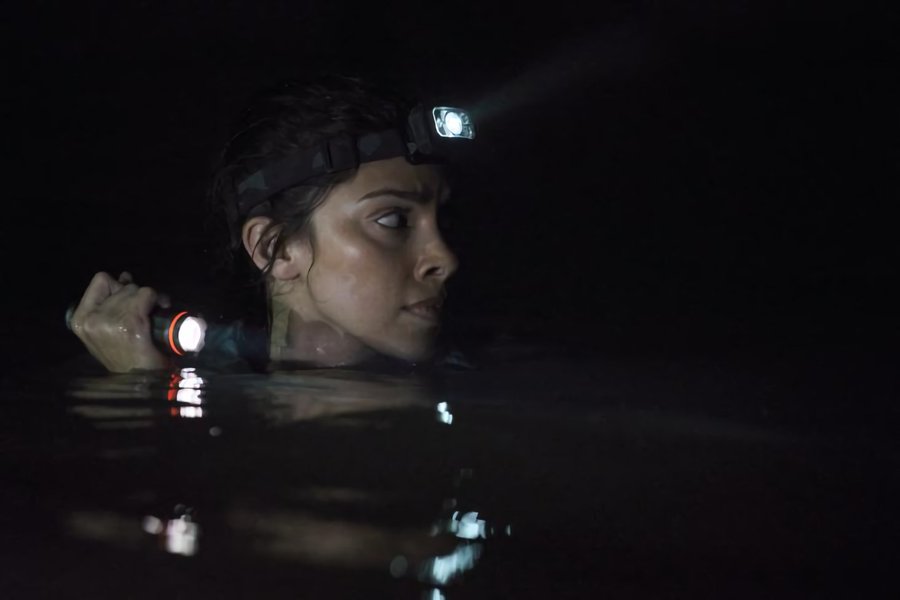
Snap: "Black Water: Abyss"


2007's Black Water served as a nifty calling card for writer/co-director Andrew Traucki: the second best killer crocodile movie to come out of Australia that year - after Greg McLean's Rogue - it was exactly the kind of thing ambitious young genre tyros make on their way to bigger and better projects. Thirteen years on, we find Traucki making... a belated sequel to his earlier success. What does that say about the possibility of evolution within the Australian film industry? Black Water: Abyss is a taller tale than its predecessor: Traucki has bought himself a drone to play with, while his crocs have retreated underground, lying in wait for fresh meat in a flooded cave system. Yet it's thinner, too: the new toys and sets can't compensate for an absence of new tricks. A quartet of model-pretty Home & Away types have been paired up for a fateful spelunking expedition; after much first-act jawing about the jobs they've lined up and the babies they're expecting, they abseil into the darkness - immediately reminding the hardened genre fan of Neil Marshall's superior The Descent - and begin to dangle above their toothy foes like an especially appetising, be-anoraked snack.

Any horror movie passing into our tentatively reopening multiplexes does so at a disadvantage, in that what's up on screen is liable to seem far less terrifying than what may be in the room. (The advantage, I suppose, is that any audience will now be predisposed to holding its breath.) As a welcome-mat release, Abyss at least offers the reassurance of delivering more or less what any of us would expect from a killer crocodile movie. Of course there's no phone signal inside the cave; of course the party - the four lovebirds, plus their disreputable, gun-toting guide - get picked off one-by-one; of course those you'd put money on to be picked off first and survive the ordeal are those who get picked off first and survive the ordeal. What's in between is really no more than basic puzzle-solving - how to get intact bodies from this side of the cave to that side without attracting undue crocodilic attention - with a cursory splash of interpersonal soap you might think would be best worked out in the car on the drive back home, rather than standing in a cave filling up with water containing a very hungry predator. The functional results may serve a purpose for anyone who desperately wants to get back to wolfing down popcorn while sat in front of utterly formulaic fodder, but the onscreen water-treading mirrors its director's, straining to keep himself visible within the marketplace. In thirteen years, Traucki hasn't found a better strategy to convert his crocs into a credible threat than throwing his camera around at surface level while cranking up his soundtrack. It generates a lot of foam and flailing around, and - this time out - very little in the way of genuine bite.

Black Water: Abyss opens in cinemas nationwide on Friday.

Tuesday, 7 July 2020

In the beginning: "Film Title Poem"


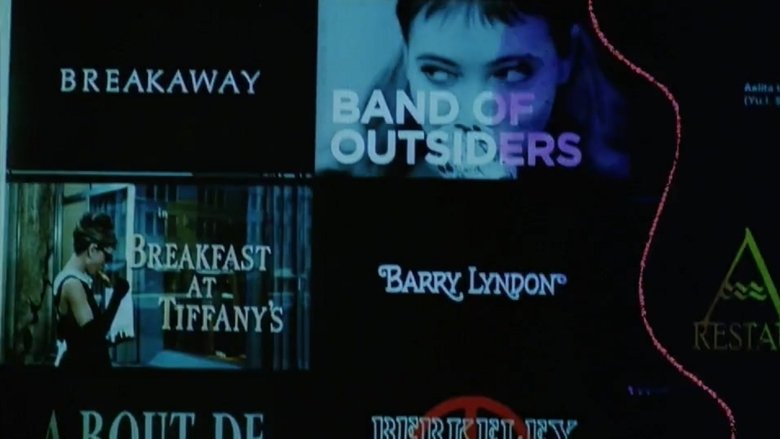
Our friends at MUBI have been amusing themselves during lockdown by staging an inhouse competition to find the most esoteric project they can get on the official UK release schedule. I think the 60-minute tone poem constructed out of swatches of clothing from around the world remains in pole position, but the streaming platform's latest release, Jennifer West's Film Title Poem, runs it unarguably close: here is a 70-minute curio stitched together out of title cards sourced from diverse points in the cinematic landscape. (West suggests her own subtitle, "A Hackers [sic] Odyssey", the Hackers half-inched from Iain Softley, the Odyssey from Kubrick.) Curiously, we're not looking at the cards as they were seen in their original context, but projected on West's bedroom wall or as paused on a laptop, with the director herself using what looks like a common-or-garden table lamp to illuminate those words she wants us to reconsider; these reproductions are then overlaid with relevant scraps of score and the kind of scratched-on doodles and squiggles that have been a feature of do-it-yourself experimental cinema since the form's conception. The structure is broadly alphabetical - we start out considering the formatting of such titles as After Hours, Altered States and Amy, and wend our way towards Yellow Submarine, Zabriskie Point and Zorns Lemma - although sporadically a loose cannon (loose canon?) like The Wicker Man or News from Home will pop up where it's not supposed to, as if misfiled.

What does it all represent? Well, primarily softcore porn for font buffs, who'll get to contrast the relative plainness of silent-era titles with their more forceful, screen-filling Golden Age equivalents, and then those with today's varied, splashier typography. The approach generates a few funny, unexpected juxtapositions - so the heavyweight Gangs of New York cedes the screen to Garfield, and isn't that far from Ghoulies II - and may induce gleeful squeals at fragments one recognises. (I perked up on hearing a dash of the Run Lola Run score.) But its pleasures are fleeting and trivial; I found the limits of my cinephilia being tested around the time M. Hulot's Holiday gave way to a flicker of Mulholland Drive. The limitation is that the concept is right there in the title, and doesn't develop much further; we get whatever point there is - and it may be no more than West demonstrating what a catholic DVD collection she has, that women can be as exhaustingly film bro-ish as any man - within the first few minutes. (I'd also argue we get lots of film titles, but not much poetry, nothing to reflect upon - save whether the cheapo-organ original score really is the year's most annoying.) One possible influence, Christian Marclay's The Clock - a hall-of-fame gallery piece that spliced together timechecks from a gazillion different features - sustained itself over 24 hours through variation, venturing deep into the body of its highlighted films to sample wildly varied material: you never knew where it was checking in next, which is why you sat there until the gallery staff told you they were about to lock up. West, by definition, never mines deeper than any given film's opening seconds: the result's at best a patchy starter, at a time when many of us are longing for a full three-course meal. Nice try, Team MUBI, but you'd give it ten minutes tops in the Tate.

Film Title Poem will be available to stream via MUBI from Thursday.

She dances on the sand: "Breakwater"


In my review of 2017's Centre of My World, I noted an emergent cliché within queer cinema's blooming coming-of-age genre: the overhead shot of semi-clad young bodies artfully configured on a sunsoaked jetty. Breakwater, the half-hour documentary short premiering this week on MUBI, is practically Non-Hetero Jetty: The Movie - a defining early image finds its young female subjects basking shirtless in the sun - but it fully inhabits that safe space, factoring in those same subjects' experience and thereby coming up with a more rounded, lived-in picture than those earlier, callow postcards. For director Cris Lyra, her coastal locations are a getaway, an escape, somewhere one might run to once all other options have been exhausted or shut down. To this end, she's tagged along with a coach party containing a small coterie of lesbian friends, all in their late teens or early twenties, from varied ethnic backgrounds. What ensues, once they arrive at their destination, is like a chapter from Gurinder Chadha's Bhaji on the Beach revoiced in Portuguese: the girls talk about their love lives, how they style themselves, their efforts to reconcile their sexuality with their heritage.

What's immediately notable is how relaxed they are - far more so, one imagines, than any comparable subset of gay or lesbian holidaymakers would have been a generation or two ago. Perhaps that's down to the becalmed setting; more likely, it seems to me, it's due to the fact that these girls have found one another. No-one appears particularly alone here: that early jetty shot isn't just an image of idleness but togetherness, collective intimacy. As these fellow travellers hang out, chat, sing, touch one another, strip to reveal defiant tattoos and body hair, the casual observer might wonder whether the film is becoming too laidback for its own good. It's then you have to remind yourself that it was filmed in the land of Bolsonaro, where being gay is at best frowned upon by the powers-that-be. What Lyra counters with here - and it is, in its own small, quiet way, a powerful image - is a self-sustaining, mutually supportive network, of a kind women are generally better at forming than we sad and solitary men. That image remains a little rough around the edges - some of the sound is a little tinny - but what it's saying comes through loud and clear, not least in a couplet from a song the pals compose during one of this short film's many afternoons that seem to stretch out forever: "Resistance is a woman/A girl, a flower". A question floats up on the horizon: what happens to these girls when they have to leave the jetty behind?

Breakwater is available to stream from today via MUBI UK.

Monday, 6 July 2020

From the archive: "Black Water"


Crikey. "The saltwater crocodile population of Northern Australia is expanding," a title card reads. "So is the human population." Something, clearly, has to give. Black Water, a calling card from Aussie directors Andrew Traucki and David Nerlich, deserves its theatrical release for taking seriously a set-up that countless direct-to-video releases have played for campy, winking, rubber-puppet thrills. Two sisters and the eldest's boyfriend are on a driving holiday; after witnessing a demonstration of tensile jaw strength at a crocodile petting zoo (foreshadowing!), they sign up for "Backwater Barry's Alternative River Tour" - only Barry himself is out when they arrive, so they end up in a boat captained by his second-in-command, a Steve Irwin lookalike in a Castlemaine XXXX cap. Needless to say that, some way upriver, the boat is capsized, its makeshift skipper swallowed up, and the trio find themselves up a tree in a mangrove swamp, surrounded by nothing but a watery expanse inhabited by an angry, hungry handbag-in-waiting. A one-set drama, essentially, the set being "some trees" and "water", it's a largely successful throwback to less complicated times - Jaws is the obvious comparison point - forcing the audience to react to suggestive editing, ripples in the water, the dilemma with which these characters are presented (swim for help, or stay put?) and the credible fear on the actors' faces. It's still a film about people being menaced by a crocodile - an inherently funny concept, provided you're not being menaced by a crocodile yourself - so you watch Black Water with an expression of knowing amusement rather than abject terror. But there's admiration in those smiles, somewhere close to the eyeteeth, for the way the film clamps you in its jaws and tosses you back and forth like a rag doll.

(September 2008)

Black Water is available on DVD through Fabulous Films, and to stream via Amazon Prime; a sequel, Black Water: Abyss, opens in cinemas nationwide this Friday.

Close your eyes: "Dreambuilders"


The gradual reopening of our cinemas may just bring about a new phase in film criticism, more rigorous and demanding yet. Between the usual checks and balances - weighing the time-honoured matters of quality, effectiveness, relevance and fun - one of the queries that has to be floating through the reviewer's mind as he or she steps hesitantly into a post-Covid world surely has to be: is this film really worth risking anybody's life for? It's a question that prompts an even bigger one in its turn: how many films might one actually say that about? All very well to assume the persona of a macho frontline hack, striding forth to confront Corona armed only with a Biro, a notepad and lofty notions of being prepared to die for the seventh art, because - hey! - cinema! Christopher Nolan! But are any of us privileged souls really willing to send entire families to the ICU with a thumbs-up in the name of business as usual? For one thing, the readership for quality film journalism would appear to be on life support as it is; we simply can't afford to lose those readers we have. More seriously, though, we've all just been through a period that gave us pause for profound reflection, not least about the dangers of shovelling down anything in an indiscriminate manner. The more I've thought about it, the more it's struck me that the current crisis has subdivided us into three types of people: those in desperate need of the stimulation and reassurance that comes with a daily or weekly routine, and those who are getting by perfectly fine without the corporate structures that were set in place around us. The third group of people, lest we forget, are already in the morgue or the ground.

Which brings me, via an especially circuitous route, to Dreambuilders, one of a number of releases scattered over coming weeks with an eye on tempting families back into matinee screenings to buy snacks enough to offset the multiplex chains' estimated Q2 losses. (No need for facemasks, apparently.) The question of whether a digimated Scandinavian knock-off of Monsters, Inc. and Inside Out is worth risking your kids' lives for pretty conclusively answers itself, I'd say, although I also suspect most of its venues will be operating some way under 50% occupancy, so social distancing wouldn't be impossible. Its strongest suit is its hand-me-down worldbuilding. As we follow pre-teen Minna into the backstage area of her own dreams - there to see how her fantasies and worst nightmares are conjured up by a cast and crew of Smurf-blue tin men - it's clear the digimators have been handed an appreciably loose rein. They've returned clutching a network of "dreamstages", connected by a rattly, gravity-defying funfair infrastructure not unlike the Monsters, Inc. assembly line, but extended further out into abstract space. That world is certainly a cut above the character design, which proves rather more beholden to the standard Disney-Pixar template, only without the range of expressivity. Elsewhere, the adventurous cinemagoer will find themselves confronted with the usual shortfalls of imported animation: any sharpness of angle in the original concept - Minna realises she can infiltrate her snippy, Insta-obsessed stepsister's reveries and make her a better person - is soon dulled by blunt translation and bland redubbing. If you just wanted to plonk everyone down before some pretty shapes and colours for 80 minutes, then Dreambuilders would serve you on the same level as last year's middling Wonder Park - but then that movie had the advantage of releasing before the emergence of a lethal airborne virus doing its darnedest to reduce our respiratory systems to dust. The context that in days of yore was merely everything is now more than ever a matter of life and death.

Dreambuilders opens in selected cinemas from Friday 17th.