Monday, 6 January 2020

On demand: "Fighting with My Family"


A 2019 sleeper hit, Fighting with My Family constitutes WWE Studios' valentine to the Knight-Bevis clan, stalwarts of the East Anglian wrestling scene (in the movie, they fight under the "World Association of Wrestling" banner, which has an air of that "Kelvin Kline" underwear you can pick up off the market) who gave the WWE an emergent superstar in the form of their youngest daughter Saraya-Jade, better known internationally under the ringname Paige. Writer-director Stephen Merchant has remodelled them into something like a modern sitcom family: the roguish ex-jailbird father (Nick Frost), whose idea of dressing up for dinner is to sling on an XXL Norwich City top; his adoring yet no-nonsense wife (Lena Headey), herself a grappler of note; and their pride-and-joy offspring (Jack Lowden and Florence Pugh), damned as freaks by snobs who can't or won't see the extraordinary showmanship and athleticism in what they do. Merchant acknowledges the fakery of wrestling, but takes care to celebrate what's real about this scene and story: the spectacle, being not so far removed from the spectacular fakery of the movies, the camaraderie and love, and this young woman's achievement in going from the outer reaches of suburban Norwich to one of the world's biggest stages, lifting up so many people around her as she went.

Fighting with My Family is headed in one direction, then - there aren't many plot surprises - but it offers the considerable fun of watching very different styles of performer meshing together. It's the Paige story first and foremost, and while we witness the birth of that career, we might again be struck by the very great skill with which Pugh's career has so far been marshalled. Each new project of this actress has become an opportunity to showcase another side of her personality: here, she goes full Norfolk Goth, dying her hair coal-black and demonstrating a mean sulk, but Pugh also gets to take the fight to the opposition in a way the heroines of British cinema, whether prettified by period drama or ground down by gritty realism, generally don't. (Saraya-Jade may be the most memorable character of her socioeconomic type since Katie Jarvis's Mia in Fish Tank.) Behind her, Frost, Headey and Lowden are stitching an appreciably idiosyncratic support network-cum-safety net, while Vince Vaughn - as the head of the WWE's Performance Center - seems to have been nudged awake and back into snappy life by his bristling young co-star, and there's a poster-bolstering cameo from Dwayne Johnson, playing himself as the presiding spirit of wrestling.

No disrespect to the big man, but Fighting with My Family hardly seems to need him. Merchant, who - lest anybody forget - had as much influence on the eventual direction of The Office as his louder pal Ricky Gervais, hasn't lost any of his old crowdpleasing instincts, slipping in some cheerfully bawdy humour that positions the film at the higher end of the 12A certificate, overseeing a midfilm makeover that doesn't sell out his pale-and-proud heroine, and staging a brawl in a taproom to the strains of Cliff Richard's "Mistletoe and Wine". He ensures every single emotional beat is earned and lands, and within the confines of an indie studio's dual-location shoot, fashions a nice, dramatically resonant contrast between poky, overcast Britain and the spacious, sunny L.A. Paige decamps to - a place that could yet seem alienating were our heroine not possessed of a heart and spirit broadly the size of The Rock's shoulders. There are some wildly successful movies you watch as a critic and wonder what on earth the paying public saw in them; Fighting with My Family, being the most enjoyable wrestling picture since the last Mickey Rourke comeback, is not one of those instances. Who'd have thought Stephen Merchant would turn out to be our own Barton Fink?

Fighting with My Family is now streaming on Netflix, and available on DVD through Lionsgate.

Sunday, 5 January 2020

Misconception: "Good Newwz"


Very much a tale of two Indias in the multiplex as we start the year. Given the images on the nightly news, I can understand why audiences weren't all that committed to cheering the further adventures of Salman Khan's brawny hero-cop Chulbul Pandey in last month's Dabangg 3, and that was before the reviews came in. (For the first time since the career-extending success of 2015's Bajrangi Bhaijaan, Khan appears to have misread the room.) As trailed by its frankly terrifying-looking poster (and the egregious misspelling of the title), Raj Mehta's Good Newwz has evidently been pitched as brain-in-neutral escapism, the kind of high-energy nonsense that might just retain some value in helping an audience forgetting the world is on fire for two-and-a-bit hours. At the very least, this is a project geared more towards conception than destruction, and new life rather than a reassertion of the old ways Chulbul Pandey might represent: a starry sex comedy with half an eye to jollying India's newly moneyed middle classes through the tricky, sensitive if not outright taboo issue of in vitro fertilisation, Mehta's film may just remind Western viewers of last July's rightly acclaimed romantic drama Only You, albeit Only You if it had shovelled down several bags of sugar and inhaled half a tank of helium before showing up on our screens.

Others might have been drawn here by a shrewd tag-teaming of stars representing different generations. Kareena Kapoor Khan plays Deepti, an entertainment journo striving to conceive as she bypasses 40, Akshay Kumar her car salesman other half Varun, who'd rather watch the cricket than perform his husbandly duties, and generally appears far less invested in the whole babymaking project; Diljit Dosanjh and Kiara Advani are Honey and Monika, doofi in matching leisurewear whose chances of conception are a good deal higher for still being in their twenties. That these couples share not just the same fertility clinic but the same surname should be indication enough of the direction the plot is heading in, and Batra doesn't exactly stretch himself to produce a fresh batch of artificial insemination gags. Yes, the ovulating Deepti's transformation into a purring sex kitten is played for giggles; yes, there's a comedy doctor (Adil Hussain) who deploys a decidedly circuitous way of explaining the ins and outs of the IVF process (though the impromptu prayer meetings he convenes while Deepti sits in the stirrups constitute a novelty); and, yes, we're once more reminded of the grim business of the masturbatorium, here accessorised with sperm-themed wallpaper. I suspect you'll have witnessed the muddling of actual semen in at least one makeweight Hollywood vehicle for either Ryan Reynolds or Jason Bateman; Good Newwz's USP, in as much as anyone might consider it a selling point, is that you won't have seen it done this bright or this loud. I've resisted saying this, for what will become obvious reasons, but this is a comedy with spunk.

For starters, it's far better played than any Western equivalent, though you almost don't notice until the final act, when you realise you care about the future happiness of these goofballs. The senior leads have grown on me after many years of resistance, and Kumar in particular now displays a grey-templed weariness that humanises him: it's as if he, too, has grown tired of the submoronic schtick with which he made his name, and has at last decided to act his 52 years. The midlife crisis material involving Deepti and Varun is just beginning to feel a little long in the tooth when the kids show up, and of course we laugh when it's revealed that Honey and Monika are gym instructors whose first musical number together takes place in and around a Zumba class. (I gave it bonus points for the bejewelled boombox.) Mehta does a pretty good job of marshalling the couples' disparate energies, and in among the broad-brush business, he fashions a fun, lightly pointed contrast: in one exam room, the responsible adults who may just be too old to procreate, next door the fertile bubbleheads most of us wouldn't trust to keep a hamster alive for a week. As the youngsters insinuate themselves into their elders' lives, the relentless boundary-crossing threatens to become exhausting - the kids' propensity for malapropism (flubbing "sperm" as "spam", for example, and "flush" as "flesh") is a somewhat wheezing running joke - but the terms of pregnancy lend Mehta and his fellow writers a useful structure to abide by: it's a farce with the smarts to keep all the appointments set for it by its plot.

Is Good Newwz any more substantial than that? (Perhaps more crucially: does it even need to be?) I'd be hard-pressed to pounce upon a ball of fluff and tinsel such as this and spin it as representative of some "New India", doubly so at a moment when the very idea of India is being renegotiated so fractiously in the streets. That said, the handling is a bit more relaxed than any comparable project might have been ten or twenty years ago. The film never entirely rules out the option of abortion as one way out of the sticky mess the characters get themselves into (which makes it a more progressive proposition than Juno, to cite but one Western babycom), and Mehta even raises the issue of transgender parenting in passing (via a nurse who outlines a case not dissimilar to that the documentarist Jeanie Finlay followed in last year's Seahorse) without succumbing to the Hindi mainstream's usual fit of the vapours around all things trans. At a forceful push, which is really all it comes down to, Good Newwz might be regarded as existing on the outer fringes of that recent cycle of Indian films exploring alternative models of cohabitation and propagation, movies that insist there's no longer just the one standardised way of going forth and multiplying. Beyond that, it makes for reasonably diverting entertainment, a fun night out - although I also feel obliged to note, for any couples out there weighing up the pros and cons of IVF, that Mehta's film provides no substitute whatsoever for a full clinical consultation.

Good Newwz is now playing in cinemas nationwide.

Friday, 3 January 2020

For what it's worth...


Top Ten Films at the UK Box Office 
for the weekend of December 27-29, 2019:

1 (1) Star Wars: The Rise of Skywalker (12A)

2 (3) Jumanji: The Next Level (PG)
3 (new) Little Women (U) ****
4 (4) Frozen II (U) **
5 (2) Cats (U)
6 (new) Spies in Disguise (PG)
7 (new) Playing with Fire (PG)
8 (6) Knives Out (12A) ***
9 (new) Good Newwz (12A) ***
10 (5Last Christmas (12A)

(source: BFI)

My top five: 
1. La Dolce Vita [above]

2. Long Day's Journey Into Night
3. Little Women
4. The Kingmaker
5. Good Newwz


Home entertainment Top Ten (DVD/Blu-Ray/Download): 

1 (13) Once Upon a Time... in Hollywood (18) ***

2 (2) The Lion King (PG)
3 (1) Fast & Furious: Hobbs & Shaw (12) **
4 (3Toy Story 4 (U) ***
5 (new) Angel Has Fallen (15) **
6 (7) Aladdin (PG)
7 (4Spider-Man: Far from Home (12) ***
8 (5) Elf (PG) **
9 (6Rocketman (15) ***
10 (new) Dora and the Lost City of Gold (PG) ***

(source: officialcharts.com)

My top five: 
1. By the Grace of God

2. Animals
3. Yves Saint Laurent: The Last Collections
4. Once Upon a Time... in Hollywood
5. Dora and the Lost City of Gold


Top five films on terrestrial television:
1. Our Little Sister (Saturday, BBC2, 1.20am)
2. Mrs. Doubtfire (Sunday, C4, 5.40pm)
3. Jumanji (Sunday, five, 1.50pm)
4. Back to the Future Part III (Sunday, C4, 2.55pm)
5. Prometheus (Saturday, C4, 11.20pm)

On DVD: "Animals"


Animals, the latest entry in that post-Bridesmaids, post-Fleabag cycle of works centred on so-called "messy women", is a very writerly film, and it takes some adjusting to its register. The script - by Emma Jane Unsworth, adapting her own, presumably at least semi-autobiographical novel - presents us with a couple of almost thirtysomething galpals in aspirant scribe Laura (Holliday Grainger) and abrasive American barista Tyler (Alia Shawkat), living the bohemian high life on Dublin's artsier fringes. In their own eyes, they're a veritable pair of Dorothy Parkers, spending their days lounging around and coming up with frightfully sophisticated bons mots; they might well present as aspirational figures to viewers of a similar age, or younger. To everybody else on the planet, however, they can't help but resemble overgrown students living in abject dishevelment because they haven't got anywhere else to be save another pub or club, where they drink the dregs from other people's glasses before tottering home to begin the cycle all over again. Even when this pair aren't blotto - when they're in the headachey comedown phase of this lifestyle - they tend to communicate in haughty, flowery bollocks; it's possible the pair have only become this tight because nobody else can stand to be in the same room as them for longer than five minutes. Still, stick around, for this often spectacularly boozy film eventually reveals the sediment of bitter, poignant truth. Ex vino, veritas.

For one thing, the main business of Animals - directed by the Australian import Sophie Hyde (52 Tuesdays, TV's The Hunting) - is to observe how this bond is tested. One night, Laura - who strikes the eye as just the more conservative of the two girls - locks eyes and lips with a dreamy, slightly older concert pianist (Fra Fee), and no sooner have the two boinked in an alleyway than the latter offers up the keys to his flat and a ring for Laura's finger, a shot at stability we can tell she's more than halfway tempted by. And here's where having so many writers on the books begins to pay off, as Animals pins down its theme - the overdue getting of wisdom - and sets about delineating, with considerable nuance, the loosening-up of what appears to have been a longstanding codependency. Now a late payment of rent becomes a source of tension between Laura and Tyler, and a symbol of the former's uncertainty over where in life she wants to be; yet even as she strikes out in a new and to all appearances promising direction, she finds herself backsliding under Tyler's influence, dipping into a shared Mason jar of MDMA while shopping for bridal dresses. Unsworth makes it clear she's a writer rather than a pedlar of the burlesque - the sequence doesn't have the eruptive consequences that befell Melissa McCarthy in Bridesmaids, say - but she has an ear for the pronounced difference between girltalk, with its knowing, arch codes, and how those girls communicate with the wider world, in which they often seem to be struggling for the right words. Not so Unsworth, long past the "coffee house idler" stage of her writing career, who keeps coming up with tart, cutting lines: clock the poet who tells Laura "I like the way you drink - it's with a real sense of mortality".

Presumably this was one of those midrange indies where funding sources dictated shooting location - Unsworth's novel unfolded around Manchester - yet Hyde makes smart, intuitive use of Dublin, with its tradition of after-hours carousing and the art that sometimes comes out of that: there's a funny ad hoc diversion involving a contemporary literary salon that is every bit as ghastly as you'd expect a contemporary literary salon to be. Yet this filmmaker is entirely serious in her study of two distinct personalities, noting where they intersect, overlap and deviate, and that they represent radically opposed yet universal instincts. (There will be male viewers who've had nights, or indeed whole years, where they've felt more of a Laura than a Tyler, or vice versa.) One of the reasons the opening stretch feels so forced is that Grainger looks too poised and alert to play the fuzzy-headed party girl - but then Animals is already well ahead of us. What the rest of the film shows us is an essentially well-meaning young woman from a nice middle-class family being led astray by a more gregarious companion; it happens. Still, in watching Laura secondguessing herself as to whether domesticity is what she really wants by way of a corrective, Hyde and Unsworth reveal the doubt lurking beneath the poise; and Grainger nails the scene where Laura looks around a bathroom flecked with vomit and fag ash, catches sight of herself in a mirror, seems to hear a clock ticking somewhere, and decides to move on, the capper to one of the most convincing portrayals of independent growth seen in recent cinema.

It's a sign of Animals' frank achievements that it impresses even with Shawkat so conspicuously reduced to a second-banana role. The movies haven't as yet served this expert comedienne as well as TV's Search Party and the otherwise middling continuation of Arrested Development have, but Tyler nevertheless stands as the most eyecatching and vivid part the movies have yet offered her: that of a faux-sophisticate who can't even say "enchanté" without putting an expletive in the middle of it. Tyler's role is to shake things up and then be cast off - the name would appear deliberate; she's something like a Tyler Durden in smudged lipstick - but Hyde and Unsworth know that such catalyst-people can be enormous fun to be around for some while, and they allow Shawkat some of the most affecting moments in the movie: wiping away a solitary tear at the bar before defaulting to her usual whisky-sour toughness, dredging up a vow the friends made years ago, but which Laura has completely forgotten about. The more it goes on, the more obvious it becomes that Animals is a film made by women who've lived through this (or something like this), and who are now sifting hazy memories of these lost weekends and wilderness years with a gimlet eye for those experiences that deserve keeping, and those best left behind. Hyde and Unsworth do audiences the favour of introducing two women who - for all that they sometimes get up one another's noses, and on each other's tits - actually, properly like one another, but they have the smarts to see they're not alike; that these party animals are finally very different creatures, set on very different tracks. That surely happens, too.

Animals is available on DVD through Picturehouse from Monday.

Thursday, 2 January 2020

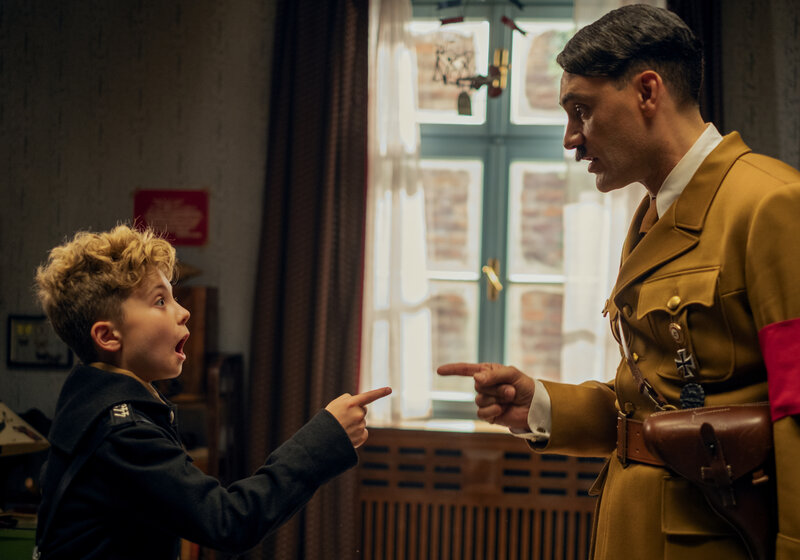
Heil honey, I'm home: "Jojo Rabbit"


We start the year with one of this awards season's more divisive offerings. Back in September, Taika Waititi's Jojo Rabbit won the same People's Choice award at the Toronto Film Festival that Green Book had on its way to winning the Best Picture Oscar, and - not unlike its predecessor - it immediately ran into a fusillade of critical brickbats. It is, unarguably, an idea Waititi could only have hustled into a studio boardroom after making a bundle of money for those suits within the MCU: a wacky "anti-hate satire", based on Christine Leunens' 2004 novel Caging Skies, in which a young boy undergoes a unique coming-of-age in 1930s Germany, with no less a figure than Adolf Hitler as his imaginary friend. In the opening fifteen minutes alone, our protagonist Johannes (Roman Griffin Davis, surely cast for his resemblance to David Bennent's Oskar in Volker Schlöndorff's film of The Tin Drum) is seen being schooled in virulent anti-Semitic propaganda, encouraged to burn books, and - in the incident that earns him the titular nickname - commanded to wring the neck of a cute ickle bunny rabbit. As with the subsequent sequence in which young Jojo is disfigured by a stun grenade, all of the above is played as a joke. Any responsible review would gesture towards the old truth that comedy is the most subjective of artforms, but some especially vocal representatives of Film Twitter would have you know that Jojo Rabbit is a very bad and tragically uncool film to like, and furthermore a deeply naive response to the resurgence of actual Nazism in the contemporary world. I risk excommunication, then, when I say this: I didn't mind Waititi's film unduly.

Jojo Rabbit struck this viewer as an essentially piffling thing: neither the great, wounding satire the moment demands, nor the crime against cinema its detractors insist, but something in between, a film that only those with leisure time enough to spend long nights pounding their socials could possibly get worked up about. My fear - sparked by the awful trailer, resistible even by the standards of modern promo cutting - was that Waititi had once more retreated into the tweeness of 2007's Eagle vs. Shark and 2016's Hunt for the Wilderpeople; the Moonrise Kingdom styling of the Nazi summer camp Jojo attends hardly settled those jitters. Yet the feature proper keeps throwing up odd little chuckles, something like the doodles in the margins that enlivened Waititi's Thor movie. It's Rebel Wilson, as a fully indoctrinated Ilsa of the SS type, declaring "O-M-Gott" upon seeing the boy's injuries; it's the drollness with which Scarlett Johansson, as Jojo's mother, gives her permission to send her ten-year-old off to war; it's a fake letter Jojo pens to dishearten Elsa (Thomasin McKenzie), the Jewish girl living in the family's crawlspace, which purports to come from her sweetheart but concludes on a downbeat note ("P.S. I'm unemployed and quite fat now"). Waititi's imaginary Führer (played by the director himself) is sparingly used, but elicits a laugh upon exiting one scene headfirst out of Jojo's window, and features in a punchline kids of a certain age and sensibility are going to adore, not least because it involves the one instance of swearing in the whole 12A-rated picture. More of that wildness would have been welcome; as it stands, Jojo Rabbit feels a bit too mild for purpose.

There's only as much jeopardy in the film as there is in the average Marvel flick: it's never dangerous enough, either as comedy or counterthreat. After the grenade explodes in his face, Jojo is left with the tiniest, Harry Potterish scar. (We at least needed an insert of the lad with blackened face and hair standing upright.) When Waititi films the lifeless lower bodies of Jewish citizens strung up from lampposts, it results in an oddly flat image, thrown away too early to have the impact it should; the surrounding Nazi flags, colour-corrected to a jaunty Ferrari red, are what pops out at you. Such reassurances ensured the film's status as a late-2019 crowdpleaser, but you feel the studio was only ever willing to sign off on Jojo Rabbit as a PG-13 proposition, which inevitably limits what Waititi can show of the horrors of fascism, and the jokes he can make at its expense. What we get, then, is a cosy sitcom Nazism, an exercise in dress-up that frequently resembles an episode of 'Allo 'Allo shot from a kid's perspective. It would be more amusing if the kids had the chops to sock over the lines Waititi puts in their mouths (in general, they don't), and edgier if Davis posed any real physical threat to McKenzie (but he's a pipsqueak), and therein lies the movie's big limitation - that it's more often cute than funny or lacerating. Setting my own somewhat shrugging reaction aside, I began to wonder what Mel Brooks made of Jojo Rabbit: turns out the answer is "wonderful", according to a throwaway press quote. I suspect the individual blessed with the chutzpah to have arrived at The Producers and recorded "The Hitler Rap" would have appreciated the effort, and that Waititi - a Kiwi with Maori and Jewish heritage - is coming from the right place. Yet I also wonder whether that glib-sounding "wonderful" conceals reservations; whether even Brooks might concede that busting a few goofy, childish moves, which is all Waititi's finally doing here, is - like so many of the Left's responses to the modern world - really too soft to stop a Nazi in their tracks. You need a blunderbuss for that, not a kazoo.

Jojo Rabbit is now playing in cinemas nationwide.

Wednesday, 1 January 2020

"The Gentlemen" (IndieWire 19/12/19)


After the vast underperformance of 2017’s King Arthur: Legend of the Sword and the hefty overperformance of May’s Aladdin, we rejoin Guy Ritchie trying to ground himself via a return to his roots. The Gentlemen is the kind of cor-blimey-what-a-carve-up shaggy-dog yarn that Ritchie spun with diminishing returns before the tantalising paycheques of franchise cinema were dangled his way: a hard-R venture, populated by RADA graduates pointing weapons and cursing at one another between elaborate doublecrosses. The difference is that its director is now in a position to equip this cobblers with the budgetary heft of an American indie (The Gentlemen emerges under the apparently deathless Miramax banner) and an altogether starrier ensemble. The problem is that at no point does Ritchie seem to have realised such material is still, on a fundamental level, cobblers.

On screen, the story is slapped together by a hack journalist; it feels like it. Hugh Grant’s lisping, seedy reporter Fletcher shows up one night in the kitchen of criminal fixer Raymond (Charlie Hunnam) and lays out the tall tale of one Mickey Pearson: a tweed-wearing Californian (played by Matthew McConaughey) who gained a foothold in London society by dealing primo weed, then met his downfall upon snubbing Fletcher’s editor (Eddie Marsan) at a cocktail party. For no reason other than it allows Ritchie to work in some of that sub-Tarantino postmodernism he hasn’t yet outgrown, Fletcher has written this saga up in screenplay form, so Mickey’s misadventures are presented as highlights from an especially salacious pitch. “Every movie needs a bit of action,” Fletcher notes, after narrating yet another dust-up; his throwaway diss of Coppola’s The Conversation (“wasn’t for me – a bit boring”) leads one to consider the extent to which he speaks for Ritchie himself.

The Gentlemen is soon overrun with varyingly lively stereotypes, shuffled before us like shell game cups. Downton’s Michelle Dockery is Pearson’s stern-faced moll, mostly secondary until an attempted rape shot with typical Ritchie sensitivity; Colin Farrell a Burberry-clad boxing coach who gets the best gag (a slur on the South London backwater of Croydon) before receding from sight; Succession’s Jeremy Strong the Jewish banker bankrolling Pearson’s operations. You can see why these actors were drawn here – they get fistfuls of lines – but Ritchie is clearly more interested in some than he is in others. Grant at least has disreputable fun at the expense of those journos who’ve crossed him, yet a coasting McConaughey renders Mickey an uninteresting cypher whose Zen koans (“Doubt causes chaos, and one’s own demise”) revive the unfortunate memory of Ritchie’s existential-drama-but-with-Jason-Statham misfire Revolver from 2005.

A limitation is that these characters are constructed entirely of hot air, the kind of posturing bollocks men have traditionally spouted in drab London boozers. Ritchie is evidently enjoying being off the PG-13 leash: cue an anal sex joke every minute, persistently mirthless play on Mickey’s weed strain “Bush”, and a drawn-out sequence involving a character named Phuc. Fail to snort, however, and you might notice how reactionary the banter is. Mickey’s whinge about hikers chimes with the image of Ritchie the aspirant country squire; a crack Fletcher aims at Chinese mobster Henry Golding – “ricence to kill” – intends to signal racist character, but also feels like a low blow intended to nudge an easy laugh out of those bulletheaded bruisers who’ve felt empowered by recent developments in the Brexit saga.

Beyond regressive windbaggery, nothing justifies the two-hour running time: not the archaic soundtrack cues, nor the lame imitations of viral gang videos, nor the clanging late homage to 1980’s seminal Britflick The Long Good Friday, unfit to inhabit the same planet as its inspiration, let alone lace its boots. So we wind up pondering once again the mystery of the Ritchie career: how a filmmaker who’s notched up at least four major duds (2002’s Swept Away, 2005’s Revolver, 2015’s The Man from U.N.C.L.E., King Arthur) and rarely risen above time-killing mediocrity in his hits continues to make the movies he wants to make. Is he the cinema’s most prominent example of white privilege? Or, like almost everyone on screen here, does he have incriminating photographs of the rich and powerful?

For all that the much-papped Ritchie may retain some idea about the evils of newspapermen, The Gentlemen itself trades in a very tabloidy view of Britain, down to a final gotcha involving the same snortingly sensational smear that circled a recent Tory Prime Minister. Peddling such raspberry-blowing nonsense might earn a tyro director the reputation of a scrappy, iconoclastic underdog; two decades and several million dollars into Ritchie’s career, it feels heavily cynical, a crass attempt to give that part of his fanbase who found Aladdin wussy something closer to what they might want. We get the films we deserve, some say. Visually unexceptional when it’s not plain squalid, shameless in its bid for a sequel, The Gentlemen is the film Britain deserves as it staggers backwards into the New Year under the questionable influence of an unabashedly populist leader. America: save yourselves.

Grade: C-

The Gentlemen opens in cinemas nationwide today.

My Top 20 Films of 2019


(All films released in UK cinemas between January 1 and December 31, 2019; click on individual titles, should you require further persuasion.)

20. Monos
An arthouse Village of the Damned, yielding some of the year's most extraordinary imagemaking.

19. Marriage Story
For making me care.
Now streaming on Netflix.

18. Everybody Knows
Any cinema that underrates, overlooks or shrugs at Asghar Farhadi is a dying cinema.
Available on DVD through Universal, and to stream via the BFI.

17. Hale County: This Morning, This Evening
A great year for non-fiction: I could have compiled a top ten just of documentaries alone.

16. Us
The year's best (dropped) popcorn movie.
Available on DVD through Universal.

15. Ash is Purest White
Available on DVD through Drakes Avenue, and to stream via Curzon and the BFI.

14. Article 15
Not a stellar year for the Hindi mainstream, all told - the only other title that came within a whisker of making this list was February's Ek Ladki Ko Dekha Toh Aisa Laga, by some distance the year's most surprising and elevating romantic comedy - but I found the taut plotting and choice imagery of this tough, atmospheric policier hard to shake.
Now streaming on Netflix.

13. I Lost My Body
Now streaming on Netflix.

12. Little Women
A period drama that felt spirited, and not pickled.
Now playing in cinemas nationwide.

11. The Souvenir
Pipped Bait to the title of the year's most distinctive British film; returned Joanna Hogg to my good books.
Available on DVD through Curzon Artificial Eye, and to stream via Curzon and the BFI.

10. John McEnroe: In the Realm of Perfection
A great, wide-ranging essay film; starts out impossibly niche - as a technical analysis of the tennis star's serve - and broadens into an investigation into what drives certain personalities on, sometimes to distraction. It wasn't that he wanted to win the point; it's that he wanted to win all the points.
Available to stream via the BFI.

9. The Farewell
Who needs Ang Lee now that we have Lulu Wang?
Available on DVD through Entertainment from January 13.

8. For Sama
Horrors and miracles, barbarism and bravery set side-by-side.
Available to stream via All4

7. Minding the Gap
The better Boyhood.
Available on DVD through Dogwoof, and to stream via Curzon and the BFI.

6. The Sisters Brothers
My favourite Audiard movie, presided over by an already spectral Rutger Hauer, sits waiting to be reclaimed as a great lost film of the 2010s.
Available on DVD through Universal.

5. So Long, My Son
Pretty damn deep, too.
Available on DVD through Curzon Artificial Eye from February 10, and to stream via Curzon.

4. An Impossible Love
A tangled #MeToo narrative avant la lettre, made with absolute compassion and at least two stupendous performances.
Available on DVD through Curzon Artificial Eye.

3. Apollo 11
What happens when we work together, and look up and out; a comet-bright corrective to the insularity and gloom of the past twelve months.
Available on DVD through Dogwoof, and to stream via the BFI.

2. The Irishman
The only Netflix-backed project that doesn't feel a single minute overlong.
Now streaming on Netflix.

1. Honeyland
The one film on this list where I still have no idea how they made it. I don't know how the filmmakers found that woman in the middle of nowhere; I don't know how they timed their arrival to coincide with the arrival of the neighbours from hell; and I don't really know how what plays out became the funny-sad-instructive free-market parable that it became. Not so much a movie as a miracle that needed witnessing.
Available to stream via Amazon Prime.