Thursday, 1 August 2019

From the archive: "The Diary of a Teenage Girl"


Adolescence is, as that early Tom Cruise vehicle grasped, a risky business. The Diary of a Teenage Girl has already stumbled while making that tightrope crossing separating the accessible, age-appropriate 15 certificate from the more restrictive 18 – a censorial ruling that seems a shade harsh, even if it allows Diary to continue the long and educative tradition of Films Curious Kids Will Just Have to Try and Sneak Into.

Writer-director Marielle Heller is altogether more poised in negotiating the fallout from 15-year-old Minnie Goetz’s decision to give up her virginity to her mother’s boyfriend. Adapting Phoebe Glockner’s in-every-sense graphic novel, Heller’s film actually provides more context for this act of transgression than Andrea Arnold did in 2009’s 15-rated Fish Tank, which proposed it was enough for a young girl to be in the same room as the apparently irresistible Michael Fassbender.

Here, we’re taken back to the San Francisco of 1976, where the ethos of free love is still hanging, albeit somewhat forlornly, in the air. With hippy-dippy mom Charlotte (Kristen Wiig) away sourcing coke with her progressive pals, Minnie (Bel Powley) can’t help but snuggle closer to Charlotte’s live-in lover Monroe (Alexander Skarsgard); driven by her growing curiosity with regards to her own form, their rough-housing and sofa-sharing soon develops into something more than PG-13.

Viewed objectively, what the film is depicting is statutory rape, which may have factored into the BBFC’s thinking; still, to do so would be to disregard Minnie’s perspective, and the fact this deeply subjective, empathetic film frames this life-altering experience as very much a choice made by its heroine. (I could also float into evidence my suspicion that a lot of teenage girls will have fantasised about losing it to Eric from True Blood.)

At any rate, as a coming-out platform for Brit actress Powley, Diary proves far more satisfying than May’s flimsy A Royal Night Out. With her vestigial puppy-fat and big blue eyes taking everything in, she has the look of a teenager rather than a catalogue model – and of the sensible one in a classroom of Farrah Fawcett wannabes, which makes her decision to take the plunge with her mom’s man, rather than any of her contemporaries, even more transgressive.

Heller’s particularly attuned to the consequences of this cherrypopping, when hormones are replaced by emotions, complications kick in, and the needy little girl emerges, naked and trembling, from behind the façade of the young urban sophisticate. Minnie’s “I think we need to talk about our relationship” gets a laugh because it sounds funny coming out of the mouth of one so immature, but the laughter dies on the lips with her lover’s dismissive response, as Monroe becomes the second father figure to cast this child away, and the first to have slept with her beforehand.

The emotions and experiences feel lived-through; perhaps it’s only the psychology that has been toned down for wider consumption. Heller certainly knows how to dramatise the power of female sexuality, and she wrestles with one of feminism’s core conflicts – that between girls and mothers held to different standards – without turning the spectacle into anything so crass as a knock-down, drag-out catfight. Still, I think the heroine breaks more rules than the movie.

Where Catherine Breillat – no stranger to this kind of material, as a CV that includes A Real Young Girl, 36 Fillette and A Ma Soeur! suggests – would work in some provocative pause for thought (or dreadful self-realisation), Heller cues up Mott the Hoople, among other period favourites, in a bid to reassure the Friday night crowd. (Could this be another reason that 18 certificate stung so – that the producers were aiming for warm and fuzzy?)

No matter: working even some of Breillat’s business into a multiplex crowdpleaser is no small achievement. Heller’s film affirms this writer-director and her young star as real talents to watch, while Skarsgard and Wiig’s performances quietly but forcefully back up the thesis on just how difficult it is to regulate (or, indeed, classify) desire – whatever your age, your gender or your standing in life.

(MovieMail, August 2015)

The Diary of a Teenage Girl screens on Channel 4 tonight at 1am.

Tuesday, 30 July 2019

On demand: "The Angry Birds Movie"


Believe it or not, there are worse things to base a movie on than a game people play while waiting for the delayed 49 bus: a character foisted on the world in a series of YouTube clips, for instance, or a Ray Cooney farce apparently written in 1983 but feeling far, far older than that. Converting Angry Birds from phone screens to a 90-minute big-screen experience has at least allowed the creatives associated with Sony's animation wing - veteran Simpsons scribe Jon Vitti and directors Clay Kaytis and Fergal Reilly - to raise and set about answering those unaddressed philosophical questions that may have popped into players' minds on those damp mornings when the number 49 doesn't show up at all. Such as: why are these birds so angry? Why are the birds and pigs at war? And why, indeed, are these pigs green? (Is it envy? Is it swine flu?) The latter goes unanswered, alas, but otherwise far more thought, energy and effort has been expended on The Angry Birds Movie than perhaps it needed to reach our cinemas: the real novelty here lies in watching a multiplex-bound studio digimation flying well above whatever our expectations may have been going in.

If the film isn't quite the knockout riot of invention provided by the first Lego Movie, it magics up a commensurate level of colourful clutter for the passive-aggressive birdland that ticks off solitary hero Red (voiced by Jason Sudeikis); and you feel the visual effects technicians having immense fun in a final act that recreates the game's propulsive pleasures on a wider canvas, pinging Red and friends at high speeds and gravity-defying angles through the stacked towers and egg repositories of Pig Island. It's that 3D-courting dynamism that steers most contemporary digimation, yet bumped up to the next level, so that even the pixelated explosions reveal deft, amusing collateral details (a pig bowling team known as the Ballhogs, a poster for Kevin Bacon in Hamlet). Equal time has been spent on the characterisation: Red's sidekicks, introduced in the course of anger management sessions, are the slow yet dependable Bomb (Danny McBride), a feathered pressure cooker who goes off as his name suggests when faced with avian or porcine injustice, and the light-footed Chuck (Josh Gad), whose Magic Mike-like fantasies suggests The Angry Birds Movie might just be the unlikely venue for a breakthrough in animated representation.

Much comedy talent has been bussed in to lend what might just have seemed a calculated exercise in brand expansion an aura of spontaneity; the supporting squawkers (Bill Hader, Keegan-Michael Key, Maya Rudolph, Jillian Bell) would do for a promising cable sitcom, and here they get material that, while limited to some extent by the U certificate, proves worthy of their timing and other talents. If this Angry Birds is a cash-in, it's a cash-in that keeps us chuckling. If nothing else, it may be the film remembered for claiming to give us Sean Penn as the voice of a wordless, growling brute named Terence, and just one of The Angry Birds Movie's unexpected aspects is that, unlike anything else in the last four decades, it makes Sean Penn seem funny. Of the substance Pixar (and, occasionally, their rivals) have given us, there is next to nothing: there is a vision of a society here, but it's so determinedly cuckoo, so hard to pin down, that it'd be futile trying to map it onto our own. On this front, The Angry Birds Movie really does look like a movie based on a downloadable app, movement for movement's sake; it spares us the sore thumbs, while giving us everything else we'd get from playing Angry Birds for ninety minutes, which is to say ninety minutes of distraction, and ninety minutes fewer in which to live your life. Nevertheless, it's the kind of well-turned nonsense kids will roar with laughter at, and even accompanying adults may find themselves weirdly diverted by. It is as William Goldman wrote of Hollywood, long before the world's first app was hatched: nobody knows anything.

The Angry Birds Movie is available to buy on DVD through Sony Pictures Home Entertainment, and to purchase via Amazon Prime; a sequel, The Angry Birds Movie 2, opens in cinemas this Friday, and will be reviewed here that day.

Monday, 29 July 2019

On demand: "Chi-Raq"


Chi-Raq, Spike Lee's typically idiosyncratic response to the issue of inner-city gang violence, rewrites Aristophanes' Lysistrata in rapped verse for a predominantly African-American cast to deliver on the streets of latter-day Chicago. (The title reflects the statistical fact there were more gang-related deaths in that vicinity than there had been in the entire Iraq and Afghanistan conflicts combined.) Lee's Lysistrata (Teyonah Parris) is a cartoonishly gorgeous sister - hair combed high and wide - who makes a decisive intervention in the clash between two local gangs, the Trojans and Spartans, which has claimed as many innocent victims as active combatants; her solution, as per the original text, is to organise a city-wide sex strike, thereby turning a kerbside grudge match into a full-blown gender war. As the chastity belt-wearing holdouts frame it: "No peace, no pussy". Lee is one of precious few filmmakers to have grown only more mischievous with age (cf. his pricelessly giggly response to seeing Green Book win Best Picture over his own BlacKkKlansman, in essence a movie about a real-life prank call that got out of hand). Part of the fun of Chi-Raq lies in imagining certain classical scholars succumbing to a conniption fit, or otherwise rolling in their grave.

Another part of the fun comes from watching Lee get to this premise, the liberties he continues to take with established film form. A prologue resembling a YouTube lyrics video sets the scene over an image of a U.S. composed of guns; we get Samuel L. Jackson as a peacocking narrator, breaking the fourth wall while sipping from a pimp cup in a barber's chair; and John Cusack, that most concerned of Chicagoans, as a preacher shouting himself hoarse in the delivery of the editorial word. Chi-Raq turns on this latter characterisation: opinion has been split on whether the movie is hectoring (to use another classical reference point) or simply going the extra mile to get its message across - making an acknowledgement, amid all its larkiness, that some things matter. Chi-Raq is not as urgent about taking this stance as was, say, the final act of Klansman - it was made under the Obama administration, when the news cycle still afforded our creatives time to think - but there is a concerted effort here to set out not just the problems of a neighbourhood, as Lee so brilliantly did in Do the Right Thing (reissued to UK cinemas this week on the occasion of its 30th anniversary), but a representative American metropolis as blighted as the Baltimore of David Simon's The Wire. If it's not the absence of father figures (spirited away either to prison, or to fight the wars to which the title alludes), it's the lack of investment; if it's not the need for excitement that leads young brothers to take up arms, it's the profiteering of those insurance companies making money off the deaths of fallen warriors.

Simon, of course, had the luxury of several seasons to set out his vision and finesse his rhetoric. Chi-Raq, by comparison, can seem crude, as cartoonish as its heroine: it hits an especially rough patch in its second act, as everybody including the viewer realises two hours is a long time to fill without anyone seeing any action. Lee drafts in David Patrick Kelly to play an armoury general in Confederate underpants who winds up straddling a Civil War cannon nicknamed Whistlin' Dick; having made this sniggering, schoolboyish point, he makes it again a few decibels louder via D.B. Sweeney as a lawmaker who enjoys dressing as Imhotep in the bedroom. It's not that there aren't sequences that are powerful, as when Lee reroutes his performers to attend an actual march for Chicago's fallen. Funny, too: Dave Chappelle drops by for one scene as an anguished stripjoint owner who realises the strike means he'll have to put some less desirable blokes on the pole, and I liked the authorities' attempt to break the stand-off by blasting slow jams intended to put Lysistrata's withholding girls in a suggestible froth. Still, Chi-Raq struggles to cohere and achieve that blunt-force power this director's best work has always had: it needs Jackson's narrator on screen to give it even the illusion of shape. Few other American filmmakers would have so rejected the pieties traditionally associated with the ghetto genre, and so enthusiastically embraced the rhymes, dance routines and climactic big bangs that take their place here - there's a weird kind of black privilege at play in Chi-Raq, which is why it's often wayward, but never dull. Yet I can understand why some accused Lee of screwing around while the world burned. The following year brought President Trump, and with it the Empire Strikes Back return of white nativism muttered about in jokey dispatches here. As BlacKkKlansman better realised, this would be no laughing matter whatsoever.

Chi-Raq is available to stream via Amazon Prime.

Saturday, 27 July 2019

From the archive: "Midnight Special"


The current vogue for Spielberg/Lucas fan fiction continues. After Jurassic World and JJ Abrams' recent endeavours, the baton - or pen - now passes to Jeff Nichols, who gave us one of the great American features of the decade with 2011's Take Shelter, that brooding rural parable that served as a lightning rod for any number of contemporary concerns. Midnight Special, which seems to exist in the same universe as that early success, might be claimed as E.T. with family station wagons in place of bikes, but its real achievement lies in the way Nichols navigates his own path between those twin titans of blockbuster cinema: it's a film that generates the pleasures, and the occasional electric chill, of seeing a resonant yarn being unravelled before us by a storyteller approaching the big leagues. 

It opens with two men and a young boy on the run through Texas - why isn't clear, although TV bulletins reporting the kid as a missing person cast at least half a shadow over his keepers' motives. Gradually, we learn that this party is being pursued not just by the authorities, but by altogether shadier forces: the tentacles of a religious cult based in these parts and overseen by pastor Sam Shepard. That's one early revelation; another is that the boy has powers, rendered as a rudimentary visual effect - a beam of white light that emerges from his eyes, such as seen in any number of naff sci-fi movies a wannabe filmmaker might have absorbed in the home-video era. (Bonus for any Spielberg wannabes: it's an almost instant lens-flare generator.) It should, in the context of the modern multiplex's detailed and filigreed VFX work, be laughable; instead, we become more concerned as to what exactly this "gift" represents.

Nichols makes especially clever use of actors who might get us to believe in the reality of this situation. He can rely upon the terse Michael Shannon and Joel Edgerton, as the boy's handlers, to stay tightlipped as to their characters' motives until we're a good distance down the road; he also brings out more of the profound yet barely articulated sadness Kirsten Dunst first revealed in Melancholia. His biggest casting coup, however, comes in the role of the middle-aged heavy Shepard's preacher sets on the boy's tail: veteran character actor Bill Camp, who has the face of a 1970s journeyman - a George Kennedy or J.T. Walsh - and doesn't look entirely out of place amid the nondescript backroads and banal suburban spaces the pursuit winds through. This could be any missionary, passing through to spread the word of the Lord.

That's another kind of storytelling, of course, and Midnight Special gains a dimension from its considered playing-off of reality against fantasy. It's there in the comic books Edgerton gives the kid to distract him from danger ("he needs to know what's real," tuts Shannon); it's there in the swimming goggles the boy is fitted with, either to keep the light in, or the world out. As in Take Shelter, Nichols is wondering whether such enhanced vision - such acute sensitivity to the possibilities of this world - is a blessing or a curse; when those among us who resolve to light the way are hounded as this kid is hounded, perhaps we're all better off keeping our blinkers on.

As a result, Midnight Special might be approached as another of 2016's notable parenting parables, yet there's a marked difference between Spielberg (who's generally regarded the family as a benign, cohesive entity) and his successors, who deem family dynamics worthy of closer, more critical study, as one might study extraterrestrial activity. As in Room, the child comes to represent a fragile form of hope; what this unusually quiet and thoughtful chase movie is preoccupied with is how we protect our young, and what it is we're protecting them from.

What that is exactly is best left for Nichols to reveal, and for you to discover for yourself, but given that Midnight Special takes in religious extremism, surveillance satellites falling from the sky and muttered talk of some nuclear threat, it soon becomes clear that the writer-director has more on his mind than simply shuttling everyone from A to B. Lucas and Spielberg were Californian baby boomers, born into a moment of relative prosperity and security, and who spent their formative years of the cinema. Nichols grew up in Texas, home of the doomy weather warning, and appears to have seen a lot more bad news across a greater variety of media.

There are losses and limitations that come with that sensibility, notably a reluctance to venture a joke, lest it let light in on the gloom and expose any absurdity in the premise. Yet there are considerable gains, too: a form of fiction that brings us closer to the emotions we feel when we stay up to watch the nightly news - which addresses the grown-ups in the audiences as well as the young. (It is at once the year's most apposite 12A, and an antidote to the snarky escapism of Messrs. Abrams and Whedon.)

If the closing moments lose a little in making our harried young hero's visions explicit, building CG bridges between this world and the next - scenes that can't help but recall last year's grand folly Tomorrowland - the rest of Midnight Special proves deeply engaged with the issue of what it will take to get us there in one piece. Bracket it with this season's The Witch and 10 Cloverfield Lane as another utterly fascinating document of the dying of the Obama light, and a moment when America fears itself, its children and all its tomorrows to be very much under attack.

(MovieMail, April 2016)

Midnight Special screens on BBC2 tonight at 11pm. 

Friday, 26 July 2019

For what it's worth...


Top Ten Films at the UK Box Office 
for the weekend of July 19-21, 2019:

1 (new) The Lion King (PG)

2 (2) Toy Story 4 (U) ***
3 (1) Spider-Man: Far from Home (12A) ***
4 (4) Yesterday (12A) **
5 (3) Annabelle Comes Home (15)
6 (new) Pavarotti (12A)
7 (6) Casino Royale - Secret Cinema (12A)
8 (5) Aladdin (PG)
9 (7) Midsommar (18) **
10 (8) The Queen's Corgi (PG) **

(source: BFI)

My top five: 
1. The Chambermaid

2. Only You
3. Die Tomorrow
4. The Edge
5. Varda by Agnès 


Home entertainment Top Ten (DVD/Blu-Ray/Download): 

1 (2) 
Captain Marvel (12) ***
2 (3) Alita Battle Angel (12)
3 (1) Fisherman's Friends (12)
4 (5) Spider-Man: Into the Spider-Verse (PG) ***
5 (new) Us (15) ****
6 (17) Mary Poppins Returns (U) ***
7 (4Fighting with My Family (12)
8 (8) Bohemian Rhapsody (15)
9 (6) How to Train Your Dragon: The Hidden World (PG)
10 (16) The Greatest Showman (PG)

(source: officialcharts.com)

My top five: 
1. Us

2. Ash is Purest White
3. Birds of Passage
4. The Hole in the Ground
5. The Kindergarten Teacher


Top five films on terrestrial TV:
1. Heimat Home from Home: Chronicle of a Vision - Part One (Saturday, BBC2, 12.45am)
2. The Third Man [above] (Sunday, BBC2, 12.40pm)
3. Midnight Special (Saturday, BBC2, 11pm)
4. Shaun the Sheep Movie (Saturday, BBC2, 9.10am)
5. The Diary of a Teenage Girl (Thursday, C4, 1am)

From the archive: "Shaun the Sheep Movie"


With pre-Christmas release Paddington still doing Top 10 business – and doing better than anyone would have predicted in the States – we appear to have rediscovered the lost art of exporting satisfying family entertainment to the masses: no 3D, no rote quest narratives, nothing that might obstruct the sincere storytelling traditionally undertaken in bedrooms everywhere before lights-out.

In the case of Aardman’s latest stopmotion Shaun the Sheep Movie, we can extend that list to include “no more than one ‘the’ per title” (curious) and – crucially – “no words”, for what we’re offered here is all but a silent movie, centred on a flock of wordless woolly Gromits. Perhaps only The Artist’s success could have tempted the company to expand its dialogue-free CBeebies fave to feature length, yet the team assembled under directors Richard Starzak and Mark Burton have outdone themselves finding other ways for their characters to communicate.

From the off, it’s clear Shaun is pitching to a younger crowd than the universally loved Nick Park movies, not least as its timid, hungry, murmuring hero is clearly meant as a toddler surrogate. The show’s parameters have, however, been enlarged for the big screen: tempted beyond Mossybottom Farm’s peaceful hedgerows in pursuit of the errant Farmer, Shaun and chums will wind up in “The Big City”, a bewildering landscape for any little lamb, stocked as it is with such terrifying authority figures as relentless animal containment officer Mr. Trumper. (Accompanying adults are permitted to snigger at that one.)

What follows is a succession of meaty set-pieces that speak to hours of brainstorming in the writers’ room and pop with deft visual gags worthy of being paused and reassessed on DVD. (The Aardman staff aren’t just dextrous animators and inventive gagmen; they’re also canny suits who know that stocking their films deep with this kind of extra-narrative material will likely drum up repeat business down the line.)

No po-faced synopsis could do justice to the chaos unleashed by these characters in operating rooms and chi-chi restaurants; one throwaway sequence involving a sheep losing his jumper would make scant sense on the page, but it had me in bits as it unfolded on screen. The film flows appreciably between stop-offs: the opening and closing movements, involving a runaway caravan and a pantomime horse respectively, are mini-masterclasses in that Looney Tunes motion that’s run through Aardman’s work ever since A Close Shave and The Wrong Trousers.

Yet whatever speed they’re going at, these characters bear the traces of well-thumbed personalities. Take the Farmer: a squinting, invariably tatty figure in Vic Reeves specs, he nevertheless comes to serve as a father figure to Shaun in much the way James Cromwell’s Farmer Hoggett did to Babe. There’s a genuine emotional kick when, in the throes of plot-induced amnesia, he shoos his flock from his door; the sheep, bless ‘em, wind up encamped in the Big City’s own Poverty Row, drawing pillows for themselves in the dirt.

That these ovines are all somehow distinctive – no boilerplate animation here – is a keystone of the film’s cheeringly matter-of-fact inclusivity, which extends to female bus drivers, male hairdressers (a major plot point) and a recognition, among the supporting characters, that plasticine comes in many colours. (You could call it the Paddington effect.)

If it all feels effortless, perhaps it is. Set against the groundbreaking Wallace work and the underrated dynamism of Pirates!, the essentially modest STSM finds this company consolidating while playing to an established base; to pick up the agricultural theme, they’ve constructed a slightly bigger barn in a field adjacent to one they’ve already harvested with some success, and the plot – about a hero who just wants his world to return to normal – is just conservative enough to reassure the restless toddler demographic.

Still, you could equally argue The Wrong Trousers was no less geared towards putting the penguin back in his bottle, and at a time when the market for family films is becoming increasingly aggressive – not to mention flooded with flatly contemptuous product – it’s heartening to see this team responding with charm, good humour, and the most expressive sound effects of the year. Aardman are getting so good at the pictures, they no longer have need for words.

(MovieMail, February 2015)

Shaun the Sheep Movie screens tomorrow at 9.10am on BBC2.

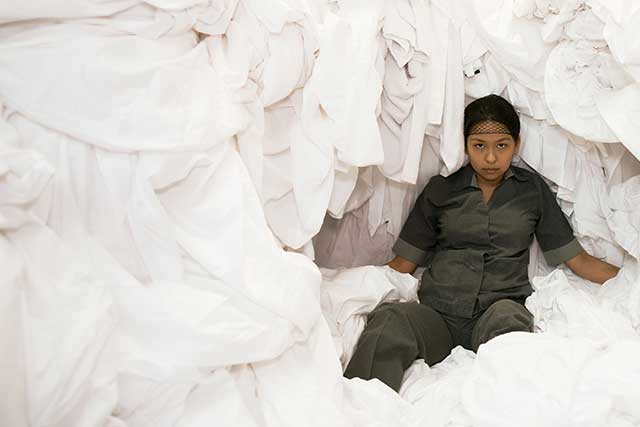
Superwoman: "The Chambermaid"


As anyone who's occupied the position could tell you, the role of hotel chambermaid involves a lot of menial labour: if you find changing your own duvet cover the most rotten of chores, imagine having to do it fifty or so times a day, seven days a week, for precious little thanks, and not much more money. The job also, however, bestows a funny sort of privilege: the opportunity to pass at will behind locked doors, and thereby see how the other half live. (Less so if you're working in a Travelodge, but even so, there are levels of access.) The idea of hotel as hierarchy sustains The Chambermaid, a drolly impressive first film from the writer-director Lila Avilés, which never leaves the chi-chi corridors and functional backchannels of a plush Mexico City establishment, and in doing so sets a rich, self-contained universe before us. Heroine Evelia (the quietly mischievous Gabriela Cartol) is a disruptor, a 24-year-old indigenous woman who's learnt to use the invisibility bestowed on her by her housekeeping gig - the invisibility that sees guests stripping naked in her presence, or paying her no heed whatsoever - to take a few liberties here and there: rifling through bins to glean the odd discarded item for herself, carving out pockets of that same leisure time the hotel's clientele have booked themselves in for. In Avilés' conception, Evelia's something like a fixer in a prison-camp movie: we spend much of the film's running time wondering how much this young woman can make off and get away with.

The movie's strengths are observational: it notices Evelia, dares to give her an inner life, considers how she might spend her days. Phonecalls snatched between room services sketch in the nature of the heroine's emotional ties - just who she's doing this work for - and we gradually gain a sense of the small hopes she guards for herself. She has an eye on a red dress someone's handed into lost and found and, beyond that, on a promotion to the hotel's prestigious 42nd floor suites; she takes in-house classes with the aim of obtaining her GED, although she will make credibly haphazard progress on that front. It's a film that not only understands what it is to scrape by - Eve's colleagues endeavour to drum up a few extra bucks here and there via the sale of Avon-like moisturisers or fidget spinners - but has some element of that scraping folded into its very form. Avilés offers us thin slivers of scenes that, over The Chambermaid's 100 minutes, build up to provide a more complete picture of this woman's work. Some of these scenes are cursory: there are a few blunt interactions with a local celebrity who proves every bit as rude and thoughtless as you fear celebrities who check themselves into five-star hotels would be. Others are more surprising, sight gags that - through repetition and variation - becomes appreciable running jokes, like Eve's growing closeness with a window cleaner who's developed a crush on her. Crucially, Avilés never gives into the drudgery of this workplace; instead, she skips down these corridors with the same curiosity as her heroine, aware that all life is here.

The Chambermaid wouldn't hold us as it does without its leading lady; it's a mini-masterstroke of casting. Cartol will almost certainly be the tiniest figure you chance upon on screen this week, but she's by far the most compelling with it: Avilés has such faith in her as a presence that she can set up a scene that involves no more or less than Evelia waiting for a lift - and then make both a joke and a small act of heroism out of it. The scene has a point: Eve's story, we gather, is one of great, unheralded patience and resilience - the patience and resilience that allows menial labourers to go back and deal with other people's not inconsiderable shit, day in, day out. Cartol does a lot with the downturned gaze that's been drilled into this character, yet she demonstrates such irrepressible spirit whenever Eve is left to her own devices - when she feels she's not being watched - that we can't help but root for her to get her due; Avilés bestows an additional grace upon her in those scenes that find this minion looking out, through the vast windows of the hotel's penthouse suites, onto a world in which she would appear to play such a small part. Those set-ups are as about as widescreen as The Chambermaid gets, but the fact Avilés isn't pushing for some vast tableau means Eve comes into even clearer focus than the saintly housekeeper of Alfonso Cuarón's Roma. We believe this woman; we cheer for her, perhaps as her tentatively upward mobility mirrors our own, and worry whenever that progress is checked. By the final moments - with Avilés weighing up whether or not to give Evelia the release she deserves from this five-star prison - you may find yourself head over heels in love with her.

The Chambermaid is now playing in selected cinemas, and streaming via Curzon Home Cinema and the BFI.