At some point - because it is the way of the digital world - somebody on this planet will undergo the happy accident of sitting down before the 2019 release Only You in the mistaken belief they'd treated themselves to the 1994 romcom of the same name, a film perhaps best remembered nowadays, in our Marvel-dominated moment, for pairing Tony Stark with Peter Parker's Aunt May. What, provided they stick with it, will this befuddled punter get out of the mix-up? Something that operates - and eventually hits - closer to home than the earlier movie's Venetian merry-go-round; less romantic gloss, certainly, but with that, a greater understanding of the interpersonal realpolitik, the day-to-day conversations and negotiations, concessions and compromises, which keeps people together over the long haul. Less Hollywood star power, unarguably - but considerable compensation in the sight of two extremely talented young performers all but setting fire to the screen with the kind of incandescent chemistry you don't often see in mass-tested, PG-rated studio movies.
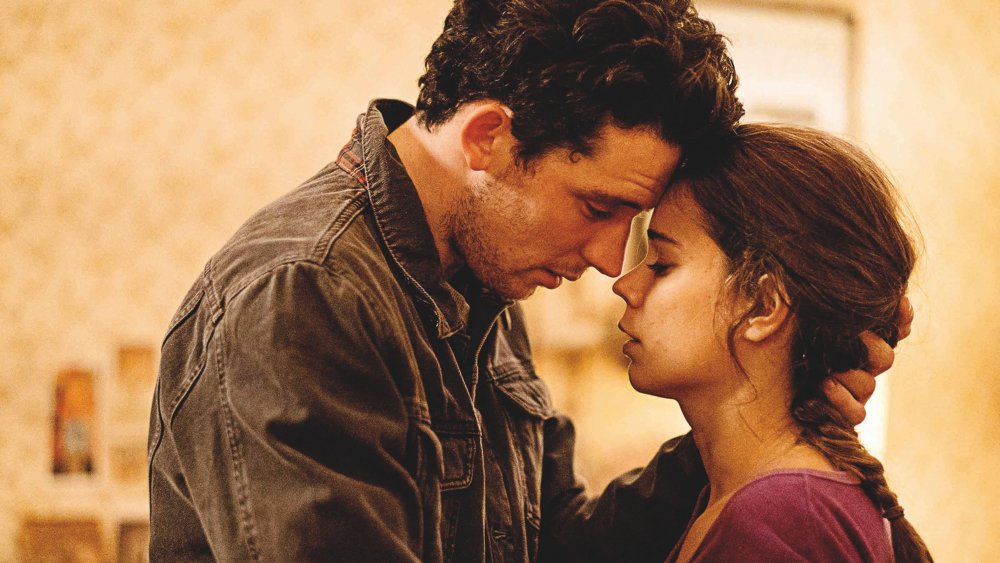
Our punter should be reassured that they will witness an authentic meet-cute: on the streets of Glasgow one New Year's Eve, thirtysomething Elena (Laia Costa) hails a taxi, only to see it sail past her to stop for twentysomething masters student and part-time DJ Jake (Josh O'Connor). He, gallantly, offers to share the ride, in part because he's taken an obvious fancy to her, and a hook-up soon becomes a thing becomes an actual relationship with cohabitation an option before complications set in, related to the age gap that separates the pair. This in itself wouldn't necessarily throw anybody raised exclusively on the Hollywood romcom - if I rightly recall, there are multiple recent entries in the Jennifer Lopez filmography devoted to the older woman/young lover dynamic - yet Only You's debutant writer-director Harry Wootliff clearly intends to probe a little deeper than those popcorn movies inspired by supermarket-checkout magazine articles on new trends in coupling: what she's interested in is how this mad headlong dash into love is paused by Elena's increasingly hesitant biological clock.
IVF will be the defining chapter in these lovers' lives, as it has been for so many, not that the movies have troubled to explore this very modern science much; those turkey-baster comedies, geared primarily towards semen-displacement farce, hardly count. Whether through personal knowledge or close, careful research, Wootliff has understood there is an involving, human drama in the stresses, costs and bruises (physical and emotional) that follow from putting a fragile possibility of happiness in the hands of medical science. Here, Only You establishes itself as something more than just another date movie - or at the least a date movie for those who've been round the block a few times, and had some of their skylarking illusions stripped away in the process; perhaps even a date movie for lovers who are setting out on this process themselves. The great strength of Wootliff's film is that it realises, however frightening or disheartening IVF might seem, it is just a process, no more or less than browsing a dating site for potential matches, or installing someone you care about in your flat is a process. By ushering her leads into rooms staffed by actual medical professionals, Wootliff can break down and talk us through the science; back at Jake and Elena's flat, she shows us the ups and downs, and also the very great love and solidarity that get even people who meet on the street through the worst of these. Our punter expecting Robert Downey Jr. exchanging amorous banter with Marisa Tomei might be a tad thrown by the grim obligation of the on-the-clock fucking, the fact the montages revolve around hormone injections, and by one especially raw fight, during which not just this relationship, but the world entire threatens to rip itself apart. Yet they might equally feel themselves learning and growing, as the characters here learn and grow.
Crucially, Wootliff gets the basics right, laying the foundations movies and relationships alike need in order for something substantial and lasting to be built. When Jake tells Elena "I love you, you're gorgeous" at a perilously early stage in both film and romance, you buy it entirely, as you did everything O'Connor said in 2017's God's Own Country; there isn't a shot or a scene here that will harm this actor's growing rep as British cinema's most sensitive and sincere beanpole. Costa, for her part, does seem older - more worldly, and all the more attractive for that - than she was as the flighty artist in last year's shambling Netflix relationship drama Duck Butter. You could run these movies back-to-back as illustrations of the difference between carefree twenties and careworn thirties, and Only You will seem doubly impressive to anyone who's cast an eye over the earlier film for being a properly rounded picture of accelerated love, where Duck Butter was really no more than a dashed-off sketch. Wootliff makes thoughtful use of Glasgow as a city where many people live, work and strive to make a future; a couple of skilfully written and played scenes between O'Connor and onscreen dad Peter Wight shade in how would-be babymakers Jake and Elena are themselves their parents' children; and the film sticks its landing, at that place where love becomes inseparable from hope, altogether beautifully. There is no reason why our flexible punter couldn't then source the original Only You - which remains nothing if not accessible - albeit with a whole new perspective on its smooth romantic sailing; Wootliff, to her considerable credit, realises happiness is more often than not hard work - harder than our romcoms typically allow for - but also that we owe it to ourselves to put the hours in.
Only You is now playing in selected cinemas, and streaming via Curzon Home Cinema.
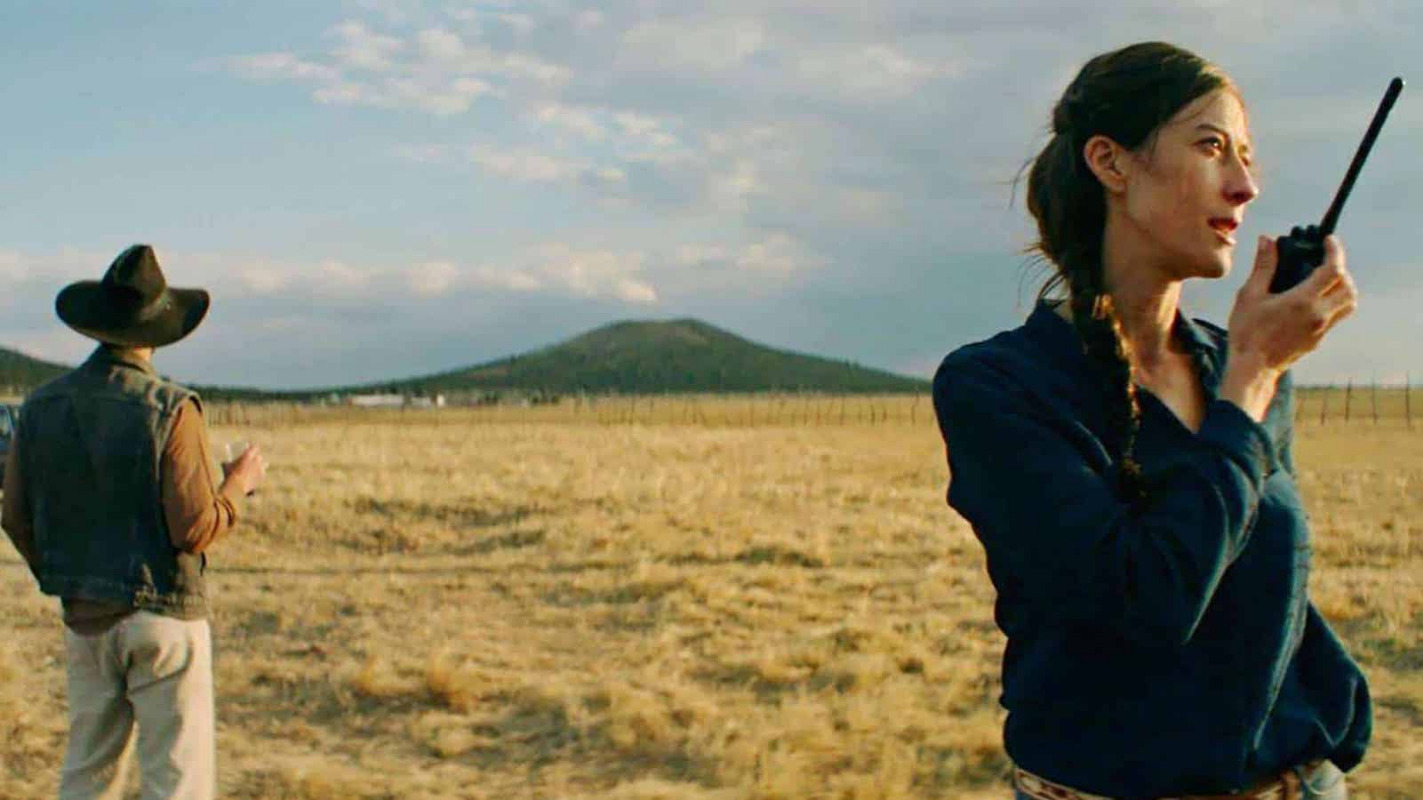
Now this is some old-school counterprogramming: a film so far removed from a Disney x Beyoncé redo of The Lion King as to seem beamed in from another era, another universe entirely. Carlos Reygadas is the Mexican writer-director who emerged in that millennial moment when the movies were nudging (and, in certain cases, vigorously frotting) against the boundaries of accepted representation. In between a lot of what came to be defined as slow cinema, he gave us gerontophilic sex in 2002's Japón, unsimulated sex in 2005's Battle in Heaven, and rather joyless swinger sex in 2012's Post Tenebras Lux, an occasionally atmospheric yet often strained upper-case Art Movie in which Reygadas appeared to be working through some deeply personal hang-ups, possibly of most concern to him and his nearest and dearest. His latest film, arriving on UK screens after receiving an understandably mixed reception at last year's Venice festival, pushes further still in this direction. Our Time runs just shy of three hours, is discursive as all hell, and has at its centre a marriage between a couple of ranchers played by the director and his real-life wife Natalia López, tested when the latter takes up with an American ranchhand. You could, I'd venture, depart after the opening half-hour - mostly consisting of footage of the ranchers chasing their livestock, or bulls charging after the ranchers - and be confident about knowing the film's theme. Wild hearts run free. It's only natural.
To do so would be to miss plentiful evidence that Reygadas is a great landscape artist manqué. There are scenes in this director's earlier works that have lodged in the mind, not because of the words and actions of the characters within them - people being routinely the least interesting element in Reygadas movies, rarely more than crash-test dummies bussed in at the last minute to be stripped or otherwise humiliated - but because of the worlds they looked out onto: Japón's craggy hillsides, the flooded fields of Post Tenebras Lux. Reygadas has always done his best work as the sun is coming up or going down, when those worlds appear newly anointed or ominous; he sees the promise in our surrounds, and then the lurking existential terror. Our Time is, at root, a domestic drama - more Scenes from a Marriage - tempted outside to play under 2:35: 1 skies. As one of the lovers' texts has it, with regard to the pair's illicit couplings, "It's always more exciting outdoors", which we can see for ourselves - though those words start to ring somewhere between ironic and entirely hollow in the course of the long, generally lacklustre advert for polyamory that follows.
Much of Our Time's shortcomings as drama stem from Reygadas's self-appointed "uncompromising auteur" status. It would be possible to countenance a pithy two-hour account of consenting adults attempting to finesse and childproof the sharper points of a love triangle: Liv Ullmann achieved something in this vein with 2000's Faithless, though that was a project driven by the wracked, self-lacerating conscience of its screenwriter Ingmar Bergman, wisened enough to know that, however enthusiastically we might try, three into two doesn't easily go. Reygadas, by contrast, gives himself a lot of time and space to fill - too much, it transpires. In last year's The Wild Pear Tree, the Turkish writer-director Nuri Bilge Ceylan took three hours to knot together his signature landscapes with the internal growth of a brattish would-be author; the film had a credible sense of tangled life unfolding organically before us. There is so much of what Nicholas Parsons would deem deviation in Our Time - the highlights of a timpani concerto, shots taken from inside the bonnet of a moving car and on the wing of a landing plane, lessons in the finer points of ranch management - that it quickly starts to seem a ruse, an acknowledgement that what's going on at the heart of the picture really isn't all that major: a not untypically squalid breach of trust that gets shruggingly worked out over glasses of wine by characters who at all points in this affair present as far less passionate than the animals, even the trees around them.
As performers, Reygadas and López prove a modest step up from the lumpen non-professionals this director has typically stuck himself with, convinced he can fashion marble from clay: comparatively urbane bohemians, they at least appear comfortable before the camera, even when asked to lay bare souls and other body parts. Yet they never quite convince as anything more than thinly veiled sketches of whatever it is they themselves had to work through in their own relationship before the cameras started rolling (the "our" in the title appears especially significant), and so the movie only rarely appears like anything other than a thinly veiled excuse for this filmmaker to indulge his fantasies of watching and filming his other half getting off with another man. (I mean, fine, whatever works - but I've got ironing to be getting on with.) The most vivid moments in Our Time - the stuff you remember, even as you happily leave the rest to the director's personal spankbank - involve the film's younger players: the teens of the prologue, frolicking on a beach as signifiers of the innocent simplicity of youth, and the Reygadas-López children, cast as versions of themselves, whose sporadic, school-assignment narration of these events (a sort-of "Who My Parents Did On My Holidays") both lends the drama a semblance of shape while giving it the faint air of one of those Judd Apatow domestic comedies, removed of any identifiable traces of humour. In their place, an agonised narcissism, with which viewers will have to wrestle for three hours. When the wife first hooks up with her beardy, unprepossessing lover - the only scene outside some fairly lame last-reel chairthrowing where López doesn't appear impossibly wan - she does so gazing into the mirror. In its own way, it is as emblematic as all the business with bulls and horses that bookends the film - and it takes an awful long time to get from one example of animal behaviour to the next.
Our Time is now playing in selected cinemas, and streaming via Curzon Home Cinema and the BFI.
In the fifty years since Man first set foot on the Moon, the movies have given us one very good and one near-definitive documentary on the achievement, namely Al Reinert's Oscar-nominated For All Mankind and David Sington's In the Shadow of the Moon. The USP of Todd Douglas Miller's Apollo 11 is to show us the nine-day Moon mission as live - instantly bridging the generation gap separating those who sat glued to the lunar landing as it unfolded on the night of July 16, 1969 and those of us born over subsequent decades, who've tended to experience galaxy-changing events via rolling-news coverage. The miracle is how much - how much detail, how much tension, how much wonder - Miller squeezes from what is essentially raw feed: footage beamed back from the cameras positioned around the rocket, the launchpad and Mission Control over those fateful days, which was then locked up in a NASA vault for the best part of half a century. We've all seen so much in recent years that has threatened to leave us numb, jaded; Apollo 11 is the first film of 2019 - the first film for a long time - to equip everyone who steps into the auditorium with a fresh pair of eyes.
Approaching these events from the purely technical, rational perspective of a TV news producer - no emotive voiceovers or framing devices, a soundtrack that favours echoey tech chatter and electrical fuzz over stirring orchestral score - and as something that happened (that is happening) liberates the images: though they flow sequentially, with clear cause and effect, we often have to puzzle out the precise import of what we're seeing, and thus the mission entire. Far from some tweedy museum piece, Apollo 11 instead becomes an act of discovery (or rediscovery) in homage to the events it describes. Miller is aware that, five decades on, we might look at these images a different way to those who saw them on the nights in question. Hard, now, to watch the launch - with its searing flares of light and heat, and one remarkable close-up (perhaps frame enlargement?) of the rocket's haphazardly riveted underbelly - without being reminded of the Challenger disaster thirty years later; the journey towards the Moon would recall Apollo 13 even before the onscreen appearance of Jim Lovell (the astronaut played by Tom Hanks in the Ron Howard movie) among the NASA wonks; while a slightly trippy descent brings to mind Gravity, and perhaps even 2001. The film allows us to spot the risks, but also - as that dusty grey-white orb gets ever closer, and a whole new frontier opens up - the very great and lasting rewards.
One shift in emphasis involves the key personnel. Messrs. Armstrong, Aldrin and Collins occupied pride of place in the Reinert and Sington films, but the astronauts are limited to walk-on roles here, largely indistinguishable beneath their helmets and spacesuits. (We cannot tell whether, say, Armstrong was thinking of his late daughter, as last year's First Man rather fancifully supposed.) Instead, the focus is put back on the collaborative nature of the enterprise, Miller's editorial line insisting that this is what can be achieved when a nation puts its heads together, as opposed to locking antlers. Houston is evoked very nearly as vividly as the Moon: a vast support team of brillantined chaps touting sliderules and pocketguards, some puffing away on cigarettes, most of whom look as if they could be played by either Bill Pullman or Kevin Costner, each playing a part in ensuring Armstrong and cohorts enjoyed safe intergalactic passage. Time and again, the film amazes us with some display of precision, whether in Miller's approach - painstakingly matching comms feed to images, so the technicians can talk anew - or in the astronauts' own trajectory: witness the lunar module's descent onto the Moon - the most heartstopping setpiece of summer 2019, as it would have been in the summer of '69 - complete with rapidly descending onscreen fuel gauge and an alarm going off that we sense can't be positive. (Spoiler alert: the Eagle lands with sixteen seconds' worth of fuel remaining. Don't know about you, but that strikes me as a hell of a gamble to take while travelling this far at that velocity.) If you're suggestible enough to entertain the commonly held conspiracy theory that the Moon landings were faked, Apollo 11 will at the very least impress upon you the copper-bottomed thoroughness of the alleged fakers' con job.
The rest of us, looking back at Earth from the stars, will find ourselves pondering the question of where Man stands today, and one of the reasons the movie hits home so hard is that the answer is very likely: not all that much further on. Though there has been progress in the emerging nations - in India, especially, making good on its vast science and engineering potential - the best the West has recently proposed in the way of out-of-this-world activity is President Trump's so-called Space Force, less a coherent policy proposal than a ready-made pitch for some naff, sub-Glen Larson mid-Seventies network-TV dross, such that it was soon seized upon by The Office's Greg Daniels and Steve Carell as the basis for a spoof comedy. (As ever with Trump, the idea was all but forgotten about the moment the words escaped his lips.) Elsewhere, space programs have been defunded and dismantled, or passed into the grasping hands of entrepreneurs keen to profit from those who literally have money to burn. Miller can refute that idea of space as business-as-usual with most of these extraordinary images, but especially with one insert of the plaque the astronauts left behind on the Moon, bearing the legend "we came in peace for all mankind". If the use of past tense seems poignant, the documentary is fuelled - as Reinert's was - by those final three words: for all mankind, not just some. Apollo 11 returns us to a time of upward gazes and open minds, and to a universe without borders, which makes it something of a UFO at a moment when it feels as though everybody's retreated indoors to squabble on Twitter. Over the past few years, mankind has started to seem grounded if not mired, stuck on a planet with dwindling resources, making the best of a perilously bad hand. Apollo 11, 93 minutes that urgently insist we don't have to settle for this, reawakens the dreamer and the scientist within us, and allows the mind and spirit to soar.
Apollo 11 is now playing in selected cinemas.
Not so very long ago, in a time before Shrek but just after Spinal Tap, the grand viziers of La-la-land decreed their subjects should be gathered together to hear a fairytale, by one of its wittiest court jesters, about a beautiful princess, her love for a humble farmboy, and the mysterious masked man who comes to her rescue after she's married to a tyrannical king and carried away by mercenaries. There would be swordplay, and giants, and "kissing parts", and a happy ending, and everyone who heard it thought it the most wonderful story they'd ever been told; even better, in fact, than the one about the Goblin King, or the one about dark crystals, or the one that the troubadour from the neighbouring republic of Kajagoogoo had claimed was never-ending. And thus did enchantment set in, and all was well in the kingdom, at least for another 94 minutes.
William Goldman's novel The Princess Bride was already wise to the ways youngsters were having their attention snatched away from them: appropriately, the film's first shot is of a very 1980s computer baseball game. Yet the whole project would counter by coming up with renewed ways of winning that attention back, most notably by appearing at once a good deal smarter than the story being told. The great joy of Rob Reiner's film is that it's never smarmy; of course, it helps that the people doing the interrupting on screen are Peter Falk, pretty much ideal casting as the narrating grandfather, and a pre-Wonder Years Fred Savage, whose puppy-fat cheeks were just aching to be pulled. The trick is that it genuinely seems to believe in the romance, virtue and magic it annotates; it deconstructs to show just how central these elements are to the art and craft of truly satisfying storytelling, and denies us an easy outlet for our cynicism with every new cut to Savage's increasingly beguiled face. Billy Crystal's latex-coated cameo as Miracle Max looks less and less funny as the years go by, but Cary Elwes (as the farmboy) and Robin Wright (as the Princess) were never to top this; if you had any sense, you'd also take Mandy Patinkin as Inigo Montoya over the Patinkin of Yentl, and his double-act with Andre the Giant is just about perfect.
The Princess Bride is available to stream on Netflix, and on DVD through Lionsgate.
Adapted from a novel by Marilynne Robinson, Bill Forsyth's American studio debut Housekeeping is a lesson in how to do what would come to be known (rightly or wrongly) as a chick flick with intelligence and integrity. We're at the end of the 1950s, the decade of the teenager, but our young heroines - forthright, upfront Lucille (Andrea Burchill) and the mousier, awkward Ruthie (Sara Walker), who in the eyes of her sis spends "too much time looking out of windows" - find themselves being raised in the remote and deeply conservative community of Fingerbone, Idaho by an eccentric aunt Sylvie (Christine Lahti). With her tacit approval of the girls' truancy, and a tendency to keep fish in her coat pockets, Sylvie is nobody in Fingerbone's idea of a responsible guardian - certainly not Lucille's - and her idiosyncratic, instinctive parenting techniques split the sisters, seemingly forever more. A film of a more mainstream sensibility - a Mermaids, say - would let Lahti off the leash, and illustrate Sylvie's dottiness via relentlessly upbeat, pop-scored montages, as all the women on screen settled down for true love with the right, patient man. Yet in the absence of those men - save an antagonistically prying sheriff - Forsyth holds tight focus on the girls, their shifting perceptions of the woman who came to replace a mother they never really knew, and of the sometimes despondent places they inhabit.
It's all narrated by Ruthie the elder, which might have been a detrimental instance of a film telling us rather than showing, were it not for Forsyth's love of (Robinson's?) language: witness the description of a train derailing "like a weasel sliding off a rock". In fact, the film wears its literary origins, its writerly smarts, with great pride: the central unit of individuals choosing (rather than being forced by blood ties) to stick together has something of later Paul Auster novels about it, or you could approach the movie as a female-centred equivalent to Stand by Me. (Both films make memorable use of train tracks.) This is a beat or two slower in pace than the Reiner movie, and Forsyth's wit isn't much called for in an essentially gentle matinee piece, but the storytelling remains quietly radical (events are directed towards "an end to housekeeping", which entails burning down the house), and Walker and Burchill (who all but disappeared after this) create a very credible sisterly relationship hinting at long-standing rivalries and resentments, as well as obvious love and support.
Housekeeping is available on dual format DVD/Blu-Ray through Powerhouse Films.
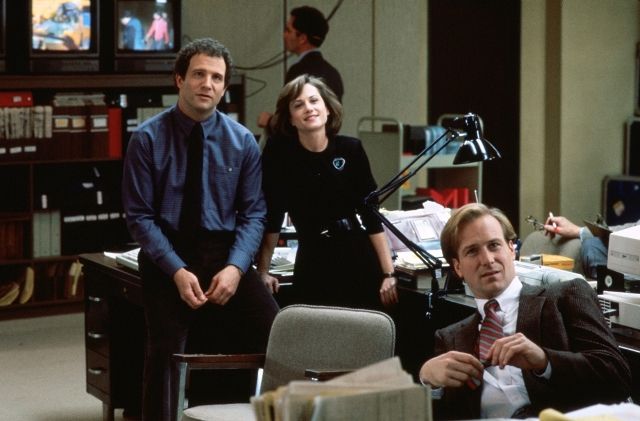
Was Broadcast News the last hurrah for truly grown-up, sophisticated movie comedy in Hollywood? One of the ten best American screenplays of the 1980s establishes a love triangle between a trio of misfits charged with bringing the news to us each night: brilliant but neurotic, pathologically unhappy producer Holly Hunter (terrific: operating at 200mph, and the closest the movies had had to a Hepburn for decades), and her two favourite reporters, slick but intellectually insecure William Hurt and funny but schlubby Albert Brooks. In 1987 - the year of Wall Street - it must have been radical to see high-flying professionals with real doubts, yuppies with humanity, passionate believers doing what they do for love, not money. Writer-director James L. Brooks gave us a rare, entirely unpredictable romance - every corner of this triangle has their attractions and flaws; even Hurt's significant other is characterised with some sympathy - eyefuls of the behind-the-scenes wrangling that goes into live news, and dialogue that probably should be quoted more than it is.
Brilliantly, Hunter's personal decision is made for her by a colleague's professional lapse: underpinning Brooks's writing here is a genuine distaste for the way news was already being turned into an entertainment, a theme that was to sustain several seasons of The Daily Show going into the current century. After this, Brooks was to venture into movies only occasionally, with more failure (I'll Do Anything, Spanglish) than success (As Good As It Gets), becoming more significant as the producer who helped Matt Groening bring The Simpsons to the screen. Hurt and Hunter were bound for more dramatic material, and while Brooks, A. took up the torch for this particular type of comedy (in 1996's Mother and 2005's Looking for Comedy in the Muslim World), as would others (Ron Howard with 1994's The Paper, Ron Underwood with the same year's Speechless), everybody was soon to find that the Farrellys, and less talented jackasses, had run off with their audience; only Aaron Sorkin would pick up the thread, and then on TV (The West Wing, Studio 60, The Newsroom).
Broadcast News is available on DVD through Fox.
Top Ten Films at the UK Box Office
for the weekend of July 5-7, 2019:
1 (new) Spider-Man: Far from Home (12A) ***
2 (1) Toy Story 4 (U) ***
3 (2) Yesterday (12A) **
4 (new) Westlife - The Twenty Tour Live (12A)
5 (new) Midsommar (18) **
6 (new) The Queen's Corgi (PG) **
7 (3) Aladdin (PG)
8 (5) Casino Royale - Secret Cinema (12A)
9 (new) Anna (15)
10 (7) Rocketman (15) ***
(source: BFI)
My top five:
1. Only You
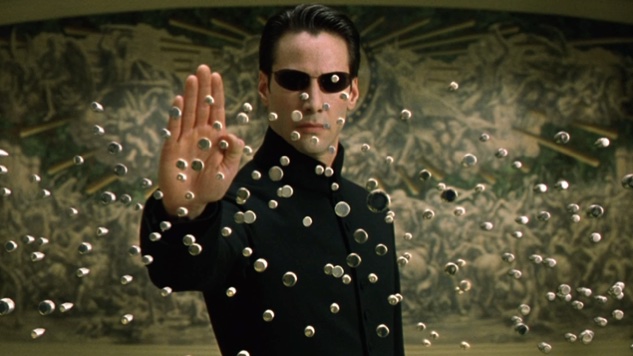
2. The Matrix [above]
3. The Matrix Reloaded
4. The Matrix Revolutions
5. Jaws
Home entertainment Top Ten (DVD/Blu-Ray/Download):
1 (new) Captain Marvel (12) ***
2 (1) Fighting with My Family (12)
3 (4) Toy Story (U) *****
4 (3) How to Train Your Dragon: The Hidden World (PG)
5 (9) Spider-Man: Into the Spider-Verse (PG) ***
6 (5) Toy Story 3 (U) ****
7 (2) Cold Pursuit (15) **
8 (6) Toy Story 2 (U) *****
9 (8) Aquaman (12)
10 (13) Bohemian Rhapsody (15)
(source: officialcharts.com)
My top five:
1. Ash is Purest White
2. Birds of Passage
3. The Hole in the Ground
4. The Kindergarten Teacher
5. Captain Marvel
Top five films on terrestrial TV:
1. Lethal Weapon (Friday, ITV, 11.10pm)
2. Star Wars Episode IV: A New Hope (Sunday, ITV, 1.30pm)
3. McFarland, USA (Saturday, BBC2, 3.30pm)
4. Tomorrow Never Dies (Saturday, ITV, 9.50pm)
5. The Quiet Ones (Thursday, C4, 1am)