Sunday, 16 June 2019

On demand: "Stree"


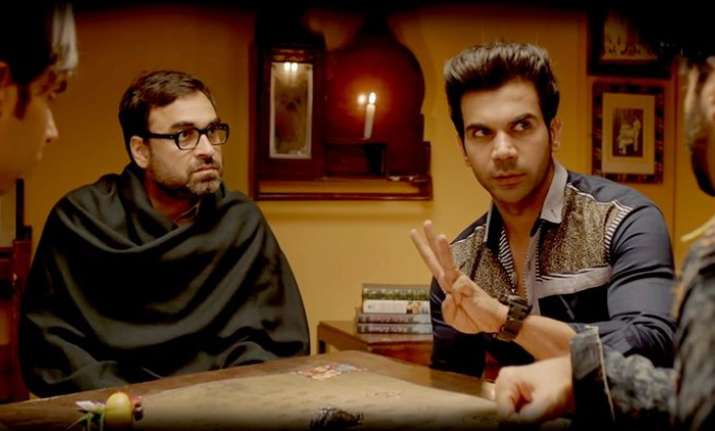
In the two years since the conclusion of the Telugu epic Baahubali bestrode the international box-office like a colossus, the Indian mainstream has doubled down on all things big, yielding a procession of long, lavish magnum opuses: Padmaavat and Thugs of Hindostan last year, Manikarnika and Kalank this. Local audiences, perhaps understandably feeling overstuffed, have instead started to gravitate towards smaller, lower-profile, more distinctive diversions, such as the beguiling comedy-horror Stree, one of the sleeper hits of 2018. Amar Kaushik's film is well-managed and carefully composed, running just two hours rather than the now-standard three and constantly altering the shape of its central conflict, such that it never becomes entrenched. It's also, purely and simply, a great deal of fun; you can see why movielovers turned out for it so. Rather than requiring D.W. Griffith-scale sets, much of the action plays out within the confines of a superstitious rural village where even now, in the second decade of the 21st century, the residents hold firm to a belief in the Stree, a witch who adopts human form to prey upon single men. Bad news, this, for our hero Vicky (Rajkummar Rao), a guileless tailor introduced tumbling head over heels for the spookily serene new girl in town (Shraddha Kapoor). Having seen movies enough, you and I will have some idea of what he's getting into; the running joke, however, is that the protagonist is basically clueless, somebody very much to be toyed with.

The set-up allows Kaushik and the emergent writing team known as Raj and DK to themselves toy with what the opening credits describe as a "ridiculously true" folk legend, while throwing in plenty of knowing scary-movie business. Not for the first time in a film such as this, there are rules to guarantee survival, but they're delivered by Pankaj Tripathi (the crime boss in Netflix India's Sacred Games) in the guise of a distractible, prissy scholar. The Stree's first victim is shown preparing for an evening of what's euphemistically referred to as "friendship" with a lady of the night. And when Vicky is handed a list of tasks by his mysterious new sweetheart, the score takes on some recognisable Mission: Impossible bombast - no matter that said mission involves no more than our boy figuring how to get his hands on a lizard to remove it of his tail. The script, meanwhile, is fashioning its own form of amusement circumnavigating viewer expectations and warding off any misogyny that might lurk amid its mythos. The poor old Stree, it transpires, is as much of a victim as those she's been led to prey upon, this time of a patriarchal society's assumptions. That much becomes clear in the unusually strong second half - always a litmus test for modern Bollywood; the movie doesn't peak too soon - as the village empties out and Vicky assembles a ragtag team of ghostbusters to shoo the spirit in the direction of peace.

Here, Kaushik makes merry with his story beats and delights in his ensemble, particularly the droll Tripathi and the sleepy Aparshakti Khurana, whose Bittu can be witnessed eating a banana during one team meeting, presumably as it's important to keep up potassium levels when dealing with the undead. Funnier still is Raj, more character actor than star, but an increasingly reliable kitemark of quality - he was the crusading lawyer in 2012's Shahid and the faux-romantic hero of February's Ek Ladki Ko Dekha Toh Aisa Laga - who here gets to stutter and stammer and seem to care not one jot that much of the joke is on him. (One great, subversive image late on: Vicky in newlywed garb perched atop a rock like a siren, yet conducting himself in the manner of a lamb to the slaughter - a lure not just for the Stree, but for any analysts of gender in Bollywood cinema, who'll note how this makeshift damsel-in-distress is occupying a spot the movies have traditionally reserved for the fairer sex.) Representatives of that generation bombarded into submission by the Conjuring franchise and its myriad spin-offs may find there isn't enough quiet-quiet-loud for their liking. Yet Kaushik swaps in other forms of surprise (throat-singing!) and ample wit besides: to these VHS-trained eyes, Stree really wouldn't look out of place in a double- or triple-bill with any of that weirdly memorable Eighties run of comedy-horrors that began with Vamp and The Monster Squad and eventually begat Beetlejuice.

Stree is now streaming on Netflix.

Friday, 14 June 2019

For what it's worth...


Top Ten Films at the UK Box Office 
for the weekend of June 7-9, 2019:

1 (1) Aladdin (PG)

2 (new) X-Men: Dark Phoenix (12A)
3 (4) Rocketman (15) ***
4 (3) The Secret Life of Pets 2 (U)
5 (new) Take That - Greatest Hits Live (12A)
6 (2) Godzilla: King of the Monsters (12A)
7 (new) Bharat (12A) **
8 (new) Casino Royale - Secret Cinema (12A)
9 (6) John Wick: Chapter 3 - Parabellum (15) ***
10 (new) Late Night (15)

(source: BFI)

My top five: 
1. Kind Hearts & Coronets [above]

2. A Season in France
3. The Adventures of Priscilla, Queen of the Desert
4. Gloria Bell
5. Liam Gallagher: As It Was


Home entertainment Top Ten (DVD/Blu-Ray/Download): 

1 (29) Stan & Ollie (PG) ***

2 (new) The Lego Movie 2: The Second Part (U) ***
3 (3) Bohemian Rhapsody (12)
4 (1) How to Train Your Dragon: The Hidden World (PG)
5 (new) The Mule (15)
6 (2) Bumblebee (PG) ***
7 (4) Glass (15)
8 (10) Aquaman (12)
9 (5) The Secret Life of Pets (U) **
10 (6) Mary Poppins Returns (U) ***

(source: officialcharts.com)

My top five: 
1. Sauvage

2. Beautiful Boy
3. Liam Gallagher: As It Was
4. A Private War
5. Can You Ever Forgive Me?


Top five films on terrestrial TV:
1. Babe (Saturday, ITV, 1.45pm)
2. Mia Madre (Saturday, BBC2, 12.45am)
3. What We Do in the Shadows (Sunday, BBC2, 11.15pm)
4. Billy Elliot (Saturday, BBC1, 10.20pm and Friday, BBC1, 12.10am)
5. Whisky Galore! (Sunday, BBC2, 11.30am)

"The Hummingbird Project" (Guardian 14/06/19)


The Hummingbird Project **
Dir: Kim Nguyen. With: Jesse Eisenberg, Alexander Skarsgård, Salma Hayek, Michael Mando. 111 mins. Cert: 15

At last, the starry drama about fibreoptic cable-laying the world has been crying out for. Part of me wants to cut this enigmatic drama from Canadian writer-director Kim Nguyen some slack for going out of its way to disprove the notion there are no longer any truly original concepts in North American cinema: it’s markedly distinct from anything currently showing, and you’ll be amazed anybody heard this pitch and thought to open a chequebook rather than, say, calling security. Yet scene-by-scene, Nguyen’s sketchy question-mark of a film proves so leftfield it risks seeming esoteric or – with its technical dialogue on the matter of “neutrino messaging” – openly baffling, the kind of verbose corporate parable David Mamet would sit down to write only after a heavy night on the sauce.

Jesse Eisenberg plays Vincent, an ambitious day trader pumping his resources into digging a tunnel between Kansas and New York, a scheme designed to tap stock market data a millisecond faster, and thus turn him a sizeable profit. To this end, he has recruited his nervy coder cousin Anton, played – in the first of many bizarre choices here – by Alexander Skarsgård beneath a bald pate that immediately recalls BBC arts editor Will Gompertz. Skarsgård wasn’t alone in spending long hours in hair and make-up puzzling over this script: Salma Hayek, as the ruthless CEO the pair aim to undercut, has her lustrous locks dipped in grey paint and offset with NHS specs. Eisenberg, meanwhile, contends with tummy trouble, for Vincent’s burrowing sets off rounds of doubtless symbolic intestinal distress.

What can it all mean? The business of rewiring America for personal gain feels secondary to Nguyen’s vision of characters who, for all their efforts to connect, appear deeply alienated. Around the neutrinos, one spies some conventional messaging about faster communication not necessarily equalling better communication. Yet it’s so erratically delivered you suspect scenes have gone missing; Vincent’s unhealthy obsession is conveyed via a Morse code of Eisenbergian yammering. It’s a rare misfire that makes one want to see more from its maker: we get intriguing ideas, images and locations, and enough close-ups of excavation equipment to enrapture plant-hire enthusiasts. With few narrative or thematic hook-ups, though, I guarantee a lot more headscratching before this working definition of a curio.

The Hummingbird Project opens in selected cinemas from today.

Thursday, 13 June 2019

Citizens of nowhere: "A Season in France"


Mahamet-Saleh Haroun is the Chadian writer-director who, with French funds, has filed some of the most astute and engaging film-dispatches to have come out of Africa since the turn of the millennium: 2002's Abouna, 2006's Dry Season and 2010's A Screaming Man all secured UK distribution, while 2016's honourable political inquest Hissène Habré, A Chadian Tragedy played at that year's London Film Festival. His latest feature A Season in France, another notable contribution to the current wave of artistic responses to the question of migration, follows characters who might easily have figured in Haroun's earlier African films as they strive to put down new roots on the European mainland. By the standards of the huddled masses recent cinema and TV have depicted scrambling for their lives, Abbas (Eriq Ebouaney), who's fled civil war in the Central African Republic for a fresh start in Paris, has it pretty good as we join him. Granted, he has to hop from temporary lodgings to temporary lodgings, son and daughter in tow, as he waits for his appeal to be heard by the Court of Asylum; on the other hand, he's found steady employment on a market stall, and love with a colleague, Carole (Sandrine Bonnaire). Yet the further Haroun leads us inside this limbo - the dreadful pause to hear whether you have the right to exist in the place where you live and work - the more certain sadnesses become apparent. Abbas is haunted by the spectre of his late wife, which has started to impact upon his relationship with Carole; and unlike his happy-go-lucky daughter Asma (Aalayna Lis), his closed-off son Yacine (Ibrahim Burama Darboe) has grown resentful of dad's inability to keep the same roof over this already lopsided family's heads.

Spending time among these characters allows us to notice how Haroun's school of social realism is more overtly stylised than, say, the Dardennes, who worked a similar narrative beat with The Silence of Lorna and The Unknown Girl. Haroun doesn't move his camera much, and there's none of that on-the-fly, over-the-shoulder faux-vérité by which the Dardennes get us into their protagonists' heads and shoes. Instead, he stands his ground - putting down roots Abbas cannot - and simply observes, unafraid of deploying lighting shifts, sound effects or Wasis Diop's spare, unobtrusive score to move our emotions around. He spots, in passing, the sudden chill of privilege Carole feels sat in a waiting room among asylum seekers, knowing they'll likely walk out of this space with their lives changed one way or another; mainly, Haroun uses the camera to find a distinct, politically pointed line of approach to his asylum seekers - meeting them square on as vulnerable, flesh-and-blood men. Both Abbas and bookish family friend Etienne (Bibi Tanga) are suffering from a sexual impotence that feels inextricably linked to their powerlessness as citizens, their fears of a knock at the door in the night, the erosion of their role as providers of shelter. (It's the dramatic flipside of the impotency theme running through Ousmane Sembene's great African satire Xala.) We see the sting when Yacine huffs "a real father would have his papers", and we witness this man withering in other departments, too, losing his job, his temper, his nerve. With nothing to prove his existence, Abbas becomes very nearly as ghostly as his wife's apparition; first he howls, then he disappears into the ether.

That phallocentric element may complicate matters, threatening to reduce A Season in France to no more than just another film made by a man about the experiences of a man. (Factor in the racial aspect, and it's a heated argument waiting to happen.) Reassurance lies in the unarguable fact Haroun made this film about this particular man: a gentle, nurturing giant - pushing a placeholding diet of omelettes and pears upon his offspring - who, through circumstances beyond his control, comes to question all the decisions that have led him to this point. It might sound unbearably sad, but Ebouaney creates a touching, understandably harried intimacy with Bonnaire, and he's great with the kids, who emerge over the course of these 100 minutes as forceful personalities in their own right. It's a tremendously empathetic performance: deprived until the closing moments of any explanatory monologue, he instils in us a rich sense of what Abbas has lived through, the things he's seen, and just what he's lost (or abandoned) along the journey to what he'd hoped would be secure ground. The film around him operates at the level of quiet tragedy, too nuanced and melancholic to start hectoring its audience, although it gathers an unexpected, accusatory power in a final movement that carries us from limbo to haunted wasteland. The fixed timeframe of the title reflects how Haroun links migration to a form of nostalgia - a longing for the fixed points and home comforts of the past that manifests in the present as a restless, draining, possibly futile search for certainty. I don't think you'd necessarily have to have travelled from the Central African Republic to feel that way nowadays.

A Season in France opens in selected cinemas from tomorrow.

Wednesday, 12 June 2019

Woman of the world: "Gloria Bell"


In 2013, the Chilean writer-director Sebastián Lelio made Gloria, a surprisingly tense portrait of a middle-aged divorcee negotiating the Santiago dating scene that showcased a knockout performance from Paulina Garcia. In the course of its 110 minutes, you watched this woman stumble across a late (if not necessarily last) shot at happiness and then saw it snatched away from her by circumstance, leaving her alone and pulling frenetic shapes on the dancefloor to the Eurodisco original of the song that begat Laura Branigan's early 80s hit "Gloria". Was she losing it, or merely enjoying a rare moment in the spotlight? Either way, you were left wondering what would become of her. Becoming the subject of a US remake would have been fairly low down that list of potentialities, but that's where Lelio now takes his heroine for a twirl. The Gloria of Gloria Bell has been conceived along similar lines, as a survivor of the disco era who still has the music inside her, but who's reached that point where she's no longer certain anyone will ask her to dance. Yet as played by Julianne Moore, she's a notably sleeker and smarter proposition. This Gloria goes to yoga; and she wears what one might term sexy librarian specs, rather than her predecessor's altogether retro, functional, health-service lenses. "Have you had work done?," someone asks her at a bar, a distinctly American possibility no-one was asking of the dowdied-down, fuller-figured Garcia's Gloria. After going through similar moves on different streets, Moore's Garcia winds up wilding out to the Branigan version of "Gloria", but not before we've had time to notice and consider just how this character's world has changed.

At heart, the new movie remains an honourable character study. Part of Lelio's project first time round - underlined by his subsequent work as a scholar of the marginalised (A Fantastic Woman, Disobedience) - was to notice the sort of woman the movies don't notice much, and to investigate how she spends a time she might feel had started to run out. The approach results in such small, quiet triumphs of empathy as the scene here that depicts no more than Gloria Bell folding linens while mouthing Paul McCartney's "No More Lonely Nights"; the song may not always be so pointedly melancholic, but that's a scene recognisable from most lives, and one not often filmed, certainly not in North America. The new film will at the very least be a field day for anyone who would consider themselves prepared to watch Julianne Moore doing laundry, or taking the trash out, or getting her hair done; the bonus is that Lelio has liberated her to do all that adult stuff she's rarely been allowed to attempt in her recent mainstream-franchise commitments. She swears, she screws, she stresses - though there's a pronounced difference in the level of the latter that goes some of the way to explaining why the remake isn't quite the experience the original was. 

Garcia's Gloria was a woman on the verge of a nervous breakdown, which made her and the film that struggled to contain her such an unpredictable, at times exhilarating watch. Moore, whether by design or natural inclination, is more controlled in the part; even in the love scenes, she comes over as guarded, undressing with back turned to the camera, where Garcia threw herself at the screen with unselfconscious abandon. (The best American remake of Gloria may actually have been released five years before the original: Erick Zonca's Julia, with Tilda Swinton unravelling in the title role.) I never felt worried for Moore's Gloria the way I did for Garcia's Gloria, which made me wonder whether this project hasn't lost a little in translation. Partly, that's down to the cosier environment Lelio now sets his heroine in: American money evidently gets you bigger hotel suites and swankier restaurants than Chilean money. When this Gloria staggers hungover past two showgirls in full costume on the Vegas strip, she appears to be inhabiting a dream, and not the nightmare Garcia passed in and out of. Partly, it's a consequence of American cinema's eternal need to make plain and reassure. As that McCartney cue flags, Gloria Bell's soundtrack is nothing if not on the nose in amplifying the subtext (sometimes the text) of certain scenes: I'll allow Gloria Bell making eyes at a stranger on the dancefloor to the strains of "Ring My Bell" on the grounds of audacious cheek, but forcing this singleton to sit through an impromptu singalong to Gilbert O'Sullivan's "Alone Again, Naturally" is a choice any Will Ferrell comedy would play for knowing laughs. (Even the heroine's ringtone is jollier.) 

The deluxe recasting has its effects, too, inevitably. As Arnold, the silver fox who flits in and out of Gloria's life, John Turturro is so much less mysterious and more knowable than his Latin equivalent: he's another of this very capable actor's put-upon sadsacks, so we sense not much joy can come of this coupling long before it actually hits the skids. Gloria's distracted son is played by an overqualified Michael Cera (given not a single funny thing to do); her ex's new love is played by Jeanne Tripplehorn (and you go "ooh, that's Jeanne Tripplehorn"); and Gloria goes on a wild night out with cuddly Sean Astin, which struck me as rather like taking scatter cushions and a comfort blanket on a bender. None of this detracts from the film's bottom-line professionalism: it's well-dressed, easy company, an engaging watch, and a film that will do no harm whatsoever to its maker's future employment chances. Yet where Gloria filmed vividly real people, Gloria Bell offers familiar faces, and that changes our relationship to these characters. It's one of those remakes that by no means shames or defaces the original, but it does diminish it slightly in the memory. Garcia's Gloria is no longer the one-of-a-kind she once presented as - though Lelio would doubtless insist there's a Gloria in every bar in every town, and that it still behoves us to look.

Gloria Bell is now playing in selected cinemas, and streaming via Curzon Home Cinema.

Monday, 10 June 2019

1,001 Films: "Babette's Feast" (1987)


Before Chocolat, Big Night and Like Water for Chocolate, there was Babette’s Feast, which – depending on whether your tastes run to the sweet or savoury – vied with Juzo Itami’s mid-80s arthouse fave Tampopo to provide the starter course for a whole cinema of gastronomic delights. First released in 1987, Gabriel Axel’s immensely pleasurable adaptation of an Isak Dinesen story about a devoutly religious coastal community in 19th century Denmark returns to UK cinemas this week in a new digital print, and it’s adopted a strange new pull over those 25 years as a parable on the benefits of immigration – not least mouthwatering fusion cuisine.

The eponymous Babette (Stéphane Audran) is a French domestique who arrives in Jutland after fleeing the internal chaos that gripped her homeland following the Revolution. As an act of gratitude towards the sisters who take her in, Babette plans a lavish meal for the community’s aging locals, deploying the very latest (and most extravagant) forms of French cuisine. The community adopts its most puritanical collective frown, but they don’t quite know what’s cooking: the chef’s offerings, both edible and otherwise, prove far too good to be sent back to the kitchen.

Familiar faces retained from the Bergman ensemble include Bibi Andersson and Jarl Kulle, but the film – not to its detriment – is something like Bergman purged of any doubt. When dashing career soldier Lorens (Gudmar Klöving) observes that, in life, “all things are possible”, he means all good things, just as Axel takes an immense delight in filming all-natural phenomena: the human voice rising up to the heavens, sunsets and sunrises, fine food and wine. Twenty-five years on, the same advice applies: if you haven’t already made post-screening restaurant reservations, have at least an apple or a bag of crisps to hand.

In the course of the 1988/89 award season, Babette’s Feast received Best Foreign Film prizes from the British and American Academies, as well as the London Critics’ Circle, and it’s easy to see why. Staffed by a twinkly-eyed cast of veterans tucking into strong, innately satisfying source material, and demonstrating an admirable patience in its storytelling, it’s an enduring reminder of the simple life and the good life: a parable of selflessness initially prepared with love and care for the Me generation, yet ready to be savoured whenever things get too complicated. That Christmas shopping expedition can wait a little longer; dinner, however, may not.

(MovieMail, December 2012)

Babette's Feast is available on DVD through Artificial Eye.

Sunday, 9 June 2019

1,001 Films: "Project A II" (1987)


The sequel to one of Jackie Chan's biggest successes in his native Hong Kong, Project A II opens with a handy recap of the original's highlights - including a Harold Lloyd-inspired clockface stunt - before establishing that police cadet hero Dragon Ma has been put in charge of a district previously overseen by a detective deep in the pockets of the local crimebosses. Once installed, Dragon Ma and his gang of four just men have a tough time holding the fort against various clans: corrupt colleagues, who simply want to return to their gambling; Mob bosses, who want their turf back; a group of pirates who've escaped from the first movie and blame Ma for their captain's demise; bowler-hatted envoys of the dowager empress; and revolutionaries attempting to liberate China from Manchurian rule. It's probably tattier than you'd like (or exactly as tatty as you'd want): a series of loosely strung together setpieces in which staggering numbers of extras try to avoid one another by way of preludes to mass brawls (Maggie Cheung ends up with roughly 27 men representing different factions ghosting around her apartment at one point). Clearly, one of the requirements for the sequel wasn't a manageable number of characters. Still, those setpieces - which include Chan trying to escape from an industrial-sized mortar and pestle, and a fistfight in a rotating cage of feathers - are several times more imaginative than those in the star's subsequent American work. The highlight is a Defiant Ones-style chase/fight sequence in which Ma sends the pirates packing while shackled to the man he replaced, but even the more conventional episodes of chopsocky offer some astonishingly deft fleet-of-hand: Chan grabbing one opponent's feet and relieving him of his slippers, or managing to incapacitate another foe simply by throwing his hat back into his face.

Project A II is available on DVD through Hong Kong Legends, and on Blu-Ray (as part of a boxset with the original feature) through Eureka Entertainment.