Saturday, 27 April 2019

From the archive: "Captain Fantastic"


The actor-turned-writer/director Matt Ross has been a recognisable indie face for two decades now: he counted among the nightclubbers of 1998's The Last Days of Disco and the cutthroat company men of 2000's American Psycho, and has more recently been spotted amid the ensemble of cult HBO sitcom Silicon Valley. It makes a kind of sense, then, that his latest directorial outing, Captain Fantastic, should in some way be a reflection on living the principled-yet-penniless independent life, a lightly philosophical dramedy - of the type generally lauded at the Sundance Festival - weighing up the pros and cons of going off-grid. These are the misadventures of the ironically named Cash clan, a motherless tribe living in the woods of the Pacific Northwest whose offspring have been schooled by their hippy dad Ben (Viggo Mortensen) in the ways of self-sufficiency and showering under waterfalls. (There's some bagpipe-playing, too.) The call of the wild will be interrupted by a call from the blue. While picking up supplies, Ben learns that his other half, institutionalised with acute depression, has committed suicide, a development that drags him and his well-drilled youngsters back to civilisation on a rescue mission: to reclaim the body from the in-laws in order to give it the Buddhist burial Mrs. Cash had requested.

What follows looks from a distance like one of those culture clashes that has sustained many an American independent venture since the moment of Easy Rider. On one side of the screen, Ross places straggly longhairs who make a point of celebrating "Noam Chomsky Day"; on the other, we see the well-fed squares guzzling on the teat of capitalism. "They look like hippos!," exclaims the clan's youngest Zaja (Shree Crooks) of the well-insulated patrons milling around the bank lobby where these worlds first collide. Yet where we might expect a fight to the death, Ross instead offers broadly affectionate satire, gently ribbing both ends of the political spectrum. Ben's exasperated commentary on what he sees looking out the windscreen of the family's converted bus offers a sustained critique of the American dream, yes; but Ross amuses himself (and us) showing the Cashes' shambling lefty alliance has become plagued by holier-than-thou infighting. "Only a Stalinist would call a Trotskyist a Trotskyite!," objects eldest son Bo (George Mackay), at which point British viewers are bound to find their minds drifting towards the Labour Party's current travails. 

Captain Fantastic is an unusual American picture in that it refuses to bear out one side as any more correct or enlightened than the other. True, Team Viggo have conviction, right-on wisdom and its younger constituents aren't glued to a screen, but the normies have pancakes, television and sex, and which sentient humanoid would turn their nose up at any of those? It's telling that one of the first stops the Cashes make upon their return to civilisation is at the all-American household of Ben's sister Harper and her hubby Dave - Kathryn Hahn and Steve Zahn, such an apposite pairing their names even rhyme - whose domesticated happiness and stability don't seem as objectionable as Ben might venture; only an especially militant soul would put these two up against the wall. Ross's script keeps testing everybody's beliefs, and thereby nudges these characters - like a concerned parent - towards a healthy rapprochement, a more lasting and beneficial harmony than might be found out in the woods. Some of this is already latent in the casting. It's become a truism to say that actors-turned-directors are the best directors of actors, but the performances Ross elicits really are very good: the Cashes, to take one key element here, both convince as a ragbag dragging themselves backwards through hedgerows at daddy's behest, and cohere as a family unit with their own history, allegiances and in-jokes.

Crucially, Ross nails the casting of the clan's polar opposites. Frank Langella, an erstwhile screen Nixon, is an especially inspired choice to play the hardline grandfather warding Ben away from his daughter's corpse, and having Mortensen play Ben makes a good deal of sense, too. As written, the character is close enough to Mortensen's established public persona to make Ben's fatherly advice sound sage and sincere, but the star also retains a sense of humour about this dude that works in Ross's favour. He's willing to let everything hang out, but retains the modesty and perspicacity to note that Ben isn't the superhero the (ironic) title would introduce him as, rather a man who - in the absence of a mollifying female presence - has raised his family to serve as his own private army. There are missteps, like the final-reel singalong that miraculously rebrands these cabbage-patch kids as well-rehearsed Glee alumni, and I wonder/worry whether, post-Little Miss Sunshine, a much-trumpeted "Sundance sensation" with this many youngsters in its cast is bound to trigger certain preconceptions: the word "twee" may feature in less forgiving reviews. Sweet-natured and open-minded may be closer to the mark, I'd say: at a point in 2016 where everybody appears more entrenched than ever, solace can be taken from a movie that so obviously sets out in search of the centreground that is our common humanity.

(September 2016)

Captain Fantastic screens on BBC2 tomorrow at 10pm, and on Thursday at 12.05am.

Friday, 26 April 2019

For what it's worth...


Top Ten Films at the UK Box Office 
for the weekend of April 19-21, 2019:

1 (2) 
Shazam! (12A) **
2 (1) Dumbo (PG) **
3 (5) Captain Marvel (12A) ***
4 (new) Kalank (12A) ***
5 (new) Red Joan (12A)
6 (new) Greta (15)
7 (3) Wonder Park (PG) **
8 (6) Wild Rose (15) ****
9 (7) Pet Sematary (15)
10 (8) Little (12A)

(source: telegraph.co.uk)

My top five: 
1. Monty Python's Life of Brian

2. Ash is Purest White
3. Styx
4. Wild Rose
5. The Sisters Brothers


Home entertainment Top Ten (DVD/Blu-Ray/Download): 

1 (new) Mary Poppins Returns (U) ***

2 (1) Aquaman (12)
3 (3) Bohemian Rhapsody (12)
4 (2) Ralph Breaks the Internet (PG)
5 (5) Fantastic Beasts: The Crimes of Grindelwald (12)
6 (4) Spider-Man: Into the Spider-Verse (PG) ***
7 (8) A Star is Born (15) ***
8 (7) Venom (15)
9 (15) Avengers: Infinity War (12) ***
10 (new) Mary Poppins Double Pack (U) ****

(source: officialcharts.com)

My top five: 
1. An Impossible Love
2. Minding the Gap

3. The House by the Sea
4. Being Frank: The Chris Sievey Story
5. Spider-Man: Into the Spider-Verse


Top five films on terrestrial TV:
1. 2001: a Space Odyssey [above] (Saturday, BBC2, 8.30pm)
2. Paths of Glory (Saturday, BBC2, 10.50pm)
3. Train to Busan (Saturday, C4, 1am)
4. Captain Fantastic (Sunday, BBC2, 10pm and Thursday, BBC2, 12.05am)
5. 2 Fast 2 Furious (Saturday, ITV, 10.30pm)

China crises: "Ash is Purest White"


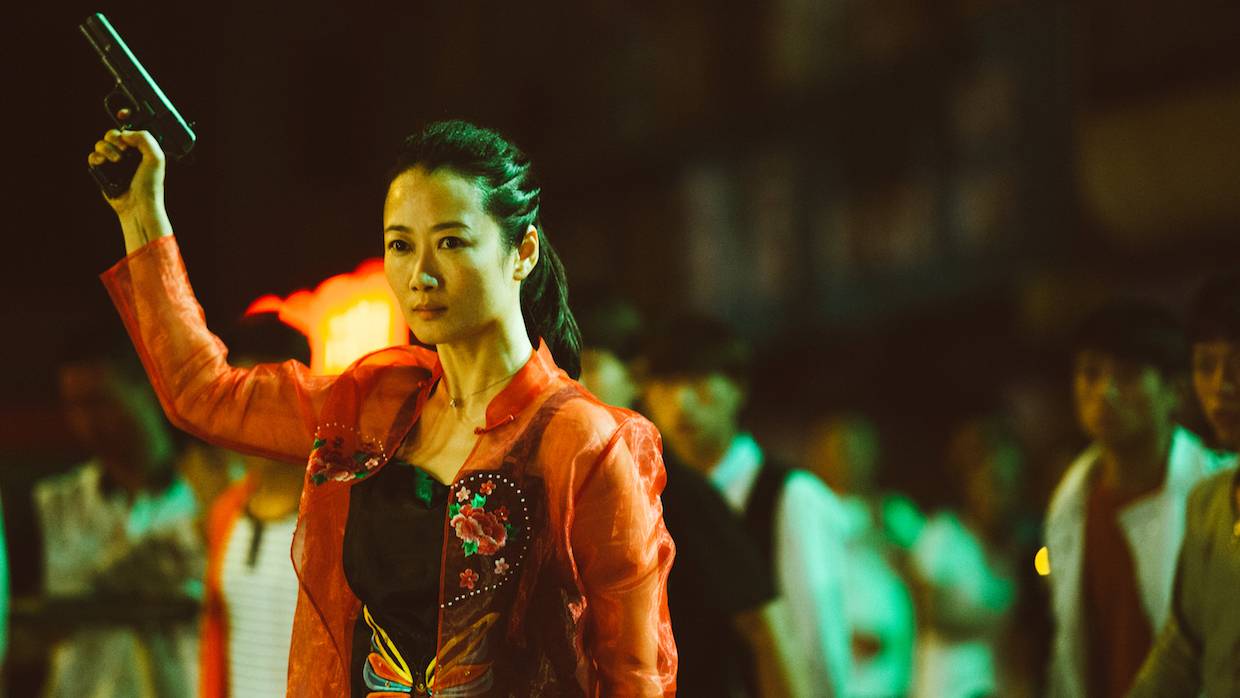
At the turn of the last decade, the writer-director Jia Zhang-ke made a decisive break for it. Having signed off on a series of elliptical works (notably 2006's Still Life and 2008's 24 City) which wouldn't have looked out of place as video art, he began a series of genre-influenced movies that consolidated his position as the conscience of Chinese cinema - the filmmaker best placed to capture the effects the country's rapid capitalisation has had on his compatriots - while lending him a renewed commercial appeal. You could claim this transformation as itself a consequence of capitalism - or at least a consequence of that strain of capitalism that insists the individual must adapt to market demands or risk being deemed surplus to requirements. Yet it seems equally likely that this shift in the filmmaker's thinking was down to a woman. In his early films, Jia appeared less interested in people as flesh-and-blood presences than as abstracts - vulnerable dots on changeable horizons. Since marrying the actress Zhao Tao in 2012, however, Jia has found himself obliged to come up with roles worthy of his bride's striking presence: the vengeful sauna receptionist in 2013's A Touch of Sin, the lovelorn heroine of 2015's Mountains May Depart, and now, in Ash is Purest White, a canary in the coalmine of China as it was in the first years of this century.

Seasoned viewers may be reminded of those much-exported period films Zhang Yimou completed thirty years ago - at another time, in another world - which offered up the director's muse Gong Li as part of some very pretty scenery. Yet over the course of the seventeen years described in the course of Ash, Zhao's Qiao is constantly moving against the grain of Chinese society - which is why she perhaps appears so at risk. When we're introduced to her in 2001, it's in a cold, hard mining town being sold off for private property, much to the despair of Qiao's radio-operator father. In search of shelter, she's taken up with Bin (Liao Fan, an actor with something of Powers Boothe's implacability), the heavy who runs the local gambling den and maintains friendly links with the developers. This gets Qiao in the room when big decisions are made, and bundles of money with which she intends to buy Dad one of those new houses; Zhao is particularly good at suggesting a woman who's grown used to the finer things in life. Still, we're left wondering just how much cover a brute like Bin can provide. The best he can do, it transpires, is hand her a stolen gun and a terse refrain of "It's every man for himself". When Qiao uses the weapon - not in anger, but to fire a warning shot after Bin is attacked in the street - she's the one who ends up serving prison time, as Jia pursues a tragic irony that speaks to the imbalances of power in this developing country: Qiao is willing to offer her man greater protection than he ever did her.

The second act - in which, removed of her former securities, Qiao re-enters a world that is all but unrecognisable in search of the guy who betrayed her - underlines how Ash stands as a synthesis of Jia new and old, a film built on earlier achievements. Early on, we watch the gangsters partying to the strains of the Village People's "YMCA", the kind of immediately recognisable soundtrack cue that would have been unthinkable amid the slower-burn likes of 24 City (but here follows Mountains May Depart's ironic deployment of "Go West"). In almost any other context, the song would be a cue for celebration; Jia cuts in what looks like documentary footage of workers in camps, contrasted with images of a newly leisured class in such a way as to flag up a growing divide in Chinese society. Qiao's search for Bin will take her to the Three Gorges Dam, site of Jia's Noughties inquiries, and shining symbol of the nation's development; the renewed focus positions the Dam as an Eastern analogue to the American West, a destination that has attracted exactly the chancers, swindlers and snake oil merchants those earlier films worried they might. The Dam itself is as sturdy a metaphor for the double-edged nature of state capitalism as 21st century cinema may have happened across, both a stunning logistical and architectural achievement, and a void built on bulldozed homes for the benefit of an elite few. Jia returns here to check the levels, not just of the waters, but the compassion in the hearts of those living thereabouts.

He does so with a sharply defined focal point in Zhao, quietly exceptional as Qiao transforms from cigar-puffing moll to meekly vulnerable patsy, becoming only more sympathetic as the extent to which the character is a victim of circumstance - a middling fish reduced to small fry and released into a bigger pond yet - becomes clear. In an especially telling episode, Qiao shows up at the Chamber of Commerce where Bin now works - a pointed development in itself - and fails to trigger the building's automatic doors, or attract the attention of the woman behind the desk there: the insider has suddenly become an outsider, and invisible with it. Jia sees her, of course: he sees the appetites that this flirtation with the big time has instilled in her, the needs (and neediness) it's left her with, the desperate sadness that attaches itself to her quest for renewed meaning and purpose. We are, evidently, lightyears away from the pretty complacency of the Zhang-Gong collaborations - the final third takes in UFOlogy and urban futurism, as if life has sped up beyond our own experiences, before describing the rut these leftovers wind up in - but this eminently absorbing and involving drama confirms confirms Jia, a master of cinematic space and time, as among the best guides we now have to what's up in China, and just what China might be up to.

Ash is Purest White opens in selected cinemas from today, and is available to stream via Curzon Home Cinema and the BFI.

"Styx" (Guardian 26/04/19)


Styx ****
Dir: Wolfgang Fischer. With: Susanne Wolff, Gedion Oduor Wekesa, Simon Sansone, Felicity Babao. 94 mins. Cert: 12A

Our creatives continue to form more imaginative and compassionate responses to the issue of mass migration than our politicians. Like recent TV conscience-prickers Home and Don’t Forget the Driver, Austrian director Wolfgang Fischer’s quietly gripping second feature immerses us in the debate around freedom of movement; cinematically, it’s not unlike a clever rethink of J.C. Chandor’s All is Lost. That terrific survival drama exerted a form of white privilege by having Robert Redford wrestle tempestuous seas on his lonesome, with no-one else around to steal his thunder or close-ups. Fischer and co-writer Ika Künzel float the notion there might be something more compelling and provocative yet in the sight of a struggling sailor encountering others in far worse conditions. For the earlier film’s collision of hulls, substitute a seismic and troubling collision of worlds.

Assuming the helm here is an amateur yachtswoman, Rike (Susanne Wolff), embarking on a planned recreational jaunt from Gibraltar to Darwin’s beloved Ascension Island. A prologue establishes her ability to handle a crisis as part of a paramedic team dispatched to a traffic accident; what Fischer then dramatises, quite brilliantly, is how hard it is to maintain such cool, rational positions once you’re adrift on your own, with finite space and resources, and storms battering you from every side. When Rike encounters a rusting vessel overloaded with African refugees off Cape Verde, she’s faced with an entire continent’s quandaries. Does she heed the slow-moving authorities’ terse communiques to maintain a distance, or lend the hand her fellow travellers are pleading for? If the latter, for how long can she keep that hand extended?

At any moment, we sense ship and film could tip either way. Vivid location shooting carries us some distance beyond platitudes, to a place where even the wind starts to sound indistinguishable from human howling. Yet Fischer’s resolutely responsible storytelling – leagues removed from any anti-migrant hysteria – anchors the film, as does Wolff’s intelligent, keenly felt performance as a capable, concerned citizen confronted by a situation that surely demands the same urgent collective action taken on land after multi-car pile-ups. No easy solutions bob into shot – there may be none – but the film retains a thriller’s hook in continually obliging us to assess Rike’s tough judgement calls, and may well endure as a representative work of this moment. Fischer literalises the turbulence we’re now navigating, and asks some Teutonically stern questions of our moral compasses.

Styx opens in selected cinemas from today.

"The Dig" (Guardian 26/04/19)


The Dig ***
Dirs: Ryan and Andy Tohill. With: Moe Dunford, Lorcan Cranitch, Francis Magee, Emily Taaffe. 97 mins. Cert: 15

Twins Ryan and Andy Tohill’s distinctive homecoming parable, further proof of Irish cinema’s resurgent boldness and versatility, finds a striking visual metaphor for the emotional labours required to find peace of mind nowadays. In the prologue’s teachable example of show-don’t-tell filmmaking, rough-hewn, edgy Ronan (Moe Dunford) returns to the boarded-up farmhouse he once called home with an apparent eye to starting afresh. An obstacle to the quiet life soon emerges, in the form of a crumpled older man, Sean (Lorcan Cranitch), observed digging up the adjoining peat bog. Why his quest agitates the prodigal farmhand is but gradually revealed, yet with admirable economy, the Tohills and screenwriter Stuart Drennan establish a stand-off between men in small dark holes who’ve sublimated all feeling into obsessive, possibly futile activity.

Certain shots framing these worker ants against the horizon reminded this viewer of Philip Haas’s underseen film of Paul Auster’s The Music of Chance, which set two disparate drifters to assembling a stone wall on an eccentric recluse’s estate. Yet the Tohills’ antagonists aren’t building but excavating, dragging themselves towards early or shallow graves; the idea of a long-buried past resurfacing in the Irish present carries a renewed resonance. Below the film’s mournful toplayer, indeed, there lurks a simmering, suppressed violence. We fear relations between this pair will only deteriorate if either party finds what they’re looking for, and while Sean’s daughter Roberta initially holds out some prospect of escaping these ruts, tending Ronan’s calluses and keeping a lid on da’s rage, actress Emily Taaffe gives even this prospective peacemaker her own flinty secrets.

That interior/exterior tension informs the whole picture, which often resembles a chamber piece yanked, for its own good, into a wide open space. Cinematographer Angus Mitchell, certainly, has a field day among these pitted landscapes and big brooding skies; this was evidently one of those shoots where everybody stood round waiting for the sun to go in. At times, the Tohills can be seen straining too hard for gravity. Roberta’s conspicuously filthy kitchen leaves us itching for a Brillo pad, and it’s a touch heavy-handed that closure should eventually be found at gunpoint. Yet it’s seen through and kept honest by committed performers who don’t mind getting their hands dirty: the bristling Dunford, haunted Cranitch and Francis Magee, as the old-school copper on everybody’s backs, etch subtly varied models of bruised, bloodied, borderline-toxic maleness. 

The Dig opens in selected cinemas from today.

Three strikes: "Rupert, Rupert & Rupert"


With due respect to acquaintances with the name, fears that the British film industry has become a playground for the upper-middle classes aren't likely to be much allayed by a film calling itself Rupert, Rupert & Rupert. (Nor, indeed, by the presence of a Pandora and a Daisy amid its cast list.) Father and son Mick and Tom Sands have here arrived at one of those self-produced brainscramblers we'd maybe thought were being weeded out of the release schedules, a film that has the honourable idea of exploring the stretch of hinterland separating creativity from mental illness, but which proves unfit for purpose on a scene-by-scene basis, and in places irresponsibly bad. Its set-up - struggling actor with multiple personality disorder comes off his meds at the exact moment he lands the lead role in a lost Christopher Marlowe play - is promising, in an early Farrelly brothers sort of way, and it's vaguely witty that one of the three Ruperts unleashed should be a ranting loon who meshes well with the Elizabethan vengeance tragedy, if not his castmates. Yet at every turn the execution proves more strange than funny or revealing: I'd challenge anyone not associated with the production to watch more than five minutes without developing a furrow in their brow the size of the Grand Canyon. (And if they're still watching at the entirely-WTF introduction of a publication titled Child Bodybuilding, I'd advise them to hold onto their heads, lest the questions of taste and intent being raised pop their skulls open altogether.)

The usual technical limitations of the poverty-row Britpic are front, centre and very much in your face: Rupert's bedsit, with its close-ups of used condoms stuck to the pillows, is an unnecessarily dismal and dead-end location, and even when the Sands relocate to the theatre, matters don't noticeably improve, a camera set up on some temporary seating wobbling whenever characters walk past. The theatreland setting, however, is but a proscenium arch enabling hyperventilating leading man Sandy Batchelor to quiver, howl at the moon, go apeshit on the one item of furniture the budget allows for, and gaze lasciviously at the supporting actresses reduced to their underwear by a plot device apparently sourced from Patrick Stewart in Extras. It is just possible that Rupert's haphazard progress towards something like happiness was intended as a sincere comment on the difficulties faced by those living with this condition, and perhaps on the levels of abuse that have traditionally been tolerated behind the scenes of showbusiness in the pursuit of high art and great truth. On screen, however, it registers as a mostly exhausting acting showcase, and a piddling members-bar joke that lands somewhere between fluffed and utterly misdirected.

Rupert, Rupert & Rupert opens in selected cinemas from today. 

Dirty work: "Loro"


What's billed as the new Paolo Sorrentino film, Loro, is actually two films in one - or, rather, a selected highlights package of same. Sorrentino's first project after floating The Young Pope onto our satellite channels was conceived as a diptych of features, each one around 100 minutes in length, on the rise to power of Silvio Berlusconi; after their domestic release, these were edited into one two-and-a-half-hour movie for easier international consumption. The results display an unevenness and eccentricity that are as much to do with form as content. Sorrentino retains both the interest in Italian power structures he demonstrated with The Family Friend, the Andreotti biopic Il Divo and the coda of The Great Beauty, and that most un-A.J.P. Taylor-like fondness for recreating the above in the kind of brightly lit, fast-cut, ADHD-inducing images more commonly associated with pop promos and ad campaigns. Not for Sorrentino the austerity of a Roberto Rossellini when it comes to excavating the past; instead, he dives into altogether enthusiastically into the corruption and toxicity of the Berlusconi years. The extensive legal disclaimer placed very carefully before the main feature is the last time for 150 minutes you could Loro of being circumspect.

Its line of approach is perhaps its most measured aspect. Berlusconi himself will eventually assume centre stage, played by chameleonic Sorrentino fave Toni Servillo as a free-roaming Cheshire Cat grin supplemented by liberal applications of hair oil, yet for much of the first hour, we find ourselves in the dubious company of Sergio (Riccardo Scamarchio), a small-time pimp with aspirations of becoming a political player who embodies the flaws of the system that held Berlusconi up. Silvio has the power, pulling Italy's strings from the lakeside villa that served as his Mar-a-Lago, but the upwardly mobile Sergio grants the film access: to the well-to-do chatterers hymning the country's newfound "economic energy", and to those sex workers offered up to politicos as a way of securing crucial votes. It's a smart, clear-eyed authorial move, underlining how it took more than one man to throw a bunga-bunga party, and that Don Silvio was but the tip of an especially grimy and compromised iceberg. On set, however, Sorrentino looks to have succumbed to more sensational instincts. Nothing represents Loro as a whole more than the look Sergio gives the camera around ten minutes in while banging one of the girls we've just seen him offer as a bribe, a look that both acknowledges that his is a filthy business, while also seeming to ask the viewer whether they, too, wouldn't love a bit of this. Consider that advance warning of a decidedly horny history - or at least a history that comes on strong, as per Berlusconi legend. Adhering to Sergio's catchphrase "Show me a tit", there's barely a frame in the opening 45 minutes without a mammary thereabouts; your mileage thereafter will depend on the extent to which you find this representative rather than exploitative, and whether even "a bit", in this context, strikes you as too much.

It both helps and hinders that this international cut is such a ragbag; possibly Sorrentino himself wasn't sure what form this material should best take. (I could see clear episode breaks in here - and on TV, it wouldn't seem quite so weird that Sergio disappears for an episode or two.) The single-sitting Loro hits upon extraordinary sights and sequences: a mysterious prologue involving a lamb, a quiz show and an air con unit; a bald-pated PA who suggests a Mediterranean brother to Robert Blake's character in Lost Highway; an exploding garbage truck that seems to cover the whole of Italy with its contents; a recreation of the 2009 L'Aquila earthquake that chimes with the theme of a country being shaken to its rotten foundations. (Sort of brilliant, too, that a film in which an ageing satyr promises to show one young visitor a real-life volcano erupting should instead climax with a papier-mâché replica sputtering out.) And it seizes upon patches of revealing, instructive writing: Berlusconi refuting his grandson's observation that he's just stepped in poop - insisting that he could never step in poop - because only a mediocre mind would believe such a thing, positioning himself as post-truth before the fact. (I also liked Silvio telling Sergio to make sure his bunga-bunga girls eschew the wearing of high heels as "we're not very tall".)

That these isolated moments pop out so, however, is in part down to the film's wafflier, less effective writing and superfluous scenes of bacchanalia, which survive into this cut long after a point has been made. The unreconstructed breastiness is one thing; I personally could also have done with far less of Silvio's singing, although I suspect his houseguests would have thought the same thing. Throughout, we're dangerously close to seeing a national tragedy being replayed as a joshing diversion of the kind Berlusconi's own TV networks dealt in, a feeling only heightened when Servillo pops up in a second role as a businessman keen to finance Berlusconi's political progress. Editorial is being generated here about the kind of tinpot chancers restyling themselves in this Teflon despot's image, but mostly it's a comedy turn in a film that doesn't appear unduly concerned with the sufferings of the Italian people. Sorrentino, granted, makes the regime's superficiality - the slick salesmanship that made fools of millions, the eyecatching surfaces concealing all manner of crimes and misdemeanours - dazzlingly apparent. Yet just as some felt Scorsese's The Wolf of Wall Street was all too readily available for misappropriation by braying city yahoos, you sense Berlusconi wouldn't be unduly miffed by this lengthy portrait of himself as a master manipulator surrounded by pretty girls with their bits on display like game-show prizes. No legal action has as yet been taken against Loro; in our era of shamelessness, there may be no longer be such a thing as bad publicity. Sorrentino, for his part, emerges from the edit suite with his reputation as a remarkable imagemaker intact, yet questions continue to linger as to whether those images hold much of real substance, and add up to anything more than the shiniest, most flattering of mirrors.

Loro is now playing in selected cinemas, and streaming via Curzon Home Cinema.