Saturday, 13 April 2019

From the archive: "Zero Dark Thirty"


The official Bin Laden movie arrives laden with controversy. Accusations persist that Kathryn Bigelow has, in obtaining access to classified documents, compromised the filmmaker’s ethical code; worse yet, that she’s effectively pledged her troth to Jack Bauer, and become a flagwaver for state-sanctioned torture. Can it be true? Could the director who displayed a rigorous critical intelligence in such pre-Oscar titles as 1995’s Strange Days really have started plastering up officially licensed images with the indiscriminate fervour of a teenage One Direction fan covering her bedroom with posters of Harry Styles?

It’s a droll irony, then, that Zero Dark Thirty should open with a blank screen. We see nothing, instead listening to various audio recordings collated on the morning of September 11, 2001 – terse check-ins from air traffic control, desperate calls home from those trapped in the Twin Towers – which speak more potently (and more emotively) than any tired newsreel now would. The darkness we’re plunged into may be most crucial to our understanding of Bigelow’s film: early notice we can read whatever we like into what follows.

Cut to: Islamabad, 2003. A CIA agent (Jason Clarke) is overseeing an interrogation – involving waterboarding and various other forms of torture – that will yield scraps of information pertaining to the suspect known internally as “Usama”. Now we hear the buzz and crackle of authentic-sounding terminology (“the KSM network”, “ISI”) whose precise significance writer Mark Boal trusts us to figure out for ourselves. One helpful analyst is Maya (Jessica Chastain), a fiery addition to the line of Bigelow’s previous heroines, presented as some way smarter – or more intuitive – than the men around her: what she will observe, over the next decade, is a steady stream of intelligence gains and losses.

The film’s political stance – to these eyes, broadly neutral, and as stand-offish as The Hurt Locker was before it – may provide less of an issue than its procedural form, which automatically insists everything that happens in scenes one and two (9/11; the torture of an Al-Qaeda operative) leads somehow to scene 220 (the death of Osama Bin Laden at the hands of U.S. marines). In fact, as last week’s tragic events in Algeria suggest, this is active history, the facts of which have yet to settle fully. TV hits like 24 and Homeland have on some level understood this, and enjoyed bending these facts into various provisional, pre-emptive shapes; Zero Dark Thirty, by contrast, is presented with a steely seriousness that suggests this one’s very much for the record.

And yet, even on an initial viewing, those of us with relatively low-level intelligence clearance can spot there are problems within the film itself. The opening hour-and-a-half’s not-so-potted backstory includes a distinctly cursory recreation of the July 2005 bombings in London (one bomb, on a bus carrying the wrong number and no advertising) that, within the film’s syntax, serves a similar purpose to those punctuating single-shots of global landmarks being blown away in Michael Bay movies. Back at base, meanwhile, strawberry-blonde shortcake Chastain appears at all points just too dang sweet for the task she’s undertaking, having to fall back on some very Bigelovian signifiers (bad-ass Aviator shades, a trouser suit, one pointed instance of cursing) to try and persuade us she can mix it with the Agency’s big boys.

The film’s strength is its big-picture thinking. ZDT is good on the grimness of the past decade’s geopolitical landscape, evoking a strong sense of one atrocity following hard on the heels of another, and only being compounded by haphazard and ham-fisted official responses. Maya can’t even go out to dinner without a bomb going off in the restaurant, which is perhaps why Boal denies his characters any life beyond their day jobs; their security can just about be guaranteed within compounds. Bin Laden’s death is presented as the end result of a process of entrenchment that turned the U.S. into a wounded animal, viciously fighting its corner. “I want targets… bring me people to kill!,” demands Mark Strong’s Agency chief; clearly, people were killed, but recent news suggests any victory may have been more symbolic than lasting.

Accordingly, ZDT comes in only just behind Amour as the 2012-13 award season’s grimmest film: staffed by bureaucrats and functionaries, largely bereft of humour, somewhat like parsing several thousand words of porridgey Washington Post prose to get to the one or two paras that might stir the blood or chill the marrow. It’s undeniably a masterclass in movie logistics – admirably smart in its setting out of corridors, networks and systems – and is being recognised as such. Yet for all the ambition Bigelow displays here, I spent a good part of the running time wondering whether both she and we alike would be better off revisiting Point Break. You get fewer arguments – and generally more fun – with Keanu.

(MovieMail, January 2013)

Zero Dark Thirty screens on ITV tonight at 10.35pm.

Friday, 12 April 2019

For what it's worth...


Top Ten Films at the UK Box Office 
for the weekend of April 5-7, 2019:

1 (new) Shazam! (12A) **

2 (1) Dumbo (PG) **
3 (new) Pet Sematary (15)
4 (2) Captain Marvel (12A) ***
5 (new) Peppa Pig: Festival of Fun (U)
6 (3) Us (15) ****
7 (new) Missing Link (PG) ***
8 (4) Fisherman's Friends (12A)
9 (new) The Sisters Brothers (15) ****
10 (5) What Women Want (15)

(source: theguardian.com)

My top five: 
1. Monty Python's Life of Brian

2. Wild Rose
3. The Sisters Brothers
4. A Clockwork Orange
5. Kalank


Home entertainment Top Ten (DVD/Blu-Ray/Download): 

1 (4) 
Ralph Breaks the Internet (PG)
2 (2) Bohemian Rhapsody (12)
3 (1) Fantastic Beasts: The Crimes of Grindelwald (12)
4 (new) Spider-Man: Into the Spider-Verse (PG) ***
5 (3) Creed II (12)
6 (5) Robin Hood (12)
7 (6) A Star is Born (15) ***
8 (new) Annihilation (15)
9 (16) Incredibles 2 (PG) ****
10 (14) Christopher Robin (PG) **

(source: officialcharts.com)

My top five: 
1. An Impossible Love
2. Widows
3. Wildlife
4. The Wild Pear Tree
5. The Guilty


Top five films on terrestrial TV:
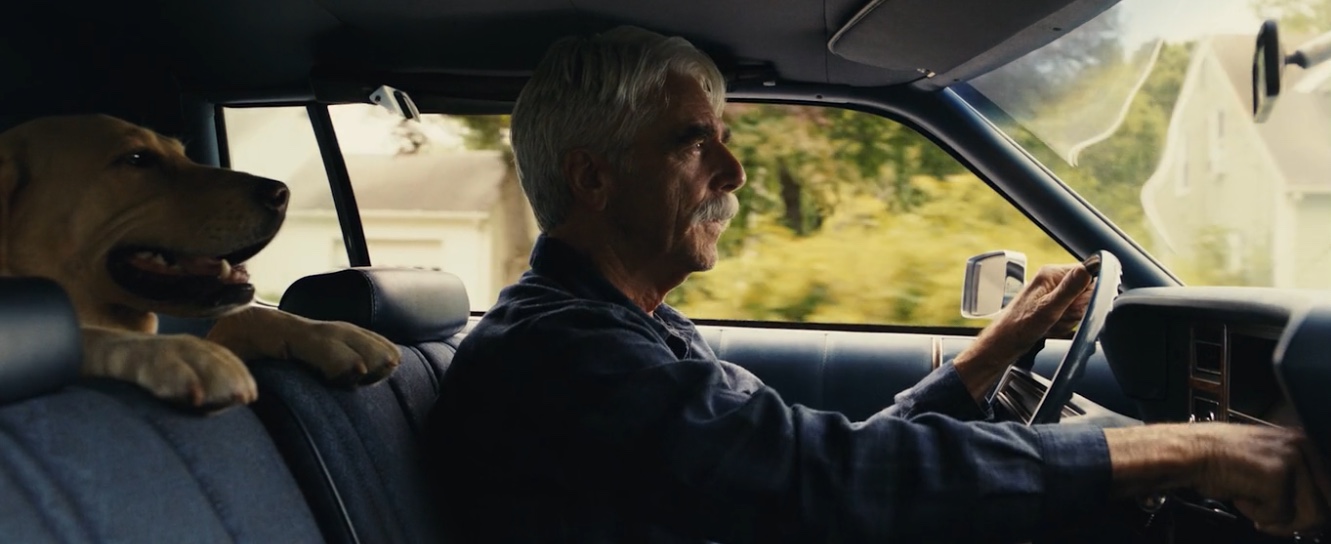
1. Robot & Frank [above] (Good Friday, BBC1, 12.05am)
2. Flushed Away (Good Friday, BBC2, 10am)
3. Sing Street (Saturday, C4, 12.10am)
4. Zero Dark Thirty (Saturday, ITV, 10.35pm)
5. Top Five (Sunday, C4, 11.55pm)

Big game hunter: "The Man Who Killed Hitler and Then The Bigfoot"


The curious chronology of movie careers - in association with the itinerant lifestyle of our performers - presents us this weekend with a solid film quiz question: which actor followed up an Oscar nominated turn in a prestige musical revival with the role of the man who killed Hitler and then the Bigfoot? The answer: Sam Elliott, who consolidates the comeback set in motion by last year's A Star is Born with a properly anchoring lead performance in cult-seeking missile The Man Who Killed Hitler and Then The Bigfoot. The title of Robert D. Krzykowski's film suggests it may have been beamed in from the same bizarro dimension as Don Coscarelli's quietly cherishable 2002 romp Bubba Ho-Tep, in which a nursing-home Elvis and a black JFK teamed up to see off a rampaging Egyptian mummy, yet it's never quite that goofball, and may in fact bearer closer relation to all those Silver Screen-ready Britpics about oldtimers searching for a renewed lease of life. For most of the film's first act, we're simply watching Elliott, toothbrush-upright as ever as the former Army man Calvin Barr, pottering around his quiet suburban neighbourhood with dog in tow, being besieged by flashbacks to his days in uniform - when, as embodied by Poldark's Aidan Turner, he seemed to have far greater purpose - and generally biding time until either death or some new mission comes along. Bubba Ho-Tep smuggled some editorial on how we treat our seniors into a riotous horror-comedy; this does something comparable with the plight of America's veterans, and what we might learn from them.

Either way, Calvin Barr could do with a jolt of adrenaline, and so too could the film, which - though likeable - suffers from some laboured pacing, with at least a couple of early sequences seeming to take forever to get to their point. (It may be deliberate scene-setting, but still feels as though there's some doddering old coot behind the camera.) You may well be reassured, however, by Elliott's innately sympathetic presence. Without ever seeming to strain, the actor sketches out the lifetime's worth of regrets - the missed shots - weighing on this character's mind; he crafts an easy bond with barber brother Larry Miller (at one point, a crestfallen Miller asks "You let someone else cut your hair?"); summons barely concealed disgust for Ron Livingston as the Fed who shows up one night to enlist Barr to pursue Bigfoot through the Canadian wilds; and more generally plays the hokum required to keep this story moving with the exact same conviction as he did anything in Star. It sets us up for a final act that sets out like an analogue redo of the recent Predator rethink, pitting one furry-faced legend against another. Yet the outcome of that tussle is less important in the film's worldview than one final flashback in which Turner and Masters of Sex's Caitlin FitzGerald do poignant work as a small, everyday romantic tragedy waiting to happen - one that might linger over any man, no matter whom he's killed. I don't doubt that some will be thrown and disappointed by the fact this isn't really a film about the killing of Hitler and the Bigfoot, or at least where the killing of Hitler and the Bigfoot proves secondary to something more considered and sincere. Still, the movie's disarming charm derives from that fact - that it's so obviously not what anybody would expect going into a film called The Man Who Killed Hitler and Then the Bigfoot, and evidently the handiwork of a filmmaker doing his darnedest to surprise us. Krzykowski pursues his own idiosyncratic path out of the bunker and into the woods; I hope we see a lot more from him than we have of late from the Bigfoot, or indeed from Hitler.

The Man Who Killed Hitler and Then the Bigfoot opens at London's Prince Charles Cinema today, ahead of its DVD release on May 6.

"Amazon Adventure" (Guardian 12/04/19)


Amazon Adventure ***
Dir: Mike Slee. With: Calum Finlay, Bege Muniz, Ed Birch, Billy Postlethwaite. 46 minutes. Cert: PG

In places, this satisfying IMAX edutainment brings forth happy memories of James Gray’s excellent TheLost City of Z. It’s a tribute to another overshadowed historical figure, that of Henry Bates, the Leicester-born amateur scientist – and Alfred Wallace associate – who struck out for the Amazon in 1848 charged with collecting insects at threepence per bug, and in so doing indirectly gathered the evolutionary proofs that backed up Darwin’s On the Origin of Species. What Bates (embodied here by an engaging Calum Finlay) observed in these parts – when he wasn’t bleary-eyed from malaria – were “leaves that could fly, bird droppings that could walk”: i.e. those craftier critters whose predator-bamboozling camouflage was so well developed they hadn’t previously been spotted. Here’s what scientists talk about when they talk about “Batesian mimicry”.

Director Mike Slee (who enjoyed a big IMAX hit with the Judi Dench-narrated Bugs! back in 2003) and screenwriters Carl Knutson and Wendy MacKeigan recognise that Bates’s fieldwork might itself pass usefully for Saturday-morning matinee fare. Verdant Brazilian location work plunges us from the opening moments into a fully immersive jungle environment, complete with such adventure-movie staples as shipwrecks, hungry leopards and mischievous monkeys. Yet this team also find smart and invariably visual means of illustrating their human subject’s breakthroughs. When a chain of stereoscopic butterflies flutters across our field of vision, each insect bearing similar yet subtly distinct markings, it’s the 3D equivalent of a lightbulb moment: you feel you could literally grasp Bates’s working.

Possibly the first-person narration holds a little too dear to the earnest tone of this wonderboy’s letters home; the youngsters around me at the press screening grew restless towards the end of an otherwise brisk 40 minutes, as the cuddly animals receded from view, and Bates returns to civilisation to prove Darwin right in the face of a harrumphing popular press. Yet the film sets about its task in the same spirit of wide-eyed wonder as its subject, using movie art to bolster its science, and thereby retooling the IMAX screen to serve as a high-powered microscope. Under Slee’s direction, even the teensiest creepy-crawlies find themselves noted and taxonomized; encouraging to see a format that generally sets audiences to non-specific gawping attempting once again to focus and refine our gaze.

Amazon Adventure is now playing at IMAX cinemas in London and Glasgow. 

"Wonder Park" (Guardian 12/04/19)


Wonder Park **
Dir: uncredited. Animation with the voices of: Sofia Mali, Jennifer Garner, Tom Baker, John Oliver. 85 mins. Cert: PG

This middling half-term timekiller arrives trailing an unusually troubled production history. It may be destined to crop up in film quizzes as the first major studio release to bear no directorial credit whatsoever, the result of Pixar alumnus Dylan Brown being fired from the project after allegations of inappropriate behaviour. (The closing credits don’t even reach for a token Alan Smithee, the pseudonym traditionally deployed when a filmmaker has chosen to disavow final cut.) An anonymous committee of animation pros was subsequently assembled to complete a salvage job we can, with some generosity, describe as semi-successful. Both you and your children will have sat through many worse films that took far easier routes to the screen – which is not to say that Wonder Park isn’t also immediately forgettable.

One key issue is familiarity. Brown and co. have taken two elements that have always tested well among the under-tens – talking animals and theme parks – and snapped them like Duplo blocks into a framework that recalls the split-level reality of Inside Out. Our heroine June (voiced first by Sofia Mali, then Brianna Denski) is a spirited suburban preteen who spends her waking hours designing small-scale log flumes and loop-the-loops for her collection of plush toys. Her faith in play is first tested when her mother is hospitalised with an unnamed condition – trigger warnings may be necessary for families who’ve undergone similar experiences – then reaffirmed when she ventures off the beaten track at maths camp and discovers the Disneyland of her daydreams has become an actual thing.

The whistlestop tour we get alights upon several idiosyncratic, Pixar-ish touches. June has a funny, catastrophising vision of her pop allowing the family home to descend into crows-nesting-in-the-fridge disarray, and having the real park overrun by zombified merchandise is an amusingly surreal flourish. Still, too often it succumbs to the default mode of so much makeweight digimation: a manic movement, indistinguishable from panicky insecurity, which yanks us past anything of substance, and shucks off all but the mildest charm. This theme park exists not to explore the strengths and limitations of June’s imagination, but so the characters can be pinballed around at 100mph. The eye is caught and sometimes diverted – with its Slush Puppie palette, it’s uncommonly pretty – but very little about it sticks. 

Wonder Park is now playing in cinemas nationwide.

Thursday, 11 April 2019

Ya basic: "Shazam!"


Landing in that putative multiplex dead zone between last month's Captain Marvel and the apparently epochal Avengers: Endgame, Shazam! has quickly entered the discourse as "DC only, you know, for kids" - thus distinguishing itself from the 37 other 12A-rated superhero movies to have come our way in the past two years, none of which, if I remember correctly, was exactly Solzhenitsyn. In one respect, however, this new arrival does present as unique. Here is a latex test balloon floated by the studio system to determine whether, in the current climate of manic comic-book consumption, it might be possible to fashion a hit, and perhaps a franchise, from the most basic ingredients: no stars (Mark Strong, Tosker from Our Friends in the North, will be the most recognisable face for UK viewers), a non-name director (David F. Sandberg, of Lights Out and Annabelle: Creation), and next to zero brand recognition. With their casting and marketing heft, the Avengers derivatives are always going to be events of some kind, but Shazam! is Hollywood in Henry Higgins mode, seeing whether it can transform a modest smattering of scraps, rags and cast-offs, the dog-ends of ideas smoked elsewhere in the movie mainstream, into something the comic-book fraternity will eventually want to take home with them on Blu-Ray or DVD.

The task, I'm afraid to say, requires a lot of effort, and generates little in the way of art or magic. The first act labours dispiritingly to put all its pieces in play: we end up at the point where orphaned teen weakling Billy Batson (Asher Angel) inherits a power that transforms him into the eponymous buff six-footer (Zachary Levi), but it takes a full half-hour of mirthless mumbo-jumbo to get there. (At 132 minutes, this is one of those nothings that demands a lot of audience indulgence; the Christmas backdrop suggests it missed at least one production deadline.) Once it's established we're dealing with a kid in a grown man's body, you start to feel the film sliding its feet under the table, and relaxing into the idea of a superhero movie with something of Big or Vice Versa in its DNA - the kind of minor genetic mutation that qualifies as a USP in a stagnant marketplace. Levi-as-Shazam - acting under Billy's commands, remember - first uses his new form to buy beer in a convenience store; when robbers burst through the doors and unleash a fusillade of (deflected) bullets his way, his first response is to ask his sidekick Freddy (Jack Dylan Grazer) to film it so the clip might go viral. Switching between identities as if operating a lightswitch - this is DC doing superhero casual, lest we forget - Billy/Shazam is the first time this cycle has foreground the kind of manchild traditionally thought to frequent superhero movies. Whether Shazam! does anything interesting or challenging with the character is another matter.

The best this painfully ordinary script comes up with is to pitch the character into a series of skits, an approach that might work if Levi, a neutered Ben Affleck, were less bland of a focal point (seriously: you spent two hours watching the guy, and you still couldn't pick his face out of a line-up at the end of them) or had recognisable jokes rather than spitballing references to deliver. Shazam is a PG-13 Deadpool, and nobody would need one of those had we not all been conditioned to respond to these things like trained seals awaiting fish. Nothing should forgive the brazen unoriginality of the training montage set to Queen's "Don't Stop Me Now", and everybody's stepping close to that line when, mid-pursuit, Shazam runs across a toy store's electronic floor piano. The discordant notes struck here only serve to remind us how Big had a story, some heart, and most of all a worldview that a disposable popcorn-shifter like this doesn't have anything like the maturity to set forth; gestures, whether derivative or empty, are all Shazam! has, and you feel it killing time until our hero and Strong - as a rent-a-baddie identified chiefly by his dodgy eye - can start laying waste to several city blocks. That confrontation throws up the movie's only worthwhile joke - premised on the haphazard nature of shouting speeches into space - but by then we're galloping towards the final affirmation of manboyism, and the promise of starrier, more substantial adventures to come. You enjoyed these titbits, didn't you? Good boy.

It has the same shape as its superhero predecessors, then, but only a small measure of their slickness and - I use the term guardedly - dramatic weight. Where the Marvel machine carries on churning out rounded product on a bi-monthly basis, DC continue to deal in flabby grabbags of ideas, with only its wilder notions (Aquaman, the Snyder cut) seeming to gain any traction. In playing very safe and nice, Shazam! only reveals itself as a good deal more threadbare than its predecessors; indeed, up until its VFX-heavy finale, which is evidently where the bulk of its budget went, the film's chief identifying feature is its cheapness. Nondescript frame after nondescript frame bears out the production values of the average Vancouver-shot TV movie, which would be fine for the TV movie in question, but strikes one as more than faintly depressing to see in the #1 movie on the planet right now, because it suggests audiences (and many critics) have given up expecting anything more from their blockbuster entertainments. Given the heightened levels of excess and repetition in this particular cinematic field, given that we have the three (count 'em, three) hours of Endgame hanging over us all like a spandexed Schindler's List, I can just about see why some have found something cheering in Shazam!'s return to basics, its humble artisanal quest to patch 21st century effects work into the generally analogue work being done in this field twenty-to-twenty-five years ago. Yet it is basic, as basic - and about as nutritionally rewarding - as chewing on cardboard or straw for two hours and twelve minutes.

Shazam! is now playing in cinemas nationwide.

Tuesday, 9 April 2019

Relativity: "The Sisters Brothers"


As its title suggests, The Sisters Brothers is principally made up of elements that don't or shouldn't connect up, or which only connect up in peculiar ways. Here is a film-reminder of the fact there was once a time, not so very long ago, when America could legitimately have been described as the Disunited or Estranged States, fumbling its way towards some notional national cohesion. Some will argue that it's not quite there yet. At its centre are a pair of siblings who are deployed by the powers-that-were as hired guns, but who would otherwise appear to have little in common but a surname. The sottish, reckless Charlie Sisters (Joaquin Phoenix) does the majority of the shooting; the more genial Eli (John C. Reilly) is content to hang back, either as a result of his seniority, or his physical bulk. As we join them, they've been pitched up the trail by a Commodore (a spectral Rutger Hauer, glimpsed briefly through a window, heard from not at all) to link up with a dandyish scout (Jake Gyllenhaal, an American trying an English accent) who's been keeping tabs on a rogue prospector with a considerable bounty on his head (Riz Ahmed, a Brit with an American twang). There's something strangely mathematical about the film's formulation: we're watching the working out of simultaneous equations, one involving figures who don't obviously tessellate - you at first struggle to reconcile Phoenix and Reilly as blood brothers - the other two individuals who mesh unexpectedly. The $64,000 question is whether the four of them are about to add up, or will simply cancel one another out.

The end credits will reveal one further incongruity: that The Sisters Brothers has been brought to the screen by Jacques Audiard, the French writer-director behind 2009's A Prophet. (If that's not odd enough, consider the fact a Western produced by Belgium's Dardenne brothers and Romania's Cristian Mungiu is currently holding down Screen 12 at the local megaplex.) We should bear in mind, however, that Audiard is one of those Gallic auteurs who've long displayed an affinity with Americana: it was evident as early as his 1994 gangster movie See How They Fall, and came to full fruition in 2005's The Beat That My Heart Skipped, his nimble Parisian rethink of James Toback's Fingers. What Audiard and regular co-writer Thomas Bidegain may have seen in Patrick DeWitt's source novel was a continuation of a recurring theme in their own work, namely the ways men position themselves in relation (and sometimes opposition) to one another. With Hauer's white-haired Commodore presenting as a predecessor to Niels Arestrup's distant father in The Beat That My Heart Skipped, obliging the younger men to carry out his dirty deeds, the new film establishes a pecking order with notable economy, then watches everybody shuffle up and down it. What keeps the film from the arch eccentricity it threatens to strike out towards is Audiard's patient, classical storytelling. We're always aware of just where these two-by-twos are and who's on who's side at what time, and crucially the director doesn't ever force his disparate narrative elements together in a bid for some commercial gold rush. More Eli than Charlie, Audiard's happy to drop back and observe how far these men will go in pursuit of their goals, to see how and why they fall.

The results prove vastly more even and rewarding than the Coen brothers' recent The Ballad of Buster Scruggs, which felt (to this viewer at least) like a half-dozen stray thoughts scrawled on the back of an envelope and sold on to Netflix at top dollar. Audiard's film has the sly, connoisseurial appeal of a character piece disguised as a linear chase movie: the further we get along the route, the more we get to know, good and bad, about these distinct and distinctive cowpokes. The roles cry out for excellent company above all else, and Audiard has availed himself of at least two of the best American actors currently working. Phoenix and especially Reilly - quietly extraordinary here, even by this actor's own high standards - succeed not just in conjuring a deep-rooted, protective fraternal bond, but in getting us to root for a pair who've earned an entirely justified reputation as cold-blooded killers. Much of that achievement stems from Eli's galumphing openness to new experiences, be that a hotel water closet or the newfangled toothbrush, and the attention he sporadically pays to those small moments of beauty that present themselves amid the discharging of pistols and the thundering of hooves: the wind rustling the treetops, or a curtain flapping in the breeze, the latter a poignant madeleine of an earlier, more domesticated existence. This America hasn't yet fixed or finalised itself, so we see no reason why a relatively cultured fellow like Eli shouldn't put down the gun and live more peaceably; his evident love for Charlie, his sometimes exasperated attempts to keep the kid from doing something mortally stupid, leads us to conclude he might be worth saving, too.

Which is to say The Sisters Brothers is far lighter and gentler in its Darwinism than the often brutal (and pretty chilly) A Prophet, but both films strike me as very much caught up with men confronted by a stark fork in the road: evolve or die. As the one scientist among this party of four (carrying, it transpires, several barrels of misappropriated catalyst) optimistically phrases it: "We'll all change - we don't have any other choice." Audiard, making his own decisive and largely successful mid-career shift, runs up against one obvious visual limitation, perhaps connected to his lowly status as a first-time director in the New World. This is the kind of big, elegiac throwback picture that cries out for the crisp definition of film; it instead gets rather sketchy digital photography, which renders some of the night and (otherwise capably handled) action scenes lamentably smeary. I also wonder whether some viewers will see it as a weakness that - beyond a late and very welcome cameo - Audiard and Bidegain see little place for the fairer sex in this world, although the absence of women allows the men to run the emotional gamut from murderers to nursemaids. Rather than hardened by their experiences out on the range, these brothers come to be softened, opened up one way or another: their final destination is both unexpected, and unexpectedly lovely. It's the kind of odd, angular, melancholy venture you'll likely find ricocheting around inside your head in the weeks between now and HBO's forthcoming Deadwood pay-off - and here, at last, might be the project The Sisters Brothers most readily lines up with: another supremely characterful illustration of the radically different impulses on which modern America was founded.

The Sisters Brothers is now playing in selected cinemas.