Friday, 9 November 2018

For what it's worth...


Top Ten Films at the UK Box Office 
for the weekend of November 2-4, 2018:

1
 (1) Bohemian Rhapsody (12A)
2 (2A Star is Born (15) ***
3 (new) The Nutcracker and the Four Realms (PG)
4 (4) Smallfoot (PG) ***
5 (5) Johnny English Strikes Again (PG)
6 (6) Goosebumps 2: Haunted Halloween (PG) **
7 (3) Halloween (18)
8 (8) Venom (15)
9 (new) Slaughterhouse Rulez (15)
10 (new) Peterloo (12A)

(source: theguardian.com)

My top five: 
1. It's a Wonderful Life

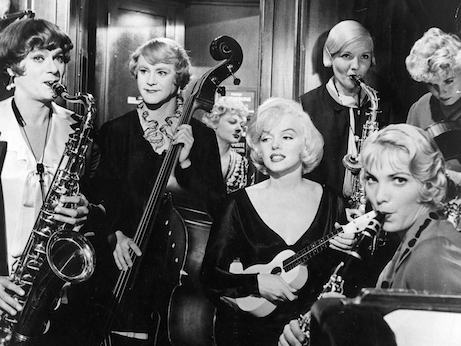
2. Some Like It Hot
3. Widows
4. Possum
5. They Shall Not Grow Old


Home entertainment Top Ten (DVD/Blu-Ray/Download): 

1 (new) Jurassic World: Fallen Kingdom (12) ***
2 (new) Sicario 2: Soldado (15)
3 (2) The Greatest Showman (PG)
4 (1) Ocean's 8 (12)
5 (new) The First Purge (15)
6 (new) Sherlock Gnomes (U) **
7 (7) Hocus Pocus (PG)
8 (5) Solo: A Star Wars Story (12) ***
9 (6) Coco (PG) ***
10 (8) Deadpool 2 (15) **

(source: officialcharts.com)

My top five: 
1. Leave No Trace

2. First Reformed
3. Lucky
4. Whitney
5. Summer 1993


Top five films on terrestrial TV:
1. Love is Strange (Sunday, C4, 12.45am)
2. Testament of Youth [above] (Sunday, BBC2, 11.05pm)
3. Headhunters (Saturday, BBC2, 11.30pm)
4. They Shall Not Grow Old (Sunday, BBC2, 9.30pm)
5. Mud (Saturday, C4, 12.15am)

"Thugs of Hindostan" (Guardian 09/11/18)


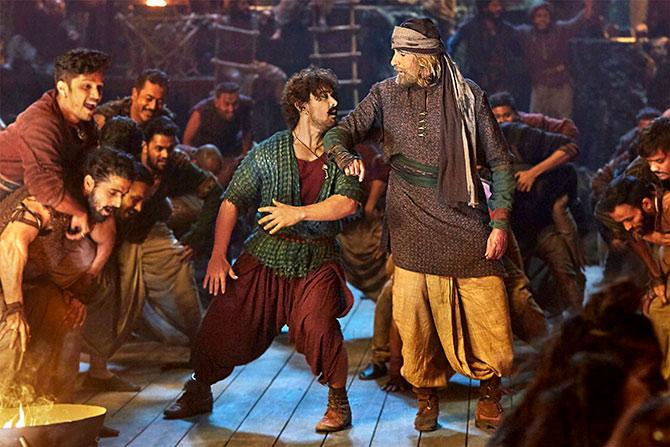
Thugs of Hindostan ***
Dir: Vijay Krishna Acharya. With: Amitabh Bachchan, Aamir Khan, Katrina Kaif, Fatima Sana Shaikh. 164 mins. Cert: 12A

Boosted by Baahubali, commercial Indian cinema has big things planned before the year’s out, among them Tamil superstar Rajinikanth’s return in 2.0 and Shah Rukh Khan reducing himself to a visual effect in Christmas release Zero. This, however, is the biggest of all: a 164-minute period swashbuckler that deploys Bollywood’s grandest ever budget and megastars Aamir Khan and Amitabh Bachchan to stage a pirate uprising against the East India Company. (As if it weren’t big enough, it’s also playing widely in IMAX.) As early use of Benny Hill-style fast-motion and some close-to-the-knuckle flirting between Khan and dancing girl Katrina Kaif insinuate, it is also – not unlike Disney’s Pirates of the Caribbean – big, daft pantomime, and might be enjoyed as such with a school’s-out mindset and the right bag of snacks.

You’ll need to make peace with the fact plot matters less than the prospect of major stars running rings around one another. The first half floats the question of who might best lead the rebellion: grizzled salt Khudabaksh (Bachchan, still a mighty screen presence at 75, despite understandable slowness in the action scenes) or Khan’s smirking, kohl-eyed triple agent Firangi, who trots into view on an ass, having seemingly been styled after Bob Dylan’s Alias in Pat Garrett and Billy the Kid. Although a third option presents herself in trainee warrior princess Zafira (Dangal’s Fatima Sana Shaikh, dourly tomboyish here), the outcome is unusually boysy for modern Bollywood: it’s a sizeable pity that Kaif, genuinely dazzling in her two musical numbers, should wind up with less screen time than the donkey.

If it diverts to some degree, it’s largely because writer-director Vijay Krishna Acharya is far more interested in the pirate life than those Disney knockabouts. We get tactical sea battles, plenty of cove action, swordfights choreographed like dance numbers, even a fiery 19th century South Asian equivalent of a Norse burial; it’s a film with money to burn, and it unabashedly torches each rupee before your eyes. Granted, it gets less irreverent as it goes on, and in terms of historical exactitude, it surely places alongside those Bank Holiday staples Titanic and Muppet Treasure Island. Yet it has that rare and unmistakable look of an event movie that was huge fun to assemble; whether you’re watching in Hindi, Tamil or Telugu – or reliant on English subtitles – much of that enjoyment does translate. 

Thugs of Hindostan is now playing in cinemas nationwide.

"303 Squadron" (Guardian 09/11/18)


303 Squadron **
Dir: Denis Delic. With: Piotr Adamczyk, Kirk Barker, Maciej Zakoscielny, Cara Theobold. 104 mins. Cert: 15

Another week, another plucky recruit to our ever-swelling reserves of war movies, attempting to recreate aspects of a major global conflict on a tuppence-ha’penny budget. September gave us Hurricane, a UK-produced, English-language drama centred on those Polish airmen who played a vital part in seeing off the Luftwaffe at the Battle of Britain. With Armistice Day approaching, we’re now offered this Polish-funded take on the same history. In theory, it should be the stronger venture: its creatives are closer to these events, and it spares us the distraction of seeing Welsh-born Game of Thrones actors playing Eastern European hotshots. The plodding, undistinguished soap set before us, however, is hamstrung by evidently modest resources and a stiffness born of a desire to serve two audiences simultaneously.

The three-pronged writing staff appointed to adapt journalist Arkady Fiedler’s non-fiction account of the same name have at least grasped this is a story in direct conversation with our present moment, mapping how the airmen overcame any xenophobia among their hosts by doing a sterling job. Yet they dramatise this détente with no great skill or flair, chopping artlessly between timeframes while handing clumsy expository dialogue to those mummers who presumably flunked the Hurricane medicals. The Polish leads get to speak in their own subtitled tongue, which is a progression, but the faceless British personnel yield regular cringes from their opening cries of “Tally ho!”; one officer eventually describes the Poles as “the bloody best pilots we’ve got”, which is not a natural formulation.

At a push, the film might serve as dozy matinee filler for those with an all-consuming interest in the subject. Cinematographer Waldemar Szmidt’s exteriors – planes parked in fields at magic hour, much rolling countryside – display a sunkissed handsomeness, though nothing really convinces us we’re looking at Northolt circa 1940. On those rare occasions the film gets off the ground, the computer-assisted dogfights are functional enough, if never as involving or thrilling as they needed to be. Such shortfalls finally condemn it to the 24-hour garage bargain bin of history: those who flew and fought – and in several cases fell to earth – surely merit greater cinematic application than this makeshift memorial, hewn from balsawood and sticky-backed plastic, can possibly summon.

303 Squadron opens in cinemas nationwide today.

Tuesday, 6 November 2018

Soft launch: "First Man"


At this stage, we cannot deny that Damien Chazelle is a filmmaker of ambition. With La La Land, his homage to the Hollywood musical's Technicolor golden age, the 33-year-old director set out to swing upon the stars; now, with First Man, Chazelle shoots for the Moon. Considerable studio money has been deployed here to recreate NASA's decade-long Gemini project, the program that eventually led to Neil Armstrong taking his fateful small step/giant leap on July 20, 1969. The feeling within industry circles would seem to be that, after the tightly controlled success of Whiplash and La La Land, Chazelle's reach has to some degree exceeded his grasp this time; though appreciably detailed and unfailingly handsome, First Man has failed to connect with the public in quite the same way. Perhaps it's the case that the problems we're now facing on Earth are so time-sucking that space travel seems more than ever a luxury, a pipe dream; more likely, I think, is that audiences got a repelling whiff of the laboratory from the trailer's endless scenes of astronaut testing, or of the faint air of piety the film hardly dispels by casting Ryan Gosling as Armstrong himself. For better and worse, this turns out to be a moon movie for that generation who can't hear the word space without wanting to have the word safe set carefully in front of it.

Josh Singer's script, drawing on James Hansen's 2005 biography, presents us with an Armstrong so sensitive he's practically saintly. We first meet him amid the passing of his young daughter, and he absorbs the impact as a rocket might that of a meteor shower, putting up a brave front at the wake before retreating to a backroom to break down in tears. This tension/release dynamic recurs throughout the film's two-and-a-half hours; Armstrong crumples upon hearing of a colleague's death during testing, then blubs on the Moon in the cinema's most egregiously sentimental voiding-a-necklace scene since Titanic. Where Tom Wolfe and Philip Kaufman lionised the bullishness of the NASA test pilots in 1983's The Right Stuff - still a stratospherically high bar for this kind of space opus - Chazelle casts the calf-like Gosling as a caring, softly spoken husband and father, a straight-up New Age spaceman characterised above all else by a dutiful stability. Explaining a design element to wife Janet (Claire Foy) over the breakfast table, this Armstrong remarks that, all in all, it's "pretty neat" - and there is something both touching and limiting in that modesty. Space exploration is here reframed not as a higher calling, nor as some out-of-this-world adventure, rather a nuts-and-bolts job undertaken by the hardiest civil servants. We don't need the hacky contrast Singer draws between his hero and the loudmouthed Buzz Aldrin (Corey Stoll), just as Armstrong barely needs jet-turbine engines to propel him into orbit: he merely rises, with great serenity, above it (and perhaps us) all.

Nevertheless, Chazelle clings to the experiential. First Man will be a boon for any viewer who wants to feel something of what it was to be shot into the higher reaches of the galaxy in a tiny, overheated tin can (and to be shook every which way in the process) or to pass from the deafening roar of a modular touchdown into the eerie silence of a moonwalk. Occasionally, he'll engineer an instructive concatenation of setpieces: we're shown how the punishing training the Gemini and Apollo astronauts endured on the NASA vomit comet readied - and steadied - Armstrong after his module began spinning out of control. (It's a prestige-movie upgrade of Whiplash's insistence that practice makes perfect.) Yet First Man desperately needs these thrills to shake multiple elements from inertia: a camera otherwise head-over-heels in love with its leading man (no mind that, deprived of the wit by which other films have made him appear charming, Gosling reverts to boring longface-isms), a script fashioned from so much cheese, a narrative set on a trajectory we all already know. The one new feature in this retelling - the retroactive imposition of 21st century trauma talk on a mid-20th century history, so that the daughter's death, rather than Mission Control, steers this mission - felt to me like a misstep, and Singer's view of Armstrong family life is almost entirely hollow, informed less by any reality than by pre-existing biopic tropes.

Foy strives - heroically, but vainly - to fortify a wife role that chiefly requires her to put the washing on (hey, those NASA undershorts won't clean themselves), stare at a radio, and tell gushing anecdotes that apply gentle sheen to the Armstrong legend while waiting for her hubby to come home. Inevitably, hubby's obsession leads to the third-act scene where the couple rows about something triflingly insignificant in the vast cosmic scheme, and I genuinely thought this was one of those films so tangled up with ideas of The Family that we were going to get a scene where Armstrong would be forced to choose between going to the Moon and attending his second child's school play. All of which is to caution that First Man is conventional in many respects. As recently as two movies ago, Chazelle seemed like a radical new talent - a hepcat, a rabble-rouser, and just the director we needed to jolt mainstream American cinema from its rut. La La Land repositioned him as a dreamer, which was fine at the time; yet the Chazelle we encounter here is no more than a nostalgic, a pursuer of lost causes. First Man is too well-made to be a complete dud - you find yourself admiring its technical craft, and the soothing precision of the twilight-blue filter DoP Linus Sandgren applies to the image like a compress - and yet it looked to me like another small step backwards, a marked cooling of jets. They put a sap on the Moon.

First Man is now showing in cinemas nationwide.

Sunday, 4 November 2018

For what it's worth...


Top Ten Films at the UK Box Office 
for the weekend of October 26-28, 2018:

1
 (new) Bohemian Rhapsody (12A)
2 (1) A Star is Born (15) ***
3 (2) Halloween (18)
4 (6) Smallfoot (PG) ***
5 (4) Johnny English Strikes Again (PG)
6 (3) Goosebumps 2: Haunted Halloween (PG) **
7 (new) The Hate U Give (12A)
8 (5Venom (15)
9 (7) First Man (12A) **
10 (new) La Fanciulla del West - Met Opera (12A)

(source: theguardian.com)

My top five: 
1. Some Like It Hot

2. Beetlejuice
3. Possum
4. Thugs of Hindostan
5. The Evil Dead


Top Ten DVD sales: 

1 (new) Ocean's 8 (12)
2 (2) The Greatest Showman (PG)
3 (new) The Crown: The Complete Second Season (15)
4 (new) Hurricane (15)
5 (1) Solo: A Star Wars Story (12) ***
6 (5) Coco (PG) ***
7 (6) Hocus Pocus (PG)
8 (3) Deadpool 2 (15) **
9 (11) Goosebumps (PG) ***
10 (8) Moana (PG) ****

(source: officialcharts.com)

My top five: 
1. Leave No Trace

2. First Reformed
3. Whitney
4. Summer 1993
5. Custody


Top five films on terrestrial TV:
1. White God (Monday, C4, 2.10am)
2. Robot & Frank (Saturday, BBC2, 1.15am)
3. Shrek (Sunday, C4, 4.45pm)
4. Ice Age (Sunday, C4, 3.15pm)
5. Killer Joe (Wednesday, C4, 1.30am)

On DVD: "Leave No Trace"


It's now been eight years since Debra Granik made Winter's Bone, that study of hardscrabble life on the fringes of the Appalachians that garnered stellar reviews and serious Oscar consideration, while ushering Jennifer Lawrence along the road to international prominence. Whatever that hiatus says about the industry at large, it may finally say a good deal more about Granik herself: that here is a filmmaker with patience in her blood, who elected to turn down the easy offers that must have come her way in the months following her Oscar platform to instead hold out, bide her time, and await the moment when she could unveil a project that would be worth the wait. Such patience is key to the success of Granik's follow-up Leave No Trace, which starts by dotting the screen with a vivid spot of colour - a father and daughter camping out amid the extraordinarily verdant forests surrounding Portland - and leaving a blankness around these images that invites questions. What are this pair doing out here? Where's the mother? That this expedition is not part of some hippy-dippy, back-to-nature stance can be intuited from the way in which the dad (Ben Foster) flinches at the sound of a lumberjack's chainsaw, and runs drills preparing his teenage offspring (Thomasin McKenzie) for the eventuality of the authorities moving in on their bivouac. What first seems an idyll is gradually revealed as a state of siege in the great outdoors.

One of the reasons Leave No Trace must have taken so long to put together is its unusual narrative shape. Taking its cue from the landscape it surveys, the drama develops organically, in a manner that may just have confounded the script doctors over at the ever-neat-and-tidy Sundance Lab. Granik gives us the happy ending half an hour in - dad and daughter coaxed out of their fraught, hand-to-mouth existence by care workers, offered security (via a job farming pine trees) and shelter (in presentable-looking accommodation) - then sits back to see what happens once these characters have a roof placed over their heads. It's during this transition that the film reveals its unifying theme. This is a drama of adaptation that, at every turn, demands the viewer be equally adaptable; tied at some essential level to the leads' transience, the film blows in the wind, goes wherever this lopsided family unit decides to go. Don't get too attached to the pine farm, or the cabin in the woods the pair break into upon their impromptu return to the wilderness, for everybody's passing through here. Granik's lens is itself set to the widest-eyed setting imaginable, gathering a succession of new sights along the route: a pensioner fandance, a beekeeping lesson.

It helps that the director recruits performers whom you'd happily follow to the ends of the earth. Granik generates an obvious empathy with the curious, adventurous, increasingly independent girl, caught picking up the totems of a more conventional upbringing - a bike, a rabbit, a boy - only to be required to drop them and move on; McKenzie, a Kiwi actress who appears never to have set foot in a city in her life, really does seem to be acting on long-nurtured instinct here. (In the forest scenes, I swear you can see her ears prick up on perceiving a threat, like those of a doe.) Yet she similarly allows us to understand where the brusque, closed-off father is coming from as he heads further into isolation and retreat. It is a gruelling and lonely path this man is bent on following - a lot of scrabbling, no lasting warmth - but the ever-thoughtful Foster makes something quietly heroic, or at least noble, out of the character's self-reliance, the pride he takes in the fact he's never made off with what he terms "other people's food". We're brought so close to these two that you may wonder whether Leave No Trace contains a seed of self-reflexivity, whether this is Granik the freelancer mulling over themes of independence (in the cinema, as in life), and where it takes us. Which do you value more: the ability to make fire with one's bare hands, or the comfort the girl takes from having a mattress to sleep on, a home to call her own?

By raising such questions - which are by no means limited to artisans of the Pacific Northwest with an Academy Award nomination under their belts - Leave No Trace assumes a more universal dimension yet; indeed, the further the film drifts away from the established centre, the more insistently the Foster character puts civilisation in all its forms behind him, the more the whole comes to resemble The Grapes of Wrath updated for a new Depression, relocated however many miles north. Granik's drama retains the same compelling mix of anger and sadness one found in Steinbeck's prose and John Ford's images, that rage that ordinary people should have been reduced to living such tentative, cursory, threadbare lives. Working towards a vision of impoverishment and trauma that feels both tangible and terrifyingly true, Leave No Trace may be the most quietly political film 2018 has given us; it's certainly among the most accomplished. It's taken time for Granik's images to find their way to us from the margins they so eloquently describe, but her patience has been wholly rewarded.

Leave No Trace is released on DVD through Sony Pictures tomorrow.

Thursday, 1 November 2018

The spider stratagems: "Possum"


Matthew Holness made his bones as the creator-star of Garth Marenghi's Darkplace, that for-the-ages Channel 4 comedy centred on a magnificently pompous horror hack. His feature debut Possum is no laughing matter whatsoever, in part because of Holness's willingness to leave any number of questions hanging and unresolved. Why has Sean Harris, never the most comforting of screen presences, been obliged to carry a brown overnight bag with him wherever he goes? Why does the bag contain a giant spider skeleton? Why, if it's not immediately obvious, does he seem so desperate to dispose of it? Secondary queries follow hard on their tail. Is the spider-thing just a puppet, as is claimed early on, or is it some other, more diabolical baggage? What does it have to do with the disappearance of a fourteen-year-old boy? What does Alun Armstrong - easing himself further into the seedy reprobate mode first suggested by April's Funny Cow - mean when he talks about the Harris character's "performance"? And what's the significance of the nursery rhyme that opens the film, gives it its title, and twists this already twisted narrative into perverse new shapes?

What's unquestionable is that Possum follows on from Ghost Stories in proposing a return to a very British genus of horror - that genus that was prevalent in the 1970s (era of Amicus, wayward Hammer and The Wicker Man) and may now provide an effective counter to the quiet-quiet-loud tendencies of commercial US horror, muted as it is by a strain of low-key island melancholy. Faced with this fresco of stunted men in cramped hovels lined with ghastly, mildewed wallpaper, we might extend a tentative hand to raise another query: why does everyone and almost everything appear so sweaty-pale or sickly-beige? It seems a deliberate choice on the part of a filmmaker who survived - but can still vividly recall - the monochromatic Seventies, with their shock-tactic public information films, their semi-regular nonce scares, their canals stagnant with bulging, twitching sacks. (Caught amid piles of rusting clutter, the Harris-Armstrong dysfunction has the comitragic look of Steptoe and Son.) Somewhere in here lurks the truly horrifying prospect of a green and pleasant land deprived of all its colour, sapped of any joy. Welcome, if you will, to Brexit Horror.

The credits - perfectly parodying those of the kind of moth-eaten quickie that might have toured the ABC chain in 1975 as the thrown-away half of a double-bill - hint that, as with Darkplace and Holness's clever, pulp-infused 2011 short A Gun for George (which played UK cinemas as part of the following year's The Joy of Six compilation), we're in for no more than brilliant pastiche, an attempt to recreate what might have been glimpsed on TV after dark in the dim days of the director's adolescence. In the months and years ahead, Possum will itself be seen there, and will almost certainly freak out uninitiated peepers with its black-museum's worth of macabre artefacts: that bag (no more reassuring once we learn what's inside); the spider-thing, with its humanoid cranium; the malevolent jar of gobstoppers kept on a high shelf in Armstrong's tumbledown; even Harris's humdrum donkey jacket, apparently sourced from some especially bleak moment in British labour relations.

Yet something about the protagonist's plight - and Harris's typically unwinking performance - invites a more sincere evaluation of the film's absurdity, as if the spider were a monkey the hero has to get off his back, or an awful mutation of those black dogs some talk of when they finally talk about depression. (There are clues, in a children's book whose charcoal illustrations inevitably recall The Babadook, and in Harris's own eerie sketch of a man who appears to have never known love.) If there's no definitive answer to the above questions, that's surely because Holness has realised only a hack of Garth Marenghi's low standing would feel a need to provide them. That leaves Possum a less overtly commercial proposition than Ghost Stories, which leavened its abuse narrative with built-in showmanship, and a magician's reveals; Holness actively appears to be pursuing the oppressive and suffocating, striving where possible to make these 85 minutes seem like a warped eternity. It's remarkably well-sustained for it, however, and peculiar and horrific in its own way, like poverty-row Kafka or Pinter: a hell beast that crawls some way under your skin before squatting to lay its eggs in your subconscious. God help you when they start hatching.

Possum is now playing in selected cinemas, and streaming via the BFI Player.