Friday, 9 March 2018

"You Were Never Really Here" (Catholic Herald 08/03/18)


You can tell an actor’s on a roll when he’s cast as Christ and a merciless killer in the course of a single season. Ahead of his idiosyncratic Jesus in this Easter’s Mary Magdalene, Joaquin Phoenix rises again as Joe, the world-weary assassin of You Were Never Really Here (**, 15, 85 mins), Scottish director Lynne Ramsay’s take on Jonathan Ames’s novel: bulked out and hoodied-up, he’s the centrepiece of a violent jigsaw puzzle bearing edges so sharp they could take your eye out. Ramsay’s New York bloodbath has been drawing comparisons to Martin Scorsese’s landmark Taxi Driver, yet the most apt review perhaps lies in wait among a police bulletin’s final lines: approach with caution, if at all.

A dishevelled hulk of scar tissue held together by muscle memories of some still-vivid trauma, Joe spends his lonely downtime pondering how to end his torment: his hobby would appear to be sticking his head in plastic bags. As for his uptime, all we need to observe is the way he eyes the ballpeen hammers in his local hardware store. Not for this thug the clean kills of a silenced gun; his tendency to absent himself from rooms, conversations, normal society stems from an awareness no good can come from his being around. Even when he gains renewed purpose – undertaking to rescue a girl from a child sex ring – we can only fear the worst.

Everything about the film has been designed to make its audience flinch. As 2011’s We Need toTalk About Kevin suggested, Ramsay has become increasingly fascinated by the evil men do, and increasingly forceful in her methods of putting that evil across. When Joe squishes a jellybean between his fingers, it registers as if a planet had been vaporised, so you can imagine the impact when somebody’s brains get blown out. There’s skill among its shock tactics – Joe Bini’s editing sublimates the worst exploitation – but I felt Ramsay pursuing this vision of dead-end masculinity into a creative dead end of her own; not even her thoroughly committed star could sell me on Joe’s late and phoney-seeming redemption.

By paring her cinema to the bone, the filmmaker has abandoned the lyricism that elevated her breakthrough works Ratcatcher and Morvern Callar: the balloons floated towards the Moon, how Samantha Morton’s face lit up upon hearing a certain song. (The one vaguely comparable sequence here, involving Charlene’s deathless one-hit wonder “I’ve Never Been to Me”, just smacks of glib Tarantino-ism.) In an increasingly ruthless marketplace, empty violence is one means of impressing yourself upon producers, critics and audiences, I guess – but as any halfway serious student of Joe’s sorrows would intuit, it’s no way to spend your evenings, and not especially good for the soul.

You Were Never Really Here opens in selected cinemas from today.

Thursday, 8 March 2018

Rolling the dice: "Game Night"


Everywhere you look, filmmakers going backwards. And then there's the duo of John Francis Daley and Jonathan Goldstein, who - after penning Horrible Bosses and its sequel - couldn't go backwards without rehashing one of those old Lumière shorts with trains pulling into stations or workers exiting factories as a vehicle for Kevin Spacey. Maybe it's monkeys and typewriters, or perseverance, or simply a late-blooming realisation they'd do better to step away from their own material, for with this week's Game Night - directed by Daley and Goldstein, from a script by Mark Perez - we've ended up with that rarest of beasts: a funny comedy with a copper-bottomed plot. Granted, it's a plot that's worked before, effectively inverting David Fincher's underrated Michael Douglas thriller The Game for renewed shits and giggles. Everyman Max (Jason Bateman), his wife Annie (Rachel McAdams) and the couple's friends are invited to an immersive game night involving staged kidnapping; the wrinkle is that their host for the evening, Max's flash brother Brooks (Kyle Chandler), is perilously in hock to mobsters, which ensures the night's first kidnapping - Brooks being dragged off into the night by armed intruders - goes down for real. His guests, oblivious, applaud the veracity of the action, and return to their cheese and crackers. That's the joke in a nutshell, but it lands, and you find yourself chuckling.

Clue by clue, this narrative nudges itself along, splitting audience sympathies among three couples taking very different approaches to the rescue mission: a pair of college sweethearts (Kylie Bunbury and Lamorne Morris), endeavouring to play by the rules even as an allegation of infidelity rears up between them; a dim bulb and his along-for-the-ride Irish colleague (Billy Magnussen and Sharon Horgan), who immediately resolve to cheat, and grasp the mess everybody's in some while before their fellow competitors; and Max and Annie, blithely pursuing those they assumed were fakers, and generating a wince or two whenever Annie starts waving what she thinks is a prop gun. You and I will need to bring a fondness-slash-tolerance for confetti-ed pop-culture references, although Perez's are well above average, and not unshrewdly deployed: an early round of the name game - during which everyone fails to remember Ed Norton once played the Hulk - somehow feeds into the Morris character's attempts to guess which celebrity his better half claims to have slept with. (Even this running gag has a surprising payoff.) Elsewhere, we get small, invariably amusing twists on the kind of action staples we've all sat through many times before. When Annie attempts to cauterise a bullet wound Max has incurred, her patient is obliged to clamp his teeth down not on some wooden stick but a squeaky-toy approximation of a cheeseburger, while one very solid riff overturns the Newtonian expectations the movies have left us with concerning bodies falling from height onto resting glass tables. 

Mostly, you find yourself purring with sweet relief at the sight of a studio comedy that's been brought to the screen with a degree of proficiency, and without the need for obvious reshoots or lazy post-production patch-ins, that proves slick in the best sense of the word; just when you think matters are about to wind down in a third act that might need a bit more oomph, a surprise (and very welcome) cameo shifts the film back into top gear, and carries everyone across the finish line. The other players are simply good fun to be around, which is what you'd likely want from any game night: it'll be a leg-up for Morris (increasingly the one reliably funny thing about TV's New Girl) and for Horgan (who plays this material much as she has her own on the small screen), and a much-needed credit on the recently wobbly CVs of both Bateman and McAdams. It's possible this script passed through multiple sets of A-list hands before arriving at this last, unexpectedly perfect pairing: these leads softpedal the clunkier writing, sock over the comedy, and - best of all - suggest a genuine warmth and affection for one another that we don't get to see nearly enough of inside the modern multiplex. Every now and again in Game Night - it's sporadic, but worth noting - we catch a glimmer of what a Thin Man movie might have looked and sounded like if that series had survived the 20th century. Perhaps I'm tempting fate here - the fartcloud of Horrible Bosses 2 is rolling in again, and it might be nice if Hollywood learnt from and built on its rare successes, rather than merely hastening to repeat them - but more adventures in the company of these two would not be entirely unwelcome.

Game Night is now playing in cinemas nationwide.

What's the colour of money?: "Black Panther"


For the poptimists among us - those dreamers who, even at this stage in the twenty-first century, sincerely believe movies and music might someday change the world for the better - Black Panther is naturally a very big and a very important thing. Here is a major studio blockbuster in which somewhere between 90-95% of the speaking roles are occupied by persons of colour, which promises to take the struggles of its African-American characters at least as seriously as Avatar and Guardians of the Galaxy did the struggles of its blue- and green-skinned characters, and which offers both a multiplicity of identification points for its younger viewers and a leg-up to a writer-director (Ryan Coogler) whose first films - 2013's Fruitvale Station and 2015's Creed - proved him more than capable of delivering potent, crowdpleasing big pictures.

Turn down the cheerleading, however, and this might equally be claimed as clinching proof of its studio's New Coke model of production: that October's Thor: Ragnarok was a Marvel movie with added comic tang, that this one is the one with a little more melanin in the mix, and that are both are essentially the warm-up acts for incoming synergasm Infinity War, in which the Avengers will be joined in battle by the Guardians and Ant-Man and Doctor Strange and the surviving Grumbleweeds. (Winner stays on to play the Sugababes.) As it is, Black Panther's colossal box office will likely set a high bar for Infinity War to leap - a development that speaks not just to corporate wiliness, but to an audience's desperate need for something even vaguely new from their superhero stories. The questions we should be asking are a) how well is that need served here, and b) how new is Black Panther after all?

For starters, it turns out to be another origin story, a phrase that forever bodes ill, and leaves us facing up to yet another ninety-minute goodies-versus-baddies runaround with a 45-minute prologue in which our hero - good T'Challa (Chadwick Boseman), recalled to the fictional African oasis of Wakanda after his father the King is killed in a terror attack at the UN - sources a mask to wear and a cave to work out of. For this, the blame can be placed squarely at the door of Christopher Nolan, and 2005's foot-dragging Batman Begins, with its morbid sixth-former's project to mansplain every last nut and bolt of a particular mythology. What's receded over the past decade-and-a-half of superhero dominance is that Hawksian notion of on-the-job training, and allowing an audience to discover a character's powers as he or she moves forwards into the world: if they remade Speed today, it would run to an extended first act in which the Sandy Bullock character undergoes mandatory driver instruction.

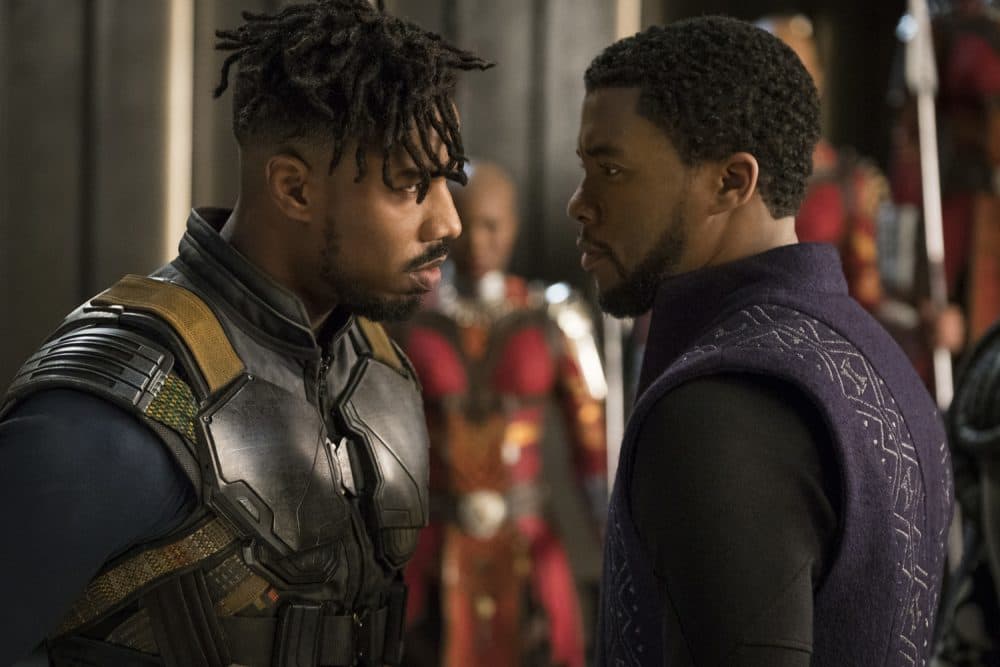
Still, Coogler has money to spend, some of which can be spent on distracting us. If we are going to have these expensively lengthy exercises in dress-up, let them all be dressed such as this. This is a film of great costumes (the designer is Ruth Carter), with the exception of the all-black bodysuit T'Challa eventually adopts in his guise of Black Panther, an ensemble so boringly basic it makes Peter Parker's homemade Spidey garb seem like some leftfield Gaultier imagining. Set against the eternally spiked form of warrior princess Okoya (Danai Gurira) or any of the haute Wakandan couture modelled by Nakia (Lupita Nyong'o), the Black Panther outfit makes one long for a reboot that centres the film's vibrant women rather than the slightly dull, chest-beating men before them - T'Challa, and Michael B. Jordan's Hollywood Beyond-haired refusenik Killmonger - who always seem to be on the verge of tearing off their duds so as to engage in another scuffle in Wakanda's vast ceremonial fishpond.

What freshness and variety there is here can be almost exclusively attributed to the film's supporting players. Coogler casts his net admirably far and wide: he recruits Angela Bassett, two decades after Strange Days should have won her an Oscar, to play the Wakandan Queen, matches older hands (John Kani, Isaach de Bankolé) with bright young talent (Letitia Wright, Daniel Kaluuya), and - typical of the broadly inclusive vibe - even encourages solid pro work from his token white guys, Andy Serkis all amusing old-school villainy as a South African mercenary, Martin Freeman downplaying nicely as the CIA wonk who realises he's secondary to the film's shows of black power. The problem lies with what they've been included in, which - for all its spears and tribal markings - never lets us see much in the way of narrative difference for long, and mostly seems content to recycle Big Movie tropes for the benefit of those paying millions currently seeking refuge in the Marvel comfort zone.

So we get: a gadgets whizz (Bond) followed by a casino visit (Bond, new Star Wars); a brotherly power struggle (Thor); the motivating death of a father/mentoring figure (everything); several double crosses intended to make a playground-level story appear more complex than it seems; and a wham-bam finale in which someone strives to steer a big spaceship through a narrow canyon (for Luke Skywalker or Poe Dameron, read Tim from The Office - though arguably Freeman is here to serve the same narrative function as Clark Gregg's Coulson did in the early Avengers movies). Even when Coogler finally cuts to the chase, his action scenes prove underwhelming, tossing on groovy forcefields and mechanical rhinos without allowing us to feel a single blow being struck, or the stakes being raised; it's mild peril as far as the manic camera can see, culminating in a final showdown, stretched across three locations, that's so diffuse nothing really matters. (Nothing in the filmmaking here matches the bouts in Creed, with their knockout one-two of technical ingenuity and emotional investment.)

What this leaves us with is a film that achieves equivalence with the middling moneymakers of the recent past without necessarily improving upon the basic formula: Black Panther is basically Black Thor, just as a soap opera like This Christmas was the black The Family Stone, just as Tyler Perry's Madea output in some way constitutes an African-American variant of Mrs. Brown's Boys. One is not noticeably more inventive than the other, and you'd be loopy to suggest two such mediocrities form a step in the right direction, let alone some giant leap forwards. I wish I could have joined those flying the flag and waving their pompoms for Coogler's film - I, too, want to believe - but all I could see was another of our most promising directors locking himself into the grim business of dollar-bill generation, with a film more likely to maintain any status quo than to overturn it.

Just as DC's ostensibly feminist blockbuster Wonder Woman helped line the pockets of executive producer (and longstanding Trump aide) Steve Mnuchin, all this African-American creativity is set to provide a nice spring bonus for shareholders who, were it not for the all-over tan one gets from holidaying in St. Bart's every winter, would be whiter than Bowie. You could, as many clearly have, cling to Black Panther as a repository of superficially stirring images - and I grant the possibility this might be one of those franchises, like Thor or Captain America, that gets either appreciably tauter or enjoyably looser the further it travels from its roots - but these first two hours looked very much to me like exactly the same impersonal, mass-produced and defanged product Marvel has been peddling for nigh-on a decade now. Perhaps it's not my place to ask, but someone should: what good does it do a tribe or its people to place its best warriors in the service of such blandly corporate endeavours?

Black Panther is now showing in cinemas nationwide.

Saturday, 3 March 2018

From the archive: "10 Cloverfield Lane"


Viewed in retrospect, 2007's Cloverfield looks very much like an attempt to work out any remaining 9/11 anxieties in the multiplex over a bucket of popcorn. In setting a bunch of kids to film a Godzilla-like attack on Manhattan using their cameraphones, Matt Reeves' film could trade on viewer memories of being in the thick of world-changing events with no immediate sense of the bigger, wider picture; another of the studios' Noughties immersion experiments that was to lead to the widespread adoption of 3D, it also ventured a sensitive nerd's parallel between the fragility of digital images and that of life itself, the surface recordings occasionally giving way - as on a well-worn VHS tape - to sunny relics of the happier time before the fall.

A decade on, and 10 Cloverfield Lane arrives as what we might call a stealth sequel, unmentioned by Paramount until the start of this year - an all but revolutionary tactic in this age of blaring, 24/7 multimedia hype. The film - directed by Dan Trachtenberg from a script worked over by Damien Chazelle (Whiplash) - proves sneaky in other ways, too: as the unusual notation of its title teases, it's not the sequel anyone might have been expecting, unfolding far from the big city some time after the events of the original film, reverting to conventional, third-person camera perspectives, and for 80% of its duration drawing on nothing more than the tensions that follow from shutting two or three people in a single location.

It opens with a young woman, Michelle (Mary Elizabeth Winstead), fleeing a failed relationship in a fast car - a flight that hits the skids somewhere out in the rural heartlands when her vehicle is sideswiped off the highway. Perhaps it's telling that, when she eventually comes to, and finds herself shackled to a wall in a stone basement reminiscent of the Saw movies, the first item she should reach for is her phone: old habits, like successful heroines, die hard. Yet up until the closing moments - by which point it has become clear that 10 Cloverfield Lane is a very different genus of monster movie - this will be the only connection with the original. Reeves' film took as its subject the outbreak of panic; Trachtenberg's is firmly on lockdown.

Mostly, we're confined to the one farmhouse-cum-bolthole, observing the shifting dynamics between Michelle, her captor-protector Howard (John Goodman), doling out scrambled eggs while insisting the air outside would kill her, and Emmett (John Gallagher Jr.), the genial contemporary she finds nursing a broken arm in the holding bay next door. This marks an interesting shift for the series. If the first film was geared towards finding new ways of shooting action, this follow-up is going for suspense: what's next, who's out there, who can you trust in here? Like last week's genre rethink The Witch, 10 Cloverfield Lane is another election-year emission that suggests America feels thoroughly threatened at the present moment - Michelle's "Paris Je T'Aime" T-shirt is a loaded wardrobe choice - but it's canny enough to discern that retreating into the shelter provided by a Big Daddy like Howard is no way forward.

Its bare-bones, no-frills, one-location framing may position matters closer to an episode of The Twilight Zone than anything likely to challenge Batman or Superman at the box office, yet here Chazelle and Trachtenberg offer a new (which is of course to say old) model for mainstream franchise-building, one that returns the emphasis to characters and ideas rather than splashy external effects. It'll certainly be a useful leg-up for Gallagher Jr. and Winstead (whose striking resemblance to the young Sigourney Weaver becomes useful over the closing stages), but it's an especially effective showcase for Goodman, who after years of bitty supporting work (an Argo here, a Trumbo there) seizes upon a role that allows him to loom properly large in a confined space. His Howard runs the gamut from bluff, man-of-the-house paternalism (suggesting an ambiguous variant of Roseanne's beloved Dan) to full-on, ogre-like temper tantrums. (When Emmett catches him watching Pretty in Pink - reputedly his late daughter's favourite film - it's both touching and somehow creepy.)

I wonder whether hardcore Cloverfield fans might take to the forums to complain that at least ninety of these minutes aren't more, well, cloverfieldy; you do sense the original script could equally have provided the template for a sequel to Monsters or Zombieland, even - at a push - White House Down. Yet whether playing "I Think We're Alone Now" over a Last Man on Earth-style montage of the advantages of the simpler life, or wringing black-comic tension from a terse parlour game, Trachtenberg assembles his film with a shrewdness that should play well with the Friday and Saturday night crowds. The wheel is not technically being reinvented here - the effects team are nudged awake in the final reel - but 10 Cloverfield Lane arrives as proof that, when not churning out bloated junk or commercial no-brainers, the studio system can still surprise us, and sometimes even surpass our expectations.

(MovieMail, March 2016)

10 Cloverfield Lane premieres on Channel 4 at 9pm tonight.

Friday, 2 March 2018

For what it's worth...


Top Ten Films at the UK Box Office 
for the weekend of February 23-25, 2018:

1 (1) Black Panther (12A) **

2 (4) The Greatest Showman (PG)
3 (new) Lady Bird (15) ****
4 (2) Fifty Shades Freed (18)
5 (new) I, Tonya (15)
6 (new) Finding Your Feet (12A)
7 (3) The Shape of Water (15) ****
8 (5) Coco (PG) ***
9 (6) Early Man (PG)
10 (9) Three Billboards Outside Ebbing, Missouri (15) ***

(source: theguardian.com)

My top five: 
1. Erase and Forget

2. The Ice King
3. Lady Bird
4. The Shape of Water
5. Game Night


Top Ten DVD sales: 

1 (new) Geostorm (12)
2 (new) The Snowman (15) **
3 (2) Blade Runner 2049 (15) ***
4 (1) The Lego Ninjago Movie (U)
5 (3) Kingsman: The Golden Circle (15) **
6 (4) My Little Pony: the Movie (U) **
7 (new) Happy Death Day (15)
8 (6) Victoria and Abdul (12A) **
9 (new) Brimstone (18) *
10 (7) Dunkirk (12) ***

(source: officialcharts.com)

My top five: 
1. The Death of Stalin

2. The Florida Project
3. Boy
4. Hotel Salvation
5. A Woman's Life


Top five films on terrestrial TV this week:
1. Memento [above] (Wednesday, BBC1, 11.45pm)
2. The Dirty Dozen (Sunday, five, 4.25pm)
3. My Brother the Devil (Saturday, BBC1, 11.55pm)
4. The Fast and the Furious (Saturday, ITV1, 11.05pm)
5. 10 Cloverfield Lane (Saturday, C4, 9pm)

"A Fantastic Woman" (Catholic Herald 01/03/18)


The rapid change the movie business is presently undergoing is such that some believed 2018 might have witnessed the Academy Awards embracing their first transgender acting nominee. The performer in question was Daniela Vega, for the Chilean drama A Fantastic Woman (***, 15, 104 mins), and that she eventually missed out should imply no failure on her part: dodderier Academy voters have always been more comfortable around Meryl, that’s all. Director Sebastián Lelio has followed up Gloria, his exhilarating 2013 study of an older woman cutting loose, with a not dissimilar project. Again, he nudges a marginalised figure into the spotlight, inviting her to shine for a couple of hours.

For much of that time, ironically, Vega’s Marina Vidal is struggling to keep from being snuffed out. A waitress and nightclub singer, her scant security comes under extended threat after her married lover drops dead from an aneurysm. The deceased’s relatives regard Marina as a nasty detail to be brushed aside: not just the other woman, but – in the eyes of the clan’s macho men – fundamentally other. The police, equally, view her with suspicion from the moment one officer clocks the (male) name on her outdated ID. Without soapboxing, the film reshapes into a quest for identity – one woman’s battle to cling onto something of the man she loved, while avoiding being written out of the picture altogether.

Festival-circuit notices have scented an Almodóvar influence, and certain images back that up: at one point, Marina is reduced to a standstill on the street by a sudden gale, just another of the forces raging against her. Yet Lelio is less inclined towards the melodramatic than he is towards the sociological. Whether we find ourselves in Marina’s car or her dressing room, this notably reflective work strives to hold a mirror up to straight society’s apprehensions around all things trans. When the deceased’s ex tells Marina “When I look at you, I don’t know what I’m seeing”, it sounds truthful, and harsher than anybody was expecting.

If the film isn’t quite as arresting as Gloria, perhaps that’s because watching a heroine trying to hold it together is less dynamic than watching one flying off the rails. Yet Lelio has overseen at least one quiet representational triumph in casting trans as trans, and then directing Vega to play frazzled this comprehensively, and well: in shot almost throughout, she makes a persuasive case for Marina’s existence and happiness, her right to be whoever she wants to be. It’s not a film of badges or labels, then, nor one seeking to wave flags or placards – just a subtly affecting expression of empathy, sent into a world that could do with a few more of those right now.

A Fantastic Woman opens in selected cinemas from today.

From the archive: "A Hijacking"


In his day job as one of the chief creative minds powering TV’s Borgen, Tobias Lindholm established himself as something like the Scandinavian Aaron Sorkin: a writer fascinated by procedure, negotiation, high-end talk, but coming at all these without any of the romantic allegiance to flag and office one found in The West Wing. Some of that fascination survived into his script for last year’s The Hunt, where beneath director Thomas Vinterberg’s errant-schoolboy cackling, you could hear somebody’s sincere interest in the cruel insinuations that might be levelled against a wrongly accused individual, and the terms in which that individual might make his defence. That voice comes through more forcefully yet in A Hijacking, Lindholm’s second film as director (after 2010’s prison saga R), which unfolds on the high seas and in the offices of a Danish shipping company.

As in The Hunt, Lindholm has turned his hand to a fiction inspired by real-life headlines, here dramatising the hijacking of a freighter by Somali pirates, and the ripples that follow from this sudden and violent rocking of the boat. Onboard, ship’s cook Mikkel (Pilou Asbaek) – introduced making shoreleave plans with his wife and young daughter over the ship’s increasingly crucial satellite phone – finds himself enlisted as a middleman between the crew and the Somalis. Yet this terse stand-off proves to be playing out on a secondary stage: the real action is back at company HQ in Copenhagen, where tight-faced CEO Peter Ludvigsen (Soren Malling, recognisable from The Killing) comes away from brokering a $15 million deal with the Japanese to learn the pirates are demanding the exact same amount for the freighter’s release.

If it becomes a sticking point as to why the company doesn’t just pay up – or even float a counter-figure that isn’t just a drop in the ocean – it equally becomes clear that, to men such as Peter, business is not a zero-profit enterprise; for all that the crew’s loved ones might tearfully emplore him to bring their boys back alive, he’s also evidently accountable to his superiors and stockholders. As the negotiation drags on – days turning to weeks, then months – patience at both ends starts to wear thin, the ship’s supplies start to run out, and the crew increasingly find themselves with more in common with their captors, who prove amenable to their demands for fresh air and toilet breaks, than they do with their recalcitrant paymasters.

The scenario’s a static one – men sitting round phones and fax machines here, at the wrong end of rifles there – and rife with obvious oppositions: the clammy, lived-in ship, as set against the sterile, inhuman corporate hub. Yet Lindholm is acutely attuned to the underlying turbulences inherent in both this story, and the wider world. His film see-saws like a coracle caught in a hurricane, tipping back and forth between the brine and the boardroom as one faction tosses the other a figure, then sits back to see whether their adversaries bite. That everybody’s on a potentially deadly fishing expedition here – trying to get something for something next to nothing – is made explicit in the mid-film sequence that finds crew and pirates uniting as one to haul in a large plaice for dinner. For all the boozy, plate-smashing bonhomie these scenes evoke, Lindholm conveys a powerful sense these characters are, in the bigger picture, mere minnows; their relationships, and the rest of their lives, will be determined by the sharks gathering at head office.

Every scene determines to get as close as it can to the reality of such a situation. The immediacy extends to the incorporation of live satellite phone delays, further complicating the conversation; to the presence of a real-life piracy expert (British-born Gary Skjoldmose Porter), here to guide us and the characters alike through the intricacies of the process; even – be warned – to a horribly realistic animal slaying that does at least chime with the cutthroat barbarism going on here. That it’s the white man holding the knife is one of several ironies through which A Hijacking makes its underlying point: that we’re all now at the mercy of our CEOs. At some point, this extraordinary wellspring of superbly rendered, supremely engaged Scandinavian drama will doubtless dry up, leaving us wondering what to do with ourselves of a Saturday evening – but not yet. Smart, critical and utterly gripping, A Hijacking arrives as the finest example of corporate-age cinema since The Social Network, care of a director who absolutely knows how to put us in the room.

(MovieMail, May 2013)

A Hijacking screens on BBC2 tonight at 11.55pm.