Saturday, 13 January 2018

Signs: "Three Billboards Outside Ebbing, Missouri"


They are, as the phrase insists, characters in their own right. Three rundown hoardings, on a desolate stretch of road on the outskirts of some podunk town, onto which a middle-aged woman has pasted a stark description of her daughter's unsolved murder, and a call to arms to the town's beleaguered police chief. Papering over the aspirational homilies that usually sit here with a message that amplifies her own long-held doubts and anxieties isn't the most popular move Mildred Hayes has ever made, but there the billboards are nevertheless: a cry for help in the dark, a lone voice in the wilderness, three stands against the injustices of this world, nagging, needling, intriguing all those who gaze upon them. Eventually, we will see the back of them - literally so, in one of the elegant reverse-angles that close out Martin McDonagh's much-discussed dark comedy Three Billboards Outside Ebbing, Missouri - but they have a way of sticking in the mind a long while after the lights have come back on, fuchsia-pink pop-ups that speak, once again, to the power of advertising.

Perhaps only a woman could have shook things up so. Here's a battle of the sexes that has sunk its claws far deeper into awards voters than that recent cinematic tennis match: no sooner has Mildred (Frances McDormand) completed her handiwork than she's besieged by the all-male employees of the Ebbing police department. Chief Willoughby (Woody Harrelson) turns out to be a decent enough cove, well-intentioned and much-loved in the community, but he literally doesn't have the time to reopen an investigation that went nowhere very much in the first place. Altogether more problematic is his rash deputy Dixon (Sam Rockwell), a blunt tool of law enforcement around whom there lurks rumour and suspicion; we know he's no good once we see he shares a mom with Mac from It's Always Sunny in Philadelphia, out of whose mouth falls gobfuls of Old South invective. Opinion is split elsewhere. Mildred gets moderate support from her son Robbie (Lucas Hedges), though even he has to confess the billboards have started to bum him out after a while; her ex (John Hawkes), however, expresses his disapproval by wrapping his hand around her throat and pinning her to a wall, which seems an unduly direct means of trying to shut her up.

Increasingly, it appears as though McDonagh, the playwright-turned-director who's made a career of penning variably heady provocations (The Lieutenant of Inishmore, In Bruges, Seven Psychopaths), has turned his eye to the subject of trauma, and the peculiar dance society now does around it. Not for the first time recently, a woman declares something terrible has happened to her, and all of a sudden it's open season: Mildred finds herself surrounded not just by those who would question her sanity and abilities as a mother, but by men who - for one reason or another - simply want peace and quiet, and thereby maintain the status quo. The wild card, which keeps the film away from the piety and predictability it might have lapsed into, is that Mildred is herself something of a wild card, an apparently concerned citizen who begins the film by turning a drill on her dentist, and ends it by initiating a firebombing campaign. Something in the way those billboards are framed replicates our conflicted responses to the traumatising act: do we print it out in angry 25-point font and rub the world's noses in it, in the hope that anger might change the world, or do we let it recede in the rear-view mirror, even as the scars remain and the wrong continues to gnaw at us?

McDonagh refuses to take an obvious side in this conflict, and that refusal - born, I suspect, of equal parts puckishness and an acknowledgement there are no stock or easy answers - has brought him a measure of pushback from Film Twitter, busy erecting their own billboards of protest along the road to the Oscars. I hear some of these protestations: I too doubt whether this filmmaker, unhesitatingly flinging the c- and n-words about, has been within thirty miles of a political correctness seminar, and I agree there are notes of barely disguised sourness in the wit. (If it does go on to scoop the Oscar, Three Billboards will surely be the Best Picture winner with the highest number of fat jokes.) There are outright missteps here, enough to suggest McDonagh isn't as yet the master filmmaker some in high office are ready to crown him as. Oddly cutely asides with Mildred talking to a (poorly rendered) CG deer or her own rabbit slippers feel like executive decisions imposed at precisely the point the character risks getting lost in the shuffle (and also nothing like anything that no-bullshit character would do); and, as in the dreary Seven Psychopaths, McDonagh believes that he can get away with some of his shonkier, more coincidental narrative manoeuvres if he knowingly flags them as such two or three scenes in advance. Martin: you can't.

Still, some of the film's so-called crimes actually struck me as interesting ambiguities, nuance of a type generally unavailable on Twitter. To shout down Three Billboards as just a film about the redemption of a racist is a thoroughly woke response, hotwired into the struggles of the present moment, but also, I would suggest, a misreading of the character in question's efficacy come the final act, and of what they might be setting off to do as the credits roll. (It also assumes that Mildred herself has unimpeachable motives, which the previous 100 minutes haven't entirely established: my impression was that McDonagh was playing with the idea of the "strong female lead", either for shits and giggles, or because he sincerely believes that people are more complicated than the majority of movies let on. What if a strong female was utterly misguided in her beliefs and actions, and carried on regardless? What to do with all our hashtags and lapel badges and copies of The Female Eunuch then?) It would, at any rate, be churlish to deny that, on a scene-by-scene basis, McDonagh has a way with even the non-profane words and, in the bigger picture, with plotting that, however it's been assembled, still succeeds in catching the unwary viewer off-guard.

The performers, too, maybe: the less assured supporting players here stick out like maladroit thumbs, but as in Fargo, another much-laureled movie bashed out by professional wind-up merchants, McDormand senses just how much of Three Billboards is going on behind her character's back, and resolves to make her the centre of the film's gravity. Lesser actresses would find themselves forgotten about as McDonagh sets about dramatising the unexpected shifts Mildred's actions cause within the Ebbing PD's power structure, but McDormand digs in, becoming a thorn in both movie and viewer's side: the billboards, when we finally bid farewell to them, suddenly resemble extensions of a forceful yet fractured personality. Some of the film's success is incidental or accidental, then - credit the luck of the London Irish - but a good deal more of its provocation and stimulation is entirely deliberate: it makes for a most unlikely awards frontrunner, but in the scope of its inquiry, its outsider's eye for small-town ugliness, resentment and anger, its reluctance to make nice, neat and tidy, and its ability to provoke heated debate both online and IRL, this is the only film of the season to feel like a vision of modern America, and not a consoling fantasy.

Three Billboards Outside Ebbing, Missouri is now playing in cinemas nationwide.   

Friday, 12 January 2018

"The Brawler/Mukkabaaz" (Guardian 12/01/18)


The Brawler/Mukkabaaz ***
Dir: Anurag Kashyap. With: Vineet Kumar Singh, Zoya Hussain, Jimmy Shergill, Ravi Kishan. 154 mins. Cert: 15

An eclectic run of credits – 2007’s bizarre psychothriller No Smoking, 2009’s Devdas update Dev. D, 2012’s crime diptych Gangs of Wasseypur – have established writer-director-producer Anurag Kashyap as Hindi cinema’s foremost moderniser. He took a beating on 2015’s Cotton Club-like period folly Bombay Velvet, but his latest is a canny comeback bid: a heavy-hitting social critique disguised as a rock ‘em-sock ‘em sports movie, following the attempts of angry lower-caste boxer Shravan (Vineet Kumar Singh) to claw back some personal and professional satisfaction after walloping the well-connected coach whose mute niece the boxer was wooing. Kashyap’s own struggles to stay mobile within a stiflingly regulated, sometimes rigged system never seem very far from the surface.

This filmmaker’s preference for no-holds-barred realism over the prevailing comforts of melodrama manifests in characters who spit and curse, use the toilet, and land genuinely wounding punches; the songs following them into battle mix the poetic with the colloquial (“I am as rough as a badger’s arse”). Yet the entire film proceeds to determinedly idiosyncratic rhythms. Kashyap’s less beholden to the standard Rocky template (Shravan is such a pariah he can’t get near a gym) than to the eccentric indie-kid choices of 2010’s The Fighter, setting his camera to study the fractious corners his leads emerge from, and cutting away to a bodypopping bystander at one point, because he senses there’s a rhyme of sorts with Shravan’s niftier footwork.

There’s a lot of dancing around – we get well-timed jabs at India’s rabble-rousing patriarchy, and the pressures developing nations put on their young – although Kashyap finds vivid focal points amid the brouhaha. As the niece, Zoya Hussain makes her signing as fiercely eloquent as any pugilist’s fists, while the bristling Singh succeeds in persuading us he could lapse into thuggery but also scrub up quite handsomely, given the chance; he plays a big part in an early contender for 2018’s strongest closing image. What precedes it can feel jolting – Kashyap’s sound design alone could induce mild concussion – but it’s self-evidently the work of a creative ducking Bollywood’s usual rules of engagement: a film to cheer, and not to be messed with. 

The Brawler opens in cinemas nationwide today.

"Darkest Hour" (Catholic Herald 11/01/18)


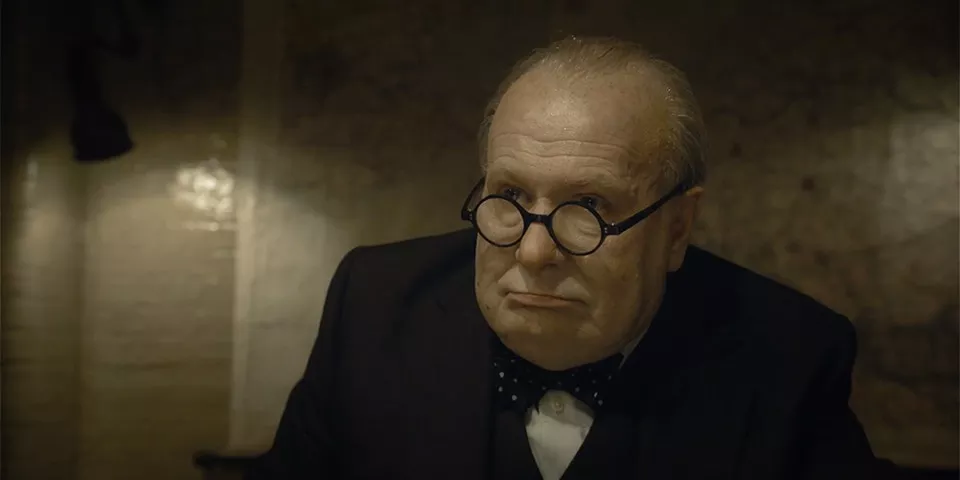
Mention Churchill to movie execs, and they respond as his namesake nodding dog: “Oh, yes.” As the debate over national identity rages on, it is perhaps inevitable we should rally around the totemic Briton, and see what wisdom he might still impart to us. Last summer’s Churchill adopted a detailed biographical line; now there’s Darkest Hour (**, PG, 126 mins), an altogether more bombastic procedural punching up our Winston’s first month in office. In the lead role, not some age- and looks-appropriate actor, burrowing inwards towards a core Churchillian truth, rather Gary Oldman, trapped beneath several pounds of latex: the first fatal error of a film forever straining for a weight and gravity beyond its reach.

The script, by The Theory of Everything’s Anthony McCarten, arrives larded with contemporary parallels. Darkest Hour opens on a sepulchral Commons, amid a growing leadership crisis: replacing the enfeebled Chamberlain as PM, Churchill must win over dissenting MPs from both sides of the aisle while commencing frantic negotiation with those on the frontlines to protect Britain’s sovereignty. For director Joe Wright, this necessitates setting Oldman down in shadowy corners (darkest hour, see), from where the actor huffs and puffs towards vast pools of light. The approach owes less to AJP Taylor than Bonnie Tyler: it’s history redrawn in broad pop-promo strokes for a nation desperately holding out for a hero.

As his flashy replay of Dunkirk in 2007’s Atonement demonstrated, Wright deals in non-subtle, easily translated images that are just expensive enough to dazzle wider-eyed onlookers. For Darkest Hour, he rolls out countless aerial perspectives of battlefields in a bid to open up what’s essentially a series of Cabinet meetings, but so much of this movement seems reductive: the PM meeting a winsome refugee’s gaze while flying into France, or jovially discussing policy decisions during a deeply condescending, biographically dubious Tube commute. Increasingly, Darkest Hour plays like a vision of Britain for a Britain that needs its politics simplified into caricature, a vulgarisation that extends to the conception of Churchill himself.

One-sided awards buzz suggests this is the Oldman show, and it’s certainly striking watching a once-unmatchable performer fighting a losing battle with a fat suit. Whatever the technical challenges, however, the results are a slap in the face to those older actors who might not have needed the phoney bulk, and – to these eyes, at least – a sorry extension of the star’s recent descent into under-directed scenery-chewing. Wibbling about boiled eggs, bellowing about everything else (“Tell the Lord Privy Seal I am sealed in the privy!”), this windbag Winston most often resembles one of Matt Lucas’s creations from a show that provides Darkest Hour with both an alternative title and, presumably, its target demographic: Little Britain.

Darkest Hour opens in cinemas nationwide today.

Hostages of fortune: "All the Money in the World"


All the Money in the World has a place waiting for it in the history books as a technical feat: as has been widely reported, once news broke of the scandal enveloping Kevin Spacey, director Ridley Scott took the decision to recast the pivotal role of J. Paul Getty with Christopher Plummer and reshoot key scenes mere weeks before the film's original holiday release date. The rationale was equal parts ethical and financial: Spacey had become a toxic asset that needed offloading, if the finished feature stood any chance of recouping its budget in the current climate. (In this respect, the director has proven a far cannier operator than, say, Louis CK, whose self-financed feature I Love You, Daddy had its release scrapped after allegations of sexually inappropriate behaviour were made against him.) Scott has long seemed like Hollywood's ideal of a director-businessman, one who talks the same turkey as the studios' corporate paymasters, brings every project in on budget and on time, and once made an entire romcom - 2006's A Good Year - dependent on the price of reserve wine. Even Scott's most populist endeavours, the recent Alien bolt-ons, have sometimes appeared like cautionary tales recounted by a John Harvey-Jones-like troubleshooter in the pages of a health-and-safety manual: how not to run an interstellar mining company. 

Handed a script by David Scarpa about arguably the 20th century's most successful businessman, and the fraught negotiations that broke out after the kidnap of Getty's teenage grandson Paul in Rome in 1973, Scott presumably leapt to sign on - and he likewise didn't hesitate to take decisive action once the full extent of the Spacey situation became apparent. (Every creative decision here seems informed by the question "What would Getty do?") Yet the curious thing about All the Money in the World is that the reshoot legend suggests an urgency about this production that is conspicuously lacking from the finished film. That leaden Scarpa script is the chief culprit. After a scene-setting prologue that sees Paul (Charlie Plummer, no relation) scooped up off the street by a VW van's worth of bedraggled Italian ne'er-do-wells, the clock doesn't start ticking as start ticking backwards. A full half-hour of this 133-minute picture is set aside to detailing exactly how Getty senior made his billions, where the kid came from, and his bohemian childhood, before Scott can circle back around to address the finer points of his central stand-off. (For the uninitiated: the kidnappers demanded $17m for the kid's safe return, but Getty senior, wary of opening himself up to further extortion attempts, refused to cough up a pretty penny.)

In the meantime, Scott intends us penniless proles to marvel at Getty's screen-filling skyscrapers ("It must have eighty storeys!," gasps the wide-eyed younger Paul), or an anecdote about an artefact that cost the billionaire $11 at a Grecian market stall but would now be worth a cool million at auction, or the old-money sweep of Getty's English country estate, with its well-stocked armoury and glamorous flame-haired fillies shooting skeet for sport over Bloody Marys out back. "I like things," Plummer's Getty muses to his go-to negotiator Fletcher Chace (a composite or invention, played in the loosest sense of the term by Mark Wahlberg). "Paintings, statues... because they're exactly what they appear to be. They never change, and they never disappoint." People, not so much: you wonder the extent to which Scott himself agrees. What we as viewers need amid this moneyed milieu are flesh-and-blood figures, someone we feel we can cling to, or who might just offset all the cold hard cash being paraded before us; what we witness instead are some deeply strange casting and performance choices.

To address the pressing issue first, Plummer slips into his scenes as to the manor born. The actor's seniority and patrician bearing makes him a far better fit for this Getty than you can ever imagine the Voldemort-like Spacey-in-latex of the film's early trailers being; there is, perhaps, an even more fascinating movie going on behind the kidnapping, tailing this desiccated penny-pincher as he stumbles around his darkened Home Counties Xanadu, clutching masterpieces to a hollow chest while mummifying himself in ticker tape. Alas, Scott and Scarpa's focus lies elsewhere. As the boy's mother Abigail, Michelle Williams tests a posh British accent that generates erratic line readings and undermines her flickers of maternal warmth, while the role of Getty's head tactician sorely demanded someone whose ability to suggest intelligence extended beyond raiding the costume truck for thick-rimmed glasses. Deprived of his usual muscle scenes, Wahlberg stands around looking bemused in period waistcoats; he may have received substantially more for doing this than his female co-star, but you wouldn't trust this guy to negotiate a pelican crossing on his own. (Best in show is Romain Duris as the kidnappers' pointman, forging an unexpected bond with his punk charge - though it still seems perverse to cast a Frenchman as an Italian.)

Scott gives us time - practically all the time in the world - to notice the film's quirks and foibles. The pulpy material, tectonic collision of social strata, and Italian setting cry out for a filmmaker working in the tradition of Francesco Rosi or any of the other great European directors who turned towards the thriller genre in the 1970s, someone prepared to shake this story by its ankles to see what truths might fall out of its pockets; instead, it's passed all too smoothly into the hands of old man Ridley, more producer than director nowadays, who potters along in second gear, ensuring every last Wiki-sourced plot point and change of location has been carefully accounted for. The results retain that mild, minor fascination that comes from stumbling onto a well-turned afternoon TV movie where recognisable faces play well-to-do people - I suspect it'll be the 2017-18 awards contender most often encountered for the first time on a long-haul flight (business class, natch) - but its achievements are almost entirely logistical: Scott has converted intriguing facts into functional sequences, and then, amid a last-minute crisis, ensured the completed product was delivered to his bosses on deadline and without undue expenditure. You can admire the professionalism, by all means, but it's not art, and it only just counts as entertainment.

All the Money in the World is now playing in cinemas nationwide. 

Thursday, 11 January 2018

Laws of gravity: "Jupiter's Moon"


Kornél Mundruczó is the Hungarian writer-director whose previously grim and resistible cinema - wispy parables of rural rape and abuse, as bare-boned as his sometime muse Orsi Tóth - took a giant leap forward after he relocated to the city for 2014's White God: here, at last, was a thriller to sink one's teeth into, possessed of both a big, bold, properly cinematic concept (a world overrun by vengeful packs of dogs) and the technique to make good on such a premise. For his follow-up, Mundruczó has reached even further out there. Jupiter's Moon adheres to one prominent arthouse trope of the present moment: it's another of our latter-day traveller's tales, opening up by tracking a young Syrian refugee, Aryan (Zsombor Jéger), as he crosses the border between Serbia and Hungary. Yet the film that follows turns out to be as close to a Marvel movie as Mundruczó is ever likely to make. After he's apparently shot dead by a patrolman, Aryan comes round to discover he has special powers, chiefly the ability to soar and swoop above his new home like Iron Man without the suit.

Now, you might say, this is an unusual if not altogether risky strategy for a serious filmmaker to adopt when addressing the migrant crisis: to abandon the harsh, boots-on-the-ground realities of such recent films as Human Flow and The Golden Dream in favour of pursuing literal flights of fantasy. It does, however, allow Mundruczó to swerve some of the pieties increasingly associated with this strain of cinema. As Aryan escapes a temporary holding camp and sets out for Budapest in a bid to reunite with the father he lost touch with at the border, his fate becomes intertwined with two men who indirectly represent different responses to this issue: a pragmatic doctor (Merab Ninidze), who becomes Aryan's unofficial manager, touring the lad around to perform miracles for cash; and a sour-faced detective (György Cserhalmi), who views Aryan as just another statistic to be rounded up and squared away. Scene after scene is elevated by Mundruczó's new-found big-picture technique. As in White God, the director - reunited with the earlier film's laudably flexible cinematographer Marcell Rév - stages long, very carefully choreographed takes through familiar-seeming metropolitan locations, while the flying scenes, achieved through a mix of analogue and digital wizardry, attain some of the elastic beauty of Alfonso Cuaron's Gravity.

Yet the setpieces in White God were very clear in both their execution and their meaning: these were the savage consequences of a dog-eat-dog world being turned upon its axis, so that dumb beasts should turn on Man, fangs bared. You will likely spend between 80-90% of Jupiter's Moon wondering just what exactly Mundruczó and his regular screenwriter Kata Wéber are attempting to communicate. When Aryan spins the house of an injured man who repeatedly spits the word "gypsy" at him, is the takehome that we should take better care of outsiders, because they possess both the power to heal us (as with the healthcare professionals who venture here from afar) and to destroy us (as with those radicalised on their travels)? Is that me being simplistic, or is it the movie? (Or is it the case that, given nationalists have traditionally appealed to the lowest common denominators, those on the Left would likewise do better to simplify - to address concerns about immigration in terms and images the man on the street might better understand?) The image rotates, and the mind boggles.

At any rate, there are signs the film gives in to a different kind of piety around its protagonist. Aryan, played by Jéger as a handsome blank, is identified at an early stage as the son of a carpenter, an occupation presumably chosen for its religious connotations, while the doctor joshingly refers to him as an angel - a reading Mundruczó later validates by having the lad ascend to the heavens, nursing what looks like a broken wing, in the wake of a midfilm subway bombing. Again, we're beset by questions: is Aryan a celestial being, sent among mortals to awaken something in the sceptical doctor, and just perhaps the jaded viewer? (The reviews following the film out of Cannes last summer suggest he'll have his work cut out for him.) Or is he something else, maybe: an embodiment or symbol of the spirit of free movement - hence all his balletic Tinkerbelling above the modern European metropolis?

I'm not sure even Mundruczó's certain, hence the scene late on in the back of a speeding ambulance where the doctor and the cop trade exactly those queries the audience will have been pondering for the duration. Though the film's own movements look to have been storyboarded down to the last small camera tilt, its ideas, admirable as they might seem, don't always seem to have been so closely thought through; the results, both kinetic and sketchy, come to resemble 2016's Midnight Special as made by someone with their head even further up in the clouds. It is true that Mundruczó has become a far more ambitious and accomplished imagemaker in recent years, and the cinema we find here is all the healthier for leaving the rape behind: one way or another, this director has landed firmly on the side of the angels. Yet somewhere amid all these spectacular twirls and humanist pirouettes, Mundruczó loses sight of one key fact: that the vast majority of the huddled masses headed our way are just regular Joes trying to get from there to here, bound by the same laws of physics as you or I, with nothing greater to raise them up than sheer force of will.

Jupiter's Moon is now playing in selected cinemas, and available to stream via Curzon Home Cinema.

Monday, 8 January 2018

Moi aussi: "A Woman's Life"


L'effet Downton est arrivé en France - in a roundabout fashion. A Woman's Life, Stéphane Brizé's bold and striking follow-up to 2015's very fine The Measure of a Man, whisks us back to 1819 and attempts to feel and think its way through a Guy de Maupassant novel last filmed by Alexandre Astruc in the late 1950s, moments before the New Wave struck. Astruc's film carried the book's original title Une Vie; here, that title receives an explicitly feminist translation, and Brizé's clearly onto something: his heroine Jeanne (Judith Chemla) is a baron's daughter who, protected by her wealth, invests her all in the men she chooses as her way out into the world - and comes to pay for it dearly. That this is a limited life is established from the off by small slivers of scenes showing Jeanne pottering aimlessly around the garden and playing backgammon with her father (Jean-Pierre Darroussin), the 4:3 framing further emphasising how cramped this leisured existence might be. Brizé's focus rests firmly on people and their immediate circumstances, which is why Jeanne's horizons appear to expand once the dashing Viscount Julien (Swann Arlaud) rides into town. Julien immediately steals Jeanne's heart (and, it seems, her maidenhood), but this bounder assumes that his wife should know her place in his household, and is prepared to exert various forms of control to ensure that she does, separating her from her friends, grinding her down, becoming more and more flagrant in his betrayals of her.

Brizé's masterstroke is to realise that, for at least its first half, this narrative is a domestic abuse drama, and thus not something that needs dressing up unduly. The bulk of the film plays out in near-silence, without the usual florid-to-overwrought orchestral score; it looks, sounds and feels like how we used to live, to borrow a phrase from the television archives. (Its signature scene is a croquet game played out not on some sculpted emerald lawn, but a semi-overgrown backyard.) What this director ports across from his earlier, contemporary dramas is a carefully cultivated, in-the-moment realism. Antoine Héberlé's sometimes misty but generally unfussy hand-held photography catches the characters as they ordinarily are, whether frail or ferocious; the economic script, signed by Brizé and Florence Vignon, has a way of cutting through any fuss to the quick. We spy how quickly this romance sours, and how quickly Jeanne is obliged to grow up, and by running together the courtship, our heroine's memories and the inky darkness of her present, an entire life seems to flash before our eyes in a shade under two hours. The approach asks much of the performers - not least to go back nearly two hundred years into a less enlightened time, without many of the usual costume-drama guiderails; they're often left improvising within set-ups - and yet the remarkable Chemla really does seem to get older and more hardened with every passing scene, both weighed down and embittered by misplaced affection, wifely obligation, self-reproach and - at the last - terrible financial penury. It forms a tragedy, yet also a notable triumph: Brizé's decisions throughout confirm him as very much the real deal, a filmmaker able to move between present and past tenses with tremendous fluency, and with the precious ability to make his worlds come alive. A Woman's Life is the most radical French costume drama since Catherine Breillat's The Last Mistress.

A Woman's Life opens in selected cinemas from Friday.

Saturday, 6 January 2018

1,001 Films: "Videodrome" (1983)


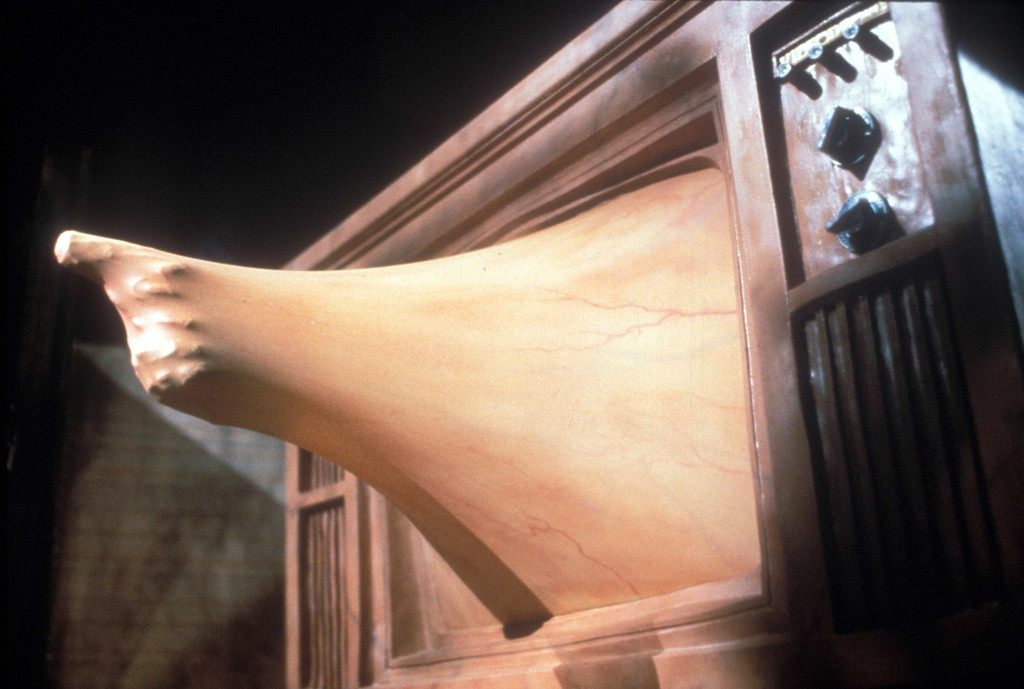
In the 1970s, television - as represented by Sidney Lumet's Network - merely drove its makers and viewers out of their minds. As we stepped into the 1980s, David Cronenberg saw that it was beginning to get under our skin, too. Working under the Universal banner at the moment of the Reagan investiture, Cronenberg adapted his previously chilly outsider methodology to propose Videodrome, a commercially oriented thriller about a successful business model that falls under threat from without and within. Having made his lowly reputation peddling softcore smut to the masses, public-access channel huckster Max Renn (James Woods) stumbles across the pirate broadcasts of the title - gonzo depictions of rape, torture and murder - which suggest there are sicker, more jaded souls out there than even he. Naturally, Renn's first response to these spooky nocturnal interruptions - which pre-empted Max Headroom by a year or so - isn't revulsion but compulsion, mixed with a certain professional admiration: "Brilliant - there's almost no production costs!"

Unflashily, and with what was becoming his usual tremendous economy, Cronenberg pulls us into a skeezy netherworld - something like noir, only in tawdry living colour - where a no-holds-barred show such as Videodrome might be conceivable in the first place, and where a dyed-in-the-wool sleazeball such as Max Renn might start to resemble first a voice of reason and conscience, then some kind of disruptive tapeworm in the body corporate - a scab unlikely ever to clean up. Three decades and multiple Twitter tirades later, and this still looks like one of the great maggoty performances of 1980s cinema: suffice to say it may now be easier than ever to buy Woods as the arse-fondling letch of the film's opening act, using a chatshow appearance primarily as an excuse to hit on fellow guest Debbie Harry, but he's also convincingly rattled as the images Renn exposes himself to take on lives of their own. 

In part, that's because the director is so unsparing in showing us the effects of those images: first making it increasingly hard for his anti-hero to distinguish fiction from reality, then softening him up - literally, in the application of squidgy latex welts about his person, and if some of these gruey analogue flourishes have dated in our age of ultra-photorealistic VFX, the ideas behind them really haven't. By the end of this most image-obsessed and body-conscious of decades, the notion there might be a link between the media and other tumours was so commonplace it could be treated comedically in Bruce Robinson's scabrous satire How to Get Ahead in Advertising. Yet the doubts and fears Cronenberg was channelling about the power of the image would assume new forms in the virtual realities of The Lawnmower Man and this director's own eXistenZ (Videodrome 2.0, effectively), at the dawn of the DVD age in the Ringu films, and in a run of millennial dotcom thrillers about websites claiming to peddle the most deranging content imaginable. None of these were quite as warped in their conception, or as visceral in their impact, as this, though.

Videodrome is available on DVD and Blu-Ray through Arrow Video.