Friday, 5 January 2018

For what it's worth...


Top Ten Films at the UK Box Office 
for the weekend of December 29-31, 2017:

1 (1) Star Wars: The Last Jedi (12A) ***

2 (new) Jumanji: Welcome to the Jungle (12A)
3 (new) The Greatest Showman (PG)
4 (new) Pitch Perfect 3 (12A)
5 (2Paddington 2 (PG) ****
6 (new) Ferdinand (U)
7 (3Daddy's Home 2 (12A)
8 (new) Tiger Zinda Hai (12A) ***
9 (4Wonder (PG)
10 (6) Murder on the Orient Express (12A) ***

(source: theguardian.com)

My top five: 
1. A Matter of Life and Death

2. Persona [above]
3. Mountains May Depart
4. Mountain
5. Molly's Game


Top Ten DVD sales: 

1 (1) Dunkirk (12) ***
2 (2) Micky Flanagan: An' Another Fing Live (15)
3 (new) American Made (15) ***
4 (6) Paddington (PG) ****
5 (4) The Hitman's Bodyguard (15) **
6 (new) Rise of the Footsoldier: The Pat Tate Story (18) *
7 (18) Fast & Furious 8 (12)
8 (11) Spider-Man: Homecoming (12) **
9 (3) Despicable Me 3 (U)
10 (19) Baby Driver (15) **

(source: officialcharts.com)

My top five: 
1. Logan Lucky

2. An Inconvenient Sequel: Truth to Power
3. Good Time
4. Detroit
5. Patti Cake$


Top five films on terrestrial TV:
1. The Social Network (Wednesday, C4, 1.10am)
2. Groundhog Day (Sunday, five, 10.40am)
3. Strictly Ballroom (Sunday, BBC2, 11.25pm)
4. And Now for Something Completely Different (Sunday, BBC2, 10pm)
5. Captain Phillips (Sunday, ITV1, 10.10pm)

Still burning: "Tiger Zinda Hai"


After a year of prominent commercial failures - twelve months in which it found itself comprehensively eclipsed by the efforts of regional film industries (Baahubali 2: The Conclusion), and which culminated in a defeat, for the time being, over the controversial Padmavati - Bollywood rallies. Retreats, arguably: its brightest late-year idea, and its biggest festive hit, is after all a sequel, clinging to the masala movie idea of seeking to offer all things to all people over a busy two-and-a-half hours. Tiger Zinda Hai brings Salman Khan's musclebound intelligence officer Tiger - introduced back in 2012's Ek Tha Tiger - out of retirement, or more specifically invites him back in from the cold. We first find the big guy up a mountain in the Tyrol - a location that yields one oddly pleasing image, of a snow-covered ski lodge blasting out vintage Hindi chartbusters - where our hero has settled into blissful domesticity with fellow survivor Zoya (Katrina Kaif). As spies working either side of the Indo-Pakistan border, these two spent the first movie warily circling one another before pairing off and vanishing beyond the state's reach; this time out, they will be fighting back-to-back, a stance adopted with great urgency once news reaches them that a party of Indian nurses have been taken hostage in Iraq by IS-like fundamentalists.

Back in 2012, Tiger might have appeared as a one-man rapid response to the success of the Bourne franchise, brawnily engaging with post-millennial realpolitik: the sequence here in which Salman (or, more likely, his stunt double) spiders vertically up the side of an Iraqi housing block before entering into pummelling fisticuffs with a black-clad assailant delivers almost exactly on that promise. For much of its duration, however, Tiger Zinda Hai plays more like an 80s throwback in the vein of White House Down or the average Andy McNab bestseller: absurd on some level, ridiculous on many more, yet surprisingly hard to disengage from once you've sat down with it. This is a script composed almost exclusively of cliches, but the writer-director Ali Abbas Zafar knows which order to put them in so as to hook us, and generates such a thunderous pace that we're yanked swiftly past those rare tropes that don't play; it's above all else a film of manoeuvres, of decoys and dummy runs that interlock logically to generate the desired outcome. The final half-hour, which plays out in more or less real time as Tiger and Zoya combine to see off their more entrenched foes and liberate the nurses before a planned US air strike, takes in its fair share of red-numbered clocks counting down, and is genuinely tense when it needs to be.

A big part of the film's success can be ascribed to its leading man. Where last summer's big flop Tubelight handed Khan an all but unactable, oddbod character who dragged him several leagues beyond his stoic comfort zone, the role of Tiger frees his biceps from ill-fitting tanktops - one astounding scene of shirtlessness looks computer-generated, but probably isn't - and returns the star to his default position of indomitable hero, a last defence against barbarism. You can see why audiences might start to feel safe around the star again - and, in fairness, he has become a far more assured screen presence than he was even as recently as 2011's Bodyguard: one upside of spending all that time in front of the gym mirror is that he's clearly spotted those areas that needed improvement. As this performer's career-rebooting 2015 megahit Bajrangi Bhaijaan demonstrated, Khan now knows how to make the cinema work for him, and he's learning how to make it work for his audience, too. The Tiger-Zoya partnership permits Zafar to enter a special plea for greater cooperation between India and Pakistan, an editorial line that leads towards one cheesily stirring image - our warriors flying both flags side-by-side on a jeep - but also generates welcome moments of levity: the more we work together, one supporting spook notes, the greater the likelihood of our winning every cricket World Cup. (Theory: all Indian cinema is to some degree a commentary on the nation's fluctuating fortunes with bat and ball.)

Elsewhere, Zafar evidently has another kind of equality in mind. Yes, Tiger gets his name in the title again, and yes, he's sent on the type of mission men have traditionally got to do in the movies. Yet it's soon clear that the kidnapped nurses have been characterised with unexpected spark and fight in them - the terrorists, for one, don't see it coming - and the action steps up another level entirely when Zoya, too, shows up in Iraq for reasons best revealed by the film. The enviably locked Kaif's appearance in the middle of a warzone is no more or less preposterous than, say, the 52-year-old Khan's first-reel escape from a pack of wolves via snowboard - and in the scene where Zoya singlehandedly clears a council chamber of gun-toting ne'er-do-wells, the actress starts to make Gal Gadot's Wonder Woman seem a bit of a wuss. (Here's a film to encourage us all back into the gym this January.) Nothing about Tiger Zinda Hai shakes my suspicion Hindi cinema needs many more modernisers and risktakers in the mould of Anurag Kashyap (whose The Brawler opens here next week) if it is to rebalance its accounts: it's a consolidation rather than a renewal, one that doesn't reinvent the wheel so much as give it another, forceful kick. Care has, however, been taken to ensure its nuts and bolts have been oiled along with its star's torso, and that the pieces fit together so that everything moves as it should. If it is a retreat, it's a tactical one, at least, made by people reassuringly confident in their actions.

Tiger Zinda Hai is still playing in selected cinemas.

Thursday, 4 January 2018

Stop the cavalry: "Hostiles"


There are director-star pairings that will forever quicken the cinephile pulse: one thinks immediately of Martin Scorsese and Robert De Niro, shortly to be reunited on Netflix's The Irishman, or Paul Thomas Anderson and Daniel Day-Lewis, prime movers behind the incoming Phantom Thread. And then there is Scott Cooper and Christian Bale, a duo who singularly failed to set the world alight with 2013's busted awards flush Out of the Furnace, and who this week reunite for the utterly ponderous Western Hostiles. The key to those more successful creative partnerships may be that their constituent components complement one another: Scorsese lends grace to the earthbound De Niro, while Day-Lewis stitches the detail into Anderson's fancier conceits. The impression one gets from their first two films together is that Bale, cinema's last bastion of Method, and Cooper, a sometime actor who turned director with 2009's Crazy Heart, are too damn similar in their sensibility, and so have come to push one another on to attain whole new levels of humourless strain. 

Hostiles offers an example of this before its first reel is even out. After Bale's Injun-hating Army captain Joseph Blocker has reluctantly accepted the assignment of escorting ageing Chief Yellow Hawk (Wes Studi) back to his reservation, Cooper cuts to a sequence in which his leading man can be observed in the desert, silently screaming while burying his pistol in the sands. There is no immediate narrative motivation for this sequence, not does it tally with anything that follows: it's just a Serious Moment of Serious Acting, put there to establish, as if we hadn't already guessed from the pre-credits massacre of a young family, or the early scene in which Rory Cochrane mutters between eighty and ninety percent of his dialogue into a thick trapper's beard, that what we are about to watch will be no City Slickers. You can appreciate the effort, up until the point - around thirty minutes in, with roughly a hundred more to go - that you sense everybody on screen is trying way too hard.

Adapting a manuscript by the late Donald E. Stewart (who somehow earns an executive producer credit some nineteen years after his passing), Cooper clearly intends this as one of those self-consciously New Westerns, an oater that reflects the concerns of a writer-director in 2018 at least as much as it does those of homesteaders back in 1898. If Hostiles is about anything other than a couple of Hollywood creatives' desperate need to impress themselves upon viewer and awards committee alike, it's about trauma: that of burnout Cap'n Joe and his put-upon charge, and of the bereaved wife and mother (Rosamund Pike) that Blocker's detachment picks up en route, who helpfully - if none too subtly - underlines this key trope when she empties an entire chamber of bullets into an already prone corpse. There are bodies on the ground and in the ground and swinging from the trees; Cooper crams so much death into every frame it's barely a surprise there's no room for much in the way of life. 

Beyond that, the writer-director clearly intends to issue a statement of some kind on race, and America's continued inability to make peace with itself. In this Old West, the white folks shoot first, and the natives' dialogue is dutifully translated, while the presence of Studi and Q'orianka Kilcher (Malick's Pocahontas) confer a certain respectability on the project, no matter that they have far fewer scenes and lines - subtitled or otherwise - than the grimacing palefaces around them. We're meant to be pathetically grateful that Cooper has rounded up a posse of committed character actors to chew these scenes over like tobaccy, and certainly we feel in safer hands when veterans like Stephen Lang (as Blocker's superior) and Peter Mullan (a fort commander) mosey on into shot. Yet the bulk of Bale's entourage (Cochrane, Jesse Plemons, Jonathan Majors, the suddenly prominent Timothée Chalamet) have no real story function save to wheel around on horseback during the shakily staged ambush setpieces. Ben Foster turns up 75 minutes in to engage Bale in two scenes' worth of resigned mumbling, before - wisely - cutting his losses and heading for the hills.

Sole point in the film's favour: a solid Western look. After carrying out Cooper's eye-rollingly obvious homage to The Searchers - another early, empty gesture towards Seriousness - the smart Japanese cinematographer Masanobu Takayanagi (The Grey) opens up the screen space in ways that prove thematically effective: this America really does look big enough for everybody. Yet Takayanagi's proficiency only further points up how little of worth Cooper brings into view: a limply episodic white-saviour narrative that shrugs off the symmetry it first feels out between the Captain and the Chief, a fair bit of thespian muscle-flexing, indulged by the director in the hope of filling the frame and the epic running time, and a lot of editorial handwringing that, at the last, packs us off to the car park with a wispy plea for unity. The insistent terseness is both a limitation and a front for a movie that really has nothing new or rewarding to communicate: it leaves us sitting before a Western where the cowpokes often seem too lockjawed to speak, and the horses have been freighted with so much baggage no-one can break into even a pleasant canter. Lighten up, dudes.

Hostiles opens in cinemas nationwide tomorrow.

The entertainer: "Murder on the Orient Express"


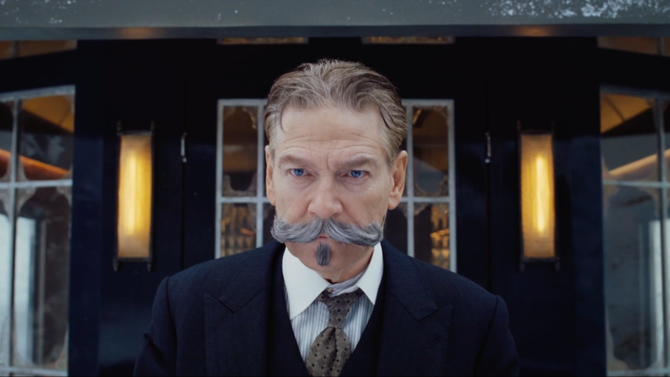
Everything you need to know about Murder on the Orient Express, Kenneth Branagh's new widescreen take on the old Agatha Christie whodunnit, can be deduced from its prologue: many criticisms can be and have been levelled at the film, but you can't say it isn't upfront about declaring its intent. We join Hercule Poirot (played by Branagh himself) in Jerusalem, cradle of civilisation, making a huge helter-skeltering fuss about the delivery of his hard-boiled eggs, making friends with a winsome local child, and then making his way down, stepping in camel poo not once but twice for balance, to the site of the Wailing Wall, where in front of a swelling crowd of pilgrims and gawpers, he briskly solves a crime that, as the detective himself notes, sounds very much like the beginnings of a bad joke. (It brings together a rabbi, a priest and an imam.) Needless to say, this isn't Christie's joke, nor really Christie's idea of Poirot; instead, it establishes Branagh's conception of the sleuth as an irresistible populist, a performer of genius, a colossal show-off. Rather than the neatly waxed moustache David Suchet adopted for the role on TV, Branagh proudly unfurls what looks like a distant relation of Digby, the Biggest Dog in the World across his top lip; it's just possible he shot the film in 65mm specifically to squeeze in its every last bristle.

My initial suspicion that this Murder would play rather better in international markets than it would in the UK, where Suchet's introspective and solitary Poirot has held sway for several decades, has been confounded by its domestic box-office, so perhaps its success can be attributed to Branagh's decision to reach for the stars - that he's pulled off the closest thing to panto we might witness inside a Picturehouse this festive season. The 2017 Murder is, unarguably, a logistical triumph, coupling together the schedules of performers spanning diverse demographics (everyone from Michelle Pfeiffer to Olivia Colman, Josh Gad to Derek Jacobi), and asking all these performers to act increasingly shady in the same lunch carriage after an American thug (Johnny Depp: first passenger off, not badly cast) gets done in during the slow haul out of Istanbul. (You're reminded this is an atypical Christie text - not so much a whodunnit as a whodidn't.) Here, then, is another of Branagh's recent selection-box movies - lavish, well-stocked, and best consumed over Christmas or a Bank Holiday - yet it's one that finds more in its source material to punch up, tinker with or elaborate on than Branagh was allowed to find in Marvel's Thor or Disney's Cinderella.

Christie purists, of course, may find themselves reaching for the Epsom salts, but a good percentage of its brashness pays off: the travelling shot following the detective as he boards, which introduces many of the dramatis personae and the spatial geography of a crime-scene-to-be, Depp's clipped response when Poirot offers a correction on the pronunciation of his forename ("So?"), the thunderous pace that brings the entire investigation in at well under two hours. Despite the ridiculous draft excluder that hangs beneath them in this instance, Branagh has always held the scent of popcorn in his nostrils - it was there as far back as his early Nineties one-two Dead Again and Mary Shelley's Frankenstein - and this distinguishes him from those Downton copyists making pretty but lifeless pictures. Aided here by the insanely busy screenwriter Michael Green (Logan, Blade Runner 2049, American Gods), he retains a sharp mind for translating yellowing words into big-picture images, and as a director, keeps justifying his technical choices: that wider-than-usual frame allows Branagh to squeeze multiple suspects into every shot, as well as trigger the avalanche that knocks everybody off-track, attempting with each stop and delay to pull Christie's careful plotting into the business of cinema, not television.

One regrettable side effect is a certain loss of intimacy. The quiet, indelibly self-contained Suchet obliged viewers to lean in, which is why so many felt so close to his Poirot; Branagh, not shy about granting himself IMAX-scaled close-ups, is pitching throughout for the back rows, which may be why so many purists and tastemakers have recoiled. One can, however, detect the slyest of jokes at this preening Poirot's expense, connected to the fact better-read cinemagoers will know exactly whodunnit way before the hero does: it's amusing that the man who declares himself "the greatest detective in the world" - a boast unthinkable in the Suchet era - should spend the next 100 minutes being given such a runaround by his fellow travellers. It's placed way down in the mix, but there's an overturning of rational certainty in this retelling that connects to both the train's derailment and the pre-WW2 setting. By the finale, this Poirot is left standing in the cold before an unsmiling panel sitting behind a trestle table (more widescreen catnip); no longer the master of all he surveys, he suddenly has the look of a washed-up auditionee learning harsh lessons in humility, and the limitations of his little grey cells. Only the prospect of another gig ("there's been a murder in Egypt, Mr. Poirot") extends any hope: for Branagh, multiplex cinema's most amenable entertainments manager, and for his backers at Fox, the show must go on.

Murder on the Orient Express is now playing in cinemas nationwide.

Wednesday, 3 January 2018

Submarines: "Renegades"


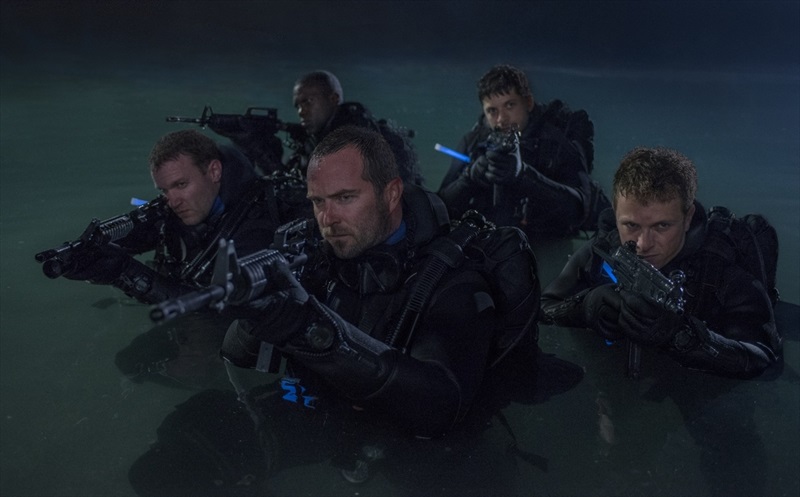
Early January traditionally brings its unfair share of DVD-bound multiplex filler, hustled onto our screens to make even the season's flatter awards fare seem newly distinguished. This year, Luc Besson's EuropaCorp has unloaded Renegades, a dumbo 90-minute duck-and-dive - written by Besson with genre hack Richard Wenk (Vamp), and directed by Stephen Quale of the almost instantly forgotten Into the Storm - about US marines hunting Nazi gold at the bottom of a lake in war-torn Yugoslavia. If the film serves any lasting purpose, it'll be as a lesson in the economics of modern film production. Here is a B-movie that looks surprisingly expensive - moving from a prologue that must have shut down central Paris for a morning or so to an evocation of the widespread carnage of Bosnia as it was in the mid-1990s - until you realise there will be no star names forthcoming in the lead roles, just interchangeable alpha himbos, buzzcuts in camouflage gear, who prove constitutionally unable to outline interesting or engaging characters. (The one recognisable face on parade is that of J.K. Simmons, picking up a post-Oscar payday doing an R. Lee Ermey routine as the grunts' office-bound commanding officer.) 

Some will question the co-opting of ethnic cleansing as the backdrop to a mindless actioner - it wouldn't be the first time a EuropaCorp production has rubbed up against the boundaries of taste - but it's soon clear Renegades intends to occupy similar territory to The Dirty Dozen or Kelly's Heroes, providing brain-in-neutral distraction for those still struggling to get out from under a New Year's hangover. The caper that follows is mild by comparison, to say the least, but there are sporadic flickers of something approaching fun. You can't help but chuckle when our heroes drive a tank thirty feet off a bridge into a river rather than submit to the local beady-eyed ne'er-do-well; likewise at the brazenness of the scene in which these yahoos earnestly discuss their plans to use the gold to rebuild nearby schools and thoroughfares, as if Ted Nugent had suddenly been recast as New Deal Roosevelt. (Snoozing viewers, meanwhile, are meant to be stirred by a narratively superfluous dust-up with an SAS interloper, amusingly scored to Ini Kamoze's "Here Comes the Hotstepper".)

Yet any affection for Renegades' old-school methodology has long been muffled, come the closing credits, by its overriding - and overridingly dull - business sense. As a writer-director, Besson remains a distinctive if wayward talent, as 2014's Lucy and last summer's megaflop Valerian and the City of a Thousand Planets established. His producer credits, alas, continue to ape the lamest kind of Hollywood thinking. Quale's drill-and-paddle finale is one long, watery yawn - a literal damp squib, fired off in a murky municipal pool - but even the hour that precedes it has, as with much recent EuropaCorp fodder, been edited in such a way to elide any possibility of sex or violence, and thereby secure the 12A rating that presumably tempts in gullible teens with Christmas pocket money to squander. That audience might emit the odd ironic snicker at the onscreen action when they're not fielding What's App alerts, but more seasoned onlookers will likely be driven to flat despair, once again, at the sight of a notionally commercial cinema determining to cut all the juicy, glistening trash out of what should have been one of its trashier pleasures.

Renegades opens in selected cinemas from Friday, ahead of its DVD release on February 26. 

Tuesday, 2 January 2018

The queen: "Molly's Game"


After leaving The West Wing and politics behind, Aaron Sorkin has started talking business, a language movie executives better understand. In a run of scintillating yet variably directed feature-length scripts, Sorkin has pondered start-up ethics (The Social Network), efficiency measures (Moneyball), even how brands can serve as fronts for personality cults (Steve Jobs). Those movies, staffed by alphas and would-be alphas trying time and again to have the last word, were powered by a certain dorm/locker/boardroom testosterone - the executives doubtless saw themselves in there somewhere - so Molly's Game, the script with which Sorkin has elected to make his directorial debut, counts as a development of sorts: it finds the man who gifted the world such vivid female characters as CJ Cregg and Amy Gardner giving greater consideration to the place a woman might occupy at the negotiating table.

Sorkin does this via the real-life figure of Molly Bloom (played here by Jessica Chastain), the so-called "Poker Princess" who, after a brief, abruptly halted career as a mogul skier that established her credentials as a risktaker, came to notoriety - and eventually Federal attention - by operating a weekly card game for highrollers with cash to throw around. These games, which began in the early years of this century, coincided with the hyperinflation of the housing market, the emergence of the 1% and the dotcom boom - you half-expect to see Messrs. Zuckerberg and Jobs showing up among the rapid turnover of faces at Molly's table - so 21st century movie convention dictates their host should be headed for a second, potentially lethal fall. This, in turn, came when the vast sums of money being generated in the deluxe hotel suites selected for the occasion caught the eye and the nose of the Russian mob.

What's refreshing about Sorkin's approach is how it invites us to make up our own minds about the figure at the centre of these events. Chastain's Molly emerges as the very image of the so-called "difficult woman", one whose headstrong voiceover - sourced from the pages of Bloom's memoir - seeks to impress something, very forcefully indeed, upon the viewer: the story of how she literally rebuilt herself from scratch in the wake of the spine-wrecking injury that put paid to her sporting ambitions. We're shown where some of her self-determination comes from in an early smattering of scenes with overbearing father-coach Kevin Costner, but it's often a matter that Molly was the smartest person in rooms otherwise occupied by obvious flops and fall guys - a position of superiority that lasted until she, too, played the wrong card, and became something of a patsy herself.

While the character is on the rise, Molly's Game makes the best use yet of Chastain's Sphinx-like smile. You buy immediately and absolutely that graspy men would set down anything up to a cool half-mil they don't have for a shot at Molly's heart, or at least her attention; equally, though, that these passing chancers were just figures on the spreadsheet of a woman trying to get ahead in the world. Molly Bloom - who may, in the final reckoning, be possessed of the world's most impervious poker face - remains an enigma that her clients, and any other onlookers (including you and I), delight in puzzling out: yes, we see this alpha female going toe-to-toe with bosses, punters and publishers, but we're also shown how she often served as a mother confessor or counsellor to her wobblier cardsharps, offering cheats a gentle but keenly felt slap on the wrist, and born losers a spot in rehab. Sorkin constantly extends our line of credit on Molly as a character, then reels it in; he shows her trying to read other people, even as he sets us to wondering what her deal really was. 

Everybody else is more or less secondary to this process, although Idris Elba projects a useful, bedrock solidity as Molly's defence lawyer Charlie Jaffey, and there are fun bits for Michael Cera, Justin Kirk and Bill Camp as examples of the very different styles of players (and men) drawn to Molly's chambers like moths to a flame. For actors, the attraction is even more obvious - the chance to inhale even a couple of lines of Sorkin's snap-crackle-and-pop dialogue, typeset heroin of which one hit is surely never enough. As a piece of writing, Molly's Game is a signature mix of high-level briefing, chewy anecdote and insider gossip, socked over in pure Sorkinese: quasi-mathematical phrasemaking ("Don't be breaking the law when you're breaking the law"), asides on the legitimacy of the key corporate phrase "verticality", characters whose opening gambit is to enter a scene wondering what the centre of the universe smells like.

I still wonder whether Sorkin's gift isn't for authorial fireworks - tossing out firecracker lines and characters - rather than exploring themes in depth: he's a showman, above all else. Yet he's a canny enough writer to draw a deft contrast between the Costner and Elba schools of parenting (a refinement of Steve Jobs' concerns), and to maintain a clear line of thought on how all his dialogue is directed: that voiceover sounds like Molly's defence of herself and her choices, where those scenes without it serve as the case for the prosecution. Some digressions strain credulity - there's a touch of the Charlie's Angels about Molly recruiting code-writing Playmates to bolster her operation, while a last-reel father-daughter reunion would feel even more contrived if it weren't so finely acted - but much of it is wildly entertaining, and commendably adult in its line of address: Sorkin now seems just about the only writer in America who missed or shredded the memo that insists characters be 100% sympathetic. You and your viewing companion(s) may emerge from this game with diverging takes on its prime mover, the relationships she cultivated, and her complicity in what came to pass - but in this age of straight-as-a-die superheroes, it's encouraging to start the New Year in the company of a protagonist who is properly, at times thrillingly, complex.

Molly's Game is now playing in cinemas nationwide.