Saturday, 14 October 2017

Family affair: "The Meyerowitz Stories (New and Selected)"


The new Noah Baumbach film provides further confirmation of two very old saws. Firstly, it dramatises the idea that children either learn from or get damaged by their parents' mistakes; secondly, it demonstrates once again that, in filmmaking, casting is half the battle. The Meyerowitz Stories (New and Selected) centres on a family unit that, for all its sharp points and rougher edges, tesselates as a family unit should, and one made up of performers among whom we very quickly come to feel at home. A vaguely boho clan, something like Wes Anderson's Tenenbaums with the colour contrast turned down several shades, the Meyerowitzes are presided over by bearded patriarch Harold (Dustin Hoffman), a once-noted sculptor - referred to, with Godlike certainty, as "The Dad" - who now spends his days nursing a variety of career-related gripes and resentments, and projecting his own insecurities onto his already harassed offspring. Accountant Matthew (Ben Stiller) initially seems the family's golden boy, not least for having figured out a way to support himself, but his return to the family's soon-to-be-sold property reveals a kid still desperate to impress or just satisfy his pop; with the dowdy, awkward Jean (Elizabeth Marvel) overlooked seemingly on the grounds of being a girl, we're left wondering about the fate of black sheep Danny, a gentle, divorced composer found clinging onto his outwardly mobile 18-year-old daughter, a lifebuoy recovered from the wreckage of his marriage.

Danny is played by Adam Sandler, and his presence is the first sign of the excellent work Baumbach did right from casting and rehearsals. Here is someone who appears out of place in the world of MoMA-high art Harold moves in, yet right down to the sorry slump of his sadsack moustache, Sandler is deeply convincing as a decent, even sweet man who's had much of the stuffing knocked out of him - and has the limp to prove it; he more than holds his own against a bluffly brilliant Hoffman, a thoroughly engaged Stiller, the slyly scene-stealing Marvel, and even in one or two scenes opposite Emma Thompson as Harold's hippy-dippy new spouse, observed fussing over the whereabouts of her "good wok". Much as I liked 2005's The Squid and the Whale, I'd spent the past decade growing resistant to Baumbach's tales of Manhattan privilege, yet there's a maturity and warmth about his writing here, coupled to a heightened idea of how to use his actors and camera to frame all this talk. Witness the inspired set-up that congregates the Meyerowitz offspring in a hospital doorway as they learn their father's doctor is about to depart to China on holiday, a choice that immediately reduces these grown-ups to the needy children they are; or the pained (yet very skilfully sustained) heart-to-heart between Sandler and Stiller that gains a comic undertow from going back-and-forth across the same scrap of community-college lawn; or - and you cannot fail to miss this - Baumbach's dryly funny habit of cutting elsewhere whenever one Meyerowitz or another reaches the very end of their tether.

If, on the surface, the film dramatises the myriad ways family members will rub each other up the wrong way, it wisely proceeds from the assumption its viewers will be only too aware of this phenomenon, and that there's no need to labour unduly over the subsequent fallout - it's what keeps The Meyerowitz Stories from toppling over into the over-emphatic, sentimental melodrama of The Family Stone or that one with Tina Fey and Jason Bateman in it. More than this, the new film feels like a suddenly middle-aged creative's touching, tentative contemplation of legacy, and what (and/or who) we leave behind us after we pass into eternal storage: hence Harold's tetchy harrumphing at the thought of being included in a group show rather than earning an individual retrospective, a show at which Danny is struck by the idea that if his father wasn't a great artist, "he was just a prick". The consoling movement of the film, however, is away from exceptionalism and towards togetherness, and from Harold being thought of as "The Dad" to being one dad among many, including, just perhaps, the viewer's own. Suffice to say infirmity plays its part in this process, as it often does in life, bringing about change in not just the great Harold Meyerowitz but his sons and daughters, too - and Baumbach is wise enough to note the support networks even chalk-and-cheese siblings can form at moments of crisis. This is the kind of movie American cinema had to originate, and has had to keep making, because it never had a King Lear of its own to revive - and this is a very good example of that kind of movie.

The Meyerowitz Stories (New and Selected) is now playing in selected cinemas, and is also available to stream on Netflix.

Between the walls: "School Life"


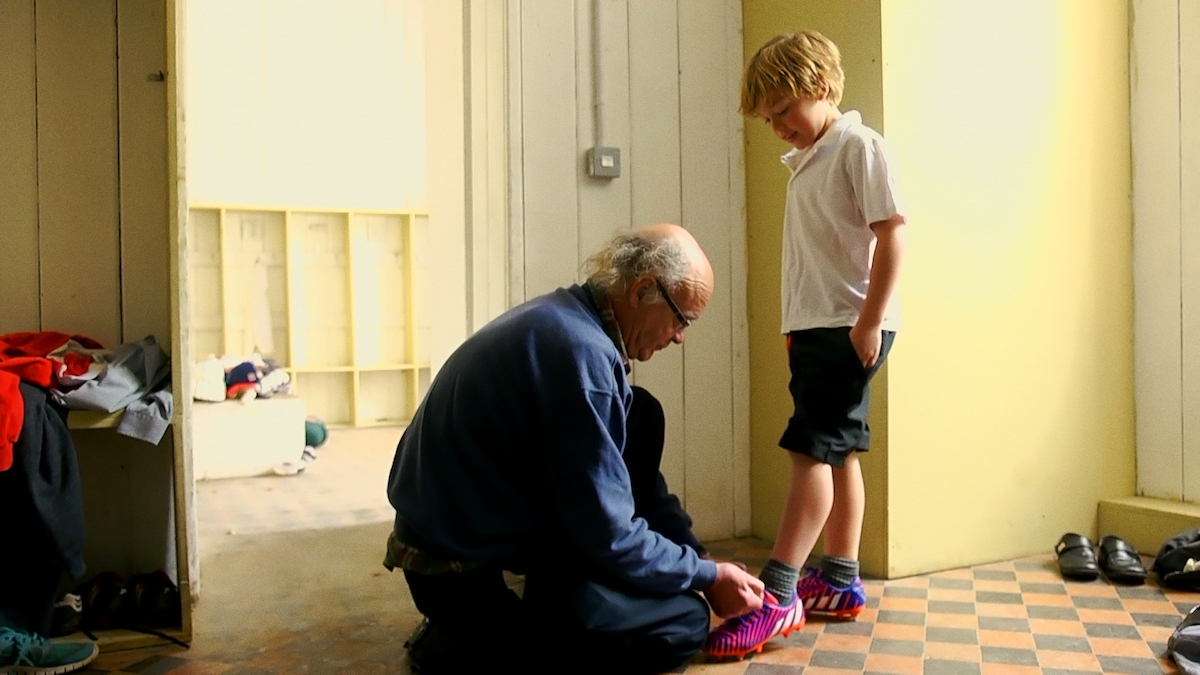
School Life is a bit of a charmer. It's just possible that documentarists Neasa Ní Chianáin and David Rane found themselves watching Être et Avoir a few years ago and wondering "why don't we have anything quite like this?" And so it was they travelled to Headfort, a boarding school deep in the Irish countryside, in order to turn their cameras upon the kind of activity that goes on in schools across the land, every day of every term. Above all, they honed in on John and Amanda Leyden, married, middle-aged teachers who live on site, presiding over a smattering of youngsters from broadly diverse backgrounds, many of whom are negotiating their first, formative weeks and months away from home. Though Mrs. Leyden's pierced eyebrow is a novelty, here are educators who - unlike, say, Michelle Pfeiffer in Dangerous Minds or Hilary Swank in Freedom Writers - actually look like the people who taught us way back when: John has that flyaway cape of white hair nature reserves solely for learned men and derelicts. (I wouldn't want to cross him; I can't do detention next Saturday.)

The emphasis is on the Leyden's teaching methods, and there is something of the spirit of A.S. Neill's experimental academy Summerhill in the non-prescriptive space they upon up for learning-through-experience. While Amanda has the book-learning down, furrowing her brow upon encountering a copy of The Shining hidden away in one pupils' desk, she also prompts her pre-teens into a debate on the (in Catholic Ireland, doubly controversial) issue of same-sex marriage; John, meanwhile, is most often found encouraging his charges to form bands and do their own DIY in the graffiti-covered, paint-splattered outhouse that passes for Headfort's music room. In short, there is between these walls an element of chaos - the chaos of life itself - which you probably wouldn't find inside your local Ofsted-fearing primary: John's tendency to dole out the occasional, withering "honey" to his female students might raise a non-pierced eyebrow or two, although I was reassured everybody was in safe hands the minute he kicked off an afterschool jam session by spinning Shampoo's "Trouble".

At risk of sounding like a teacher on parents' night, School Life could perhaps do with greater structure. I only gleaned the school's name from a minibus glimpsed in the background; we get a peek at what would appear a highlight of the curriculum - a school Olympics, complete with playing-field opening ceremony - but then have to scurry off to the next class. More drama wouldn't have gone amiss, either: is it that private schools like this only attract well-bred sorts with infinite respect for their elders? (Not in my experience.) Or that the presence of the cameras made these kids too self-conscious to play up? Still, the loose, ramshackle framing arguably mirrors the film's subject: few films have been this alert to the idea that learning can be a fun, collaborative process, and that the best teachers are open to the possibility their charges might teach them something, even if it's just a means to staying young at heart. At any rate, any educators looking on will surely find themselves a new hero in the dryly, affectionately dismissive John, who - after setting aside his full box of teacher's tricks, lighting up a fag, and hearing feet running down a nearby corridor - balefully confesses: "Don't like the sound of that. Sounds like children."

School Life is now playing in selected cinemas.

"The Snowman" (IndieWire 12/10/17)


We’re witnessing the last laps of the Scandinavian crime wave, that border-crossing multimedia movement that washed so much frosty-to-glacial genre fiction onto our shores and screens. The detective heroes of TV imports Wallander and The Bridge walked into the low winter sunset, while the Lisbeth Salander cycle has stalled to a point where reboots have been decreed necessary. Adapting The Snowman, one of Norwegian scribe Jo Nesbø’s bestselling Harry Hole mysteries, isn’t the studios’ worst idea of 2017. Yet it does feel a tardy one, and despite the industry heft thrown at Tomas Alfredson’s film, its execution leaves much to be desired. Beyond these stellar opening credits, there stretch two hours of icy, mostly lifeless waste.

Nesbø’s seventh Hole book provides the basis for this first movie, hence a certain frontloading of defective-detective tics. Michael Fassbender’s Harry is discovered blotto in an Oslo bus shelter, before stumbling back to a singleton’s untended apartment. “We found mould behind the walls,” shrugs the handyman spraying for dry rot, triggering a loud characterisation-through-property klaxon. It’s literary mildew that spreads elsewhere: Harry has a troubled relationship with his gallerist ex (Charlotte Gainsbourg), bathroom cupboards stocked deep with Diazepam, and a stack of unopened letters on his desk, most urgent among them being taunting missives from a serial killer leaving snowmen behind at the scene of his crimes.

Sniggers at early trailers suggest these melting markers will be but one of this notionally sombre thriller’s weak spots. As Harry and equally harassed partner Katrine (Rebecca Ferguson) rifle through years of missing-persons reports, we’re introduced to a whole grotto’s-worth of carrot-noses. There are forlorn-looking snowmen and irked-looking snowmen; flashbacks featuring Val Kilmer as a pie-eyed detective predecessor uncover remote mountaintop snowmen; at one point, there’s even a snowman bearing the severed head of Chloe Sevigny. “She was a free spirit,” eulogises the deceased’s twin sister, played altogether bathetically by a second Sevigny – and yes, this is the kind of film that thinks nothing of casting Chloe Sevigny as identical-twin chicken farmers.

Yet these rogue Olafs – chilling on the page, laughable when made literal on screen – are just the tip of the iceberg. Plot and screen soon throng with self-evident red herrings: James d’Arcy as an uptight husband, David Dencik as an oddball therapist with fuchsia-pink toenails, an underplaying J.K. Simmons as a local grandee trying to bring something called the Winter Sports World Cup to Oslo. It is the standard drift of Scandinavian crime fiction that all murders should point up the food chain towards corrupt, abusive or otherwise wonky administrations, but one of The Snowman’s biggest letdowns is how the promising Dencik-Simmons business winds up a narrative dead-end, somewhere between timewasting feint and audience cheat.

Such non-sequiturs, coupled with three screenwriting credits, insinuate this wasn’t the smoothest adaptation process. It may have been a non-negotiable Nesbøism that the Snowman Killer is kept on hold for long spells while the leads look into one another’s pasts: novelists generally do thread-juggling better than mainstream movies. Yet there’s a pungent whiff of contrivance about the video-fingerprint technology that requires Katrine to lug ugly, heavy kit around, and inevitably yields the clue that cracks the case. That outcome conveniently resolves all Harry’s issues in one go, while leaving viewers with a dozen or more hang-on-a-minute loose ends to pick through on the grumpy trudge back to the car.

If that process were livelier, The Snowman might have provided functional distraction, but as in his plodding Tinker Tailor Soldier Spy, Alfredson’s direction proves yawnsomely methodical, ticking off surviving plot points as though filling in some I-Spy Book of Scandinavian Crime Cliches. He permits one novelty – an unexpected revival of Hot Butter’s 1972 hit “Popcorn” – and has the advantage of screen-filling Nordic scenery, but his pacing makes the original Salander movies seem turbocharged. Mostly, he concerns himself with reproducing the atmospheric conditions of his breakthrough Let the Right One In, fogging up the viewfinder before the final reel’s choppy, unconvincing and desperately anticlimactic action.

The idiosyncratic performers might have boosted it, yet where Fassbender brought new, uncanny qualities to bear during his recent Alien androidry, here he’s stuck playing Composite Scandie Detective. Standing amid wide open spaces in woollens and parka, his Harry stares frequently into the middle distance, sporadically smoking for added notes of disquiet. Watching him wheel around one scene atop a library cart, we’re struck chiefly by the actor’s own boredom, and it’s a sticking point when your leading man appears bored an hour into a possible franchise-starter. After two hours of The Snowman, we know precisely why Harry Hole takes to drinking in bus shelters. We may even be tempted to join him there.

An after-the-goldrush project like this shortsells everyone eventually. Blink and you’ll miss Toby Jones, playing one more gobbet of exposition; Kilmer’s now ferociously lived-in presence seizes the attention during his five minutes of screen time, but he appears the victim of either dubbing or indifferent ADR; putting Gainsbourg in an LBD is the film’s thin idea of style. Any hope Ferguson might produce some consolatory warmth or heat with her co-star gets extinguished early on, and while it’s almost a relief when the film abandons its limp attempts to make Katrine interesting and instead generates another damsel-in-distress, it’s also an admission of defeat, marking the point at which Alfredson abandons any pretension to serious drama.

It’s a pity, as recent box-office charts have framed this as a boomtime for R-rated entertainments, but you can’t see a perfunctory, much-tinkered-with chore like this sticking round in multiplexes for long. Lacking the pulpy kick and verve of 2011’s native Nesbø adaptations Headhunters and Jackpot, The Snowman is too ponderous to quicken the pulse, and too drably, insistently grey to provide an accidental campfest for would-be snowmen-spotters. For all the considerable nous assembled either side of the camera, no-one can rescue it from its own mediocrity: if this were the opening tranche of a TV miniseries, you’d be exploring other channels some time between the second and third ad breaks.

Rating: C-

The Snowman is now playing in cinemas nationwide.

Thursday, 12 October 2017

Between the wars: "Goodbye Christopher Robin"


The period hits keep on coming. Although given to a gentleness that sometimes borders on tweeness, Goodbye Christopher Robin, directed by Simon Curtis from a script by Frank Cottrell Boyce and Simon Vaughan, differentiates itself by attempting to generate something other than the now-standard nostalgia for Empire - not least an ambivalence around the idea of nostalgia full-stop. This is an author biopic, very much in the vein of Finding Neverland, 2004's hanky-dampener on the tragic personal life of J.M. Barrie, but it also intends to be a continuation of its subject's commitment to pacifism, knowing full well the casualties that generally follow when flags start flying and our youngsters are sent off to the battlefield. That gentleness, for all that it might at times appear cosy or underdramatic, is in itself a political stance. 

The author is A.A. Milne, played here by the generally upright and Poohstick-thin Domhnall Gleeson as a man very much of his time. Returning from the frontlines of "the war to end all wars", he's newly traumatised by Roaring Twenties champagne corks that go off like rockets and West End spotlights that resemble searchlights. Marriage (to Margot Robbie's society belle Daphne), fatherhood and a measure of success as a playwright and wit-for-hire all follow, yet as the film has it, it was only with the family's relocation to the open spaces and fresh air of Ashdown Forest in leafy Sussex that Milne found both peace-of-mind and his most enduring success, taking off into the woods by afternoon in the company of his cute-as-a-button son Christopher Robin Milne (played by Will Tilston as a boy, and Alex Lawther as an adolescent), a.k.a. "Billy Moon", to build new worlds with the aid of the lad's ragbag teddy bear.

Cottrell Boyce and Vaughan ensure these woodland manoeuvres go a little deeper than the usual movie Eureka moments: their Pooh Corner becomes a haven, a Brigadoon-like safe space that opened up before the author for a few brief summers, only to disappear again as events elsewhere in Europe, and the Milnes' own relationship, began to darken. The best scenes in the film are those that isolate Gleeson and Tilston in the middle of nowhere, when a combination of time, nature and Billy Moon's bright-eyed purity comes to heal some of the author's scars. When Milne - commonly nicknamed Blue, with all the melancholia that infers - hears a buzzing, his mind immediately scrambles back to the flies descending upon the corpses littering the trenches; it's down to the boy to reassure him it's only bees, busy making honey (or hunny). "This is paradise," coos visiting illustrator Ernest Shepard (Stephen Campbell Moore), looking out over the rolling, sundappled hills, and it's hard not to agree - but the filmmakers keep a close eye on the issues Milne had to work through out here so that his books might later be claimed as philosophical primers.

This, admittedly, leaves little for the women of the piece to do: after mother!, Goodbye Christopher Robin is the second autumn release to draw bleak conclusions about the place of the fairer sex in big country houses. One might generously say that Robbie was miscast, except that her presence on the roster presumably unlocked some funding during the preproduction process: clenched and blinking and working frightfully hard on her cutglass accent, she's entirely unable to overturn the script's unflattering conception of Daphne as a party girl who grew cold and brittle the moment another, dependent human being was sprung from her loins. By way of consolation, Kelly Macdonald offers up her usual warmth as the Milnes' beloved nanny Olive, but I can't be the only viewer who feels he's seen Macdonald cringing her way through nanny roles in eight out of her last ten features; you do wish the British film industry would get round to finishing its Boardwalk Empire boxsets and push more adventurous and substantial material her way. It becomes increasingly apparent the film needs its women to be there solely for them to go away, for the heart of this tale is an all-male double-act: the troubled, solitary man, and the boy who, by way of his very Christopher Robin-like sensitivity (nicely caught in the bowl-headed Tilston), teaches him how to be a father - and a father not just to this kid, but all kids.

Gleeson has that stiff ex-Army reserve ("old soldier, you know; I'll see to myself") down pat, but in his quieter moments, he lets us in on a latent anger at the state of things: it's all this Milne can do to pull himself together and write, in defiance of the cruelties and iniquities of a world that would paralyse us and stifle the imagination. (Dude should have stuck around for 2017.) It is cosy for stretches - such that it's something of a culture-shock to see Phoebe Waller-Bridge, Fleabag herself, show up in twin set and pearls as a Times reporter - but Cottrell Boyce and Vaughan withhold their most complex material until the closing stretch, as we learn the extent to which young Billy Moon was himself marked and traumatised by this formative moment. Curtis's adoption of a child's-eye view, which had earlier done so much to usher us between Ashdown and the fictional reality of the Hundred Acre Wood, suddenly looks like a poignant reminder of that innocence that gets knocked out of us with age. What starts out seeming to be a film about a boy whose worst fear is to be abandoned by the adults around him finally resolves itself into a quandary Milne knew all too well: is it not every bit as heartbreaking when a parent comes to be abandoned by their child?

Goodbye Christopher Robin is now showing in cinemas nationwide.

Wednesday, 11 October 2017

A bit of a do: "The Party"


The Party, Sally Potter's return to fiction filmmaking, is a short, sharp chamber piece (71 minutes, including credits) which gestures - wildly, often amusingly - in the direction of the state-of-the-nation address some of us have spent the best part of the last year looking for. It's organised around - yes - a dinner party, a scenario that satirically inclined filmmakers from Luis Buñuel to Mike Leigh have deployed as a potential festival of embarrassments and humiliations, and it's very quickly and economically established that this one will go off with a louder than usual bang. For one thing, hostess Kristin Scott Thomas, an MP newly selected as Shadow Health Secretary, is going manic in the kitchen, burning the vol-au-vents while fielding calls from a secret lover; her hubby Timothy Spall, meanwhile, lurks gloomily in the lounge, nursing the red wine and a secret of his own. Other arrivals (Cherry Jones, Emily Mortimer, Patricia Clarkson, Bruno Ganz) appear convivial enough in the main, the one possible exception being "wanker banker" Cillian Murphy, who turns up drenched in coke sweat, and with a gun concealed in his jacket pocket. Suffice to say nobody is going to get fed, and one of The Party's comic and dramatic strengths is how it permits us to feel the collective blood sugar plummeting and irritation rising.

It may, granted, sound as if April's The Sense of an Ending has a rival for the title of Liberal Elite: The Movie, and indeed the entirety of this caprice takes place in Scott Thomas's well-appointed North London bolthole, shuffling the first-world concerns of characters who've never had to scrape to make rent. Yet Potter reveals a sharp eye and ear for her characters' cluelessness. Ganz's holistic cuckoo, burbling beatifically about the superiority of aromatherapy over the "voodoo" of Western medicine, is the obvious comic relief, but even the more grounded Jones lets slip she once did a degree in "gender differentialism and American utopianism", subjects which the director rightly senses might prompt anyone to make their excuses and leave, perhaps even vote Leave. In one front parlour, here is the frippery of the well-to-do, a jostling collection of niche concerns and special interests; set against the essentials of love, sex, birth and death, everything else is what Clarkson, the film's repository of waspish common sense, dismisses as mere dogma, that curse of the modern age. Still, they bang on and on at one another until the tenuous air of civility is shattered along with the hosts' patio door, at which point any solidarity falls apart; you lose track of the number of relationships that get smashed against these walls, or fly out the window.

Potter could just have written enough betrayals for her blue-chip cast to enact, wound these players up, and watched 'em go - it would surely have brought the house down at the Hampstead Theatre, if nothing else. That The Party feels so much richer than the hour-long, single-location doodle it presents as is down to the way she and her performers navigate a succession of electric tonal shifts. They pivot from wry comedy of manners to life-or-death tragedy, pinball via Ray Cooney farce and piquant social commentary: we're encouraged to consider just where the MP's desire to have her vol-au-vents and eat them has left her, alongside Murphy's twitchy portrait of toxic masculinity, a manchild brought up to so keenly believe he's a winner that he simply doesn't know how to react upon learning he's become a cuckold. (Inevitably, he reacts badly.) For Potter, all the isms and other certainties her generation were raised with - the capitalism and socialism, the collectivism and individualism - are now, more than ever, in a state of flux if not outright crisis. As Clarkson barks at Spall during the home stretch: "I seem to remember you called yourself a feminist in the old days." As the punch-drunk latter replies: "Everything's changed."

It's not hard to see what about the sight of once-comfortable, possibly complacent Brits falling into terminal infighting might ring a bell among UK audiences in 2017. (Potter reportedly completed her script during the 2015 general election, but she has a feel for divisions to come.) Among a spread of vividly recognisable archetypes - the helpless, self-defeating opposition figurehead, the smug guru who proves zero help when things start going south - it's Spall, half his previous physical presence but somehow twice the actor, who proves the most compelling invitee: stricken, haggard, compromised, the bruised conscience of Leigh's Secrets & Lies recast and revealed over the course of a single evening as a sorry wreck of a man, left wondering - as we surely all are - "How has it come to this?" Those words would be a better epitaph for this Party than the punchline the film eventually dashes towards, which slightly undermines the seriousness of Potter's project - suggesting that this was never meant as more than a tart, well-sustained joke. Yet in its hectic movement and wild mood swings, The Party goes some considerable way towards capturing the madness and the sickness that has consumed this country over the past eighteen months, and does so far better than any of our pretty-pretty post-Downton exercises in dressing-up.

The Party opens in selected cinemas from Friday.

Tuesday, 10 October 2017

Pinterest: "Hellraiser"


Reissued in cinemas to mark its 30th anniversary (and, not coincidentally, another Friday the 13th), Hellraiser, being the directorial debut of horror novelist Clive Barker, adds both ghoulish and human dimensions to a standard haunted-house scenario. A married couple with all sorts of baggage (Andrew Robinson and Clare Higgins) move into a spacious property that can never be a home for reasons that soon become clear: among them is the presence of the husband's brother (and the wife's sometime lover), a latter-day libertine who's literally been to hell and back, having had the misfortune of being dragged off to a shadow universe after a ritual involving a shiny, Rubik's Cube-like spirit box (a nice piece of production design) went horribly wrong. With an eye to international box-office returns, Barker gives this British-filmed production a curious mid-Atlantic feel, with a lot of actors and accents striving to pass for American - in one especially comical instance, this involving sticking a day player with a baseball cap - though it could just as easily play out as grisly domestic farce, with a wife taking in other men to feed the secret lurking in her closet.

What's particularly persuasive is the film's all-pervasive sense of decay: blackened fingernails, mouldering food, a homeless man with bugs in his beard, organic malevolence festering under the floorboards and in the walls with the rats. All that timelapse footage of carcasses mulching and decomposing in Peter Greenaway's Eighties features Barker here reverses, with creatures emerging out of primordial soup, thanks to some still impressive model work. The computer effects (and, if we're being honest, the bouffant hairstyles) have dated less well, but otherwise it remains an appreciably serious horror remnant from a decade not exactly spilling over with them: sequels inevitably followed, more expensive yet still relatively cheap in the grand scheme of things, not always approved by Barker, and often less concerned with clever plotting than the mythos of the monstrous Cenobites. Doug Bradley's implacable Pinhead became the series' poster boy, its Freddy or Jason, but he's a late arrival here, only announcing his presence during a third-act diversion in a hospital that has nothing very much to do with the main narrative thrust.

Hellraiser returns to selected cinemas from Friday.

Friday, 6 October 2017

At the LFF: "Life Guidance"


It risks giving into lazy national stereotypes, but one could argue Life Guidance was a very Austrian sci-fi movie: all clean, straight lines and antiseptic spaces, unified by an underlying unease about the direction society is pointed in. The logical endpoint, according to writer-director Ruth Mader, is an Austria governed by the (very corporate) idea of optimalisation: her film, accordingly, evokes a nation-state where citizens are pressured to make the most money and own the nicest homes, housing the priciest things, with no time or space whatsoever permitted for frailty, jollity or indeed anything else in the realms of human feeling. As in all workable sci-fi speculations, we are invited to ponder the extent to which the future may be here already.

Such emotional austerity measures have left Mader's protagonist, family man Alexander (Fritz Karl), depressed beyond tables, and most often crying on the couch in his beautifully appointed property in the suburbs. One afternoon, however, there arrives on his doorstep an oddball advisor from the state's Life Guidance division, there to passively-aggressively turn Alex's frown upside down and generally steer him back onto what's been deemed the right course. Instead, in a film that doesn't lack for shots of its lead behind the wheel of a sleek company car, this intervention succeeds only in driving our man further astray: soon, he's bunking off work altogether to stalk his would-be counsellor, hang around suboptimal housing estates, and initiate some kind of relationship with an equally depressive divorcee. Life, so the film has it, is a messy business, and we owe it to ourselves and future selves to mitigate for that.

What the film describes is a carefully controlled rebellion: in his buttoned-down suit and tie, Karl projects a variation of that fragile self-containment widely associated with Colin Firth, and Mader keeps framing/trapping him within Austria's most striking modernist and postmodern properties. The deeper he's ensnared in this narrative, the more he starts to resemble Kafka's Josef K after another century of bureaucratic capitalism: entirely uncertain how to react, and whether there's anywhere left for him to run. The great pleasure of Life Guidance is how organically this story develops and flows: each scene opens a different window onto a brave new world that seems only a few miles or minutes down the road from our own. There are, perhaps inevitably, traces of Michael Haneke to be glimpsed: Alexander reacts with blank panic upon learning an agency has recorded his white-saviour dreams of escaping to Africa, as we note with alarm that one of his fellow travellers is played by Arno Frisch, one of the original Funny Games' home invaders. (You should see this guy's nightmares.)

Yet Mader tempers any severity with a sly, dry sense of humour. Such are the conditions imposed by the authorities that a kickaround in the back garden, usually a gentle gesture towards father-son bonding, here involves dad walloping the ball as hard as he can at his lad; meanwhile, businessmen are reeducated at afternoon arts-and-crafts sessions, experiencing self-improvement through macrame; and when, at his lowest ebb, Alexander finds himself among the sorry singletons at a down-at-heel noodle bar, the possibility is raised that Mader and co-writer Martin Leidenfrost may just be dramatising, even satirising, the kind of midlife crisis - a futile kicking against the pricks - which men will still be having decades from now. Between the surge in sales of Nineteen Eighty-Four, the rediscovery of Philip K. Dick by television and the new Blade Runner, philosophical sci-fi looks to be having a renaissance, perhaps as we look for guidance on how to navigate our present dystopias: Mader's scarcely less compelling fable offers high style and no little sociological food for thought.

Life Guidance screens tomorrow (8.45pm) at the ICA, then on Monday 9 (12.45pm) at BFI Southbank, and again on Saturday 14 (2.30pm) at the Vue Leicester Square.