Friday, 6 October 2017

For what it's worth...


Top Ten Films at the UK Box Office 
for the weekend of September 29-October 1, 2017:

1 (1) Kingsman: The Golden Circle (15) **

2 (2) It: Chapter One (15) ***
3 (3) Victoria & Abdul (PG) **
4 (new) Goodbye Christopher Robin (PG) ***
5 (new) Flatliners (15)
6 (new) Home Again (12A)
7 (5) The Emoji Movie (U)
8 (6) The Jungle Bunch (U)
9 (8) Despicable Me 3 (U)
10 (4) mother! (18) *****

(source: theguardian.com)

My top five: 
1. Blood Simple

2. The Ornithologist
3. Goodbye Christopher Robin
4. The Road to Mandalay
5. Zoology


Top Ten DVD rentals: 

1 (new) Pirates of the Caribbean: Salazar's Revenge (12) **
2 (1) The Boss Baby (U)
3 (2) Guardians of the Galaxy Vol. 2 (12) **
4 (4) Logan (12) ***
5 (3) John Wick: Chapter 2 (15) ***
6 (5) Fifty Shades Darker (18)
7 (7) Going in Style (12)
8 (10) Hidden Figures (PG) **
9 (8) Kong: Skull Island (12)
10 (9) Life (15) **

(source: lovefilm.com)

My top five: 
1. City of Ghosts

2. The Red Turtle
3. My Life as a Courgette
4. David Lynch: The Art Life
5. Suntan


Top five films on terrestrial TV:
1. Bajirao Mastani [above] (Monday, C4, 1.50am)
2. Splice (Wednesday, C4, 1.25am)
3. American Pie: The Wedding (Saturday, ITV1, 11.05pm)
4. Safe (Sunday, five, 11.05pm)
5. Dial M for Murder (Sunday, BBC2, 1.15pm)

They drive by night: "On the Road"


Given that he was previously responsible for one of the best scored films in recent memory (1999's Wonderland) and an especially vivid snapshot of the Manchester scene (2002's 24 Hour Party People), any Michael Winterbottom film on the subject of music merits our attention; the only fear is that he might, at any point, retreat once again into the vogueish arsehole-and-navel-gazing of 2004's 9 Songs. Shot in the course of the band Wolf Alice's breakthrough UK tour of 2016, On the Road presents as one of Winterbottom's hybrid works. Some substantial part of it intends to be a document of life on the road, complete with all the rehearsal and gig footage the band's fans might want, but Winterbottom also introduces a note or two of fiction in establishing a tentative relationship between a representative of the band's management (Leah Harvey) and a member of the technical crew (James McArdle). The experiment that results, though it has its moments, is only halfway successful.

Several series of TV's The Trip - by some distance Winterbottom's most committed project - have brought this gadfly director's primary theme into sharper focus: the artist as romantic (even Romantic) figure, wandering this Earth, either unable or unwilling to put down anything in the way of roots, becoming increasingly aware of their own mortality. Unlike a lot of NME-endorsed chancers over the years, Wolf Alice bound onto this stage as a supremely photogenic proposition. Naturally, Winterbottom's camera becomes transfixed before lead singer Ellie Rowsell, with her capacity to appear elfin in repose while generating thunderous noise come showtime, yet drummer Joel Amey, too, sports lustrously Byronic locks, and even bassist Theo Ellis, who looks as bassists are wont to look, makes the effort of applying a glittery eye shadow before communing with his public. (It's the old Dave Hill tactic.)

Winterbottom is largely successful in his attempts to evoke the modest milieux that an emergent indie-rock band with some industry clout behind them might pass through: the curious intimacy of the tourbus by day and after dark, the varyingly self-conscious interviews given by bands just stepping into the limelight, the sight of student union bars after a gig, their now-empty dancefloors scattered with standard-issue plastic cups, the cumulative feeling we get of twentysomething travellers slowly running out of clean socks. (One nice, resonant ad hoc line, picked up in passing backstage: "Are you going for a curry after this?") Winterbottom is still to some degree the same realist who knocked out Butterfly Kiss, Welcome to Sarajevo and In This World in the first flush of his career, and it's a tribute to his embedded performers that the unbriefed viewer might well mistake them for real-life hangers-on.

The dramatic strand - which takes in our boy's fraught relationship with his alcoholic mother (Shirley Henderson, typically striking in the minute or so she appears on screen) - suffers from being underdeveloped and imprecisely miked: these snatches of conversation, overheard from afar, reflect only how Winterbottom and crew were evidently at the mercy of somebody else's schedule, obliged to capture what they could when they could. The straightahead emotion of the gigs - the band striking up a tune, the young crowd singing it back to them, or otherwise going wild - registers rather stronger. More exasperatingly, given the overextended two-hour duration, is the sheer amount of downtime On the Road obliges us to navigate: we're left in very little doubt that each day on tour may generate ninety minutes of stonking rock 'n' roll, but it also involves ten to fifteen hours of travelling, unpacking, setting up, and then moving on from one place to the next, as Winterbottom himself has from project to project.

For a while, the director finds ways to keep boredom at arm's length - Harvey's way with a song and a smile should be enough to secure her own future within the entertainment industry - but increasingly all the repetition of touring does is generate the same kinds of scenes, familiar editing strategies (as in 9 Songs, love scenes and live scenes go intertwined) and an overall diffuseness of effect. The idea - to debunk all those hoary Cocksucker Blues-era myths of life on the road - isn't an unworthy one: like many other college-educated, career-conscious mainstays of the 6Music playlist, ver Alice shy away from sex and drugs on camera, and can instead be observed discussing Harry Potter and cleaning their teeth (even, for the love of Lemmy, moisturising) before turning in for the night. Yet this isn't really the basis of compelling cinema, and there's only so many minutes of roadies wheeling equipment around you can watch before the eyes cloud over, the heart sinks, and you find yourself pestering the coach driver to drop you off at the nearest service station.

On the Road opens in selected cinemas from today.

Thursday, 5 October 2017

At the LFF: "The Hungry"


The passion of Indian filmmakers for Shakespeare continues unabated: with Vishal Bhardwaj hoovering up the Bard's prestige plays - updating Macbeth as 2003's Maqbool, Othello as 2006's Omkara and Hamlet as 2014's Haider - it's been left to newcomer Bornila Chatterjee to take a freehand approach to adapting the eternally problematic Titus Andronicus for the screen. Not for Chatterjee the gleeful theatrical excess that elevated Julie Taymor's pre-millennial adaptation Titus; The Hungry, in striking contrast, unfolds as a coolly restrained, quietly gripping slowburn, detailing the skulduggery that accompanies a transfer of power within a family-owned and operated agribusiness in latter-day New Delhi. (One touchstone looks to have been Michael Almereyda's corporate Hamlet from 2000.) After a prologue that sets out the staged suicide of corporate seedling Ankur (Life of Pi's Suraj Sharma), the bulk of the action is compressed into a coked-up wedding party, overseen by icy patriarch Tathagat (Naseeruddin Shah), in which the planned union - a sealing of deals, on several levels - unravels into bloody chaos. An element of Hitchcockian tease gets built in here: the minute we clock one of the guests offering a gift of a ceremonial duelling pistol, we can be fairly sure the reception will go off with a bang, and it hardly settles the nerves that so much of the food is being served up on skewers.

Yet faced with the play's ever-growing pile-up of cadavers, Chatterjee elects to hold back on the lipsmacking relish. Her deaths are a grim business, and taking her time allows her to invest even her source's pulpier aspects with greater depth. Losses are mourned; the seeds of revenge are carefully planted; and - with the assistance of emergent cinematographer Nick Cooke - some very crisp images are composed. This Titus isn't just a parade of horrors, sick joke or some other assault on the audience's notions of taste, but a labyrinthine plot with especially dark corners, and fleshed-out characters whose wanton appetites point them inexorably towards death, rather than the growth their company would represent: the final act, indeed, squares capitalism and consumption with a cruel kick Peter Greenaway would likely appreciate. I couldn't entirely puzzle out whether Arjun Gupta's posturing, US-educated groom Sunny was meant to be quite so annoying, or whether that was just a side-effect of a ticky performance, but everyone else fits their role like hand in murderous glove: I don't believe I've ever seen Shah play this cold-blooded on screen before. In taking some of the heat out of her material, Chatterjee has given us a film that arguably builds upon its source - and, just perhaps, reflects the cutthroat realities of Modi's business-first India more starkly and dramatically than the PM's supporters would find comfortable.

The Hungry screens this Saturday (6.15pm) at Picturehouse Central, and again on Sunday (8.45pm) at Rich Mix.  

Corporate spies: "Kingsman: The Golden Circle"


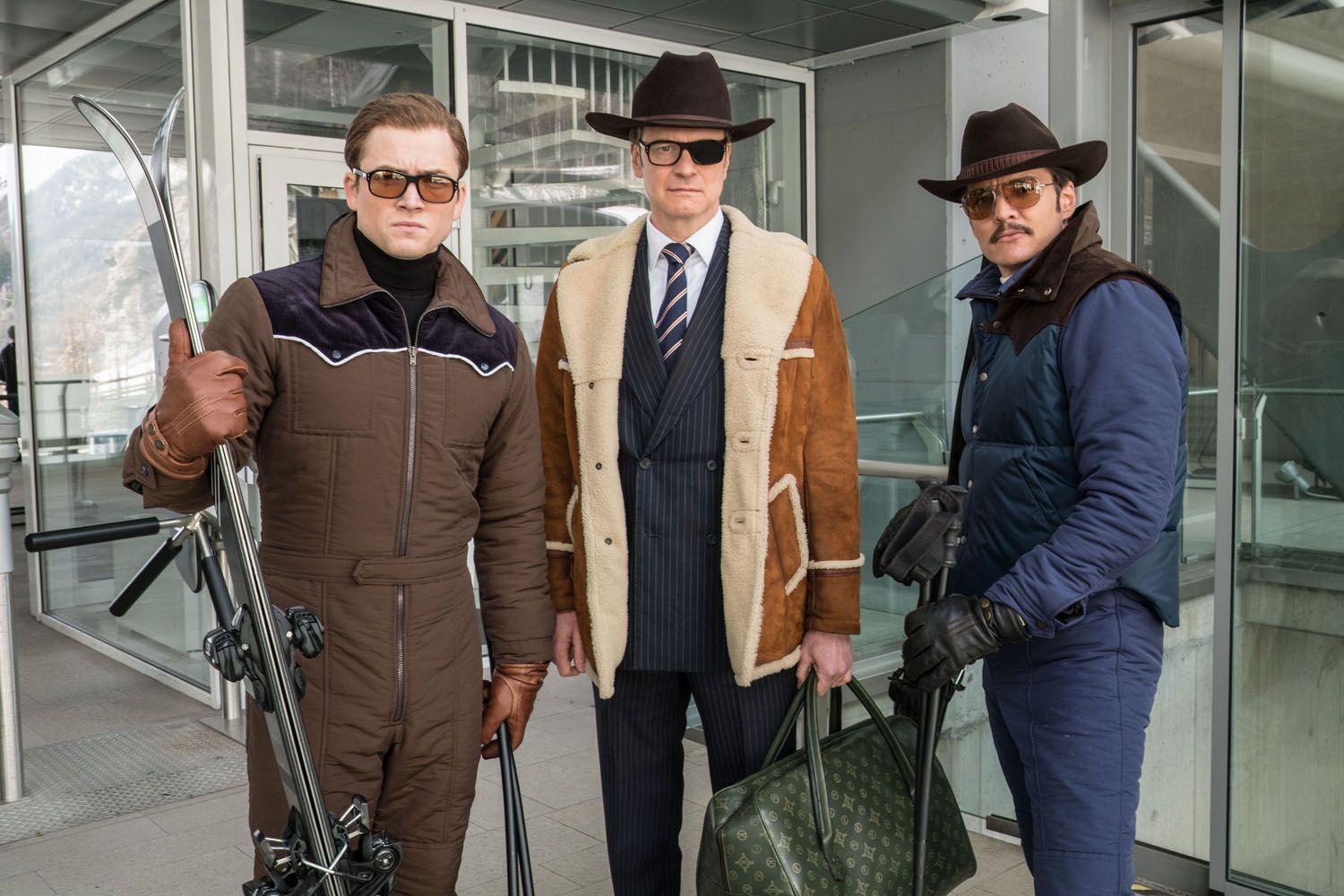
2014's Kingsman: The Secret Service was a cartoonishly violent fantasy of social mobility in which the unholy trinity behind the Kick-Ass series - comic book guy Mark Miller, nerd-enabling screenwriter Jane Goldman and producer-turned-director Matthew Vaughn - gave the distractible, snickering, hormonal teenagers who nowadays stalk the shopping-mall multiplex exactly what they wanted: loud, bloody carnage, anal sex jokes cribbed from pub toilet walls, a passing sense there might be a place for them in this big and blasted world. Like almost all of Vaughn's undertakings, it was packaged well enough to become a sizeable hit, and so, while we wait for global nuclear annihilation or the universe to right itself in some other way, here comes Kingsman: The Golden Circle, a.k.a. The Further Adventures of Eggsy, a full 141 minutes of them, not just giving the crowd what they want, but a whole lot more of what they want. My reaction proved much the same as my reaction to the Sex and the City diptych: the thin dose of smallpox that was the first movie rather inoculated me against the terribleness of the second. When your expectations are this low, there's very little chance a movie can disappoint, depress or outrage.

There are signs, however, that the first film's success caught even the calculating Vaughn off-guard. The Golden Circle proceeds with one of those sequel plots, initiated and sustained by loose ends we'd all thought the original had tied off, no matter that this approach risks implausibility in bringing the dead back to life. Sequel bloat, as evidenced by that running time, is also very much on the menu. It takes a full hour for Goldman and Vaughn to lay out the precise threat facing the Kingsmen, time the director spends ripping off/auditioning for the Fast & Furious series (it's both what the kids want, and what the habitual franchise-chaser Vaughn wants to do), setting up the domestic bliss Eggsy (Taron Egerton) now inhabits with the Swedish princess he took up the wrong 'un at the end of film one, getting Colin Firth to remember who he is and what he's still doing here (paycheques generally help, in these cases) and ushering on at least a dozen characters too many for any efficient blockbuster to deal with, foremost among them Sir Elton John, playing himself in a wilfully mismanaged cameo that most often contrives to leave him sitting around the set like an abandoned armchair or care home resident. (By complete chance, I found myself listening to "Someone Saved My Life Tonight" the very morning I set out for The Golden Circle: we seem further away than ever from that moment in popular culture.) 

In part, this is down to the new, highly considered, transatlantic direction the series takes here. In a twist literally discovered at the bottom of a whisky bottle, it turns out the Kingsmen have an American equivalent, the Statesmen, a bunch of lasso-wielding, liquor-swilling, boot-stomping rowdies introduced to the strains of John Denver's "Take Me Home, Country Roads". (The recurrence of that song here, after its recent deployment in Logan Lucky, makes me wonder how much this Denver mini-revival is down to the singer's timeless sincerity, and how much is down to a wider artistic conservatism: filmmakers giving the public the recognisable things they want.) Goldman and Vaughn's lumpen inability to do anything with dialogue that isn't the F-word (and not much more of note with that) leaves their otherwise sparky guest stars - Jeff Bridges, Channing Tatum, Julianne Moore - looking very ordinary, like any other of the jobbing thesps the director recruits; they, too, are surely here for easy money, safe in the knowledge they'll be away working on more challenging and stimulating projects by the time The Golden Circle has lumbered into its third act.

Crucially, at no point do we feel the film has actually set foot on American soil: Vaughn is one of those low-cost, high-reward facilitators happy to plonk his stars down in front of a blue or green screen and patch in the bulk of his action during post, which is why his evocations of Savile Row and Hyde Park Corner look and feel as virtual and non-atmospheric as his idea of rural Kentucky, or a pharmaceutical repository deep in the Alps. (The casting of Emily Watson as a White House advisor is one clue that this production didn't venture too far beyond Leavesden; the complete absence of humidity in its Cambodia scenes, such that Firth and Egerton can be seen to engage in multiple gunfights in buttoned-down three-piece suits and not break into even a light sweat, would be another. So long as it looks cool, right?) A certain elegance can be observed in the tailoring: I might have been tempted to give editor Eddie Hamilton praise for the dissolve that carries us through a tainted bag of weed to the forest where it was harvested, were the movie he's cut not, you know, 141 minutes long. Yet the material everyone's working with is so flimsy, and when it's awful, it's properly awful.

It's become clear with these films that Vaughn is cut from squarer cloth than he reckons: the company-man plugs for Fox News and The Sun - it's what they want - recur here, and there's a lot of dwelling upon a range of Kingsman toiletries that will presumably be in the shops come Christmas, for that berk in your life who dreams of touting a whiff of Eggsy. Equally, though, there are moments when Vaughn's yuppified veneer cracks and we get glimpses of the wannabe wideboy who helped muscle Lock Stock and Snatch onto our screens. I still haven't quite figured out whether the Kingsmans reflect his own fantasies of working-class life (yellowing reference points: England beating Germany in the footie, the Royal Wedding) or just what he thinks the working classes will pay to fantasise about. Sometimes the films get caught between the two, as in the gurgling sequence here where queen-and-country compels Eggsy to finger a pliable blonde named Clara in a yurt at Glastonbury. Still, second time around, Vaughn can't work up the snotty energy to be properly obnoxious or shocking - the film's just congested, a build-up of that same product this filmmaker has been dealing in and profiting from ever since Layer Cake, one whose short-lived highs never remotely compensate for the toll exerted on wallet and soul. The more the Golden Circle logo appears on screen, the more it appears to fit the Kingsman brand to a tee: a big, gilded nothing, whether or not that's what we want or aspire towards.

Kingsman: The Golden Circle is now playing in cinemas nationwide.

Wednesday, 4 October 2017

At the LFF: "Ava"


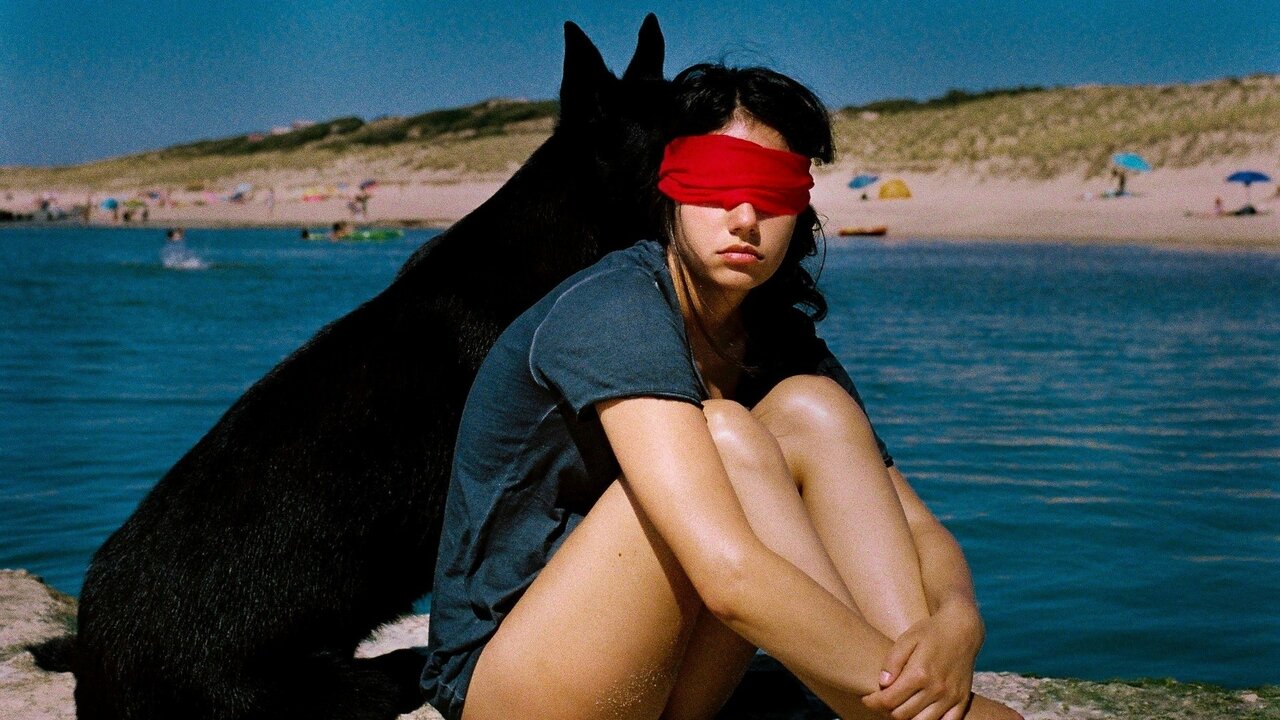
In Léa Mysius' debut Ava, light and dark exist side-by-side. After an opening tableau that locates us squarely in a French coastal resort at high season among bronzed holidaymakers surfing a vibe of unlimited pleasure, we're introduced to the eponymous teenager (Noée Abita), who proves a far less sunny subject - in part due to a diagnosis of retinitis pigmentosa that has left her facing up to a marked reduction in her field of vision. With only sporadic attention coming her way from an overstretched single mother who spends her leisure time picking up younger men at the beach, Ava elects to run off with a massive black dog, very nearly twice her size, stolen from a brooding, raven-haired Romany lad whom the local police are threatening with deportation. The theme would appear to be set: darkness closing in on already moody adolescents. Ava daubs her bedroom walls with black paint, and takes to wearing a blindfold to prepare herself for what lies ahead of her; and Mysius wouldn't be the first creative to send for a black dog as a menacing metaphor for depression.

Still, this protean writer-director appears far more interested in those lively weirdnesses that lie at the edge of her young heroine's vision: a collapsed observation bunker at the end of the beach, its shadowy crevices providing ample opportunity for exploration; a bad dream in which Mysius very nearly matches Raw's Julia Ducournau for bracing imagery. The film is all sudden lurches and ruptures, which you could argue makes it broadly analogous to one's formative years; one of its strengths is that we never know how it, or its heroine, is likely to turn out. For some time, I suspected Mysius of having had the reasonably bright idea of relocating the coming-of-age upheavals of Andrea Arnold's Fish Tank to balmier climes. The minute you spot it, the more of a remake it starts to seem: the lopsided, three-girl family dynamic, the consolatory relationship between the girl and the animal, the deployment of the travelling community to set the heroine's plight in stark relief.

Yet Ava proves too restless to remain in one spot or on one course for long: we sense Mysius hastening to see and document all she can before the final fade to black, and trying on other directors' hats to see what fits besides. The stern Catherine Breillat, for one, comes to mind - both thematically and geographically, we're not so far away from the terrain of 2001's A Ma Soeur! - and yet Mysius keeps pulling off great sight gags: Ava closing eyes and ears to maman's birds-and-bees speech, only to walk face-first into a stop sign with a resounding clang, or a moment where one nervy suitor closes in for a kiss and promptly squirts mustard from his hot dog all over Ava's thigh. (To the dark of Breillat, Mysius adds the light of Frank Tashlin.) By the time this girl and her Romany swain are smearing their bodies with mud and terrorising the bathers on a nudist beach, Ava has turned left and become a zappy minipop rerun of Pierrot le Fou.

That wild, youthful, mix-and-match energy sustains the film only up to a point, and my feeling is that there'd be a knockout mid-length feature in here. The 100-minute one we've got suffers for sending Ava out after the least interesting character in the whole resort, and the premature blindness theme comes to be forgotten about as we charge, uninvited, into a big fat Romany wedding. Still, some indication of how sporadically vivid Ava remains: I wouldn't want to lose a second of the charming musical interlude Mysius throws in just for the hell of it, and her closing frames fall somewhere between strong and perfect. The most indelible relationship is that between Ava and the pooch, blood-spattered, rounding on itself, forever threatening to devour the world entire - both a negative-image Belle and Sebastian, and a reminder that the dog days of childhood are rarely as smooth travelling as we might like.

Ava screens at 6.30pm tomorrow (Thu 5) at the Vue Leicester Square, then on Sat 7 at the Rich Mix and Mon 9 in NFT2. 

Monday, 2 October 2017

Watching the wildlife: "The Ornithologist"


The Portuguese writer-director João Pedro Rodrigues has been a festival favourite since the turn of the millennium, although his films - wholly postmodern in their approach to narrative, gender, sexuality and identity; works in which all traditional bets are well and truly off - have so far been deemed too niche by distributors for the generally conservative tastes of British cinemagoers. You could see how Rodrigues's ever-shifting, thoroughly singular latest The Ornithologist might, with judicious trailering, be sold as an approachable fable or thrilling chase movie, and yet precisely nothing about it is guaranteed: frankly - and I mean this as a compliment - there's enough in these two hours to discombobulate just about everybody.

It starts straightforwardly, doing more or less what it says on the tin. Here is a study of a close-cropped, sturdy young twitcher - as played by the emergent French actor Paul Hamy, more Jason Statham than Bill Oddie - out in the wilderness with only a canoe and a campfire for company. After he's swept away by a sudden tidal surge, he finds himself at the mercy of a pair of Chinese tourists (Han Wen and Chan Suan), who've apparently strayed from the Camino de Santiago pilgrimage route. An opening quote from St. Anthony of Lisbon has already alerted us to the presence of signs and wonders in this world, and this early stretch seems to be setting us to contrast the girls' evident superstition with the protagonist's science, rationalism with religion. "We're good Christian girls!," the tourists giggle when the twitcher offers them his tent for the night, but the next morning he awakens trussed up in his tighty-whities - one of several images that evoke religious tableaux - and with his rescuers making plans to castrate him. Chris Packhams of this world beware: things are about to get really wild.

In one fell swoop, then, a hunter becomes prey, and a watcher transformed into a doer: having disentangled himself from the ropes, our boy is obliged to navigate back through the forest towards his parked car, trying to cope with the loss of his medication, and not to be too freaked out by the series of pagan rituals he encounters en route. Framed like this, it could sound as though Rodrigues has merely reversed the polarity of countless horror movies: this time, it's a bloke stumbling shirtless through the woods, no less vulnerable than the average final girl. Yet The Ornithologist is unmistakably an art movie, one that keeps steering the viewer away from the frantic towards the reflective, and into pockets of quiet fascination: Hamy's attempts to tie a knot on a riverbank, or to aid a bird with a broken wing. 

It helps that Rodrigues has elected to play out this particular battle royale on the grandest possible stage: a sunkissed expanse somewhere close to the Spanish border that nurtures its own diverse taxonomy (the commitment to nature is such that every species featured gets listed by its full Latin name in the end credits) while permitting more primal and disconcerting elements: the shadows on a cave wall, say, or the sight of a tent illuminated from within. Those Chinese pursuers prove to be no more than catalysts, allowing director, film and protagonist to veer off in new, strange directions: it looks as though the birdwatcher may be heading backwards in time the deeper he heads into the woods, but we barely have time to consider it, given that he's busy submitting to accidental golden showers and stripping off alongside a deaf shepherd (Xelo Cagiao) who goes under the name of Jesus.

Perversity is in the film's blood: Rodrigues is surely nudging Hamy's pilgrim - and those of us congregating in the dark - further and further away from the beaten path, and towards a contemplation and appreciation of the wilder life. When the birdwatcher passes into a clearing stuffed with rhinos and giraffes, we're being encouraged to go with the flow and accept that anything is possible in this universe - including the clever reverse that sees the birds watching over the birdwatcher. The Ornithologist is sometimes bottom, sometimes top; sometimes it's high-minded and religiose, sometimes - as when a platoon of topless horsewomen gallop into view - it's classy trash, and it's this ability to confound our expectations with each new scene that confirms this filmmaker as a notable talent. You could see the film playing just as well to action-adventure aficionados as it would to gay audiences - not that those two demographics are mutually exclusive - but it could equally introduce this director to anybody who just prefers their movies to be a little more open to interpretation. This is, in every sense, outward-bound filmmaking, and it covers a lot of territory.

The Ornithologist opens in selected cinemas from Friday.

Sunday, 1 October 2017

At the LFF: "9 Fingers"


The 2017 London Film Festival opens this Wednesday night with a gala screening of Andy Serkis's directorial debut Breathe, and runs until October 15, closing with Martin McDonagh's much-anticipated Three Billboards Outside Ebbing, Missouri. A further 240 features will be screened between these two dates; as ever, my aim is to run reviews of the more notable discoveries here over the coming fortnight.

With a few bold strokes in its opening moments, F.J. Ossang's 9 Fingers establishes its own universe: high-contrast monochrome photography, eternal night, a man on the run, trailing long shadows as he goes. Ossang has occupied the fringes of French film culture for some years now - never quite making the leap from critical admiration on the festival circuit to wider international distribution - and one could perhaps try and position his latest as a crime thriller, although it's also very clearly a work in the vein of Welles' The Trial, Godard's Alphaville and (more recently) von Trier's Europa, recasting and reconfiguring contemporary locations to serve as the main reference points of some exitless, out-of-time dystopian netherworld.

The man on the run turns out to be Paul Hamy, established by last year's The Ornithologist as European art cinema's premier helpless patsy; he runs right into a band of oddly accessorised, knowingly named criminals who could be survivors of early Besson or Jeunet and Caro movies. Operating out of a country manor, this band of outlaws is obliged to abandon terra firma after taking delivery of the proceeds from their latest heist: a payload of polonium. They're doomed the minute we hear of their destination ("Nowhereland": an Antarctica of the soul, apparently, where we're told the emotions freeze over), yet what compels Ossang - and, to some degree, us - is how those aboard this ship of fools turn on one another like rats in a sack.

It is, be warned, a curious aesthetic to be confronted with this far into the 21st century. Irising in and out like the silent serials of yore, 9 Fingers presents as simultaneously dreamy and pastichey, like a Guy Maddin remake of Kiss Me Deadly, only with that filmmaker's puckish humour replaced by a frowning seriousness. When they're not squabbling or plotting, these crooks spend their time on the lam poring over poetry books and engaging in very Gallic conversations about existence. "The map is not the territory," warns the ship's navigator, which sounds ominous. Yet the film has extraordinary points in its favour. Like David Lynch in the recent Twin Peaks: The Return, Ossang has a gift for evoking vast conspiracies going on behind his filmed action, which transforms his characters into puppets, suspects or marked men. 

That action unfolds to a clanging electric-guitar score that rolls in and sounds like storm clouds gathering overhead. And it is, time and again, a hell of a thing to look at, all rolling sky- and seascapes that open up the horizon and ensure the film is never as oppressive as its predecessors in this field. (Au contraire, it's possible to wonder whether the ship is going to slide, unnoticed, off the edge of the world - or simply down the plughole everybody appears to be circling.) It's no-one's idea of a breakout hit, and - while we're always aware the characters are on the move - it's not without its longueurs, but it wouldn't surprise me if there were those, like this viewer, who preferred this kind of postmodernism - searching, freighted, possibly a little ponderous, informed not just by a long list of the director's favourite films, but an entire, centuries-old intellectual tradition - to the fly-by-night Baby Driver.

9 Fingers screens at the ICA this Wednesday at 6.20pm, then on Thu 5 at the Vue Leicester Square at 3.30pm, and on Sun 8 at the Hackney Picturehouse at 8.45pm.