Thursday, 16 March 2017

Power plant: "The Olive Tree"


Icíar Bollaín is the Spanish director and performer (and partner of regular Ken Loach scribe Paul Laverty) who enjoyed a notable critical success a few years back with the Gael García Bernal starrer Even the Rain, a film about filmmaking that developed into a parable of globalisation. Her latest The Olive Tree, again scripted by the industrious Laverty, would make a leftfield but not completely inapt double-bill with the recent Spanish hit A Monster Calls: although it swaps in latter-day sociopolitical reality for its predecessor's fantasy, it too is on some level a love story between a youngster and a tree. As a toddler, heroine Alma was taught to splice and plant olive branches by her beloved grandfather; as a child, she climbed into the branches of the most prominent olivo on her family's farmland in a fruitless protest against a land grab that saw it uprooted and displaced. This development confers metaphoric possibilities on this gnarly tangle of leaves and roots - but Bollaín's film is, above all else, about an actual olive tree, and what it means (and comes to mean) to its protagonist: when the teenage Alma (Anna Castillo) learns it's being kept in the lobby of a German energy company as a bogus symbol of sustainability, plans are hatched to bring it home.

From the off, The Olive Tree is marked by a very Loachian degree of social engagement. It opens with a none-more-Laverty scene in which the sparky Alma, possibly a distant Iberian relative of Martin Compston's Liam in Sweet Sixteen, takes time off from farmwork to prank call an uncle (Javier Gutiérrez), pretending to be a bank employee; before he can twig what's happening, he's revealed an entire sorry history of financial woes. Our heroine's trajectory towards Dusseldorf has likewise been shaped to provide the basis for a pointed yet accessible crowdpleaser, not unlike the heist in 2009's Looking for Eric. With coordinates provided by a plugged-in pal known as Wiki (Maria Romero), Alma tricks her hapless, jobless unc into hiring and driving a flat-bed truck across the continent to the party's intended destination, but the easy pick-up doesn't follow, and her time in the cab leads her to realise her fellow travellers are far more invested in this mission than she originally anticipated. We're never too far from a broad stroke: Alma's contacts in Germany exist chiefly to pull up YouTube clips illustrating the effect Big Energy is having on the environment, a slightly heavy-handed means of underlining otherwise economically delivered editorial.

Even so, one suspects Alma's journey would make an effective and affecting primer for younger viewers keen to get into some form of activism. (Heaven knows the world could do with them right now.) Bollaín hands them a striking postergirl in Castillo, who - with her step haircut and steady gaze - most often resembles a more rebellious Bérénice Bejo, and at every turn considerable attempt has been made to dramatise how globalisation might yet be stalled or countered by other forms of connectivity, be that social media or good old-fashioned boots-on-the-ground people power. The road movie element allows our driver to share something of his life experience with his passengers (and vice versa); it also permits Bollaín and Laverty to make sly and (as things stand) poignant points about the freedoms of the New Europe, those gaps through which a person might still sneak in order to flourish. Certainly, it seems significant that the uncle should end up with a scale replica of the Statue of Liberty on the back of the truck for some part of the trip, and that Alma, when warned of the distance separating Galicia from North Rhine-Westphalia, should respond with but two words, delivered with a gleam in her eye: "Open borders." Wherever the non-Scottish part of the once-United Kingdom is headed in the months and years to come, we're going to miss those - and, you can't help but think, the films (and the relationships) that come with them.

The Olive Tree opens in selected cinemas from tomorrow.

Islam-a-Bard: "Rahm"


The BFI launches a major UK/India season, and the Pakistani film industry - whose labours so rarely reach our screens - immediately responds. Rahm falls in the line of Vishal Bhardwaj, the noted Hindi writer-director-composer who's transplanted the Bard to Bollywood in a run of films that has so far yielded 2003's Maqbool (Macbeth, by any other name), 2006's Omkara (Othello) and 2014's Haider (Hamlet). Director Ahmed Jamal here ventures a Sufi interpretation of Measure for Measure, relocating the play to a near-future Lahore - played, all too clearly, by latter-day Lahore - where a sudden and unexpected change of leadership has led to a crackdown on licentiousness. The Stratford connection is presumably the reason for its UK release: recognisable elements include the innocent sentenced to death, the sister dispatched to the Governor's house to plead his case, and the wily veteran who starts to play a system rigged in favour of the powerful ("My lies will overcome your truth") and eventually ensures justice of a kind is served.

What quickly becomes clear is that Rahm shares several of the limitations of that Pakistani cinema we have seen in the West. Variable supporting turns range from soap opera-competent to amdram-hesitant, and there's a tendency to rush through key plot points before the evidently modest budget runs out. We're told about, rather than shown, the trouble that breaks out during a kite-flying festival, and then via a headline visibly Pritt-Sticked onto the front of a newspaper somebody had lying around the production office. That it remains marginally more watchable than the majority of films whose reach exceeds their grasp can be attributed to several factors. Jamal makes pretty strong use of Lahore, still an underseen location, setting his camera to roam the labyrinthine backstreets, ornate mosques and old forts (whose colonial heft filters nicely into this plot); and - more crucially - he displays a keen eye for those types who might be found in these parts.

As the heartless Governor, Sunil Shankar displays the shady handsomeness we've come to associate with Saif Ali Khan, while Sanam Saeed gives an assured performance as Sameena, this telling's Isabella equivalent: caught in veiled close-up, the British-born actress bears a narratively helpful resemblance to Western supermodel du jour Emily Ratajkowski, which is to say a beauty enough to make even the most iron-fisted of leaders drop his prayer beads. What unfolds around them is certainly erratic, but faced with the weekly welter of slickly anonymous, blandly polished product now emerging from Hollywood and Bollywood alike, there remains a certain novelty and interest in observing the work of a cinema still in the course of finding its feet: after a few awkward stumbles and wobbly spots, those stretches that do play here - beholden as they might be to the Bard's achievements in providing enduring dramatic crutches - really do come to seem like giant strides forward. 

Rahm opens in selected cinemas from tomorrow.

Saturday, 11 March 2017

For what it's worth...


Top Ten Films at the UK Box Office   
for the weekend of March 3-5, 2017:
   
1 (new) Logan (15) ***
2 (1) The Lego Batman Movie (U) ***
3 (new) Viceroy's House (12A)
4 (3) Sing (U) ***
5 (12) Moonlight (15) ****
6 (2) Fifty Shades Darker (18)
7 (5) Hidden Figures (PG) **
8 (8) Lion (12A) ***
9 (4) John Wick: Chapter 2 (15) ***
10 (new) Fist Fight (15) **

(source: theguardian.com)

My top five:   
1. Certain Women
2. Rangoon
3. Catfight
4. Logan
5. The Fits 


Top Ten DVD rentals:  

1 (new) Doctor Strange (12) **
2 (1) The Girl on the Train (15) *
3 (2) I, Daniel Blake (15) ****
4 (4) Suicide Squad (15)
5 (3) Deepwater Horizon (15) ***
6 (5) The Secret Life of Pets (U)
7 (6) Star Trek Beyond (12) ***
8 (9) Sausage Party (15) ***
9 (8) The Magnificent Seven (12) **
10 (new) Free State of Jones (15) **

(source: lovefilm.com)

My top five:  
1. The Young Offenders
2. Endless Poetry
3. Train to Busan
4. I, Daniel Blake
5. Ouija: Origin of Evil


Top five films on terrestrial TV this week:   
1. L.A. Confidential (Saturday, BBC2, 10.45pm)
2. Room (Saturday, C4, 9pm)
3. The Happiest Days of Your Life (Saturday, BBC2, 8.10am)
4. A Simple Plan [above] (Friday, BBC2, 1.05am)
5. 30 Days of Night (Friday, C4, 12.45am)

From the archive: "Room"


While giving the impression of one who could go anywhere and succeed in anything, the Irish writer-director Lenny Abrahamson has, in a series of increasingly ambitious features, worked through the themes of entrapment and liberation. His 2004 debut Adam & Paul made tragicomic, Beckettian play with a pair of addicts held in situ by bodily frailty and the crushing weight of their needs and desires; 2007’s Garage offered a study of a small-town sadsack who seemed unlikely to travel beyond his workplace forecourt.

2012’s What Richard Did, Abrahamson’s first foray into literary drama, found a young man forced to navigate a moral maze after a life-changing accident; 2014’s Frank, the director’s US debut, hinged on a creative big brain trapped inside his own papier-mâché head. With Room, a retelling of Emma Donoghue’s roundly bookclubbed bestseller, that entrapment becomes more literal still: this is another of pop culture’s ranging responses to the Josef Fritzl story, falling somewhere in between the austere Austrian chiller Michael and Netflix’s zappy comedy The Unbreakable Kimmy Schmidt.

Donoghue’s always was a compelling dramatic conceit: a young mother and son, confined to a soundproofed annexe for reasons initially unknown. From the sallow, blotchy complexions of Joy (Brie Larson) and her boy Jack (Jacob Tremblay) – and the fact the kid, who’s never been outside, is introduced celebrating his fifth birthday – we know they’ve been here some while, yet the film (adapted by Donoghue alongside Abrahamson) quickly evokes and inhabits this space: over here, the TV with dodgy reception, over there, the closet doubling as a bedroom.

In so doing, Room allows time to better understand how these characters occupy it: the long afternoons where there’s nothing to do but pick at the carpet and hope that mouse reappears out of the brickwork, those arguments where both parties literally leave themselves with nowhere to go. The chilly-sounding premise is humanised by universal concerns about raising a kid – a tricky task at the best of times, more so when you’re stuck with the blighter 24/7 for five years straight. (There are surely easier prison stretches.)

“There are two sides to everything,” Joy observes, and the film establishes an unusual conflict between the child’s fragile innocence and the mother’s horribly bruised experience. Her frantic attempts to maintain or redefine the mythology of “Room” (as it’s known) as a completely safe environment should chime with any parent or parent-to-be: the question Donoghue framed, which echoes more vividly in encroaching Dolby surround sound, concerned how one might nudge one’s offspring into this world without letting on too much of its terrors. What stories do we tell our children?

Maybe it was inevitable in the cramped circumstances, but Abrahamson works closely with Larson, already established as among the shrewdest and most intuitive actresses (Short Term 12, Don Jon), and especially with Tremblay, an uncommonly sensitive and expressive performer, to evoke the absolute primacy of this bond – each the only thing the other has left, the other’s best hope of survival in some form – until its fraying ends can be knitted into a legitimately tense escape bid.

For as readers of the novel will know, the pair’s entrapment forms only half the story – that what seems like the end of one tale (a suburban Count of Monte Cristo) in fact forms the beginning of another. Some have found Room’s second half conventional: its raw material suggests an afternoon TV movie, playing out in cosy lounges populated by semi-familiar faces. Yet even these scenes are heightened by Abrahamson’s rare gift for dramatising subjectivity: we’re now inside Jack’s head, peering out at what appears a foreign, if not entirely alien landscape.

As in Frank, this filmmaker comes eventually to survey the chaos of North America – and perhaps that of the Western world entire – with the widest of eyes, and he takes a whole lot in: sudden flurries of activity in even the homelier spaces, the surreal allure of pancakes and fresh fruit. (Late on, he even finds fresh ways of showing two boys kicking a football around.)

The remarkably moving results suggest many things, not least Abrahamson’s ability to winkle out the powerful emotions and images of real worth lying in wait between the lines of any given text. To most audiences, however, I’d hope Room might stand as the anti-Gone Girl: a high-profile adaptation from which all traces of cynicism have been banished, replaced by feeling. From the first line of Donoghue’s novel to the closing frames of Abrahamson’s film, this was an exceptional story to tell.

(MovieMail, January 2016)

Room premieres on Channel 4 tonight at 9pm.

On DVD: "Free State of Jones"


The first thing that needs saying about Free State of Jones is that, as history, it’s hooey that very nearly makes Braveheart look watertight. In reality, its hero Newton Knight was a slave-owner and bigamist whose motives were far less clear-cut than those presented here. In the race to follow Steve McQueen’s 12 Years a Slave, Hollywood has snatched up another striking Civil War tale and hurriedly repurposed it into a format the industry (and perhaps the audience) better understands: the old-timey star vehicle centred on a Caucasian saviour figure – a literal white Knight.

This Newt (Matthew McConaughey) is a beardily humble Confederate medic who deserts his post in late 1862 in order to bury a nephew shot on the battlefield in their native Jones County, Mississippi. Once there, he establishes himself as a protector and educator of those women, children and slaves being preyed upon by Government tax collectors. There follow plentiful, sporadically involving Robin Hood adventures in which Newt trains the locals up to guard their corn, the powers-that-be seize said corn, only for our merry band of outlaws to take the corn back at gunpoint.

Just as we’re settling into this altogether simplistic reading of history, a jolting “85 years later” card yanks us into a Harper Lee-like courtroom drama involving one of Knight’s descendants, accused of breaching segregation laws. You might see this great leap forwards as a sign of ambition on co-writer/director Gary Ross’s part, a desire to tell The Whole American Story while underlining how little has changed in the way the state treats its citizens. Yet it also smacks of behind-the-scenes panic: that the filmmakers sensed having Matt McConaughey running about a forest bears scant relation to contemporary race-relations.

Either way, it’s typical of a film that at every juncture strains to give us more than McQueen’s film did: more drama, more extras, more production design, more bodies hanging from trees, and many more ways to lionise its protagonist, including a most convivial mid-film hog roast. (More catering!) There are points when Free State of Jones stands still and allows us to feel those trace elements of history in its bones, the past running along its spine: a few scenes between McConaughey and escaped slave Mahershala Ali, the implied attempts of housegirl Gugu Mbatha-Raw to keep her master at arm’s length.

Yet as multiplex-bound awards bait, stillness and seriousness just aren’t in this film’s blood: Ross would rather contrive a mock-funeral ambush – pure spaghetti Western, complete with war widows leaping out of coffins to gun down their adversaries – where McQueen mournfully knew he had more than enough of our own dubious heritage to work and confront us with. Given this restlessness, the general sense of a film pulling in several directions simultaneously, it’s perhaps no wonder it can’t ever seem to get its own story quite right.

Ross presumably pitched Free State of Jones as another well-intentioned history lesson, inviting us to cheer this chiselled white dude as he came to look out for all those around him. On screen, though, you could be forgiven for seeing in Knight the origins of all those militia movement who’ve retreated to the wilds to take up arms against the State. Possibly a few bets were hedged in an attempt to appeal to bleeding hearts and the American heartlands alike, but the final product demands we turn a blind eye to its rampant gun fetishism. (More collateral damage!)   

It wouldn’t be too hard to envision a version of this story with a younger Clint Eastwood or Mel Gibson in the lead role, and in both cases it would almost certainly have turned out more forceful than the tepid, overlong compromise we’ve ended up with. There is a danger with imposing the values of 2016 on the 1860s, and seeing the heroism we want to see there: this messy episode winds up saying far less about the past than it does about our present moment, one when it’s often unclear whether society’s coming good, or simply going to hell in a handcart.

Free State of Jones is now available on DVD and Blu-Ray through StudioCanal.

Three sisters: "Certain Women"


It does require (they do require?) you to lean in. I'll confess to having had a tricky relationship with Certain Women, the latest from noted independent spirit Kelly Reichardt: when I saw it for the first time at last year's London Film Festival, in a pop-up venue roughly the size of La Scala, it left me curiously cold and unmoved, and wondering whether the filmmaker had finally traded in her usual minimalism for something frankly microscopic. Second time round, sat front and centre in a far cosier screening room, I realised that what I initially saw as the film's failing (a marked failure to communicate) was actually its subject, rendered with an admirable purity and economy of expression; that Reichardt had rediscovered, and quietly reclaimed, some of that territory on which the 1990s indie scene on which I was raised had been built: small towns, marginal lives, missed connections, the kind of nuance and ambiguity subsequently buried under a decade-and-a-half of Sundance sensations and Little Miss Sunshine wannabes. I'd failed to recognise it, that's all; in the heat of four-films-a-day festival madness, it happens.

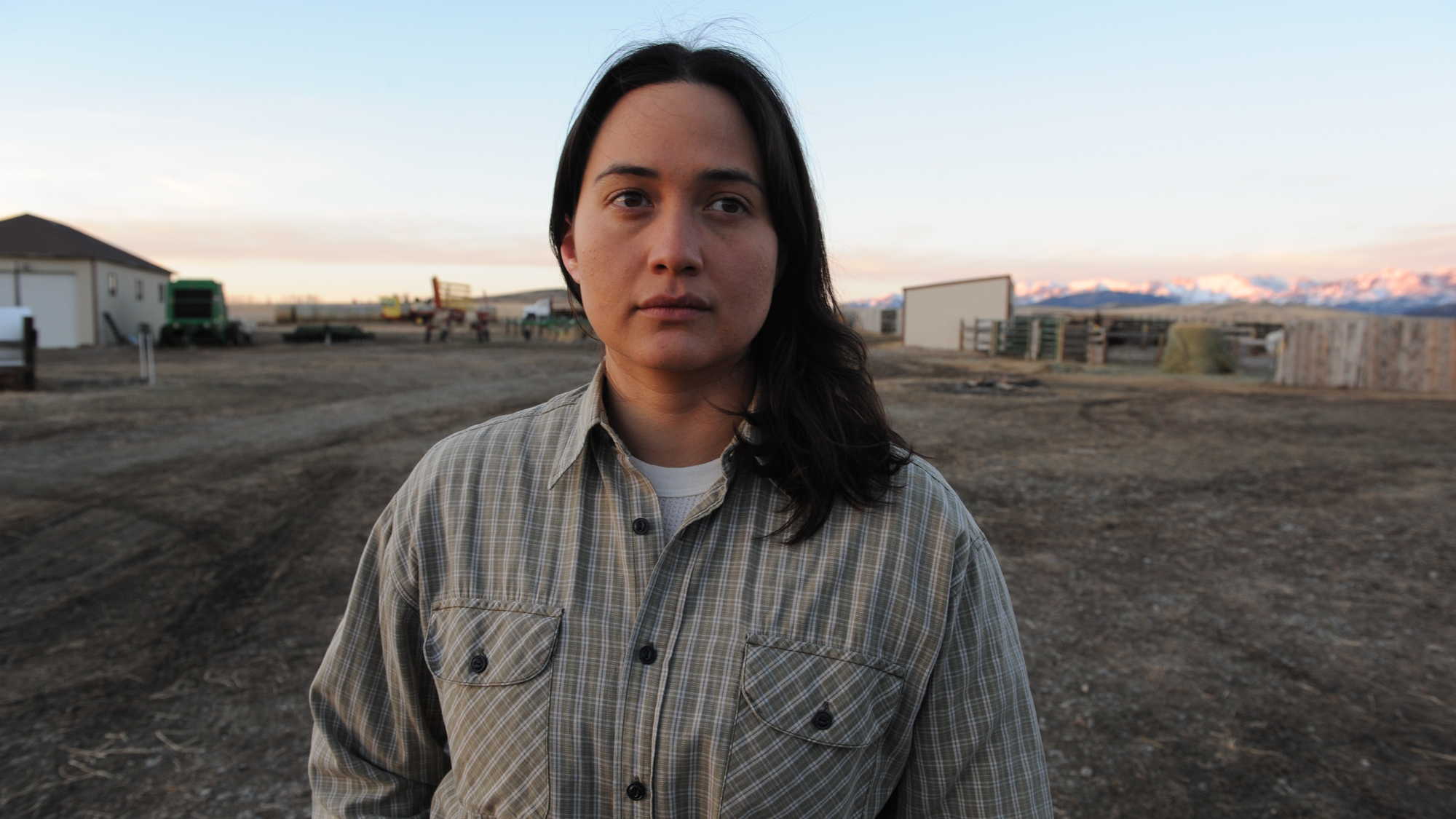
Drawn from the work of the Midwestern writer Maile Meloy, here are scenes from the lives of three Montana women stuck in their own ruts - not so much short cuts, to borrow the title of a previous movie portmanteau, as loose or dead ends. There is a tort lawyer (Laura Dern), who finds her days - and eventually her nights - hoovered up by one especially needy client. There is a married woman (Michelle Williams) whose dreams of self-sufficiency, via building a home in the wilds for her family, are obstructed by a husband and daughter who seem hellbent on isolating her in other ways. Last - and most heartbreaking - there is a young rancher (Lily Gladstone), who reaches out to her visiting nightclass tutor (Kristen Stewart), looking to boost her lowly status and self-esteem, only to be ever so gently rebuffed. How these characters interact - but glancingly - may be the key: these three sisters could, you sense, help each other out, but they don't know one another, they're busy, and it's not as though they're getting any assistance from anywhere else. (In this, the women - Williams' brattish daughter, at least one of the leads - appear as culpable as the men on screen.)

Where the heroine of Reichardt's great radical Western Meek's Cutoff was shown pushing against the headstrong males of her expedition, these 21st century women seem resigned to an altogether circumscribed existence: a few fleeting moments of peace here and there in which to smoke a cigarette, listen to the birds, have a vision of something bigger than themselves - any freedom they like, at least until regular, humdrum life imposes itself once again. This makes Certain Women a slightly more exacting watch than Reichardt's preceding, genre-infused works. The filmmaker's desire to maintain her cinematic countercurrent project can be seen from the manner in which she's recruited her starriest cast to date in order to hand them almost the antithesis of those Empowered Female roles we've come to demand from modern cinema. Instead, Reichardt directs these performers towards ordinariness, helplessness, impermanence. Dern passes harassed through similar corporate spaces to those she tore up on TV's Enlightened; Stewart is introduced in longshot, with other people's heads blocking our view, and disappears before we've barely got to know her. 

Montana's sheer space further divides everybody, and you can feel Reichardt working very hard to keep these figures in tight focus - but then the whole film is, on one level, about work, and how it can fill some voids (giving you security, and somewhere to go in the morning) but not others (meaningful human interaction, anywhere to go at night). Certain Women builds this thesis by accumulation - second time around, I sensed it getting weightier as it goes on - and by gesture, rather than editorial statement: it's the tutor ordering dessert while midway through her burger, because she's got a four-hour cross-state return journey to make ahead of getting up for her main job. (Here is the film that best integrates those dark shadows beneath the Stewart eyes.) Perhaps it's a guy thing, but I think I still prefer the expansive and comparatively propulsive Meek's Cutoff, which nudged itself along every axis and beyond the limitations of its Academy frame; here, Reichardt is forever compelled to compress, fostering the kind of hand-turned miniaturism that is the hallmark of the best short stories. Still, keep eyes, ears, heart and mind open, don't go flapping your mouth over it, and you'll be fine. It's almost as though Reichardt is teaching us how to respond to actual women.    

Certain Women is now playing in selected cinemas.

Thursday, 9 March 2017

Rage hard: "Catfight"


As ever, the secret of comedy is timing. The cherishably cartoonish satire Catfight opens against the backdrop of a bellicose President assuming office, immediately setting all of its characters on edge in a way audiences in March 2017 can't fail to recognise. With great economy, writer-director Onur Tukel lays out a vision of a society in which frenzied, status-related passive-aggression has become the currency most likely to trickle down from the powers-that-be. Every frame in the film drips with it; it's just a question of when the real deal will come out. If you're one of those people who found Meet the Parents - let alone the British Office, let alone Curb Your Enthusiasm - excruciating to watch, you should probably steer clear. For the rest of us, Catfight may well be the most cathartic release of the moment.

Among its other charms, this is also a propulsive vehicle for two notable, forthright yet tricky-to-cast performers who went AWOL the minute the movies began chasing comic-book heroines, here thrust back into the middle of the ring as old college pals renewing an old feud. In one corner, we have Sandra Oh as Veronica, a New Yorker who abandoned her studies to marry into (military-industrial) money and has had to take up drinking in a bid to wash away her self-loathing. In the other, there is Ashley (Anne Heche), a penniless artist furious that her agonised crimson daubs are being passed over in favour of such pablum as her studiomate's picture-book rendering of fluffy bunnies. When they bump into one another again at a party, it's with a crash and a bang, resulting in an altercation that leaves Veronica in a coma for two years; when she wakes up to discover her husband and her money have gone in that time, it's the start of a knock-down, drag-out grudge match.

And that's about it: ninety-odd minutes operating by Road Runner or Itchy and Scratchy logic, generating a snappy string of reveals and reversals, all set to a jolly-ironic soundtrack Larry David might crack a smile at. We had to wait until the very end of last week's Fist Fight for anything like a worthwhile confrontation; Tukel, by contrast, uses this ongoing rivalry to stage regular, spectacular no-holds-barred smackdowns, further punched up by inventive Foley work, in which Heche and Oh reposition themselves as far more interesting options to play Wonder Woman than model-turned-actress Gal Gadot. Even the more social interactions seem liable to leave someone on screen suppressing rage of one form or another: gifts at the baby shower Heche throws for partner Alicia Silverstone are rejected for not being right-on enough; gentrification transforms Bushwick into a new, unaffordable Bohemia; both heroines find themselves being turfed from their hospital beds by a slothy Dylan Baker, as a coma specialist with IBS. Everything's infuriating, and that's the point.

Tukel's suggestion is that it's not money (no longer available) nor oil (all used up) but the need to get one up, one over or one's own back on someone that has become the main motivation and lubricant coursing through American society. (Again, look to the White House, if you can bear to.) If he can't quite land the knockout blow the third act demands, his film gets as close as American movies have come for a long time to emulating the spirit of Preston Sturges or George Axelrod, throwing away his moral early on ("Wouldn't the world be a better place if we could all just relax?") in order to deliver a steady stream of yaks and yuks. Emerging in yet another week of rash Presidential Tweets, and a disproportionate Russian huff over a Disney kids' film, Catfight at the very least acknowledges that, with the way things are, you gotta laugh. Otherwise you might just punch somebody in the face.

Catfight opens in selected cinemas from tomorrow.