Wednesday, 8 March 2017
Dangerous games: "Elle"
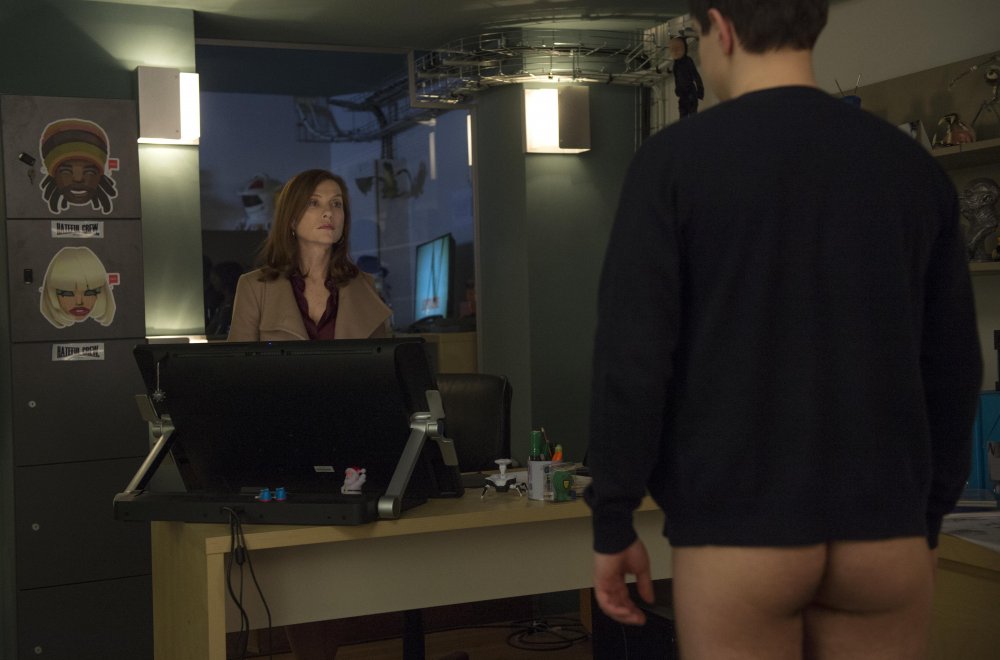
In the two decades since the glittering folly that was 1995's Showgirls, Paul Verhoeven has found himself overtaken by the jocose Lars von Trier as world cinema's premier wind-up merchant. British viewers last encountered Verhoeven with his prickly WW2 drama Black Book, back in 2006; since then, he's mostly been in retreat, plotting and scheming and waiting for the project that might allow him an even better poke at the chattering classes. With Elle, an adaptation of the French novelist Philippe Djian's "Oh...", he appears to have found it: very much constructed for an era in which everyone from the lowliest Brexiteer to the leader of the free world is keen to thrust their hot takes upon you, the film has already provoked that estimable organ Sight & Sound into the rare if not unprecedented move of running pro- and anti- reviews alongside one another, a gesture that certainly wasn't extended to Showgirls upon first release. (That film, of course, didn't come with subtitles.) Some measure of circumspection would indeed appear advisable: this is, after all, a comedy about a woman who is raped and then barely seems to countenance the fact.
To their credit, Djian, Verhoeven and screenwriter David Birke strive wherever possible to develop this premise. Most films, even the higher-minded ones, tend to render their depictions of rape as major setpieces; Elle all but throws its assault away as a sound effect before the fade in. The film's real interest lies in following Isabelle Huppert's Michèle Leblanc, modern Parisian career woman, as she cleans up - taking a very chic mirrored dustpan and brush to the crockery shattered during the attack, getting her locks changed, taking out the trash - and goes about her daily business as the head of a company making violent, tentacle porn video games. (Implication: rape culture is everywhere, and unavoidable.) It's only after she begins receiving taunting texts from her attacker that she's roused to resolve whodunnit - yet even here, her response is more practical-rational (you might say traditionally masculine, almost Holmesian) than emotional. Elle's altogether chilly base gag posits that human relations in general are so funny-strange/funny-haha that the idea of a man breaking into your house to have his way with you really isn't worth getting het up about; already, you can see why the film has made some viewers' blood boil.
Nevertheless, there's enough going on here for others to have claimed Elle as a quietly radical, perhaps even feminist text. Indirectly, the film does propose a new way of dealing with trauma, which is not to submit to it. After Michèle casually lets slip the news to her nearest and dearest ("I guess I was raped"), it soon becomes clear nobody else in the room is able to handle it; unlike all these sensitive snowflakes who maintain that a woman should make a fuss about rape, this female Bartleby insists she'd rather not, a choice that immediately transforms her into a more active figure than cinema's usual array of victims. She is, unlike the crockery, unbreakable. At this point, one feels compelled to note it is very easy for an entertainment (and especially an entertainment arrived at by three men) to propose this - and Elle is, undeniably, an entertainment, made for the majority of us who haven't been sexually assaulted rather than the minority who have, so determined to dress and thereby class up its underlying rape-revenge tropes that it frequently tips over into displays of bourgeois banality: dinner parties, fancy restaurants, well-dressed interiors. (The whole runs to two hours ten minutes, its privilege going thoroughly unchecked.)
Some of the risk, in other words, has been cushioned away. My issue with Elle as the grand provocation some have claimed it as is its decision to foreground a character who is so much the anomaly - to appropriate a hashtag de nos jours, so clearly #NotAllWomen - that we might feel comfortable around her, and not concern ourselves unduly about her general wellbeing. That Michèle should be played by Huppert with her usual committed sangfroid would be enough to establish her as somehow Other (hell, we think, if she handled what Haneke and Elfriede Jelinek had to throw at her in 2001's The Piano Teacher, she can surely survive this); a midfilm revelation about the character's parentage, suggesting she might be used to evincing some degree of detachment from the myriad brutalities of life, therefore feels like the gilding of an oddly singular and atypical lily. Elle would be a far chancier proposition if Michèle felt like a real, bruisable, flesh-and-blood woman, played by a less iconic performer, who might be seen to react to two or three of the developments Huppert maintains a strict, Keaton-ish pokerface throughout. (It isn't just that Michèle doesn't react to the rape that makes her such a strange one; it's that she doesn't react to anything.)
The idea of rape-as-slapstick negotiated by a semi-sociopathic heroine - she doesn't kill, but she'll be damned if she'll put the recycling in the right bin - yields occasional comic notes: Verhoeven wants us to be amused or amazed by the damage this tiny, resolute creature can herself inflict upon the possessions, relationships and bodies of those around her, and up to a point, I was, while remaining uncertain as to whether Verhoeven was celebrating Michèle's strength and resilience, or making her the punchline of this particular joke. When her mother (Judith Magre) suffers a heart attack, Michèle asks the understandably alarmed doctor "Is she making it up?"; her mental replays of the attack - arguably more disconcerting than the attack itself - reprogram the action into headsmashing fantasy and an eventual triumph, in a way X-Box habituees may well recognise. Here, the heroine appears both her father's child and the distractible product of her times, drawn to the flickering image on a TV screen as her own maman succumbs to tachycardia. Here, too, Elle is at its least feminist, yet most interesting - in that it finally seems to be offering a diagnosis of some wider (non-gendered) social malaise, rather than just a cleverly polished, increasingly thin gag.
Djian has form with mentally unstable women - his 1986 novel 37.2 Le Matin served as the basis for Jean-Jacques Beineix's film Betty Blue, enduring bonkbuster of the cinema du look - yet in Verhoeven-land even this fact may be a red herring: Elle finally shapes up as one vast gaping pitfall of a movie, and any reaction to it is liable to betray more about the beholder than it does about its director's methods or motives. (Better, perhaps, to make like Michèle Leblanc, and keep your mouth shut.) Such flagrant cynicism is bracing, adult, and rarely aired in today's generally happy-clappy arthouses; it's reasonably fun to dip a toe into, and Huppert's Oscar nomination will almost certainly get Verhoeven back on the studio radar, which should cheer his many cinephile admirers. Yet Elle often seemed to me to be riffing on or revelling in the finer points of rape culture, rather than doing anything substantial to repel it - you can admire the sophistry it brings to bear on an issue of brute force, but ultimately it may only be good for the beleaguered beancounters at the Picturehouse and the Curzon. That Elle seems likely to turn rape into boffo box office would in itself be enough to land it on any list of the year's most problematic movies; you might take it as a sign of how topsy-turvy and recto-verso the world now is that it was made with exactly that intention.
Elle opens in selected cinemas from Friday.
Tuesday, 7 March 2017
1,001 Films: "Monty Python and the Holy Grail" (1975)
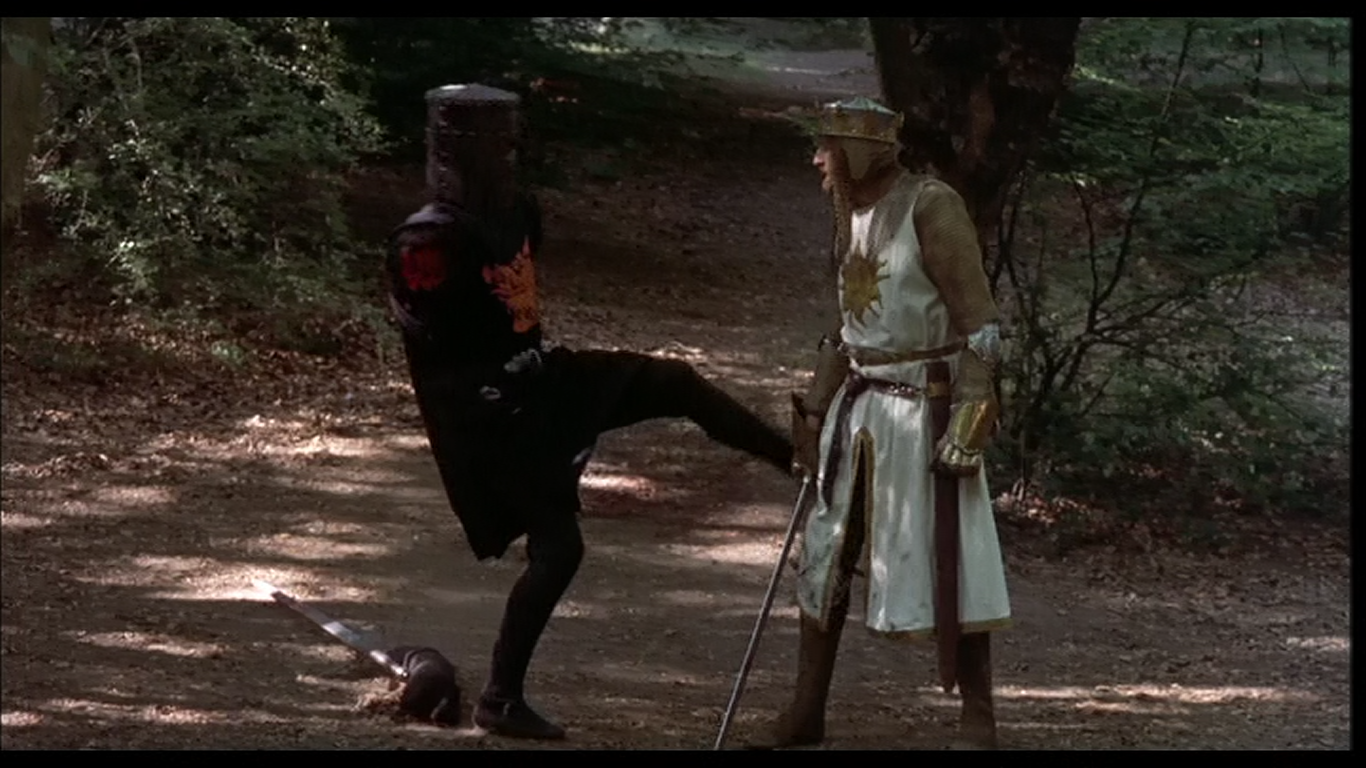
After the success of the television series, the Monty Python boys went on to indulge in a spot of Arthurian leg(end)-pulling with 1975's Monty Python and the Holy Grail, a film at once mocking itself, the conventions of historical drama, and the very idea of making a movie - much as that TV series kept breaking the frame to mock the idea of television. Strangely, you can still tell that Holy Grail was written by keen students of history. Graham Chapman's "King of the Britons" clippity-clops his way through a landscape that is muddy, bloody and almost completely backward in its ignorance and superstition: the very definition of unenlightened times. Along the way, he encounters Palin, playing one Herbert's father as another of his trademark dead-ahead Yorkshiremen ("You'll not go into a song while I'm here"); Idle, as Roger the Shrubber; and Cleese, as an Enchanter called Tim; in a comedy with a notably high bodycount, some of these even survive through to the truncated - or truncheonated - end credits. It's perhaps less satisfying in storytelling terms than Life of Brian was to be four years later - whole stretches between skits are recounted by a narrator, or via Terry Gilliam animations - but proves strong on silly and otherwise inspired gags. The budget-induced decision to replace horses with coconut shells remains surprisingly funny, and there are several of the best riffs and punchlines the Pythons ever arrived at: the much-quoted likes of "He hasn't got shit all over him", "All right, we'll call it a draw" and "It's a fair cop" can all be heard within the opening twenty minutes alone.
Monty Python and the Holy Grail is available on DVD and Blu-Ray through Sony Pictures Home Entertainment.
Saturday, 4 March 2017
1,001 Films: "Fear Eats The Soul/Angst Essen Seele Auf" (1974)
Opening with the foreboding motto "happiness is not always fun" rendered in a lurid-green font, Fear Eats the Soul has nevertheless remained Rainer Werner Fassbinder's most accessible film - or, at least, the one that hasn't been buried under reams of academic and queer theory, and doesn't require substantial historical footnotes to make sense of it. You could approach it as Romeo and Juliet with age and bitter experience on its side, and the ingrained prejudices of the entire German nation stacked up against its lovers-in-chief. These are Emmi (Brigitte Mira), a lonely, sixtysomething cleaning lady, and Ali (El Hadi ben Salim), the gentlemanly Moroccan gastarbeiter with which she strikes up a companionship after she walks into his local to get out of the rain - the first of several transgressions wider society will come to tut and fuss about.
The third act marks a return to Fassbinder's familiar theatre of cruelty, but for the most part the film's dramatic tactics are simple, pitching the supremely sympathetic Mira into scene after scene in which Emmi comes up against neighbours, co-workers and blood relatives who offer up variations on the same opinion: that foreign workers are scum/swine/dogs, and that any right-thinking German woman who gives them the time of day is a money-grabbing whore, the repetition of such sentiments driving home just how unlikely this relationship is to survive. This picture-book simplification doesn't always work in Fear's favour. One could argue Ali is presented in terms roughly as basic as his stuttering German: only belatedly are we shown what he actually does for work, and then at a moment when he's been cast in an altogether unflattering light.
For her part, Emmi appears weirdly naive and idealised for a sixtysomething woman, although there's something appealingly perverse about any film that employs an old girl who once voted for Hitler as a beacon of liberal tolerance. Despite the sometimes artless functionality of Fassbinder's direction - which might, granted, be the artless functionality of 70s West Germany, offering a director nowhere to point his camera without catching concrete and peeling paint - the film functions all the same, making disproportionately expressive a simple close-up of a barmaid turning her head away, and the recurrent framing of the lovers in windows and doorways. For ninety minutes, we are the outsiders looking in, and you realise, however accessible the film is, it's finally every bit as confrontational as this director's other public statements. There you go, Fassbinder barks: see how you like it.
Fear Eats the Soul returns to selected cinemas on March 31 as part of the BFI's Fassbinder retrospective; it remains available on DVD through Arrow Academy.
Friday, 3 March 2017
For what it's worth...
Top Ten Films at the UK Box Office
for the weekend of February 24-26, 2017:
1 (1) The Lego Batman Movie (U) ***2 (2) Fifty Shades Darker (18)
3 (4) Sing (U) ***
4 (3) John Wick: Chapter 2 (15) ***
5 (6) Hidden Figures (PG) **
6 (5) The Great Wall (12A)
7 (new) Patriots Day (15)
8 (8) Lion (12A) ***
9 (9) La La Land (12A) ***
10 (new) A Cure for Wellness (18)
(source: theguardian.com)
My top five:
1. Toni Erdmann2. Loving
3. Rangoon
4. Moonlight
5. Logan
Top Ten DVD rentals:
1 (1) The Girl on the Train (15) *
2 (new) I, Daniel Blake (15) ****
3 (2) Deepwater Horizon (15) ***
4 (5) Suicide Squad (15)
5 (4) The Secret Life of Pets (U)
6 (7) Star Trek Beyond (12) ***
7 (9) X-Men: Apocalypse (12)
8 (6) The Magnificent Seven (12) **
9 (8) Sausage Party (15) ***
10 (re) Hell or High Water (15) ****
(source: lovefilm.com)
2 (new) I, Daniel Blake (15) ****
3 (2) Deepwater Horizon (15) ***
4 (5) Suicide Squad (15)
5 (4) The Secret Life of Pets (U)
6 (7) Star Trek Beyond (12) ***
7 (9) X-Men: Apocalypse (12)
8 (6) The Magnificent Seven (12) **
9 (8) Sausage Party (15) ***
10 (re) Hell or High Water (15) ****
(source: lovefilm.com)
My top five:
1. The Young Offenders2. Endless Poetry
3. Train to Busan
4. I, Daniel Blake
5. Ouija: Origin of Evil
Top five films on terrestrial TV this week:
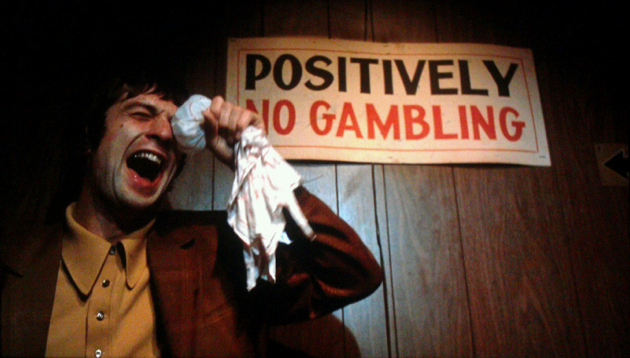
1. Mean Streets [above] (Saturday, BBC2, 10.30pm)
2. Witchfinder General (Saturday, BBC2, 2.15am)
3. North West Frontier (Saturday, BBC2, 6.25am)
4. Papadopoulos and Sons (Saturday, BBC1, 12.10am)
5. Despicable Me 2 (Saturday, ITV1, 5pm)
"Fist Fight" (Guardian 03/03/17)
Fist
Fight **
Dir: Richie Keen. With: Ice Cube, Charlie Day, Tracy Morgan,
Jillian Bell. 91 mins. Cert: 15Charting the chaos that follows from aggrieved history teacher Ice Cube challenging meek colleague Charlie Day to an afterschool ruckus, this fitful timewaster doubles rowdily down on all its flimsy-to-questionable ideas. Someone involved clearly believed there’s still mileage in watching grown men behaving like big kids, and that Day – whose oddball delivery on TV’s It’s Always Sunny in Philadelphia remains a wonder – should be taking on those bland milquetoast roles rejected by Jason Bateman. Fleeting snickers result, but fellow Sunny parolee Richie Keen can’t hold a scene long enough for anybody to find a rhythm, let alone convert a looming backdrop of mass education layoffs into the basis of a socko funfest.
Fist Fight is now playing in cinemas nationwide.
Thursday, 2 March 2017
Claws of death: "Logan"
One wonders if, at long, long last, something interesting is about to happen within the superhero genre - and whether we might have the ne plus ultra Suicide Squad and Batman vs. Superman to thank for it. Last month's The Lego Batman Movie reframed the po-faced business of caped escapism as a joke; new release Logan, spinning off from the X-Men universe, regards it as a terrible dead end, and no kind of consolation whatsoever. In James Mangold's film, the future is worn down, beat-up, and hope is so thin on the ground as to have become a valuable commodity. If there's one more Warner Bros. release that might have paved the way for this one, it's last year's Mad Max: Fury Road.
The year is 2029, and as signalled by the unkempt Mel Gibson beard he's grown since last we encountered him, Hugh Jackman's Logan - the artist formerly known as Wolverine - has entered a very bad place: working as an Uber driver (modern media's latest shorthand for bottoming out) around the U.S.-Mexico border, his claws killing him as much as they do anybody else, and driving him in turn to heavy self-medication. Logan has exiled himself hereabouts for a reason: he's assumed the responsibility of caring for the increasingly senile Professor Xavier (Patrick Stewart), tucked away inside an upturned water silo with his plants as the powers that once lit up the movie screen begin to sputter and fade.
In other words, Mangold and his fellow scribes (including Out of Sight's Scott Frank) have hit upon a workable metaphor for the way these series wax and wane, and how their constituent effects tend to wear off with age: after the underperformance of last summer's X-Men: Apocalypse (and we might note how quickly the series has cycled from Origins to any such Apocalypse), there is a sense here that the end is very definitely nigh. These things remain relative, but Logan stands as the most adult X-Men movie in tone. The 15 certificate allows the characters to spit desperate, frustrated, ferocious curses at one another, and frees Mangold up to show the damage those adamantium claws can do, rather than having to hack and slash around it in the edit to attain the family-friendly PG-13 rating.
Better yet: it allows for a certain flexibility as to what kind of movie this X-movie will be. Logan begins in Frank-ish P.I. territory, with the washed-up Wolfie being recruited by a mysterious senora to look after a young girl (the inscrutable Dafne Keen), then opens out into a sundown road movie, before arriving at a place of abject horror as the leads and their relentless, ruthless pursuers converge on an isolated farmhouse. Never just straightforward spectacle, more of a shifting character study, this is the first of these mutant movies you can actually witness mutating before your eyes, which is why the result feels like some strange, disconcerting vision instead of the usual committee-generated, cookie-cutter product.
Most atypically of all, the biggest effect Mangold has at his disposal is a carefully applied realism. The decision to downplay the usual VFX pyrotechnics leaves Logan looking a shade analogue in places: when Xavier has one of his spells, it cues outbreaks of that old-school wobblycam traditionally associated with the TV Star Trek, necessitating that everybody on screen start acting Very Slowly. Yet leaving the blue and green screens behind to shoot on dusty, lived-in locations - the milieu of Mangold's breakthrough indie Heavy, all those moons ago - serves to ground these relationships, and the action, in some kind of reality, and to further point up the leads' vulnerability. Removed of their protective digital shields, these X-Men don't seem especially well-equipped as they travel towards a final reckoning.
I've written elsewhere about how the X-Men series has remained among the most savvily produced of franchises: the characters we're reintroduced to in 2017 are played by the same actors we first met back in 2000, which speaks at the very least to careful, conscientious contract negotiation, sparing us the endless reboots that have given us two Supermen and three Spider-Men in that time. Here, you feel everyone taking a chance or two with the colossal sums of money afforded these productions, and going off the established superhero route map in the hunt for something more permanent than billion-dollar distraction: rather than labouring towards the standard final-act citytrashing, Logan ventures further out, beyond the realms of civilisation, to a point where Return of the Jedi can be spliced with Lord of the Flies. Whether the fanbase goes along with it remains to be seen, but for an event movie, it's bold, adventurous and unusually heavy-hitting when it needs to be.
Logan is now playing in cinemas nationwide.
In other words, Mangold and his fellow scribes (including Out of Sight's Scott Frank) have hit upon a workable metaphor for the way these series wax and wane, and how their constituent effects tend to wear off with age: after the underperformance of last summer's X-Men: Apocalypse (and we might note how quickly the series has cycled from Origins to any such Apocalypse), there is a sense here that the end is very definitely nigh. These things remain relative, but Logan stands as the most adult X-Men movie in tone. The 15 certificate allows the characters to spit desperate, frustrated, ferocious curses at one another, and frees Mangold up to show the damage those adamantium claws can do, rather than having to hack and slash around it in the edit to attain the family-friendly PG-13 rating.
Better yet: it allows for a certain flexibility as to what kind of movie this X-movie will be. Logan begins in Frank-ish P.I. territory, with the washed-up Wolfie being recruited by a mysterious senora to look after a young girl (the inscrutable Dafne Keen), then opens out into a sundown road movie, before arriving at a place of abject horror as the leads and their relentless, ruthless pursuers converge on an isolated farmhouse. Never just straightforward spectacle, more of a shifting character study, this is the first of these mutant movies you can actually witness mutating before your eyes, which is why the result feels like some strange, disconcerting vision instead of the usual committee-generated, cookie-cutter product.
Most atypically of all, the biggest effect Mangold has at his disposal is a carefully applied realism. The decision to downplay the usual VFX pyrotechnics leaves Logan looking a shade analogue in places: when Xavier has one of his spells, it cues outbreaks of that old-school wobblycam traditionally associated with the TV Star Trek, necessitating that everybody on screen start acting Very Slowly. Yet leaving the blue and green screens behind to shoot on dusty, lived-in locations - the milieu of Mangold's breakthrough indie Heavy, all those moons ago - serves to ground these relationships, and the action, in some kind of reality, and to further point up the leads' vulnerability. Removed of their protective digital shields, these X-Men don't seem especially well-equipped as they travel towards a final reckoning.
I've written elsewhere about how the X-Men series has remained among the most savvily produced of franchises: the characters we're reintroduced to in 2017 are played by the same actors we first met back in 2000, which speaks at the very least to careful, conscientious contract negotiation, sparing us the endless reboots that have given us two Supermen and three Spider-Men in that time. Here, you feel everyone taking a chance or two with the colossal sums of money afforded these productions, and going off the established superhero route map in the hunt for something more permanent than billion-dollar distraction: rather than labouring towards the standard final-act citytrashing, Logan ventures further out, beyond the realms of civilisation, to a point where Return of the Jedi can be spliced with Lord of the Flies. Whether the fanbase goes along with it remains to be seen, but for an event movie, it's bold, adventurous and unusually heavy-hitting when it needs to be.
Logan is now playing in cinemas nationwide.
Wednesday, 1 March 2017
From the archive: "River of Grass"
"Kinda in limbo right now." "Limbo. That sounds nice." In the course of her 1994 debut River of Grass, the writer-director Kelly Reichardt staked out the Florida Everglades (the river of the title, in Native American speak) to do something a little more impressionistic with the standard lovers-on-the-run crime drama: the result would prove to be something like Badlands remade by a filmmaker who felt Badlands was still too much of a rollercoaster ride, a procedural in no particular hurry at all. Three lives come to intersect: that of a petty crook (Larry Fessenden, on his way to becoming a low-budget auteur in his own right) who robs a cash register and returns to his mom's house to hide out; a detective (Dick Russell) who would be on the crook's tail, if he could only rouse himself from his barstool and find the gun he's lost; and the detective's daughter (Lisa Bowman), a bored mother-of-two whose life changes forever after she crosses county lines one night, and breaks a heel in the process.
We should probably make allowances for the vagaries of low-budget early 90s filmmaking: the film hasn't dated entirely well, and when it finally made its UK debut in April 2012, screening in a post-midnight slot on Film4 as part of a Reichardt retrospective, the image jammed and flickered at one point, as though being played back on VHS. We also have to conclude that the decade that elapsed between River and Reichardt's follow-up Old Joy did this filmmaker a power of good, obliging her to further pare away at an aesthetic which here extends to a self-consciously poetic voiceover, and one or two clunky semi-professional performances too many. Yet River of Grass still fascinates as the first stage of an ongoing experiment on movie character, and how that may be revealed as much through inaction as action - a subversion of that very male, Hawksian rule that may be Reichardt's most radical and valuable contribution to the contemporary American scene. (If that sounds overly academic, well, Reichardt is just more serious and studious about this than, say, the Linklater/Kevin Smith model of slackerdom, emerging around the same time.)
The film gets its energy from the wild-maned, gaptoothed Fessenden - a budget Nicholson imitating Belmondo in Pierrot le Fou - and his ability to clamber into and rearrange any given location, but Reichardt means to show how all this energy doesn't get him anywhere: his inability to pull the trigger when it counts costs him dearly (hell, these lovers-on-the-run don't even screw, and you can make of that what you will), literally and amusingly so in the movies' first ever convenience-store gazumping. In the meantime, we get drunken conversation, drifting in swimming pools, lethargic smoking and napping in motel rooms, and a certain amount of staring into the mirror, as our heroine (capably fleshed out by Bowman, a dozier Patricia Arquette) gradually discovers the grass isn't notably greener on the wilder side of life. As a country number titled "Lingering" floats over the soundtrack, these lovers will grasp there's nowhere much to run now they've set up tolls on the road. It may finally be crucial that the detective is a part-time jazz drummer (and gets a montage in which to demonstrate his skills): as with Reichardt's later, more celebrated works, River of Grass finds its own offbeat rhythms, and then quietly, admirably sticks to them.
(April 2012)
River of Grass screens as part of the Kelly Reichardt retrospective at the BFI Southbank tonight at 8.50pm, and on Saturday at 2.30pm; Reichardt's latest film, Certain Women, opens in selected cinemas from Friday, and will be reviewed here in due course.
Subscribe to:
Posts (Atom)