Tuesday, 10 January 2017
Homecoming: "Manchester by the Sea"
In decades to come, the career of the writer-director Kenneth Lonergan will likely be taught in film schools as an object lesson in what happened to the American cinema in the first years of the 21st century. Where graduates of the music video and advertising industries were handed blank cheques to set off all manner of explosions, Lonergan has had to bow and scrape to assemble three movies in 17 years, one of which was all but buried by the studio that funded it. Manchester by the Sea, the third of these films, marks a return to the familial tensions and unhappy homecomings of Lonergan's 2000 debut You Can Count on Me, and a return to something else, too: that more adult form of drama the major studios have abandoned to cable television and streaming services in their rush to recoup easy superhero bucks. That it should return in a movie backed by the emergent Amazon Studios is an irony it would take a grown-up to recognise.
The first sign we aren't being spoonfed, rather left to feel our own way into this story, is that Lonergan has created a protagonist who isn't of a mood to let anybody in without a lot of hard work. Lee Chandler (Casey Affleck) is a bluff, solitary janitor, entrenched in a snowy Boston, who spends what seems like the entire first act engaged in the thankless task of trying to keep his tenants' front steps free from precipitation; by night, for his own entertainment, he gets angry-drunk and seeks out his next barfight. This grim routine is interrupted when news breaks that his brother Joe has died, returning him to the frozen-over childhood home enshrined in the title. In Manchester, Lee is greeted with gasps and mutters that speak to his infamy among the female townsfolk; his arrival also sparks flashbacks that seek to explain how we got here from there. In these, the Lee we see is a family man and - most crucially of all - a happy drunk. What happened?
It's soon clear that returning to a home without an obvious father figure confers a new-found responsibility on Lee's shoulders: one of his tasks in Manchester is to shepherd Joe's son - and his nephew - Patrick (Lucas Hedges), an especially hormonal teenager negotiating that formative moment when a boy first invites his gal to stay over, although Lee's response, when asked whether he might be open to a longer-term custody arrangement, is a shrugging "I'm just the back-up." On television, Manchester by the Sea would be one of those sitcoms in which an individual wholly unsuited to parenthood and domesticity has those very conditions imposed upon him - except that situation plays out here in a starkly muted palette, and with the understanding we're heading not towards a group hug, but the cause of Lee's hurt. This, it turns out, is a tragically simple mistake, one by which Lonergan can acknowledge luck - pure, dumb luck - as a defining (and perhaps the defining) facet of our existence.
The masterstroke is that the film is never allowed to seem schematic or predetermined. Having set all this down on paper, Lonergan the director allows his scenes to breathe, the better to allow us to scope out this location, with its piled snowbanks and bracing marine breezes, and to allow his expert cast to squabble and bicker and thereby rough up his dialogue into something like life. The big difference between Lonergan and other playwrights-turned-directors is that he's never precious: the film may have the trappings of tragedy, but - scene by scene - it assumes the unpredictable rhythms of a comedy. There is, for starters, a sly background joke here about the kind of hard-grafting, hard-drinking family of blue-collar men it might be tough, if not impossible, for anybody of a more sensitive disposition to peaceably co-exist with; and yet the priapic Patrick (whose irrepressible horniness is such you'll never hear the phrase "logging off" in quite the same way again) is a blast of useful energy who gives the jaded Lee the momentum he needs to rebuild.
The actors, necessarily, seem alert to every possibility. Affleck, in an indelible portrait of damaged, emotionally inarticulate masculinity, appears beset by an ongoing internal tumult that spills out in harsh words and thrown punches; we sense the softness and joy taken from him at a pivotal moment, but he also allows us to note Lee taking on some of his late brother's stability. (In a smart casting coup, Joe is played in flashbacks by Kyle Chandler, whose square-jawed solidity has been the bedrock of recent small-screen dramas, from Friday Night Lights to Bloodline.) The supporting players work wonders, too, often with just a clutch of Lonergan's lines to equip themselves with: Gretchen Mol as Joe's wife, understandably exasperated by all the testosterone; Tate Donovan, late of Damages, lending additional heft to a one-scene bit as Patrick's ice hockey coach. (It appears part of Lonergan's project is to reclaim fine performers from the blue-chip TV dramas in which they've been hiding out.)
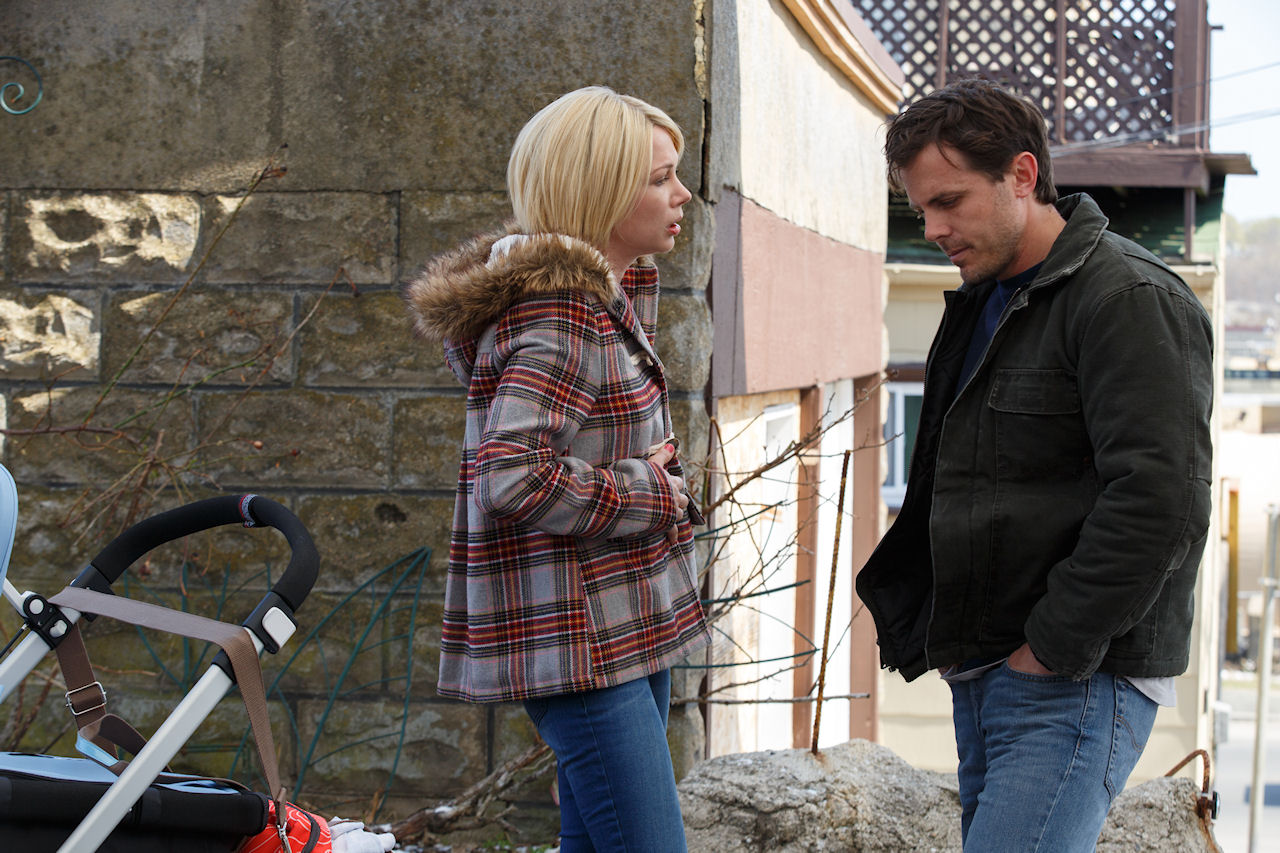
Best of all, perhaps, is Michelle Williams as Lee's ex-wife Randi, just smart enough to have spotted the protagonist's festering resentment at his fate, and to have walked away some time ago: the tentative reunion she and Affleck share on an ordinary street corner will be one of the most affecting encounters you'll witness in a cinema all year. In such sure hands, Manchester by the Sea comes to assume far greater shape and purpose than Lonergan's grand film maudit Margaret, that moral maze that turned into a logjam both before and behind the camera. Here, the director and his players mould everyday conversations such as these - with their awkward pauses and reachouts, their sudden flurries of disaccord - into the kind of drama we relate to and involve ourselves with because it speaks eloquently to those struggles and battles we face at every turn in the road. Two or three more of these things, and we might read the first of the thinkpieces about cinema rising from the dead.
Manchester by the Sea opens in cinemas nationwide from Friday.
Monday, 9 January 2017
The dreamers: "La La Land"
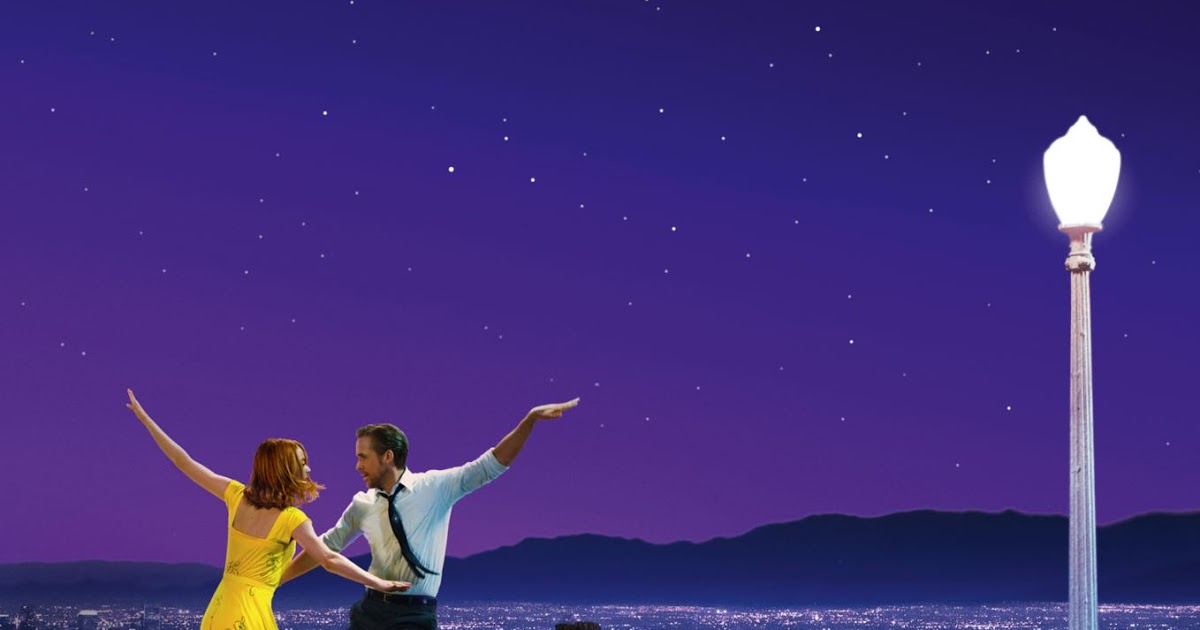
It will depend on what kind of escapism you go in search of, this second week in January. Damien Chazelle's heavily touted musical La La Land might usefully be approached and considered as 2017's The Artist, which is to say a novelty hit that wowed and seduced the first responders on the festival circuit, then rode out the inevitable waves of critical backlash to secure itself a clutch of Best Picture nominations as the year wore itself out. It is also, not coincidentally, a movie about the movies, and the reasons why we might persevere with them in the face of all the world's Paul Blarts: chiefly, the eternal yearning to see handsome fellows and pretty girls fall into stride, and thereby occasion a harmony that might be denied to us in the world beyond the multiplex.
On a comparatively banal level, the film is also Chazelle's immediate follow-up to his 2014 breakthrough Whiplash - and, in several respects, an extension of it, unfurled in a Cinemascope ratio that literally broadens this talented filmmaker's horizons. The progress of struggling jazz pianist Seb (Ryan Gosling) and aspirant actress Mia (Emma Stone) through latter-day L.A. once again frames an idea of music as a force that, in gathering up the emotions of everyday life, comes somehow to be larger than life - a pursuit that might, if we're lucky, eventually validate our earthly struggles, our rehearsal-room blood, sweat and tears, and elevate all our creative endeavours to the stars.
La La Land sporadically does thoughtful, even clever things with its music, transporting us up and down the keyboard just as the narrative whizzes us back and forth in time, reassuring us with the reveal that the naff-awful cover version of "Take On Me" heard at the start of one party scene is, in fact, being played within the scene by a naff-awful covers band. Of Justin Hurwitz's original songs, however, the news is less good. These are passable, in a someone's-written-old-timey-showtunes way, but they are, very audibly, the work of someone working night and day to write old-timey showtunes, rather than, say, connecting specific emotions to specific melodies to create something memorable and fresh.
I spent most of the musical numbers wishing somebody in the wake of Whiplash's success had introduced Chazelle to Adam Schlesinger, the Fountains of Wayne genius who penned the retro-leaning breakout hits of That Thing You Do! and Damsels in Distress. Schlesinger has a gift of making his pastiche sound effortless - like fresh-off-the-piano pop, rather than slavish tribute act. (Chazelle is so close to this it's frustrating: he's savvy enough to cast That Thing's Tom Everett Scott in a key role, leaving him precisely one Kevin Bacon degree away from greatness.) Perhaps there is an innocence the movies can never get back, however much we might long for it: whenever Gosling and Stone break out in flurries of dance, on a side road in the Hills or inside the Griffith Observatory, it's now impossible not to see the punishingly long hours of choreography required for these performers to hit their marks before the cameras. It's meant to be casual; instead, it has the look of a hard shoe shuffle.
The film's pleasures, then, are chiefly non-musical: a certain feeling or mood. Gosling and Stone shared the better scenes in 2011's pretty throwaway Crazy, Stupid, Love., and their fizzy chemistry cuts through some of La La's more ersatz elements. It's irksome they should bond over jazz and movie references, but then here are a couple of kids with too much time (and not enough work) on their hands, hanging out in quiet pockets of a metropolis indifferent to their presence, forging their own connection and rhythms, a conspiracy we feel lucky indeed to be let in on. We sense this relationship is heading somewhere when they lean in to share a first kiss at the cinema - pure movie love - and the film they're meant to be watching (Rebel Without a Cause, in glorious Technicolor) burns up in the projector; they'll set off a smoke alarm in the course of their first argument as a couple.
As 12A-rated evocations of heat go, all this is enjoyable enough, but you might just wish Chazelle had given his leads something more profound to do than fall repeatedly in and out of love. (And even as I write that sentence, a voice in my head is insisting there may be nothing more profound to do than fall in and out of love: Chazelle is counting on this.) On one level, The Artist was about an individual discovering he had a voice, a subtext that had obvious metaphorical applications beyond the movies; if La La Land deigns to float anything so burdensome as a subtext, it concerns outsiders being embraced (or rejected) by the mainstream, which obviously reflects Chazelle's position as an independent spirit being welcomed in from the cold, but simply may not play with anyone who doesn't regard their life as what X Factor contestants refer to as "a journey". For better and worse, this is a film only someone who's succeeded in showbusiness gets to make.
The rest of us are free to take refuge in the look of the thing. For after a decade and a half of greasy, blurry, dashed-off-on-digital doodles, here is the return of Film - a film shot on film, as were Singin' in the Rain and Meet Me in St. Louis and The Umbrellas of Cherbourg and The Young Girls of Rochefort before it. With its candied colour-matching and sundown skies, La La Land is rarely less than incandescent to behold, cinematographer Linus Sandgren working with grading technology that wasn't available to Jacques Demy, let alone Vincente Minnelli. The resulting lush flatness may be the best advertisement for the movies a young writer-director could have produced as 2016 ceded to 2017, and those "Is Cinema Dead?" thinkpieces began to stack up; it will also surely make for a lovely moment on Oscar night, as Ryan and Emma trot out one or other of the year's Best Original Song nominees. Keep in mind, though, that La La Land may only be an advert, gorgeous but ephemeral, selling us nothing more lasting than a pocketful of perishable, non-refundable dreams.
La La Land opens in cinemas nationwide from Friday.
Saturday, 7 January 2017
Craicheads: "The Young Offenders"
Already a sizeable hit in its native Ireland, Peter Foott's The Young Offenders arrives on these shores as a fine recent example of what we might call "eejit comedy": an elaboration of an apparently true story, centred on two bumfluffed teenagers who could scarcely be any less like criminal masterminds. Hearing rumours that a million-Euro shipment of cocaine has washed up somewhere along the coastline, opportunist Cork lads Conor (Alex Murphy) and Jock (Chris Walley) set off on stolen bikes to retrieve their share, convinced they will soon be possessed of the fortune to buy up "mansions, cars, caves and tits" - everything a boy raised on MTV's Cribs might desire. That these aren't the brightest of sparks can be discerned from the fact one of their stolen vehicles is, in fact, a girls' bike; the punchline - and we can see it coming a mile off, although the experience is no less pleasureable for that - is that they will conspire to make a complete bollix of this impromptu salvage operation.
To his eternal credit, Foott proves a good deal more ambitious and accomplished than his feckless characters. He knows he can get cheap laughs just from the sight of these two stroppy wankers in tracksuits, defined as much as anything by the handscrawled "FUCK OFF" sign taped to Conor's bedroom door. Yet he takes care to build a proper, touching relationship between them, too: joshing, cursing and roughhousing their way through each at least semi-improvised scenario, Murphy and Walley come to resemble a spotty Laurel and Hardy, or less spotty Adam and Paul, depending on your comedy vintage. You might even claim this misadventure as a bromance-in-waiting - and indeed the stout, friendless, awestruck Conor gamely confesses at one point that he would hypothetically go gay for the gangling, headfirst Jock, although he of course mispronounces "hypothetically" as he does.
If the bulk of the film adheres to the quest-narrative template, shuttling our gawky anti-heroes from city to coast, all the while pursued by their cop nemesis (memorably described in Conor's voiceover as "a shit Serpico"), Foott always gives his characters funny things to say and do. I very much enjoyed the boys' plans to meet their pursuer halfway in a Heat-style coffeeshop tête-à-tête, lent a new parochial bathos here for being downgraded to a tea room. (Jock's intended opening gambit is to wonder whether the lawman might give them a headstart.) There's also plenty in the boys' attempts to strangle a chicken for their tea: as Conor phrases it, "Ignorance really is bliss, and right then, we had shitloads of it." What's crucial is that Foott is broadly on their side: the film's bright styling, boisterous soundtrack (including a belated Sultans of Ping revival) and youthful energy seems to recognise that this diversion is as much an adventure for this pair as the one those posh Anglo-Saxon types set out on in the recent Swallows and Amazons remake.
Better yet: as the film progresses, it sketches in an affecting sense of what the protagonists might be looking to escape from - a boozy, savings-nicking da in Jock's case, and for Conor, a life behind the fish stall run by his single mother (a nice, sympathetic turn by Hilary Rose), who takes one look at her son's partner-in-crime and asks her boy, "If you are going to mindlessly mimic someone, can you at least pick someone with half a brain?" Getting us to invest in these eejits - to warm to their dumb loyalty and dogged persistence - allows Foott to deliver a genuine crime-movie kick come the final reel, as the boys inadvertently cross the one person they shouldn't, and their idiocy comes home to roost. Now that the McDonagh brothers have blotted their copybooks, there's all the more reason to cheer a vibrant comic sensibility emerging from the Emerald Isle: Foott does more to humanise these dolts than any of Noel Clarke's 'Hood movies did for their characters - and in the throwaway epithet "dickhead on the roof", he may just have inspired a new musical somewhere, too.
The Young Offenders is now playing in selected Irish cinemas, and opens in selected UK mainland cinemas from Friday.
Friday, 6 January 2017
For what it's worth...
Top Ten Films at the UK Box Office
for the weekend of December 30-31, 2016:
1 (1) Rogue One: A Star Wars Story (12A) **2 (new) Why Him? (15)
3 (new) Passengers (12A) **
4 (new) Monster Trucks (PG) **
5 (2) Moana (PG) ****
6 (3) Fantastic Beasts and Where to Find Them (12A) ***
7 (new) Collateral Beauty (12A)
8 (new) Ballerina (U) ***
9 (new) Dangal (PG) ***
10 (4) Sully: Miracle on the Hudson (12A)
(source: theguardian.com)
My top five:
1. Blue Velvet
5. Half Way
Top Ten DVD rentals:
1 (4) Bad Moms (15) **
2 (1) Finding Dory (PG) ***
3 (3) The BFG (PG) ***
4 (6) Ghostbusters (12)
5 (7) Mechanic: Resurrection (15) **
6 (9) Me Before You (12) **
7 (5) David Brent: Life on the Road (15)
8 (10) The Legend of Tarzan (12)
9 (new) Brotherhood (15)
10 (re) Swallows and Amazons (PG)
2 (1) Finding Dory (PG) ***
3 (3) The BFG (PG) ***
4 (6) Ghostbusters (12)
5 (7) Mechanic: Resurrection (15) **
6 (9) Me Before You (12) **
7 (5) David Brent: Life on the Road (15)
8 (10) The Legend of Tarzan (12)
9 (new) Brotherhood (15)
10 (re) Swallows and Amazons (PG)
(source: lovefilm.com)
My top five:
1. Julieta2. Hell or High Water
3. Ethel & Ernest
4. Dog Eat Dog
5. After Love
Top five films on terrestrial TV this week:
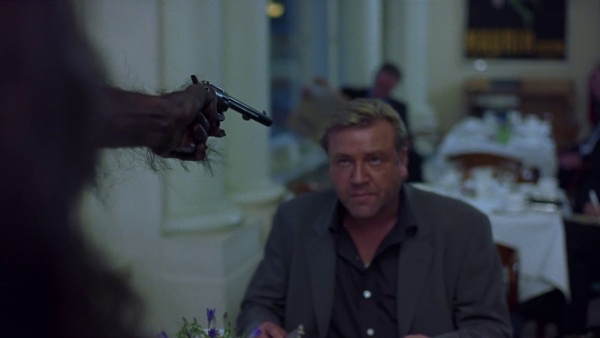
1. Sexy Beast [above] (Friday, C4, 12.10am)2. Walkabout (Saturday, BBC2, 12.45am)
3. From Here to Eternity (Friday, BBC2, 2.35pm)
4. A Most Violent Year (Sunday, BBC2, 10pm)
5. Legally Blonde (Sunday, five, 4.35pm)
True faith: "Silence"
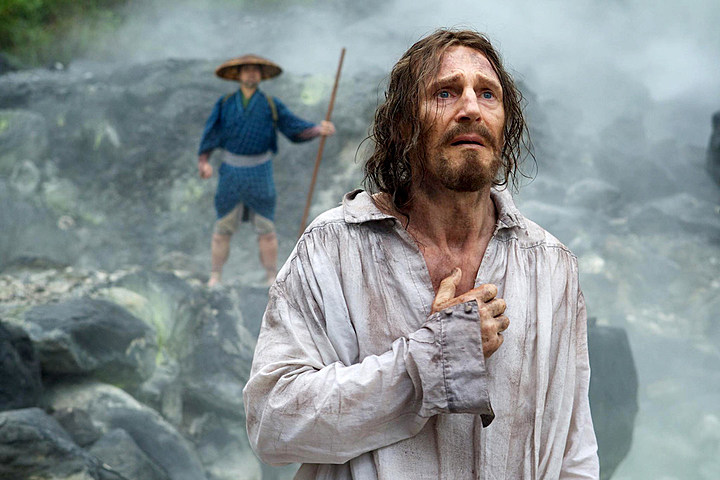
After the excess, some sobriety. It isn't just that Martin Scorsese's ascetic epic Silence emerges into UK cinemas in the cold light of New Year; it's that it marks Scorsese's return, after 2013's thoroughly profane The Wolf of Wall Street, to that devout strand in his filmography that previously begat The Last Temptation of Christ and Kundun, and which arguably began the minute Harvey Keitel passed his hand through hellfire in Mean Streets. By all accounts, the director has wrestled long and hard with the idea of bringing Shusaku Endo's 1966 novel to the screen, and that seriousness and sincerity of purpose sits behind the resultant film's every graven image. Here is a test or leap of faith, sent forth in the belief a work this out of time - one that goes stubbornly against the flow of images coming out of the dream factory nowadays, which cares not a jot for easy sentiment, spectacle or snark - might still connect with a largely secular audience of consumers who've spent the past decade being mollycoddled by the Marvel corporation, or re-registering as Jedis.
Endo gave Scorsese and his regular co-writer Jay Cocks one compelling hook to work with: this is, on its most basic, narrative level, a clergymen-on-a-mission tale, dispatching earnest 17th century Jesuits Rodrigues (Andrew Garfield) and Garrpe (Adam Driver) to Japan - site of a bloody Buddhist purge of all things Christian - to rescue their mentor Father Ferreira (Liam Neeson), a dog-collared Kurtz reported to have renounced his beliefs and gone native. The stakes are established in the course of a prologue that locates Ferreira on a blasted hellscape, surrounded by severed heads on pikes and fellow priests being put to the cross - another Last Temptation; obliged to operate deep under cover, within clandestine Christian communities riven with their own doubts, suspicions and tensions, the two priests will be forced to pursue very different paths.
The most immediate reference point for UK audiences would be The Mission, that grandiose Goldcrest-era prizewinner that deployed Scorsese's chosen lonely man Robert de Niro and a soaring Ennio Morricone score among its barrage of effects. Yet where that film was the very model of mid-Eighties, British-are-coming screen confidence, Silence - as signalled by that title, and the casting of professional shyboys Garfield and Driver - proves a far more introverted and hushed venture. For Scorsese, clearly, faith is a deeply personal, internalised matter: we get not a single note of non-diegetic music here, while the narrative is nudged along by Garfield's pored-over, ruminative voiceover. (The cicadas of the Japanese countryside fill in any gaps on the soundtrack.)
Even if you don't or can't share these beliefs - if you remain firmly Team Dawkins, and somewhat bemused as to why there should be so much sturm und drang on Earth over our imaginary friends in the sky - there remains plenty in Silence to affirm one's faith in cinema as religion, and in Scorsese as one of that cinema's most passionate and persuasive proselytisers. His overhead shots provide a dramatic shift in perspective that make their own case for the presence of some all-seeing deity; a pivotal digital transition - which is to say, a genuinely special effect - allows Rodrigues, lost in the wilderness, to see Christ in his own reflection. (There is a later moment, involving the voice of Christ, that a filmmaker raised in our culture of irony couldn't even begin to conceive of.)
Then there is the heightened attention to meticulously researched, attentively rendered ritual, not least the stomp on a copper engraving of Jesus that puts the seal on the act of apostasy: no-one in cinema, not even the grand fetishist Tarantino, has made feet so expressive. You don't have to look too far towards the edges of each frame to catch Scorsese carefully weighing his own steps. Silence is undeniably a deliberate work, so far removed from Wolf's freewheeling carnival of bad taste as to seem like an act of penance. Where its predecessor rubbed our faces in fake tits and blow, Silence insistently retreats from the action, holding the burning, crucifixions and beheadings in extended longshots, the effect of which is to make the agonised close-ups and conflicted two-shots all the more impactful.
Some may mourn - several have mourned - the absence of spontaneity. The middle hour locks us up with Rodrigues as he suffers at length under Japanese lock and key, and held in such tight, demanding focus, Garfield - whose affecting impersonation of blood-spattered American virtue bolsters Mel Gibson's forthcoming Hacksaw Ridge - starts to seem like a placeholder for an actor better suited to incarnating a fervent Portuguese Jesuit: he can only furrow his brow so far, and so often. Yet the unplaceable Driver, with his saintly mien and natural, unforced air of intensity, appears entirely of this landscape, and Neeson commits in a way he hasn't seemed to for a good few years: apparently thankful for the opportunity to attempt something thoughtful, reborn in a fashion that suits Ferreira's character.
It is Scorsese's own conviction, his determination to pin these images, and the ideas behind them, to the multiplex doors, which finally elevates Silence to the very forefront of the director's recent output: from first frame to last, you can feel him wrestling, still, with the nature of faith, how it changes with time, age and place, and what good it might do a man to long for salvation in the next life when doing so can cause so much hurt and grief in this one. Even with Marty's name attached, a sombre interrogation of what lies deep down in the hearts and souls of humankind probably isn't likely to shift a whole lot of popcorn in the present marketplace - but Silence passes into the light as a major statement from a filmmaker finally living up to his billing as a hallowed modern master.
Silence is now showing in cinemas nationwide.
Thursday, 5 January 2017
Zero gravity: "Passengers"
Passengers, Hollywood's idea of grown-up sci-fi for the holiday season, turns out to be mostly fancy packaging. It has a couple of the hottest (and, crucially, most bankable) stars of our moment, in Jennifer Lawrence and Chris Pratt; they're working under the gaze of a newly Oscar-nominated director (in Morten Tyldum, late of The Imitation Game), and to a screenplay from the increasingly prominent (and bankable) scribe Jon Spaihts (Prometheus, Doctor Strange); and it all takes place on a gleamingly designed spacecraft - in essence, an interstellar cruise ship - on which it might well be fun to spend a couple of hours, if not a couple of months. What more could you want?
It has a functioning first act, at least. Aboard the good ship Avalon, carrying some two thousand cryogenically stored migrants from an overpopulated Earth to the colony planet of Homestead II, Jim Preston (Pratt) is awakened by a dramatic meteor storm. To his creeping dismay, he realises he is the only passenger to have been roused from his slumbers - a troubling malfunction, given that the craft is a full ninety years from its ultimate destination. This early stretch is thus somewhat like I Am Legend crossed with The Martian, striving to solve the problem of cosmic solitude: after absorbing this initial existential blow, Jim takes refuge in the ship's not inconsiderable leisure resources, shooting hoops and dining at the top table, enjoying post-prandial confabs with android bartender Michael Sheen.
Pratt, still testing the parameters of his stardom, brings to this task some of the clownish distractibility he displayed in his breakthrough role as the puppyish Andy Dwyer on TV's Parks & Recreation: it's quite a good gag that, left entirely alone, Jim should revert to the same slobbishness in space that he might fall into back home, cultivating a beard-and-beergut combo with which to catch all his complimentary food and drink. It is, it transpires, crucial that our hero should start to resemble Robinson Crusoe - a man helplessly, indefinitely cast away - for one day, just over a year into his seclusion, he stumbles across a potential girl Friday in the form of Aurora Lane (Lawrence), a writer making the same trip, but still very much sealed in transit. Here is someone a man might shave and shape up for, and in setting Jim to ponder pushing the release button, Spaihts and Tyldum are surely framing a more specific question for their audience: what if you had the chance to spend some quality alone time with Jennifer Lawrence? Would you take it?
The resulting fantasy - for that's what we're dealing with here - has been decried as creepy and stalkerish, and these would be valid criticisms if the film were anything other than flimsy to its core; if it were of our world, rather than merely a shit-hot pitch left to balloon outwards in the L.A. sun. (A more valid criticism: Passengers is a film that demonstrates exactly how far out of touch Tinseltown has become from the rest of the galaxy.) Unlike, say, 2009's Moon, which took time to consider what it might be for a man to find himself lost in space, Tyldum's film is all chicanery: it's just not interested in the ethics of altering the trajectory of another person's life (or about lying to her when you do). This questionable meet-cute is simply presented as the answer to a plot problem, a way for Spaihts to keep the movie wheels spinning for a full 120 minutes.
What follows has the look of four or five movies in one, none of them especially well developed. The second act is zero-gravity skylarking, eagerly watching Pratt suit up and Lawrence strip down to her lingerie, and thereby encouraging us to think: golly, don't they make a swell couple? Well, sorta, although Tyldum's direction takes a turn for the sappy around this juncture, pitching the pair into the cosmos on a zipwire, egging on Thomas Newman's florid orchestrations, and heavily insinuating that this one giant leap into the unknown is Very Much Like Falling in Love. (The courtship scenes are where Passengers starts to resemble Solaris, albeit a Solaris itself taken out of the deep freeze a good ninety years too soon: it gets drippy.)
Anybody who's made the mistake of keeping their brain running will be wondering why these two grown adults seem to take endless delight in the onboard kids' stuff - the dance games! the unlimited cereal refills! - and whether a writer such as Aurora wouldn't start to tire of spending her afternoons inside a giant floating Dubai. (That said, the extracts we hear of her intergalactic magnum opus don't exactly suggest a great, inquiring mind.) As a pared-down vision of the sexes operating in isolation, the material is never as barbed or as funny as TV's The Last Man on Earth, its tone limited by the commercially desirable certificate - a stricture that also neuters any horror we might feel when Aurora wakes up for a second time, this time to Jim's fateful actions back in the holding bay.
Nothing here could be used to refute the notion that, above a certain budgetary level and beyond the business-as-usual domain of the franchises, the studios are now only interested in turning out extended Twilight Zone episodes, purged of the moral and philosophical grist that might keep an audience up at night. The assumption is that we're here solely for a good time - and yet, by constantly redrafting the rules of its own game (some might say cheating), Passengers can't even deliver that. Spaihts can evidently run you off plot by the yard, like ribbon, and there are passages here that suggests a facility for tying it in bows - there's always some crisis going on or being neatly resolved - but once unpicked, there's just nothing here we might usefully take into the New Year with us. Hold onto your receipts.
Passengers is now playing in cinemas nationwide.
Wednesday, 4 January 2017
Market forces: "Rogue One"
The empire expands. What we're getting with the Star Wars spin-off Rogue One is a stopgap in two senses: a multiplex placeholder, set down so that Disney can sustain a brand and hoard more money in advance of next year's Episode VIII, and a narrative bridge between the events of Episode III and Episode IV (which is to say the first Star Wars). You could resent the series just for forcing grown critics to have to explain such hairsplittingly trivial, odorously nerdy minutiae, but one of the foremost logistical achievements of Gareth Edwards' film is how it manages, with (or in spite of) copious digital firepower, to tesselate with the clunky analogue look and feel of the 1977 Star Wars. Rogue One isn't going to look at all out of place in the inevitable boxset when it emerges ahead of Christmas 2017, yet even this speaks more to a desire to fit in and conform rather than push the envelope or attempt anything challenging within the established template. Another way of approaching the film would be as a billion-dollar afterthought, conceived a long, long time after Peak Lucas by men (and it could, perhaps, only be men) who couldn't bear the thought of putting childhood things away - certainly not if there's a nice percentage deal in it for them.
Two clicks into this "new" Star Wars cycle, it's become apparent that the films aren't going to be greatly more substantial than their immediate predecessors, those prequels renounced by even the most devout of fanboys. It's true The Force Awakens and Rogue One have recruited a better class of actors to waste - you'd take Riz Ahmed over Hayden Christensen in most circumstances, and Daisy Ridley and Felicity Jones make feistier heroines than Natalie Portman's 97%-facepaint Queen Amidala - yet wasted they are on such dramatically weightless spectacle. Once more disengaged from the playground-level goodies-versus-baddies runaround of the plot, I began looking - really looking - at the actors' faces, and saw there not the hopped-up excitement of fans getting to enact their wildest childhood fantasies, nor the determination of committed thesps keen to fashion a grittier, more realistic, more credible Star Wars worthy of the 21st century, but acute embarrassment - the embarrassment of men and women obliged to direct endless expositional claptrap or windy platitudes about "the Force" towards the tennis balls on sticks that pass for giant squid creatures or oddly named planets at the green-screen stage of shooting.
What's particularly irksome is how this Disney/LucasFilm mega-production co-opts resistance imagery in order to lay the path to the first movie's raid on the Death Star. At every step, Rogue One is geared to grinding down resistance, much as its ideal audience would popcorn kernels. Where cinephiles once took up arms against the threat of reviving dead performers (Bogart, Chaplin, Monroe etc.) as digitally rendered "synthespians", here we're meant to thrill to the sight of a pixellated Peter Cushing as Grand Moff Tarkin because, well, Star Wars. (As it is, the cyber-Cushing is an especially ugly effect, dredged up from the lower depths of Uncanny Valley.) And while such setpieces as the early freedom-fighter attack on a marketplace have set some to considering Rogue One as a serious study of guerilla warfare - positioning the film as the series' very own Battle of Algiers - this seems as spurious as the claim Avengers Assemble has anything to do with Shakespeare, intended to reframe a cold hard commercial proposition as vastly more complex and pertinent than it is. (Of the anti-Trump rhetoric rumoured to have been edited into the film at a late stage, there is, of course, nothing.) As our ragtag heroes dash from one massive Lego set to the next, there is a large and loud explosion every thirty minutes on average, if that's all you're after - but if action-figure horseshit with interminable footnotes attached is the only radical art we have left to fight for, and the basis of the only projects our best and brightest young filmmakers are aspiring towards, perhaps it's best if civilisation is left to sink into the ocean.
Rogue One is now showing in cinemas across the universe.
Subscribe to:
Posts (Atom)