Saturday, 12 November 2016

For what it's worth...


Top Ten Films at the UK Box Office   
for the weekend of November 4-6, 2016:
 
  
1 (1) Doctor Strange (12A)
2 (2) Trolls (U)
3 (new) The Accountant (15)
4 (new) A Street Cat Named Bob (12A) **
5 (new) Nocturnal Animals (15) **
6 (new) The Light Between Oceans (12A)
7 (4) The Girl on the Train (15) *
8 (3) Jack Reacher: Never Go Back (12A)
9 (7) Storks (U)
10 (5) Bridget Jones's Baby (15) *

(source: theguardian.com)

My top five:   
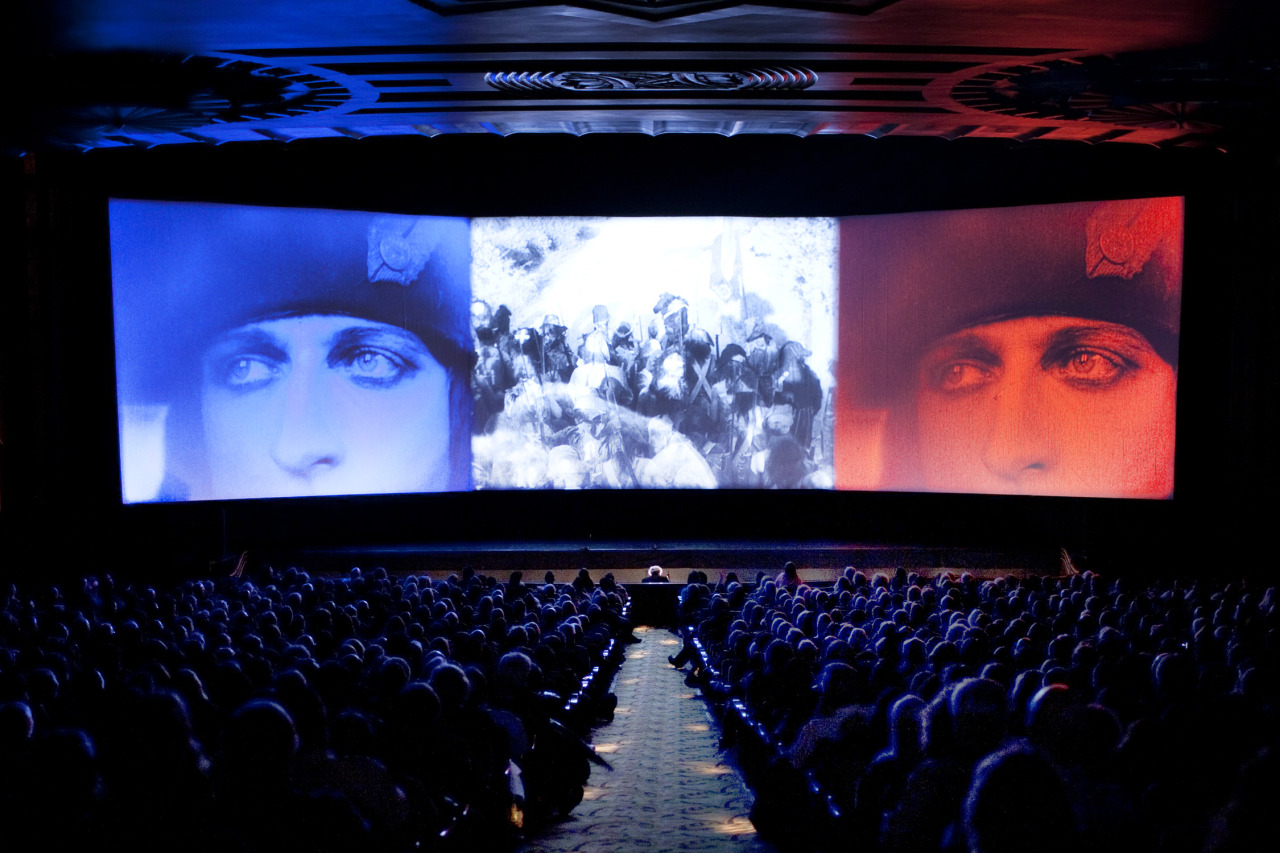
1. Napoleon [above]
2. Richard Linklater: Dream is Destiny
3. The Innocents
4. Francofonia
5. Girls Lost


Top Ten DVD rentals:  
   
1 (1) Supersonic (15)
2 (3) Star Wars Episode VII: The Force Awakens (12) **
3 (new) Now You See Me 2 (12)
4 (5) Alice Through the Looking Glass (PG)
5 (4) Gods of Egypt (12)
6 (9) Batman vs. Superman: Dawn of Justice (12)
7 (6) The Nice Guys (15) ****
8 (re) The Guv'nor (15)
9 (7) The Take (15)
10 (8) Mother's Day (12)

(source: lovefilm.com)
                                   
My top five:  


Top five films on terrestrial TV this week:   
1. Silent Running (Wednesday, C4, 2am)
2. The Bourne Ultimatum (Saturday, ITV1, 10.45pm)
3. She's Out of My League (Sunday, BBC2, 11.30pm)
4. 2012 (Saturday, five, 5.30pm)
5. In Time (Monday, five, 11.05pm)

Wednesday, 9 November 2016

Russian arcs: "Revolution: New Art for a New World"


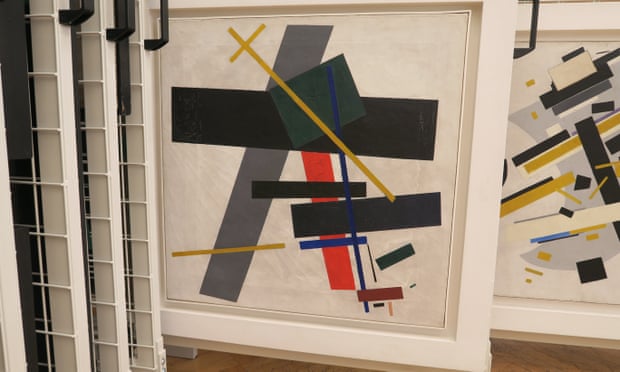
Margy Kinmonth is the British documentarist who - unlike certain U.S. Presidential candidates - has been entirely upfront about her close links with Russia. A few years back, she gave us Hermitage Revealed, a scholarly tour of that venerable art institution; her no less stimulating follow-up, Revolution: New Art for a New World, hones in on several of the key works the Hermitage houses, while also allowing itself to roam a little further afield. As its title suggests, Revolution's core interest lies in that art fomented in the course of the uprisings of just under a century ago now, transforming the look and scope of not just painting but architecture, sculpture, cinema, theatre and graphic design. Again, Kinmonth's methods are of an older documentary school. Sit-down interviews with experts are intercut with dramatic reconstructions and readings that bring out the featured artists' personalities: we are introduced (or reintroduced) to the excitable mythomane Eisenstein, the brooding Malevich, the dreamy Kandinsky and Chagall. As the film director Andrei Konchalovsky, interviewed about his painter grandfather, phrases it, theirs was "extremist, even terrorist art". These guys, like so many angry or agitated young men, wanted to blow shit up.

While providing a broad overview for philistines like me, Kinmonth digs deep into the archives and comes up with interesting new material: she makes an especially good case for the early "analytical realism" of the long-buried Filonov, a painter who used dots and grids to render the human body as though on a cellular level, before he reverted to more conservative representational methods as the Stalin regime exerted its grip. Some kind of rhyme emerges between the unconventional shapes being flashed up on screen and the unconventional personalities responsible for them. Here were creatives who tesselated but for a brief moment in the teens and Twenties, and were obliged to shuck off their edges once order of a sort had been restored, their status shifting almost overnight from allies of a vibrant and radical new political movement to - in several cases - enemies of the state.

Kinmonth certainly isn't blind to the social limitations of this art: she shows that it failed to put food on the tables of the starving peasantry, and how it was swiftly co-opted by commerce, as almost all vital artistic movements eventually are. Yet she's at least as fascinated by the process of making art during those long Russian winters as she is by the end results, and that fascination permits us to grasp how many of this movement's better known works were separate expressions of the same revolutionary goal - most obvious in the link between Battleship Potemkin and Rodchenko's 1930 photograph Steps. It ends unhappily, with canvasses being shredded and torched, and a round of executions by the firing squad - proof, if nothing else, of the ongoing threat great art poses to the powers-that-be - but the work as framed here continues to hold and beguile the eye, relics of idealism and change that far outlasted their political moment.

Revolution: New Art for a New World screens in selected cinemas tomorrow night. 

Tuesday, 8 November 2016

On demand: "Mascots"


Christopher Guest continues to mine something close to comic gold from fly-on-the-wall observance of leftfield/otherwise fringey activity. After tackling regional amdram (Waiting for Guffman), dog training (Best in Show), folk music (A Mighty Wind) and awards-season positioning (For Your Consideration), Guest's latest mockumentary Mascots - composed for Netflix, as per the new world entertainment order - plunges us inside the furry world of competitive mascotry, part of that process whereby our sporting events have been transformed into global televisual spectacle. (Leading your ornery grandfather to moan that they've destroyed the integrity of his favourite heavily sponsored, advert-interrupted sport.)

The usual semi-improvised scenes set forth a whole new gallery of North American eccentrics and other archetypes: the can-do couple (Zach Woods and Sarah Baker) whose happy faces conceal latent marital issues; the bendy kook (Parker Posey) whose Laurie Anderson-inspired routine entails imagining the final moments of a roadkill armadillo; the middle-aged misfit (Christopher Moynihan) nursing a disastrous Facebook crush; and the Irish-Canadian bad boy (Chris O'Dowd) who performs - on ice - as a character known as The Fist. Reflecting Guest's British heritage - and his recent transatlantic HBO endeavour Family Tree, which starred O'Dowd - the field of survey has been extended to South London, where we find Owen Golly Jr. (Tom Bennett, comic sneak thief of this summer's Love & Friendship), hedgehog mascot of non-league Willingham Rovers.

It takes a while to make the introductions, but what quickly comes clear is that Guest is, in his own way, as engaged with worldbuilding as a Peter Jackson or James Cameron; the difference is that Guest's worlds are intentionally smaller. We learn, for example, that the Rovers play their home games at Peasdale Park ("with its legendary Flange Road end"); that O'Dowd's troublemaker was once part of a religious cult inspired by the old Sunday teatime favourite Highway to Heaven. The event bringing these disparate souls together - the annual World Mascot Association Championships, held this time round in Anaheim, California - is being monitored for possible broadcast by no less than the Gluten-Free Channel, carried in "over two cities nationwide", as its beaming representative John Michael Higgins has it.

Once again, one senses we are in the safest of comedy hands, and at its best, Mascots offers the joy of watching old pros who know exactly how to bring added VFM of one form or another to the set - even if the audience is technically watching for free as part of a subscription service. Jane Lynch and Ed Begley Jr. sustain the laugh rate as judges whose own rivalry threatens to overshadow the competition, and Guest knows he can coax out at least one hearty cackle just from handing Fred Willard, as a decidedly non-motivational coach going under the name Greg Gammons, Jr., a copy of "Pup Life" magazine ("Dogs are funny, aren't they?"), or from the idea that Jennifer Coolidge might have wound up married to an understandably shellshocked Bob Balaban.

That there's nothing especially ground- or format-breaking here is exemplified by Guest's own return as Corky St. Clair, the swishing choreographer of Waiting for Guffman: both before and behind the camera, he's found a laughter delivery system that works, and he's very much sticking to it. Yet he keeps setting this ensemble to bouncing off one another, in the process generating new, distinct and generally warming energies. The second half can then be devoted to the competition itself, and throughout these variously crass, inane, sexually inappropriate, in at least one case utterly incomprehensible mascot routines, you can't help but spy Guest's own craft and showmanship, his affection for anybody setting even a furry foot into the frame. No spoilers, but as Mascots allows one of its players a moment of genuine high-wire triumph, your chuckles subside, replaced by sincere oohs and aahs - and an acknowledgement of the carefully choreographed skill on display here.

Mascots is now streaming on Netflix.

Saturday, 5 November 2016

1,001 Films: "Papillon" (1973)


For its opening hour, Papillon - Franklin J. Schaffner's film of Henri Charriere's memoir - looks like an ungainly attempt to cross the prison drama with Laurel-and-Hardy-like odd-couple knockaround. A mannered Dustin Hoffman as fumbling forger Dega and Steve McQueen as the laconically suffering safecracker-patsy of the title are introduced plotting to flee a Guyanan penal colony even as they sit in the bowels of the boat shipping them towards it. Look at McQueen's "why I oughta..." expression as Hoffman bungles the pair's efforts to land a cushy work detail! Chuckle as they fail to wrestle a snapping alligator out of a swamp! Thankfully, Hoffman then sees his thick comedy-prop glasses trampled into the mud, McQueen is locked up in solitary after the first of several escape bids, and the film is transformed into a greatly more substantial proposition: an expressionist portrayal of what it means to exist in a five-by-five cell and wake up every morning in your own filth, complete with freakout dream sequences and long spells of darkness and silence. (Steve McQueen, meet Steve McQueen - for this was the stuff of 2008's Hunger.) Soon after our hero regains his bearings, Hoffman returns to his old ways and specs, and the second attempted breakout is staged as a Keystone Kops routine (uptempo music, guards getting clonked on the bonce); by this point, you'll either be hooked on the old-school storytelling expertise (care of Schaffner and screenwriter Dalton Trumbo) or you will have switched over in exasperation. The remainder of this long, gruelling experience is a procession of grisly horrors - leper colonies, amputations, death traps, duplicitous nuns, softcore frolics with topless natives, incipient old age - assuaged by a big bag of coconuts and held together by McQueen at his most vigorous. Here's a performance that senses exactly how hard it is for a guy to retain his cool, and his marbles, when he's shitting in a bucket and pulling out his own teeth.

Papillon is available on DVD through UCA.

Friday, 4 November 2016

For what it's worth...


Top Ten Films at the UK Box Office   
for the weekend of October 28-30, 2016:
 
  
1 (new) Doctor Strange (12A)
2 (1) Trolls (U)
3 (2) Jack Reacher: Never Go Back (12A)
4 (3) The Girl on the Train (15) *
5 (5) Bridget Jones's Baby (15) *
6 (4) Inferno (12A) **
7 (8) Storks (U)
8 (new) Ae Dil Hai Mushkil (12A) **
9 (7) Miss Peregrine's Home for Peculiar Children (12A)
10 (6) Ouija: Origin of Evil (15) ***

(source: theguardian.com)

My top five:   
1. Boyz N The Hood
2. Richard Linklater: Dream is Destiny
3. Ethel & Ernest
4. Train to Busan
5. I, Daniel Blake


Top Ten DVD rentals:  
   
1 (new) Supersonic (15)
2 (1) Captain America: Civil War (12)
3 (new) Star Wars Episode VII: The Force Awakens (12) **
4 (2) Gods of Egypt (12)
5 (3) Alice Through the Looking Glass (PG)
6 (4) The Nice Guys (15) ****
7 (6) The Take (15)
8 (5) Mother's Day (12) 
9 (7) Batman vs. Superman: Dawn of Justice (12) 
10 (new) Money Monster (15) 

(source: lovefilm.com)
                                   
My top five:  


Top five films on terrestrial TV this week:   
1. The Lady Vanishes (Saturday, BBC2, 1pm)
2. Dead Poets Society (Sunday, BBC2, 11.15pm)
3. Glory (Saturday, BBC2, 10pm)
4. The Painted Veil (Wednesday, BBC1, 11.15pm)
5. Carry On Screaming (Saturday, ITV1, 11pm)  

"A Street Cat Named Bob" (Guardian 04/11/16)


A Street Cat Named Bob **
Dir: Roger Spottiswoode. With: Luke Treadaway, Ruta Gedmintas, Joanne Froggatt, Bob the Cat. 103 mins. Cert: 12A
 
More meme than movie, this cut-price rendering of James Bowen’s bestselling memoirs sees homeless busker Luke Treadaway’s plight positioned a distant second behind the ginger tom who reportedly hastened Bowen’s return from the margins. Truly spoilt, Bob is afforded more close-ups than Garbo at her peak, a jolly Routemaster excursion, even deeply silly cat’s-eye POV shots that distract from the generally featherheaded depiction of life below the poverty line. Longshots, however, reveal our feline hero would rather lick his nethers or ponder running into traffic than endure any more of Treadaway’s acoustic guitar stylings. Perhaps Ken Loach should have popped an otter in Daniel Blake’s pocket for luck.

A Street Cat Named Bob is now playing in cinemas nationwide.

Thursday, 3 November 2016

Pagan poetry: "Girls Lost"


Our Scandie chums continue turning out coming-of-age sagas with the same regularity as they make murder-mysteries, but Girls Lost treads a distinctive path, suggesting how The Sisterhood of the Travelling Pants might unfold as reworked by Björk and the coven in The Craft. Instead of anything so materialistic as jeans, it’s a rare and delicate orchid – Mother Nature! – which rallies its trio of teenage outsiders, a sign writer-director Alexandra-Therese Keining (adapting a Jessica Schiefauer novel) isn’t afraid to confront the florid strangeness of adolescence. We’re headed towards a through-the-looking-glass twist that changes these girls’ position in the lunchqueue pecking order, while begging debate in at least a half-dozen academic papers on Gender Fluidity in 21st Century Cinema. The hothouse atmosphere can turn languid, and Schiefauer’s tangled plotting perhaps needed extra pruning here and there, but its stronger stretches are shot like a midsummer night’s dream, and it’s engagingly played by a cast of young spirits-in-flux. 

Girls Lost opens in selected cinemas tomorrow, ahead of its DVD release on December 5.