Friday, 6 June 2014

"36" (The Guardian 06/06/14)


36 ***
Dir: Nawapol Thamrongrattanarit. With: Vajrasthira Koramit, Wanlop Rungkamjad. Cert: NC. 68 mins

Thai writer-director Nawapol Thamrongrattanarit here presents us with three-dozen single shots, lasting two or three minutes apiece; operating rather like a slo-mo flicker book, these come to track several years in the life of a location scout with her own tendency towards photo-hoarding. Formally, it’s not so far from Kiarostami’s Five and Ten, or its producer Aditya Assarat’s blissful Hi-So, which cast a similar spell with the same basic ingredients: image as memory, people wandering among symbolic rubble. Thamrongrattanarit works hard on this exercise, eliciting wry chuckles from one character’s frustrated attempts to retrieve his email password, and palpable poignancy when another dies, leaving those left behind with only images like these – becalmed moments, suspended in time – to remember them by. Succumb to its peaceable rhythms, and it adds up to a distinctive if slight experience – an object lesson in what can be achieved without recourse to frenetic cutting or camera-twirling.

36 opens in selected cinemas from today.

"The Sacrament" (The Guardian 06/06/14)


The Sacrament **
Dir: Ti West. With: Joe Swanberg, AJ Bowen, Amy Seimetz. 95 mins. Cert: 15

Following a run of notable horror reproductions (The House of the Devil, The Innkeepers), Ti West’s latest feels both more expansive – choppering Vice reporters into a seemingly progressive tropical utopia raises intriguing social themes – and yet a marked disappointment. For an hour, West’s usual virtues – worked-over characterisation, solid performances, pacing that prefers growing unease to cheap shocks – are to the fore. Then the cat emerges from the bag, and drags the better ideas away: the finale’s limp hide-and-seek, threaded around a very flat, uninflected replay of a major tragedy. Cackling producer Eli Roth may be to blame; West has done and can do better.

The Sacrament opens at London's Prince Charles Cinema tonight.

"NOW: In the Wings on a World Stage" (The Guardian 06/06/14)


NOW: In the Wings on a World Stage **
Dir: Jeremy Whelehan. With: Kevin Spacey, Sam Mendes, Maureen Anderman. Cert: 15. 97 mins.

As if running filmed plays in cinemas wasn’t perverse enough, here’s a making-of for a long-gone theatrical event: the production of Richard III toured worldwide by Sam Mendes’s Bridge Project. Where Al Pacino’s Looking for Richard dug into the text’s themes, NOW collates high-profile Facebook photos: the cast pause sightseeing to gush about their personal journeys, and we’re meant to applaud their great fortitude in being flown around the globe to speak somebody else’s lines. The apex of smugness? Enter, stage right, Mr. Kevin Spacey: “People talk about playing to the Gods – this time, I think the Gods came to us.” Oh, actors. 

NOW: In the Wings on a World Stage opens in selected cinemas from Monday.

"Pluto" (The Guardian 06/06/14)


Pluto **
Dir: Su-won Shin. With: David Lee, Jun Sung, Sung Ha Jo. 114 mins. Cert: 15

This plays like a restrained, somewhat redundant live-action rejoinder to the ferocious vision of last year’s animated The King of Pigs. Again, it’s a tale of murderous rivalry in Korean school corridors: by having bookworm-that-turns June (David Lee) take an elite group of scholars hostage, writer-director Su-won Shin presumably intends to put a ruthlessly competitive system on trial. Yet her approach remains studious to a fault: the awkward performers huddle in passive-aggressive formations, while relentless crosscutting between time schemes deprives the siege set-up of any tension. Mostly academic: the work of a directorial new kid stammering over her own best ideas.

Pluto opens in selected cinemas from today.
"Common People" (The Guardian 06/06/14)


Common People *
Dirs: Stewart Alexander, Kerry Skinner. With: Sam Kelly, Diana Payan, Iarla McGowan. 89 mins. Cert: 12A.

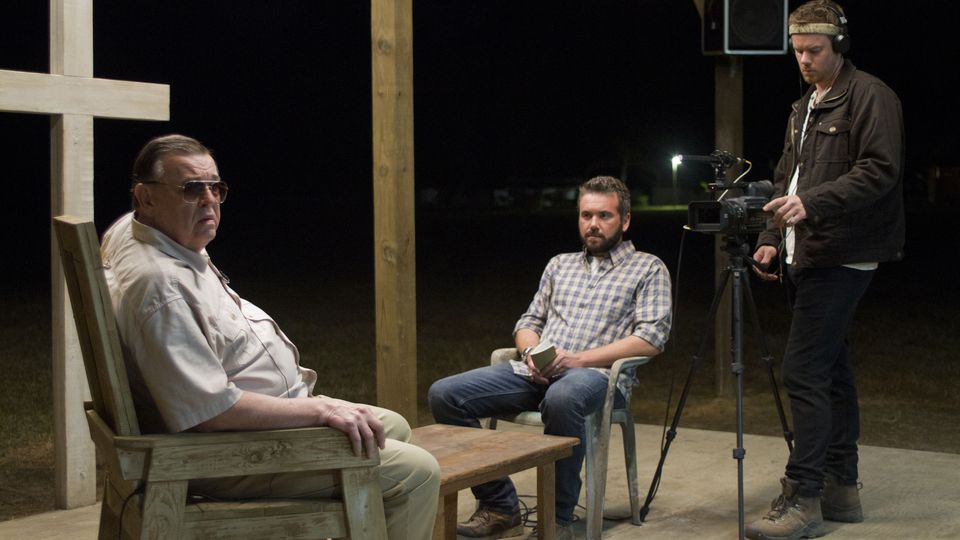
Nowt to do with Pulp, but an excruciatingly twee community project, set on Tooting Common yet so bereft of recognisable human behaviour it could be unfolding in the furthest reaches of the Andromeda galaxy. An am-dram scoutmaster finds ways to distract his precocious charges from retrieving spent condoms; two oldtimers lend their voices to bum-sniffing dogs (“Ruvvery: that’s lovely in dog”); its clumsy Big Society cheerleading peaks with the torturous immigration metaphor sparked by an escaped parakeet. It wears its heart as a toddler does ice cream on a hot day: on its sleeve, down its front and all over its trousers. 

Common People opens in selected cinemas from Tuesday.

Thursday, 5 June 2014

Forest fire: "I Declare War"


The somewhat misconceived Canadian curio I Declare War relies upon a single gimmick: the dubbing of a game of capture-the-flag undertaken by a handful of pre-teens in a forest close to their homes with the sound and visual effects of a fully-fledged war movie - so that balloons explode like bombshells, and toy guns go off like Howitzers. The sensation-courting approach obscures, if not outright obliterates, the script's quiet, anthropological, quasi-Dennis Potter-ish idea about adult characteristics (loyalty, responsibility, the lust for power) manifesting in the young, and the cause isn't best served by a very ordinary crop of performers, whose turns range from the awkward to the at best functional, and at every point seem like refugees from some Degrassi (or afterschool equivalent) cattle-call. Garth Jennings' enduringly sweet Son of Rambow demonstrated that, with the right marshalling, similar material might be manoeuvred across demographic lines, and play just as well to old and young alike; this simply gets mired in no-man's-land, likely too intense for the whippersnappers, and too jejune-seeming to hold the attentions of grown-ups.

I Declare War opens at selected cinemas from tomorrow, ahead of its DVD release on June 30.

Tempus mutandis: "X-Men: Days of Future Past"


The X-Men franchise stands as one of the few to have gone unrebooted, which suggests somebody somewhere's been doing something right these past fourteen years. Unlike Spider-Man and Superman, there's a definitive screen Wolverine in Hugh Jackman, who's remained adamantium-plated in the role despite the middling-to-botched spin-offs of X-Men Origins and last year's The Wolverine; the framework set in place by the producers and the performers is such that the series could generate an offshoot (2011's X-Men: First Class) which suggested even Matthew Vaughn might have some use as a director-for-hire. It's this integrity - and the not-coincidental return of director Bryan Singer, who was only a few years on from The Usual Suspects when he signed on for the first instalment - that allows X-Men: Days of Future Past to attempt an almost insanely complicated narrative round-up, threading all its universes together where rival franchises, still tentatively setting down roots and testing the audience's response, probably couldn't.

The new film deploys what we might call the Terminator gambit. We open on a bleak, post-apocalyptic futurescape, made even greyer by the 3D glasses, in which our heroes have been defeated, and Halle Berry's Storm has, in an additional humiliation, suddenly been forced to wear the unflattering haircut of "Too Shy"-era Limahl. (The strain will ultimately prove too much for her, as indeed it did for Kajagoogoo.) In desperate search of a way out of this black hole, Xavier (Patrick Stewart) and Magneto (Ian McKellen) - united in apparent defeat - get their hands on a time machine, and resolve to send their best warrior (Jackman) back to the 1970s with the intention of correcting the path of history: a nice twist, this, on all those movies in which time travellers are specifically instructed not to meddle with the events of the past.

They say it is the winners who get to write (and rewrite) history, and since the geeks inherited the earth some time around the dawn of the last millennium - removing fantasy like this of the stigma it once had in polite society - these films now routinely attract A-list thespian talent, rather than those B-movie lunks who once wandered confused into this territory, trying not to bump into the wobbliest of scenery. There are still, one would venture, far too many mutants and superpowers up on screen for the X-Men's third-act rally to ever truly be in question, but there's something of interest in the situation Wolverine is dropped into: the very human mess of heartbreak and betrayal left behind at the end of First Class, which finds the younger Xavier (James McAvoy) bruised from the loss of his shapeshifting sweetheart Raven (Jennifer Lawrence) to the darker-leaning Magneto (Michael Fassbender).

In both time periods, the franchise has been blessed with actors capable of making the most of the few emotional beats in a script necessarily heavy with exposition, and of establishing a clear continuum between past and present. Casting decisions made a decade-and-a-half ago are still paying off, both in individual scenes and at the box-office; of the newcomers, it somehow makes sense that the troubled but amenable McAvoy would lose his hair and grow into Patrick Stewart, and that the aloof Fassbender will eventually become the lofty McKellen, reservations over the longer-term comic viability of ITV's Vicious notwithstanding. Lawrence lends a character who's essentially a walking effects showcase a kind of sass and slink, although the suspicion persists that Raven is still intended as an analogue for all those demonic females who've broken or loosened the bonds between male nerds; though by definition no-one can quite get a handle on her, a grown-up entertainment like American Hustle was rather more forceful about countering such assertions with the understanding we men can just as easily be fools for love.

Still, the human frailty inherent to this triangle elevates Days of Future Past over the brute-force bullying of Avengers Assemble, and Singer's film is next-gen in several other respects, too. The sequence in which Wolverine's new right-hand man Quicksilver (Evan Peters) - a speedfreak slacker with the ability to bend time to his will - halts the action in a Pentagon shootout to flick bullets from under the noses of key characters replays The Matrix's groundbreaking, presumably labour-intensive "bullet time" conceit for such leisurely sport Singer can get away with laying Jim Croce's "Time in a Bottle" (rather than, say, the Propellerheads) over the top. (Anybody seeking to illustrate the advanced rapidity of today's processor chips might point to this as an example, or the way Edge of Tomorrow more or less throws away in passing a litoral combat sequence those working on Saving Private Ryan must have spent many, many months slaving over.) Staging another set-piece as flickering, Zapruder-ish Super 8 also allows Singer to provide both bonus notes of period authenticity and welcome relief from all that clanking around on the metallic gantries blotting the Marvel landscape.

DoFP rather needs these showstoppers, if only to break up the sheer weight of backstory Singer sets himself to plough through, and give zip to a distinctly post-Nolan event movie with notably less humour and colour than there was in earlier instalments: even the very Star Trek-y diversion (acknowledged as such in the appearance of William Shatner's Captain Kirk on a background monitor) of having its younger and elder Xaviers meet is played for furrowed brows, not laughs. Still, these characters do have plenty to be mulling over, for once. Faced with the prospect of yet another summer blockbuster that edges into a third hour, its arteries clogged, its once-clean lines blurred, this does at least feel like a properly busy and detailed universe; one can still imagine future instalments zipping off, Quicksilver-like, in any number of directions, and coming back with an infinite number of stories worth telling.

X-Men: Days of Future Past is in cinemas nationwide.