The Frozen Ground did the barest minimum to make the UK's Top 10 films last weekend, and - in truth - it does the barest minimum to bring its lipsmacking true story - the pursuit and eventual arrest of Alaskan serial killer Robert Hansen - shuffling and shrugging onto the screen. It's saddled itself with now cut-price stars electing to go down the self-effacing character actor route, to the detriment of any wider, more compelling drama: Nicolas Cage, as the detective driven to reopen Hansen's dormant file against the wishes of the local PD, falls back on the frowny sincerity last tried around the time of 1999's 8MM, while John Cusack, whose sweaty scuzzball in the recent The Paperboy suggested a new and semi-intriguing career path, makes the not unintelligent but limiting choice of bland anonymity to play Hansen, the supermarket manager and family man who maintained a fondness for keeping teenage prostitutes chained up in his basement for weeks at a time.
With not much going on front and centre, you'd hope for some life among the supporting cast, but instead we find Radha Mitchell salvaging whatever she can from the cutting-room floor in the non-role of Cage's missus, producer Curtis "50 Cent" Jackson further devaluing his own brand in Jar Jar Binks dreadlocks as - surprise! - a thuggish pimp, and the usually very funny Kurt Fuller stuck behind a beige desk as the Alaskan D.A.. The one performer who comes close to owning their own strand, somewhat unexpectedly, is Vanessa Hudgens, who in the space of just two movies - and The Frozen Ground at least gives her more to play with (and wear) than April's Spring Breakers - appears to have comprehensively trashed her erstwhile Disney starlet image. As Cindy Paulson, the one crack-huffing stripper who survived Hansen's attentions, she's credibly tough and bruised, working through the kind of breakdown many of this actress's contemporaries have played out off-screen.
It's just a pity her performance should be at the mercy of such a shoddily structured script, which tosses Cindy around not just between Hansen and the cops, but between these factions and every other nefarious or otherwise letchy male on screen, in an attempt to raise some terminally low stakes. Rarely better than functional on either a visual or narrative level, and often just plain insensitive in its handling of Hansen's crimes, this is exactly the sort of blunt, cursory, shoulda-gone-straight-to-DVD venture one might reach for to illustrate how US cinema is presently lagging some distance behind its engaged and committed televisual equivalent. A late Thursday evening premiere on 5USA - after the CSI reruns, if just ahead of the cage-fighting - surely awaits it.
The Frozen Ground is in cinemas nationwide.
This one could and probably should have been better. A sort of Grumpy Old Spies - the title's an acronym for Retired and Extremely Dangerous - RED is held back from achieving anything the altogether more sincere Sneakers or Space Cowboys managed by its relentless flipness of tone. From the opening shot of an alarm clock belonging to Bruce Willis's weary ex-agent Frank Moses ticking round to 6am to the mid-film shootout in a container yard, the material - adapted from a graphic novel by Warren Ellis and Cully Hammer - doesn't so much subvert cliches as present them with a mitigating smirk and a shrug of some already slackened shoulders.
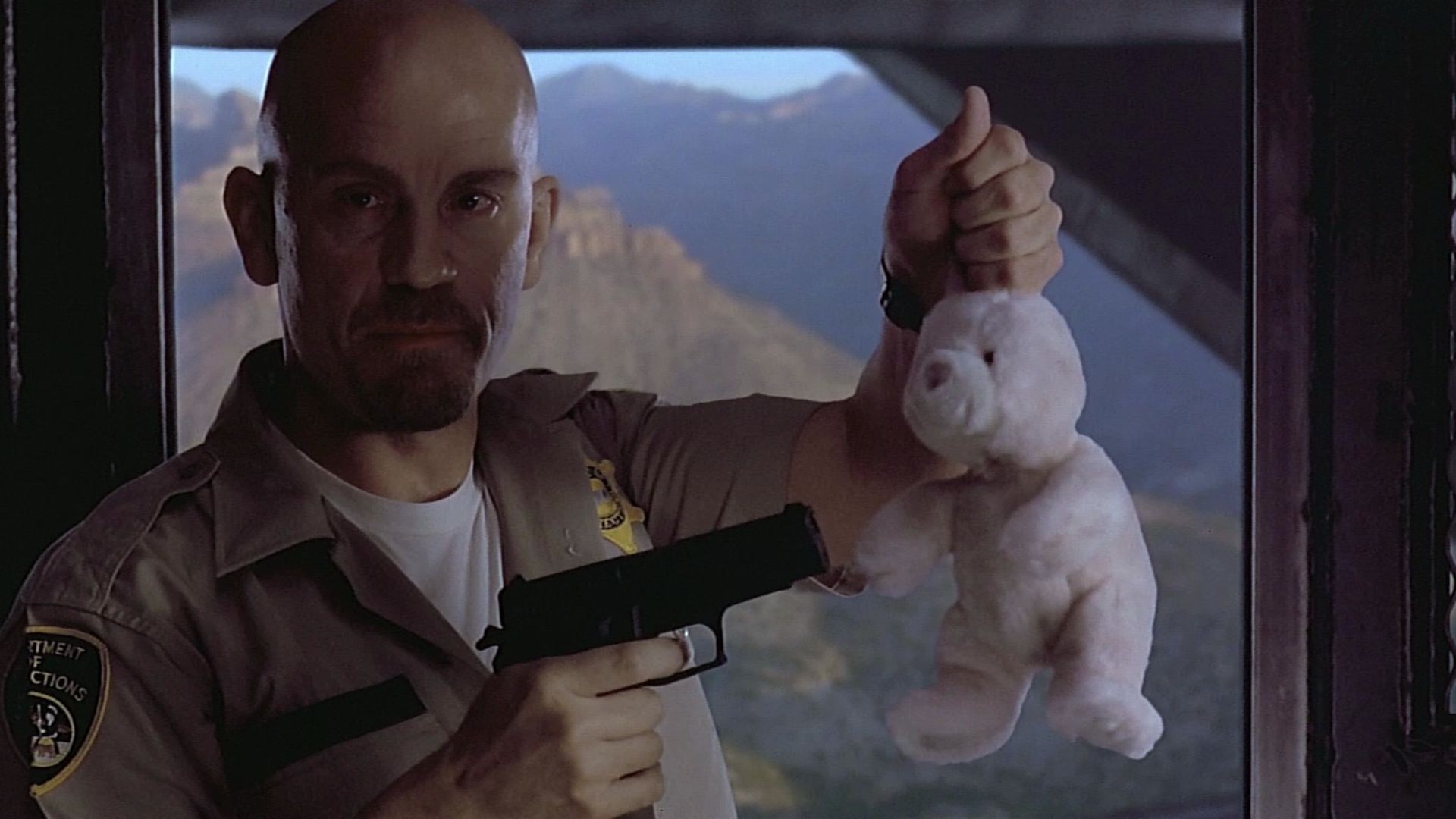
A lot will depend on your feelings for the assembled performers, and whether or not you can bear to watch them in even screenfilling, in-flight nonsense such as this. Willis's low-key, unforced cool is enough to make one wish he'd push himself more often; John Malkovich doing wacko - even within the PG-13 straitjacket RED is obliged to wear - is always fun, to some degree; and I believe my thoughts regarding Mary-Louise Parker have long been a matter of public record, and quite possibly of some concern for the actress's legal team. (Again, though, I sensed the movies undervaluing her drollness; that she's too good for tagalong klutz roles like the one she's landed here.)
The casting of Helen "The Queen" Mirren as a dead-eyed assassin - letting out one of her now-trademark "bugger"s (cf. State of Play) whenever she gets shot at - is about the level RED is operating at, although among its thespian clutter, you'll also find amusing-ish one-or-two-scene bits for Ernest Borgnine as "The Recordskeeper", Brian Cox as a bibulous Russian contact, and Rebecca Pidgeon as a stiff CIA chief in the inevitable trenchcoat. It's an end-of-season Hollywood pantomime, in effect: everyone present is cruising along with the blithe air that none of this really matters - that this is just temporary, make-believe, a flick - and that that in itself can and will excuse any amount of incoherence and implausibility. Morgan Freeman appears to die twice, and come back; dragged with each new frame from her Kansas City home towards Washington, then New Orleans, Parker winds up wondering "How did we end up in New York?", and you do kinda know how she feels.
Arriving barely months after the very similar, if not entirely interchangeable Knight and Day, and mere weeks before The Tourist, it may chiefly be of note for announcing a new (or revised) model of mainstream American filmmaking for our present age of austerity: one that finds a vast talent base flying in for presumably reduced paycheques and a couple of days' shooting here and there on projects overseen by rent-a-hacks (if you can winkle out any thematic link between Robert Schwentke's work on Tattoo, The Time Traveller's Wife and this, you're a better critic than I), committing to no theme or idea in particular, but content to whip an audience along for the ride. I guess there are worse ways to kill a couple of hours, but if the characters refuse to stick around and burrow down in our subconscious, how on earth do you expect the movie to?
(February 2011)
RED is available on DVD through Entertainment One, and screens on Film4 this Thursday night at 9pm. A sequel, RED 2, opens in cinemas nationwide from Friday.
Top Ten Films at the UK Box Office
for the weekend of July 19-21, 2013:
1 (1) Monsters University (U) **
2 (new) The World's End (15) ****
3 (2) Despicable Me 2 (U) ***
4 (3) Pacific Rim (12A) **
5 (4) Now You See Me (12A)
6 (6) World War Z (12A) **
7 (5) The Internship (12A)
8 (7) Man of Steel (12A) ***
9 (new) The Frozen Ground (15)
10 (8) This is the End (15) ***
(source: Guardian.co.uk)
My top five:
1. We Steal Secrets: The Story of WikiLeaks
2. Blackfish
3. The World's End
4. Roman Holiday
5. The Enigma of Kaspar Hauser
Top Ten DVD rentals:
1 (1) Life of Pi (12) ***
2 (3) Les Miserables (12) *
3 (10) Robot & Frank (12) ****
4 (7)
Arbitrage (15) ****
5 (4) Oz the Great and Powerful (PG) **
6 (5) Django Unchained (18) **
7 (2) Parker (15)
8 (6) Safe Haven (12A)
9 (8) The Hobbit: An Unexpected Journey (12) ***
10 (9) Flight (15) **
(source: lovefilm.com)
My top five:
1. A Late Quartet
2. In the House
3. White Elephant
4. The Returned
5. Beware of Mr. Baker
Top five films on terrestrial TV this week:
1. Con Air [above] (Saturday, BBC1, 10.30pm)
2. One Flew Over the Cuckoo's Nest (Tuesday, BBC1, 11.50pm)
3. The Dirty Dozen (Saturday, five, 12.55pm)
4. Trading Places (Saturday, C4, 12.10am)
5. Animal Kingdom (Sunday, C4, 11.45pm)
Russ Meyer's Faster, Pussycat! Kill! Kill! is one of those semi-legendary B-features that feels as though it should have been shot in cash-in 3D, even if it wasn't ultimately - such is the way in which its weird, fetishistic energies pop out of the screen at you. At its centre: a trio of mocking, cackling go-go dancers, perfectly content to spend their downtime burning off any remaining energies (and gas) in driving round and round the desert in cars with gleaming, deadly curves that seem like extensions of their own bodies. (For those unfamiliar with the Meyer oeuvre, let me phrase it euphemistically: these models come complete with their own twin airbags.)
On one hand - and Meyer's films have perennially risked accusations of being one-handed - it's pure, possibly titillating exploitation. Yet on the other, it's a resurrection of the kind of tough broad who'd been absent from the screen during the Doris Day era: these women are placed very firmly in the driver's seat, and given the plot they eventually veer into (involving a missing girl, a reclusive, wheelchair-bound millionaire and his musclebound lunk son) is sunbleached noir, they come to resemble 40s femme fatales (kill! kill!) as pumped up for the more permissive Sixties.
The timid framing suggests that, at this stage, this director was still (understandably) terrified of asking his actresses to let it all hang out for him, and it's limited by performers who operate in one note or less - I don't think Meyer was really listening - but Faster, Pussycat! arrives at a strange vision simply by smashing together wild extremes of masculinity and femininity: there's a rare kind of artistry in the way Meyer keeps finding exactly the right camera angle to make head go-go girl Tura Satana's cleavage appear simultaneously as impressive and as insurmountable as Mount Rushmore.
Faster, Pussycat! Kill! Kill! is available on DVD through Films Sans Frontiers.
Sounds funny to voice it, but there is an argument to be made that the 145-minute fantasia Juliet of the Spirits - coming hot on the heels of the 138-minute 8 1/2, and the 180-minute La Dolce Vita - marked the last point before Fellini spiralled off into absolute self-indulgence, and began sticking his own name before (and in) the titles (Fellini's Roma, Fellini's Casanova) of films in which he was chiefly dramatising his more perverse and wayward desires. This one's Giulietta in Wonderland, essentially: a psychedelic fairytale constructed around the director's wife and muse Giulietta Masina, much as those earlier works were organised (if that's the right word) around Marcello Mastroianni.
While her blithe, possibly philandering hubby goes off to the office for days and weeks, the bored Giulietta shuffles out into the world on a quest for personal fulfilment, and quickly finds herself surrounded by the kind of kooks, cranks and grotesques audiences were by this point expecting to find in a Fellini movie. The first wave of these - including, forsooth, a medium - shows up around the five-minute mark, and thereafter the leading actress is all but carried away on a torrential stream of consciousness that sometimes resembles Fellini doing a Scary Movie on the cinema around him: there are images lifted directly from Lola Montès and The Seventh Seal, vast Technicolor sets to rival anything in the Jerry Lewis canon, and an attempt to get at the heroine's troubled psychology that feels very much like a riff on Marnie. Most crucially of all, perhaps, it comes to regard a failing marriage as an occasion for a party, rather than, as Antonioni saw it, cause for a wake or post-mortem.
Fellini compensates for the near-total absence of plot development with staggering, striking or simply funny set-pieces (the school play halted by parental intervention, a trip to a treehouse stuffed with silly hats) and by hanging it all around the dainty shoulders of Masina, a performer who - simply by presenting her face to the camera - could carry an audience anywhere. The fact the flashbacks reveal the extent to which Giulietta and her predecessors were under the yoke of the men in their lives marks the film out as second only to Nights of Cabiria as the most properly feminist work in this eternally lusting and fantasising director's filmography: you could see the heroine as a continental sister to all those bored Californian housewives in the American movies of the 1960s and 70s, reaching out for New Agey curatives and longing for liberation of a kind. It really is spirited - more happening than film - and its suggestion we should throw the doors open and let life flood in whenever we hit troubled waters in love leads me to believe it comprises one of the all-time great post-breakup movies.
Juliet of the Spirits is available on DVD through Nouveaux.
Top Ten Films at the UK Box Office
for the weekend of July 12-14, 2013:
1 (new) Monsters University (U) **
2 (1) Despicable Me 2 (U) ***
3 (new) Pacific Rim (12A) **
4 (2) Now You See Me (12A)
5 (3) The Internship (12A)
6 (4) World War Z (12A) **
7 (5) Man of Steel (12A) ***
8 (6) This is the End (15) ***
9 (new) Bhaag Milkha Bhaag (12A)
10 (7) The Bling Ring (15) ***
(source: Guardian.co.uk)
My top five:
1. We Steal Secrets: The Story of WikiLeaks
2. The World's End
3. Roman Holiday
4. The Enigma of Kaspar Hauser
5. Lootera
Top Ten DVD rentals:
1 (1) Life of Pi (12) ***
2 (new) Parker (15)
3 (new) Les Miserables (12) *
4 (7) Oz the Great and Powerful (PG) **
5 (2) Django Unchained (18) **
6 (new) Safe Haven (12A)
7 (new) Arbitrage (15) ****
8 (4) The Hobbit: An Unexpected Journey (12) ***
9 (5) Flight (15) **
10 (new) Robot & Frank (12) ****
(source: lovefilm.com)
My top five:
1. In the House
2. White Elephant
3. The Returned
4. Arbitrage
5. Robot & Frank
Top five films on terrestrial TV this week:
1. Raiders of the Lost Ark [above] (Saturday, BBC1, 6.30pm)
2. Hue and Cry (Tuesday, BBC2, 12.35pm)
3. Synecdoche, New York (Tuesday, BBC1, 12.30am)
4. Carry On Up The Khyber (Thursday, C4, 1.25pm)
5. Dumb and Dumber (Sunday, five, 10pm)
The screenwriter Robin Campillo has come to prominence in recent years for his collaborations with Laurent Cantet - he co-wrote 2008's outstanding The Class - but he made his own confident stab at directing back in 2004 with the remarkably well-sustained philosophical chiller Les Revenants, which is being released on DVD this Monday under the title of the hit TV series it subsequently inspired: The Returned. Campillo here treats the undead as a sociological phenomenon, his low-key yet admirably precise intentions signalled early on with a cut from the film's "zombies" pouring out of the cemetery to a council meeting in full progress: the emphasis from here on in is not on what they might do to us, but what we might do with them if they did, indeed, come back.
Glassy-eyed, "they" are, and slow on the uptake, too, but since they display no immediate signs of blood/brainlust, they've been ruled by the UN to have their own human-ish rights, returning them to their earlier homes and jobs - and forcing those left behind, who mourned their passing first time around, into coming to terms with some occasionally unhappy memories. Suspicion, however, persists among the wider community: a shared concern about where these houseguests go at night obliges the council to fork out for surveillance cameras attached to balloons.
Again, we see how Campillo has come to flip the genre on its head: the issue in Les Revenants isn't bloody population decrease, but sudden and seemingly incontrovertible population increase - thus making the film a thousand times more relevant to a society growing older and more crowded by the day. 65% of the 70 million undead revived here are, we're told, upwards of sixty years old, which puts a stop to any thoughts of sexy zombies, while setting up the perennially fruitful themes of integration and adaptation: the focus is held firmly on those mental and physical processes that allow us to forgive and forget, to connect and reconnect, in any case to get on with life.
What's scary about these so-called antagonists is their apparent inability to love as they once did; they really are zombies in this respect, going unfeelingly through the same old motions, unable to change or conceive of anything worth building. "Their thoughts and memories go crowding into darkness" is the somewhat poetic diagnosis one Red Cross worker offers; indeed, these returned appear more depressed than they do feral, which again allows Campillo and the film to raise the question of proper treatment.
It could seem drippy or bloodless - flirting with romantic drama in places, which might send more seasoned gorehounds hurtling to the exits - were it not astonishingly acted (or, rather, non-acted) by its revenant ensemble, who numb their emotions and somehow manage to locate previously unexplored tensions in the notion of zombies who just want to get back to normality. Stripping back some of the gory excess allows the film to be eerie and haunting in whole new ways, and for Campillo to redefine what, in fact, the zombie movie might serve as: a conduit for asking wider questions of society, and how, at times of stress, we both do and don't relate to one another.
The Returned is available on DVD through Arrow Films from Monday.