Thursday, 11 July 2013

A new leaf: "Lootera"


Lootera is the latest collaboration between director Vikramaditya Motwane (who wrote 2009's modish myth-update Dev.D) and writer Anurag Kashyap (who directed the recent underworld epic Gangs of Wasseypur), the pair presently being credited with nudging Hindi cinema towards a new maturity. (Given the global success of last month's utterly sophomoric Yeh Jawaani Hai Deewani, you feel they may just have their work cut out for them.) Considering their ultra-hip credentials, it may come as something of an eyebrow-raiser to see Mills & Boon listed as a (gulp) "brand partner" in Lootera's opening credits, but what follows satisfies as both the definition of a swooning period romance and a tale of forbidden love that could easily translate to a Wasseypur-style gangster milieu.

In 1953, the household of a rich landlord is thrown into physical and emotional disarray by the arrival of Varun (Ranveer Singh), a handsome yet diffident archaeologist keen to dig for relics on his host's sizeable estate. In the course of his business, Varun locks eyes with Pakhi (Sonakshi Sinha), the landlord's beautiful yet ailing daughter, winning her heart in declaring his desire to someday paint a masterpiece in the Himalayas. He is, however, acutely aware that he doesn't have the fight in him to snatch the girl away from her over-protective father, and so resolves to keep digging; in doing so, he happens upon some other way of undermining this suddenly fragile household.

An end credit reveals the story was inspired by O. Henry's short story "The Last Leaf" (set amid the boho Greenwich Village set), but Motwane and Kashyap are clearly also indebted to Shakespeare (the lost empire) and even Chekhov (there are prelapsarian trips to an orchard). Cinematically, Lootera backs away from almost every Bollywood cliche you can think of. Motwane has sought out authentic-looking locations rather than sets, and allows the action to be quiet and restrained where others might have aimed for loud, frenetic and showy. Several times, the soundtrack is hushed to the extent you can hear the characters breathing, a tactic designed in part to point up Pakhi's growing respiratory distress.

The actors, relieved of the burden of playing to the cheap seats, come into their own; these are unmistakably performances, and not mere panto turns. Singh, indeed, initially appears so reticent and shrugging a presence one starts to question his thespian credentials - until it transpires Varun's diffidence is crucial to the plot. And Sinha, who caught the eye as the female lead of last November's Son of Sardaar, only benefits from having an entire film constructed around her. Lootera needs you to fall in love with her from scene one (you do), and for the intensity of that feeling to grow with every passing frame (it does), so you feel precisely that hurt and betrayal that is to come (you do). 

All of which is to let slip that, yes, there are narrative surprises here, too: there's something truly inspired in how the film comes to undermine its own foundations, turning what we think is one story into quite another, via one of the dooziest pre-intermission cliffhangers you will ever encounter. The second half - which opens with Pakhi, like the writers, scratching away at a pad, venturing new directions for her story - reveals just how fine the line is between romance and noir, realism and poetic realism, and how, by reducing the melodrama to a low simmer, a commercial Bollywood release might channel not just the emotion of, say, Le Jour Se Leve, but also its artistry and infallible story logic, and in such a way as for that not to sound like a preposterous proposition.

That this is still a transitional film is apparent from some patchy, grainy-looking night scenes, where the digital photography temporarily leaves a carefully composed and lushly lit production looking Dogme-rough, and from the need the producers feel to flash up an onscreen health warning every time one of the characters reaches for a cigarette. Yet, in the main, Motwane and Kashyap have between them found wholly rewarding solutions to the question of how the Hindi cinema might grow up without sacrificing the distinct strengths and core values of Bollywood. Varun will eventually paint his lasting masterpiece, but it's an affecting miniature, in a form that is absolutely not what you may have been expecting. The film's a lot like that, too.

Lootera is in cinemas nationwide.

Wednesday, 10 July 2013

Hackers: "We Steal Secrets: The Story of Wikileaks"


Following on from 2010's The Social Network, Alex Gibney's new documentary We Steal Secrets might count as the latest in what will doubtless become an ongoing series of films about Kids Who Changed The World (While The Rest Of Us Struggled To Sign Into Netflix). Let's face it, the pulsing question we want answered by this vital information-age primer concerns the real identity of Julian Assange. Is he a libertarian crusader? A "humanitarian anarchist", as one analyst interviewed here puts it? Or is he just the slimiest character Simon Pegg might end up playing at some point - an alleged sex offender, resisting responsibility by any means, a seedier Zuckerberg, with Warholian hair and smirk? Can he squirm out of this one? Not quite, it turns out.

This was a rapid ascent - processor chips enable that - and Gibney grasps as such, scrolling past the tags and dashes of getting a stateless furysource like Wikileaks up and running to address the one-two combo of exclusives that made the website's name and sent the mainstream media - constrained by such analogue concerns as factchecking and print deadlines - scrambling: the notorious 2010 release of a 2007 video showing an U.S. Apache gunship gleefully opening fire on Iraqi journalists and civilians (as uploaded under the leading title "Collateral Murder") and the 2011 release of classified Pentagon documents pertaining to the Iraq and Afghanistan conflicts, as unlocked by troubled soldier-turned-hacker Chelsea Manning.

This, Gibney posits, was the gamechanger. Now even the Guardian and the New York Times were chasing Assange and chums, desperate to bring these upstarts into the fold. But it was a shaky alliance. The Guardian's Nick Davies reports there were major disagreements over the handling of the Manning documents: where the seasoned journalists were reluctant to print anything that could get people on the ground killed, Assange clung to what was once an old-media credo - publish and be damned. The resultant scoop may be the apex of the Wikileaks story, but having stormed the castle, trouble (quickly) followed. The facts are still contentious and debated, the scars fresh, but no less deeply felt for that: the rape accusations that Assange tried to swat away as an obvious smear campaign, the boardroom bust-ups (very Facebook), the final (for now) retreat into laptopped isolation, and behind the doors of the Ecuadorian embassy, as these born loners revealed their true colours. 

As in Client 9, his expert unpicking of the Elliot Spitzer scandal, Gibney is alert to the possibility his subject might stand for something positive and progressive, even as he puts his fingers on some compelling character flaws. We Steal Secrets consistently hones in on the psychologically revealing aspects of this story: take the original instant-messaging flurry that saw Manning and his Wikileaks contact Adrian Lamo bond over their confused sexual identities. What such exchanges come very eloquently to describe is an almost anti-social network of overstimulated outsiders - technically brilliant, socially awkward, attempting to drown their insecurities with Red Bull - who ported an adolescent hatred of bullying authority figures over into adulthood, only to run face-first into a moral firewall. They were trying to make the world a better place - and a truthseeker like Gibney can appreciate the effort - but they did so in the most guileless and muddle-headed of ways.

After the necessarily restrained Mea Maxima Culpa, this very plugged-in film once more showcases Gibney's great facility with pop culture, sourcing an Australian current-affairs report about hacking and dipping into 1983's War Games to make or underline a particular point, but its own form of journalism remains searching, human and fundamentally sound. There's a real coup in the film's final reel, as Gibney sits down with the two women at the centre of the Assange rape case: the kind of nuts-and-bolts journalism less curious news gatherers, keener to sensationalise or merely report the party line, somehow overlooked, leaving the women in question open to demonisation from the bent-knuckled, misogynist trolls lurking beneath the Internet's shadier bridges. (And we're hardly dissuaded from spotting the parallels between these HTTP-savvy outsiders and Assange's own boysy crew.)

What we have diagnosed here, finally, is a perception problem: an inability to see the world in any terms other than binary ones and zeroes, us and them. (Ironically, the Bush administration that first took America into war in the Middle East had much the same issue.) Assange's mission statement, established early on in the film and frequently returned to, was "we're going to fuck them all", no matter that the snafus his website was hellbent on exposing may have been plenty fucked already. Facts, like women, are difficult and delicate organisms that possibly deserve better than simply to be fucked and splurged, grabbed from one place and tossed heedlessly into the night; sometimes they demand to be treated with a degree of care and tact. Among this exceptional, era-defining film's many achievements: you come away from it convinced Alex Gibney would make a far better lover than Julian Assange.

We Steal Secrets: The Story of Wikileaks opens in selected cinemas from Friday. Swiss Toni is on holiday.

Tuesday, 9 July 2013

Games without frontiers: "Play"


Anybody who caught Swedish director Ruben Östlund's funny, provocative Involuntary upon its UK release back in 2010 will find his follow-up Play, extrapolated from several real-life criminal incidents, every bit as peculiar and striking. The new film follows two lines of inquiry. In a shopping mall, a gang of teenage migrants stage an elaborate graft on their white contemporaries; these developments are punctuated by scenes and increasingly desperate announcements on board a train heading from Malmö to Gothenberg, wherein an inspector bemoans the presence of an unclaimed wooden cradle in the communal baggage area.

Two films down the line, Östlund's technique is emerging as not dissimilar to that observed in certain contemporary comedies (Curb Your Enthusiasm being the most prominent example): put your - in Östlund's case, only semi-professional - performers into awkward social situations, then sit back and observe. The level of external control involved ensures Östlund's visions are cooler, and perhaps even crueller, holding the characters at a remove, as though they were under surveillance, or trapping them behind glass, as a scientist would a sample under a microscope slide.

Though still often squirmingly funny, these set-ups are intended less to usher us less towards laughs than they are towards a recognition the events they depict are very much a part of our world; the safety net provided by, say, the Larry David persona in Curb has here been comprehensively removed. When the migrants bully a male passenger on a tram, the result is a scene very nearly as jolting as the one involving Juliette Binoche on the Metro train in Michael Haneke's Code Unknown - and, more than that, another reminder of just how much of the modern world is given over to bullying and hectoring.

A political subtext emerges from these interactions, and it turns out to be no coincidence that the film should open in a shopping centre. Play, with its expertly corralled young cast, comes to suggest that consumerism has given rise to a newly unhealthy need to acquire material goods - call it pester power - and that adults and authority figures have started to give into kids everywhere. (As in We Need To Talk About Kevin, the cradle is regarded as an obstruction in more ways than one.) Östlund's subjects nonetheless remain vulnerable: they are just kids, after all, and as liable to be preyed upon by one another as they are by prevailing market forces.

The filmmaker lays out his credentials as the new Haneke in a scene in which one of the migrants' victims is challenged to complete one hundred push-ups by his captors; as Haneke might, Östlund leaves his camera running on every last, despairing effort. He has sharp points to make - the victims' tearful calls home are diverted to voicemail, because their parents are off working the long hours required to keep their heads above water - and he makes them well, yet the film around them feels a mite overstretched: at two hours, it's all too clearly in thrall to the idea harsh reality has to equal real time.

As in Involuntary, Östlund asks us to question just how far we're prepared to go along with the dominant ideology (neo-liberal capitalism, in this instance, with its dazzling illusion that we can get whatsoever we want), but the earlier film held one's attention across diverse strands, allowing the director to explore new paths and alleyways. Play meanders into the countryside and back, nagging away at its themes like a finger on a loose tooth, in a way that proves pleasurable to some extent, yet increasingly protracted - and problematic besides. Östlund is so much the scientist here that he risks appearing neutral on the data he's collected, which in turn leaves his film open to dangerous interpretations.

One reading - let's call it the EDL reading - of Play is that the jolting sights it presents us with, such as the displaced tribe of native Americans we're shown dining in the mall's McDonalds, are an inevitable consequence of globalisation; that neo-liberalism has led to the wrong laws being enforced, and nice white boys (like the ones in the movie, one of whom even plays the clarinet!) getting turned over by nefarious darkskins. For all its formal brilliance, Play's Rorschach blot-isms can be maddening: belatedly, we get the big reveal and some kind of counterimage (a nice young white girl dancing to African tribal music), but we've spent too long getting there. And even then, its own liberalism could be taken as a rather brusque statement - that, like that cradle, immigrants are here: get used to it.

Play opens in selected cinemas from Friday.

Friday, 5 July 2013

For what it's worth...


Top Ten Films at the UK Box Office              
for the weekend of June 28-30, 2013: 


1 (new) Despicable Me 2 (U) ***
2 (1) Man of Steel (12A) ***
3 (2) World War Z (12A) **
4 (new) This is the End (15) ***
5 (new) Hummingbird (15) **
6 (4) Behind the Candelabra (15) ***
7 (3) After Earth (12A)
8 (5) The Hangover Part III (15) **
9 (8) Before Midnight (15) *****
10 (7) Epic (U) ** 
 
(source: Guardian.co.uk)

My top five:              
   
 
1. Before Midnight  
2. The Enigma of Kaspar Hauser
3. Lootera
4. Paradise: Faith
5. The Act of Killing  
   

Top Ten DVD rentals: 
 
1 (new) Life of Pi (12) ***
2 (4) Django Unchained (18) **
3 (new) Hansel & Gretel: Witch Hunters (15)
4 (1) The Hobbit: An Unexpected Journey (12) *** 
5 (3) Flight (15) ** 
6 (2) Argo (15) ***
7 (new) Oz the Great and Powerful (PG) **
8 (new) Broken City (15) **
9 (6) Wreck-It Ralph (PG) *** 
10 (new) Warm Bodies (12) ***     

(source: lovefilm.com)


My top five:                    
1. NO      
2. Cloud Atlas  
3. Mea Maxima Culpa: Silence in the House of God    
4. Lincoln        
5. Chasing Ice 


Top five films on terrestrial TV this week:               
1. Duel in the Sun [above] (Saturday, BBC2, 2.25pm)
2. Hot Tub Time Machine (Sunday, C4, 10.10pm)
3. Wanted (Saturday, ITV1, 10.50pm)
4. The Siege (Sunday, five, 10pm)
5. In the Loop (Saturday, BBC2, 10.45pm)

"Bula Quo!" (The Guardian 05/07/13)


Bula Quo! (PG) 90 mins **

It’s surely a hallucination: an action movie, cobbled together to mark Status Quo’s 50th anniversary, in which Rick Parfitt and Francis Rossi are forced on the run in Fiji after exposing an illegal gambling ring. I may have witnessed Craig Fairbrass thumping somebody into unconsciousness with a flip-flop. The hits ring out loud and clear, and Parfitt and Rossi are typically laidback and likable. The rest’s rather too relaxed: all low-octane, MacGyver-y escapes on golf buggies and scenic railways, it’s cosily plodding and not notably rock ‘n’ roll – but then, isn’t that somehow so very Quo?

Bula Quo! opens in selected cinemas from today.

Thursday, 4 July 2013

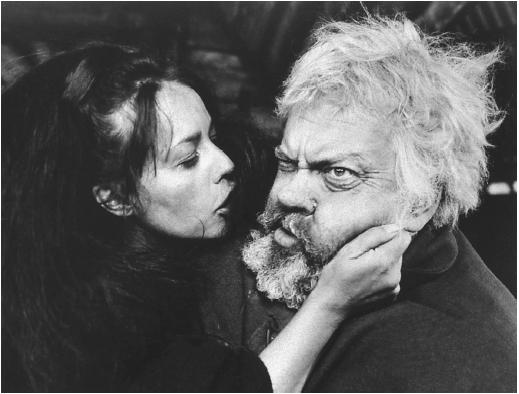
1,001 Films: "Falstaff: Chimes at Midnight" (1965)


Dating from Orson Welles' period in exile, Falstaff: Chimes at Midnight stands as a notionally more democratic, alternative-angle mash-up of several key Shakespearian texts, as undertaken by a writer-director clinging to such lines as "Give me the spare man/And spare me the great ones" as cold comfort at a time when his legacy was being superceded by a whole new wave of movie brats. As with Othello and The Trial, it scores by grounding its action on sites where it looks like these dramas might actually once have played out: it's very much a product of the same decade that gave the world Pasolini's rough-hewn Trilogy of Life, although with Welles at the helm, the results inevitably skew starrier, finding spots for Jeanne Moreau (rehearsing proto-Eva Greenisms as the local harlot), Marina Vlady and (oddly enough) Margaret Rutherford as a hostess.

Though Welles is respectful enough of the texts (and Shakespearian mores) to cast Gielgud as Bolingbroke and deploy Ralph Richardson as his narrator, the focus isn't on the castles (with Kane and Ambersons, Welles had already broached the downfall of kings) but on the kinds of taverns and bawdy-houses the director himself was fond of frequenting off-screen. In assuming the role of Falstaff, the writer-director-star could restructure whole plays around his expanding waistline, effectively recrowning himself in the process: the assumption throughout is that we'd rather hang out with this Player King than with the pinched and sneering Gielgud. Even when Falstaff is pretending to be the latter - "Play out the play, man; play out the play - I have much to say on behalf of that Falstaff" - he intends to be talking about himself.

That emphasis on playing, the delight in dressing up and attempting such impersonations, is key. Though the verse is rendered somewhat crude and inelegant in places by obvious post-synching, it may not be entirely inappropriate in this instance: the film is as much a repository of fat jokes as were later Eddie Murphy or Martin Lawrence vehicles. Say what you - or yo' momma - like about Shakespeare, struggle as we collectively might to keep up with the exact meaning of the lines, the guy wrote some more than halfway decent insults and putdowns, rather gleefully compiled here by a performer all too aware of his increasing girth. Falstaff alone is on the wrong end of such as "you clay-brained guts", "a gross fat man - as fat as butter" and "your means are very slender - and your waist is great". (Snap!)

On a conceptual level, one senses Welles responds less to the Bard's high art than to his low blows, something closer to the gutter he found himself in. Visually, however, there is enough evidence here to suggest how Welles's cinema actually benefitted from being removed from the American system: dynamically shot and edited, possibly to hide the meagre resources left at its maker's disposal, Chimes at Midnight has the invention and immediacy of so much oppositional world cinema emerging around this period. The battle sequences, in particular, are right up there with The Round-Up in a compositional sense, and have the urgency not of hidebound costume drama, but something like The Battle of Algiers on horseback. Its idiosyncrasies may count against it overall, but it's a very solid leftfield contender for the title of Best Filmed Shakespeare - and would have been a far more dignified way for Welles to have shuffled off the stage than all those aborted ad campaigns of the 70s and 80s.

Chimes at Midnight is available on DVD through Mr. Bongo.

Wednesday, 3 July 2013

Mystery man: "The Enigma of Kaspar Hauser"


From its opening lines of on-screen text - "Can you hear the screaming all around/That screaming that man calls silence?" - it's clear that Werner Herzog's project with The Enigma of Kaspar Hauser isn't just historical extrapolation, but an attempt to overturn perceptions and prejudices, and force us to find wonder in that we might have become complacent towards - or simply never have taken the time to consider in the first place. All this plus the oft-told story of the eponymous foundling (played by the once-seen, never-forgotten Bruno S.), discovered one morning in a town square barely able to speak, having spent his childhood and adolescence chained to the floor of a barn - and thus knowing nothing of the world as we like to think we know it.

Herzog has a go at guessing where Kaspar came from - suggesting he might have been the unwanted, adoptive son of an aristocrat in a cape, trying to cut his losses - only to pursue the line that the civilisation the foundling was thrust into was every bit as cruel, constraining and crazy as his formative years. The film is entirely in thrall to its Peter Pumpkinhead-like prophet-hero, with his fresh eyes and unique take on the world: in a work very much about seeing, we watch as Kaspar attributes conscious thought to apples ("the apple hid in the grass"), compares man to tree frogs and (unknowingly) clocks society's hypocrisies - before he's deemed to have seen too much.

Appropriately enough - and like the best Herzog - you can't take your own eyes off it. If there's nothing quite comparable to the epic widescreen spectacle of Aguirre or Fitzcarraldo, the director is always busy finding new elements for the viewer to marvel at: the lead actor's strikingly unschooled portrayal of Kaspar, his face every bit as much the picture of innocence as Klaus Kinski's was of derangement, his mouth giving forth some of the most alien-sounding German ever to have been uttered; the variety of avian imagery (someone needs to write the thesis "Hypnotising Chickens: Wildfowl in the Work of Werner Herzog"); the touring circus in which Kaspar, like John Merrick after him, temporarily becomes the main attraction; even just a passing shot of a monkey on horseback, or the final-reel horror of the human brain being sliced up like a roast chicken.

The Enigma of Kaspar Hauser returns to selected cinemas in a new print from Friday.