Friday, 5 October 2012

"Sinister" (Moviemail 05/10/12)


Writer-director Scott Derrickson is gaining a reputation as one of the American horror cinema’s most promising tinkerers, apparently motivated to seek out eye-catching new frameworks for long-troubling campfire stories. Derrickson’s 2005 hit The Exorcism of Emily Rose was an odd, not wholly successful attempt to pass an alleged tale of demonic possession through the Law & Order procedural cookiecutter. With belated follow-up Sinister, the filmmaker has taken the pith of those now tired-seeming found-footage movies (think Blair Witch, Cloverfield et al.) and crafted something gripping and involving around it.

Vaguely desperate true crime writer Ellison Oswalt (Ethan Hawke) – ten years from his last commercial success, haunted by a book that let a killer go free, prone to drinking: a man ripe for an unravelling, in other words – has moved with his family to pen his latest opus in a neighbourhood where a family was murdered, and a young child went missing, only a short while before. Oswalt’s wife Tracy (Juliet Rylance) has her reservations, wondering “We didn’t move in a few houses down from a crime scene again, did we?” He assures her no, that’s not the case; he’s right, but in all the wrong ways.

Nobody’s nerves are calmed when a box containing dusty reels of Super-8 film is discovered in the attic: given deceptively jovial labels (“Pool Party”, “B-B-Q” etc.), these canisters feature Kodachromed family memories juxtaposed with footage of vile torture-murders. Immediately, protagonist and viewer are united as one: we’re both left sitting fearfully in the dark, parsing a handful of flickering images for clues. It turns out these films-within-the-film aren’t the unresolved odds-and-ends common to found-footage horror, but a grisly complete legacy, with its own narrative arc and a final (not unguessable) revelation.

That half of the film that doesn’t play out on the walls of Ellison Oswalt’s private screening room is left to unreel on the leading man’s face, and Hawke gives as committed a performance within this kind of role as Johnny Depp in Secret Window or John Cusack in 1408. Even the fitful Emily Rose coaxed interesting moments from the likes of Laura Linney, Tom Wilkinson and Campbell Scott, and again you see how unusually attuned Derrickson is to actors from the time and space he affords Hawke and Rylance to work through the marital meltdown that follows when Tracy finds out why, in the current sluggish marketplace, this house was such a snip.

Around these characters, sonic whizzes Marc Aramian and Dane A. Davis and composer Christopher Young concoct an abstract, unsettling soundscape, in which even the once-reassuring whirr of the projector comes to hint that something’s not right. Not surprisingly so, given those Super-8 films Derrickson has left us with: these genuinely creepy artefacts are shot and cut in such a way as to make the flesh crawl on an impressively regular basis. Sinister is nothing to change the medium, certainly, but it’s a brisk, effective lesson in the manipulation of the image – and of the audience compelled to keep watching it.

Sinister opens nationwide today.

"Some Guy Who Kills People" (Moviemail 05/10/12)


Kevin Corrigan is one of those actors who’ve worked consistently over the past two decades – usually in scuzzy antagonist parts: you’ll recognise the downturned, generally unshaven face from True Romance, Living in Oblivion and The Departed – without ever quite landing a breakthrough role. (You’d have had to stay up past midnight to have seen his one flirtation with the mainstream, playing sleazy Uncle Eddie on the sly sitcom Grounded for Life, when that show went out on ITV at the start of the Noughties.) The low-budget black comedy Some Guy Who Kills People, which shuffles off to DVD a mere ten days after its cinema release, is probably as close as Corrigan is ever going to get to a star vehicle, and in his own shrugging, self-effacing way, he makes something quietly diverting of the occasion.

He’s playing Ken, a sometime mental patient now eking out a low-ranking existence as a counterman at an ice cream parlour in a nondescript town where bullying and casual cruelties are an accepted daily occurrence. Ken takes most of these low-blows and jibes on the chin, instead trying to connect with a potential love interest (Lucy Davis, a long way from The Office) and reconnect with Amy (Ariel Gade), the young daughter left behind when he was institutionalised. It’s a clear bid for reintegration, made at almost exactly the wrong moment, for an eye-catching number of corpses – those of Ken’s former high-school tormentors, offed in gruesome fashion – are just beginning to pile up in the town morgue.

Given that director Jack Perez’s previous credit was the attention-seeking Mega Shark vs. Giant Octopus, the new film proves an oddly tranquilised proposition; it shambles listlessly through its kill scenes, and barely bothers to set up a secondary suspect, making the final reveal something of a half-hearted afterthought. The chief concern of Ryan A. Levin’s script lies elsewhere, in more surprising and involving territory: watching a man with an extremely chequered past attempting to live the “normal” life expected of him. For stretches here, practically the sole movement on screen is the twitching of Corrigan’s face as Ken tries to pull himself together and corral his damaged psyche, in his new guise of inexperienced family guy.

The film isn’t funny or bloody enough to earn the cult status it clearly aspires to – one recurring trait of Perez’s early filmography: movies that can’t live up to their titles – but it retains a dogged, low-key charm, while allowing this director to attempt something more character-driven than brawling creature features. The always-welcome Karen Black and Barry Bostwick give good value dishevelment as Ken’s mom and the sheriff who’s after her (and, for different reasons, her son), and Corrigan works out a nicely tentative, even surprisingly touching chemistry with the bright, sparky Gade. If Some Guy Who Kills People helps viewers and casting directors put a name to its leading man’s face, it’ll all have been worthwhile.

Some Guy Who Kills People opens in selected cinemas from today, ahead of its DVD release on October 15.

"Liberal Arts" (Moviemail 05/10/12)


As directed by actor Josh Radner (TV’s How I Met Your Mother), Liberal Arts plays out the common fantasy of returning to university ten years older and wiser. Radnor’s Jesse is a 35-year-old New Yorker invited back to his Ohio alma mater to attend the retirement festivities of his erstwhile mentor (Richard Jenkins); in one of those plot contrivances baked up in the Sundance Lab, he’s all too ready for a change of scenery, having just split up with his girlfriend. On his first afternoon on campus, Jesse runs into peach-ripe 19-year-old Zibby (Elizabeth Olsen), who naturally has a thing for older guys, and introduces our boy to the wonders of classical music (“Beethoven: whoa”) as he wonders what, exactly, to do with her.

“Why do I like this guy so much?,” Zac Efron wonders of Jesse, in his good-for-the-poster bit-part as another of this campus’s resident kooks. “Because he’s… likable,” is Zibby’s response. Like August’s Take This Waltz, Liberal Arts establishes itself very quickly as one of those nice indies – let’s call them nindies – in which terribly likable characters do everything they can not to have to say no, thus deferring any conflict. To anyone raised on an American indie sector that actively sought out real-world hardships to address – as opposed to what Zibby defines as the general “suckiness” of the post-grad world – Liberal Arts will feel dramatically thin: a film notionally set in the higher education sphere of 2012 surely ought to at least pay lip service to departmental cutbacks and reduced job prospects.

Scraps of interest pop up along the way, however. In what amount to recurring cameos, those wily veterans Jenkins and Allison Janney (as an embittered English lecturer) conspire to do something unexpectedly flinty with the tofu crumbs Radner’s script leaves them with. There’s also a degree of pleasure to be taken from watching Olsen, this year’s female breakthrough star, trying to give this fantasy some grounding and spontaneity – though after the extreme experience of Martha Marcy May Marlene, she convinces as a 19-year-old only as much as the kids on Glee now do as high-schoolers, and not at all as a sexual naïf.

It’s just that, in his feature debut, Radner struggles to suggest much of a personality – either before or behind the camera – beyond that of a bearded sitcom softie. A couple of ruminative, even truthful scenes late on raise its grade, but overall Liberal Arts plays like an extended version of the kind of middle-of-the-road sofa-fest you might relax into on E4 any other weeknight. Compare it to Peep Show’s second-series back-to-Dartmouth episode, an altogether sharper and funnier rendering of the exact same scenario, and its shortcomings as both comedy and drama become rather too apparent.

Liberal Arts opens in selected cinemas from today.

"The Perks of Being a Wallflower" (Moviemail 05/10/12)


The Perks of Being a Wallflower is one of those retroactive teen movies, seeking to impose the values of a fortysomething writer-director on characters who aren’t old enough to know any better. The kids in Stephen Chbosky’s unpersuasive adaptation of his own young adult bestseller give one another mixtapes and typewriters, rather than MP3s and STDs; when one of its youthful leads is heard to yelp “oh my God, they’re playing good music” at a homecoming dance, the track they end up jiving to is “Come On Eileen”. Chbosky wouldn’t be the first director who, when faced with going through adolescence all over again, retreated into reassuring fantasy, but it’s almost as though he hasn’t seen the inside of a shopping mall for the best part of 25 years.

The wallflower in question is friendless nice guy Charlie (Logan Lerman, just the right side of bland), trying to find his place at high school with the aid of slacking, mocking, openly gay senior Patrick (We Need to Talk About Kevin’s Ezra Miller, pushing rather too hard) and punky sweetheart Sam (Emma Watson, with creditable US accent). Chbosky’s overall project, however, is to reframe the past through adult eyes; so concerned is he with asserting sound hipster taste on his characters that all logic gets scrambled. Sam insists “everything sounds better on vinyl”, yet she doesn’t recognise that it’s Bowie who’s singing “Heroes”, let alone the track itself. Bizarrely, the film pursues the point further: not one of these notionally culture-savvy teens can track a copy of “Heroes” down, referring to it in the awed tones of some obscure rarity. (God knows what they’d do if they ever heard “The Laughing Gnome”.)

Perks has nice things in dispatches – Paul Rudd as the kind of English teacher we’d all want to have had, Watson in a Santa hat granting Lerman his first kiss – yet that soundtrack keeps drowning out whatever issues the script wants a go at, and its sincere baloney extends beyond rock ‘n’ roll to sex (“I’m tired of touching her breasts,” moans Charlie of one swiftly dumped girlfriend, becoming the first teenage boy in history to utter these words) and drugs (according to Chbosky, acid casualties end up shovelling snow in geometrically perfect circles). Even the much-derided Glee, which has cast thirtysomethings as quarterbacks and cheerleaders, has shown more of a clue as to how teenagers really sound, and what they might do.

In the meantime, the hits keep on coming: XTC’s “Dear God”, New Order’s “Bizarre Love Triangle”, the Cocteau Twins’ “Pearly Dewdrops’ Drops”, Young MC’s “Bust a Move”, L7’s “Pretend We’re Dead” – great songs all, yet songs that have as much business being here as Cannibal Corpse’s “Hammer Smashed Head” would have on the soundtrack of The Best Exotic Marigold Hotel. Perks will go down a treat among teenagers who would consider themselves sophisticated – but you can bet they’ll be back to belching Mountain Dew and showing each other their rude bits on Chatroulette soon enough.

The Perks of Being a Wallflower opens nationwide today.

Big wuss: "Taken 2"


Meanwhile, Hollywood continues to wuss out. The version of 2008's Taken I saw was either the hard 15 that emerged in cinemas after a classification fudge, or the 18-rated cut that was eventually released on DVD. The film was stupid (and retrograde, and xenophobic) as all hell, but it was at the very least committedly stupid: it punched and kicked its way into the minds of some neanderthal sector of the cinemagoing public, and dutifully became a very handy hit for its studio Fox, spawning first one of the better episodes of Family Guy in recent memory, and now the obligatory sequel Taken 2.

The first (some might say only) thing you need to know about the follow-up is that it's a 12A, suggesting the studio might now intend to turn Liam Neeson's burly ex-special forces op Bryan Mills into a Jason Bourne-like role model for teenagers with pocket money to burn and a secret yen to go round punching Albanians in the face. Bafflingly, however, the new film labours under the delusion that those who turned out for the first one wanted less of Big Liam doing exactly that - and here, he's given plentiful opportunity to do so, having been taken prisoner in Istanbul by Rade Serbedzija's dusky ne'er-do-wells in retaliation for the first film's carnage - and more of Maggie Grace's unbelievably dim damsel-in-distress, officially the stoopidest girl called Kim observed on screen since Jack Bauer's daughter exited 24, pursued by a cougar.

110 minutes were set aside for Taken 2's press show; the release print runs to a mere ninety, a discrepancy that would hint around twenty minutes of cutting were required to facilitate this particular paradigm shift. Nothing about this version, either before or behind the camera, makes sense. Franchise creator Luc Besson has hired Olivier Megaton to direct, but the film keeps having to cut away from or around Megaton's (as it were) gift for thick-eared action. (A precedent may have been set by last year's unexpectedly entertaining Besson-Megaton collaboration Columbiana, which retooled the action movie for teenage viewers.) 

All the car chases here pass through untended food stands and cardboard boxes, rather than enemy flesh-and-bone (I liked the stray doughnuts artfully arranged on Liam's rear window); the fistfights are reduced in the edit to a bloodless blur; and the explosions, when they come, are of the cheapest CGI. (Kim has been instructed to let her dad know where she is on her rescue mission by tossing hand grenades out of the window at regular intervals, like a less civic-minded Hansel or Gretel; frankly, you wouldn't trust her with even this rudimentary form of satnav.) One rooftop chase is a flat crib from Tom Tykwer's The International; elsewhere, the renewed emphasis on family leaves the franchise resembling a Spy Kids movie without the winning sense of humour. At one point, Liam's formerly taciturn Mills is required to speak the line "Don't go there, friend", like a best friend in a Queen Latifah romcom.

Audiences aren't supposed to mind this childproofing, or the intelligence-insulting plot points (cf. the dramatic purpose of Bryan Mills' barbequing buddies), because the formula is as simple - and simplistic - as it was first time round. Again, a Taken film boils down to this: these are the good guys, who look and sound like you - yay! These are the bad guys, who have dark skin and speak a funny language - boo! Let's face it, it's not as if there was a greatly promising franchise to ruin here, but all this reductionism does is further assert the right of grumpy Americans to stomp all over countless Eastern Europeans (hell, if you're really looking for a fight, countless Muslims) in defence of the most airheaded teenager ever put up on screen. Taken 2 is another reason for people to burn flags and set fire to embassies, and the world has quite enough of those as it is right now.

Taken 2 opens in cinemas nationwide today.

Marital problems: "The Knot"


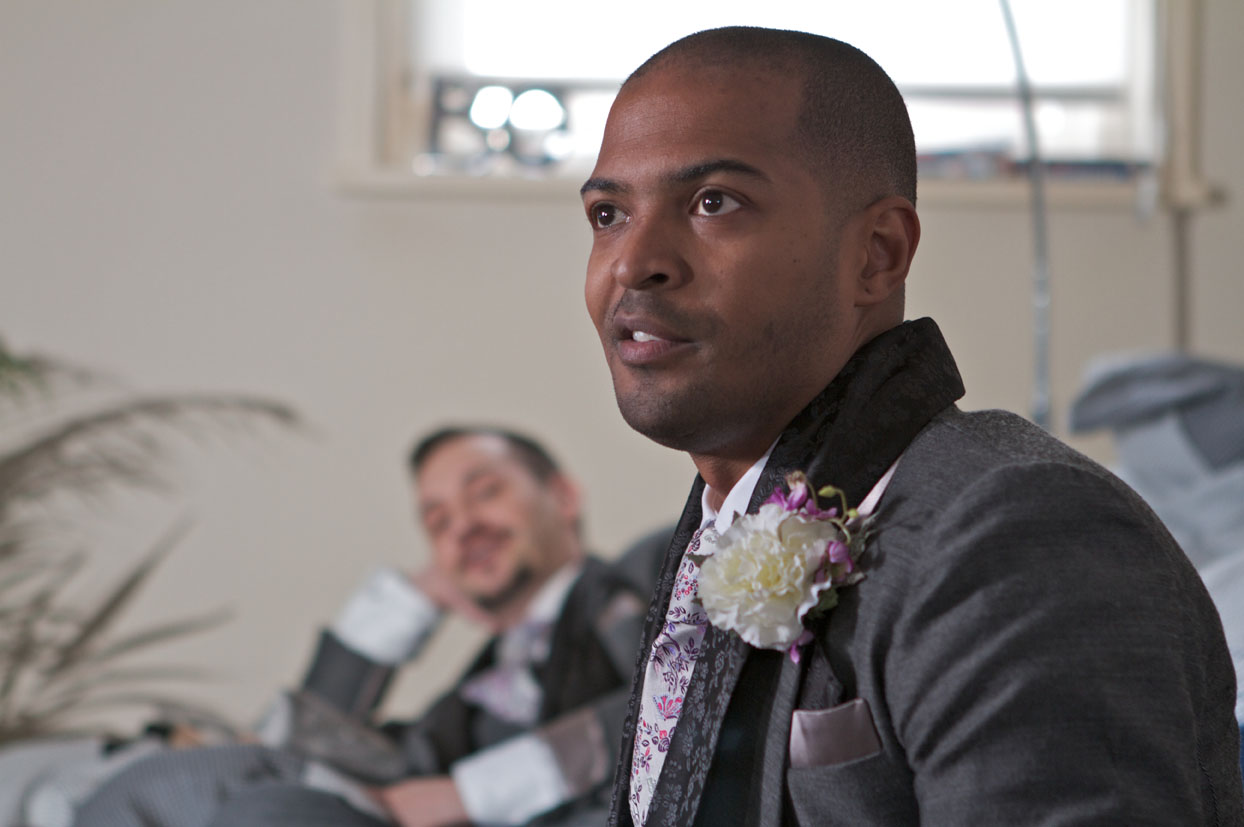
If there were two subgenres we just haven't seen enough of lately, they'd be wedding movies and Noel Clarke movies. The Knot - which Clarke wrote and starred in, but has left to newcomer Jesse Lawrence to direct, lest anyone accuse him of stretching his talents too thin - joins the two in unholy matrimony, and very nearly jumps a shark onto another bandwagon: half the film has been shot by the characters on camcorders, resulting in the kind of found footage that sorely needed losing again. Let's dip in, shall we? 

At the five minute mark, someone pulls a dildo out.

At eight minutes, we have the introduction of Mena Suvari, presumably here to secure overseas funding: she's greeted by a fat man in his underpants, and suddenly adopts the expression of someone who realises further American Pie reunions wouldn't be such a terrible idea after all.

The eleventh minute sees a stripclub flashback that left me wanting to remove all traces of my genitalia, closely followed by a hen party interlude that suggests Clarke was aiming for equal-opportunity crassness.

In minute seventeen, somebody drops the ring into a toilet. No-one laughs.

The twenty-first minute sees bride Talulah Riley reduced to her underwear, continuing 4.3.2.1's Noel Clarke tradition of ogling young actresses in their pants.

Minute twenty-three offers a severed penis in a jar.

Minute twenty-four ushers on Lenny Beige actor Steve Furst as a Teutonic hairdresser who is - wait for it - ever-so-slightly camp!

The bar being set low by this point, the above actually risks provoking laughs of a sort, but fear not, because by minute thirty-four, we're back to the level of Riley doing a poo in her wedding dress. (Remember Bridesmaids, anyone?)

There's another whole hour of this kind of material, interspersed with incredibly annoying, pseudy inserts in which the bride and groom muse to camera on what marriage means to them, a conceit presumably meant to distinguish The Knot from all those fluffy-meringue wedding movies waving dildos and severed penises around. Every other minute cues up some wholly terrible, piss-weak musical offering from the very bottom of the Devil's iPod Shuffle. Its commercialism is rank, and - worse - hopeless, because it's going after pounds that have already long been spent on product substantially funnier, and far less sour than this: even the recent A Few Best Men had rather more endearing leads than Clarke and rent-a-herbert Jason Maza. One semi-notable development: Clarke looks to have discovered a new Danny Dyer in groomsman Matthew McNulty, sold to us as an upgrade because he looks to smell of cigarettes and Lynx body spray. Thanks, Noel. But fuck off for a bit now, eh?

The Knot opens in selected cinemas from today.

Tuesday, 2 October 2012

From the archive: "Taken"


You want silly? The Luc Besson-scripted, Pierre Morel-directed Taken, a dumb-as-nuts attempt to update the white-slave melodrama for the 24 era, has silly in spades. Forgive me the indulgence, but this is one of those rare occasions where to describe the plot is to review the film. Liam Neeson plays Bryan Mills, a single dad with an armed forces background who's estranged from his teenage daughter Kim (Maggie Grace). One day, Liam takes a job working the security detail for a Britneyesque pop sensation played by Holly Valance (of course), and rescues her from a knife-wielding assailant (of course). This unintentionally comical warm-up, involving a little light muscle-flexing intended to introduce our hero as A Very Hard Man Indeed, actually has nothing to do with the plot proper, which involves Kim heading for Paris, something her controlling pa is very grumpy about, doubly so when he learns she's intending to follow U2 around on their European tour.

Needless to say, father's concern turns out to be wholly justified. The first person Kim speaks to en France is a hunky ne'er-do-well, who charms the pants off her travelling companion ("I hear French guys are amazing in bed," she coos - thanks for that, Luc) and leads a gang of people-smugglers to snatch them both away. One of Liam's ex-army mates listens to a pair of screams on Kim's last call home and somehow ascertains not just that the gang's leader is Albanian, but also which town said leader comes from, and that his first name is Marco. And so Liam turns up in Paris in a big black trenchcoat, baguette under his arm (no, really), ready to kick some immigrant ass. As the big man himself roars upon his arrival: "I'll tear down the Eiffel Tower if I have to!"

Morel, who previously directed the free-running movie District 13, has a certain gift for close-quarters, brutalist action - one shot of Neeson banging his head on a pavement caused me to wince more than I have at the movies for some while - but it's a gift more sensitive viewers might to return unopened, and he's clearly better with stuntmen than actors. Grace, from TV's Lost, overdoes the giggly, tearful hysteria in a manner that suggests some form of mental deficiency - perhaps a consequence of asking an actress in her late twenties to play seventeen - while Famke Janssen is once again wasted in the joyless role of nagging ex-wife. 

Neeson, for his part, has to suffer through the indignity of extended negotiations with streetwalkers, blow away an evil sheikh holding a curved blade to the throat of his fair-skinned daughter (what year is this again - 2008, or 1908?), and - in one particular mise en abime - subject one of his victims to a bizarre rant on the downside of outsourcing torture to Third World nations. It's one thing to apply the electrodes to someone, quite another to blame them for not providing sufficient power to do the job properly. I spent half the running time smiling at Taken, tickled by the fact I didn't have to pay to see such nonsense; the remaining minutes were spent wondering whose intelligence - Neeson's, or mine own - Taken, being by some distance the stupidest film of the year, was insulting the most.

(September 2008)

A sequel, Taken 2, opens this week.