Tuesday, 5 June 2012
What lies beneath: "The Pact", "The Innkeepers" and the return of the minor key
One of the reasons Prometheus appears to have disappointed some is its distinctively low key: rarely can there have been such a discrepancy between the loud fanfaring of a film's publicity and the cool, quiet tenor of the film itself - a state of affairs which just goes to show Hollywood (and its PR wing, in particular) knows nothing anymore, if it ever really did. Yet after two-and-a-half decades of event movies, each one attempting to outholler the last, the return to a minor key in American filmmaking is something to be encouraged and nurtured. If Hollywood can no longer play the top notes - as a spate of noisy misses, revivals and duds suggests it can't - than it'd do well to develop the lower end of its scale, and a pair of independently produced haunted-house movies opening in the UK this Friday provide a possible way forward in this respect.
In The Pact, an appreciably controlled feature debut from writer-director Nicholas McCarthy, a young woman returns to her childhood home in the wake of her mother's death, only to find that her older sister has also vanished, after abandoning her young daughter with a friend. We twig these girls have problems beyond the realm of the supernatural, and for our heroine Annie (Caity Lotz), who's roared back into town on a signifying motorbike, her sibling's disappearance is nothing out of the ordinary: "That's what this family does when times get tough - we take off." From this point on, McCarthy largely forsakes externalities - no lashings of gore, no splashy digital effects - to burrow inwards, both into this family's history and into the house itself, with the discovery of walls within walls, layers under layers; it's an oddly scholarly film, seeking out creepy or illuminating details on or in maps, censuses, photographs and websites. (McCarthy is particularly good on the bonding properties of ice cream.)
If the film falls back on some old familiar tropes elsewhere - seances and poltergeists, Psycho-ish peepholes and plotting, plenty of things that go bump in the night - it's held together by a very credible performance from the hitherto unknown Lotz, a dead ringer for Heather Graham whose armoury of stomping movements and fierce stares mitigate against any lingering winsomeness. Unusually for a male-authored horror movie, The Pact finally turns on female empathy: the title presumably refers to the accord between a mother and her daughters, but it's also there in the faith Annie places in a psychic friend from the wrong side of the tracks (Agnes Bruckner) - a belief in supernatural forces that, to his detriment, isn't shared by the male detective working the disappearance angle. It should tell you everything you need to know about the low key McCarthy is operating in that the latter role is filled by former Starship Trooper Casper van Dien.
The Innkeepers [pictured above], the latest addition to the oeuvre of the very promising Ti West (The Roost, The House of the Devil), is more expansive: its budget extends to hiring a well-appointed location (the real-life Yankee Pedlar Inn in Torrington, Connecticut), and populating its corridors with a handful of recognisable faces and names. Still, it qualifies for this low-key bracket in that most of its running-time is taken up with downtime. Luke (Pat Healy) and Claire (Sara Paxton) are a couple of sarky, snarky kids working in the reception area of a modern American hostelry slowly being drained of clientele and other life by neighboring Best Westerns and Howard Johnsons: you know, the kind of sterile, interchangeable corporate environments where nothing interesting ever happens.
Nothing much happens here, either, for the film's opening half-hour. Luke and Claire have the odd guest to check in, but mostly they're left to eat sandwiches, bicker and surf the Net; the most dramatic action of its early chapters comes when Claire pops out to an adjacent diner for coffee, where she's met by Lena Dunham playing a waitress called Elysabeth - of course Elysabeth-with-a-y - who, in an amusing play on the actress's inchoate star persona, sets the heroine to flee with a sudden blast of over-sharing. What West has has done, in effect, is cross-fertilise the traditional haunted-house picture with the drollery of slacker comedy: his bored heroes will eventually go looking for ghosts because, well, it's something to do. Surprisingly - perhaps even shockingly - they find them, too.
The House of the Devil was so precise in its recreation of a 70s TV movie aesthetic that, for all its zest and brio, its appeal may have been limited to fanboys. The Innkeepers, by contrast, looks and sounds like a more considered bid for multiplex play: Jeff Grace's score could well have been lifted from a Touchstone horror-comedy from 1989, while West goes about bolstering (and undercutting) his scares with laughs, in the way a Joe Dante or John Landis used to. Healy's re-emergence from the little boys' room in the middle of one suspense sequence is a nice gotcha, but much of the film depends on Paxton's endearingly daffy reactions to anything that might remotely put the wind up her. (Given how uneventful Claire's life is, it doesn't take much.) West lures us in with the suggestion this location is simply too homely to contain properly dark shadows, and that our heroes might just be punking one another, but gradually it emerges there really are other spirits hanging around with nowhere better to go.
It's a less serious proposition than The Pact - an old-fashioned creepshow, such as the major studios used to be relied upon to make from time to time - but West has real fun with his setting, characters and actors: after her appearance in last year's very strong Stake Land, there's another worthwhile genre outing for Kelly McGillis, as the Shirley Maclaine-like actress who's checked in with a case full of healing crystals, and may know more than she's willing to let on. Telling that both of these movies should turn on what's lurking in the basements of their respective properties: at a time when mainstream American cinema has started demanding we look up at the screen in awe, even when there's no longer anything awesome to be observed there, The Pact and The Innkeepers are films that quietly (and, in West's case, almost shruggingly) implore us to look down and notice that they're there - to spot whatever ripples and tremors are coming up from the underground.
The Pact and The Innkeepers open nationwide from Friday.
Sunday, 3 June 2012
Too big to fail: "Prometheus"
Prometheus promises to be many things - a backstory for Alien, not to mention the most overhyped movie in the galaxy - but crucially it's a homecoming of sorts for director Ridley Scott, regaining control of a franchise he launched back in 1979, and which has since been hijacked by directors good (Cameron, Fincher), bad (the hacks responsible for those AvP duds) and French (Jean-Pierre Jeunet). Though claimed as The Most Terrifying Film of All Time, what's often forgotten is how quiet, spooky, even still Scott's original was: released as the fractious 70s gave way to the rapacious 80s, it indirectly caught the peculiar chill of that post-Vietnam, pre-corporate moment in depicting a bunch of roughneck workers sent to do the dirty work of the powers-that-be. The new film preserves more than a little of that eerieness. You'll have to sit for almost an hour this time before the eggs hatch - a gestation period that allows Scott and his team to accumulate ideas, tension, ominousness, those elements that collectively come to show up the Avengers movie as so much noisy kids' stuff - but then sometimes the best event movies come to those who wait.
Hollywood has become greatly more commercialised in the three decades since Alien, and - perhaps because, as a producer and executive producer, he now spends almost as much time in conference rooms as he does on filmsets - Scott has become fascinated with business, its people and practices. Yet like his contemporary George Lucas, whose Star Wars prequels floated a toplayer of rebel-alliance posturing even as they descended into the most joylessly corporate brand-extension manoeuvres, it's never previously been clear whose side the cigar-chomping Scott is on: consider his 2006 comedy A Good Year, which sought to engage an audience with the sight of a banker unwinding on his hols. (Try pitching that movie nowadays.) Prometheus, however, strikes certain critical notes: what we're watching here is a business model that comes to collapse like the DNA helixes spiralling out under the film's opening credits.
Aboard the ship of the title, a ragbag team of scientists, blue-collar workers and outright mercenaries have been assembled with the aim of investigating a distant, Earth-like planet depicted in several cave paintings discovered by Dr. Elizabeth Shaw (Noomi Rapace) on the Isle of Skye. There have been more tenuous bases for adventures in foreign policy these past few years, so we go along for the ride. The mission has been bankrolled by an aging plutocrat (Guy Pearce, almost unrecognisable under latex make-up) and is overseen by Meredith Vickers (Charlize Theron, as glacial as a boardroom table moving on two legs, rather than four). Vickers's stated aim is to minimise any risk, but we know that attempting to minimise risk in an Alien movie is as trying to hold back the tides; sure enough, once on the planet in question, her charges are soon removing their helmets against all advice, and taking off much more besides to bunk up with one another. It's like they want to die.
Vickers' aide-de-camp is the android David (Michael Fassbender), whose flamboyant blonde tresses are explained in a brisk, terrifically acted early sequence showing David mimicking Peter O'Toole in Lawrence of Arabia. David, cursed with no soul of his own, worships Lawrence in the way some latter-day execs probably have a sneaking desire to be Don Draper or Patrick Bateman. At first, his mouthing of O'Toole's lines ("The trick, William Potter, is not minding that it hurts") seems cute and funny, but the repetition of that phrase brings out its latent cruelty; when we see the android assuming the hot seat in an alien spacecraft, and putting himself at the centre of the universe in its holodeck display, we begin to have our doubts. A ship piloted by the blase Idris Elba (more concerned with Christmas tree baubles and bedding the boss than with the health-and-safety of his passengers) for a company that would hire Sean Harris (a serious rival to Joseph Gilgun in Lockout as the 2012 movie character you'd most want to cross the country to avoid in your local boozer) and welcome the hubris of T.E. Lawrence aboard is, surely, doomed to go down.
If these characters are sloppy - human, you might say, and therefore fallible - Prometheus itself is grounded by the sure craft that's always been evident in Scott's work, even in plodding duds like the recent Robin Hood. Alien, we remember, was an evolutionary leap in production design, both in terms of its H.R. Giger-conceived creature and its simultaneously sterile yet lived-in spaceship, here given a deluxe retrofitting. (Vickers' corporate suite offers hologrammatic snowscapes and a state-of-the-art medilab, pointedly unavailable to any junior members of crew.) Scott's obsessive attention to detail really pays off in tiny, yet awesomely suggestive syntheses of actor and effect: Pearce's gnarly yellow toenails, briefly glimpsed, or the Foley sound that accompanies Rapace doing up the zip on her jumpsuit in the wake of one particularly nasty incident.
There's certainly an element of cruise control here - that we're in the hands of an old professional, navigating whatever bumps the script (by Jon Spaihts and Lost's Damon Lindelof) presents him with - and it's not all plain sailing. The performers in Alien were largely veterans of a very low-key form of 1970s American cinema (think Yaphet Kotto, Harry Dean Stanton, Tom Skerritt, Veronica Cartwright), whose realism made the unreal appearance of that damn chestburster all the more alarming. In Prometheus, we're dealing with a motley international crew, drawn up to appeal to all available markets, who simply have to make more noise just to be intelligible over the din of Men in Black 3 next door. (In the modern multiplex, no-one can hear you scream.) Certain elements - Rapace's English accent, Kate Dickie's Scottish accent (which is, according to all available evidence, her own) - don't quite sit right on the ear; more generally, the film lacks the snap, crackle and pop of last year's Rise of the Planet of the Apes, a B-movie in an A-grade gorilla suit.
Scott is maybe too old-school a filmmaker for that now, but he knows how to imbue his material with a sense of heft, weight, gravitational pull, if you will: this is a rare contemporary blockbuster to strike a balance between masculine and feminine (and Other), as well as between spills and subtext. For their part, Spaihts and Lindelof have twigged how suspense might be wrung within the prequel format: their characters are wide-eyed innocents (believers, in certain cases) who don't know what to expect from this territory, when those of us looking on do - which is why you fear the worst when low-billed Harris and Rafe Spall, left behind overnight on the planet, spot an eel-like creature emerging from a breeding ground and elect to engage it in play.
This sequence - which, some have speculated, may have been added after audience previews demanded more alien activity - turns out to be a rarity. Much of the film is conceptual, ideas-driven, striving to tap into a general sense of unease about what's waiting for us, whether in the space the characters inhabit, or in time: the Pearce character is aboard to embody old age, fraility, and what happens when you find out even vast wealth can't insulate you from the terrors of the universe. The most disturbing thing in Prometheus isn't a specific image or sequence (although Rapace plays bodily intrusion every bit as vividly as she did in The Girl with the Dragon Tattoo), but a two-word statement: "There's nothing." (And no, the character in question isn't talking about their pension fund.)
In this, the casting of an Australian actor to play a withered empire builder suddenly seems incredibly pointed, not to mention downright subversive. If NewsCorp shareholders wanted visible proof that Rupert Murdoch is no longer fit to rule, all they'd need to do is grab screeners of the Fox-bankrolled Prometheus and last autumn's borderline-Marxist In Time, widely released films that prove critical of the corporate mindset in ways that cut deeper than, say, the larky rib-nudging of the company's in-house joker The Simpsons. Among the many things Prometheus turns out to be is a treatise on power and powerlessness: on the way in which the will to power most often takes root in those without soul, and how, when the worst happens, it's the workers, not the institution, that get hurt first. Scott's film plays out 75 Earth years and who-knows-how-many light years ahead of us, but its triumph is that it never seems so very far away from home.
Prometheus is on nationwide release.
I see you: "Death Watch"
With Godard licking his wounds after the failure of his Marxist-Leninist project, and Truffaut settling into a rhythm of very Truffautish semiautobiographical dramas, Bertrand Tavernier was the razor-sharp Claude Chabrol's foremost rival for the title of most interesting French director of the 1970s. That Tavernier's 1980 sci-fi drama Death Watch should return to UK cinemas just as The Cabin in the Woods ends its theatrical run, and in the week Big Brother - flagging, but still, apparently, commercially viable - returns to our television screens can be seen as felicitous coincidence: it's one of those world-full-of-cameras fables that seeks to ask, some way behind Hitchcock, but a fair while before anybody else thought to do it, just how far we'd be prepared to watch, and how much stimulation we actually require before we switch off for the night.
Tavernier's film is set in a future world, but shot in turn-of-the-80s Glasgow, shown as tired and lived-in, in dire need of colour, sensation, new ideas; the opening crane shot has the city's skyline emerging from a cemetery, and it's clear that's where everybody will be returning after a few words from our sponsors. In this world, where novels are churned out by computer program and citizens are urged to recycle their water supplies, jobbing cameramen like Harvey Keitel's Roddy can have recording devices implanted in their very eyeballs so as to monitor their subjects more efficiently (not to mention covertly). Roddy's allotted subject is Katherine (Romy Schneider), a writer who's just been informed she has a terminal illness, making her perfect emotional pablum for an upcoming reality-cast.
Decades on, the sight of individuals expiring in and around prime-time has very nearly become a commonplace, but there's a particular cruelty to the way Katherine is elevated to the standing of made-for-TV martyr: only when the press show up on her doorstep does she learn the show's cynical producer (Harry Dean Stanton, tiredness already in his bones) has deemed her a worthy subject. "There are private things," she asserts, when she goes to confront him in his production office. "Are there?," he retorts. "Why?" Katherine assents to the show, chiefly to cover her ailing father's medical bills, but then initiates a cat-and-mouse game - between seen and seers, subject and audience - by venturing into the Highlands, Roddy in tow, hoping that the reception up there will be patchy enough to gain some much-needed perspective on what remains of her life.
In this escape bid - vast (and very Godardish) billboards intruding on what would otherwise be an unspoilt paradise - there's maybe a hint of the just-filmed Logan's Run, yet where Hollywood elected to put Jenny Agutter in a loincloth, Tavernier and his co-writer, the novelist David Rayfiel, choose to hone in on a man and a woman carrying notable baggage around with them. (Roddy has a complicated, unresolved relationship with his ex-wife.) This heavy-footed, heavy-hearted film proves less interested in the chase than the moral and philosophical implications of the show's project: it's something like Sullivan's Travels updated for a world becoming saturated with images. (Contemporary viewers may also be reminded of Andrew Niccol's recent work, although Tavernier and Rayfiel ultimately prove far less optimistic in their conclusions.)
For all this, I don't think Death Watch quite counts as a lost classic. Keitel is somewhat miscast in the everyman role (he's better suited to Roddy's later torment, getting one great Methody moment scrabbling round on a beach like a crab), and one misses the irreverence and joie de vivre of Tavernier's thrillers and period pieces from this moment. Yet - as befits a film where cameras are central - it is weirdly illustrative of the difference between Movies Then and (Most) Movies Now. The Cabin in the Woods, gigglingly high on its postmodern conviction that Nothing Really Matters, treated this set-up as the basis for an enjoyable yet only mildly pointed joke. Tavernier, working at a time when everything was still very much up for grabs, casts with grave purpose: Max von Sydow, on loan from Bergman, as an exemplar of a better world - exiled from mediated images, yet still living the good life, surrounded by art and literature - and Schneider, her beauty still evident yet fading in one of her last roles before her premature death. Could she have known she was unwell? Did Tavernier and Keitel realise they really were filming a woman not long for this world? The film's doubt is timeless; what it's gained over the years is a morbid poetry.
Death Watch is on selected release.
Saturday, 2 June 2012
For what it's worth...
Top Ten Films at the UK Box Office
for the weekend of May 25-27, 2012:
1 (new) Men in Black 3 (12A) **
2 (1) The Dictator (15)
3 (2) Marvel Avengers Assemble (12A) **
4 (new) What to Expect When You're Expecting (12A) **
5 (3) Dark Shadows (12A) ***
6 (4) American Pie: Reunion (15) **
7 (new) Moonrise Kingdom (12A) **
8 (5) The Raid (18) ****
9 (6) Beauty and the Beast 3D (U)
10 (new) Iron Sky (15) **
(source: BFI)
My top five:
1. Passport to Pimlico [above]
2. Prometheus
3. Himizu
Top Ten DVD rentals:
1 (3) The Girl with the Dragon Tattoo (18) **
2 (5) The Grey (15)
3 (1) Mission Impossible: Ghost Protocol (12) ***
4 (re) Hugo (PG) ***
5 (6) Contagion (12) ***
6 (7) In Time (12) ***
7 (2) War Horse (12) **
8 (new) Haywire (15) ***
9 (8) The Help (12) ***
10 (9) Crazy, Stupid, Love. (12) ***
(source: lovefilm.com)
My top five:
1. The Artist
2. Chronicle
3. Hadewijch
4. Coriolanus
5. Carancho
Top five films on terrestrial TV this week:
1. Demolition Man (Saturday, ITV1, 10.45pm)
2. The Terminator (Bank Holiday Monday, BBC2, 10.30pm)
3. Alien (Saturday, C4, 11.05pm)
4. The Lord of the Rings: The Return of the King (Saturday, C4, 7.20pm)
5. The Page Turner (Bank Holiday Monday, C4, 1.50am)
"Himizu" (The Guardian 01/06/12)
Himizu (18) 129 mins ****
Himizu is on selected release.
"On the Sly" (The Guardian 01/06/12)
On the Sly (U) 77 mins ***
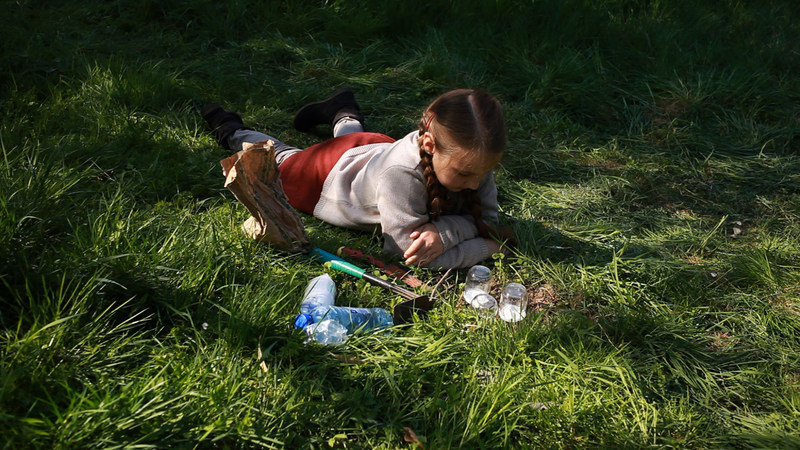
An oddly charming curio, this: an English dub of a
live-action French film observed entirely from its overlooked heroine’s
perspective. At the end of a weekend family retreat, knee-high Cathy (Wynona Ringer,
the director’s daughter) stages a rebellion of sorts, running off to the woods when her parents leave for home. What follows is
rather like a Gallic Home Alone,
sidelining any parental panic in favour of tiny, telling asides on how the
young register time and basic tasks differently. The editorial pleas to pay
proper attention to the seeds one plants are heavily underlined, but Ringer has
an endearing presence: her uncertain scrabbling yields something both more
truthful and spontaneous than Moonrise
Kingdom, this season’s pre-eminent runaway success, on the subject of how
we all once approached the world.
On the Sly is on selected release.
"The Turin Horse" (Metro 01/06/12)
The Turin Horse (15) 146 mins ***
With
zippy superheroes having hijacked Hollywood’s imagination, world cinema is
fighting back with films that depict frailty, suffering, slow decline: you
know, what the rest of us see when we look in the mirror each morning. Those
awaiting Amour, Michael Haneke’s
Palme d’Or-garlanded
study of old age, will get a bracing kick from The Turin Horse, the doomy Hungarian director Béla Tarr’s final film
before retirement. Inspired by the anecdote that drove philosopher Friedrich
Nietzsche potty (or pottier), here are six days in the hardscrabble life of an
aging, one-armed farmer and his caring, compassionate daughter, eking out an existence
on a storm-blasted plain where food is limited to one boiled potato a night.
The sole form of entertainment: sitting at a window watching the leaves rustle
by.
It sounds
like a French & Saunders arthouse parody, but Tarr is unmatched at drawing
the viewer into these grimly forbidding environments. Long, detailed takes –
count ‘em: just thirty-odd shots in 146 minutes – allow us to register what
happens when the couple’s routines begin to go awry, sorely stretching their
reserves; the farmer’s stoic horse and the mocking, musical gusts rattling the
stable doors become supporting players in some timeless, quite possibly
apocalyptic struggle. Whipping up more wind than the campfire scene in Blazing
Saddles, Tarr transforms the sparsest of elements into a pretty remarkable
experience. Probably best to take a scarf, though: to wrap yourself up in, if
not to hang yourself.
Subscribe to:
Posts (Atom)